




Abstract
Conservatives are often blamed for spreading misinformation, but it is unclear whether certain situations trigger them and, if so, why. The authors examine situations that are politically polarized, meaning the topic and/or its framing conveys conflict, discord, or disagreement between the two main political parties (conservatives and liberals). The authors study whether conservatives react to polarized situations by spreading ingroup-skewed political misinformation that is objectively inaccurate but not necessarily understood to be false and whether liberals are less reactive. Using a multimethod approach, the authors conduct six studies, including analyses of statements by public figures and speeches by U.S. presidents, as well as controlled experiments. The results indicate that in polarized situations, conservatives’ need for ingroup dominance is elevated, so they convey more misinformation than liberals. In less polarized situations, conservatives’ need for ingroup dominance is tempered, reducing their misinformation conveyance. These findings suggest that misinformation should not be blamed solely on the individual trait of conservativism, as polarized situations exaggerate conservative motives and behaviors. While news media, social media, political figures, and others may be incentivized to emphasize political polarization to gain audiences and bolster engagement, the resulting misinformation harms truth, trust, and democracy. Possible remedies include improved fact-checking and media literacy education.
Misinformation is broadly defined as “information that is incorrect, possibly by accident” (Scheufele and Krause 2019, p. 7662). Although misinformation is objectively incorrect, the individual sharing it may not deliberately seek to spread falsehoods (i.e., it may not be intentional disinformation; Scheufele and Krause 2019). Misinformation has been identified by the World Economic Forum (2024) as the world's most significant risk at present. A recent survey conducted in 142 countries found that 60% of internet users perceive online misinformation as posing a high risk to them personally (Knuutila, Neudert, and Howard 2022). Twenty percent of the visual political content on social media has been deemed misinformation (Yang, Davis, and Hindman 2023). The present research focuses on a particularly damaging and widespread type of misinformation: ingroup-skewed political misinformation that bolsters one's political party and/or disparages the rival party (Vosoughi, Roy, and Aral 2018).
Misinformation has distorted public discourse on a variety of issues, including public health (Kreps and Kriner 2022), environmental protection (Chinn, Hart, and Soroka 2020), and election integrity (Haber et al. 2021). With approximately 3 billion people worldwide poised to vote in upcoming elections (World Economic Forum 2024), political misinformation poses an immediate threat to the legitimacy of these democratic processes and the government officials they elect. Misinformation pertaining to the 2020 U.S. presidential election, which incited a violent attack on the U.S. Capitol, exemplifies just one of the harms (McCarthy 2021). Despite fact-checking initiatives by major social media platforms (e.g., Meta), news media (e.g., Reuters, AP News), and nonprofits (e.g., PolitiFact, FactCheck.org), misinformation is pervasive and continues to grow (McDonald 2021). Thus, we need a better understanding of who is most likely to spread misinformation, in which situations, and why.
Conservatives tend to be more likely to spread political misinformation than liberals, as initially theorized by Jost et al. (2018) and supported by numerous empirical studies (Grinberg et al. 2019; Guess, Nagler, and Tucker 2019; Osmundsen et al. 2021). For instance, Allcott and Gentzkow (2017) found that during the 2016 U.S. election cycle, out of 38 million politically misinformative posts on Facebook, 30 million (79%) were skewed conservative, whereas 7.8 million (21%) were skewed liberal. Yang, Davis, and Hindman (2023) found that posts with imagery from conservatives were five to eight times more likely to be misleading than posts from liberals.
However, it is not yet known whether conservatives are more prone to spread misinformation across virtually all situations, or whether certain situations may trigger them. In this research, we focus on politically polarized situations where the topic and/or its framing conveys conflict, discord, or disagreement between the two main political parties: conservatives and liberals (Bavel et al. 2021; Han and Federico 2017). News media, social media, political and public figures, and others may intentionally or inadvertently polarize a situation (Wilson, Parker, and Feinberg 2020). For example, when reporting on the expulsion of a U.S. congressperson, the U.S. Wall Street Journal described it as a “tense vote” (Ferek and Vielkind 2023), whereas the U.K. newspaper The Guardian framed the same event more neutrally as a “bipartisan vote” (Reed 2023). Both characterizations are accurate but differ in polarization. We ask whether polarization can increase misinformation spread by conservatives and, if so, why.
Based on theories of political ideology, we posit that conservatives will convey more ingroup-skewed political misinformation than liberals because they value ingroup dominance more strongly; however, polarization will trigger this value difference and behavior. Researchers have found that conservatives are more likely than liberals to seek ingroup dominance, that is, they want their ingroup to dominate and be superior to other groups (Graham, Haidt, and Nosek 2009; Janoff-Bulman 2009; Jost, Federico, and Napier 2009; Ordabayeva and Fernandes 2018). Conveying ingroup-skewed misinformation helps with ingroup dominance, which should appeal to conservatives as it is a core value, but that value may not be salient. Among conservatives, the need for ingroup dominance may become salient in politically polarized situations.
Our findings indicate that conservatives in polarized situations have an elevated desire for ingroup dominance, which provokes them to spread ingroup-skewed misinformation, whereas liberals do not react this way. In addition, conservatives and liberals do not differ in less polarized situations. Our research appears to be the first to show that conservatives’ tendency to convey misinformation is driven in part by their need for ingroup dominance, provoked by polarization. More broadly, we show that misinformation is caused not only by a person's ideology but also by situational factors. The marketplace often incentivizes polarization to increase audiences and engagement (Berry and Sobieraj 2013; Wilson, Parker, and Feinberg 2020), inadvertently provoking misinformation. There are viable solutions, though, including better fact-checking to remove the misinformation and media literacy education to teach misinformation detection.
Theoretical Framework and Hypotheses
Political Misinformation and Ideology
Both conservatives and liberals contribute to the dissemination of political misinformation (Hochschild and Einstein 2015), yet research has shown a tendency for conservatives to disseminate it more than liberals (Allcott and Gentzkow 2017; Grinberg et al. 2019; Guess, Nagler, and Tucker 2019; Hameleers and Minihold 2022; Nikolov, Flammini, and Menczer 2021; Osmundsen et al. 2021). It has been argued that conservatives are more prone to spread misinformation due to their greater exposure to it (Grinberg et al. 2019; Guess, Nagler, and Tucker 2019; Guess et al. 2021), social network homogeneity (Allcott and Gentzkow 2017; Nikolov, Flammini, and Menczer 2021), cognitive vulnerability (Pennycook and Rand 2019), desire for chaos (Lawson and Kakkar 2022), desire for alternative reality (Hameleers and Minihold 2022), major news doubt (Lutzke et al. 2019), or major news nonrepresentation (Osmundsen et al. 2021). However, one study relating conservatism to misinformation has found mixed results (Pennycook and Rand 2019), and other studies have found null results (Ahmed and Gil-Lopez 2022; Hopp, Ferrucci, and Vargo 2020; Horner et al. 2021; McPhetres, Rand, and Pennycook 2021; Pereira, Harris, and Van Bavel 2023).
The divergent results have prompted a few researchers to consider potential moderators. Lawson and Kakkar (2022) find that conservatives share more misinformation than liberals, but only if they are low in conscientiousness, meaning they have a low propensity to “follow the rules of society, maintain social decorum, and think before acting” (p. 1155). There is no difference between highly conscientious liberals and conservatives. Overall, though, previous research has largely failed to study potential moderators that could impact how political ideology may affect misinformation spread. A table in Web Appendix A summarizes this research.
Situational Polarization as a Moderator
Due to the prevalence of political polarization, the current research focuses on it as a possible moderating factor. In the United States, political polarization is characterized by an ideological divide between conservatives (Republicans) and liberals (Democrats) in their stances on political and social issues, initiatives, and individuals (Fiorina and Abrams 2008). Surveys conducted by the Pew Research Center (Dunn 2020; Laloggia 2018) and the Public Religion Research Institute (2019) indicate that polarization is pervasive when political topics are discussed in the United States, including the role of government (Public Religion Research Institute 2019), government funding for different programs (Laloggia 2018), and the severity of specific national problems (Dunn 2020). Polarization intensifies during presidential and other elections, whipped up by politicians seeking to get out the vote, obtain donations, and win (Schaeffer 2020). Moreover, social media platforms, by tailoring their algorithms to maximize view engagement including likes and shares, often amplify polarization (Barnidge 2015; Bavel et al. 2021; Finkel et al. 2020).
Polarization has many adverse social outcomes; for instance, it can generate social misperceptions and undermine civility and norms of mutual respect in political discourse (Ahler 2014; Finkel et al. 2020). Research has also linked polarization to misinformation, but it has mainly focused on polarization stemming from individual characteristics such as extremist views, rather than situational factors (Bessi et al. 2016; Jenke 2023; Marino and Iannelli 2023; Osmundsen et al. 2021). Hence, we do not know whether situational polarization affects misinformation spread or whether conservatives and liberals respond differently to it.
Motive to Achieve Ingroup Dominance
A key value difference between ideological conservatives and liberals is their motive to attain ingroup dominance, meaning their desire for the ingroup to dominate and be superior to outgroups (Ordabayeva and Fernandes 2018; Pratto et al. 1994; Womick et al. 2019). Social dominance theory suggests that this difference may originate from rival viewpoints on hierarchical social structures, because conservatives typically view dominance-based hierarchies as legitimate, whereas liberals see them as illegitimate and advocate for equality (Jost et al. 2003; Ordabayeva and Fernandes 2018). Moreover, according to moral foundation theory (Graham, Haidt, and Nosek 2009), conservatives typically prioritize binding moral values that promote ingroup cohesion, such as loyalty, authority, and purity. In contrast, liberals tend to focus on individualizing moral values like care and justice, prioritizing the rights of individual members of society over their ingroup interests.
Another theory, the model of moral motives, suggests an ideological difference in how people form groups (Janoff-Bulman and Carnes 2013). Conservatives tend to form groups based on shared social identity, leading to impermeable intergroup boundaries that aim to protect and elevate their ingroup. Liberals, conversely, tend to form groups based on shared goals of social justice, resulting in permeable intergroup boundaries and an emphasis on intergroup equity. Despite differing perspectives, these theories collectively suggest that conservatives desire ingroup dominance, and liberals less so.
However, situational factors could affect people's felt motivation to attain ingroup dominance (Duckitt 2006; Jost et al. 2003). A situation that may trigger this motivation could be political polarization: that is, the extent to which the topic discussed and/or the way the topic is framed elicits conflict, discord, and disagreement between political parties (Bavel et al. 2021; Kim and Zhou 2020). Research finds that polarization heightens the salience of people's ideological motives (Kaikati et al. 2017). Thus, we posit that polarized situations, by accentuating intergroup divisiveness, may temporarily activate the ingroup dominance motive, value, or mindset, but only among conservatives for whom this is a fundamental value, not liberals. In less polarized situations, the conservative motive for ingroup dominance may not be triggered; thus, conservatives and liberals may experience this motive similarly. Hence, our first hypothesis is:
When people are motivated to achieve ingroup dominance, they have been shown to use stereotypes, exaggerations, or other misinformation that bolsters the ingroup and/or disparages the outgroup (Maass, Ceccarelli, and Rudin 1996; Scheepers et al. 2003, 2006). For instance, during political debates and elections, ingroup-skewed misinformation often spikes (Osmundsen et al. 2021; Riley 2022). We propose that conservatives will be more prone to respond to politically polarized situations by disseminating misinformation than liberals, because their desire for ingroup dominance will be more salient. See the following hypotheses and Figure 1.
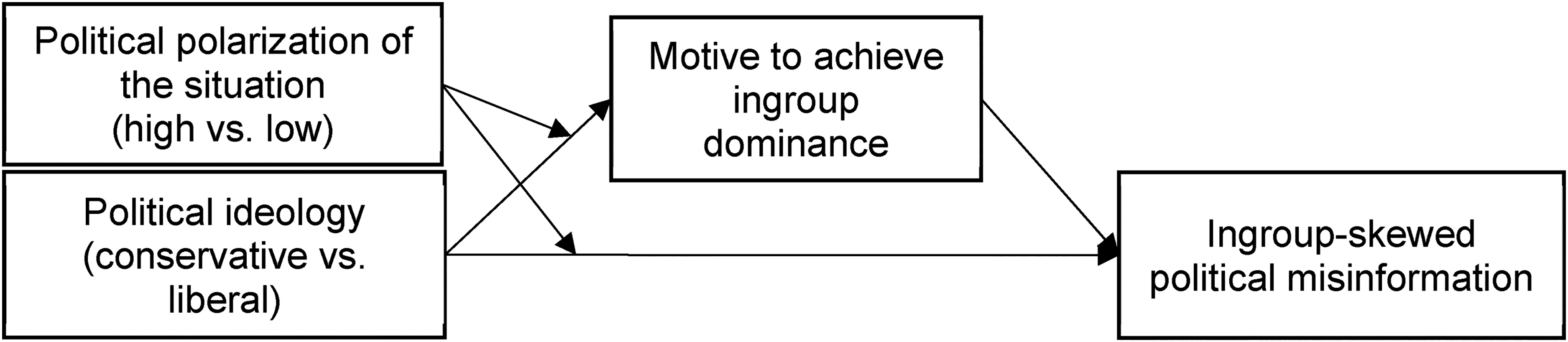
Framework Relating Ideology and Polarization to Motive and Misinformation.
Overview of Studies
We conduct six methodologically diverse studies on how ideology and polarization may affect salient motives and, thus, misinformation. Study 1 uses a ten-year PolitiFact dataset of political misinformation in social media and news media by known U.S. public figures, supplemented by Wang's (2017) content coding of each figure's political ideology and discussion topic, along with Pew Research Center (Dunn 2020; Pew Research Center 2019) survey data on discussion topic polarization. Study 2 uses a similar 16-year PolitiFact dataset with date-stamped statements (Misra 2022), combined with the Federal Reserve Bank's monthly polarization index for U.S. political news (Azzimonti 2018). Studies 3–5 are experiments that measure ideology and manipulate polarization via topic framing; in addition, they measure intent to post misinformation on social media and motive to achieve ingroup dominance. To extend Study 3's basic findings, Study 4 manipulates two types of misinformation that either supports the ingroup or attacks the outgroup. Study 5 manipulates polarization more realistically via social media newsfeeds. Study 6 analyzes nearly a century of speeches by U.S. presidents to assess whether their ideology (liberal or conservative) and polarization (election or postelection) impact their use of phrases expressing the desire to achieve ingroup dominance, consistent with our theorized mediator.
Study 1: Misinformation Triggered by Politically Polarized Discussion Topics
Method
Since 2007, an organization called PolitiFact has built an archive of political statements in social media and news media by U.S. public figures (people involved in politics, social movements, or social activism) (Wang 2017). PolitiFact provides each statement in condensed form and also arranges for it to be rated by journalists on a scale ranging from 1 = “true or accurate” to 6 = “pants on fire,” or highly misinformative. We make use of a public dataset called LIAR, which includes ten years of PolitiFact-checked statements (2007–2016), augmented by Wang (2017) to include the public figure's ideology as Republican (conservative) or Democrat (liberal) and the discussion topic.
Using the discussion topic appended to each statement by Wang (2017), combined with Pew Research Center survey data, we determine the level of polarization associated with each topic. In two surveys, Pew Research Center (Dunn 2020; Pew Research Center 2019) asked people in the United States their political opinions on 23 different topics, along with their ideology: Democrat (liberal) or Republican (conservative). We characterize 21 of these 23 topics as politically polarized because liberals and conservatives disagree significantly on them, with 2 topics less polarized due to no significant disagreement between liberals and conservatives (Web Appendix B). Comparing the 23 Pew Research Center political topics with Wang’s topics appended to the PolitiFact statements, we find matches for 36% of the statements (3,532 out of 9,837). Based on these matches, 91.22% (N = 3,222 out of 3,532) of the statements are on polarized topics, and 8.78% (N = 310) are on less polarized topics. Of these 3,532 statements, 2,016 (57%) are made by conservatives, whereas 1,516 (43%) are made by liberals.
We conduct a 2 (ideology) × 2 (polarization) ANOVA followed by pairwise t-tests. The predictor variables are ideology, with two levels (conservative vs. liberal), and polarization based on the topic discussed, with two levels (high vs. low). The dependent variable is the level of misinformativeness of the statements made based on the PolitiFact ratings (1–6).
Results
There is a main effect for ideology indicating that conservatives convey more misinformation than liberals (Mconservative = 3.36 vs. Mliberal = 2.92; F(1, 3,528) = 24.34, p < .001). This main effect for ideology replicates previous findings. There is also a main effect for polarization, as there is more misinformation given high versus low polarization (Mhigh = 3.30 vs. Mlow = 2.98; F(1, 3,528) = 12.53, p < .001). These main effects are qualified by a two-way interaction (F(1, 3,528) = 4.22, p = .040). Conservatives are more misinformative than liberals given high polarization (Mconservative = 3.62 vs. Mliberal = 2.98; t(3,528) = 11.96, p < .001) but not low (Mconservative = 3.11 vs. Mliberal = 2.85; t(3,528) = 1.50, p = .133). This study provides initial support for our H2, relating the predictor variables of ideology and polarization to the main outcome: misinformation (see Figure 2).
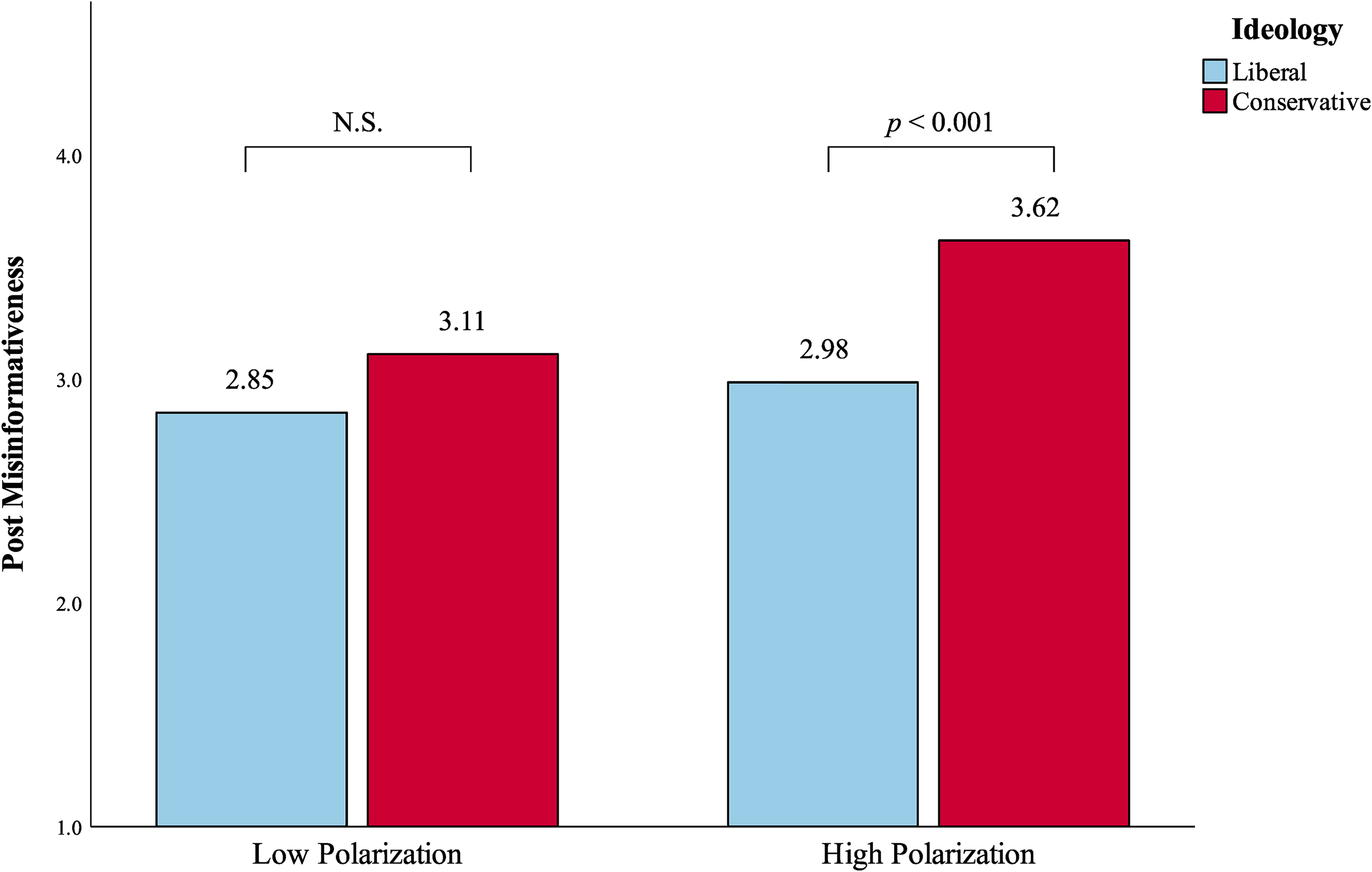
Ideology and Polarization Affect Misinformation U.S. 2007–2016 (Study 1).
Discussion
Study 1 provides initial evidence that conservatives convey more political misinformation than liberals in situations of high (but not low) political polarization. However, this study has limitations due to the incomplete matching of the discussion topics with the Pew Research Center survey data on topic polarization, resulting in only 36% of the dataset being utilized. Additionally, the majority (91.22%) of statements are made in polarized situations. The relatively few statements in less polarized situations could conceivably explain the null effect for ideology for those situations. Study 2 resolves these issues by using an index of political news polarization that is reported monthly (Azzimonti 2018) along with monthly data on misinformation (Misra 2022) for the United States.
Study 2: Misinformation Triggered by Politically Polarized News
Method
Study 2 uses a similar dataset to Study 1, compiled by PolitiFact, with political statements by U.S. public figures rated on misinformativeness (1–6). But this time, we use a 16-year dataset spanning 2007–2022, augmented and made available by Misra (2022). The Misra dataset contains date stamps, whereas the Wang (2017) dataset used in Study 1 lacks date stamps. Unlike Wang’s dataset, which includes the ideology of each public figure, Misra’s does not, so we scrape individuals’ party affiliation from PolitiFact's “People and Group” page. We identify the ideology for 13,517 (64%) of the statements, 7,930 (59%) by conservatives and 5,587 (41%) by liberals, and we analyze this set of statements.
To assess polarization, we use the Federal Reserve Bank of Philadelphia's (2023) U.S. political news polarization index. The bank searches for political keywords and polarization keywords in combination, in English-language U.S. news articles archived on Factiva, a major online news aggregator. It disseminates a monthly polarization index that reflects the political topics discussed and/or the topic framings in that month's news. The index is widely used in finance and economics to examine the impact of polarization on firm, market, and government outcomes, such as the cost of equity (Pham 2019), the level of cash holdings (Cheng et al. 2018), exchange rates (Jia, Goodell, and Shen 2021), and oil prices (Apergis, Hayat, and Saeed 2021).
We calculate the political polarization trend to describe the change in polarization in the news between the date of each PolitiFact-rated statement and the same date a month prior. We use the trend because there is little consensus on what constitutes polarization when it is viewed as a static state, but considerable agreement when it is viewed as a dynamic process and its level changes discernibly, either improving or deteriorating (DiMaggio, Evans, and Bryson 1996; Fiorina and Abrams 2008). In contrast to previous studies that analyzed monthly, quarterly, or annual data (e.g., Azzimonti 2018), we use daily data and calculate the polarization trend as follows.

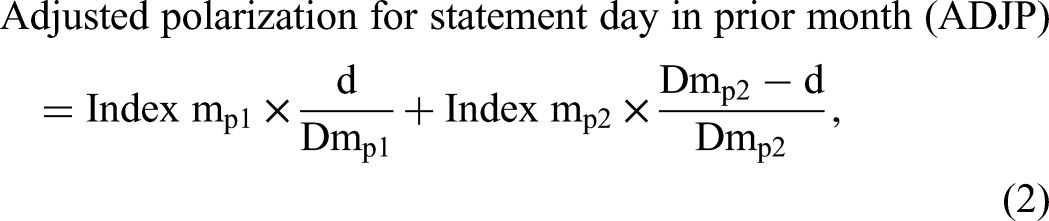

where Index m refers to the polarization index in the statement month m, Index mp1 and Index mp2 refer to the polarization indices in the one and two months prior, respectively, d denotes the statement day within the month (1–31), Dm denotes the total number of days in the month (1–31), and Dmp1 and Dmp2 denote the total days in the one month and two months prior, respectively. The political polarization trend is greater than 0 when polarization increases in the news, 0 when there is no change, and smaller than 0 when polarization decreases. For example, imagine a statement made on April 1, 2020, when the polarization index is 151 in February, 59 in March, and 35 in April 2020. The trend is −.61, showing a sharp drop in political polarization from March 1, 2020, to April 1, 2020, which occurred as the COVID pandemic hit the United States.



Results
We observe a main effect for ideology on misinformation, with conservatives spreading more misinformation than liberals (Mconservative = 3.59 vs. Mliberal = 2.94; F(1, 13,513) = 629.81, p < .001) replicating previous findings. There is no main effect for polarization (F(1, 13,513) = .21, p = .648), but there is a two-way interaction (F(1, 13,513) = 6.59, p = .010). A follow-up floodlight analysis indicates that conservatives’ statements are more misinformative than those of liberals, except when the polarization trend is declining by −.65 or more (Mconservative = 3.40 vs. Mliberal = 3.08; t(13,513) = 2.55, p = .011). These findings further support H2 (Figure 3).
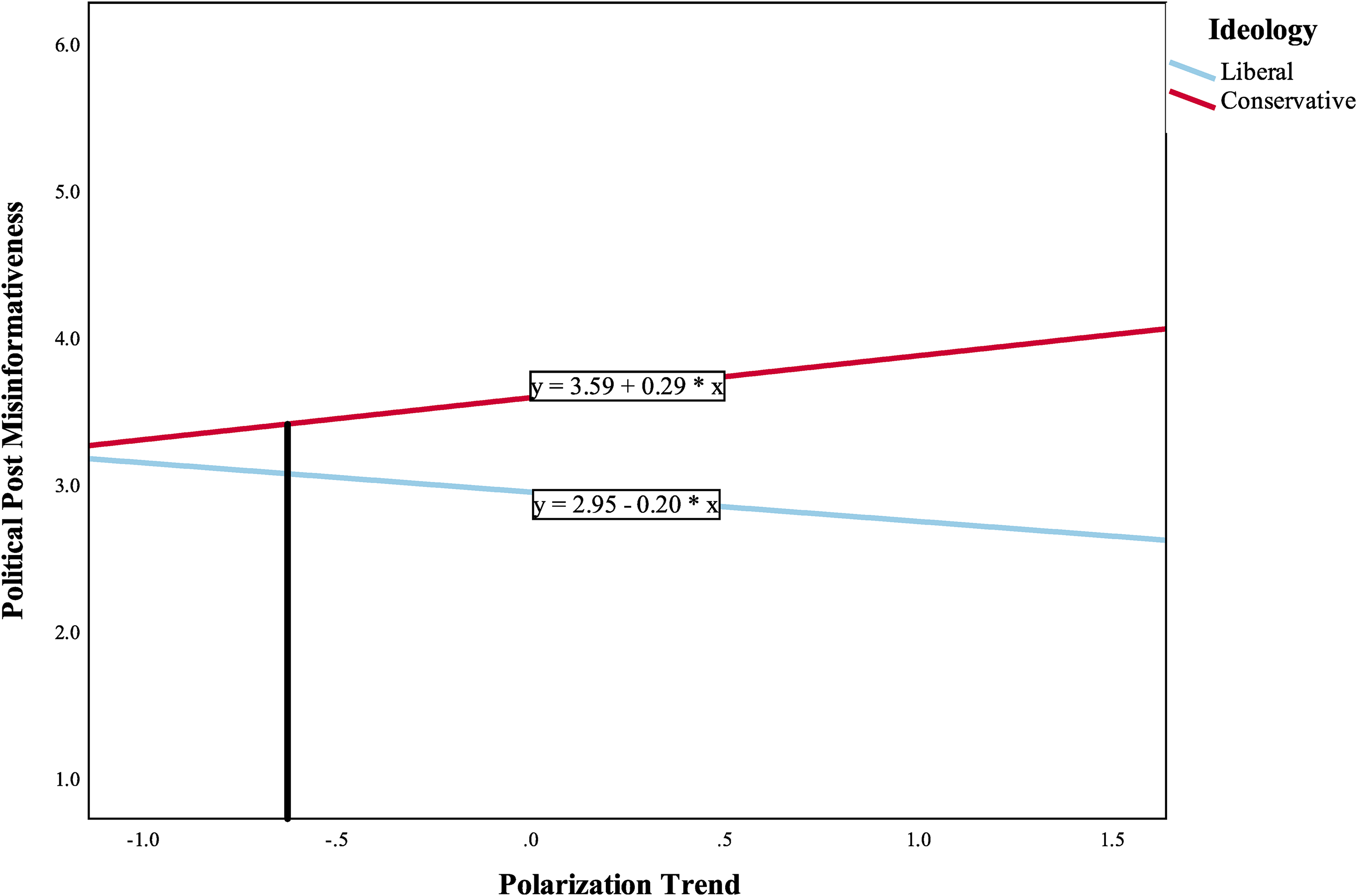
Ideology and Polarization Affect Misinformation U.S. 2007–2022 (Study 2).
Discussion
Study 2 finds that when political polarization in the news intensifies, conservatives are more inclined to convey political misinformation than liberals. This ideological gap diminishes and eventually disappears with declining polarization. However, due to the nature of secondary data, we can only study correlations, not causality. In addition, the statements recorded by PolitiFact are condensed, which limits our ability to conduct textual analysis to seek motives that may lead to misinformative statements. Next, we use experiments to investigate causality and the motives that may drive conservatives to convey misinformation in polarized situations.
Study 3: Experiment on Misinformative Social Media Posts Triggered by Topic Framing
Method
Design and participants
Study 3 is a controlled experiment that uses a 2 (ideology: liberal vs. conservative) × 2 (polarization: high vs. low) between-subject design. Participants’ ideology is measured. We manipulate polarization by showing quotes from Republican (conservative) and Democratic (liberal) leaders that frame the relationship between the two parties as either cooperative or oppositional. Intent to post misinformation is the dependent variable, and motive to achieve ingroup dominance is the mediator. We recruited 283 U.S. adults to complete an Amazon Mechanical Turk (MTurk) survey, 143 liberals (Democrats) and 140 conservatives (Republicans) using a recruitment quota. Participants’ age range is 19 to 78 years, the mean age is 42, and 45.6% identify as female, 52.3% as male, and 2.1% prefer not to declare.
Procedure
We asked participants to indicate their party affiliation (Republican or Democrat) to assess their ideology (conservative or liberal, respectively). Fifteen people said that neither party affiliation describes them; we did not collect data from these participants, because we assign ingroup-skewed misinformation based on ideology. Participants were informed that the survey consists of two discrete parts that are clearly labeled, and part 1 randomly manipulates political polarization. For high polarization, participants read quotes from the existing U.S. Republican and Democratic Senate leaders, based on the leaders’ actual statements, which frame the relationship between their two parties as competitive and oppositional. For low polarization, participants read quotes by the same two leaders that frame the relationship between their two parties as cooperative and bipartisan. Both Senate leaders are older white men, and their quotes are similar in length, minimizing confounds (Web Appendix C).
Survey part 2 showed five ingroup-skewed misinformative posts in random order. The posts attack the rival party, mirroring the attack messages prevalent in politics (Johnson-Cartee and Copeland 2013). Based on actual social media posts made at the time, they are matched on length and layout to avoid confounds (Web Appendix C). Conservatives (Republicans) saw attack posts like “A Democratic Senator is under investigation for helping Russian billionaires” and “Democratic Senators are deliberately creating the global food shortage,” while liberals (Democrats) saw “A Republican Senator is under investigation for helping Russian billionaires” and “Republican Senators are deliberately creating the global food shortage.”
We measure our dependent variable by asking “How likely are you to make a Facebook post like these?” (1 = “Extremely unlikely,” and 7 = “Extremely likely”). Then, we measure the mediator, motive to achieve ingroup dominance (Scheepers et al. 2003, α = .90): “Would this post make your group stronger?,” “Would this post motivate your group?,” and “Would this post make your group better?” (1 = “Extremely unlikely,” and 7 = “Extremely likely”). Afterward, participants completed a manipulation check of polarization: “Please recall the conversation between Democrat and Republican Senate leaders you saw earlier. How much do Democrats and Republicans agree or disagree with each other on different issues?” (1 = “Strong agreement,” and 7 = “Strong disagreement”). Finally, we collected demographic information.
Results
Pretest of misinformative posts
We pretested our posts on misinformativeness and ingroup skewness (Pennycook and Rand 2019) using an independent sample of 146 MTurk participants. Participants reported their party affiliation, read the ingroup-skewed misinformative posts, and answered our questions. ANOVAs find no difference between conservatives and liberals in their perceptions of post accuracy (p = .256) or ingroup skewness (p = .750; Web Appendix C). Overall, we characterize the posts as misinformation because, on a scale with 5 being “accurate” and 3 being “unsure,” the perceived accuracy means are significantly lower than 3 for both liberals and conservatives (ps < .05). Yet the perceived accuracy means are significantly higher than 1 (“inaccurate”) for both groups (ps < .001), indicating that, on average, the posts are not viewed as definitively false. We do not know whether some people might view the posts as deliberate disinformation or a purposeful intent to deceive because we did not assess intentionality.
Manipulation check of polarization
In the main study, we conduct a manipulation check of polarization. A 2 (ideology) × 2 (polarization) ANOVA finds a main effect for polarization as expected (F(1, 279) = 100.34, p < .001), with no main effect for ideology (F(1, 279) = .12, p = .727) and no two-way interaction between ideology and polarization (F(1, 279) = .51, p = .475). Participants perceived more polarization between parties in the high-polarization situation compared with low (Mhigh = 6.23 vs. Mlow = 4.39; t(279) = 10.03, p < .001).
Intent to post misinformation
An ANOVA on misinformation intent reveals a main effect for ideology, with conservatives expressing more intent to post misinformation than liberals (Mconservative = 2.03 vs. Mliberal = 1.59; F(1, 279) = 7.34, p = .007), mirroring past findings. There is no main effect for polarization (Mhigh = 1.90 vs. Mlow = 1.72; F(1, 279) = 1.27, p = .262) but the expected two-way interaction (F(1, 279) = 5.94, p = .015). With high polarization, conservatives report a greater intent to post misinformation than liberals (Mconservative = 2.32 vs. Mliberal = 1.48; t(279) = 3.64, p < .001). With low polarization, they are comparable (Mconservative = 1.74 vs. Mliberal = 1.69; t(279) = .19, p = .848). H2 is supported (Figure 4, Panel A).
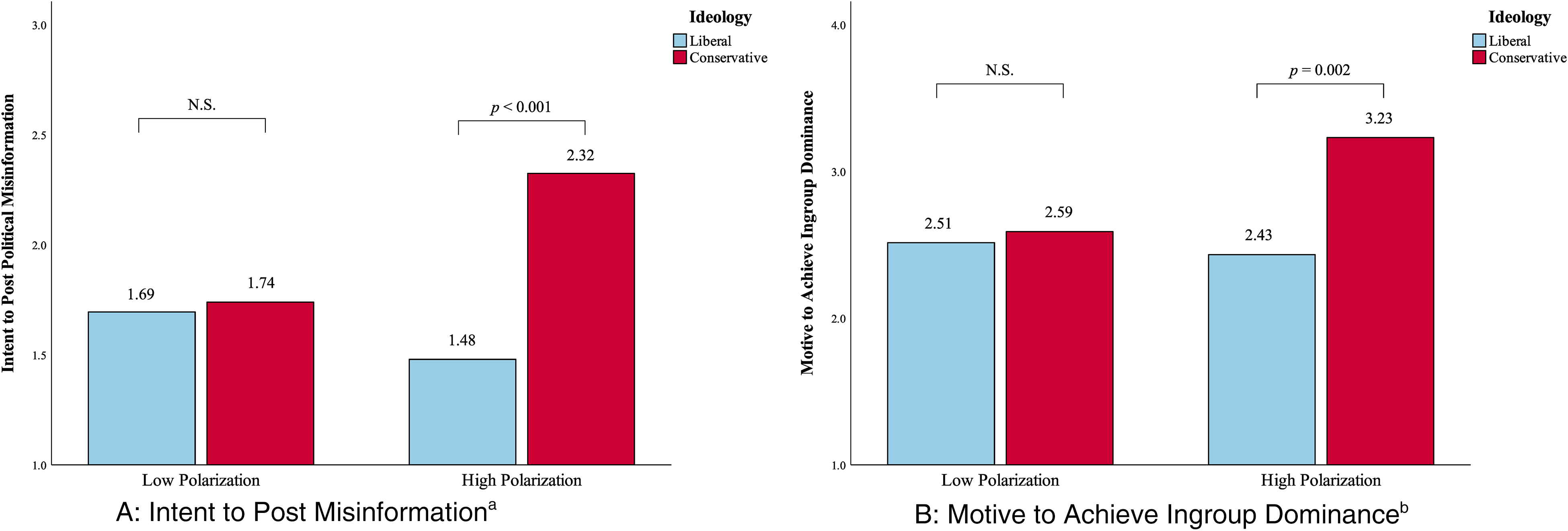
Ideology and Polarization Affect Intent to Post Misinformation and Motive to Achieve Ingroup Dominance (Study 3).
Motive to achieve ingroup dominance
An ANOVA on motive to achieve ingroup dominance shows a main effect for ideology, with conservatives higher on this motive than liberals (Mconservative = 2.91 vs. Mliberal = 2.47; F(1, 279) = 6.10, p = .014), but no main effect for polarization (Mhigh = 2.83 vs. Mlow = 2.55; F(1, 279) = 2.50, p = .115). There is the expected two-way interaction (F(1, 279) = 4.18, p = .042). With high polarization, conservatives express a stronger motive for ingroup dominance than liberals (Mconservative = 3.23 vs. Mliberal = 2.43; t(279) = 3.19, p = .002). With low polarization, conservatives and liberals are comparable on this motive (Mconservative = 2.59 vs. Mliberal = 2.51; t(279) = .30, p = .763). Thus, H1 is supported (Figure 4, Panel B).
Mediation tests
We evaluate motive to achieve ingroup dominance as a mediator using PROCESS Model 8 (Hayes 2017). The increase in misinformation by conservatives versus liberals is mediated by the motive to achieve ingroup dominance given high polarization (indirect effect = .4199, 95% CI = [.1366, .7516]), but not low (indirect effect = .0397, 95% CI = [−.1875, .2828]). The moderated mediation index comparing indirect effects for high and low polarization is significant (index = .3802, 95% CI = [.0217, .7826]). H3 is supported.
Discussion
In this experiment, we replicate and extend the results of our two secondary data studies. Our findings indicate that when conservatives encounter a politically polarized situation, it triggers their desire for ingroup dominance, which leads them to post ingroup-skewed political misinformation. Liberals are not so triggered, and post less misinformation.
Study 4: Experiment with Replicate Misinformative Posts to Show Robustness
Method
Design and participants
Study 4 seeks to replicate the previous findings using two types of ingroup-skewed misinformative posts: those that either support one's own party or attack the rival party. We use a 2 (ideology: liberal vs. conservative) × 2 (polarization: high vs. low) × 2 (replicate misinformative posts: support vs. attack) between-subject design and our prior measures. We recruited 581 U.S. participants for an MTurk survey, 305 liberals (Democrats) and 276 conservatives (Republicans), aged 18 to 77 years (mean age = 42 years), 47.3% identifying as female, 50.6% as male, .9% as nonbinary, and 1.2% prefer not to declare.
Materials and procedure
Participants were asked to report their party affiliation as Republican or Democrat; 21 said neither, which terminated their data collection. The main survey has two parts, each clearly labeled. Part 1 randomly manipulates polarization to be high or low as in Study 3 (Web Appendix C). Part 2 shows the misinformative social media posts, five per condition. As a randomized replicate factor, conservatives (Republicans) were shown attack-outgroup posts like “Democratic Senators are all racist” or, alternatively, support-ingroup posts like “Republican Senators are never racist.” Liberals (Democrats) were shown comparable attack-outgroup posts like “Republican Senators are all racist” or, alternatively, support-ingroup posts like “Democratic Senators are never racist.” We use the Study 3 measures (intent to make similar misinformative posts [dependent variable] and motive to achieve ingroup dominance [mediator]; alpha = .94). We obtained the same polarization manipulation check and a replicate post check and collected demographics.
Results
Pretest of misinformative posts
We pretested our posts using an independent sample of 239 MTurk participants. They reported their party affiliation, read the misinformative posts, and answered questions about post accuracy and ingroup skewness. An ANOVA confirms that, as expected, political ideology and replicate post do not impact perceptions of post accuracy (ps > .231) or ingroup skewness (ps > .142; Web Appendix D). Both conservatives and liberals rated post accuracy as significantly lower than 3 (“unsure”; ps < .001) but higher than 1 (“inaccurate”; ps < .001). Both conservatives and liberals perceived the posts they were shown as ingroup-skewed regardless of whether the posts expressly supported their own party or attacked the rival party. The average ingroup-skew ratings are consistently higher than the neutral scale midpoint of 3 (ps < .001).
Manipulation check of polarization
In the main study, a 2 (ideology) × 2 (polarization) × 2 (replicate post) ANOVA on the polarization manipulation check finds the expected main effect for polarization (Mhigh = 6.24 vs. Mlow = 4.07; F(1, 573) = 268.78, p < .001) with no main effect for ideology (p = .435) or replicate post (p = .574) and no interactions (ps > .10).
Intent to post misinformation
An ANOVA on intent to post misinformation finds a main effect for ideology, consistent with prior work (Mconservative = 2.05 vs. Mliberal = 1.75; F(1, 573) = 4.92, p = .027), but no main effect for polarization (Mhigh = 1.94 vs. Mlow = 1.86; F(1, 573) = .40, p = .527) or replicate post (Msupport = 1.98 vs. Mattack = 1.81; F(1, 573) = 1.57, p = .210). We see the expected two-way interaction between ideology and polarization (F(1, 573) = 8.23, p = .004), with no three-way interaction involving replicate post (F(1, 573) = 1.05, p = .306), so we collapse across replicate posts. Given high polarization, conservatives reported greater intent to post misinformation than liberals (Mconservative = 2.28 vs. Mliberal = 1.60; t(573) = 3.58, p < .001). Given low polarization, their intent is similar (Mconservative = 1.81 vs. Mliberal = 1.90; t(573) = .46, p = .644). These results again support H2 (Figure 5, Panel A).
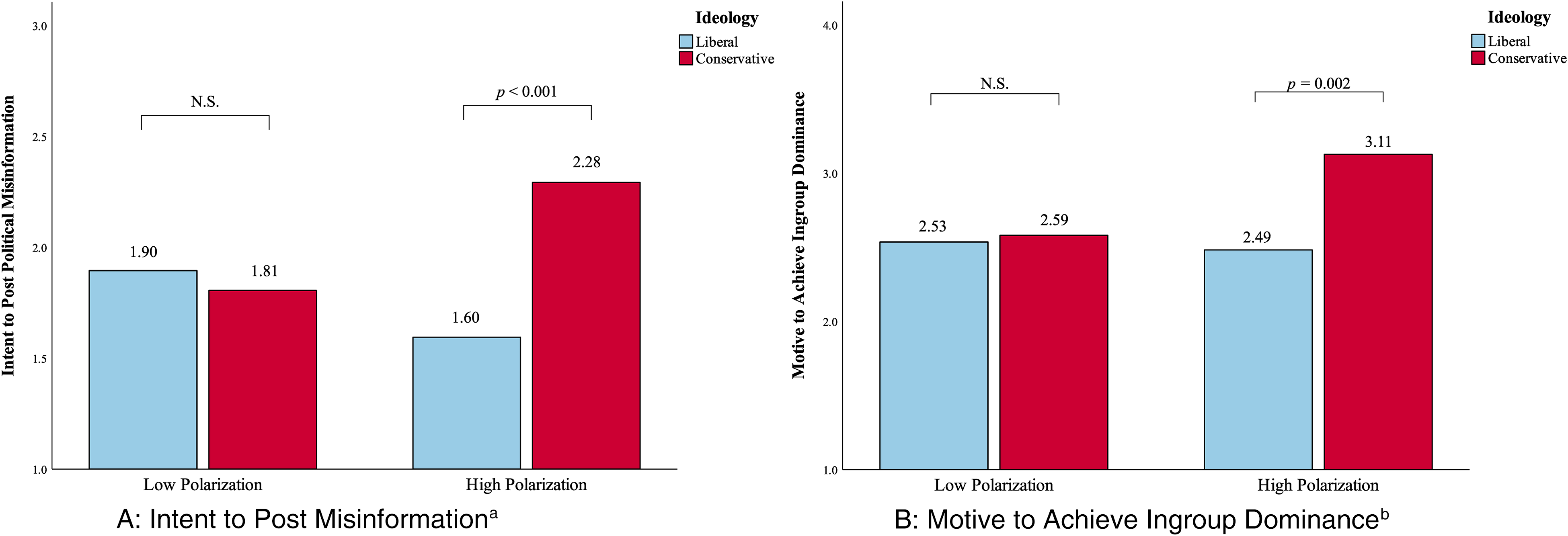
Ideology and Polarization Affect Intent to Post Misinformation and Motive to Achieve Ingroup Dominance (Study 4).
Motive to achieve ingroup dominance
An ANOVA on motive to achieve ingroup dominance shows main effects for ideology (Mconservative = 2.85 vs. Mliberal = 2.51; F(1, 573) = 5.71, p = .017) and replicate post (Msupport = 2.85 vs. Mattack = 2.50; F(1, 573) = 6.03, p = .014), but not polarization (Mhigh = 2.80 vs. Mlow = 2.56; F(1, 573) = 2.80, p = .095). We see the anticipated two-way interaction between ideology and polarization (F(1, 573) = 4.01, p = .046), with no three-way interaction involving replicate post (F(1, 573) = .26, p = .611), and so we collapse across replicate posts. With high polarization, conservatives expressed a stronger motive to achieve ingroup dominance than liberals (Mconservative = 3.11 vs. Mliberal = 2.49; t(573) = 3.10, p = .002). With low polarization, conservatives and liberals were comparable on this motive (Mconservative = 2.59 vs. Mliberal = 2.53; t(573) = .28, p = .784, Figure 5, Panel B). This finding further supports H1.
Mediation tests
Based on PROCESS Model 8 (Hayes 2017), the increase in misinformation from conservatives versus liberals is mediated by a motive to achieve ingroup dominance given high polarization (indirect effect = .4345, 95% CI = [.1660, .7190]), but not low (indirect effect = .0305, 95% CI = [−.2344, .2962]). The moderated mediation index comparing indirect effects for high and low polarization is significant (index = .4041, 95% CI = [.0252, .7953]). H3 is supported.
Discussion
Study 4 finds the same pattern as before. In a politically polarized situation, conservatives (vs. liberals) are more motivated to attain ingroup dominance, resulting in a higher intent to post ingroup-skewed political misinformation. In a less polarized situation, conservatives and liberals are comparable. We replicate these effects using misinformation that either expressly supports the ingroup or attacks the outgroup; it does not seem to matter. In other words, the specific approach to seeking ingroup dominance appears to be inconsequential.
Study 5: Experiment with Misinformative Social Media Newsfeeds to Show Robustness
Method
Design and participants
Study 5 employs a more realistic manipulation of political polarization within a situation. People see social media newsfeeds based on real news, where the news topics and/or the topic framings are either highly polarized or less so (Brady, Crockett, and Van Bavel 2020; Kubin and Von Sikorski 2021). We use a 2 (ideology: liberal vs. conservative) × 2 (polarization: high vs. low) between-subject design and our prior measures. We recruited 288 U.S. adults for an MTurk survey, 148 liberals (Democrats) and 140 conservatives (Republicans), aged 20 to 79 years (mean 42 years), 44.4% female, 54.5% male, and 1.1% prefer not to declare.
Materials and procedure
We asked participants their party affiliation as Republican or Democrat; 12 said neither, and their data collection was terminated. Our survey consisted of two discrete parts, each clearly labeled. In part 1, participants were randomly assigned to read a newsfeed with seven articles either high in polarization (e.g., “Senate Republican slams veto threat to unleashing U.S. energy reserves”) or low in polarization (e.g., “Congress takes bipartisan steps to protect U.S. petroleum reserves”; Web Appendix E). To avoid confounds, we used articles that were similar in length that addressed comparable topics (e.g., energy reserves, budget, jobs), but the specific topics and/or their framings were polarized (e.g., veto threat) or less so (e.g., bipartisan steps). The articles are based on U.S. news stories from January 1, 2023, to February 14, 2023, which we found on the news aggregator Factiva by searching for political keywords combined with high-and low-polarization keywords (described in Web Appendix E). Thus, our operationalization of political news polarization is similar to the widely used polarization index (Azzimonti 2018).
In survey part 2, we showed participants five misinformative posts, some supporting their own party and others attacking the rival party (Web Appendix D). We use the Study 3 measures: intent to make similar misinformative posts (dependent variable) and motive to achieve ingroup dominance (mediator; α = .93). After this, participants completed a manipulation check of polarization: “Please recall the 7 U.S. political news stories you saw at the beginning of the survey. In that news, how much did Democrats and Republicans agree or disagree on different issues?” (1 = “Strong agreement,” and 7 = “Strong disagreement”). Finally, we collected demographics.
Results
Manipulation check
As expected, an ANOVA on our manipulation check of newsfeed-induced polarization shows a main effect for polarization (F(1, 284) = 43.730; Mlow = 2.45 vs. Mhigh = 6.24, p < .001), no main effect for ideology (p = .696), and no interaction (p = .883).
Intent to post misinformation
An ANOVA on intent to post misinformation shows no main effect for ideology (Mconservative = 2.28 vs. Mliberal = 1.99; F(1, 284) = 2.35, p = .126) or polarization (Mlow = 2.10 vs. Mhigh = 2.16; F(1, 284) = .102, p = .750) but the expected interaction (F(1, 284) = 5.31, p = .022). After exposure to the high-polarization newsfeed, conservatives reported a greater intent to post misinformation than liberals (Mconservative = 2.53 vs. Mliberal = 1.80; t(284) = 2.71, p = .007). After exposure to the low-polarization newsfeed, conservatives and liberals were comparable in their intent (Mconservative = 2.03 vs. Mliberal = 2.18; t(284) = .54, p = .586), supporting H2 (Figure 6, Panel A).
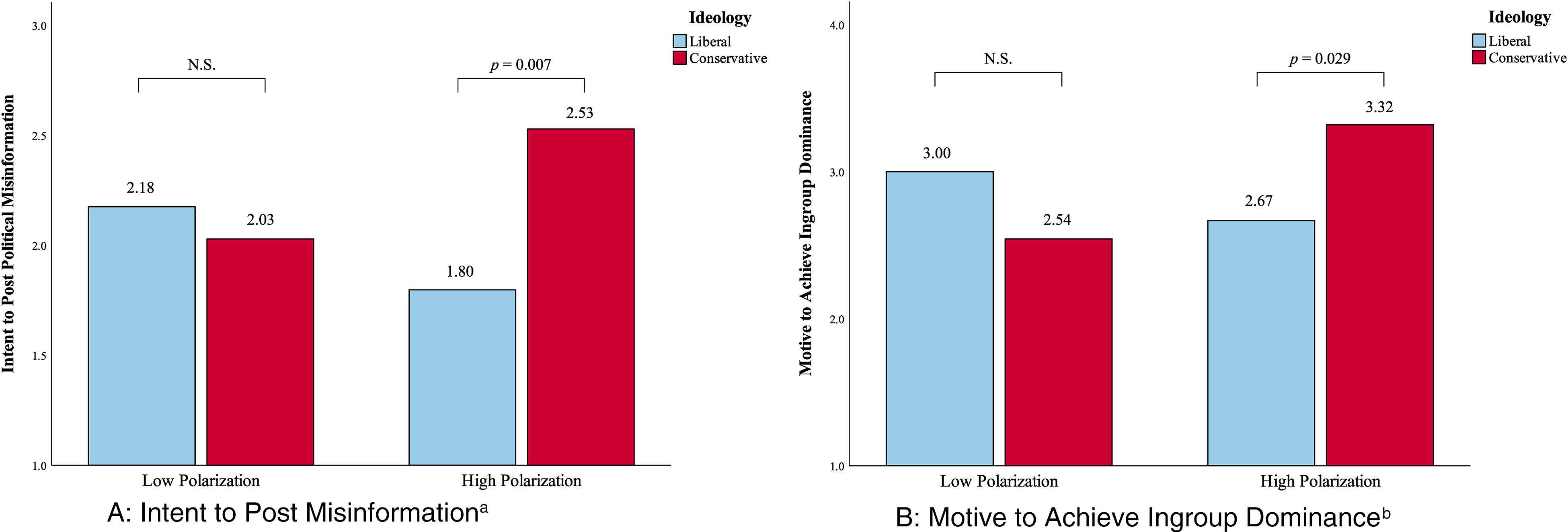
Ideology and Polarization Affect Intent to Post Misinformation and Motive to Achieve Ingroup Dominance (Study 5).
Motive to achieve ingroup dominance
An ANOVA on motive to achieve ingroup dominance finds the posited interaction (F(1, 284) = 6.96, p = .009), with no main effect for ideology (Mconservative = 2.93 vs. Mliberal = 2.83; F(1, 284) = .22, p = .643) or polarization (Mlow = 2.77 vs. Mhigh = 2.99; F(1, 284) = 1.10, p = .293). After exposure to the high-polarization newsfeed, conservatives expressed a stronger motive for ingroup dominance than liberals (Mconservative = 3.32 vs. Mliberal = 2.67; t(284) = 2.20, p = .029). After exposure to the low-polarization newsfeed, conservatives and liberals are comparable on this motive (Mconservative = 2.54 vs. Mliberal = 3.00; t(284) = 1.54, p = .125). H1 is supported (Figure 6, Panel B).
Mediation tests
Based on PROCESS Model 8 (Hayes 2017), the increased misinformation by conservatives versus liberals is mediated by a motive to achieve ingroup dominance given high polarization (indirect effect = .4564, 95% CI = [.0702, .8881]) but not low (indirect effect = −.3198, 95% CI = [−.7598, .0822]). The moderated mediation index comparing indirect effects for high and low polarization is significant (index = .7763, 95% CI = [.2212, 1.4013]), supporting H3.
Discussion
Study 5 manipulates political polarization in newsfeeds similar to social media situations. Our findings indicate that a polarized newsfeed provokes conservatives into striving for ingroup dominance, which causes them to post ingroup-skewed political misinformation, while liberals do not react this way. Even conservatives do not react this way with a less polarized newsfeed.
Study 6: Motive to Achieve Ingroup Dominance in U.S. President Speeches
Method
Study 6 is a secondary data analysis of U.S. president speeches. In this study, we aim to provide further real-world evidence that, in politically polarized situations, ingroup dominance motive is elevated among conservatives but not liberals. We use a 94-year dataset (1929–2023) composed of 18,438 speeches from 16 U.S. presidents, 8 Republicans (conservatives) and 8 Democrats (liberals), from the 31st president (Herbert Hoover) to the 46th (Joseph R. Biden). We compare the liberal and conservative leaders’ expressions of ingroup dominance in polarized (election) and less polarized (postelection) situations (Hernández, Anduiza, and Rico 2021). Sourced from the American Presidency Project (2023), the dataset distinguishes between election speeches (i.e., campaign speeches) and postelection speeches (inaugural addresses, State of the Union speeches, farewell addresses, and major national remarks). Overall, 3,013 speeches (57.2% from Democrats, 42.8% from Republicans) occur in polarized election situations, with 15,425 (54.1% from Democrats, 45.9% from Republicans) in less polarized postelection situations.
We analyze the text of the speeches using Linguistic Inquiry and Word Count’s (LIWC-22's) dictionary for first-person plural pronouns (e.g., “we,” “us,” “our”) to identify ingroup keywords (Boyd et al. 2022; Matos and Miller 2023; Perdue et al. 1990). We find that 123 speeches (.7%) lack ingroup keywords, so our final analysis includes 18,315 speeches. We apply LIWC-22's Contextualizer to extract sentences with these ingroup keywords, along with 15 words before and after each keyword, forming up to 31-word phrases (Fridman et al. 2021). Then, using LIWC-22's dictionaries for positive and negative tonality, we calculate the overall positivity of the words in the extracted phrases in each speech as our measure of motive to achieve ingroup dominance, and aggregate the results by speech. The formula for this word count measure is:

Results
The ANCOVA finds a main effect of ideology on motive to achieve ingroup dominance, with conservative presidents expressing more ingroup dominance in their speeches than liberals (Mconservative = 55.82 vs. Mliberal = 51.35; F(1, 18,308) = 63.40, p < .001). There is also a main effect for polarization, as high polarization increases expressions of ingroup dominance (Mhigh = 55.75 vs. Mlow = 51.42; F(1, 18,308) = 53.35, p < .001). We see the expected two-way interaction (F(1, 18,308) = 218.59, p < .001). Given high polarization, conservative presidents used 13 more words to express motive to achieve ingroup dominance than liberals (Mconservative = 62.11 vs. Mliberal = 49.40; F(1, 18,308) = 153.96, p < .001). Given low polarization, liberal presidents used four more words to express motive to achieve ingroup dominance than conservatives, which is a minor albeit statistically significant difference in the opposite direction (Mconservative = 49.54 vs. Mliberal = 53.30; F(1, 18,308) = 69.92, p < .001) (Figure 7). Overall, H1 is supported. These results include covariates; Web Appendix F reports results without covariates, which are similar.
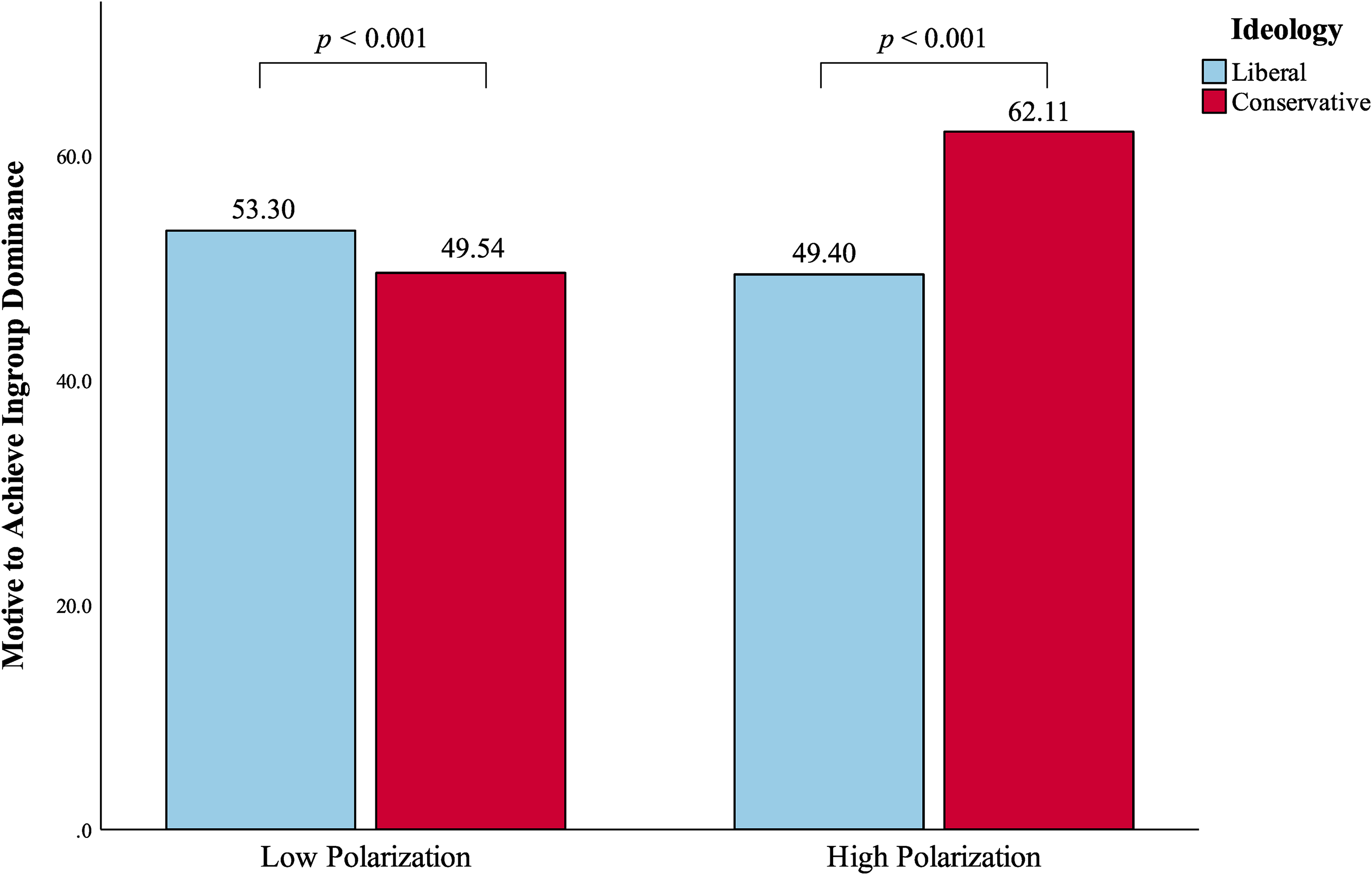
Ideology and Polarization Affect Motive to Achieve Ingroup Dominance, U.S. Presidents’ Speeches, 1929–2023 (Study 6).
Discussion
In Study 6, we examine nearly a century of U.S. presidents’ speeches. We find that in politically polarized situations (during elections), conservative presidents use more words expressing motive to achieve ingroup dominance than liberal presidents. However, this effect diminishes and even slightly reverses in less polarized situations (postelection). We acknowledge that the use of first-person plural (e.g., “we”) in speeches could sometimes refer to the U.S. citizenry as a whole rather than a partisan ingroup (Democrats or Republicans), but the U.S. citizenry is arguably another ingroup. Thus, it appears that conservatives are motivated to attain ingroup dominance given polarization, and liberals less so, possibly regardless of the ingroup (meriting future study).
General Discussion
Summary of Findings and Theoretical Insights
The impact of political ideology on misinformation spread has attracted considerable research of late. The majority of studies show a tendency for conservatives to spread more misinformation than liberals (Allcott and Gentzkow 2017; Grinberg et al. 2019; Guess, Nagler, and Tucker 2019; Hameleers and Minihold 2022; Nikolov, Flammini, and Menczer 2021; Osmundsen et al. 2021). However, situational factors, such as political polarization, have been neglected in studies of the misinformation landscape. While research has connected polarization with misinformation, it has primarily focused on polarizing individual traits like ideological extremism (Bessi et al. 2016; Jenke 2023; Marino and Iannelli 2023; Osmundsen et al. 2021) and has overlooked the effects of polarizing situations caused by divisive political topics or their framing. Moreover, while it has been shown that conservatives value ingroup dominance more than liberals (Ordabayeva and Fernandes 2018; Pratto et al. 1994; Jost et al. 2003), this value has not been linked to their propensity to spread misinformation.
Our research enhances our understanding of when and why conservatives tend to spread more misinformation than liberals. We find that an ideological asymmetry emerges when politically polarized situations trigger conservatives’ desire for ingroup dominance. Acting on that salient desire, conservatives spread ingroup-skewed political misinformation, which is of uncertain accuracy, but not definitively false. In less polarized situations, conservatives’ desire to achieve ingroup dominance is tempered, along with their misinformation conveyance. In supplemental analyses, we explore whether a related conservative motive, the motive to prevent outgroup dominance, might also be driving their misinformation spread, but the results are not supportive of this alternate theory (Web Appendix G).
We find that even U.S. presidents are sensitive to political polarization within situations, underscoring its importance. In nearly a century of speeches, conservative compared with liberal U.S. presidents are more likely to use wording that expresses ingroup dominance, but only when situations are politically polarized (i.e., during elections; Hernández, Anduiza, and Rico 2021). We do not observe this pattern in less polarized situations (i.e., postelection).
Substantive Implications
Drivers of misinformation
Our findings indicate that politically polarized situations are a significant cause of political misinformation, not just conservatives’ tendency to propagate it. The news media, social media, political and public figures, and others contribute to political polarization, likely driven by marketplace incentives (Wilson, Parker, and Feinberg 2020). Global news revenue has declined from $180 to $126 billion in the last decade, only partially offset by digital news revenue growth from $12 to $85 billion (World Association of News Publishers 2015, 2024). To bolster revenue, news media often accentuate political polarization by using conflict-framing headlines and stories, especially in the digital arena. Instead of emphasizing the importance of political consensus in decision-making, they highlight political conflict to garner audiences (Berry and Sobieraj 2013; Kim and Zhou 2020).
Social media is also guilty of amplifying polarization and intergroup conflict (Brady, Crockett, and van Bavel 2020; Kubin and Von Sikorski 2021). Posts that go viral on social media tend to contain contentious content, which drives user engagement (Stieglitz and Dang-Xuan 2013; Fine and Hunt 2023); consequently, social media algorithms often expressly recommend contentious content (Finkel et al. 2020). Similarly in politics, stressing polarizing party differences rallies voters and increases donations (La Raja and Wiltse 2012; Leonard et al. 2021); thus, it has become a strategic political tool (Syropoulos and Leidner 2023; Wilson, Parker, and Feinberg 2020). Due to rising polarization, conservative and liberal voting in the U.S. Congress is more divided now than any other time in recorded history (DeSilver 2022).
Harms of misinformation
People are exposed to misleading content from political leaders and commentators. It has been estimated that 75% of statements made by conservative leader Trump and 41% of statements by liberal leader Biden have been mostly false or false (PolitiFact 2024a, 2024b). Perhaps as a consequence, in roughly two decades from 2001 to 2023, distrust in the U.S. government has dramatically increased from 32% to 92% among conservatives and from 48% to 75% among liberals (Pew Research Center 2023).
Misinformation leads to more negative feelings toward and stereotypes of rival groups. Currently, about 62% of conservatives and 54% of liberals report very unfavorable attitudes toward the rival party, marked increases from 1994, when only 21% of conservatives and 17% of liberals felt this way (Pew Research Center 2022). Many conservatives and liberals perceive rival party members as immoral, dishonest, unintelligent, lazy, and/or closed-minded (Pew Research Center 2022). Misinformation also deepens distrust of the news media (Pérez-Escoda et al. 2021), with 58% of conservatives and 23% of liberals distrusting it (Jurkowitz et al. 2022), which ironically promotes the consumption of lower-quality news (Mosleh and Rand 2022).
Misinformation adversely impacts democratic processes. In the year following the 2020 U.S. presidential election and accompanying misinformation about election fraud, 400 restrictive voting bills were introduced in 47 U.S. state legislatures (Brennan Center for Justice 2021). Worse, 14 states passed restrictive voting bills that, for instance, shortened the mail-in voting period, eliminated election day registration, and/or reduced ballot dropbox access. These changes have decreased voter turnout and engagement, particularly among minority voters (Fraga and Miller 2022; Ritter, Coll, and Tolbert 2024). Misinformation has also adversely affected scientists, such that Americans’ distrust in them has increased from 12% to 27% (Kennedy and Tyson 2023).
Responses to misinformation
One potential response to misinformation in the news is to enhance fact-checking to make it more instantaneous and accessible (Porter and Wood 2021). However, fact-checking organizations are constrained by limited human and financial resources. The International Fact-Checking Network (2024) reports that 59% of these organizations operate as nonprofit or academic initiatives, 68% have fewer than ten employees, 70% rely on part-time volunteers, and 84% identify fundraising as their greatest challenge. Although some fact-checking organizations have started to implement automation, deepfakes created by artificial intelligence hinder these efforts (Lee et al. 2023). Given these challenges, we recommend that fact-checkers strategically allocate more resources when situations are politically polarized (e.g., during elections). They may also want to integrate fact checks with the U.S. Federal Reserve Bank's polarization index to better understand and predict when misinformation is likely to spike.
Media literacy education can also be used to combat misinformation (Chen, Xiao, and Kumar 2023). Although 84% of U.S. adults support media literacy education as a school requirement, only 38% of these adults have received such training (Reboot Foundation 2022). A recent survey finds that 52% of high school students are persuaded by political misinformation and 90% cannot complete crucial media literacy tasks (Breakstone et al. 2021). As of 2023, 18 U.S. states have passed bills mandating media literacy education for K-12 students, up from up just 3 states in 2013 (Media Literacy Now 2024). As of 2023, California, the most populous U.S. state, requires media literacy instruction at every grade level, with a main goal being to teach students to identify misinformation (Buller 2023). Nonprofits like Media Literacy Now (2024) and the News Literacy Project (2024) provide educational resources for this purpose.
Limitations and Future Research
It would be advantageous to measure political ideology and manipulate political polarization in two separate time periods to avoid carryover effects, so we recommend that future research adopt this approach. We also suggest comparing survey platform data on ideology with people's self-reports, so any discrepancies can be noted and analyzed. Other motives that may lead to misinformation spread should be explored, such when the misinformation is entertaining or attention-getting. Research should examine whether our findings generalize to other countries and cultures, as we use data from the United States, which is economically developed and Western. In particular, research should examine whether the ideological mindset differences between conservatives and liberals in the United States hold in Eastern cultures and whether and how this may affect misinformation spread.
Previous studies on political ideology can be extended to see if polarization magnifies their effects. For instance, if situations are politically polarized, do conservatives further narrow their charitable giving to focus on ingroups (Farmer, Kidwell, and Hardesty 2020), or do they more vehemently reject fair trade products (Usslepp et al. 2022)? In addition, prior studies that have examined individual-level polarization stemming from ideological extremism should consider situational polarization. With polarization rising globally, and conservative movements growing as well, we hope our insights will help nations, communities, and individuals better prepare for the effects on misinformation spread to preserve truth, trust, and democracy.
Supplemental Material
sj-pdf-1-jmx-10.1177_00222429241264997 - Supplemental material for Political Polarization Triggers Conservatives’ Misinformation Spread to Attain Ingroup Dominance
Supplemental material, sj-pdf-1-jmx-10.1177_00222429241264997 for Political Polarization Triggers Conservatives’ Misinformation Spread to Attain Ingroup Dominance by Xiajing Zhu and Cornelia (Connie) Pechmann in Journal of Marketing
Footnotes
Acknowledgments
The authors thank Professor John Jost for his brilliant insights early in the process, and the JM review team for their incredibly detailed and constructive feedback.
Coeditor
Cait Lamberton
Associate Editor
Bob Meyer
Declaration of Conflicting Interests
The authors declared no potential conflicts of interest with respect to the research, authorship, and/or publication of this article.
Funding
The authors received no financial support for the research, authorship, and/or publication of this article.
References
Supplementary Material
Please find the following supplemental material available below.
For Open Access articles published under a Creative Commons License, all supplemental material carries the same license as the article it is associated with.
For non-Open Access articles published, all supplemental material carries a non-exclusive license, and permission requests for re-use of supplemental material or any part of supplemental material shall be sent directly to the copyright owner as specified in the copyright notice associated with the article.
