




Abstract
This study examines how supervisor-candidate coauthoring collaborations contribute to doctoral students’ writer identity. Three candidates’ coauthorship experiences with their supervisors were investigated in depth using a multiple-case study design. Interviews, written reflections, and email correspondence between coauthors enabled thick descriptions of these candidates’ writer identity formation. Guided by Burgess and Ivanič’s framework of writer identity, the multiple-case study showed how the candidates’ autobiographical selves, discoursal selves, authorial selves, and perceived writer were influenced through the experience of coauthoring with supervisors. Notably, the candidates benefited from supervisor-candidate coauthorship by engaging in scholarly collaborations, bolstering their confidence as academic writers, and strengthening their authorial voice and rhetorical awareness. This study also reveals potential pitfalls or challenges of such collaborations, highlighting key considerations for supervisors and candidates considering coauthorship.
Keywords
Introduction
Doctoral students tend to be aspiring researchers and academics who are trained to become “knowledge workers” (Lee & Boud, 2009, p. 18) with “competent autonomy” (Gurr, 2001, p.85) in producing academic or scientific work in academia and beyond. How such aspirations are achieved has been a popular focus for researchers investigating doctoral pedagogy, as understanding these processes may enable doctoral students to reach their myriad identity goals. Previous literature offers different lenses for examining the identities of doctoral students, including their academic identity, researcher identity, and scholarly identity (de Magalhães et al., 2019; Mantai, 2017; Xu & Grant, 2020). The formation of these identities occurs in varied academic activities such as researching, research training, publishing, teaching, and participating in conferences. Notably, these activities involve varying degrees of academic writing, as most academic outcomes during PhD candidature are presented through written texts, such as a PhD thesis and journal articles.
Despite the centrality of academic writing to the doctoral journey, only a few studies have specifically examined doctoral students’ writer identity. In other words, writer identity has often been subsumed in studies focused on doctoral students’ academic, scholarly, and researcher identity (e.g., Mantai, 2017; Xu & Grant, 2020). When coining the term “writer identity,” Ivanič (1998) defined it as “the identity of a person in the act of writing” (p. 24) and proposed that such an identity evolves as the writer identity codevelops with writing. As Tusting (2015) argues, writing functions as a space in which the writer constructs their “unique individuality” and “relational identities” (p. 248). Ivanič (1998) further proposed that writer identity can be variably presented at the textual, reflective, social, and sociocultural levels. At each level, writer identity can be influenced by multiple factors; for example, when writers engage in literate activities such as reading, writing, and reflecting on their writing, their writer identity can be molded by others who are involved in the writing, such as a pen pal (Ware, 2022). By influence here, we seek to emphasize the complexities of the factors contributing to doctoral student identity among which collaborative work with supervisors is situated.
Indeed, literate activities can facilitate doctoral students’ writer identity formation. One such activity that appears to be an effective and supportive approach is that of coauthoring with supervisors (Kamler, 2008; Liardét & Thompson, 2022; Lokhtina et al., 2022; Pinheiro et al., 2014). For example, in their exploration of coauthorship among laboratory research teams, Florence and Yore (2004) highlight how such collaborations prepare the candidate 1 to become “more proficient” (p. 650) and “more persuasive, thoughtful” writers (p. 659). Several studies have explored the coauthoring process between supervisors and candidates; however, many of these investigations focus exclusively on the experiences of candidates studying within STEM disciplines (e.g., Chaopricha, 1997; Florence & Yore, 2004).
Research into the experiences of candidates coauthoring with their supervisors in the humanities, arts, and social science (HASS) disciplines where coauthorship has not traditionally been a normative practice is less common but appears to be rising recently (Guzmán-Valenzuela et al., 2022; Henriksen, 2016; Leane et al., 2019; Wang et al., 2024). Perhaps the most robust study of coauthorship in HASS is that of Welfare and Sackett (2010). In their survey of “student-faculty collaborative research,” they mapped different scenarios within which supervisor-candidate coauthorship takes place. Across the nine scenarios they identified, two major distinctions emerge according to the ownership of the project: (1) the candidate functions as a research assistant on the supervisor’s project, or (2) the supervisor acts as a coauthor on the candidate’s doctoral project.
While these scenarios allow for a deeper understanding of the contexts within which supervisor-candidate coauthorship generally occurs, at present, few studies have examined such collaborations among HASS candidates. Further, research has not yet examined how the actual practices of supervisor-candidate coauthorship in HASS inform the candidate’s writer identity formation at the textual, reflective, social, and sociocultural levels. The current study thus aims to investigate the practices of supervisor-candidate coauthorship to better understand how HASS candidates’ writer identity is influenced by these practices. It was conducted in Australia, where the researchers are based. Such an investigation is timely given the increasingly competitive academic climate (Pinheiro et al., 2014). Across Australia, the foremost and often sole requirement for degree completion is the PhD thesis (Mullins & Kiley, 2002); however, in the competitive realm of postdoctoral employment, there is increasing pressure to publish during candidature or immediately following the submission of the thesis for examination (Frick & Mason, 2022). This pressure brings with it a need to more thoroughly understand how to foster writers who can produce legitimate academic work not only via a thesis but also through journal articles. Furthermore, current research in this space tends to focus more on the improvement of doctoral writing than on doctoral writers and their perceptions toward their writer identity formation. Thus, this study aims to shed light on some of the influences on HASS doctoral students’ writer identities while coauthoring research with their supervisors.
Literature Review
One of the most comprehensive theories of writer identity is Burgess and Ivanič’s (2010) framework. In their investigations into writer identity, they map identity formation along a spectrum of textual, cognitive, social, and sociocultural practices and argue that writer identity exists not only in the text but in the mental space, social interactions, and sociocultural context. Notably, several studies have used this framework to examine writer identity but have generally focused on one specific level of writer identity formation at a time rather than exploring identity across all levels and dimensions. For example, Ivanič and Camps (2001) examined graduate students’ writer identity at the textual level and argued that voice could be regarded as the representation of the writer identity in the text while Hyland (2002) observed how academic writers convey their “identity invested with individual authority” through writing (p. 1091). Researchers have also adopted move-step analysis to examine the ways in which the writer builds their writer identity within the text. For example, Tuckley et al.’s (2024) study of letters of recommendation reveals that the recommenders establish their credibility by highlighting their expertise, qualifications, and authority. Other investigations have identified the varied ways doctoral students convey writer identity in the text. For example, when they engage critically with the literature, doctoral students express their authorial voice (de Magalhães et al., 2019) and, specifically, their ability to “enact authorial control over” the cited literature in manuscript writing (Kwan, 2013, p. 212).
At the cognitive or reflective level, investigations into writer identity have examined how writer’s reflections and perceptions influence their writer identity. For example, Lindenman et al. (2024) explore writer identity as exemplified in nonobligatory “life” writing (e.g., diary or journal writing, social media posts, and speeches), finding that writers tended to construct their personal identities through writing for emotional well-being, memory curation, and reflection. Studies of academic writing also find that writers’ reflections affect their self-perception as writers. Bekar and Yakhontova’s (2021) study of undergraduate and graduate thesis writers revealed how these academic writers variably perceived themselves to be anxious writers, independent writers, triumphant writers, or supported writers while writing their theses. Adopting a shared reflective lens, Sword et al. (2018) examined questionnaires from 1223 academics in 15 countries and found how they sensed frustrations or anxieties as “familiar/familial companion[s]” in their writing (p. 865). Similarly, researchers adopting a cognitive perspective to examine doctoral students’ writer identity highlight the value of candidates’ confidence-building practices (Lassig et al., 2013). Being a confident academic writer means candidates have high self-efficacy, embrace the challenges of writing academically, and function as “capable and efficacious scholarly writers” (Lassig et al., 2013, p. 309; see also, Wang, Liardét, & Lum, 2024).
At the social and sociocultural level, researchers have emphasized how writer identity is formed in the social context or within social relations. In one longitudinal study of an adolescent’s writing, Lammers and Marsh (2018) observed how a writer presented herself in her writing was influenced by factors like receiving critical feedback from a valued reader. In another study of an early-career researcher’s voice, Karsten (2024) traced “the polyphony of own and interiorized voices that feed into the formation of a writer’s textual voice” (p. 7) to illustrate how the individual’s identity is influenced by the various personal and collective voices involved in her writing (see also Deroo, 2024). Moreover, an academic writer can intentionally seek to be enculturated into a social context (Xu & Grant, 2020). Doctoral students, for example, can proactively access and engage with supervisors, writing groups, and writing workshops in the academic community to build their legitimate voice (Kwan, 2013). Across the literature, one of the most important factors that has been found to contribute to doctoral writer identity is feedback from supervisors. For instance, Anderson’s (2021) investigation of second language doctoral students at a Canadian university found that supervisors’ corrective feedback enables candidates to become “publishable author[s]” (p. 143).
Although these studies provide in-depth investigations of writer identity, they tend to focus on either the textual, cognitive, social or sociocultural level rather than examine writer identity across all four. The present study seeks to depart from this trend and explore doctoral students’ writer identity across the dimensions of Burgess and Ivanič’s (2010) framework. Specifically, these aspects include the autobiographical self, discoursal self, authorial self, perceived writer, and socially available possibilities for selfhood.
The first of these aspects, the autobiographical self, refers to the writer’s life experiences, sense of worth, commitments, beliefs, and social positionings (Ivanič, 1998). The autobiographical self of an academic writer can be related to the writer’s academic writing and publishing experience and their disciplinary background (Matsuda, 2015). The second aspect, the discoursal self, refers to the writer’s writing styles, choices of wordings, and the “discursive practices they are able to draw on” (Starfield, 2002, p. 125). A discoursal self of an academic writer, for example, is one of the possibilities for selfhood that exist within the academic discourse context (Tardy, 2012).
The third dimension of Burgess and Ivanič’s (2010) framework is the authorial self, which refers to the ownership and authority of the work, the writers’ authorial voice, or specifically, “how authoritative the writer feels” (p. 240). The authorial voice of the writer is usually interwoven with the writer’s independence and individuality (Zabihi & Bayan, 2020). The fourth dimension, the perceived writer, refers to two subaspects of writer identity. One is called the actual perceived writer, denoting the image of the writer that the real readers form when they read. The other is the anticipated perceived writer, referring to the writer’s anticipation of how their intended or “imagined readers” will view them (Hyland & Jiang, 2016). There is one final dimension, the socially available possibilities for selfhood, which represents a pool of identities that the writer can draw upon and which encompasses the former aspects and other possible identities beyond writer identity (Burgess & Ivanič, 2010). To adequately analyze this fifth dimension, however, a researcher would require more substantial data representing the participants’ life experiences than what was collected for the purpose of this study. Therefore, the present study will focus on the first four dimensions of the writer identity framework. This multilevel lens allows for a multidimensional exploration of writer identity, and in this study, this framework will be applied to explore how the doctoral student’s writer identity is influenced through the process of coauthoring with a supervisor.
The Study
To examine how candidates’ writer identities are influenced through the processes of supervisor-candidate coauthorship, this study adopts a multiple-case study design (Yin, 1984). The use of a multiple-case study enabled the researchers to discover “real-life events” occurring in the actual practice of coauthorship, shedding light on the occluded space of supervisor-candidate coauthorship (Yin, 1984, p. 14). The multiple-case study provides a “thick description” of the actual coauthoring process (Creswell, 2007, p. 194) and further enables the exploration of how these processes contribute to the candidate’s writer identity in varying coauthor teams and scenarios, revealing their uniqueness, particularity, and diversity (Stake, 1995).
The case study was conducted following the five steps of Creswell’s (2007) procedure. We first determined that the use of case study could answer the research question in a thorough way. As this study is part of a larger research project 2 into higher degree research (HDR) practices, supervisor and candidate participants working or studying in the disciplines of HASS were originally recruited to participate in a questionnaire distributed to Australian universities. Participants were invited via email with the survey link embedded. To achieve distribution across HASS disciplines, we used a random stratified sampling method. First, emails were sent to HDR directors, managers, and administration offices in various HASS faculties/departments/schools at Australian universities, requesting that they distribute the online survey to doctoral students and supervisors. As data from candidates reached the desired sample size but data from supervisors did not, we then emailed supervisors in the seven HASS disciplines that the candidates primarily represented. Supervisors’ email addresses were found on universities’ staff profile pages. At this stage of the data collection, quota sampling was adopted to gain a similar disciplinary distribution of doctoral students. At the conclusion of this survey, participants were invited to participate in the present study. Given that the survey participants were recruited individually and not according to their supervisor-candidate relationship, we then needed to reach out to these participants’ coauthors to inquire if they were willing to participate in the case study portion of the investigation. For this reason, adopting snowball sampling and with the participants’ permission, we further contacted their coauthors. Each supervisor-candidate coauthorship team was regarded as a case, or a “bounded system” (Yin, 1984). The time boundary of each case was from the outset of writing the coauthored article to the submission of the manuscript to an academic journal.
The data collection for the multiple-case study began in February 2021 and concluded in December 2022 (i.e., 22 months). In total, seven cases emerged, involving 18 participants (i.e., 7 doctoral students and 11 supervisors); all participants received remuneration for their involvement. For purposes of this investigation, we decided to focus exclusively on cases that resulted in the manuscript being submitted for review and those cases that consisted solely of HASS candidates and supervisors, given our focus was to explore the collaborations of HASS supervisor-candidate coauthors. Thus, the present investigation examines three cases that represent the three main types of coauthorship revealed in the data: coauthorship drawing upon the candidate’s thesis by monograph (TBM), coauthorship as part of the candidate’s thesis by publication (TBP), 3 and coauthorship within the supervisor’s project. The three selected cases center around three candidates and their five supervisors, as is shown in Table 1. All participants involved in this study self-identified as being HASS researchers. Coincidentally, all three of the candidates were studying for degrees in Education; as a result, the supervisors represent different areas of educational research (e.g., Aboriginal Studies, Science Education). Notably, not every supervisor or colleague who served as a coauthor on the manuscripts featured in these cases joined the present study as a participant. References to other nonparticipating supervisor coauthors are therefore generic (e.g., the “principal supervisor”).
Background Information of Participants in Interviews.
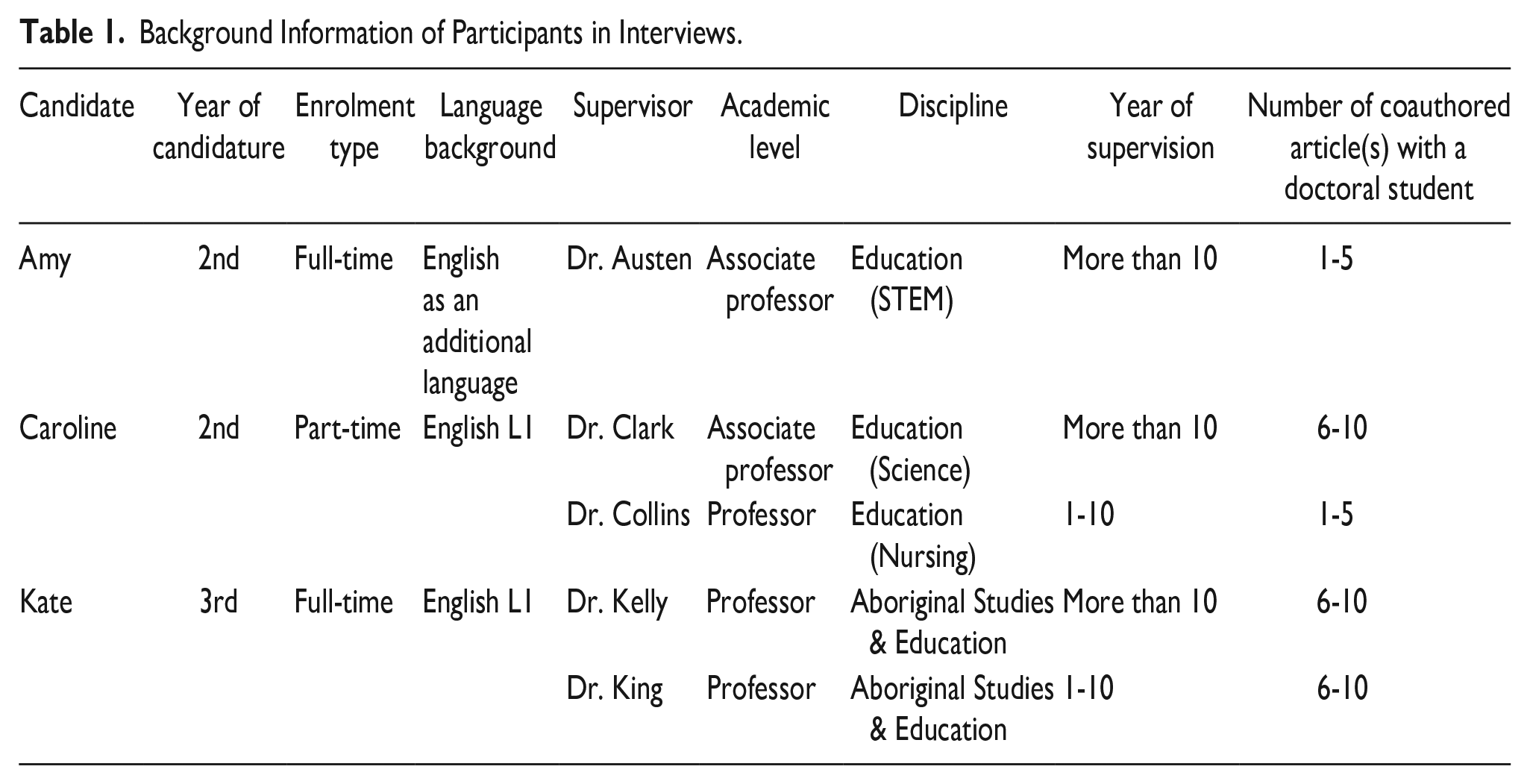
Three types of data were collected from the participants in each case: candidates’ written reflections, email correspondence between coauthors, and interview data. Candidates’ written reflections and coauthors’ email correspondence serve as unobtrusive data to illustrate the coauthoring process. Throughout the duration of preparing their manuscripts, candidates were asked to reflect on their experiences while coauthoring with their supervisor(s). A fortnightly reminder email was sent to each candidate with a writing prompt to guide their written reflections and to check for any updates on their coauthored papers. The same prompts were used throughout the collaboration and focused on what the coauthor team discussed and accomplished in the meetings regarding the coauthored paper. The candidates were also asked to reflect on how they felt about the tasks they completed and discussed in the meetings. The aim of the written reflection was to capture how the doctoral students view themselves and the key events or factors influencing their identity formation. Finally, once the article was submitted for review, candidates were asked to forward email exchanges to the researchers. Participants had the option to choose which emails they forwarded, thus protecting their privacy and ensuring compliance with ethical guidelines. For instance, Caroline’s principal supervisor (PS) did not participate in the study; therefore, that supervisor’s correspondence was excluded from the data.
Participants were also interviewed twice, each individually. The initial interviews, conducted at the beginning of the collaboration, are semistructured interviews following two interview guides: one for the interview with the candidate and the other for the supervisor, respectively. The interview guides were designed based on existing literature and our own coauthorship experiences. Supervisors and candidates were interviewed individually, which uncovered their perceptions toward their coauthorship experiences, the detailed practices within the coauthoring process, and the candidate’s writer identity formation in such practice. The final interviews involved stimulated recall, during which interviewees were shown the email correspondence between coauthors to prompt their recollections on the collaboration. Candidates were also shown their written reflections. These interviews sought to uncover candidates’ and supervisors’ perceptions toward their coauthorship experiences, the detailed practices within the coauthoring process, and the factors that influenced the candidate’s writer identity formation. The aim of interviewing coauthors before and after the collaboration was to examine the complete picture of the process, the difference between expectations toward and actual practices of coauthoring, and the candidates’ academic writer identity formation as perceived by both supervisors and candidates. Table 2 offers details of the data collected in each case study.
Case Study Data Collection Matrix.
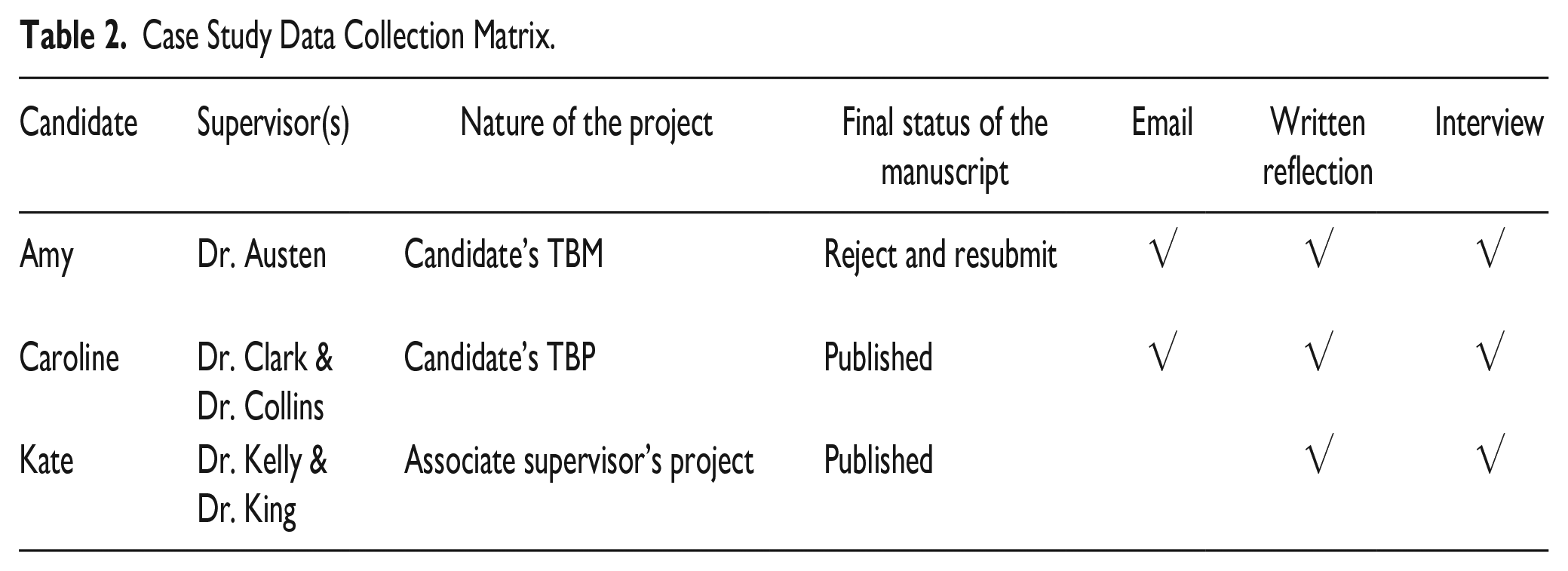
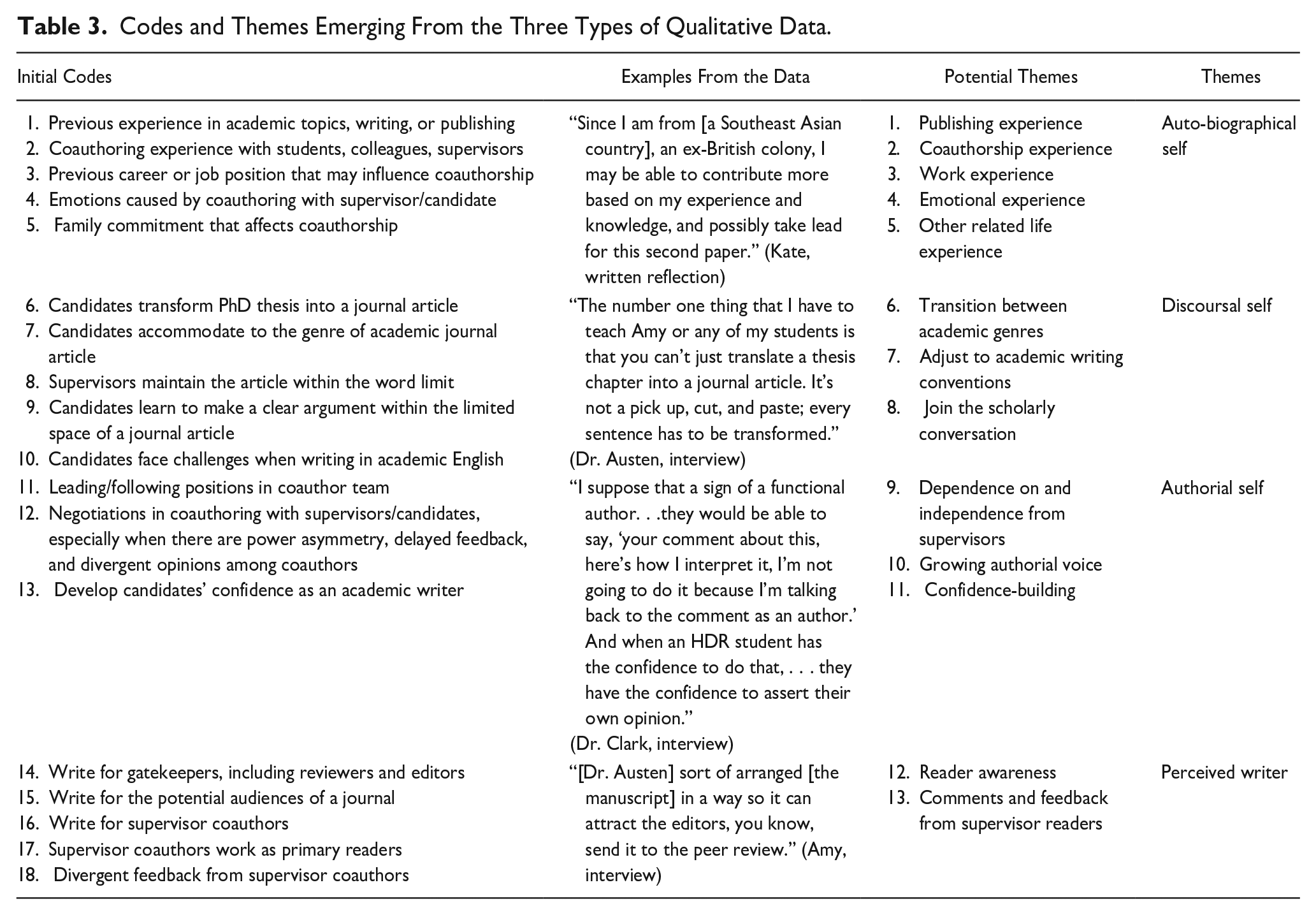
All interview data were transcribed verbatim with an online transcription tool, Otter.ai. All interview transcripts produced by the tool were reviewed, typographic errors were corrected, and misheard words were revised and/or added to ensure the transcripts were as accurate as possible. Interviews, email correspondence, and written reflections were coded in NVivo (Release 1.5) and analyzed through the six-step procedure of theoretical thematic analysis (Braun & Clark, 2006). The three types of data sources had equal weight in the data analysis. During the initial coding of the interviews, reflections, and email correspondence, 18 codes emerged from the data. From these initial codes, the researchers discussed the excerpts and identified potential themes that corresponded to the codes, using the lens of the writer identity framework proposed by Burgess and Ivanič (2010). For example, the following excerpt from a supervisor coauthor below was originally coded as “write for the potential audiences of a journal”: I don’t quite understand that, you need to explain it in a way that someone who’s not a multilingualism heritage language researcher would also understand.
Upon discussion of the excerpts coded as such, we identified the theme of “reader awareness” and further categorized such excerpts as “perceived writer.” Through this coding and thematic analysis process, we found the 18 original codes correlated to 13 potential themes that were then in turn categorized according to four of the five dimensions from the writer identity framework. The codes, potential themes, and themes are outlined in Table 3.
Codes and Themes Emerging From the Three Types of Qualitative Data.
The next step of conducting this case study was a “within-case analysis” followed by a “cross-case analysis” (Creswell, 2007, p. 75), which means that the themes of each case were summarized, and then a theoretical thematic analysis across the cases was conducted. Each case was then reported following the order of a “narrative description” (Stake, 1995, p. 123), including a background vignette (e.g., the context and related issues of each coauthorship team and each candidate), descriptions of a major theme, and a closing vignette (Creswell, 2007; Stake, 1995). Within the description of each case, a timeline of the collaboration is presented to map key events of the engagement. Additionally, the excerpts selected to report the narratives were illustrative quotes that directly speak to the actual coauthorship practices or the candidate’s writer identity formation. Further assertions were given in the discussion section, meaning that each case was “couched in terms of personal views or in terms of theories or constructs in the literature” (Creswell, 2007, p. 244). Finally, the analysis across cases is reported in the discussion.
Findings
Amy: “I’m On the Upper End of the Novice Zone”
Background vignette
Amy is an international student from a Southeast Asian country where she received her master’s degree before coming to Australia, where she is a full-time PhD candidate at a leading university. Amy was first interviewed for the present study during her second year of PhD candidature. At the time, she had just successfully coauthored an article with her PS, Dr. Austen, drawing on the findings from her thesis written as a monograph. Although the article had just been accepted by a top-tiered journal, in her initial interview, Amy described herself as a “novice.” When discussing the process of coauthoring on that paper with Dr. Austen, she recounted how hesitant she was to challenge her supervisor’s advice: “I thought I had to accept all of [Dr. Austen’s] comments; I don’t have the right to reject.”
At this point, Amy was in the early stages of planning and developing a second coauthored paper with Dr. Austen and two of her other supervisors, again drawing on the findings she had written up as part of her monograph thesis. Shortly after Amy submitted her thesis, she turned her attention to writing this manuscript based on the findings from the thesis. Figure 1 presents the major events that occurred in Amy’s co-authoring experience with her supervisors.
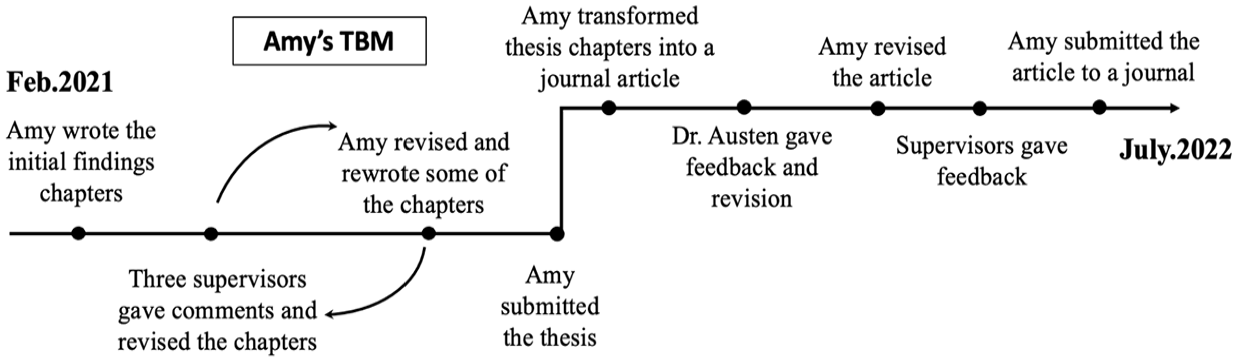
Amy’s coauthoring timeline.
Transforming findings chapters into a journal article
Amy’s coauthorship experience is heavily intertwined with her thesis writing, as she had already written her monograph thesis. She was drawing on this aspect of her discoursal self to then collaborate with her supervisors to transform her thesis findings into a journal article. As such, one core challenge Amy faced was resolving how to recognize and articulate her thesis findings in the limited space of a journal article. When writing the thesis, Amy was not overly concerned with the length, but in transforming those findings into a journal article, word count limits became a central consideration. Amy recounted how she initially attempted to reduce “8008 words to 6444 words” by deleting unnecessary information or outdated references. However, Dr. Austen’s approach was somewhat different. Rather than just removing repetition, Dr. Austen focused on concision and clarity, “reorganiz[ing] the words, so it makes more sense,” resulting in a “condensed and more chiseled version.” Amy recounted how Dr. Austen often used diagrams or figures to convey information that might otherwise require significant description in the text, modeling how writers “don’t have to actually say a lot of words.” While Amy “probably [wrote something] in four sentences; [Dr. Austen] will probably do it in one” and would show Amy how to “summaris[e] something in a few sentences that won’t take up a lot of space.” When reflecting on this process, Dr. Austen acknowledged the difficulty of such a transformation: “It’s not a pick up, cut, and paste; every sentence has to be transformed.”
Apart from refining her expression to be more concise, Dr. Austen emphasized to Amy the need to be selective when determining which findings from the thesis should be included in the manuscript. In one of her interviews, Dr. Austen noted a common pitfall for doctoral students attempting to convert a thesis into a journal article: they “think if they’ve got five themes [in the thesis], they’ve got to have five ideas in that one paper [but] they can’t get the whole thesis down into 7000 words.” In providing such instruction, Dr. Austen is guiding Amy to consider the editorial requirements of the anticipated perceived writer while also playing a critical role in shaping Amy’s discoursal self. Amy struggled with this process and clarified that the challenge for her was to identify “what is the most important finding or the most interesting thing that a journal would probably accept.”
Throughout the process of writing both the thesis and, later, the journal article, Amy was able to report her findings but struggled to interpret them. As early as her initial interview, she reflected: “I was just reporting my findings, but you have to discuss it, and then you have to explain why it matters; how is it contributing to the field?” This struggle was further revealed in Amy’s written reflections, where she noted that she was “not sure whether the discussion is going to the right direction or not.” When Dr. Austen provided in-text comments on the manuscript, she would often mark the places in the text where the “interpretation-without-discussion” problem lingered, as Amy recounted: [Dr. Austen] guided the discussion of the results using track changes. She left questions for me to think about, which eventually guided my writing. [And] she made comments within the paragraphs to include in my interpretation and discussion.
Reflecting on this challenge in her final interview, Amy said frankly, “I’m working on it, but I still miss it.”
Beyond the need for her discussion to adhere to the genre expectations of a journal article, Amy’s supervisor contributed to her identity of a perceived writer by teaching her to be mindful of potential readers when writing a journal article, especially those gatekeepers such as journal editors and peer reviewers. Much of the input Dr. Austen provided as a coauthor focused on making Amy’s writing “much easier to follow for the readers,” “giv[ing] clarity to the reader,” and “arrang[ing] it in a way so it can attract the editors.”
Although Amy relied heavily on her supervisor coauthors in transforming her thesis into an article, Dr. Austen made a point of ensuring that Amy took the lead (e.g., “I left the decision up to [Amy]”) to improve her authority as an academic writer, making independent decisions about the conceptualization of the article, based on “which way [Amy] wants to go.”
Another critical way Dr. Austen helped build Amy’s authorial voice was by encouraging her to express her arguments with more confidence. Amy recorded such an exchange in her written reflection: According to [Dr. Austen], the claims I made in my paper had to be more definitive and forceful, rather than polite. The assertion was missing throughout the entire paper. She shared her screen and showed me an example where I was being suggestive rather than powerful.
In learning to express her ideas more confidently within the manuscript, Amy also learned to assert herself when collaborating with her supervisor coauthors. Amy recounted how at the beginning of her PhD, she dared not reject her supervisors’ feedback, but through the process of coauthoring with those same supervisors, Amy learned to reject some of their comments or suggestions when she thought it reasonable to do so. Amy described how she now felt that she “can actually reject [supervisors’ feedback].” Often this occurred when she felt one of her supervisors was misinterpreting the data, and she commented that “if it’s your data, you know it better than anyone. So, if someone else is writing or adding things on behalf of you, that will probably be a wrong interpretation.” Such comments appear to indicate growth in Amy’s authorial self. However, it does not appear to mean that Amy became completely independent, as when she mentioned her supervisors’ feedback, she still commented: “It gives me the confidence that they have said ‘it is okay’ then it must be okay.”
Amy’s summary
At the outset of Amy’s collaboration, she described herself as a “novice” and was hesitant to challenge her supervisors’ advice. Seventeen months after her first interview for this study, Amy acknowledged: “I’m about to shift to the intermediate.” Importantly, however, the extent of this growth was somewhat limited. In her final interview, she continued to identify as a novice, albeit “on the upper end of the novice zone.” Such a description gives us insight into the trajectory and progress of Amy’s autobiographical self. Transforming her thesis findings into a manuscript while collaborating with her supervisor coauthors allowed Amy to observe and understand how seasoned academic writers craft a journal article. Dr. Austen’s guidance raised Amy’s awareness of the genre differences between thesis chapters and journal articles, growing her capacity to be an academic writer who can adapt to a broader range of academic genres. What is more, Amy learned several writing strategies from her supervisor coauthors, with her authorial voice gradually growing more robust.
Caroline: “It’s Not Just Managing the Supervisors; It’s Almost Managing Their Egos”
Background vignette
Caroline is a domestic candidate in the second year of her candidature. Two years prior to joining the present study, she became a contract lecturer at a university in Australia. She avoided enrolling in a PhD program for several years, but in the end, obtaining a PhD was the hurdle preventing her from securing a permanent, long-term teaching job, and she eventually relented: “I’m doing my PhD so that I can have my job as an educator.” One of her colleagues, an established academic with whom she had worked for a long time, offered to supervise Caroline as her first PhD student. Consequently, Caroline accepted the generous offer, and her colleague became her PS. Caroline chose to write a TBP and explained that doing so enabled her “to be research active as part of [her] role [as a lecturer]” and “kill two birds with one stone.”
In total, Caroline had three supervisors: one principal and two associates. Her PS chose not to participate in the current study. Her first associate supervisor, Dr. Collins, was the head of the school within which Caroline was enrolled, and where her PS was employed. Her second associate supervisor, Dr. Clark, was a senior academic from a neighboring department in the same university. Caroline’s doctoral study was interdisciplinary and, thus, Dr. Clark was engaged to contribute her expertise from an outside discipline.
When Caroline commenced the current study, she had already coauthored a short paper separate from her PhD with her supervisors and had submitted it to a non–peer-reviewed journal. In the initial interview, she was asked whether she viewed herself as an academic or scholarly writer in her field, especially given this successful publication experience. Caroline’s response was surprisingly succinct: “No, I feel like a complete imposter.” Caroline was about to coauthor a second article with her three supervisors to serve as a literature review or background chapter for her TBP. In total, from start to finish, Caroline’s coauthor team spent nine months preparing and writing this article before submitting it for review, a period of time mapped in Figure 2.
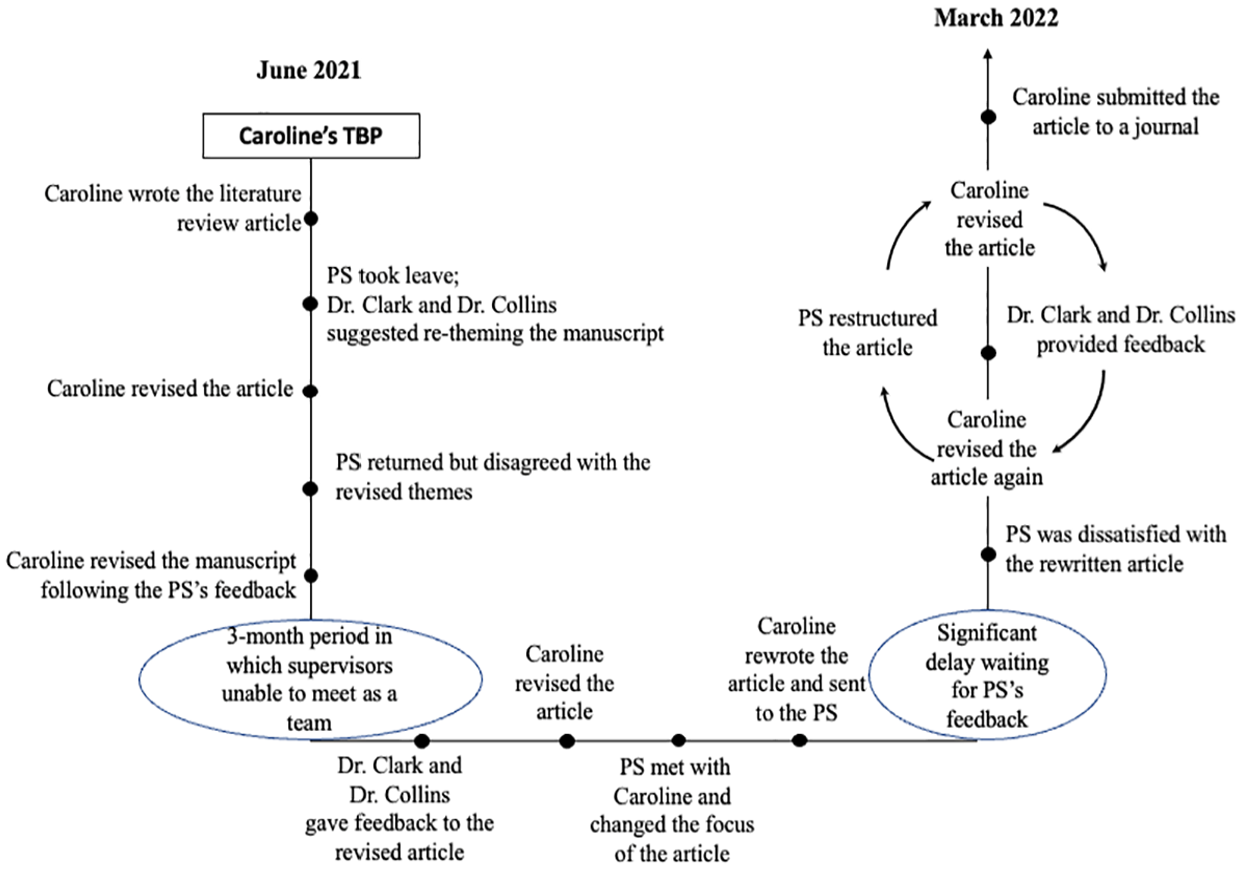
Caroline’s coauthoring timeline.
Coauthorship as a “political nightmare”
In her initial interview for this study, Caroline’s experience coauthoring her first manuscript with her supervisors was fresh on her mind. Caroline characterized that experience as a “political nightmare” and specifically lamented how difficult she found the process of allocating authorship, noting that her approach was simply to “keep them [all] happy.” Although Caroline did not disclose the details of this challenging situation, her comments largely pointed to the complicated power relations between her and her supervisors: “I have to work with them as colleagues as well as them being my supervisors, and at one point, [Dr. Collins] was [also] my manager.”
These challenging power dynamics continued throughout Caroline’s collaboration with her supervisors. Caroline attempted to integrate their divergent feedback and recounted multiple situations in which she had to manage their sometimes conflicting views, which resulted in the manuscript enduring multiple rewrites. For example, when it came time to delegate tasks, there was some controversy around the division of labor (e.g., who should be reviewing the candidate’s first draft; “[Caroline] was sort of saying, ‘Can you review this first?’ And then that was the delay at Christmas because [Dr. Clark] and [Dr. Collins] were waiting for [the PS] to review it.”) and the different coauthors’ writing styles (e.g., whether the writing conformed to academic conventions; “[The PS] was giving feedback, saying, ‘this is not academic writing,’ and [Caroline] said the reason that [she] had that sentence in there was that was a suggestion that [Dr. Clark] had put in”). At one point, a clearly exasperated Caroline commented: “It’s not just managing the supervisors; it’s almost managing their egos at the same time.” Comments such as this reveal Caroline’s evolving authorial self. While on the one hand, Caroline appeared to be at the mercy of her supervisors’ conflicting schedules and feedback delays, her efforts to manage the team and navigate their untimely feedback reveal her increasing authority as an equal coauthor.
The setbacks and challenges caused by her supervisor coauthors’ conflicting opinions triggered a range of negative emotions for Caroline. When reflecting on the whole coauthoring process, she described how “the LR changed focus so many times throughout the process of writing, which for a novice writer was surprising and frustrating.” In interviews and written reflections, she variably described herself as “confused,” and her affective experience in coauthoring with her supervisors as “annoying.” The adjective Caroline used most frequently to describe how she felt about her collaboration was “frustrated.” It took Caroline and her supervisors nine months to produce a publishable manuscript, a protracted period that Caroline found unnecessary: “If [the PS] had read the paper two or three revisions ago, I wouldn’t have wasted so much time.”
Apart from delays related to the PS’s feedback, the email communications between the other coauthors illustrate how some of the hold-ups were caused by a lack of clarity around who should provide feedback and in what sequence: I just wanted to check that [the PS] is going first? (Email from Dr. Collins) I jumped the gun because I am on holidays as of Saturday. (Email from Dr. Clark) I am happy to go first with the new one, since I didn’t comment on the last. (Email from Dr. Collins)
As a result, Caroline often found herself not only managing the research and write-up of the findings but also learning to “work out how to manage [her supervisors] better.”
Another critical factor that delayed the eventual submission of the paper was the difficulty in finding a time that every supervisor could meet and discuss the manuscript as the coauthors’ schedules frequently clashed. It was often impossible to gather all of her supervisors in a meeting, which resulted in Caroline having to manage their conflicting opinions and instructions across different points in time: My supervisors have not all been at the same meeting for a few months due to leave and other commitments, so it is difficult to get input at different times and not in the same discussion.
As a result of these scheduling conflicts, Caroline had to invest substantial time in communicating with her supervisors and ensuring that everyone was updated on the new directions and inputs that would emerge from a given meeting. By the final stage of preparing the paper, Caroline dreaded getting feedback from her supervisor-coauthors given how much extra work and rewriting the previous rounds of feedback had caused (“I was reluctant to continue with the feedback from other (associate) supervisors”). She noted how she was “at my wits’ end and felt no further on than I was six months ago.” Although Caroline’s supervisor coauthors reassured her that the twists and turns she was experiencing were a “learning process” and that the “back and forth process” was to be expected, Caroline still felt that “the length of time [to complete the manuscript] is still probably not normal.”
Throughout her interviews and reflections, Caroline attributed these delays to her supervisors’ scheduling conflicts and time limitations. However, one of her associate supervisors, Dr. Clark, had some further insights into the dynamic at play. She astutely observed how the supervisor coauthors had “different experiences as writers in different fields [with] different expertise and lenses.” Along with their varied interdisciplinary perspectives and experiences, these supervisors brought their “different expectations and knowledge of the writing processes” to the coauthoring collaboration. Dr. Clark explained: “The way something might be expressed in a journal for [this discipline] might be different from how I might express it in my field of science education.” Receiving such insightful feedback from her supervisor coauthor has the potential to develop Caroline’s identity as a perceived writer, as it enables her to better understand varying disciplinary expectations toward the writing process.
In the end, despite the meandering course her coauthored manuscript took, Caroline acknowledged that having valuable discussions with her supervisors “develop[ed] my understandings” and got her “to think about things differently from what I had been thinking about them.” Even though the article was shaped and reshaped many times, Caroline acknowledged that coauthoring with her supervisors made her more familiar with the processes of writing and publishing a journal article, contributing to her autobiographical self: Completing the paper, like myself being involved with my supervisors, it’s given me a lot more depth of understanding of the processes. . .. [In the future,] I’ll feel more confident in those steps and the processes.
Caroline’s summary
Throughout Caroline’s coauthorship experience, the primary challenge that arose was managing her team of supervisors. Facing this challenge, Caroline expressed an array of negative emotions, including frustration, confusion, and irritation. Yet through her collaboration, Caroline appeared to have gained a certain sense of legitimacy and grew in her ability to manage myriad challenges, developing her resilience as an academic writer. In her final interview, Caroline commented that although the manuscript had been submitted for review, she still did not “have confidence in being an academic writer.” Eventually, the coauthored manuscript was published, a milestone Caroline described in her final written reflection as a “great relief.” While Caroline’s reflection on her experience was largely negative, there is reason to believe that the accomplishment of publishing this manuscript contributes to Caroline’s evolving autobiographical self, especially given her motivations for pursuing the PhD in the first place: to become a “research active” lecturer.
Kate: “They See Me As More of an Active Contributor”
Background vignette
Kate is a multilingual scholar from a Southeast Asian country. Three years prior to joining the present study, she and her family moved to Australia so she could pursue her PhD. During the initial interview, Kate was asked whether she perceived herself to be an academic or scholarly writer. She was unequivocal in her response and clarified that her perception was rooted in her limited publication experience: “No, no, no, no. I only have one publication and have so many peers who have published so many.”
Kate’s PS on her PhD project was Dr. Kelly, and her associate supervisor was Dr. King. While writing her PhD thesis, Kate worked as a research assistant (RA) for one of Dr. King’s projects. Dr. Kelly also collaborated on Dr. King’s research project, and along with Kate, they had already coauthored a journal article prior to participating in the present study. In her initial interview, Dr. Kelly lauded Kate’s exceptional writing skills, citing them as a compelling reason to coauthor with her. Dr. King similarly explained his reason for deciding to coauthor with Kate: She has a background in school leadership.. . . She knew a lot of the literature and things like that.. . . We could bounce [ideas] off each other.
The article the three coauthors prepared was a systematic literature review, and Kate was asked to take the lead. This collaboration happened to occur at a time the coauthors’ city was in lockdown due to the COVID-19 pandemic. During this time, Kate had to work from home, which resulted in a challenging balance of juggling her PhD, coauthoring an article, taking care of children in lockdown, and managing her household. Kate recorded the details of these challenges in her written reflection: It is quite impossible to write for more than 2 hours each time without having to stand up and go and cook and check on the children.
Figure 3 presents the timeline of the article that Kate coauthored with her supervisors.
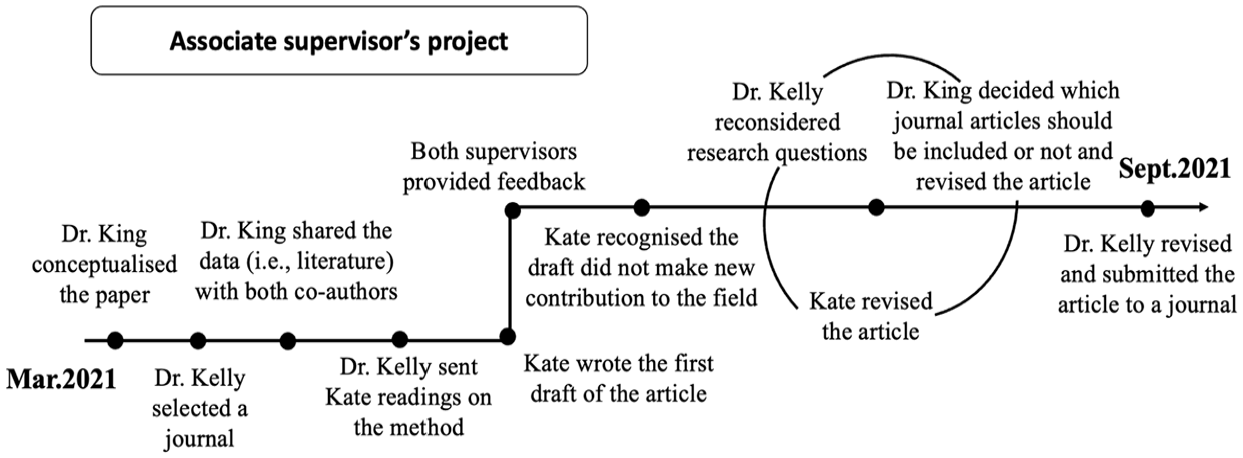
Kate’s coauthoring timeline.
Writing outside of the field: lack of voice but a learning opportunity
Although Kate was collaborating with her supervisors on this manuscript, her own research project was somewhat distinct from the respective fields of Dr. Kelly and Dr. King, and the paper they were preparing was not in her field of expertise but rather in a field that overlapped with that of her supervisors. This misalignment of expertise was a significant challenge for Kate, and despite Dr. King’s belief in her capacity, Kate still found the writing to be daunting.
At the beginning of the collaboration, Dr. King conceptualized the paper, and Dr. Kelly proposed possible target journals. When choosing the journals, Dr. Kelly reminded the team of the need to target the potential readers for the coauthored article, raising their awareness of the anticipated perceived writer: When I’m talking with [Dr. King] and [Kate], I am saying to them: “who’s the audience that we want for this paper? Is it in indigenous [studies]? Is it in government policy? Is it in a teacher professional journal?”
Once the three authors nailed down the target readers, Dr. King shared relevant literature to “bring up some names” in the related field. Although there was no evident division of labor among the coauthors, Kate, as an RA and the second author of the article, had a clear task: to write the first draft of the article. To accomplish this, Kate had to invest significant time in reading and familiarizing herself with the literature because the topic was outside her area of specialization. Another challenge Kate faced was the scope of the systematic review. Not only was Kate synthesizing research in a field outside of her own, but she was also summarizing two decades of research. Although her supervisor coauthors were not rushing her, Kate expected to be able to work faster than she did. The tension between her high expectations for herself and her lack of familiarity with the literature caused her stress: When I don’t have deep content knowledge, I need to spend a lot of time reading before I can write. So then, that process will take up a lot more time because I had to read a lot more.. . . That delays the process, so when it’s delayed, I feel stressed.
An additional challenge that Kate faced was her lack of experience and knowledge of conducting a meta-synthesis, which was the method her supervisor coauthors had chosen. Dr. Kelly recommended that Kate read relevant literature on conducting a meta-synthesis “to take a look and see whether that is applicable.” As a result, even before starting to write the first draft of the article, Kate had to spend a significant amount of time reading and learning to use this methodological approach to conduct the review, and in doing so, building her repertoire of discursive practices that she could later draw on.
After completing the first draft of the article, Kate sensed that the draft lacked novel insights into the field and recounted: “I felt I didn’t say anything important or anything much to add to what was already known.” Both supervisors agreed, and so the team of three worked closely together to reanalyze the literature. Because of Dr. King’s expertise in the field in which the coauthored paper was situated, he decided which studies were most relevant, directing Kate to “add this reference here” or pointing out when “the author’s work is not suitable to be cited in [their] paper.”
While Kate followed her supervisors’ lead, she also worked proactively to revisit the manuscript and “tried to discuss the issues from other perspectives.” After rereading the whole draft, she found that “there were some issues that were repeated across the different levels,” so rather than relying solely on the supervisors to point out the innovative ideas, Kate “decided to rewrite according to the themes” that she identified on her own, demonstrating her increasing authority and ownership of the project. Subsequently, her supervisors agreed to Kate’s themes and proceeded to “discuss the content of the paper, how to make it more comprehensive.” Despite her role as an RA and her position as second author, this process of reinterpreting themes helped Kate realize that she “want[ed] to offer new insight and a new perspective,” as she explained: When we want to publish, we want to ensure that we are writing something that is not mentioned before; something that is of value; something that is meaningful; because we are not repeating what other people have said.
Kate worked diligently on completing the manuscript. Upon observing her proactive and positive attitude toward the collaboration, her supervisor-collaborators decided to offer Kate another opportunity to coauthor an additional manuscript. Kate interpreted this invitation as an indication of her supervisors’ trust in her abilities: “they think I’m really doing good work. . . [and] see me as more of an active contributor as well in terms of the content and the ideas.” Indeed, when reflecting on the collaboration, both supervisor coauthors spoke highly of Kate. Dr. King confirmed that coauthoring with Kate was “quite straightforward and quite smooth.” Similarly, Dr. Kelly described Kate as a collaborator who is “terrific” and “easy to work with.”
When reflecting on the whole coauthorship experience with her supervisors, Kate acknowledged that “even though it’s an area I’m not familiar with, and I still have not developed a lot of passion for, it’s an area that has given me a lot of learning opportunities.” These learning opportunities bolstered Kate’s confidence not only as a collaborator with her supervisors but also as she looks toward her future career as a publishing academic: The writing of the paper, the revision, and the submission process itself helps me gain confidence in how I can go about writing my own paper and going through the whole submission process.
Kate’s summary
The uniqueness of Kate’s story is that she collaborated with her supervisors on a paper outside of her own field. This presented challenges, such as familiarizing herself with the research and a method that was new to her. However, she assumed a proactive role in tackling difficulties, exhibiting significant independence, contributing her authorial voice to the manuscript. In the end, her supervisors even offered her an opportunity to take the lead on an additional manuscript. Such an experience of coauthoring with her supervisors also inspired confidence in Kate to write and publish on her own. Notably, at the outset of this collaboration, Kate explained that her inability to identify as an academic writer was tied to her limited publication experience. By the end of this collaboration, she had gained confidence in this identity, even though she had only increased her publication track record by a single output. Rather than publishing “so many” publications, like her peers whom she compared herself to, Kate was able to grow in her identity through the collaborative coauthoring processes.
Discussion
The present study set out to investigate how doctoral students’ writer identities are influenced through the process of coauthoring research with their supervisors. To answer this research question, the discussion will explore each aspect of the three candidates’ writer identity. The three cases illuminate how supervisor-candidate coauthorship serves as an enculturating process through which candidates’ autobiographical self, discoursal self, authorial self, and perceived writer are influenced, a process through which the supervisor coauthors play a major role. Notably, the study further revealed how each candidate’s writer identity evolved across all three distinct types of collaboration, revealing that the candidate’s ownership of the project or position on the research team did not appear to be a major factor in the candidate’s writer identity formation. In other words, despite the complicated power relations within the three coauthorship teams and the central or peripheral position of the candidates within these teams, the candidates’ writer identities have all been influenced in various ways.
In terms of the autobiographical self as an academic writer, all three candidates’ writing, publishing, and other related scholarly experiences accumulated through the process of coauthoring with their supervisors. These experiences have become their “personal repertoire” of academic literacy (Ivanić, 1998, p. 328), and as Kate’s case suggests, the “discoursal history” created through the process of coauthoring with her supervisors will benefit her future publications (Ivanič, 1998, p. 24). More importantly, candidates such as Amy who write a TBM gain an opportunity to be scaffolded by their supervisors when writing a journal article. Despite the challenge of writing in a new academic genre, the coauthorship experience broadened her scholarly background (Matsuda, 2015). Notwithstanding that Caroline’s collaboration was frustrating, she similarly acknowledged how her coauthoring experiences enabled her to become familiar with the publishing process, making her a more proficient academic writer (Kamler, 2008). Finally, Caroline’s and Kate’s successful output of coauthored publications contributes to their academic profiles (Poe, 2021).
These cases also revealed how the candidates’ discoursal self was boosted through coauthoring with their supervisors. Particularly for Amy, transforming thesis chapters into journal articles refined her ability to employ both academic genres, constructing her discoursal self as an academic writer who can adapt to multiple genres. Amy acquired discoursal knowledge from her supervisors, learning to write more concisely, using multiple “semiotic resources” such as figures to condense information (Burgess, 2012, p. 226). Following the guidance of her supervisor coauthor, Amy learned to build a persuasive and assertive argument in a more scholarly way. Such a process of adapting to academic conventions grew Amy’s discoursal self as she evolved as an academic writer (Ivanič, 1998). In Kate’s case, her discoursal self was molded as she ventured into her supervisor’s field. By coauthoring with her supervisors on a research project outside her immediate area of interest, Kate was able to join the scholarly conversations of new research fields (de Magalhães et al., 2019). During this process, her supervisors guided Kate to situate their coauthored article in the field, cite the most suitable scholars, and employ the appropriate methods (Kwan, 2013). Through these activities, Kate engaged in the rhetorical conventions of this community of practice, an experience she might not otherwise have had if the opportunity to coauthor on her associate supervisor’s project had not transpired (Chaopricha, 1997).
The doctoral students’ authorial self was also influenced through these coauthoring collaborations. In Caroline’s case, the twists and turns of her coauthorship experience pushed her to cultivate her authorial voice as she learned to manage her team of coauthors and persevere to complete the coauthored manuscript despite multiple obstacles. This finding is consistent with that of Guerin et al. (2011), who observed how the management of the supervisory team can drive candidates to “assert their independence,” particularly when confronted with conflicts that originate from within the team (p. 148). Notably, while Amy’s case did not involve the same degree of disruption and delays as Caroline’s, she also grew in her authority as an academic writer as she developed the confidence to reject some of her supervisors’ feedback. Amy’s case also reveals how supervisors can proactively contribute to the formation of the candidate’s authorial self. For example, Dr. Austen ensured that Amy took the lead and made critical and independent decisions regarding the coauthored article. This finding expands Morton and Storch’s (2021) recommendation that supervisors assume the “best position” to cultivate their candidate’s distinctive voice; specifically, the supervisor asserts their supervisory power to bolster the candidate’s authorial self. This was certainly true of Kate’s case as well. Kate proactively took the lead in finding a new lens to interpret research findings, which indicates Kate’s role as an “active agent” who is able to make independent decisions herself (Tusting, 2015, p. 246). Her initiative-taking effort highlights how candidates’ authority and independence as academic writers can be enhanced regardless of the power asymmetry between coauthors or the candidate’s peripheral position within a coauthoring team (Lokhtina et al., 2022).
While the data revealed how these candidates cultivated their autobiographical, discoursal, and authorial selves through these coauthoring experiences, it most strongly revealed how the candidates were influenced as perceived writers. This is unsurprising given the collaborative nature of coauthorship. Aligning with Burgess and Ivanič’s (2010) conceptual idea of the perceived writer, the supervisor coauthors in all three cases assumed the role of the actual readers to contribute to their candidates’ writer identity. In Caroline’s case, her three supervisors functioned as three readers, bringing their varied interdisciplinary perspectives and experiences to the feedback they provided. Caroline then had to negotiate her supervisor readers’ voices, rewriting, reintegrating, and restructuring the manuscript while managing their often disparate views, reinforcing Hyland and Jiang’s (2016) supposition that authorial voice is often co-constructed between writers and readers. The supervisor coauthors in this investigation further raised their candidate coauthors’ reader awareness by highlighting the importance of writing for their target audiences, particularly the specific audience of the target journal, editors, reviewers, and relevant scholars (Tardy & Matsuda, 2009). This was especially evident in Kate’s case, as Dr. Kelly identified the target journal and audience at the outset of the collaboration to guide the focus of the systematic review. Similarly, Dr. Austen reinforced the need for Amy to write in a clear and concise way to attract readers, frequently reminding her to keep in mind journal gatekeepers such as editors and reviewers. Such guidance is particularly useful for novice scholars as they may need to draw on their supervisor coauthors to rhetorically or textually construct the target readers (Hyland, 2002).
While the benefits and contributions of collaborating with supervisors were plentiful, the multiple-case study also revealed how supervisor-candidate coauthorship could bring about challenges and risks to the candidate’s writer identity formation. For example, in Caroline’s case, her fragmented coauthor team and delays in coauthors’ feedback caused her to invest considerable time into rewrites, marring much of her coauthoring experience with confusion, frustration, and even annoyance. Such a drawn-out experience can be particularly “frustrating and wearing” for novice scholars (Robins & Kanowski, 2008, p. 14). Further exacerbating Caroline’s experience were the disparate views and “predictions as to what the reader will value” that the different members of her coauthoring team brought to the collaboration (Burgess & Ivanič, 2010, p. 248). Because the images of perceived writer are distinct, supervisor coauthors may provide divergent guidance or comments to the candidate writer, based on their distinct expertise. When the coauthors represent different disciplines, this dynamic may be even more salient.
Conclusion
The escalating demand for doctoral publishing in higher education introduces mounting challenges for doctoral students, particularly in establishing their identity as academic writers. To tackle these challenges, doctoral students need more accessible guidance and just-in-time scaffolding than ever. This study demonstrates that engagement in supervisor-candidate coauthorship raises the candidate’s confidence, independence, and authority as an academic writer, facilitating multiple dimensions of their writer identity. Importantly, identity construction is an ongoing process, and the present study has examined just one aspect or component of that process. However, the findings present a compelling case for supporting doctoral candidates’ emerging writer identity through such collaborations. First of all, the coauthoring process with a supervisor can strengthen the autobiographical self of doctoral writers, allowing them to accumulate scholarly experiences (i.e., the experiences of academic writing, publishing, and collaboration). Further, unlike the secondary or subordinate position that the candidate usually occupies in doctoral supervision (Xu & Grant, 2020), the candidate’s authorial self is amplified when managing and coordinating a coauthoring team.
The candidate’s increasing awareness of both the anticipated reader and their role as a perceived writer suggests that they are socialized into the academic community when coauthoring with their supervisors. During such a process of socialization, the candidate adapts their writing to the genre expectations of the journal article, which contributes to the growth of their discoursal self. Importantly, the use of Burgess and Ivanič’s (2010) framework enabled this study to uncover the occluded space of writer identity formation in supervisor-candidate coauthorship. Yet the theory is not without its limitations. For example, although Caroline’s authorial self has been strengthened owing to the various challenges she faced while coauthoring, the leading voice of the coauthoring team was still her principal supervisor. Such a case reveals that one aspect of the authorial self could be further refined into the managerial self that Caroline mainly assumed.
Some caveats of engaging in supervisor-candidate coauthorship should be acknowledged. For example, divergent feedback, delays in the rotation of revising manuscripts, and varied expectations toward the manuscripts may arise in the collaboration. As our multiple-case study indicates, coauthors’ collaborative and proactive initiatives help to address these problems. Our case study also indicates that though such problems negatively impact the candidate, the experience of dealing with the problems can also become a valuable scholarly experience that further enhances the candidate’s formation of their independent writer identity. It is our hope that such an investigation generates fresh insights into the process of facilitating doctoral students’ writer identity formation, specifically emphasizing the benefits of engaging in the supervisor-candidate coauthorship.
Footnotes
Declaration of Conflicting Interests
The authors declared no potential conflicts of interest with respect to the research, authorship, and/or publication of this article.
Funding
The authors disclosed receipt of the following financial support for the research, authorship, and/or publication of this article: This work was supported by the China Scholarship Council: [Grant Number 201906290017].
