



Abstract
Article publication as a requirement for graduation appears to be the most compelling challenge for doctoral candidates, especially for the non-English speaking ones. In order to contribute to this topic of growing interest, we aimed to investigate the key challenges to doctoral student research publication and develop an understanding of support they needed to ease the publication process. To this end, we conducted semi-structured interviews with 19 non-English speaking doctoral students in varied science and social science programs at an international university in north Cyprus. The findings revealed that the participants supported the “publish or no degree” policy as a condition for their graduation despite several challenges it created for them, such as lack of publication experience, weaknesses in the article composition, tough criteria of journals, and inadequate support from the instructors at the course phase. Peer-support community among the doctoral students lacked in the examined context and promoting it might yield positive results.
Introduction
Over the last few decades, under the influence of neo-liberal policies of performativity (Lei, 2021; Pusser & Marginson, 2013) and “hyper-performativity” (Macfarlane, 2021, p. 459), the world has witnessed more aggressive shifts in the assumptions and norms and new orientations toward higher education. The traditional predominant role of many universities has shifted from equipping the learners with knowledge (i.e., “teaching”) to commodification of knowledge (Schmeichel et al., 2017) as research outputs. In order to survive in a highly competitive international arena and be a world-class university (Deem et al., 2008), many universities which offer PhD programs worldwide have started seeking acceptance in an English-only research world (Belcher, 2007). The “marketization of higher education” (Lei, 2021, p. 68) as result of neo-liberal policies connected with ever increasing globalization and mobility appears to have compelled universities to review and change their research assessment regimes (Lynch, 2015). To increase their research visibility and thus their position in the university rankings, universities pressurized and evaluated their academic staff according to their publication performance for job employment, promotion, and funding grants (Englander & Uzuner-Smith, 2013). To this end, PhD programs have become popular as they are the milestones on the publication route. Postgraduate students have become the promising hope for institutions for developing scientific and technical innovations (Nerad, 2010) (and thus attracting investments and funding grants for the university’s budget), and their research outputs as publications would contribute to the institutions’ research performance.
The increase in the number of students graduating from doctoral programs worldwide (as reported in OECD, 2019), however, has consequently led to an uplift in the supply and decrease in demand. This has made the universities increase their graduation criteria by adding more requirements to graduation in order to nominate the elite and graduate them. Among these requirements are preparing distinctive dissertations, mastering English as it is the main research language, and publishing articles in high quality scholarly journals which are included in leading indexes.
The trend for the non-Anglophone researchers (including the doctoral students) to decide to publish their findings in English rather than in their own language can be explained by the increased use of English as a lingua franca in international scientific communication (European Commission, 2003) and, as a result, the researchers’ “desire for their research to be recognized and rewarded” (López-Navarro et al., 2015, p. 939). Nevertheless, the discussion on how privileging of publications in international English-medium journals (H. Lee & Lee, 2013) may affect the local scholarship and research cultures negatively in terms of immediate use value (Lillis, 2012) and researchers’ autonomy (Curry & Lillis, 2017) is beyond the scope of this paper and is not being questioned.
The number of publications as research outputs has ever since become a critical factor in individuals’ and institutions’ performance measures (Guerin, 2016) as well as ranking the universities, leading to the flourish of an extensive number of journals publishing several issues annually. The blooming of publication has made many universities worldwide adopt the “publish or no degree” policy in their doctoral programs, in which the PhD students are demanded to publish one article or more as a requirement for graduation, which, on the one hand, helps the universities in increasing their ranking (Kamler, 2008). On the other hand, it assists in preparing the doctoral students for the research community, which has become an essential aspect of the economic cycle (Powell, 2004).
In spite of its importance in preparing doctoral students as researchers, the “publish or no degree” policy has been reported in several studies as an additional source of “pains” for the doctoral students (e.g., Lei, 2021; Li, 2016; Robins & Kanowski, 2008) who already face multiple challenges (Schmidt & Hansson, 2018) in their highly challenging endeavor. A study conducted by Green et al. (1992) in relation to the productivity of doctoral students highlighted that students tend to have poor output in scholarly publication, such as articles, conferences, and book chapters. This challenge in getting published seems to remain since then as reported in many other studies in the related literature (e.g., Aitchison et al., 2010; Bailey, 2017; Habibie & Hyland, 2019; Maher et al., 2014; Murray & Metheny, 2002), which all emphasize that doctoral students find themselves under the pressure of revising their dissertation (with totally different characteristics from those of an article with respect to length, target audience, intensity, etc.) into a publishable article. Their lack of prior experience in publication, even in local journals, makes article publication a substantial obstacle.
Other factors that add up to the toughness of article publication are reported in related studies as linguistic challenges (mainly for non-English speaking authors), insufficient feedback from supervisors, and deficiencies in self-organization, involving their resilience, motivation, and time management skills (e.g., Odena & Burgess, 2017; Paltridge & Woodrow, 2012), all of which contribute to a decrease in publication output at the doctoral level (Kamler, 2008) and students’ burnout, which may eventuate in dropping the doctoral study (Kehm, 2004; Li, 2016). Within the Writing for Publication (WFP) literature, linguistic challenges were perhaps the most studied issue (Duszak & Lewkowicz, 2008; Hanauer & Englander, 2011; Perez-Llantada, 2014), especially from the perspective of native versus non-native speakers. Obviously, writing in a language (in English) other than their own adds extra challenges to the novice authors (i.e., doctoral students) in terms of use and misuse of English, such as grammatical problems and misuse of words.
In Kim and Karau (2009), the lack of faculty support was reported as a significant environmental predictor of poor research productivity. In the same vein, the role of feedback from different sources (supervisors, peers, institution, etc.) is highlighted in improving doctoral students’ pedagogical and strategic skills (A. Lee & Boud, 2003; Page-Adams et al., 1995). In the latter study, (Page-Adams et al., 1995), it was reported that the conversations, suggestions, and collaboration led to a noticeable improvement in the publication output of the doctoral students who were involved in a peer-feedback research group, compared to that of other doctoral students who did not participate in it. The enrolled students could publish an average of 3.8 articles per year while the average was 0.29 for the latter other group (p. 406).
Overall, the referred studies conclude that article publication flourishes via the receipt of supervisory, institutional, and research societal support, as opposed to a doctoral student’s individual effort to develop publication skills. In other words, collaboration predominantly from the supervisors, peer colleagues, and the university as the institution seems to be essential in order to decrease the challenges encountered by doctoral students. The nature, level, and medium of such collaborations, however, are context-specific, involving social and cultural variations. Thus, studies conducted in different research contexts may reveal interesting nuances. Therefore, there is a need for further studies to be conducted in different research contexts to look into the challenges of non-native doctoral students’ publication process.
To this end, this study aims to investigate the perceptions of the doctoral students about the article publication requirement as a condition for their graduation. It also views the challenges they encounter, and the support they receive. It is guided by the following research questions:
(1) What are the perceptions of the doctoral students about the article publication requirement?
(2) What challenges do the doctoral students encounter in their publication journey?
(3) What kind of support do they need to accomplish their publication requirement for graduation?
The study reviews the opinions of students in all the faculties offering doctoral programs in English (Art and Science, Business Administration, Communication and Media Studies, Education, Engineering, and Tourism).
Statement of the Problem
While applying for a PhD program, I (the first author) opted for a highly ranked university that can rehabilitate my knowledge and sharpen my research skills to fit the growing needs of education. I, therefore, chose the context of the study as my target university since it has a high rank, being the first in North Cyprus, the second in Turkey, among the 251 to 300 best young universities in the world, and among the 501 to 600 best universities in the world. These rankings prove the important position of the university nationally, regionally, and internationally.
Joining the PhD program at such a prestigious university in 2017, I have noticed that the main concern for many of the students is the article publication as a requirement for graduation. The publication must be in a journal indexed in an SCI, SCI Expanded, SSCI, or AHCI. The essence of the challenge sources from the fact that the doctoral students are novice authors with no previous experience in publication, and the requirement forces them to rocket from their no experience to reach the expertise throughout their years of study. In fact, this requires extensive support along with the extra efforts paid by the students.
Realizing this challenge has evoked my interest in getting deeper and knowing more about what is waiting for me in the future. After viewing the statistics from the Institute of Graduate Studies and Research (IGSR), I found that out of the 441 doctoral students who finished their course phase and started with their dissertations and articles, 60 doctoral students were classified under the “waiting for publication” (WFP) status, which represented around 15% of the total number of the students. Being in WPF status meant that the candidates had been doctoral students for more than 6 years. It also indicated that they finished their dissertation research and submitted it to IGSR and were waiting for the publication of their article to graduate. Being an English language teaching PhD candidate, I was more concerned about this issue especially when finding some of my senior colleagues who were in the program for around 10 years without graduating.
Furthermore, the “waiting for publication” status varied from one program to another. The results show that there is a significant difference in the percentage of “waiting for publication” among the departments (Table 1). While there are programs that have no “waiting for publication” students (applied mathematics and computer sciences, business administration, chemistry, mathematics, and physics) and other programs with a very low percentage of waiting for publication (tourism management and computer engineering), certain programs (educational sciences, English language teaching, architecture, industrial engineering, civil engineering, and economics) have a high percentage of students falling in this status. Furthermore, there are programs (communication and media studies, international relations, finance, and mechanical engineering) that have a percentage less than the general average (15%).
Doctoral Students’ Waiting for Publication Status Per Department.
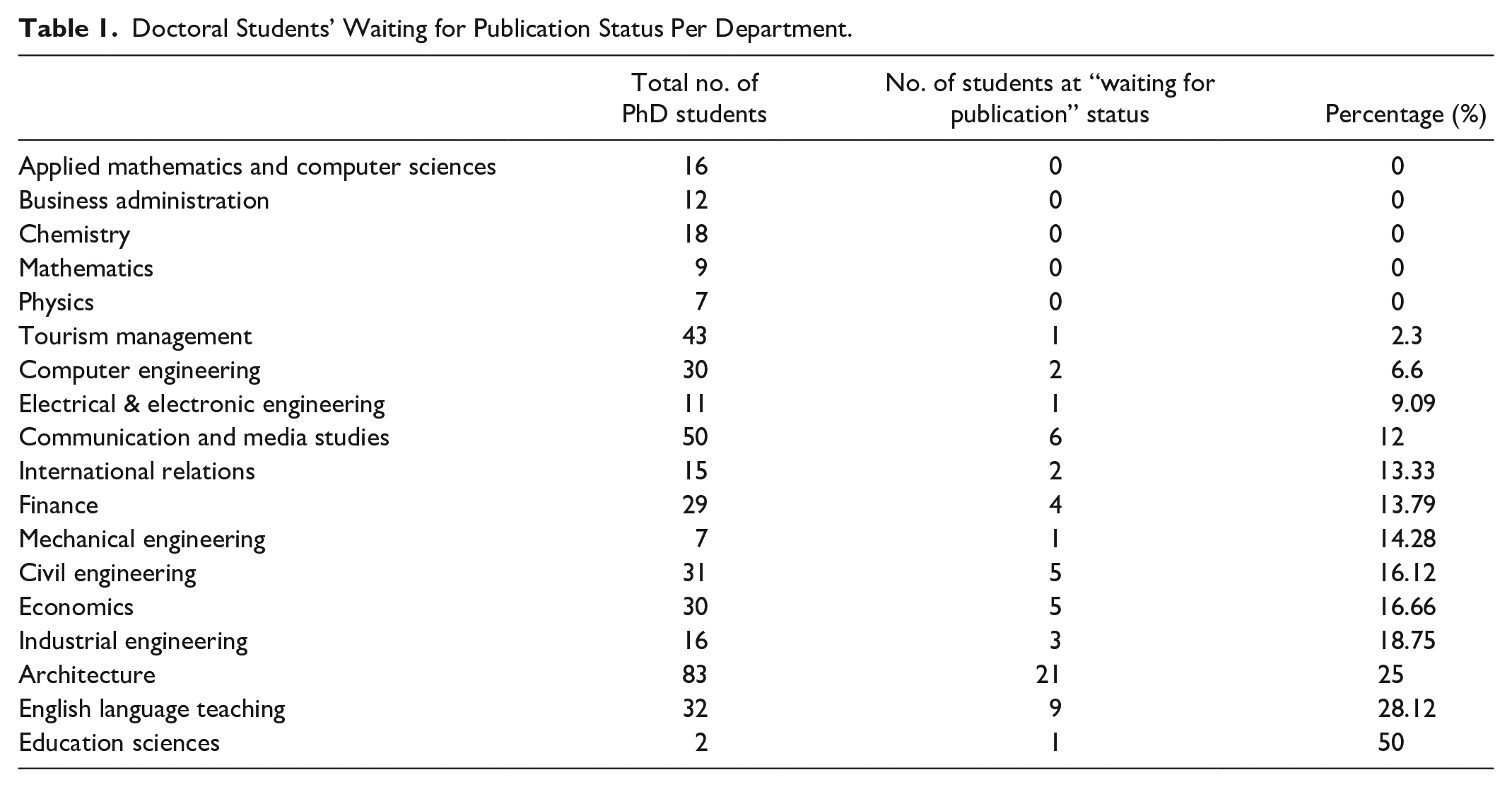
Table 1 reveals that the social science programs have more “waiting for publication” students compared to the hard sciences. Hence, the “publish or no degree” policy seems to be severer with some programs than others, which indicates that the article publication condition policy with the indexing required by the university may not fit all students. For instance, a PhD student at the English Language Teaching program has a possibility of around 28.12% to spend more time in the study due to the publication requirement compared to 0% for a doctoral student at physics or chemistry programs.
A review of recent studies about research in the Middle East, Asia, and Africa (the regions from which the majority of the university’s students come) shows that the research in these regions is far behind that of the western world (Ahmed, 2020; Lages et al., 2015). This, in turn, has a negative effect on the economic cycle of those regions. The university where the present study was conducted is a major source of doctoral graduates (from Turkey, Iran, Arab World, and Africa) for the Middle East due to its high ranking. Having a high percentage of “waiting for publication” in some programs, which may even lead to dismissing students, represents an obstacle that may affect the regional economy (Pedersen, 2014). Doctoral graduates are needed to conduct professional studies and equip the market with the latest researches to make the economy cope with the international developments. With a shortage in filling this gap, the regional market may not be up-to-date with the latest developments in the other parts of the world, which in turn puts sticks in the regional economy cycle. Although there are a handful studies that dealt with the research challenges in the Middle East (Ahmed, 2020; Amour, 2012; Lages et al., 2015), these remain general ones since they do not tackle it from the doctoral programs’ point of view. Also, they only examine the Middle Eastern international students in western universities rather than in a Middle Eastern one. To the best of our knowledge, there are no studies that investigate the publication challenges for the Middle Eastern and African doctoral students in a Middle Eastern context. From this perspective, this study aims to fill this gap by investigating the perceptions, challenges, and needed support in getting published as a graduation requirement from the doctoral students’ point of view.
Method
This study was a part of a larger study conducted as a multiple-case study at an international university in north Cyprus to examine the “publish or no graduation policy” from the perspectives of doctoral students, supervisors, and policy makers (i.e., university’s top administration). The present study, however, focused specifically on the doctoral students’ perspective, regarding how they perceived the article publication requirement as a condition for their graduation, and how they described their challenges they encountered and the support they received. The aim of this article is to elaborate on the doctoral students’ perspective thoroughly while the data from the supervisors’ and policymakers’ perspective were still being analyzed at the time of writing this study. The study adopted a qualitative inquiry method, as it would enable the authors to “build a complex, holistic picture, analyze words, report detailed views of informants, and conduct the study in a natural setting” (Creswell, 1998, p. 15), to reach a contextualized rather than generalizable understanding of doctoral students’ perspective in meeting institutional publication requirement, hoping that the findings would contribute to the larger data in the related literature.
Research Site
This study was conducted at an international English Medium of Instruction (EMI) university in northern Cyprus. With an over 40-year history and 17,500 students from 110 countries and 1,100 academics from 35 countries, it has aspired to be the top university in northern Cyprus, the second in Turkey, among the 251 to 300 best young universities in the world, and among the 501 to 600 best universities in the world.
In addition to 108 undergraduate and school programs, the university offers 96 post-graduate programs (18 of them being doctoral programs), all in the English language, in various fields including engineering, media and communications, English language teaching, architecture, business and economy, tourism, computing and technology, and sciences. The candidates applying to these programs are required to submit an international English exam result, such as IELTS (minimum 6.5) or TOEFL (minimum 79) for their admission into the programs. Those who do not have such documents are given an English proficiency examination at the university. Should they succeed, they can begin the program; should they fail, they are required to take English courses based on the results of the English examination they participated in. These requirements aim to guarantee the linguistic ability of the students in the course, thesis, and article stages of their program.
The duration of the PhD program tends to be between 3 and 5 years. The courses stage includes seven to eight courses, followed by a qualifying exam. During the research stage of their studies, at the end of each semester doctoral students are obligated to present their progress in front of a “Thesis Monitor Committee” (TMC), comprised of the supervisor and two other professors specialized in the field of the student’s study. The TMC members guide the doctoral students at every phase of the research, suggesting amendments to keep the student on the correct research track. As a condition requirement of for their graduation, the candidates are required to publish at least one article on their PhD research topic in a journal indexed in one of the followings: Science Citation Indexing (SCI), Science Citation Indexing Expanded (SCI Expanded), Social Science Citation Indexing (SSCI), or Arts & Humanities Citation Indexing (AHCI).
Participants’ Profile
In order to capture the diversity and commonality in doctoral students’ perspectives on the challenges they face and the support they need, we adopted a non-probabilistic, convenience strategy based on the willingness of for participation (Creswell & Poth, 2016; Hejase & Hejase, 2013). The reason behind adopting this strategy was due to the context of the study. After the qualifying exam, the majority of the doctoral students get back to their homelands and conduct their research there. Hence, applying a non-random research strategy enabled the researchers to find more participants from those who were still present at university. For this purpose, after obtaining the approval of the university’s Ethics Committee, several doctoral students in all programs were contacted in person and invited to participate in the study. About 19 students (13 males and 6 females) agreed to take part. They had all completed their course loads, passed the qualifying exam and were either at the final stage of writing their dissertation or completed it and working hard to publish an article.
The participants (all names in this study are pseudonyms) varied in their gender, nationality, program they were in and their previous publication history. Table 2 presents background information about them.
Background Information on the Student Participants.

Examining the perceptions of the participants about the article publication requirement necessitated asking them about any previous publications they may have had in their academic career. Table 2 shows that 16 participants had no experience in publication activities, prior to their current efforts upon their articles, which makes their experience a theoretical one. The remaining participants reported having previous experience in publication. In detail, three participants published one article: Maher in a local journal and Suzan in an SCI indexed journal. Anne was the only exception, who had more experience than the others with two articles published in local journals and one chapter in a book, which was also published locally. These results show that the participants were still novice authors with no solid experience in publishing articles in journals indexed in SCI, SCI Expanded, SSCI, or AHCI. In fact, the lack of experience in article publication for the participants makes the publication condition a challenging one since they have to learn the techniques needed for composing not only a reader-friendly article but also a unique one to get the admission from a journal.
Data Collection and Analysis
The primary source of data for the present study included semi-structured interviews with 19 doctoral students, guided by a phenomenological interviewing approach (Seidman, 2006) in which the participant “reconstructs his or her experience with the topic under study” (p. 15). interview schedules, and conducted in English. The first author conducted all the interviews with individual participants in three rounds (in June, July, and August 2019, respectively), each round focusing on one of the research questions addressed in the study.
At the beginning of the interviews, the interviewer reminded the interviewees the bylaw of the university in relation to article publication as a requirement for graduation, which reads as follows: (Article 26/2), For the thesis jury to be appointed, the candidate should fulfil scientific activities and meet special conditions (at least one publication related to the thesis topic has to be published or be accepted for publication in SCI, SCI-expanded, SSCI, and AHCI indexed journals) specified in the Academic Evaluation Criteria. Then, in the first round, the doctoral students were encouraged to talk about how they view the university’s article publication requirement for graduation. In the second round, they were asked to describe their challenges in fulfilling the publication requirement, and finally in the third round, they talked about the support they needed and the support they were provided by their peers, instructors, supervisors and the university administration. Data from each round were analyzed immediately so that the themes emerged from the participants’ responses led the interviewer to ask the most appropriate questions in the next round to go into deeper of the matter and thus elicit richer data.
All the interviews were recorded, with the consent of the participants, using Otter Application, which both records and transcribes. To make sure that the auto-transcription is adequate, we checked the scripts several times. After that, we analyzed the interviews using the “thematic content analysis” (Braun & Clarke, 2006), in which we read each interview in depth to highlight the major themes. We adopted this analysis type because of its flexibility in providing a range of analytic options that may match with other similar findings in the related literature. In doing so, first we got familiar with the data by reading the transcripts closely and repeatedly. Then, we coded them line by line, highlighting the key words which would be significant in answering the research questions. To exemplify, we noted down positive and negative views about article publication requirement (time, stress, and money), lack of experience, need for more courses, workshops, training about article publication, lack of support, supervisors’ role, and no collaboration among peers as some of the major points highlighted by most of the interviews. Then, we sought ways to organize the derived codes into themes and we finally identified the themes as perceptions, challenges, and support. To guarantee the trustworthiness of the emerging themes, they were given to two research experts, who are PhD faculty members and have good research experience, for evaluation. The last stage of the data analysis process involved producing interpretations and conclusions to identify and clarify the problem based on the themes analyzed and supported by excerpts from the interviews.
Findings
The analysis of the interview data reveals three major concerns for the doctoral students in their struggle for publication. The first concern is how they perceive the institution’s policy for publication in doctoral education, the second one is related to the challenges that they encounter in meeting the publication requirement, and the third one is the type of support they need in fulfilling the publication requirement. The findings about each of these concerns are given below.
(1) Perceptions of the Doctoral Students About the Article Publication Requirement
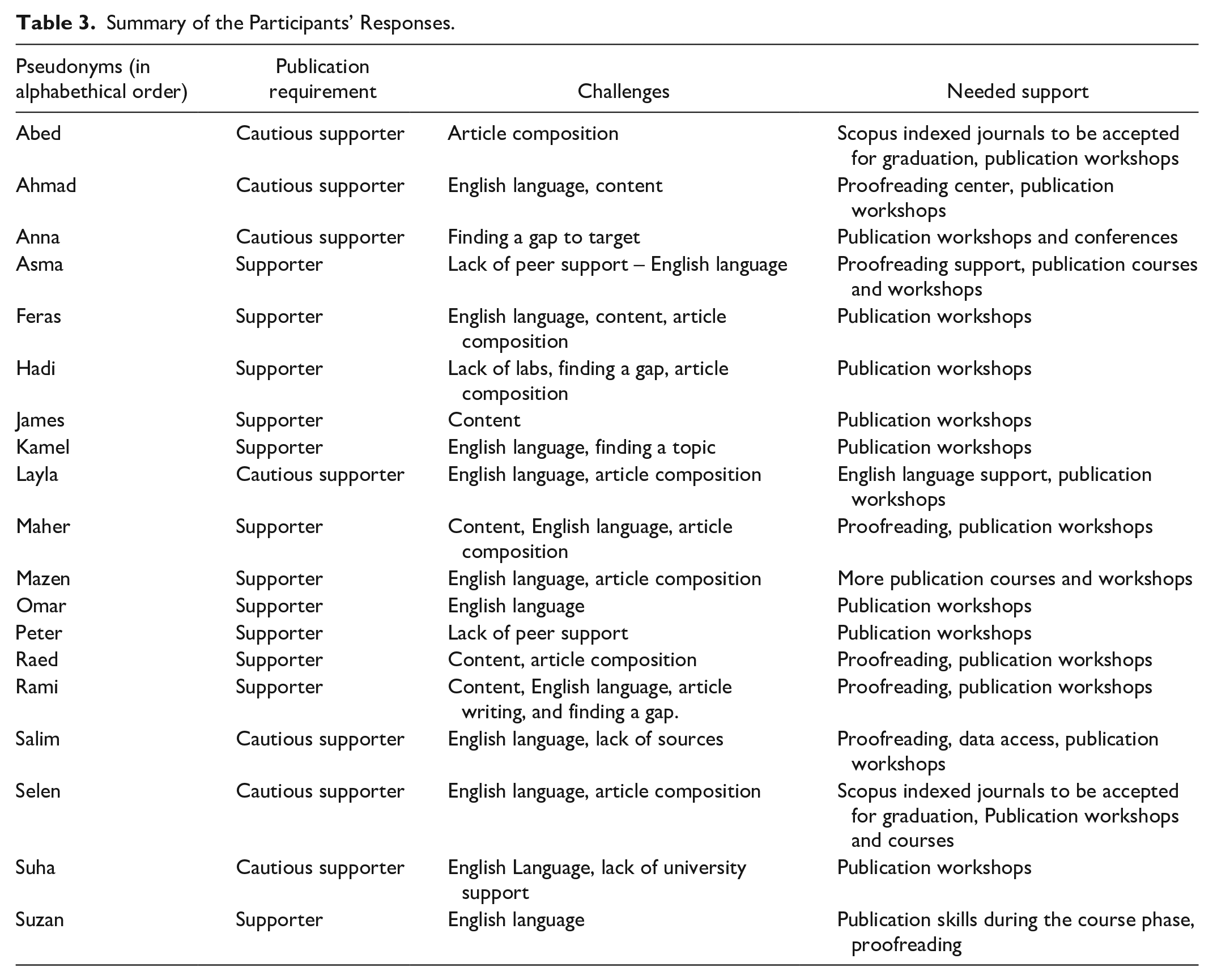
As mentioned before, the interviewees were first reminded of the bylaw of the university in relation to article publication as a requirement for graduation and invited to talk about this prerequisite. They responded to the first research question about their perceptions of the article publication requirement as a condition for graduation. The responses are divided into two groups, Group A which absolutely support the university’s publication policy and Group B which are mildly negative about it due to a number of reasons. The responses of each participant are summarized in Table 3.
Summary of the Participants’ Responses.
Group A: Supporters
The first group consider that although publication is a challenge in their graduation path, they believe it constitutes a vital cornerstone of their future career. Publishing articles in highly prestigious journals is a credit for finding a good job vacancy and immersing in the research community after graduation. Raed, for example, believes that “a PhD program is not for everybody. It is a program that is designed to train students and be through the scientific community. . . for me, the requirement is correct”. With this account, Raed admits the difficulty of the doctoral program in terms of article publication; however, he believes it is the nature of the program to be difficult; thus, the hardship of this program is the very mark of its uniqueness and quality, which enables only those who are able to stand its challenges to enroll in it and receive its credits upon graduation. Publication, Raed claims, is important as it sharpens their skills and trains them to publish more articles in the future. It is apparent that Raed considers his future career and does not merely view graduation as the ultimate goal. He evaluates himself as a future researcher or supervisor. Therefore, to him, difficulties encountered are typical, and they polish his experience in publication as a necessary academic performance all through his future academic life.
Among the doctoral students who wholeheartedly endorsed the university’s stated rationality for its publication requirements, there was one, Suzan, who even demanded an increase in the number of articles required for publication. Suzan believes that it is a good chance to gain experience in publication during the doctoral study since learning the publication methods and techniques in a research community can help her in improving her future chances as a researcher. In fact, this is apparent since she has already published one SCI article and she is still working on her dissertation, meaning that fulfilling the requirement of publication grants the PhD students a relief, and makes them think of improving their publication skills to be ready for their future as PhD holders.
Group B: Cautious supporters
The participants in this group expressed that they were not totally against the requirement itself, but the limited number of journals publishing in their fields frustrates them as it causes delays in their graduation as well as in commencing their future career. This group includes Abed, Ahmad, Anna, Layla, Salim, Selen, and Suha. For them, awaiting the decision of journals is viewed by those students as a waste of time and source of depression. They believe that the university should revise their decision and expand the limited list of journal indexes by adding some other decent indexing with a wider variety of journals and more flexible requirements for publication. As Selen pointed out in the following excerpt,
. . .so these regulations should change honestly. . .because now do you [does the university] think of Plan B? I mean, like not cancelling your [the university’s] obligation requirements. It might be . . .not only one SSCI but maybe two Scopus indexed publications.
Selen’s comment provides a clear illustration of the tension between the doctoral students’ plea for expanding the options of journal types that they can publish in and the university’s requirement of publishing in explicitly listed journal types. Studying in a social science department (English Language Teaching), Selen states that there are only a few SSCI or AHCI journals that publish articles in her research area, which has been restricting her graduation. At the time of the interview, she had spent around 8 years in the doctoral program, with 4 years awaiting publication. As she suggests, having alternative options for publication will assist in increasing the variety of journals she may publish in, such as Scopus index as an option to SSCI or AHCI. She adds that Scopus index is a viable one, providing numerous journals that publish articles in her research area. Her further consideration is to increase the number of articles in Scopus to two, as fair proof that it is not an option for avoiding the difficulty of the publication requirement. Instead, her aspiration is for numerous options of publication, to accelerate her graduation. At this point, Selen agrees with Suzan about the importance of publishing more articles during the doctoral level when suggesting having two articles indexed in Scopus instead of one SSCI or AHCI.
Related to the difficulty encountered in publishing an article in the given indexing, the editorial process takes too long, as added by Selen. Having only a few journals indexed in SSCI or AHCI that publish articles in the scope of her area of study, Selen reported that the earliest response she received from a journal was 9 months. Hence, the long time needed for publication represents a nightmare for her and her colleagues since publication is not easy in their field. Suha, like Selen, highlights this challenge, noting that
. . . [The journal says] we are not going to publish anything related to [the] Middle East. The answer comes after 15 months, after 7 months, after 11 months. This is not their [journal’s] time, it has been my life.
At the time of the interview, Suha, who spent 10 years in the PhD program, had just been granted the decision for publication by a journal, after a lengthy 6-year waiting for publication journey, which she states the wait has made her lose her life. In one case, she mentioned waiting for a journal response for an entire year, before receiving a rejection stating that her article was “out of the scope of the journal.” A decision that could have been made in a day, made her lose an entire year of her life.
It appears that some doctoral students may spend up to 1 year waiting for a single journal to make a decision on their article. If rejected, it is only then they can apply to a different journal. This, at times, means some students may wait for many years before their article is published. Essentially, due to the publication requirement for graduation, the students may spend years moving from one journal to another, until their article is published. To avoid this waste of time, students look for easier methods of publication, such as open access journals. The authors, in this case, pay publication fees, and the article is then publicly published online. In return, the journal provides faster revision services and may even overlook some errors located in the article. This often comes with a high price tag, with the publication fees often unaffordable for many students. As Rami pointed out,
Most of them (the journals) are going to be. . . like . . . open access journals with money, trying to reject us so we will try to push in their open access.
According to Rami, some journals (which offer both services, closed access and open access) reject articles in an effort to encourage application to the open access mode. In his opinion, this turns into a business for some journals. While some students prefer to take the shortcut and publish in an open access journal to save time, others believe it is their right to receive fair evaluation for their articles, without delay, no matter the mode of publication they choose.
The aforementioned discussions clearly reveal the endorsement of the doctoral students, both “optimists” and “pessimists,” of the importance of publication as a requirement since it sharpens their research skills, which have become a critical aspect of the work market. Nevertheless, the time factor and limited index types accepted by the university represent a nightmare for some students.
(2) Encountered Challenges in Constructing the Article for Publication From the Dissertation
Since all the participants are novice authors, with no or almost no experience in publication, we decided to investigate the challenges that face them in constructing an article that meets the requirements of the indexes required by the university. Content analysis of the interview data revealed a number of factors as weaknesses in article publication such as finding a research focus, deciding on the content of the article, composing the article cohesively, and using the English language appropriately, which were re-grouped under two main categories: challenges related to genre knowledge and challenges related to the English language.
A. Genre knowledge challenges
The main challenges for doctoral students are the skills and techniques required for publication. As novice authors, their challenges are greater. The skills the doctoral students acquire during their studies may assist them in publishing articles among local journals; however, the graduation requirement is a bite more than they can chew. The major source of challenge is sharpening their skills to meet the requirements of the international journal. To meet the criteria’s set, the students must master the publication techniques, while enhancing their knowledge in the article publication genre. The interviews produced three genre aspects that the students encounter: defining the focus, constructing the content, and cohesion.
Defining the focus
Deciphering a gap within the related literature to target with research represents a challenge for doctoral students even before they start their research. Many doctoral students in the current study reported feeling helpless in locating an entry point to research at the very beginning of their dissertation writing process, that is “a trending topic” which will have a chance to get published in the targeted journals. At this stage, they say they suffer from uncertainty with relation to workable topics, as they must simultaneously produce a plan that aligns with the research interests of the supervisor, while producing promising content suitable for publication.
Mazen, for example, said
“It’s hard to find the gap. . . In the finance field, if you want to find the gap, you have to know where development really is. So, that is a bit of a constraint for us”.
Although they had read many academic articles during their MA and PhD studies, Mazen added, they still require a critical eye to detect a unique gap in the literature to help them choose their dissertation topic which will later –when sent to a journal as an article—be attracting the attention of the editors and has a higher chance to get published. The difficulty of this challenge, however, showed variances based on the fields. Anna, who studies communication and media studies, for example, finds it “difficult to find the starting point at all” whereas Mazen finds it “a bit of constraint” in his field of finance. This finding supports the viewpoint that the quality of dissertation is a very significant factor in increasing the chance of getting published; to put it differently, the right quality dissertations will probably evolve into a ranked journal article (Thomas & Skinner, 2012).
Constructing the content
Constructing the content of the article is noted by the participants as another genre-related challenge, which demands profound knowledge in the related area. Several participants (N = 7) in the study admitted that they have a weakness in doing this, and this indicates the commonality of the content hardship among the doctoral students. To exemplify, Hadi (doctoral student in the Electrical & Electronic Engineering program) said,
“In our field, you have to find a problem, and when you find the problem, you have to solve it on the computer . . . So, the biggest part of the problem is getting your results accepted. If your research is acceptable, scientifically, I think all other things [of article writing] are easy”
This highlights the significance of scientific knowledge as the main challenge within his department. To him, processing the data requires adequate knowledge and technical skills in the content of his field to enable him to elicit the appropriate results. The use of software programs on computers to find adequate solutions, or being apt to use the discipline-related statistical analysis procedures, for example, would be closely related to (i) the issue under investigation, (ii) its related literature background, (iii) selection and application of research methods appropriate to methodology, (iv) presentation of data that reflects the theoretical framework, (v) critical evaluation of the relationship between the empirical results and the literature, and finally (vi) highlighting the key issues, along with recommendations, research limitations, future research, and implications (Thomas & Skinner, 2012).
Cohesion
Article publication is not restricted to conducting research and eliciting significant results; it also requires a skill in composing all the data cohesively, using techniques and structures to make the different parts fit together and flow smoothly, making it more reader-friendly. This necessitates extensive knowledge in each part of the article, with its functionality and requirements, to avoid any possible misleading in the cohesion of the article. As pointed out by Thanheiser et al. (2012), cohesion can be built in conceptually and methodologically, and
[it] can also be achieved rhetorically by explicitly telling the reader what one is doing, how one will do it, and why. These rationales and road maps help the reader see the flow and make the argument transparent. (p. 154)
This issue is not related to the linguistic knowledge of academic writing, such as register, grammar, or spelling. It is rather a technical matter that deals with the essence of article writing and techniques—the necessary skills required to compose a consistent article that grabs the attention of the reader from the abstract to the conclusion. The difficulty of doing it was worded by a doctoral student, Selen, as below:
I have my data, I have my tables. I have a rough method, and a section for literature, I know. . .. but somehow I’m not able to bring it together. I don’t know how I should start with the introduction, how far the introduction should go, when I should move to the literature, where I should stop the literature and go to the methodology and then move to findings and discussion.
In this account, Selen has a challenge with putting all the pieces of the research in one article. In fact, this challenge was also voiced by Abed, Feras, Hadi, Layla, Mazen, and Raed. Each section of the research should be explained sufficiently with details for the clarity of the study; yet, the student does not know what “sufficient” exactly is. Some journals, for example, require a brief summary of the related literature as part of the introduction, whereas others request a more in-depth literature review in a separate section. Some articles have a thorough explanation of the discussion making a very deep connection between the results and other recent studies while some other articles may only state the results with a few connections to the literature. With these differing expectations from the author and the level of literature varying from field-to-field and research subject, the difficulty the students are exposed to in this genre thickens. Furthermore, there is a need to know the relation between consecutive sections of the article, as Selen suggests. Explaining the rationale behind the research purpose and the methodology tool, for instance, makes the researchers able to understand the techniques between the lines to make them compose a smoothly written article with harmonious flow. Although this seems obvious, some articles are published with some missing parts of the essential components of the article, such as not having a clear research question, not explaining the rationale behind the study, or even not having a lengthy literature review. Reading such articles published in highly indexed journals, therefore, seems to make the doctoral students unable to define a clear pattern of an article they can have while composing their articles.
B. English language-related challenges
Another source for the encountered challenges in composing articles for publication was reported to be the English language. Applying the English Medium of Instruction (EMI) policy in a non-native English-speaking country, the university has mainly non-native English-speaking students and academic staff, who speak English as a foreign or second language. This variable is reflected in the participants of the study, that is, 19 non-native speakers of English. This reality poses the English language as an obstacle for the students, or at least for some of them, when composing their articles. As previously stated, the university requires a document indicating competency of English, prior to enrolling in PhD programs. Nonetheless, academic writing has a style that differs from the general one, which makes the doctoral students’ competency not sufficient to compose a readable article.
The native versus non-native speakers’ dichotomy has been that of a controversial one as voiced by the doctoral student Rami, who believes that “being a non-native speaker is a problematic factor in article writing and publishing”. Learning a language is different from acquiring it, and when it comes to self-confidence for non-native speakers in the use of appropriate registers, hedges, phrases, vocabulary, and structures, this is an area not comparable to their native peers.
The linguistic challenge, however, varies among the participants based on a number of factors, including the linguistic level of mastery. About 13 participants (Ahmad, Asma, Feras, Kamel, Layla, Maher, Mazen, Omar, Raed, Salem, Selen, Suha, and Suzan) reported English language as a major problem, and their views varied based on the medium of instruction at their previous place of education. To exemplify, Ahmad, a 48-year old doctoral student, voiced his English language-related challenge as follows:
Ahmad: You know, for me, I have for . . . my [my previous] study [was] since we are 1995 [I finished my BA in 1995]. It was my study [my study was] in Arabic, not English. That . . . that’s why it is very, very difficult for me.
The script of the interview displays his level of the English language, exhibiting several grammatical mistakes. In reality, he experienced difficulty in speaking with ease in English. This may be due to the medium of instruction in his previous education, which was not in English. He also said that the difficulty could be due to his age, where he might assume he cannot develop his language skills at this point in his life. Having several responsibilities (family, work, and study), he believes that his age is unlikely to assist him in developing a good level of English language to compose an article. Whatever the root of this dilemma is, English represents an obstacle in his publication path.
(3) Type and Nature of Support to Accomplish the Publication Requirement for Graduation
The encountered challenges and the position of the doctoral students as being the individual responsible for the publication, set the scene for the appropriate support to lessen the difficulties during the article publication journey. Based on this, the participants were asked to describe the sources of support they received and their efficacy in paving their article publication path, as well as the nature of support they wished to have been provided to complete their publication journey peacefully. The anecdotes they told in the interviews revealed four sources of support, namely supervisors, instructors, peers, and university, each of which is briefly explained below.
Supervisors: The main support
Analysis of the interview data reveals that the mentorship provided by the supervisors represents the main support for the doctoral students. Supervisors usually lead their supervisees down the road of research through formulating their research concepts, suggesting sources, and giving feedback about the article. The main issue emerged in interview analysis was the “ownership of the responsibility”. As stated earlier, all the interviewees believe that the main responsibility of article publication falls upon their own shoulders when it comes to reading about the topic, conducting research, collecting data, and writing the article. Mazen, for example, expressed it as follows:
I believe that a PhD student should be independent. . . you are studying PhD, so you should be a researcher there.
For Mazen, the PhD candidate holds the responsibility for publishing the article. Being a PhD student necessitates adopting a new identity as a researcher. This includes holding the majority of the responsibility within the labor division of the publication activity. Although challenging, the requirement of the article should be basically performed by the doctoral student. Supervisors, on the other hand, should guide the students throughout the article journey, giving feedback, suggestions, and sources, an opinion voiced by Asma as follows:
The professor [supervisor] is an expert in that field, but in your own area of interest, you are the expert. . . and therefore this professor may know very little about the area of expertise, because you are the one that is digging into the literature. This professor is mostly concerned with how you scientifically organize your findings.
Asma believes that doctoral students are responsible for deepening their knowledge in their topics, excelling their knowledge beyond the realms of that of their supervisors. Reaching the level of expertise required begins with accepting to be the expert in the very specific topic worked upon first as a student. This requires extensive work in reading, analyzing, and writing, till the students reach the ultimate level that enables them to publish their article. On the other hand, the supervisors may not have an in-depth handle on the students’ very specific field and thus, they can only provide guidance, feedback, suggestions, and sources.
Despite the acknowledgement of this possibility, participants emphasized the role of the supervisor who should be mentoring their work step-by-step, playing various roles such a guide, feedback provider, material source, and linguistic specialist at different stages of the research. A doctoral student, Peter, pointed out that the supervisor should be a guide for the doctoral students during the article writing phase. To him, mentoring the students and guiding them through the path they need to follow represents the main pillar of the supervision responsibilities.
Peter added that:
In this advisory level, you will normally have a problem in trying to establish a specific connection between the interests of the student and the interests of the supervisor. . . Sometimes a student is interested in something different.
The existence of a common research affinity between the supervisor and the student ensures the receipt of the appropriate support from the former. In other words, doctoral students need to decide on the research area(s) they are interested in and match it with those of the supervisors, to guarantee the support required. Should the supervisor have no experience in the research area of the supervisee, the supervisor will need to read and research more to provide their feedback, which might not be possible with their existing academic and administrative duties. This may lead to a decrease in the support and feedback s/he would give to the supervisee. Feedback serves as a safe zone for the doctoral students to revert to each time they face challenges. This was highlighted by each and every interviwee in the current study. To exemplify, Maher said:
I think they [supervisors] should read the results of the PhD students first, and after that they should try to modify, try to cut it to guide them to improve the level after experiencing [reviewing] their results. . . so I think it’s really essential for supervisors to be in [at] the center of the research [of the student].
In this account, Maher added that the role of the supervisor is the cornerstone of article publication. Although the supervisee is expected to work on the article solely, the supervisor (who usually has his/her name in the publication as co-author) should be a guide at every level of the research. The substantial support given by the supervisor assists the doctoral students to gain self confidence in the work they produce and eliminate the feelings of being lost. Any interruption in the continuity of this support—because of research-focus mismatches, supervisors’ tight work schedule, or their insufficient publication experience in general—may result in delays (or even total failure) in article publication and thus doctoral students’ graduation.
Instructors
Experience in academic writing, participants claim, begins early at the course phase during which the candidates work on projects, read articles, and learn how to evaluate the ideas they are exposed to. The value of this phase lies within its role as a practical phase for acquiring research skills to produce preliminary articles, projects, and assignments, which can sharpen the learnt skills and help in improving the students’ performance, as well illustrated in Suzan’s comment.
Before the supervisor, it’s the responsibility of the teachers who are providing the courses. We should begin building research knowledge much earlier than the article composition time. We should have prior preparation by our course instructors. . . we should be exposed to more projects, assignments, and even papers that can be published in local journals. I am not sure if we had this preparation.
The responses on this aspect varied based on the students’ programs. While eight students (Omar, Mazen, Selen, James, Kamel, Maher, Suzan, and Layla) confirmed gaining this kind of experience during their doctoral course phase, the others stated that they were required to study only the course content without any real focus on the research experience. Therefore, the participants consider that there is a need for a plan to be implemented by the university, ensuring that all doctoral courses across the programs focus on research knowledge additionally.
Peers
As a third source for support, the interviewees mentioned their peers, who naturally compose a research community. Yet, the data analysis revealed that the “peer feedback community” seems not to be very active in the context of the study, as voiced by Peter:
Most of the students work as single individuals; you have your topic. . . so you have to have a big challenge of trying to reach out to other students that are interested in what you’re working on because sometimes you have an idea, you are not sure if that is correct. You need somebody to validate it.
Peter confirmed the efficacy of such support as it helps in guiding the doctoral students in their research, but he desperately talked about the lack of peer support in the research community at university. He added that working on certain research areas requires an outsider who is able to validate the work and give suggestions; yet, there is no such a culture in the university and doctoral students work alone even if they have topics in the same area as other students.
The peer community role, however, is not completely inactive as Asma believed. Although the “content” feedback is not common among the doctoral students, the linguistic feedback seems to be more common. Doctoral students who do not trust their writing skills in English language may demand and receive support from their peers who have a better command of the English language. Especially before submitting their papers for publication, a capable peer that they know well gives this support by proof-reading their paper and making some grammar or punctuation corrections.
University
The interviewed participants also highlighted the importance of support they expected from the university in general. In their opinion, as universities benefit from the articles published by their students, in terms of the knowledge achieved and ranking reached among other universities, they should support their students to mitigate their challenges and help them in their article publication. When asked what kind of support they receive from the university, they gave various responses. For instance, Omar said the following:
I think providing free access to articles is important. . . so we can easily download any article we want. This is a good point, which is not available in many universities.
Due to the need for academic resources, and since access to these resources often requires a pricey subscription, such access tends to be met by the university itself. For Omar, the university offers access to a variety of journals, which enables him to be up-to-date with recent research. This represents a critical resource for the students, helping them detect gaps through reading the future research suggestions within recent articles.
Nevertheless, the access is not open for all the needed resources. For example, while responding to an earlier question about which part of the publication process was most difficult for him, one participant (Salim) referred to the accessibility of the data he needed for his research study as follows:
. . .the thing that . . .umm. . . collection, data collection? Yeah, it’s the most difficult for me because some data needs money. Some websites doesn’t [don’t] open [there is no access for some data by the university].
Despite the decent open access provided, there are still some restrictions. Since his major was economics, Salim had to deal with information related to data streaming that was provided by certain websites, which he did not have access to, so he had to pay money to access the information he needed.
Viewing other sources of tools needed by the participants to easen their publication, some reported that not all of the tool varieties are provided by the university. In this study, there are two participants who reported encountering challenges in their data collection due to the shortage of support for their own studies. One was Hadi, who said the following:
The main problem I had was the experimental results. and we don’t have a lab cleared up here for me. . . so I did them [analysis] in Canada. This is the main difficulty.
Hadi’s study required a lab equipped for his research purpose, and the university did not have these facilities available, which in turn caused delays until he met some scholars during a conference, who conducted the study for him in their lab, with him sharing their names in his article. Although it is not easy for universities to provide all their doctoral students with the equipment needed for their studies, there is a need for the university, as Hadi worded, to provide the lab services for their students in other institutions.
The interviewees also considered other kinds of support that the university should provide them with, in order to improve their publication skills, in the form of workshops, courses, training, etc. For this, the following quote from Selen is explanatory:
. . . they [workshops] should tell us. . . like. how we should prepare our data for publication, how we should rely on it. They should show us the difference of terminology and language and content in thesis and article. They should tell us the difference between the article and thesis.
Workshops can equip doctoral students with condensed experiences. They can offer them all the information needed for article publication, in terms of methodology, data collection and analysis, hedges and expressions, current trends in the related field, journals and their criteria, and many other skills. The university offers workshops for article publication now and then; however, the students would like the frequency of such workshops to be increased, since they are short sessions. According to Selen, there are some workshops held by the university targeting all doctoral students across all the departments, where general skills are discussed. Despite the benefits of such workshops, Selen highlighted, there is a need for more specialized workshops provided in every department and given by experts in the field, who provide research techniques. In this way, the benefit will be higher and the students can obtain more knowledge and experience they need to sharpen their research skills.
Discussion and Conclusion
This study critically examined the perceptions of the doctoral students of the “publish or no degree” policy applied at their university as well as their encountered challenges and received-support to improve their article publication skills and prepare them to be active scholars within the research community. The data collected represents a spotlight on a novice authors’ community, which demonstrates the efficacy of the current regulations implemented by the university in improving the article publication abilities of the doctoral students. We argue that scaffolding doctoral students through experiencing publication at the institutional level plays a vital role in shaping their identity as researchers and enables them to publish articles in high indexed journals. Publication is not only essential for the doctoral students’ graduation, but it is also for their future as PhD faculty members since there is an increasing pressure on the academia to the so-called “publish or perish.”
The findings also indicated that despite the weaknesses of the participants and lack of previous experience in the publication career, they still feel positive toward the publication requirement for their graduation. Nevertheless, the longtime consumed in waiting for the article to be published represents a source of anxiety for the doctoral students since it delays their graduation. Since the current indexing does not fit all the programs equally, the number of journals indexed in SCI, SCI Expanded, SSCI, or AHCI may severely vary from one program to another. The discussions with the participants showed that the fewer the number of journals in the study area of the student, the more time they spend till graduation. In other words, the “one size fits all” policy unintentionally leads to repercussions in the timing of graduation conditions of some doctoral students. Therefore, the university’s policy about the publication conditions needs to be re-evaluated.
The weak experience of the doctoral students in article publication prior to their commencement in the doctoral program seems to represent the main obstacle. Requesting novice authors to publish an article in a high indexed journal can be like squashing water. This is in line with the results of Green et al. (1992) which assure the importance of previous experience as an essential aspect of increasing the publication chances of the students. Hence, students’ publication skills should be polished during the course phase or earlier in their master studies, where the students should be encouraged to experience publication in local journals.
Clearly, the article publication issue at the doctoral level requires firm pedagogical procedures by the university to decrease the restrictions in the doctoral students’ publication path. Despite the regulations implemented by the university in this respect, there is still a need for intimate support to equip the students with more knowledge and experience to sharpen their skills and enable them to immerse themselves in the research community. In this line of thinking, more workshops and seminars should be held in different departments. They should be provided by experts in relation to the research field, such as engineering, business, etc. Moreover, information on research methodology and its techniques should be disseminated. Such events can guide the doctoral students during their research by equipping them with more research skills, using appropriate hedges and phrases in their articles, and grabbing their attention to the research trends to help them target recent gaps in their research. The requested workshops may positively affect the knowledge of the students, as suggested by Cuthbert and Spark (2008).
Shaping the research capacity of the doctoral students represents a main goal for the students and university alike, and this requires discursive pedagogical practices to assure creating the appropriate research identity for the doctoral students upon their graduation. From this lens, there is a vital need for improving the course phase at the doctoral program, to allocate a good proportion of their time in mastering research skills. This can be implemented through projects and assignments, to compose articles and even publish them in local journals. A key move required by the university is implementing institutional publication as a pedagogic practice rather than an individual option. Encouraging the doctoral students to work on articles during their course phase and publish them in these journals can establish a publication base for the students, which can shape their identity as authors and improve their critical thinking.
Furthermore, enhancing peer collaboration within the doctoral students’ community, can diligently improve the research skills of the students (Flowerdew & Li, 2007). This is in line with the results of Page-Adams et al. (1995) in the importance of peer-feedback in improving the publication of doctoral students, in quality and quantity. In this regard, the university can facilitate the doctoral students’ group for feedback at different departments. This can build self-confidence for the doctoral students as authors and encourage the endeavor for co-authoring with other peers in publishing articles. The university can even establish projects that encapsulate many research areas. This can provide the doctoral students with a plethora of research options for their thesis, while simultaneously serving the university in achieving research goals, at the conclusion of the project. Working in a common project can positively increase a peer feedback community among the doctoral students, which teaches them the know-how skills in article writing and submission.
One risk that may emerge if doctoral students are not helped to be equipped with theoretical and methodological knowledge as well as the style sought by the legitimate journals is a possible temptation to search for shortcuts to get published in “predatory” journals (Alrawadieh, 2020; Cobey et al., 2019; Kurt, 2018),which are described as easier and faster (Shehata & Elgllab, 2018), instead of in “legitimate” international outlets. This issue is discussed in detail in Mertkan et al. (2021).
This study can be viewed as an addition to the related literature since it previews article publication from the perspective of the doctoral students. The results can benefit the prospective doctoral students, supervisors, and policymakers since it highlights the challenges encountered. This, in turn, may assist in increasing awareness about publication and the need for taking action to avoid the emerging challenges. Although this study represents a remarkable view on the article publication challenges and support from the doctoral students’ perspective, many questions remain unanswered, which can be targeted in future research. As this study was qualitatively conducted in one context with a small sample, its findings should be cautiously extrapolated to other contexts. Furthermore, the study examined the article publication case from the students’ perspective, while there is a substantial need to have the same study from other stakeholders’ point of view, such as supervisors, administrators, and even journal editors and reviewers. We believe that investigating the said discourse communities can add a consistent remarkable value in assisting students in completing the article publication challenges and support at the doctoral level.
Footnotes
Declaration of Conflicting Interests
The author(s) declared no potential conflicts of interest with respect to the research, authorship, and/or publication of this article.
Funding
The author(s) received no financial support for the research, authorship, and/or publication of this article.
