



Abstract
This study examined whether the linguistic distance between the first (L1) and second (L2) language is a significant determinant of L2 writing skills of 292 adult immigrants from 39 different source countries, who were beginner learners of Spanish L2. Gender, age, length of residence in Spain, education level as a proxy for literacy skills in L1, enrolment in Spanish language courses, and overall communicative competence in Spanish were also considered. Using both standard procedures for assessing L2 writing and performance-based psycholinguistic measures of accuracy and text-production fluency, the findings highlight the important role of linguistic proximity in achieving greater accuracy, text-production fluency, and overall L2 writing scores. Other significant predictors were age, enrolment in Spanish courses, and education level for accuracy; and length of residence in Spain and education level for text-production fluency. Although length of residence in Spain was negatively associated with text-production fluency in L2 writing, mediation analyses revealed that the effect of age on text-production fluency was mediated by length of residence in Spain and that L2 proficiency level mediated the link between linguistic distance and text-production fluency. Furthermore, most of the errors that these immigrants made were morphosyntactic and spelling errors, while vocabulary errors were rare.
Introduction
The phenomenon of migration, which is understood as the process of moving from the country of origin to a different destination, is related to literate experiences and practices; as Leonard (2013) argued, “If the social and literate movement are related, then the rising complexity of global mobility must also have literate implications” (p. 14). It is well documented that frequent exposure to and use of the target language enhance oral fluency, and this applies to both second language (L2) and migration contexts (Chiswick & Miller, 2008; Isphording & Otten, 2011, 2014). However, acquiring a high level of writing skills in the L2 is an important cornerstone for many immigrant learners and, at the same time, a crucial requirement for their professional development, facilitating access to more attractive positions in the labor market and higher earnings than those ensured by a high level of L2 oral skills only (Dustmann, 1994; Esser, 2006). For example, although many migrants who arrive in Spain have attended university in pursuit of a degree in their countries of origin, they end up being unemployed. If they find a job, the great majority of them are employed in personal and domestic services, construction industry, hotel trade, and agriculture (see Éltető, 2011)—sectors that do not necessarily demand a high level of L2 writing skills. 1 Furthermore, we live in a globalized world in which international communication and interaction and the vital role of the electronic and social media in modern life—especially during extraordinary circumstances such as the current COVID-19 pandemic—require at least a minimum degree of familiarization with the written mode (C. Robinson & Gadelii, 2003; Schoonen, 2022).
The current study aimed to assess the extent to which the linguistic distance between the first language (L1) and the L2 is a significant determinant of L2 writing competence of 292 immigrant workers who were living in Madrid and were beginner learners of Spanish L2. The concept of linguistic distance refers to how similar or dissimilar one language or dialect is from another. According to De Bot (2007), “it does seem possible to place languages along a continuum based on formal characteristics such as the number of cognates in languages or sets of shared syntactic characteristics” (p. 391). In this study, the linguistic distance was operationalized as “the minimum number of insertions, deletions, or substitutions of a single character needed to transform one word into the other” (Petroni & Serva, 2010, p. 2281) and was assessed with the normalized and divided Levenshtein distance, which derives from the Automated Similarity Judgment Program (ASJP) developed by the German Max Planck Institute for Evolutionary Anthropology. The measure is based on the use of an algorithm that allows researchers to convert a core set of 40 words (Swadesh list 2 ) of one language into the same words of the target language (Spanish in this study) by deleting, inserting, or substituting alphabetic or phonetic characters (Ginsburgh & Weber, 2020; Isphording & Otten, 2011, 2013, 2014; Petroni & Serva, 2010). These words refer to common things and environments from different languages. For example, in order to convert the English word night into the German word nacht, we have to replace i by a and g by c. This equals to two changes, which must be divided by the number of characters of the word (i.e., five in the above example, but if the number of characters of the words that are compared is unequal, we must divide by the largest number of characters) (Ginsburgh & Weber, 2020). Therefore, while the linguistic distance between Spanish and Italian—two romance languages—is 58.31, the linguistic distance between Spanish and a Slavic language, such as Ukrainian, is 90.91. 3 In a series of studies, Isphording and Otten (2011, 2013, 2014) demonstrated the advantages (compared to other approaches 4 ) of the normalized and divided Levenshtein distance. Specifically, this measure indicates the percentage of dissimilarity between pairs of languages, with lower values representing closer linguistic proximity; it can take values of above 100% when phonetic inventories (speech sounds) in two different languages are quite dissimilar; it is not influenced by internal or external incentives for learning an L2; its wide range of values makes it an ideal measure for quantitative approaches and mathematical and statistical models; and it covers all relevant pairs of languages, even those that are considered to be rarer (Isphording & Otten, 2011, 2013, 2014).
Our study contributes to the existing literature in several ways. It analyzes a large corpus of L2 written productions of adult immigrant learners of Spanish coming from very diverse countries of origin (up to 39 different source countries using a variety of different writing scripts). Thus, the number of languages covered here is far greater than those examined by previous—Second Language Acquisition (SLA) or L1 writing—studies. 5 Additionally, unlike the great majority of previous studies that relied on self-reports of communicative or writing proficiency (but see Van der Slik, 2010), the corpus used in this study was part of a certification examination and was assessed using both standard assessment procedures for L2 writing (holistic and analytic rubrics) and specific psycholinguistic measures (i.e., text length as a proxy for text-production fluency, and linguistic accuracy based on the number of segmentation, spelling, morphosyntactic, and lexical errors that participants made in L2 writing). In other words, the study not only examines overall L2 writing skills among these immigrants but also aims to deepen our understanding of how the linguistic distance between the L1 and the L2 influences L2 writing at the micro level (i.e., accuracy and text-production fluency). Moreover, the target language was Spanish, a major international language; in this way, the study attempts to overcome the “monolingual,” “monocultural,” and “ethnocentric” bias of a great deal of available evidence, which mainly derives from the study of writing skills in English (Cumming, 2009; Manchón, 2009; Ortega, 2009; Silva et al., 1997). As mentioned previously, the linguistic distance between participants’ L1 and Spanish L2 was assessed with the normalized and divided Levenshtein distance. Although this measure has widely been employed in economic research, it has rarely (if at all) been applied in SLA or L2 writing studies, where the common tendency is to investigate the influence of L1 on a newly learned language via comparison of means statistical tests or binary variables based on language families. For example, in their meta-analyses of 103 L2 writing studies, Kojima and colleagues (Kojima & Kaneta, 2022; Kojima et al., 2022) operationalized L1-L2 distance using a dichotomous variable (Indo-European languages vs. Indo-European and non-European languages). As the authors acknowledge, “even when both L1 and L2 are Indo-European, the processing of different languages can vary greatly and can cause individual variability in L2 writing proficiency and its sub-skills” (Kojima et al., 2022, p. 197). Therefore, more sensitive measures of L1-L2 distance are needed in order to disentangle the role of L1 in L2 writing. To our knowledge, this is the first study to examine whether the normalized and divided Levenshtein distance is a predictor of text-production fluency and correctness 6 in L2 writing among adult immigrant L2 Spanish learners. 7
L2 Writing Skills of Immigrant Learners: Challenges and Methodological Problems
In September 2004, a group of specialists in the teaching of Spanish as an L2 discussed and drafted the Manifiesto of Santander. This document focuses on the teaching of the Spanish language to immigrant learners and highlights the need to design specific courses for this population that take into account their interests and different levels of training and professional qualifications (Villalba Martínez & Hernández García, 2005). 8 Currently, the premises of the Manifiesto of Santander and the problems set forth therein continue to be valid, since the teaching of Spanish to immigrants has not been fully consolidated from an institutional point of view. Contrary to what the signatories requested, educational policies promoted by the Spanish Ministry of Education to regulate and standardize the teaching of Spanish to immigrant learners have not been entirely materialized; thus, immigrants often attend Spanish language courses thanks to the efforts of nonprofit organizations and volunteer teachers who, despite their excellent intentions, have not always been provided with adequate training, or lack the necessary resources to face the multiple challenges and needs of immigrant learners (García Mateos, 2008; see also D’Agostino & Mocciano, 2021, for similar accounts in the Italian context). As Gonzalves (2021) points out, similar arguments can be found in the international literature, with instructors reporting “feeling unprepared” to teach literacy, in addition to the new language, to adult immigrants who are not literate in their L1.
The teaching of literacy skills to immigrant learners implies further pronounced educational challenges, which manifest in many dimensions. For example, although the ability to speak and read in the target language might ensure more employment opportunities, mastering the writing skills and conventions of the dominant language of the host country will eventually provide immigrants with a wider range of prospects for economic development (e.g., high-paying jobs) and for expressing their culture and identity with increased self-confidence (Dustmann, 1994; C. Robinson & Gadelii, 2003). However, many immigrants and refugees might lack the motivation to learn to read and write (but see Winlund, 2021). This might be attributable to lower L1 literacy skills with the subsequent difficulty this entails when trying to read and write in a new language. These challenges collide head-on with the urgency of acquiring an appropriate level of L2 literacy.
Research on the economics of migration and the language skills of immigrants mainly focused on L2 oral proficiency as assessed either through 3- or 4-point self-reported scales or based on the number of languages spoken regularly (Chiswick & Miller, 2014). However, self-reported data of this kind 9 are subject to certain biases. 10 For example, one could argue that having “(very) good” writing skills is mainly about the correct use of grammar and vocabulary, neglecting cohesion and coherence, which undoubtedly constitute other important indicators of writing mastery. Also, L2 learners might believe and self-report “(very) good” writing skills just because they can speak the target language with relative ease. Chiswick and Miller (2014) argued that in immigration contexts “analyses using literacy skills show the same patterns as those using speaking skills” (p. 10), and this is explained by the high correlations between L2 reading or L2 writing, on the one hand, and L2 speaking, on the other. However, this assumption might not always be correct. Theoretically, all people without language or cognitive impairments born in a specific geographical territory would be able to speak their L1 fluently; yet, not all of them are expected to master the orthographic conventions of their L1 or to have advanced academic writing skills, as “writing is attained only rarely and only with great effort” (Weigle, 2005, p. 128). In a similar vein, many immigrant L2 learners, regardless of their age or education level, can eventually reach a satisfactory degree of communicative competence in the language of the host country (e.g., as a result of the constant exposure to that language and longer stays in the host country) and acquire a quite diverse vocabulary (e.g., vocabulary related to their professional domains) without necessarily being able to write fluently, accurately, or coherently in the L2.
Cumming (1989, 1995) pointed out that a high level of proficiency in the L2 is a facilitative rather than a sine qua non condition for achieving writing expertise. The results of her study showed that both L2 level of proficiency and writing expertise explained “large but distinctly separate” percentages of the variance in writing quality and problem-solving strategies. Furthermore, people usually transfer their linguistic abilities (including writing) from their L1 (or other languages they have acquired) to a newly learned language, but this is quite unlikely when they have not developed these abilities through formal schooling or professional experience (Cumming, 1989), or when their L1 is unwritten ( C. Robinson & Gadelii, 2003). However, these individuals are able to learn to speak and communicate orally in the L2.
Young-Scholten (2013) argued that “reliance on easy-to-recruit middle-class secondary and university participants has had the—unintended—consequence of diminishing the attention paid to socially excluded adult L2 learners” (p. 441). According to the author, research on immigrant populations is socially relevant because their language acquisition process is subject not only to linguistic but also (and particularly) to nonlinguistic variables. Contrary to the long neglect of the immigrant population in the SLA literature (Young-Scholten, 2013), the linguistic barriers and diversity of immigrants and their impact on international migration and trade flows have been a prominent topic in research in economics. Although it is impossible to summarize this research in a few pages, in what follows we review some studies that are particularly relevant as they examined the influence of the normalized and divided Levenshtein distance on the language acquisition of immigrants in the United States, Germany, and Spain.
Linguistic Distance as a Predictor of Language Proficiency in Migration Contexts
Using data from the 2000 US Census, the German Socio-Economic Panel, and the National Immigrant Survey of Spain, which were exclusively based on male immigrants aged between 16 and 65 and self-reports of language fluency converted into a dichotomous variable (1 = “good” or “very good skills” and 0 = otherwise), Isphording and Otten (2013) found that linguistic distance was negatively correlated with immigrants’ self-reported language skills. This was interpreted as the higher costs of language acquisition among immigrants whose L1 was more distant from the language spoken in the host country (see also Isphording & Otten, 2011). 11
In a subsequent study, which used data from the American Community Survey and the German Socio-Economic Panel of immigrants between 17 and 65 years, from non–English-speaking or non–German-speaking countries, and who had arrived in the destination country at the age of 17 years or later, Isphording and Otten (2014) reached similar conclusions. Linguistic distance had a negative influence on the perceived 12 language skills of immigrants. Moreover, the authors used an interaction term in their statistical models (i.e., linguistic distance × years since migration) and found that gaps in the perceived level of proficiency of immigrants whose L1 had a close or distant linguistic proximity to the target language tended to increase over time of residence, but this pattern was mainly observed in the data from the American Community Survey. The authors interpreted this difference in assimilation patterns “as a potential outcome of stronger enclave effects in the US” (p. 46) and highlighted the need to conduct research beyond Anglophone countries.
It is interesting to mention an observation made by the authors, that “Linguistic studies typically analyze the effect of linguistic distance employing small samples” (p. 32) and that “While specialized linguists have dedicated their whole career to studying the difference between two specific languages” (p. 32), research questions of this kind only require a simple standardized and continuous linguistic distance measure. Although both statements represent an undeniable reality, it is also true that linguistic studies go beyond the mere use of self-report ratings and examine the multidimensionality of the construct of communicative (or writing) competence through assessment tasks and well-refined scales and descriptors, as well as linguistic and psycholinguistic measures (e.g., discourse-, sentence-, and word-level variables) that require extremely laborious and time-consuming analyses and coding. To do this kind of analyses, linguists would likely need considerable time if they had to deal with the “sufficiently large” sample sizes employed in economics. Even though in linguistics we also use self-reports of L2 proficiency as indicators of L2 learners’ actual performance (see Van der Slik, 2010, p. 402, for a discussion), when it comes to L2 writing, we must acknowledge that statements such as “my writing skills are ‘bad’ or ‘good’” do not capture the complex processes and the multidimensional levels of writing (see, e.g., Troia et al., 2019).
Esser (2006) further summarized some of the findings of economic research on the writing competence of immigrants. For example, it has been shown that education level and age at migration seem to have stronger effects on L2 writing than on L2 oral fluency, and that writing requires individual language training. However, the four macro skills (reading, listening, reading, writing) are expected to mutually support each other and to have cumulative—rather than isolated—effects on immigrants’ L2 acquisition process. In addition, an earlier study by Dustmann (1994) that included self-reports of writing skills of immigrant learners of German found that length of residence, years of schooling, and years of job-specific education had a positive and significant effect on the writing abilities of both male and female immigrants; in fact, the latter two variables seemed to be more advantageous for writing development than for speaking fluency.
It is also important to include in this literature review Van der Slik’s (2010) study with an impressive sample size (5,594 and 5,636 for speaking and writing, respectively) of immigrant learners of Dutch L2 from 11 West European countries. He found that a cognate linguistic-distance measure, 13 rather than a genetic linguistic-distance measure, 14 had stronger explanatory power in predicting (global) oral and writing proficiency, as assessed with the State Examination of Dutch as a second language. Gender (with women outperforming men), education level, 15 age at migration, length of residence in the host county, and schooling quality explained a significant amount of the variability in L2 writing skills. Interestingly, time (in hours) spent studying Dutch had a negative influence on writing. As the author clarifies, an important limitation of the linguistic distance measure used in his study is that it only considers Indo-European languages, while the normalized and divided Levenshtein distance used in the present study covers all relevant pairs of languages.
Accuracy and Fluency in L2 Writing
Writing proficiency is a form of language proficiency (Schoonen, 2022). However, L1 and L2 writing proficiency are not necessarily (and do not always have to be) assessed based on the same criteria. As Schoonen (2022) argued, although a person with “limited inspiration” to write may be viewed as a poor writer, “from a cognitive-education or second language acquisition (SLA) point of view, we probably want to be more lenient, because we usually accept that students who have to write about a very unfamiliar topic, let us say The evolution of the ladybug, will produce little text. So, generation of content might not be at the core of writing proficiency (cf. Weigle, 2002), or maybe not writing proficiency at all” (p. 88). We agree with Schoonen that “discussing the criteria for evaluating writing performances is opening Pandora’s box” (p. 89), and that these criteria are subject to many variables, such as the context and purposes of writing and assessment, the intended readers, the paradigm used, and so forth.
Generally speaking, L2 writing performance can be assessed by means of holistic and analytic scales, as well as quantitative indexes and frequency-based measures. 16 This study draws on the cognitive-interactionist approach to SLA (P. Robinson, 2011; Skehan, 1996; Skehan & Foster, 2001) that considers linguistic complexity, accuracy and fluency as fundamental dimensions of L2 communicative competence (Housen & Kuiken, 2009; Housen et al., 2012; Larsen-Freeman, 2009; Wolfe-Quintero et al., 1998). These linguistic dimensions are important core aspects when assessing L2 writing. Since the participants of the present study had a low L2 proficiency level and were not expected to produce linguistically elaborate and sophisticated texts, linguistic complexity was not considered.
Accuracy has been characterized as the oldest and most transparent linguistic construct and the one with the greatest internal consistency (Housen & Kuiken, 2009; Housen et al., 2012; Palloti, 2009; Wolfe-Quintero et al., 1998). The term is generally linked to the ability to produce error-free language. This view does not deny the importance of error in the process of L2 learning and acquisition; it rather reflects the systematic efforts in the field of SLA to objectively assess L2 accuracy. Objectivity does not necessarily imply a binary wrong or right division. Accuracy can be assessed based on the general impression of a set of raters, or by quantifying specific errors based on some pre-established criteria. These two approaches do not cancel each other but can—and must—be treated as complementary (see, e.g., Kojima & Kaneta’s 2022 meta-analysis). When assessing a large number of exams, the first approach is more viable; the second approach is more fruitful in order to identify L2 writers’ specific language difficulties and needs and to overcome some shortcomings of the first approach (e.g., effects of fatigue on human raters, halo effect). In this study, both approaches have been applied. Vocabulary and grammatical accuracy and control were among the descriptors of the analytic scale used to assess overall writing competence and were complemented with a performance-based measure 17 that quantified the proportion of errors by taking text length into account.
Contrary to accuracy, most of the definitions of fluency in SLA research have been developed with reference to oral production (see, e.g., Chambers, 1997; Schmidt, 1992; Segalowitz, 2007). In fact, some scholars argued that a viable definition of L2 writing fluency is lacking (Abdel Latif, 2008; Bruton & Kirby, 1987; Fellner & Apple, 2006). Bruton and Kirby (1987) distinguished between an initial stage of writing fluency that concerns aspects such as quantity and speed, a feeling of comfort that helps individuals write quickly and without fear, and a second stage characterized by the generation of more ideas that emerge with greater ease and are clearer. Fellner and Apple (2006) defined writing fluency as “the number of words produced in a specified time frame, together with lexical frequency, irrespective of spelling and content, provided that the writer’s meaning is readily understandable” (p. 19). From the perspective of the potential reader, writing fluency can be conceptualized as the integration of linguistic elements into sentences that exhibit a certain degree of accuracy (Wolfe-Quintero et al., 1998). Moreover, writing fluency requires attentional control but can be fostered by a high degree of automaticity of certain components of writing (e.g., handwriting) (Fayol et al., 2012; Olive & Kellogg, 2002).
Based on the above definitions, it appears that both quantity and speed matter when evaluating writing fluency. Indeed, in their analysis of more than 100 measures of complexity, accuracy, and fluency, Wolfe-Quintero et al. (1998) established three types of writing fluency measures: (1) measures based on the absolute number of words, sentences, clauses, t-units, and verbs; (2) measures based on the speed of written production, such as the number of words per minute; and (3) length-based measures and ratios, which are based on the total number of words in relation to the total number of error-free t-units or clauses (see Norris & Ortega, 2009, and Mavrou, 2016, for a discussion of the limitations of some of these measures).
More recent L2 writing studies that focused on the process rather than the product of writing examined L2 fluency behaviors (e.g., length and location of pauses) using keystroke logging and eye-tracking techniques (e.g., Chukharev-Hudilainen et al., 2019; Révész et al., 2017, 2019). These techniques, which are ideal for experimental studies, were impossible to implement in the current study in which participants had to undertake a certification exam in an authentic language testing setting. Moreover, this study investigated L2 writing by immigrant learners of Spanish at the beginner level who were not expected to produce long, sophisticated, or linguistically complex texts, nor to develop a great number of ideas. As the time allotted for the completion of the writing section of the certification exam was the same for all the candidates, the total number of words that the participants used in their texts was deemed appropriate to assess L2 writing fluency. This measure was also used in a recent meta-analysis of 103 L2 writing studies (Kojima & Kaneta, 2022).
Method
Participants
Participants were 292 immigrant learners of Spanish, 91 males and 194 females (missing data = 7), aged between 16 and 71 years (M = 33.95, SD = 9.85, missing data = 1). Their country of origin, length of residence in Spain, years of enrolment in Spanish L2 courses, and education level varied. Specifically, up to 39 different countries of origin were included, representing seven different language families: Argelia, Bangladesh, Belarus, Brazil, Bulgaria, Cameroon, China, Congo, Egypt, Ghana, Guinea, Guinea Bissau, India, Italy, Ivory Coast, Jordan, Kenya, Kuwait, Mali, Mauritania, Moldova, Morocco, Nigeria, Pakistan, Palestine, Philippines, Poland, Portugal, Romania, Russia, Senegal, Sierra Leona, Somalia, Sri Lanka, Sudan, Syria, Uganda, Ukraine, and the United States. Participants’ L1 was the official language spoken in these countries. In some cases, participants reported a second L1 (2 L1); for example, 13 Ukrainian participants reported having 2 L1 (Ukrainian and Russian). However, for reasons of parsimony, only the linguistic distance between Spanish and the first L1 reported by the participants was considered in the analysis. The average number of years that participants had been enrolled in Spanish L2 courses was 4.48 (SD = 5.22, missing data = 5), whereas their education levels were distributed as follows: 105 participants had attended university or had a university degree, 32 had obtained a vocational degree, 49 had stopped their studies after high school (12 years of schooling), 60 after secondary education, and 26 after primary education (10 and 6 years of schooling, respectively), while 6 participants had never attended school (missing data = 14).
Materials and Procedures
Diploma LETRA
All participants attended the fifth edition of the Diploma LETRA examination held in Madrid on the 28th and 29th of May 2016. The Diploma LETRA (Lengua Española para Trabajadores Inmigrantes [Spanish Language for Migrant Workers]) is a language proficiency test addressed to immigrants who have a linguistic proficiency in Spanish equivalent to up the A2-n level. This level is somewhat lower than the A2 level established by the Common European Framework of Reference for Languages (Council of Europe, 2001). The purpose of the exam is to assess immigrants’ communicative ability to carry out everyday transactions related to the public and professional domains.
The Diploma LETRA consists of four sections: reading comprehension, audiovisual comprehension, written expression and interaction, and oral expression and interaction. The first three parts of the exam take place on the same day. Lecture rooms are available for this purpose. Only one student can be seated at a table, and the entire examination process is supervised by trained professionals (teaching and research staff who have been involved in the design and implementation of the exam). Candidates are not allowed to use their mobile phones, textbooks, notes, the internet, or any means of external communication. Once the participants have completed the reading, listening, and writing sections of the exam, they are allowed to leave the room, but they are advised to maintain silence so that they do not disturb the students who are still doing the exam. For the oral exam, which is assessed by two independent raters, each candidate is assigned a time slot that can be on the same day of the exam or on a different day but always after the candidates have completed the other three sections. 18
For this study, we used the data from the writing section (only Tasks 2 and 3), as well as the overall scores that participants obtained in the exam (i.e., their level of proficiency in Spanish based on their scores on the four sections). The writing section comprises three tasks that must be completed in 25 minutes. In Task 1 (not considered in this study), candidates had to fill in a form with personal information; in Task 2, they were asked to write a job posting (Usted tiene un negocio y quiere contratar a un nuevo empleado. Escriba un anuncio. El anuncio debe explicar trabajo que ofrece, horario del trabajo, sueldo y forma de contacto. “You own a business and want to hire a new employee. Write an advertisement. The advertisement must explain the job you offer, working hours, salary, and contact details.”); and in Task 3, they were required to respond to an email (e.g., accept or reject an invitation). The prompts for Task 3 were as follows: Imagine que usted es un alumno o una alumna de la Escuela de Español Cervantes y ha recibido este correo electrónico. Lea el correo electrónico que le ha enviado Alicia Romero y responda a este mensaje con unas 20 palabras como mínimo. “Imagine that you are a student at the Cervantes School of Spanish and that you have received this email. Read the email that Alicia Romero has sent you and reply to this message using at least 20 words.”
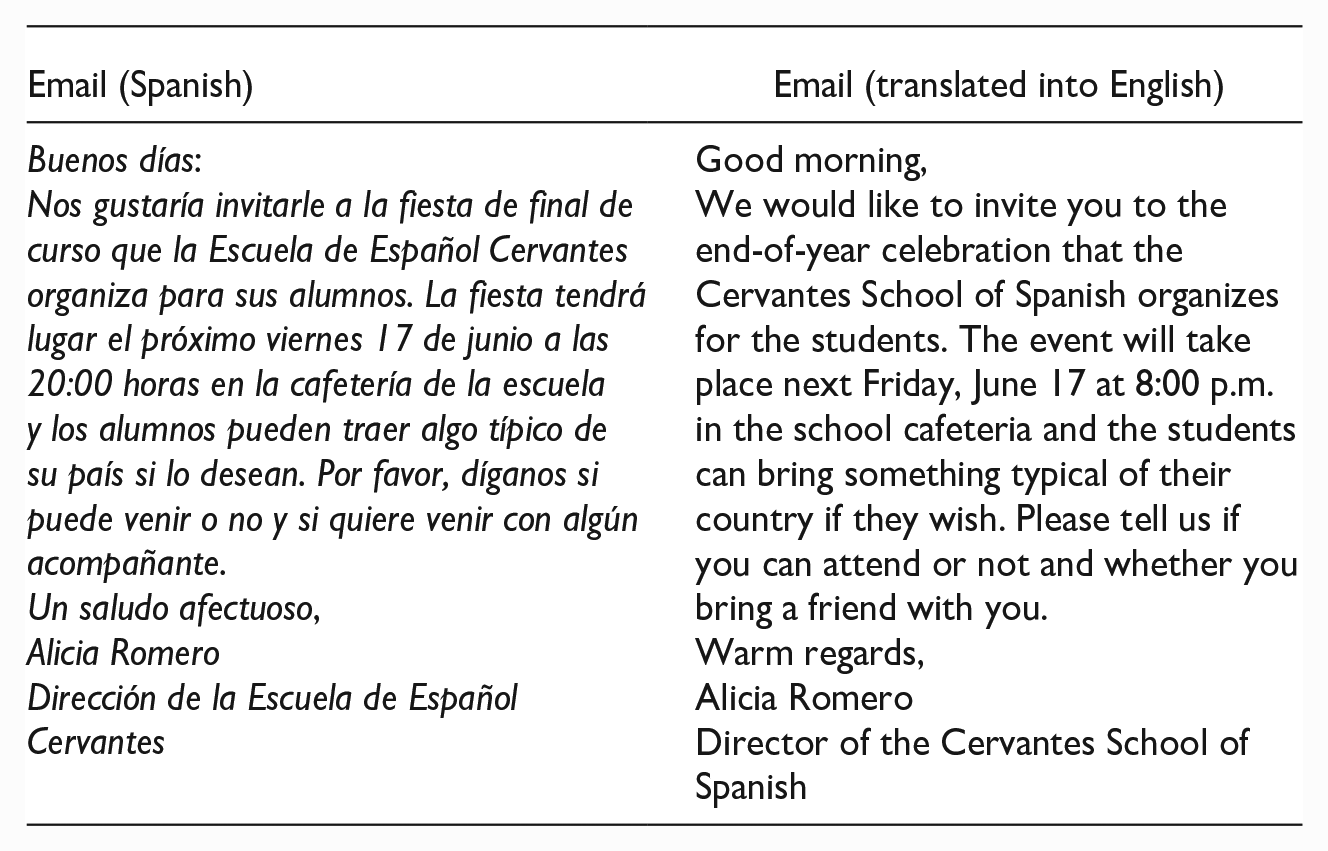
Writing performance was assessed by two independent raters using a holistic and an analytic rubric. 19 Both rubrics include four score bands that are later transformed into a final score ranging from 0 to 10 because immigrant learners of Spanish are more familiar with this numeric scale and can interpret it easier (Baralo, 2012). The holistic rubric gauges communicative effectiveness and linguistic control related to vocabulary and grammar. These two aspects are reflected in specific descriptors that have been developed for each of the four score bands (ranging from very unsatisfactory response = 1 point to very satisfactory response = 4 points). For example, 4 points are assigned when the two following conditions are met: (1) “The writer provides the required information in a very satisfactory way, offering pertinent information and more details than the requested to fulfill functional purposes. Text genre is adequate. The text is understood without the need to re-read it” (communicative effectiveness); (2) “The writer uses a varied and accurate linguistic repertoire, according to the proficiency level assessed by the exam” (linguistic control). The analytic rubric includes descriptors assessing overall expression and interaction, discourse cohesion and coherence, sociopragmatic competence, vocabulary accuracy and control, grammatical accuracy and control, and spelling; for each of these descriptors, candidates can obtain a maximum of 4 points (see Baralo, 2012, pp. 20-22).
Performance-based measures of accuracy and fluency
In addition to participants’ scores on the writing section of the exam and their overall scores, the texts they produced were analyzed using two performance-based measures: the number of words that the participants produced in both tasks, which served as a proxy for text-production fluency, and the number of errors in both tasks, which was used to calculate an index of linguistic correctness (i.e., the percentage of linguistic accuracy in relation to the total number of words). This was not a straightforward analysis because of certain linguistic and nonlinguistic variables that needed to be considered (e.g., irregular handwriting, illegibility, lexical elements that turned out to be superfluous when measuring text length, and operationalization of error). For the purpose of word counting, names and surnames, nicknames, contact or telephone numbers, emails, postal addresses, dates, abbreviated elements, words containing slashes or split by a hyphen, amounts of money, and illegible chunks were counted as one single lexical unit, while nonlexical elements, such as bullets, emoticons, and signatures, were discarded from word counting. The errors were classified into four categories: spelling errors (e.g., *experencia [experiencia “experience”]); segmentation errors generated by the incorrect union or separation of two or more words (e.g., *voya [voy a “I am going to"]); morphosyntactic errors (e.g., *buenos tardes [buenas tardes “good afternoon”]); and lexical errors referring to errors in word choice, omission of lexical elements, and L1 interference. After counting the total number of errors in both tasks and for each participant, linguistic correctness was computed according to the following formula: 100 – [(total number of errors in both tasks × 100) / total number of words in both tasks].
Results
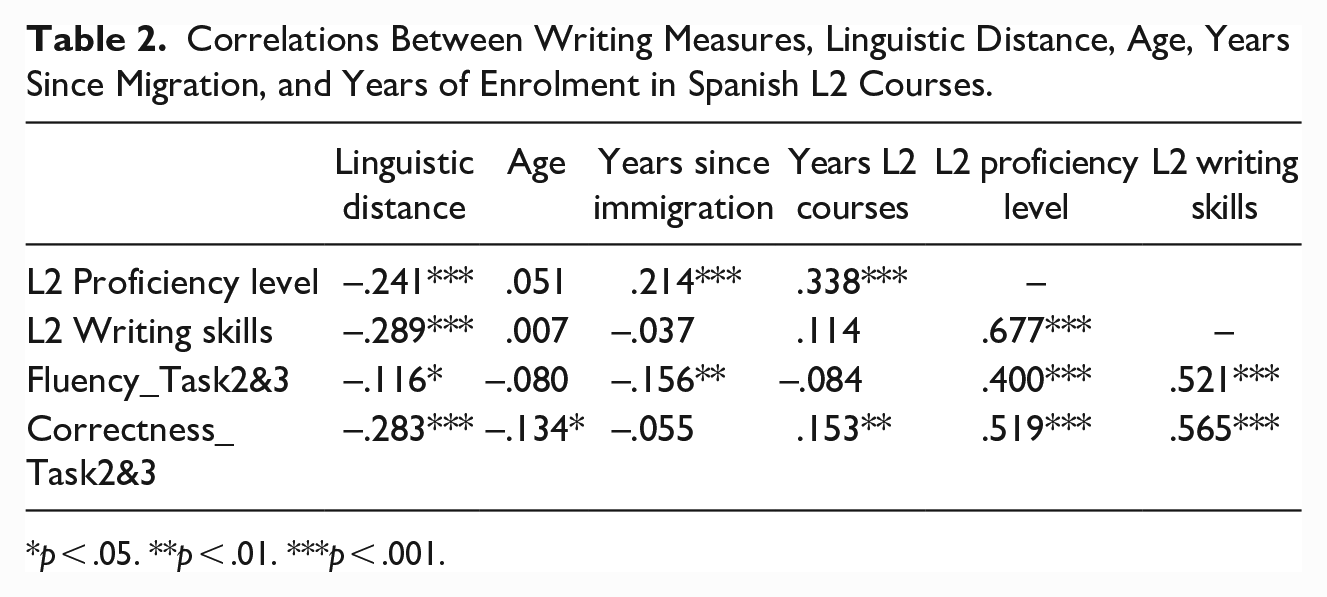
Descriptive statistics (mean, standard deviation, skewness, and kurtosis) for the linguistic variables of the study are summarized in Table 1. For all these variables, the values of skewness and kurtosis were quite low. Pearson product-moment correlations between linguistic distance, age, years since immigration, years of enrolment in Spanish L2 courses, and measures of writing and communicative competence in Spanish are presented in Table 2. As can be seen, participants whose L1 had a greater linguistic proximity to Spanish tended to achieve better results in overall L2 proficiency, writing skills, accuracy, and text-production fluency. It is important to note that the assessment of writing skills using the holistic and analytic rubrics correlated significantly with both performance-based measures (r = .521 for accuracy, and r = .565 for fluency), which indicates that these measures tapped into some aspects of writing that were also assessed with the rubrics (i.e., vocabulary and grammatical accuracy and control that is equivalent to accuracy; overall expression and interaction and cohesion and coherence, which take into account the amount of information provided by the candidates). 20
Descriptive Statistics for the Linguistic Variables of the Study.
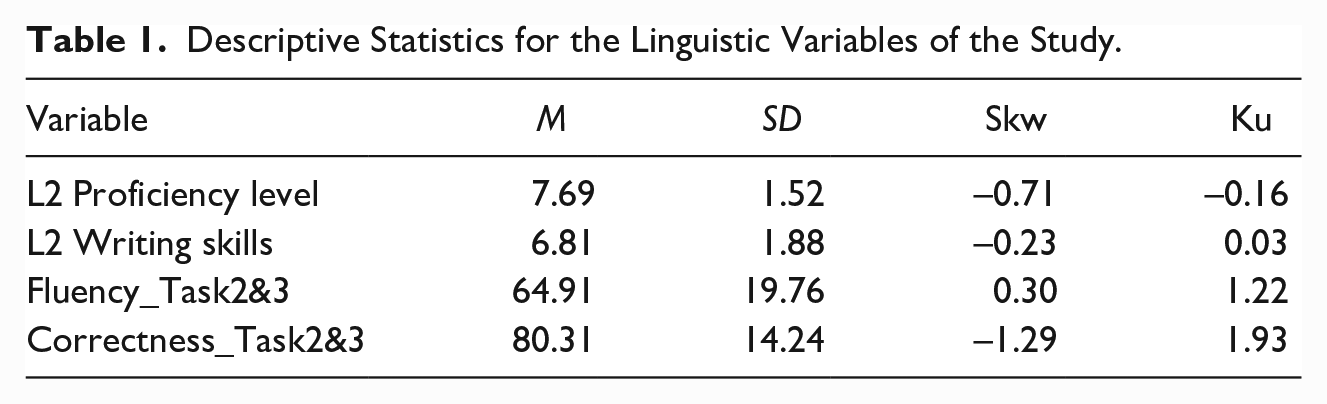
Correlations Between Writing Measures, Linguistic Distance, Age, Years Since Migration, and Years of Enrolment in Spanish L2 Courses.
p < .05. **p < .01. ***p < .001.
To take into account the remaining categorical variables of the study (i.e., gender and education level), a series of multiple linear regression models were computed. For gender, the reference category was female. For education level, in order to reduce the number of dummy variables, we merged participants with no education (n = 6), primary and secondary education within the same category, those who had completed secondary education or had a vocational training degree into a second category, and those who had attended university or had a university degree into a third group, which was used as the reference category. The remaining predictor variables were linguistic distance, age, years since migration, and years of enrolment in Spanish L2 courses. Two interaction terms were also included (age × age and linguistic distance × years since immigration) but they did not reach statistical significance; therefore, they were removed from the final models. The regression model referring to fluency was first estimated (Table 3), followed by the model predicting linguistic accuracy (Table 4). Finally, participants’ scores on the writing section of the exam served as the dependent variable of the third model (Table 5).
Predictors of Fluency in L2 Writing of Adult Immigrant Learners of Spanish.
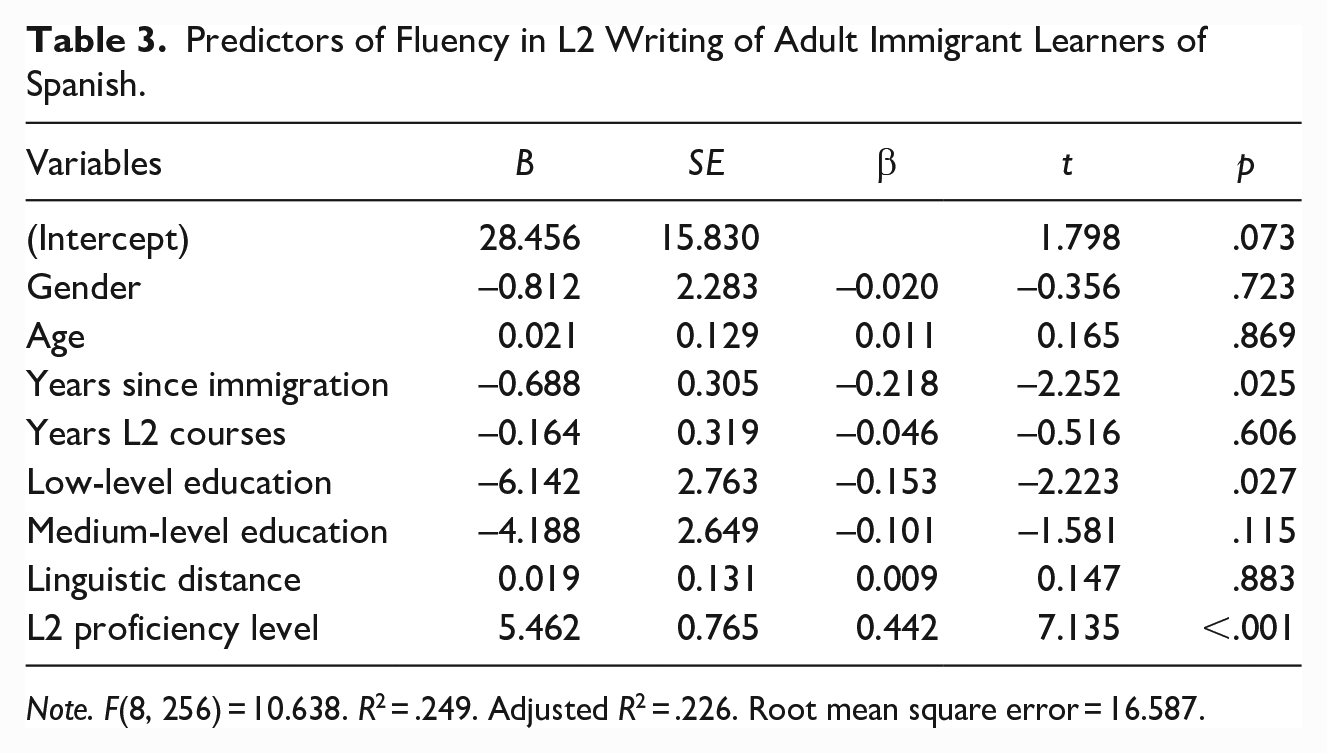
Note. F(8, 256) = 10.638. R2 = .249. Adjusted R2 = .226. Root mean square error = 16.587.
Predictors of Correctness in L2 Writing of Adult Immigrant Learners of Spanish.
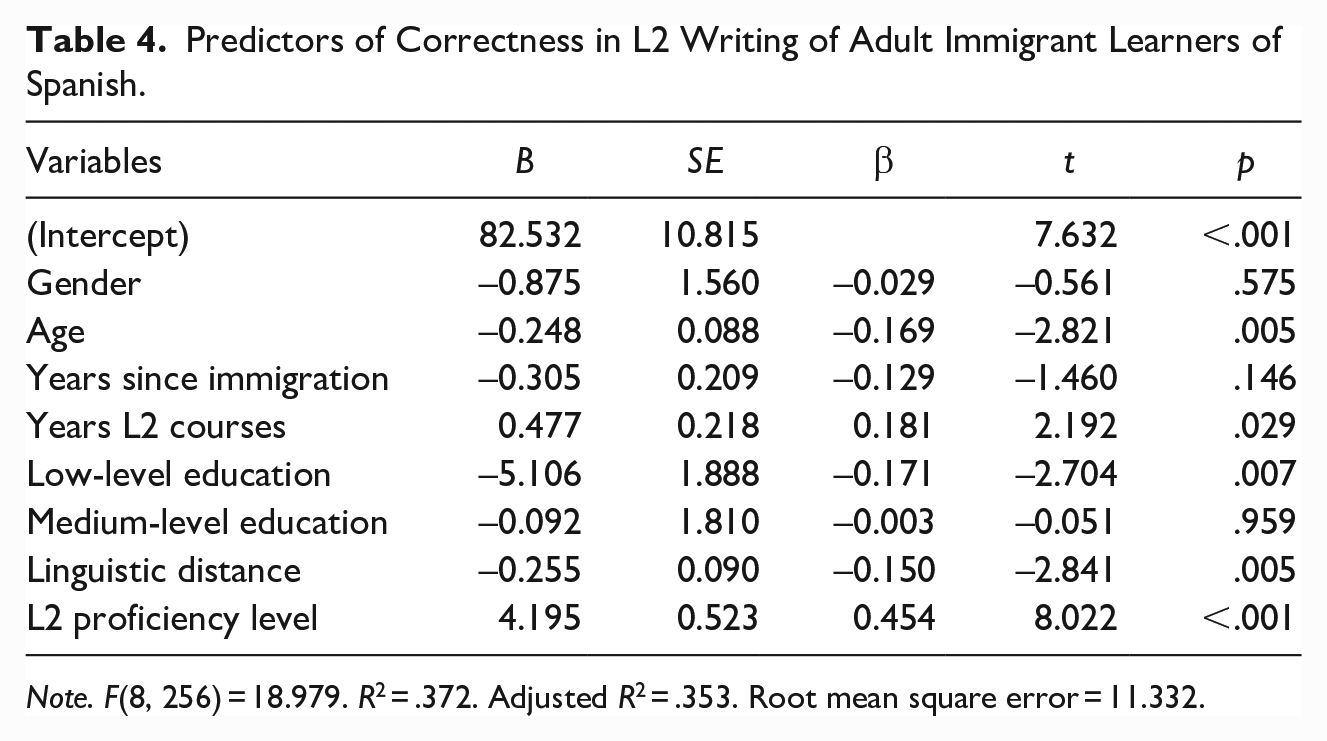
Note. F(8, 256) = 18.979. R2 = .372. Adjusted R2 = .353. Root mean square error = 11.332.
Predictors of L2 Writing Competence of Adult Immigrant Learners of Spanish.
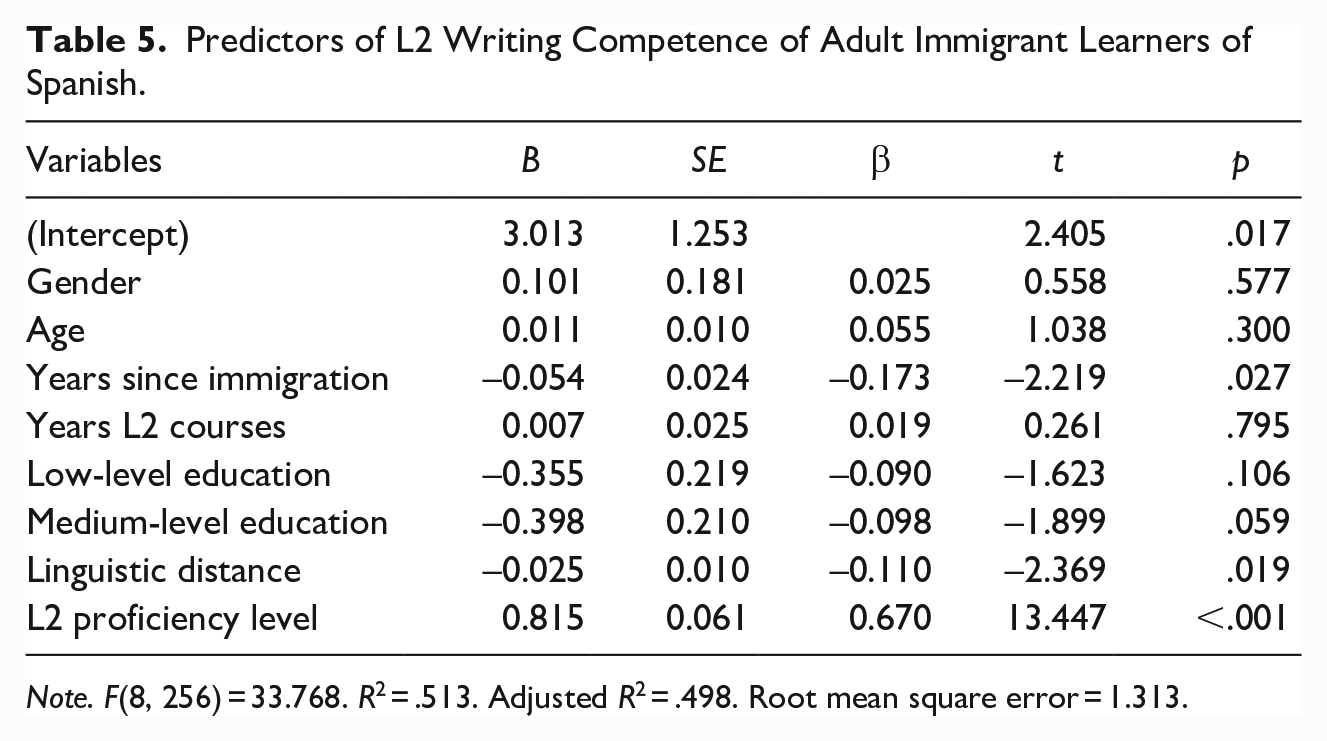
Note. F(8, 256) = 33.768. R2 = .513. Adjusted R2 = .498. Root mean square error = 1.313.
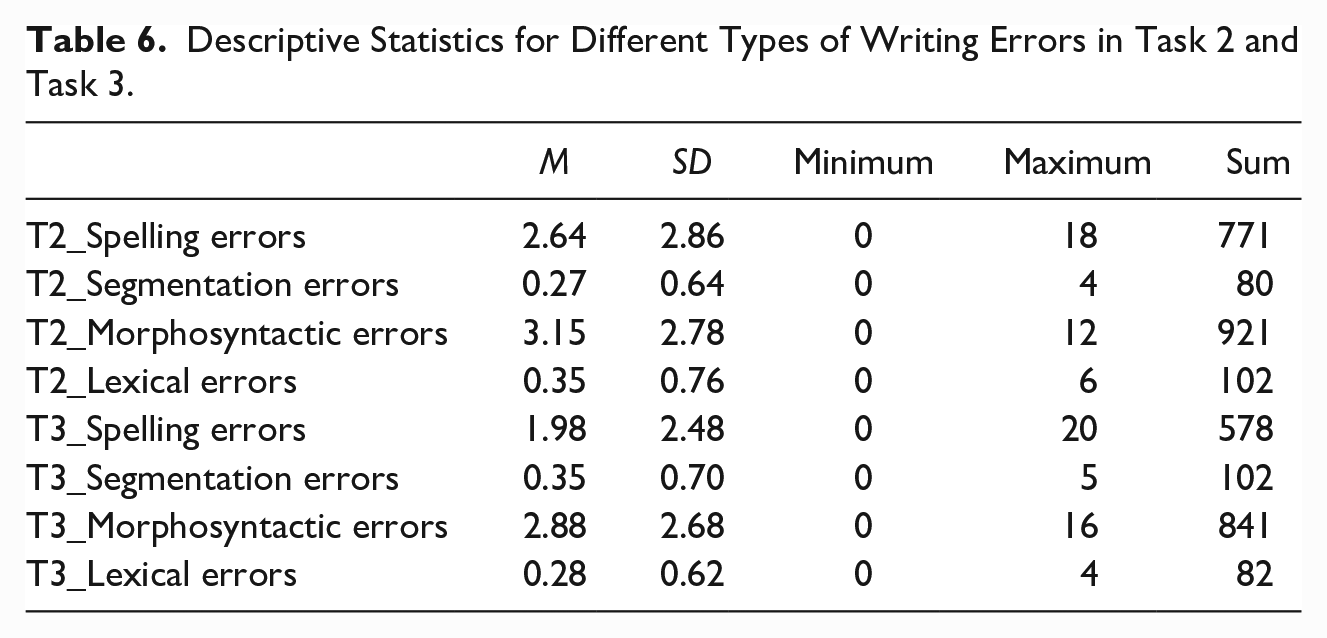
The results showed that L2 proficiency level in Spanish, years since immigration and education level explained around 24% of the variability in text-production fluency. 21 In other words, participants who obtained higher scores on the exam, had been living in Spain for shorter periods of time—and were therefore younger than their peers 22 —and had a medium or high level of education in their L1 (more than 12 years of schooling) used more words in their texts. A complementary mediation analysis based on 5,000 bootstrap samples revealed an indirect negative relationship between linguistic distance and fluency, which was mediated by L2 proficiency level (b = −0.234, z-value = −3.649, p < .001, bootstrap 95% CI [−0.37, −0.13]). Furthermore, L2 proficiency level in Spanish, linguistic distance, age, education level, and years of enrolment in Spanish L2 courses explained a significant amount of the variability (around 35%) in linguistic accuracy: younger participants, those whose L1 had a greater linguistic proximity to Spanish, had attained a higher proficiency level in L2, had attended school for at least 12 years, and took Spanish L2 courses for longer periods achieved a higher level of linguistic accuracy in L2 writing. Descriptive statistics for the different types of errors that participants made (see Table 6) revealed that most of these errors were morphosyntactic (n = 921 in Task 2 and n = 841 in Task 3) followed by spelling errors (n = 771 in Task 2 and n = 578 in Task 3), while the total number of segmentation errors and lexical errors in both tasks were comparatively very low (<103). Therefore, any assumptions regarding the influence of the above predictor variables exclusively concern morphosyntactic and spelling errors. Finally, writing competence was predicted by overall proficiency in Spanish, linguistic distance, and years since immigration. When the same analysis was replicated using the backward elimination method, education level also emerged as a significant predictor (i.e., university students performed better than the remaining two groups). In this adjusted analysis, the above variables explained 50% of the variability in overall writing scores, F(5, 259) = 54.066, R2 = .511, adjusted R2 = .501.
Descriptive Statistics for Different Types of Writing Errors in Task 2 and Task 3.
Discussion
The main goal of this study was to examine whether the linguistic distance between L1 and L2, along with other nonlinguistic variables, influence the writing competence of 292 immigrant learners of Spanish at the beginner level who took a certification exam. The results revealed that linguistic distance, length of residence in Spain, education level, and overall L2 proficiency in Spanish predicted immigrants’ overall L2 writing scores. These results add up to existing evidence on the important role of linguistic distance in predicting immigrants’ language outcomes—as assessed either with self-reports (Dustmann, 1994; Isphording & Otten, 2011, 2013, 2014) or with certification exams (Van der Slik, 2010)—and suggest that linguistic proximity confers a significant advantage when it comes to L2 writing in a newly learned language by immigrants. Education level had an additive effect, which is in line with the assumption that low-literate adult immigrant learners progress more slowly in L2 acquisition (Kurvers et al., 2006; Young-Scholten & Strom, 2006) and corroborates previous findings on the role of L1 literacy in L2 writing (Gonzalves, 2021; Kurvers, 2015; Kurvers & Stockmann, 2009; Manjón-Cabeza Cruz & Sosiński, 2021). These results are consistent with Kojima et al.’s (2022) meta-analysis of the external correlates of L2 writing, which revealed that L1 writing skills explain a considerable amount of the variability in L2 writing performance. They further support Cumming’s (1989, 1995) claims that L2 proficiency level plays a facilitative role in L2 writing (including overall L2 writing quality, accuracy, and text-production fluency). In fact, L2 proficiency level proved to be the strongest predictor variable explaining around 35% of the variability in L2 writing performance, while linguistic distance, length of residence in the host country, and education level explained 15% of this variability. This finding appears to indicate that L2 proficiency level is a strong predictor of L2 writing skills among immigrant learners of Spanish at the beginner level, who have not attained the threshold level of linguistic competence that would allow them, for example, to transfer their L1 writing skills to the L2 (see, e.g., Cummins, 1979; Majchrzak, 2018).
By contrast, length of residence in Spain was negatively linked to participants’ overall L2 writing performance and L2 text-production fluency. Further mediation analyses suggested an indirect negative relationship between age and L2 text-production fluency mediated by length of residence in Spain. Therefore, to interpret the above findings, we must consider length of residence together with age. Participants with shorter stays in Spain were also younger and were probably bilingual or multilingual speakers from a young age. Previous evidence suggests that, as opposed to late bilinguals, early bilinguals who are late learners of a third language are better able to control verbalization in the target language, while preventing interference from the other languages they speak (Martin et al., 2013). Furthermore, some empirical studies point to the benefits of bilingualism on writing performance (Poorebrahim et al., 2017), as well as to the greater exposure of young adults to online platforms (Leung, 2013), which provides them with a variety of opportunities to engage in interactive textual environments. This leads us to the conclusion that constant exposure to the target language resulting from longer periods of stay in the host country may enhance L2 writing skills if it is combined with a relatively early age of onset of the L2 or a high degree of bilingualism.
The results of our study also revealed a robust contribution of linguistic distance to accuracy. Spanish is a transparent language, both phonologically and orthographically (i.e., it has one-to-one relationships between its graphemes and phonemes). Therefore, the greater the linguistic proximity between immigrants’ L1 and Spanish—particularly as assessed with a linguistic distance measure that taps into the phonetic similarities across languages—the greater the immigrants’ ability to retrieve from memory and transcribe correctly the L2 words needed according to the intended text and meaning. This may be quite obvious in the case of vocabulary or lexical items, 23 but our study suggests that linguistic distance is also important for grammatical accuracy. In a similar vein, Boon and Kurvers (2008) observed that immigrant L2 learners might struggle to fill in a questionnaire with basic information and attributed some common L2 writing errors to the differences between L1 and L2 in the formation and frequency of appearance of letters and sounds. Although our results contradict those obtained by Kojima and Kaneta (2022) in their meta-analysis of 103 L2 writing studies, it is important to note that the linguistic distance measure that these researchers used was based on a dichotomous distinction between Indo-European versus Indo-European and non-Indo-European languages, while the linguistic distance measure used in the present study takes into account more subtle differences between the language of origin and the target language.
Age, education level, and years of enrolment in Spanish L2 courses also emerged as significant predictors of L2 writing accuracy. Previous studies confirm the negative link between age and the number of morphosyntactic errors or other measures of global L2 writing skills (Kurvers, 2015; Kurvers & Stockmann, 2009). At least to some extent, this might be attributable to age-related declines in (some) attentional processes and working memory functions (Bopp & Verhaeghen, 2005; Vallesi et al., 2021; Zuber et al., 2019), which are necessary at the initial stages of L2 learning in order to process, retain, and retrieve the correct L2 forms, especially when this learning takes place implicitly (i.e., in an immersion context). This interpretation is reinforced by previous L2 writing studies suggesting a positive link between working memory and L2 writing accuracy (Bergsleithner, 2010; Chenoweth & Hayes, 2003; Mavrou, 2020, among others). As Mavrou (2020) argued, linguistic accuracy might be “the result of several computations that operate first on individual linguistic elements or combinations of these elements (e.g. chunks) and later at a more global level (e.g. clause, utterance, paragraph)” (p. 9) and that require both memory and attentional processes. For example, at the initial stages of L2 learning, as in the case of our participants, prepositions and verb conjugation tend to be learned using a memory-based approach—which is enhanced by the similarities between the L1 and the L2; as the process of L2 acquisition develops, these learners are better able to analyze and reflect on the particularities of the new language. Therefore, older learners might have acquired learning strategies that allow them to overcome working memory constraints, but eventually—and as the results of this study indicate—a minimum L1 literacy level and L2 formal instruction need to be added to the equation for older adults to achieve higher levels of L2 writing accuracy (Kurvers, 2015; Kurvers & Stockmann, 2009). As Kurvers et al. (2010) pointed out, “for older students (i.e. students older than 40) and students without any schooling in the home country it is more difficult to progress quickly in L2 literacy than for younger students or students who had attended primary school” (p. 73). It is also possible that being highly literate in L1 combined with more hours of attendance on L2 courses help immigrants practice the new language more extensively (both in the written and the oral mode), and greater L2 practice may enhance L2 accuracy.
Regarding fluency, the results of the mediation analysis revealed that the link between linguistic distance and the total number of words that the participants produced in their texts was mediated by L2 proficiency level. This novel finding highlights the important role of overall L2 proficiency in L2 text-production fluency, beyond any differences in the structural components of the L1 and the L2: the closer the linguistic proximity between the L1 and the L2, the greater immigrants’ ability to express themselves fluently in the L2—at least in the written mode—as long as their L2 proficiency level is sufficiently high. Although in Kojima and Kaneta’s (2022) meta-analysis linguistic distance was not a significant moderator, the operationalization of linguistic distance in their study might have not been sensitive enough, and the authors did not run mediation analyses as did the present study.
L1 literacy level had an additional positive effect not only on L2 accuracy but also on the number of words participants used in their L2 texts. In other words, immigrants past the age of compulsory schooling (12 years) produced more words and achieved a higher level of accuracy. This is in line with Kurvers’s (2015) findings revealing a statistically significant correlation between years of L1 schooling and writing skills of 322 immigrants in the Netherlands. As L1 literacy usually develops in formal settings and entails cognitive changes (Olson, 2004), 24 immigrants with high L1 literacy skills may be equipped with the mechanisms or strategies needed to map written forms onto their meanings, or to convert sounds into letters to access the printed form of L2 words, and they do so not only more easily but also more accurately. To achieve this, a minimum threshold of literacy (around 12 years of schooling according to the results of the present study) seems to be necessary.
Nonetheless, this study has several limitations that should be acknowledged. An important drawback of this study—yet very common in our field—concerns the nature of the sample, which was self-selected; participants took the exam voluntarily and were probably driven by similar motivations (i.e., to certify their level of proficiency in Spanish and obtain a diploma that they could use when applying for a job or studies). Moreover, the way the concept of error was operationalized in this study is very restrictive and does not capture how immigrants construct meaning based on their language resources or other sociocultural factors. However, writing is not only about learning and applying a set of grammar rules or specific vocabulary; it is “a meaning-making activity, rooted in social contexts, and reflecting power relations between different groups” (Myhill & Jones, 2007, p. 325). Also, what constitutes an error from a strict morphosyntactic point of view could be perfectly acceptable or at least would not impede communication in a different interactional (or writing) context. It could even be seen as an indication of progress. Thus, we share Manjón-Cabeza Cruz and Sosiński’s (2021) opinion that deviances from the standard should be seen as “a starting point for improvement” rather than as errors, and we agree with Haswell (1988) that “Writing errors may be not so much mistakes as mis-takes, or missteps, inevitable in traversing new ground, not so much stubbornness—fossils of previous more ignorant learning stages in need of clearing away to allow subsequent progress—as stumbles, wrong turns made when new tactics are attempted” (p. 482). It is also important to stress that writing is a recursive process, and lack of time pressure and anxiety—which are typical of language testing conditions—would have probably helped our participants go through further stages of editing or rewriting to improve the quality of their texts. Therefore, future replication studies should broaden the scope of L2 writing assessment and investigate whether linguistic distance is a strong predictor of immigrants’ L2 writing abilities in more diverse writing contexts. Additionally, our study examined a specific set of key variables that might influence L2 writing; however, the list of potentially influential (linguistic and nonlinguistic) variables is quite long. Future studies should consider specific circumstances surrounding immigration (e.g., reasons for migration, immigration status and experience), cultural differences and how they determine language learning habits and L2 engagement, social networks, amount and intensity of previous exposure to the target language at the country of origin and to social media platforms, the role of incentives in the time invested to develop L2 literacy, qualifications and skills and how they might enhance or obstruct L2 writing mastery, factors affecting handwriting (fatigue, carpal tunnel, personal history of manual labor), to mention only a few. Furthermore, although proxies are convenient, future studies should try to employ standardized tests of L1 literacy, as well as a wider range of L2 writing tasks and more varied L2 writing measures (both product- and process-based). As emotions are always embedded in writing, future research should also address the extent to which linguistic distance is a proxy for emotional detachment by examining the emotional dimensions of the texts produced by immigrants (see e.g., Mavrou & Bustos-López, 2018).
Conclusion
Fluency and accuracy are not only relevant in everyday tasks (e.g., when filling official documents, conducting writing tasks at work) but also constitute important cues in computer-mediated and online interpersonal communications—an aspect that has been investigated in the general population (Ellison et al., 2006; Van der Zanden et al., 2020, among many others) 25 but less, if not at all, among immigrants. The findings of this study highlight the important role of linguistic proximity in achieving greater accuracy, text-production fluency and overall L2 writing scores. A minimum threshold of literacy (around 12 years of schooling) also emerged as a significant predictor of all aspects of L2 writing addressed in this study. These results can inform both language policies for immigrants and the design of L2 courses and teaching materials for this population. For example, L2 courses could be structured by placing immigrants with similar linguistic and L1 literacy profiles within the same classroom, as “we cannot have the same expectations of L2 adult learners with emergent print literacy as we have for L2 learners who have extensive experience with alphabetic print literacy in their L1s” (Gonzalves, 2021, p. 13). Explicit (hand)writing instruction might need to be reinforced, particularly for those students lacking a high degree of L1 literacy (see Gonzalves, 2021). Teachers and instructors of these courses should receive additional training comprising both theoretical knowledge of the challenges that new immigrant writers usually face in L2, and teaching skills development that will allow them to establish rapport with these students and guide them through the multiple stages of L2 literacy—and particularly writing—skills. Teaching materials could be enriched with more grammar and spelling activities, as immigrants—especially those whose L1 has a greater linguistic distance from Spanish—seem to struggle with these aspects. As Gonzalves (2021) argued, “explicit instruction may help students become more attuned to letter form, letter positionality, number of letters in a word, etc.” (p. 12). Undoubtedly, some immigrants will drop out of L2 courses; for this reason, providing incentives for them to invest in these courses and—if possible—in L2 courses specifically designed to enhance their L2 writing skills is essential because it will pay off in the long run, either because writing will help them improve their oral skills or because good writing skills will open more doors for them in the labor market.
To conclude, language and international migration are current topics in the field of (micro)economics, and language skills are seen as a form of human capital. The acquisition of an adequate level of literacy skills—and especially writing skills—in the new language is the gateway to a more balanced social and economic inclusion and can facilitate the pathway to equal opportunities for career development and a better quality of life. Therefore, understanding the determinants of writing skills in immigrants and finding ways to enhance these skills are challenging goals that the field of SLA should address in more detail. In doing so, and as Young-Scholten (2013) rightly argued, future studies should not neglect the “ongoing research on naturalistic, low-educated L2 adults of which mainstream SLA is unaware because the findings appear in languages other than English, in local journals whose target readership is native-language L2 teachers” (p. 450). Undoubtedly, immigrants’ writing abilities await and deserve further attention, exploration, and interdisciplinary collaboration.
Footnotes
Declaration of Conflicting Interests
The authors declared no potential conflicts of interest with respect to the research, authorship, and/or publication of this article.
Funding
The authors disclosed receipt of the following financial support for the research, authorship, and/or publication of this article: This research was carried out within the framework of the research project “The migrant population of the Madrid Region: A multidisciplinary study and tools for sociolinguistic integration (IN.MIGRA3-CM)” (ref. H2019/HUM5772), funded by the Madrid Region and co-funded by the European Social Fund.
