




Abstract
We look at a yearlong university–community partnership’s potential to create more equitable planning practices through an analysis of the sub-genres of student-generated planning reports. Using an actor–network approach to identify four different kinds of reports (manual, boundary object, framing, catalyst), we find that both the content of these reports and their translational work in existing practice-based networks can influence student learning and planning practices—what we term practice-based politicization—by defining, aligning, enrolling, and mobilizing. Ultimately, the relational context of these partnerships is essential to their effectiveness, suggesting that longer term engagements between university programs and their community partners are more likely to support mutual learning and deepen students’ pedagogical exposure to both an agonistic and collaborative approach to planning practice.
Introduction
Most planners believe the documents they produce have the potential to guide institutional practices and influence outcomes—indeed, we would be unlikely to engage in research, analysis, and recommendations if we did not.
Most planners and planning scholars also believe that conditions in cities and regions are not as equitable, livable, and sustainable as they could or should be (Brand 2015; Gough 2015; Zapata and Bates 2016), and that there is great potential in the power of planning courses and university programs to partner with local communities and jurisdictions to work toward knowledge co-production and project implementation that is useful and beneficial to all involved (Botchwey and Umemoto 2018; Slotterback and Lauria 2019; Watson 2014).
In this article, we examine outputs of a university–community partnership—the course reports produced through Livable City Year (LCY), a university–community partnership at the University of Washington (UW)—to consider some of the ways that planning documents help shape and influence subsequent outcomes. We adopt an actor–network perspective as both a methodological and pedagogical lens, accounting for the highly contingent and politicized nature of planning practice (Eraydin and Frey 2018), as well as the need for ongoing processes of reflection, trust-building, and mutual learning in community-engaged research and teaching partnerships (Balassiano and West 2012; Siemiatycki 2012; Sletto 2010).
Why plans and reports have value—the work that they do and the alignments that they sometimes enable—is a question that depends on a number of different conditions and considerations. The way a planning report works, or fails to, will depend both on the circumstances around its formation, and the characteristics and circulation of the document itself. In the sections that follow, we situate these claims within a growing body of actor–network scholarship in planning, and introduce a typology for understanding more about the role played by course reports in the LCY partnership.
By characterizing the agency of different planning reports as being deeply related to the context in which they are created and used, we hope to improve understanding of how the material artifacts of planning perform the often political role of translation (definition, alignment, enrollment, and mobilization) within continually forming networks of planning practice. We conclude with thoughts about the implications of this analysis for both pedagogy and practice.
Context and Method
The LCY program at the UW is intended to provide support to local governments to carry out high-priority projects and to offer training to university students. By matching city-defined projects related to livability and sustainability with existing university courses in a related topic area (e.g., engineering, business, planning, environmental services, housing law), city departmental staff and university faculty and students navigate an opportunity to learn from one another through applied, professional research and recommendations.
In a broad sense, LCY is borne of an increased emphasis within universities on engaged and embedded scholarship, urban-serving designations, and a long-standing commitment among planning scholars to acknowledge and activate their positionality as participants in applied research settings (Baum 2000; Sletto 2010). It also demonstrates a growing interest of individuals across the university—students, faculty, and administrators—to see the outputs of their research, scholarship, and coursework positively affect their community, an established aim for many planning programs (Ashley and Vos 2015).
This kind of program also fills a pedagogical niche for students. Based on a survey of civic-mindedness of LCY participants in the 2017–2018 school year—conducted using the civic-mindedness framework developed by the Center for Service and Learning at Indiana University Purdue University Indianapolis (IUPUI; Steinberg, Hatcher, and Bringle 2011)—we learned that a majority of students who participate in this program self-report their commitment to community engagement as a motivating force for their pursuit of higher education. Almost 90 percent of respondents indicated that their sense of responsibility to make a difference in the community comes from internal motivations (38%) or compassion for the community itself (50%), and 70 percent of students expressed the belief that the connection between community engagement and higher education can contribute to improving society or serving others. Yet few students have opportunities to put these normative commitments into practice: only 15 percent participated in service-learning experiences outside of the LCY partnership (online Supplemental Material: LCY Civic-Mindedness Survey 2018).
LCY is also a response to real resource needs experienced by ambitious and understaffed jurisdictions. Local city governments in the United States are generally under-empowered, in both a fiscal and a statutory sense, relative to the complexity and costliness of the issues with which they must contend (Frug and Barron 2008; Pierre 2011). To contribute productively to regional governance for sustainable community development, local jurisdictions must be in a position to make their own policy and program investments, with an eye toward the larger regional dynamics—for example, housing, transportation, labor markets, environmental conditions—within which they are embedded. LCY provides short-term capacity to a municipality, to research and push new projects along—almost thirty in the partnership year we describe here (2017–2018). And as with so many metropolitan regions globally, the Puget Sound region in the past fifteen years has been affected by the explosive growth of urban land markets, a shortage of housing and transit investments, and a resulting increase in spatial, economic, and environmental inequity. Between 2010 and 2017, population across the region’s eighty-two cities and towns grew by approximately 10 percent, with a roughly 20 percent increase in jobs; however, over this same period, average home prices increased by 43 percent and average rents increased by 68 percent (Puget Sound Regional Council 2018). As local property values rise, people of color are increasingly displaced from established neighborhoods (Saldana and Wykowski 2012) and local governments often struggle to recapture and redistribute this new prosperity.
Our own involvement in LCY involved intersecting roles as a course instructor, graduate student, and researchers. In addition, one of us worked for the LCY program as a report editor, one of us served as a program co-director, and both of us worked together on one of the partnered courses. Methodologically, we were embedded in the program at multiple levels and were interested in its success on behalf of the university and the partner city (Tacoma, Washington), where we both have established ties—as well as trying to observe and learn from its shortcomings, as our LCY commitment would end after a year, but our investment in Tacoma and in community-engaged learning would not. As a program co-director, Taufen was involved in matching the city’s projects with university courses and establishing the scope of work between faculty and city staff. As a report editor, Olson worked closely with student and faculty teams to strategically communicate individual project findings and recommendations. And both of us were involved in scoping, researching, and delivering one of the selected projects.
Networks 1.0 and Structures of Neoliberalization
The eras of communicative planning, collaborative governance, and the New Public Management brought with them a new conceptual frame for theory and practice: networks (Agranoff 2006; Booher and Innes 2002; Hajer and Wagenaar 2003). An important development in shifting understanding of governance practice from its historical foundations in highly bounded, hierarchical, and bureaucratic government decision structures, networks help to capture a far more complex reality, where public and private actors, nested scales of authority, and regional, national, and global flows of capital and imperatives populate local governing institutions (Crosby and Bryson 2005; Healey 2007).
This interpretation of local urban planning and governance networks helps us account for the interlinkages that we know to characterize the field of practice: for instance, the importance of a regional field office of a federal agency to the funding and implementation of a local program, the influence of a donor or philanthropic group on the policy design and longevity of a local service model, or emergent non-profit–public partnerships to address persistent or “wicked” problems like homelessness. Rather than an organizational map with straight edges and lines of authority, network theories introduce messier maps, where numerous institutions and people make decisions and pursue goals through a variety of different mechanisms and connections (Ansell and Gash 2007; Crosby and Bryson 2005). This framing resonates with what many of us experience to be empirically true, and the network construct has replaced simpler organizational models in a range of fields, including politics, planning, business, and public policy.
In collaborative planning in particular, one of the critiques of the network model is that, while the structure may have changed (flat and multi-nodal, as opposed to tiered and vertically linear), the actions and outcomes that it privileges, and power dynamics that it bolsters or justifies, have not (Purcell 2009; Watson 2014; Weir, Rongerude, and Ansell 2008). Worse, the loss of hierarchical authority characteristic of the traditional state has been accompanied by a “hollowing out” of state power and resources, the main concern associated with neoliberalism (Campbell, Tait, and Watkins 2013; Harvey 2005). Thus, networks as next-gen governance structure may actually obscure and endorse processes of political legitimation, so that existing elites are more, not less, able to manipulate and capture the support and benefits of planning decisions.
To the extent that networks are understood as a new kind of structure, the actions that planners and others take are understood in response to, or in coordination with, that structure (Taufen 2017). If the network structure is benign, as much of the initial literature and analysis implies, then planning action is (or ought to be) cooperative: how do we manage and collaborate within these new network settings to get things done? If the network structure is more quietly and perniciously oppressive, as critical planning analysts claim, then planning action is or ought to be resistant: how do we frame and empower insurgent ideas, marginalized groups, and redistributive ends to contend with such a setting?
If, however, networks are not structure itself, but rather a contingent—if frequently path-dependent (Pierson 2000)—arrangement of people, organizations, things, and patterns of behavior (Feldman et al. 2006), then perhaps effective planning action must cooperate and resist, using networks and their enactment to politicize rather than reproduce the reliably unjust conditions of urbanization.
Why Politicization?
The idea that planning practice ought to be politicized by community-engaged learning is not a foregone conclusion in university–community partnerships, and indeed many examples of community-engaged learning do end up being little more than student labor filling in for that of consultants. However, we find empirical and normative support for the critical role that community-engaged learning can play in the extensive literature on equity planning and sustainable urban development (Savan 2004; Schweitzer, Howard, and Doran 2008; Zapata and Bates 2016). We view the need for politicization as rooted in the reality of social and spatial inequity—and therefore the need for mutually beneficial aims of community-engaged research and co-learning between partners to increase institutionally equitable practices. This understanding of politicization is a complement to more antagonistic concepts, which tend to focus on disruptive tactics by non-state actors outside of institutional contexts (Miraftab 2009; Purcell 2009).
Given the equity concerns and resource constraints facing urban regions, an important question is whether tensions and trade-offs inherent in sustainable development are intentionally brought forth from university research and classrooms and into government practice (Lowe and Ehrenfeucht 2017; Taufen 2018); that is, whether course projects offer new or alternative recommendations that might further local and regional aims of social equity and environmental health, in addition to providing new mechanisms for community engagement, broadly understood. We understand this as an important pursuit of such university–community partnerships, where projects that strive to leverage the empirical research and social learning role of the university (Taufen 2019) have the potential to significantly alter accepted ways of approaching local policy and programs, politicizing through practice rather than polemic.
What we term a “practice-based” understanding of politicization relies upon a particular understanding of networks, where networks are conceptualized less as a structure and more as a relational process. For programs such as LCY to influence livability and sustainability outcomes at the local and regional level, such networks must be sometimes-porous performances of people, programs, institutions, things, technologies, and routines—an understanding of networks aligned with an actor–network or object-oriented ontology (Bennett 2010; Latour 2005).
Furthermore, in a symmetrical, heterogeneous reading of networks, all objects have potential agency, and thus the latent, if highly uncertain power to enact new enrollments, framings, relations, and performance outcomes. It is in this translational agency of objects—such as planning reports—that we locate a possible form of practice-based politicization, where the objects themselves enact means of re-rendering and unsettling received assumptions of who associates with whom, and what, and how.
Networks 2.0 and Actants of Politicization
This different way of thinking about networks opens up different potential spaces for influence and agency. While a network structure can be quite durable, its constitution and relations must be continually performed (Latour 1986; Law 1992). Agency, although constrained, is available to a variety of actors within this performed structure—both human and organizational actors, whom we are used to treating as such (planning departments, elected leaders, community groups, city agencies, etc.); as well as non-human actors, to whom we are less inclined to attribute power (for instance, buildings, smartphones, illustrations, and ecological features, like rivers or trees). This actor–network perspective on planning and governance (Beauregard 2015; Farias and Bender 2010; Rydin and Tate 2016) suggests that things, as well as people, have translational agency in establishing relations and rendering them durable. In this understanding, networks become more porous and more complicated—including becoming more (potentially) susceptible to politicization.
In an actor–network framework, an actant translates between other entities in a network, creating an associative link among people and things, thereby affecting what happens next. An actor–network perspective tells us that this happens in specific ways. Something that is translating does so in four ways (or stages): problematization, interessement, enrollment, and mobilization (Callon 1984; Law 1992). That is, an actant can define a problem or process, shifting, reinforcing, or disrupting existing patterns; it can align various actors and interests in this conceptualization; it can enroll other entities and resources, in time and place; and it can mobilize this into a stable, ongoing pattern.
Depending on their context, planning reports or documents often attempt to do all of these things; in addition, Latour (2005) states that translational actants will tend to either open up (mediator) or foreclose (intermediary) next steps. A report that is an intermediary follows the conventional wisdom of the role of plans: it shapes subsequent action, reinforcing existing network patterns. A report can also be a mediator, however, whose agency will tend to provoke and create new associations, understandings, and arrangements, sometimes in unpredictable ways. Examples of an actor–network approach to plans and policy documents have emerged in the literature, helping to account for the ways in which these things perform as network actants—orienting, defining, shaping, and/or delimiting subsequent forms of action. In some cases, these are regulatory in nature, wherein a new policy requirement functions as an actant (Rutland and Aylett 2008) or to shape the agency of planners, developers, or other urban actors (Rydin 2012). Written documents operating outside of a regulatory network can also serve as actants, for example, in Delaney’s (2014) description of the production of strategic planning documents by an international NGO (nongovernmental organization) operating in Vietnam. These reports, which were intended to guide future action, served as an artifact of the translation that took place during the process of compiling project reports—but they also had the function of enlisting the participant-researchers on the ground to make these changes in practice (Delaney 2014). The function of such planning documents within networks can span a regulatory to a translational role; the actual function of planning documents is often divorced from their initial intention, gaining new power as they move within a network.
This new understanding of reports-in-networks challenges the frequent assertion that, once created, most planning documents merely sit on shelves. Such a critique rests on a specific understanding of the role of plans within networks: in the rational planning model, plans are instrumental, performing as “how-to” manuals to guide implementation. However, within a framework that acknowledges distributed power and networked governance, many scholars have noted the shifting role that plans and planning documents play in shared-power contexts, wherein implementation often relies on the consent and action of a wide array of actors: regional and local governments, municipal corporations, non-profit and business stakeholders, and organized publics (Crosby and Bryson 2005; Hajer and Wagenaar 2003). For some, plans work as boundary objects, creating a mutually beneficial framework for multiple actors to access and use (Lejano and Ingram 2009). For others, such representations can help to enable and elevate plurivocal narratives (Goldstein et al. 2013), lend substance and staying power to the “ontographies” of planning practice (Beauregard 2015), or enlist “digital ethnographies” in processes of collaborative sense-making and spatial planning (Sandercock and Attili 2012). Networks of planning practice are populated and perpetuated by things, as much as people—and among these powerful actants are plans, policy documents, and project reports.
Planning Reports as Network Actants
At the culmination of planning projects, we all can point to those plans or reports that successfully find their audience, while others languish; some have their desired effect, some never get published or shared, and others develop “a life of their own,” perhaps quite different from anything their authors intended. Recognizing that each of these actant roles can be quite powerful, albeit in different ways, can help planners to anticipate and enact network outcomes based on the demands of context and the potential influence of a planning document.
Zitcer’s (2017) recent work on the nature of genre in planning publications is instructive here. After its production, a planning text is likely to be taken up within a particular interpretive community, where the “project of mutual learning” will be shaped by the “web of relationships consisting of authors, readers, and the texts themselves” (Zitcer 2017, 585). Not surprisingly, scholars recognize a variety of sub-genres within academic writing; however, we are likely less adept at recognizing genre variations and their rationales in “the typical planning report” (587). Yet as we seek to train emerging professionals, translate research findings, and affect practice, the potentially strategic functions of different planning “genres” become particularly important.
To illustrate this potential, we turn to the creation of project reports for the LCY partnership. We choose here to focus on the reports produced as part of the LCY program because they provide a durable output and a tangible way to understand and interpret the potential for practice-based politicization across a wide array of disciplines and course arrangements. In 2017–2018, the city partner proposed thirty-eight projects, from twelve different city offices and departments; three-fourths of these were successfully matched with UW courses and faculty across two campuses, eight schools, and twelve departmental units. Projects included traditional land use planning and community development projects; initiatives from the City Manager, Finance, City Attorney, Information Technology, Environmental Services, Fire, and Power and Utilities divisions; and efforts proposed by quasi-public and non-profit organizations such as the metropolitan parks district, master builders, and the housing authority. 1 In each of these capacities, report production and delivery can significantly change an otherwise non-professionalized relationship between students and the partnering department at the city.
By design, there are similarities among the reports: students generated an introduction that outlined the problem statement and relevant data illustrating the problem; described the research methods and methodology they employed; presented key findings or the results of original research; and (where appropriate) articulated recommendations based on their findings. With the support of a professional report editor and graphic designer, one or two students from each course were provided with a stipend to collate the course work into one document, and generate or provide graphic assets. Although reports vary in length from 20 to almost 100 pages, each report is branded with the LCY, UW, and partner city logo, and made publicly accessible online. And, although each report is designed to follow the same branding and format, serving as a sort of “immutable mobile” that can be passed around and between networks, they also offer a glimpse into the variety of scopes, disciplinary approaches, and report sub-genres that are possible within such a broad engagement.
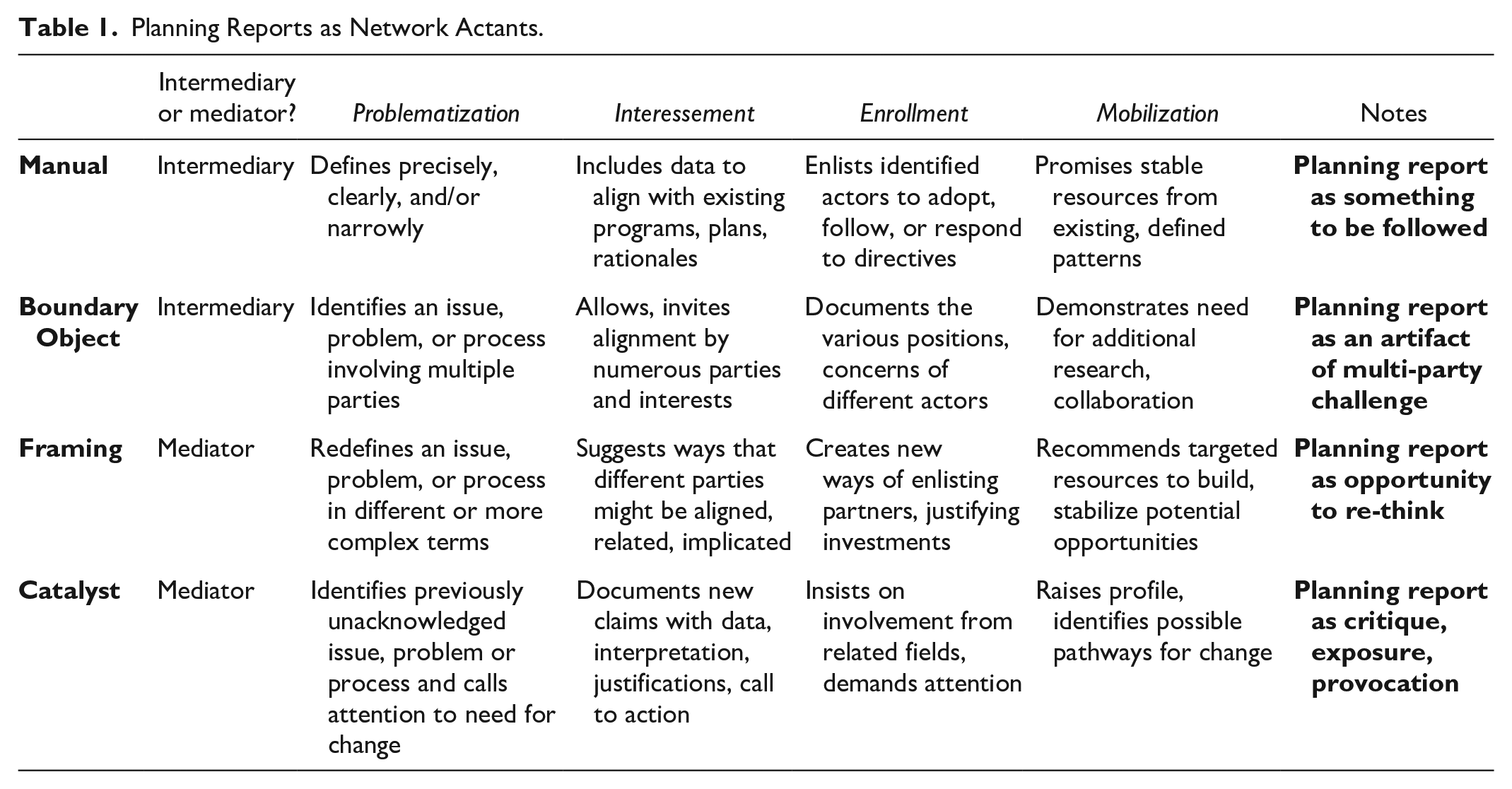
The translational capacities of actants (defining, aligning, enrolling, and mobilizing) help us to distinguish between report sub-genres. We show the ways in which such project reports offer the opportunity, though not the inevitability, for practice-based politicization of student participants and institutional practices, and we categorize these different reports to conceptualize their potentially strategic role within networks. Table 1 provides an overview of these sub-genres, followed by examples from the LCY program.
Planning Reports as Network Actants.
Report-as-Manual
Some reports function primarily as a manual to guide practice (Hajer 2003; Hopkins 2000), effectively fulfilling the expectations of city departments: they use student labor to produce staff-identified needs. Although this work is largely transactional and conducted within the existing political limitations of the department, in some instances, the focus of such reports is to serve as a proposed intervention in department practices. For instance, one LCY project saw architecture and planning students conduct historical research and a cultural resource survey for two historically underrepresented neighborhoods, gauging whether the neighborhoods were eligible for nomination to the National Historic Register. The project delivered baseline information for the city department as they gauged community interest and collected data on intact cultural resources before deciding whether to move forward with historic designation (LCY 2018d).
Such reports can leverage student expertise and labor to improve department practices (just as much as they might reinforce the existing inequitable ones); thus, the potential of a report-as-manual to affect equitable practice is largely dependent on the internal culture of the department and staff requesting the work. If city staff are able to define the project using a set of interests or aims that are within the responsibilities of the unit but difficult to resource, investigate, or pursue through existing budget lines and rationales for bringing in a consultant, then a report-as-manual can do important practical work to align and enroll students and community members, justifying investments that may have otherwise been dismissed in a chronically resource-constrained environment and mobilizing new programs or policies. Yet the transformative potential of these more instrumental planning documents is certainly not guaranteed, particularly if city staff have overlooked critical equity implications in the scoping of projects—just as many planning consultants find their work constrained by the limitations imposed by clients.
Report-as-Boundary Object
Some planning reports document the process of social learning, serving as an artifact to represent and illustrate a social process that has already taken place (Innes and Booher 1999, 2004). These reports can act as a boundary object (Quick and Feldman 2014), offering a shared opportunity for people from different sectors to contribute to the creation of a guiding document or strategic planning process. These reports are most common when the project creates a community of practice of sorts: city staff and students co-learning about a project together, where process and project documents serve as “concrete artifacts that unite different individuals in a common purpose” (Hart and Wolff 2006, 133).
In a university–community partnership such as LCY, these reports can serve as an artifact of the deliberative process of co-learning that takes place between city staff, students, and external constituencies (Karlin et al. 2017; Schweitzer, Howard, and Doran 2008; Taufen 2019). The report-as-boundary object offers an opportunity to document the learning process that researchers and/or city staff went through together; it might also be used to pilot-test a particular approach and determine its feasibility for future project. Some of the “boundary object” reports within the LCY context were projects initially designed with a broader scope: for example, gather empirical data to inform recommendations, or produce a set of policy guidelines. While these projects may not have been workable within the university timeline or political constraints of the city department, the mere documentation of the process can serve as a boundary object—allowing city staff to use the findings in a way that is politically useful to them, even if it differs from the approach taken by students.
In one LCY (2018c) project, students intended to conduct community-based data (surveys and focus groups) with marginalized communities to learn about their needs and opinions related to the city’s passive open space conservation program, which relies on volunteer labor. However, students found that even making initial contact with these groups was an obstacle: after contacting more than fifty community-based organizations and after-school coordinators, students received a response from fewer than five. From those groups that they did hear from, several expressed frustration about the role of students on the project, making clear that it should be the role of city staff, not students, to reach out to community members and learn about their needs. With these project challenges, it was impossible to collect a meaningful amount of empirical data. Therefore, the report defines the challenges encountered by students, aligning this with the experience of the city staff member on prior outreach projects. Such a report sought to enroll departmental leadership that a new approach to working with communities was required—and ultimately mobilizing the need for institutional change within the organization. As with many planning processes that encounter unforeseen challenges, such a report allows for the definition and alignment of challenges (or sometimes of failures), producing a boundary object that different actors can deploy within their own particular context to enroll and mobilize for different political ends.
Report-as-Framing
Many planning theorists have discussed the agenda-setting and framing potential of planning documents and reports (Hajer 2003; Schon and Rein 1994), elevating new issues to a policy arena or surfacing latent interests around specific policy proposals. Framing and re-framing can also serve as a form of sense-making within organizational cultures, which in turn can allow for the reordering of departmental or institutional priorities (Weick 1995).
One LCY (2018a) project inventoried civic engagement practices within local government to generate a new typology (Arnstein 1969) and imaginary (Quick 2015) of civic engagement in practice. By interviewing city staff and analyzing, then reflecting back their accounts, and qualitatively cataloging existing institutional practices as part of civic engagement—including the quotidian work of public hearings and customer service at the permitting counter, as well as more radical community-empowerment events and capacity-building programs—the interpretive project sought to re-frame this work, in particular its importance for building trust and relational reciprocity across race, class, gender, age, and ethnicity. Students worked to surface latent assumptions about civic engagement, an examination of existing practices that shifts ideas about where this work is done, who does it, and why.
As an output, the report defines civic engagement and aligns it with the organization’s strategic goals with ideals of representative local governance. Workshops with city staff and the publicly accessible document sought to enroll staff in the process of more effectively including residents in policy-making, and ideally mobilize both staff and leadership to treat many existing programs and initiatives as opportunities to build trust with residents and improve relations with underrepresented communities, rather than thinking of civic engagement as an add-on or special sauce. When a framing report is sufficiently embedded and taken up within its unique context, it can pave the way to political change.
Report-as-Catalyst
Social movement theorists and scholars of innovation recognize that a catalyzing event, person, or dynamic can help to create change in risk-averse or highly resistant settings (Meyer, Jenness, and Ingram 2005; Tarrow 1998). By necessity and in keeping with a more agonistic understanding of social change, reports that act as catalysts to spark systemic change might need to initiate this change from an outside position (Bond 2011). Although produced on behalf of the city client, to achieve their catalyzing potential, reports often directly challenge existing ways of doing things; provide examples of alternative approaches, as well as justifications; and provide an opportunity for interface with a larger number of non-state actors.
One LCY (2018b) project that assessed implicit racial and socioeconomic bias in the municipal court system intentionally leveraged the outsider role as students to provide empirical and provocative analysis that is unlikely to be immediately popular or politically feasible. The report uses multivariate regression analysis to define the reality of implicit bias in the court system and align the data with particular metrics of racial and socioeconomic profiling. It seeks to enroll other actors by making recommendations that may be politically unfeasible in the short term, in an effort to open a policy space and mobilize previously unexplored possibilities. By shifting the parameters of the conversation, these kinds of planning reports have the potential to act as a catalyzing intervention, creating new political conditions that make the very consideration of these recommendations more plausible. However, the potential of this kind of report to create change is likely to be particularly reliant on its role in networks: to see these recommendations realized, the report would necessarily need to enroll and mobilize external, non-state reformers to push for institutional changes.
The differences between these reports show that their roles can be generalized as types of translational actants—defining, aligning, enrolling, mobilizing in distinct ways—with some foreclosing next steps (intermediary) and others opening up new ones (mediator). Within the LCY program, differences between reports relate to aspects of the organizational and political environment, including the size and sophistication of the class undertaking the project, the training and inclination of the instructor, the aims and relative embeddedness of the city staff lead, and the available time and energy of all involved. Nevertheless, we find that as indicative types, or sub-genres of planning reports, such distinctions can potentially help project partners to anticipate how a work product might be used, and to plan accordingly—relative to, rather than ignorant of, the constraints imposed by the organizational and political environment. A university–community partnership offers a specific context for identifying planning report sub-genres; however, many of the conditions of their production will be familiar to practicing planners (including municipal staff, consultants, community organizers, political aides, or non-profit or foundation staff). Planners, in an array of different roles and contexts, also work to ensure that their work is defined in a way that is palatable to clients and/or the political context, with recommendations that are aligned to the particular institutional or social context in which they are working, and that enroll state and non-state actors appropriately—and can ultimately mobilize those actors to implement change.
Practice-Based Politicization
The power of LCY reports as manuals, boundary objects, framing devices, and catalysts relies on their subsequent effects in the context (networks) in which they are deployed. What makes these various approaches amount to a new kind of politicization—what we term practice-based politicization? Drawing on these four different ways of conceptualizing report outputs, we illustrate that, through student and faculty engagement with a public client, there exists the potential to raise new questions, provide connections between civil society and academic research, and (sometimes) to shift the agenda to catalyze changes within a municipal institution. While each project does not always deliver on this lofty goal, we believe that enhancing the critical urbanist outcomes of such reports is a programmatic and pedagogical, rather than political, question. And, by necessity, the functional use of a report depends on its traction and movement within networks. It is the individual agency, and political impulses, of different actors—students, faculty, city project leads, external advocacy groups and organizers—that is what ultimately can lead to shifts in institutional practices and policy outcomes.
By becoming more specific and realistic about the type of planning report that is needed and can realistically be delivered and taken up at a particular point in time and within a given organizational and political environment, planners can expand their toolbox from what is traditionally viewed as the successful role of a plan (manual) to include, validate, and recognize other highly functional and politically essential roles for these actants (boundary object, framing, or catalyst). Questions about context—for example, what does a planner want a planning document to do, and in what ways (define, align, enroll, mobilize)? What is realistic to hope for, or expect a report to do, in a particular network arrangement or existing environment (intermediary or mediator?)—strengthen decisions regarding plan sub-genre. For university–community partnerships in particular, but also for planners in general, this question of how to strategically shape the genre of a planning document, particularly given the unique context of different relationships, institutions, or networks, can also become a key pedagogical outcome for students.
For LCY reports that are contracted and delivered as manuals, such as the historic district example explored above, the document serves as a resource in subsequent policy moves and network associations. In this instance, the data that were collected, analyzed, and illustrated in a highly legible and easily shareable report form enable city staff to assess the feasibility of a new program, including metrics and images that can be shared with city administrators and elected officials. The report provides analysis and imagery that can be mobilized to build support and interest elsewhere, as well—with state and national preservation organizations, with potential funding partners, and with the neighborhoods and community members who participated in the initial survey. By exploring and documenting the possible expansion of historic district designation in Tacoma, the report enlists an established policy space and its associated resources for neighborhoods whose historicity and cultural value has historically been undervalued or ignored. This is a practical politicization that can yield resident investment and advocacy, new public lines of support and visibility, and changes to broader patterns of place stewardship—in the case of historic preservation, a network largely dominated by non-profit elites.
For LCY reports that function as boundary objects, the convening and exploration of a set of planning and policy interests (in the example above, community connections to open space) can highlight and legitimize a lack of communication, a set of real conflicts or challenges, and/or nascent opportunities for bridge-building between different constituencies. Perhaps surprisingly, this politicization may be more effective than a traditional reading of plans-as-manuals would suggest. If a community development initiative requires stronger, more concerted relationship-building by the city, as this one did—or documents a complicated, unresolved, multi-stakeholder process, as others do—a report that reflects the conflictual, agonistic nature of such a process can flag the issues involved for government officials and legitimate the interests and concerns of stakeholders, rather than papering them over in a tidy but inaccurate account. Such a report that passes back into the hands of city staff or elected officials can create a rationale for careful investment to build upon areas of shared trust and/or navigate and better understand areas of disconnection and fracture.
As framing devices, LCY reports politicize by questioning, amplifying, enlarging, or re-casting existing assumptions about the work being done. A report of this nature can aid in subsequent network associations by empowering city staff to claim and align their work with existing governance rationales, or highlight new justifications and areas for investment. In the case of the civic engagement project described above, the report draws on deep qualitative data from staff across all city departments to re-frame civic engagement as something that is done within a variety of different government services and departments, as opposed to being limited to mandated public participation on specific and usually controversial projects; it also highlights the central importance of continued institutionalized racism in the city’s hiring, neighborhood development, and public outreach practices. A report-as-framing invites and/or establishes interpretations of a public issue that might be poorly understood or falsely delimited, setting an agenda for new prioritizations, interconnections, and policies.
LCY reports acting as catalysts have perhaps the most overtly politicized role and hoped-for network effects. In the example above, students and faculty mounted an explicit and intentional challenge to likely forms of bias prevalent in the prosecution of cases by the City Attorney’s office. By marshaling established empirical studies and longitudinal research, the report deliberately provokes critical reflection—and likely defensiveness—on the part of a government unit that is otherwise fairly insulated from day-to-day reflection about the relative equity impacts of its work. Such a report will likely require additional investigation and coordination with external allies and advocacy resources; however, the document itself provides a mechanism to enroll those actors in a continued effort and puts city staff on notice that previously unexamined practices will be open to evaluation. In this sense, such a report can involve political risk for a jurisdiction investing in a partnership such as LCY; its claims can be shared with media or with civil rights and legal advocacy groups, and can affect the careers and reputations of the city leaders involved.
University–Community Partnerships as New Networks
Beyond the network effects of reports as actants, a partnership like LCY amounts to the creation of a new network infrastructure to port information from civil society and the academy into the functions of municipal government (and perhaps the other way around). With the urgency around environmental sustainability, institutional racism, and urban livability in our region—and the increasing complexity of our problems—more robust decision-making networks are required. For planners, planning scholars, and planners-in-training, this means more proactive and context-based understandings of how work products might be used—and a mandate to improve our ability to match capacities, opportunities, and challenges with available resources.
Through the partnership of these large institutions and the professional support and presentation of reports, we open the opportunity for “back door” politicization, in which student-researchers are granted access and bring resources to local government institutions. We view this experiential training as an important pedagogical investment in a planning education that is both critical and practical. Where the planning academy fails students, perhaps, is in the presentation of a false or at least untenable choice between agonistic struggle and complicit collaboration (Bond 2011)—particularly when there are often much more nuanced, practice-based opportunities to transform existing governance structures and institutions to become more radically inclusive and equitable.
The willingness of planning instructors to themselves be agents in asking questions of practice itself—to take on the risk of trying to engage and influence how projects are pursued, by whom, and at what moments in pursuit of “better” outcomes (Campbell, Tait, and Watkins 2013)—is a very real education in the vagaries of planning and governance. Pedagogically, it has the potential to equip students to retain and refine their critical commitments, by attempting to thread them into the very real settings and challenges where they will eventually be trying to build careers and make an impact.
Most planning academics working to equip students with a critical approach are themselves within professional degree programs, working with students likely to go into planning practice. Where the literature has been most provocative and instructive is in the recognition that students’ community-engaged, experiential learning relies on connections forged before, beyond, and after individual courses (Balassiano and West 2012); that developing cultural competency and race-critical dialogue requires ongoing institutional commitment, in and out of the classroom (Lung-Amam et al. 2015); and that the most effective engaged learning courses will be oriented toward community capacity-building (Botchwey and Umemoto 2018). Taken together, and from a relational process-based perspective, this suggests that partnerships such as LCY may be best suited to campuses where engaged learning is a new or poorly institutionalized practice, in need of a one-year boost or pilot demonstration, or jurisdictions where few established ties to university programs have been established.
In the case of the Tacoma campus of the UW, where both of us are based, the LCY partnership served to highlight the work that was already happening at our local urban-serving university (UW Tacoma) and its growing, outward-focused programs—work that was perhaps until that point undervalued and poorly acknowledged by leaders both within the campus administration, within city departments, and among local non-profit and community groups. The short term—and in some cases, abruptly ended and unresolved nature of 2017–2018 LCY course partnerships, itself perhaps inevitable when matching the academic calendar to the sustained nature required for community partnerships (Savan 2004)—demonstrated to Tacoma civic leaders that the local, smaller, urban-serving campus of the UW is in many ways ideally poised to forge the kind of long-term, responsive, and engaged research partnerships that are most beneficial to students and communities. In the year following the LCY partnership, UW Tacoma administration moved to elevate and resource Community Engagement to a fully staffed unit on campus, providing support and visibility for partnerships that, in many cases, had been underway and building slowly for years.
This learning experience of the LCY partnership is consistent with both the research in engaged learning and the insights of actor–network theory. In the relative difficulty of affecting practice through a single course and its report—however deeply researched and well-intended—we see a strong justification for the kind of long-term, iterative engagements that enable better anticipation of how a course report will be taken up and used. This is a planning and actor–network success, perhaps, but more importantly it means that better translational skills to define, align, enroll, and mobilize will also serve the practice-based equity aims of cultural competency, race-critical perspectives, skills-based experiential education, and community capacity.
Conclusion
The foregoing analysis is offered as a means of explicating the practical and political implications of adopting an actor–network approach to local network governance and university–community partnerships. We focus on the role of reports, and show how understanding their translations (defining, aligning, enrolling, mobilizing) can influence subsequent planning and governance practice by performing as a manual, boundary object, framing, or catalyst.
As we have demonstrated, although they have the potential to enact their own agency, such reports are deeply embedded in the contextual reality (networks) through which they eventually travel. Thus, for practitioners, academics, and instructors of planning seeking more equitable futures, part of the goal of university–community partnerships must also be to build new institutional capacity and relationships to ensure that they have a thorough understanding of each project’s unique context before attempting to offer recommendations for institutional transformation. Much scholarship on university–community partnership has focused in particular on the importance of long-term relationship-building rather than short-term “parachuting professionals” (Reardon 2000; Savan 2004). Such an approach allows for more balanced power dynamics and successful two-way flow of information between university practitioners and the communities with whom they work. Although these projects can sometimes be less “sexy” for students, and might even seem, on the surface, to offer less potential for students to politicize practice, the long-term relationships that are built with communities can foster understanding—and a greater assurance that the project’s outputs are more likely to be useful to, and used by, community partners.
While the use of a project report is always contingent and uncertain, the adoption of an actor–network approach helps us to express—and demonstrate to students—how the things of planning practice can be important means of building critical perspectives and normative commitments into the day-to-day work of planners and city staff. The people involved are still essential, and in stable planning and governance networks, this may be the basis for truly generative potential: if things such as reports can be mobilized and translated into networks to produce new, different, or more equitable outcomes, then the people involved can potentially be equipped with an expanded repertoire of planning imaginations and interventions.
Supplemental Material
online_supp_Civic_Mindedness_Catalyst_WebQ-1 – Supplemental material for Practice-Based Politicization: Planning Reports as Actants in a University–Community Partnership
Supplemental material, online_supp_Civic_Mindedness_Catalyst_WebQ-1 for Practice-Based Politicization: Planning Reports as Actants in a University–Community Partnership by Anne Taufen and Anneka Olson in Journal of Planning Education and Research
Footnotes
Acknowledgements
The authors wish to thank the staff at the City of Tacoma, University of Washington students and faculty, and Livable City Year staff and leadership who lent their time, expertise, and experience to Livable City Year Projects, as well as the faculty colleagues who provided insight in early review of this paper.
Authors’ Note
A draft of this paper was presented at the 2018 meeting of the Association of European Schools of Planning (AESOP) in Gothenburg, Sweden, “Making Space for Hope,” July 10–14, 2018.
Declaration of Conflicting Interests
The author(s) declared no potential conflicts of interest with respect to the research, authorship, and/or publication of this article.
Funding

Supplemental Material
Supplemental material for this article is available online.
Notes
Author Biographies
References
Supplementary Material
Please find the following supplemental material available below.
For Open Access articles published under a Creative Commons License, all supplemental material carries the same license as the article it is associated with.
For non-Open Access articles published, all supplemental material carries a non-exclusive license, and permission requests for re-use of supplemental material or any part of supplemental material shall be sent directly to the copyright owner as specified in the copyright notice associated with the article.
