



Abstract
This study sought to understand the knowledge, skills, qualities, and tasks that municipal employers expect from planners and to assess how well they align with those identified as important by academic scholars and accreditation bodies. Through a content analysis of 150 municipal planning employment advertisements collected from across Canada, the study identified the planning-relevant qualifications demanded by municipal governments. The analysis revealed that the municipal planning sector prefers prospective employees with a planning degree, the skills demanded by municipalities generally align with the competencies identified by the Canadian Institute of Planners, and municipalities mainly target well-rounded planners.
Introduction
Planning practitioners are confronted with a range of different issues, including those that are complex, messy, and multi-faceted, which are commonly referred to as “wicked problems” (Balassiano 2011; Baldwin and Rosier 2016; Rittel and Webber 1973). In this context, planners need knowledge, a diverse set of skills, and the capacity to apply these resources to different contexts (Dawkins 2016; Greenlee, Edwards, and Anthony 2015). Drawing primarily from surveys of educators and practitioners, a number of researchers have sought to identify the specific skills and competencies that planning professionals need to succeed in planning practice (Dalton 2007; Dawkins 2016; Greenlee, Edwards, and Anthony 2015; Guzzetta and Bollens 2003; Miller 2019; Ozawa and Seltzer 1999; Seltzer and Ozawa 2002). Although many of these studies are dated, they offer a solid foundation for analyzing the “marketplace” of the planning profession, which includes both the supply of knowledge and skills offered by trained planning practitioners, as well as the demands of employers who seek to recruit planning talent.
In this article, we focus on the demand side of the planning profession by examining the qualifications municipal governments seek when recruiting planning practitioners. The study analyzed 150 planning employment advertisements issued by municipal governments in Canada between 2018 and 2019, to identify expectations regarding education, specific knowledge areas, professional qualities, and skills, as well as the tasks planners would be expected to perform. We then compared these employer demands with the competency standards outlined by the Canadian Institute of Planners (CIP), the national association, and accrediting body for planning professionals, to assess the congruence between demand and supply. The municipal planning sector was targeted because more than half of Canadian planners are employed in the municipal sector (CIP 2019). Greenlee, Edwards, and Anthony (2015) also suggested that municipal governments bear a responsibility in addressing complex and emerging issues that demand skilled planning practitioners.
The research revealed three key findings. First, municipal employers overwhelmingly expect prospective employees to have a planning degree at either the graduate or undergraduate level. Second, the skills demanded by municipalities generally align with the competencies identified by the CIP and the skills identified in existing literature. Third, municipalities mainly target well-rounded planners with knowledge of land use planning.
The article begins with a review of contemporary literature to identify the skills that are typically associated with the planning profession. The second section discusses the competency standards for the planning profession in Canada. The third and fourth sections discuss the findings from the analysis. The paper concludes with key recommendations and directions for future research.
Literature Review: The Demand for Planning Skills
There is a well-established and expanding body of research on the supply and demand of the planning “marketplace” (Alexander 2001; Contant and Forkenbrock 1986; Dalton 2007; Dawkins 2016; Greenlee, Edwards, and Anthony 2015; Guzzetta and Bollens 2003; Miller 2019; Ozawa and Seltzer 1999; Seltzer and Ozawa 2002). The bulk of this research relies on surveys that solicit the views of educators and practitioners about the knowledge and skills they consider to be critical for the planning profession. Studies in this vein typically inquire about both generic skills (e.g., communication, interpersonal relations) and specialized knowledge and skillsets (e.g., competence with specific computer software; particular expertise, such as economic development).
As early contributors to the study of planning practice, Schon et al. (1976) identified several broad skills they deemed necessary to succeed in planning, including writing (an ability to produce clear reports and memos), synthesis (an ability to synthesize large amounts of information), interaction (an ability to work with different stakeholder groups), consulting (an ability to work with clients), and research design (an ability to identify problems and solutions). In addition to these skills, Contant and Forkenbrock (1986) found that management (an ability to plan and manage project including logistical skills, budgeting, and scheduling techniques) and data analysis (an ability to use and analyze data) were important skills in planning.
Building on this earlier work a decade later, Ozawa and Seltzer (1999) and Seltzer and Ozawa (2002) found that communication skills remained highly regarded among planning practitioners, along with working well with colleagues, working with the general public, and understanding the needs of the public and clients (Ozawa and Seltzer 1999; Seltzer and Ozawa 2002). The researchers also identified as highly desirable skills the ability to complete tasks on time and within budget, being a “self-starter,” and being able to read and interpret zoning legislation (Ozawa and Seltzer 1999; Seltzer and Ozawa 2002). Conversely, the least sought-after skills included competency in linear regression, expertise with geographic information systems (GIS), an understanding of micro-economics, and an ability to develop and maintain budgets (Ozawa and Seltzer 1999; Seltzer and Ozawa 2002). The desirability of these skills, however, has evolved since the work of Ozawa and Seltzer (1999) and Seltzer and Ozawa (2002). Expertise in GIS, for example, has become a sought-after skillset in planning practice and in planning school curricula (Dawkins 2016; Pojani et al. 2018).
Guzzetta and Bollens (2003) found that communication skills were highly valued by professionals in the field of urban planning and in affiliated fields such as architecture and real estate development. The researchers also noted that report writing, familiarity with laws, ordinances, and policies, and an ability to make effective presentations were highly desirable skills among practitioners (Guzzetta and Bollens 2003). The least valued skills were technical skills, quantitative analysis, and writing for the public.
More than a decade later, Greenlee, Edwards, and Anthony (2015) surveyed U.S. planning staff and decision makers to identify skills deemed important, finding that many were remarkably consistent with studies conducted decades earlier, but also that skills valued less in earlier studies had grown in importance. Specifically, the top-ranked skills included communication (oral, visual, and written), synthesis, research, and information retrieval, including locating information from published sources (Greenlee, Edwards, and Anthony 2015). Some of the lowest ranked skills included recording (i.e., photography and film making), grantsmanship (the ability to identify funding sources and prepare formal requests for funding), evaluation (the ability to carry out evaluations), social media (the ability to communicate with broader audiences using social media platforms), and Internet (the ability to design and maintain websites and web data interfaces).
Dawkins (2016) was the first to compare the skills employed in planning practice with those offered by graduate programs endorsed by the Planning Accreditation Board (PAB), a nonprofit organization in the United States that promotes excellence and high-quality education for future planners. The PAB includes representatives from practicing planners affiliated with the American Institute of Certified Planners and planning educators. The study found close congruence between the demand and supply side of the planning practice, wherein top-ranked skills included an ability to write reports and lengthier documents, familiarity with qualitative analysis, a working knowledge of basic data processing methods and software, and competency in GIS and spatial analysis (Dawkins 2016). The study also identified areas of general planning knowledge that were both taught in graduate schools and used in practice, including an understanding of the rationale for and purpose of planning, the legal context within which planning occurs, environmental processes, the planning process, and connections between planning and implementation (Dawkins 2016).
Most recently, Miller (2019) assessed the preparedness of those who completed undergraduate planning programs for the demands of entry-level planning positions, including generic skills and specialized planning knowledge. Highly sought-after skills included writing, oral communication, attention to detail on work products, teamwork and collaboration, problem solving, and a willingness to accept constructive criticism (Miller 2019). Key knowledge areas included an understanding of land use terminology and comprehension of land use regulations and laws (Miller 2019).
In summary, previous studies of planning practice have highlighted a greater preference for generic skills (e.g., communication). Greenlee, Edwards, and Anthony (2015) found that the majority of planning directors were more willing to hire an entry-level generalist with limited understanding of a broad range of topics than to hire a candidate who specialized in one area of planning. Similarly, Dawkins (2016) observed that skills pertaining to general planning knowledge were among the most commonly obtained and used in planning practice. The literature also suggested that the need for certain specific skills (e.g., GIS) has become more important over the decades (Dawkins 2016; Pojani et al. 2018).
This study sought to complement survey-based research, which has focused primarily on the supply side of the planning profession, by assessing the qualifications demanded by employers seeking to recruit planners at the municipal level. By analyzing the content of recent employment advertisements, the study drew insights about the knowledge, qualities, and skills that candidates must possess to be competitive in the planning employment marketplace. Furthermore, by comparing the qualifications demanded by employers against the competency standards for the Canadian planning profession, the study evaluated how closely the demand and supply for planning practice align.
Competency Standards for the Canadian Planning Profession
The CIP and the Professional Standards Board for the Planning Profession in Canada (PSB) are responsible for setting out appropriate professional standards and competencies for planning practitioners and for accrediting planning schools (CIP 2011). Professional standards provide a transparent measure for evaluating the competencies required of planning practitioners, including specific knowledge, skills, and aptitudes (CIP 2011).
Professional planners in Canada are expected to possess functional (i.e., specific knowledge areas) and enabling (i.e., specific skills) competencies (see Supplemental Appendix I for a detailed listing of competencies). These competency standards are developed with input from planning practitioners and planning academics, and are reviewed regularly to ensure they remain relevant and applicable to planning practice (CIP 2011). The competencies identified by the CIP align quite closely with skills and knowledge areas identified in the literature cited above. The core functional competencies include knowledge of (CIP 2011)
Human settlement—understanding of human settlement, its evolution and history, influence of natural setting, changing forms of political and social structure, and influences on communities;
History and principles of community planning—understanding of the history of planning in Canada and other countries, and knowledge of planning theories, principles, and practices;
Government, law, and policy—understanding of government and legislation within the realm of planning and understanding of the policy process and its application to planning;
Plan and policy consideration—understanding of environmental and sustainable development issues, issues of diversity and inclusiveness, the functional integration of knowledge, and finance and economics;
Plan and policy making—understanding of planning approaches and focus, developing visions and outcomes, strategic information gathering and analysis, and obtaining input and approval;
Plan and policy implementation—understanding of decision making and risk management, implementation planning, project management, finance and administration, and evaluation;
Developments in planning and policy—understanding of emerging trends and issues.
The core enabling competencies include skills in (CIP 2011)
Critical thinking—issue identification, problem solving and decision making, research and analytical, innovation and creativity, political awareness, and change management;
Interpersonal—integrity and trust, diversity and inclusiveness, facilitation, negotiation, collaboration and consensus-building, and conflict management;
Communication—listening, written, oral, and visual presentation; understanding of information and knowledge required to support decision making; use of information technology; internal and external relations;
Leadership—understanding of the importance of values and vision, being responsive and able to propose influential recommendations, team-building, understanding of accountability and frameworks to support performance measurement, and managing resources and results;
Professionalism and ethical behavior—professionalism, ethical standards, and continuous life-long learning.
Accredited planning schools in Canada are expected to integrate these competencies into their curriculum. Professionals who have work experience but did not graduate from an accredited planning program (e.g., a degree in geography) are expected to demonstrate that they possess the functional and enabling competencies for professional planners. As such, one of the objectives of this study was to assess the extent to which the knowledge areas, professional qualities, skills, and tasks demanded by municipal employers align with the competency standards for the Canadian planning profession.
Method
To investigate the demand side of the planning marketplace, we collected and analyzed 150 employment advertisements from across Canada that were posted between 2018 and 2019. Advertisements were retrieved from various publicly accessible sources, including postings from municipal government employment websites, the CIP website, and job boards of the provincial planning associations (e.g., Ontario Professional Planners Institute; Planning Institute of British Columbia). We specifically targeted advertisements that aimed to recruit municipal planners. Advertisements included in the dataset specified “planner” in the job title and conveyed an expectation that the recruit would work within a municipal planning department in either the planning policy unit or development planning unit. We did not target specialized websites that advertise positions with specific interests and experience, such as conservation authorities, school boards, and transportation agencies. Municipalities might also use other avenues of communication to recruit planners with certain specialties. As such, one potential limitation of this study is that we did not exhaust the full breadth of avenues municipalities might use to recruit planners.
The advertisements were then coded using NVivo qualitative data analysis software, which involved categorizing information into nodes based on the following qualifications:
Education—academic discipline specified in employment advertisements (e.g., planning, architecture, geography, public administration);
Professional designation—designations specified in advertisements including membership with the CIP and other professional status (i.e., being a registered professional planner);
Experience—years of professional experience (i.e., zero to three years, three years, or more than three years) and any specific experience (e.g., managerial experience, land use planning);
Knowledge—knowledge areas specified in advertisements (e.g., knowledge of best practices, budgeting, planning legislation, planning theory);
Professional qualities—specific character traits sought of applicants (e.g., professionalism, accountability, respectful, tactfulness);
Skills—specific skills identified in advertisements (e.g., communication, organizational, leadership, conflict resolution);
Tasks—tasks and responsibilities specified in employment advertisements (e.g., process planning applications, act as a representative, respond to inquiries, write reports).
Our analysis did not include a list of predefined categories for nodes (e.g., a list of academic disciplines for the education node). This was intentional as it allowed us to explore the expectations more fully regarding education, specific knowledge areas, professional qualities, skills, and tasks demanded of planning practitioners. We reasoned that starting with a predefined set of categories would limit our analysis and potentially neglect important planning-relevant qualifications not considered in the existing literature and competency standards for professional planners. We also did not classify the advertisements based on whether they sought generalist planning positions or specialized planning positions (e.g., heritage planner, policy [long range] planner, development planner, transportation planner, parks planner), for two reasons. First, we wanted to understand the full breadth of qualifications demanded by municipalities when hiring planning recruits. Second, the advertised planning positions varied substantially, which made it unfeasible to categorize them into uniform groups, while also providing insightful findings.
The coded data were exported to MS Excel for analysis. Descriptive statistics were used to explore the key areas of qualifications. Once the analysis was completed, we compare our findings against the functional and enabling competencies identified by the CIP and skills and knowledge areas identified in the literature review.
Results
This section presents the results of the analysis. There are five sub-sections: education and experience, key knowledge areas, professional qualities, relevant planning skills, and common planning tasks.
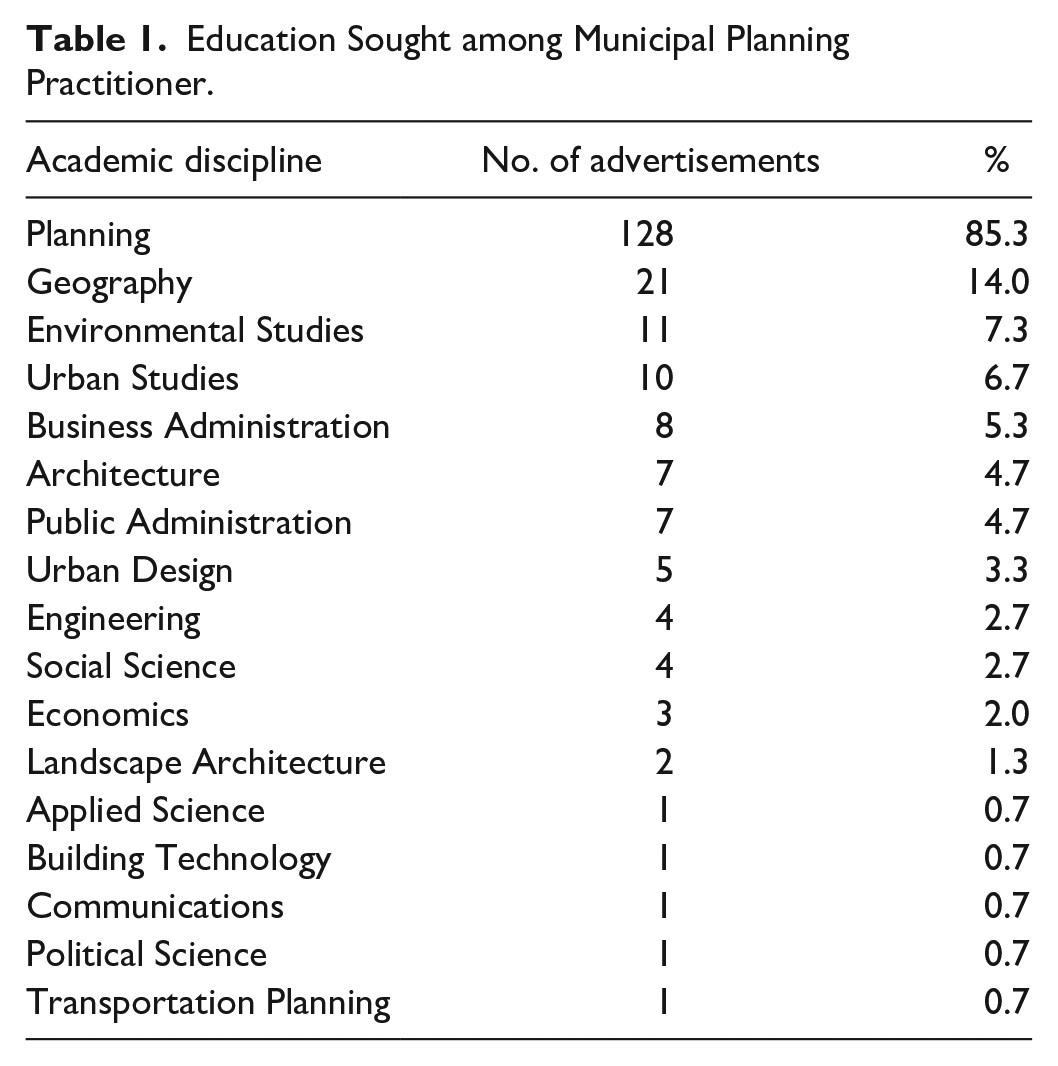
Table 1 highlights the education credentials that municipalities sought in their recruitment of planning practitioners. An overwhelming majority of the employment advertisements specified a university degree either at the graduate or undergraduate level. The most frequently cited academic discipline was Planning (85.3%), followed distantly by Geography (14%), Environmental Studies (7.3%), and Urban Studies (6.7%). It is not surprising that all advertisements do not require a degree in planning, given the multi-disciplinary nature of the planning profession. We cannot comment on the preference for a graduate versus undergraduate degree, as many employment advertisements did not explicitly specify the level of education preferred. It is interesting to note that only nine advertisements specified an accredited planning degree. The advertisements did not mention any requirement to possess a Canadian or U.S. accredited degree suggesting that any applicant with the requisite experience can qualify for the position regardless of where they completed their degree. However, most advertisements (80% or 120 postings) sought candidates with full membership in, or eligibility for, respective provincial planning chapters and the CIP, including possessing, or in the process of securing, official designation as a Registered Professional Planner. As we discuss later, an accredited planning degree does provide a more expedient route to obtaining full planning membership with CIP and respective provincial planning chapters.
Education Sought among Municipal Planning Practitioner.
Roughly half of the employment advertisements (51.3% or seventy-seven postings) targeted senior practitioners with more than three years of experience, including senior policy and development planners, coordinators, supervisors, planning managers for policy and development, and planning directors. There were 22 percent (or thirty-three postings) of advertisements that targeted practitioners with one to three years of experience, including planning technicians, junior and intermediate planners, and planning analysts. Another 16 percent (or twenty-four postings) sought practitioners with three years of experience. Approximately 10 percent (or sixteen postings) of employment advertisements did not specify years of experience.
Table 2 presents key knowledge areas specified in the planning employment advertisements. Nearly 70 percent (or 104 postings) specified that candidates must possess knowledge of planning legislation, principles, and procedures. Specifically, employers sought knowledge of federal, provincial, and municipal planning laws and regulations, as well as technical knowledge about planning processes such as official plan and zoning bylaw amendments, plans of subdivision, and site planning. Roughly 25 percent (or thirty-eight posting) of advertisements specified that candidates should have knowledge of the local government operating environment, including familiarity with the functions, management, and operations of municipal governments. A handful of advertisements (8.7% or thirteen postings) sought municipal planning practitioners with knowledge of current and emerging trends, including being able to identify and propose solutions to complex problems facing communities.
Key Knowledge Specified in Planning Employment Advertisements.
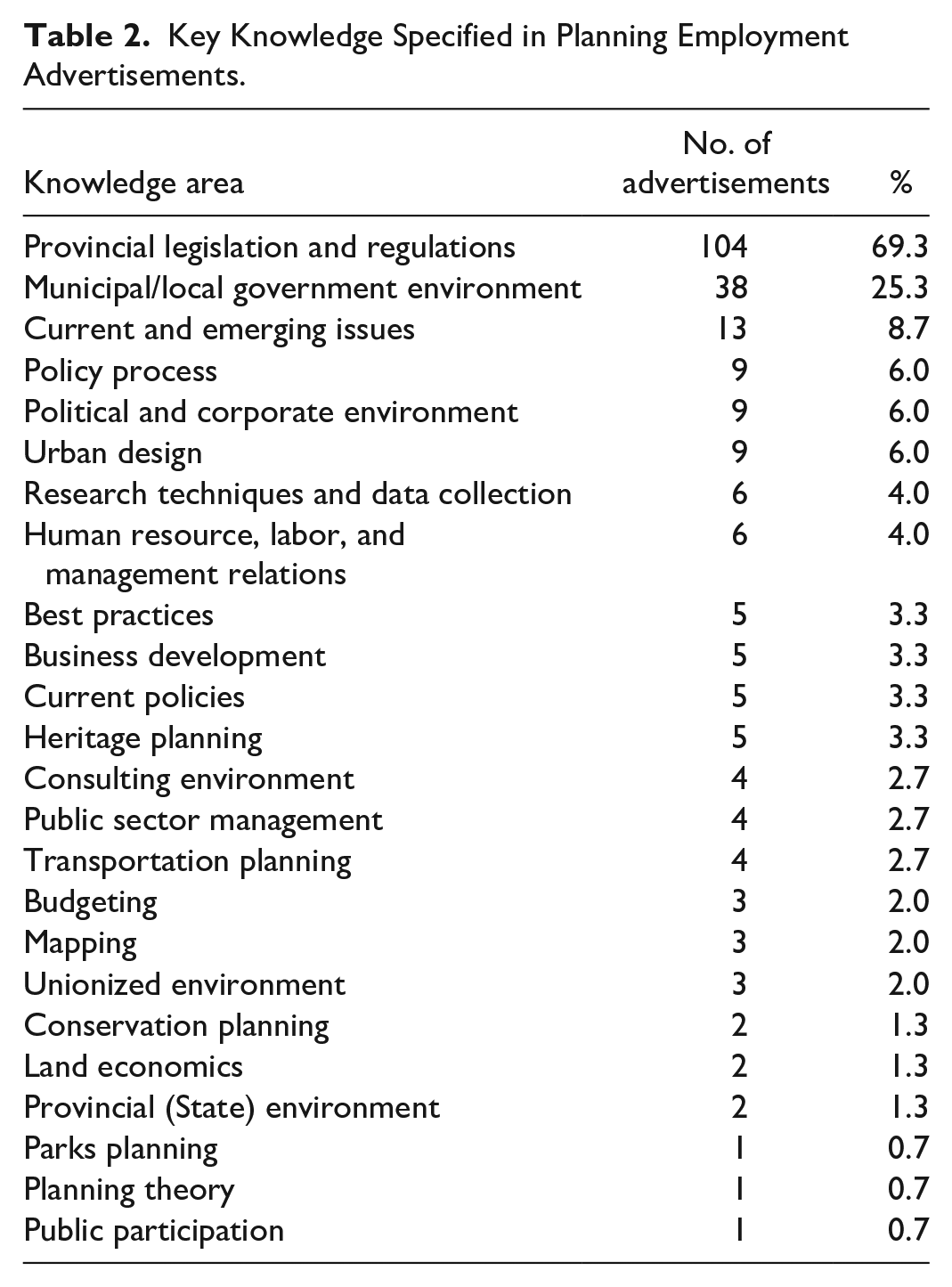
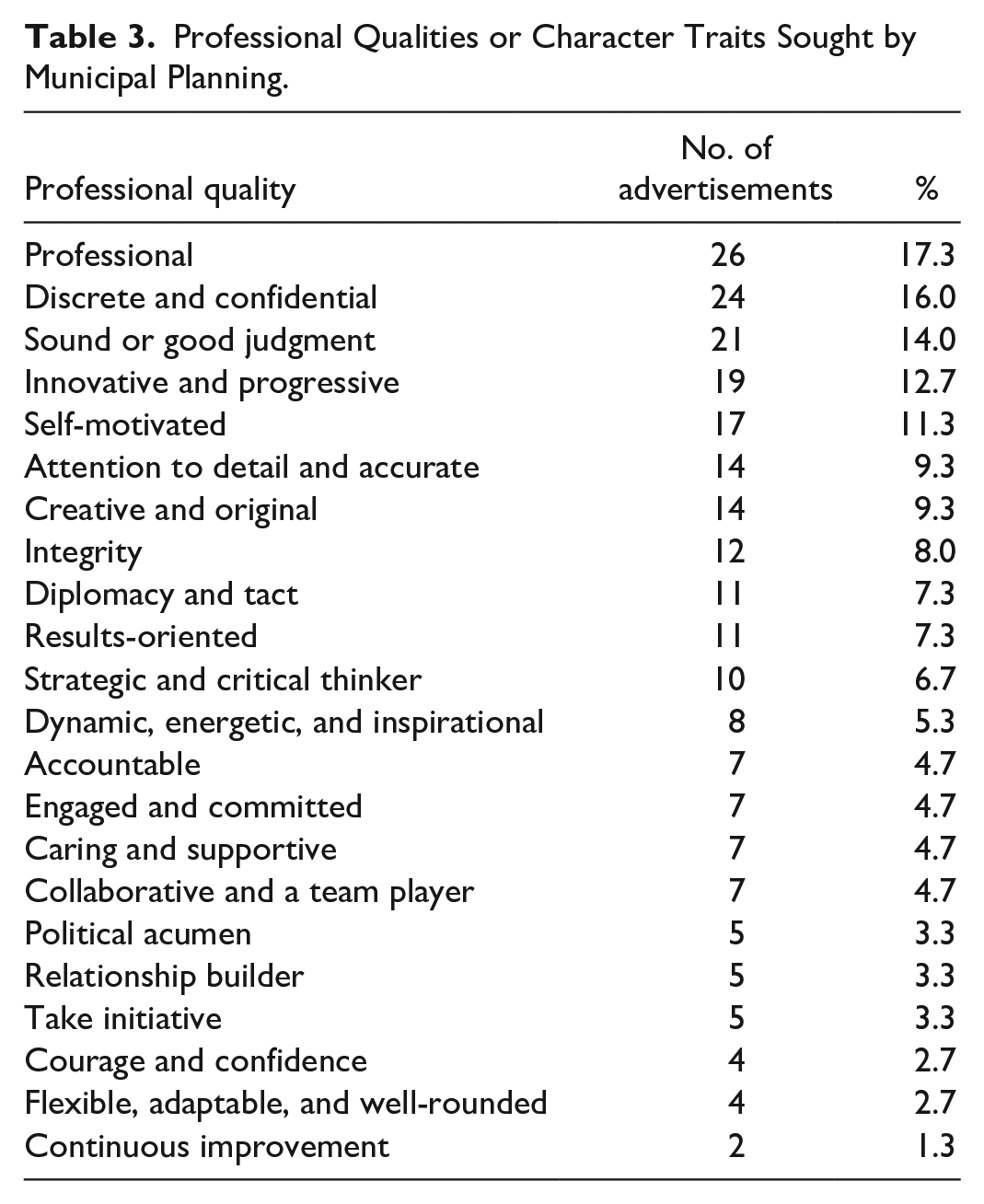
Table 3 highlights professional qualities and character traits sought by municipal governments seeking planning recruits. Roughly one-third of advertisements sought candidates who are professional (17.3% or twenty-six postings), discrete and confidential (16% or twenty-four postings), and capable of sound judgment (14% or twenty-one postings). Municipal employers also prioritized other notable traits, seeking candidates who were innovative or progressive (12.7% of nineteen postings), self-motivated (13.3% or seventeen postings), creative and original (both 9.3% or fourteen postings), and who demonstrate attention to detail (both 9.3% or fourteen postings each).
Professional Qualities or Character Traits Sought by Municipal Planning.
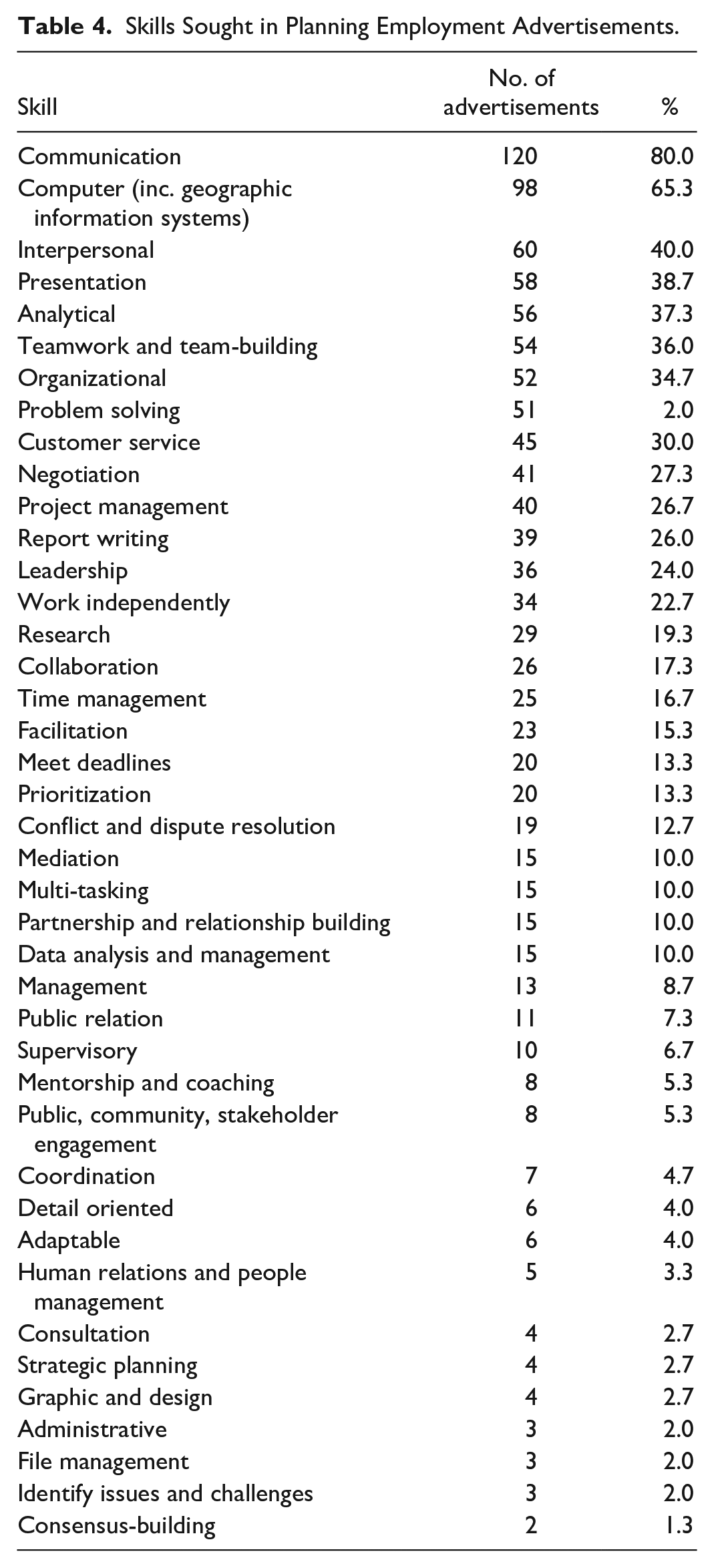
Specific planning skills sought by municipal employers are summarized in Table 4. The two most frequently cited skills included strong written and verbal communication (80% or 120 postings) and advanced computer skills (including Microsoft Office and GIS; 65.3% or ninety-eight postings). The emphasis on GIS runs counter to Ozawa and Seltzer’s (1999) and Seltzer and Ozawa’s (2002) finding that suggested GIS was one of the less demanded skills in planning. Other notable skills included strong interpersonal relations (40% or sixty postings), ability to make effective presentations (38.7% or fifty-eight postings), analytical capacity (37.3% or fifty-six postings), teamwork and team-building (36% or fifty-four postings), organization (34.7% or fifty-two postings), and problem solving (34% or fifty-one postings). This finding suggests that there are changing expectations regarding planning skills as initially conceived by previous studies.
Skills Sought in Planning Employment Advertisements.
The tasks specified in employment advertisements are presented in Table 5. Planners were expected to engage in a variety of activities as part of their employment. Roughly 70 percent of advertisements (or 103 postings) expected planning practitioners to provide recommendations and planning advice on subjects such as land use, rural and urban issues, development and building permit applications, and planning studies. A majority of the postings also expected practitioners to process planning applications, including official plan and zoning bylaw amendments, site plans, draft plans of subdivision, minor variances, and severances. The processing of official plan and zoning bylaw amendments and development applications (including site plans and plans of subdivision) were specifically mentioned in ninety-six advertisements (64%) and seventy-four advertisements (49.3%), respectively, indicating a strong demand for these activities.
Tasks Expected of Municipal Planning Practitioners.
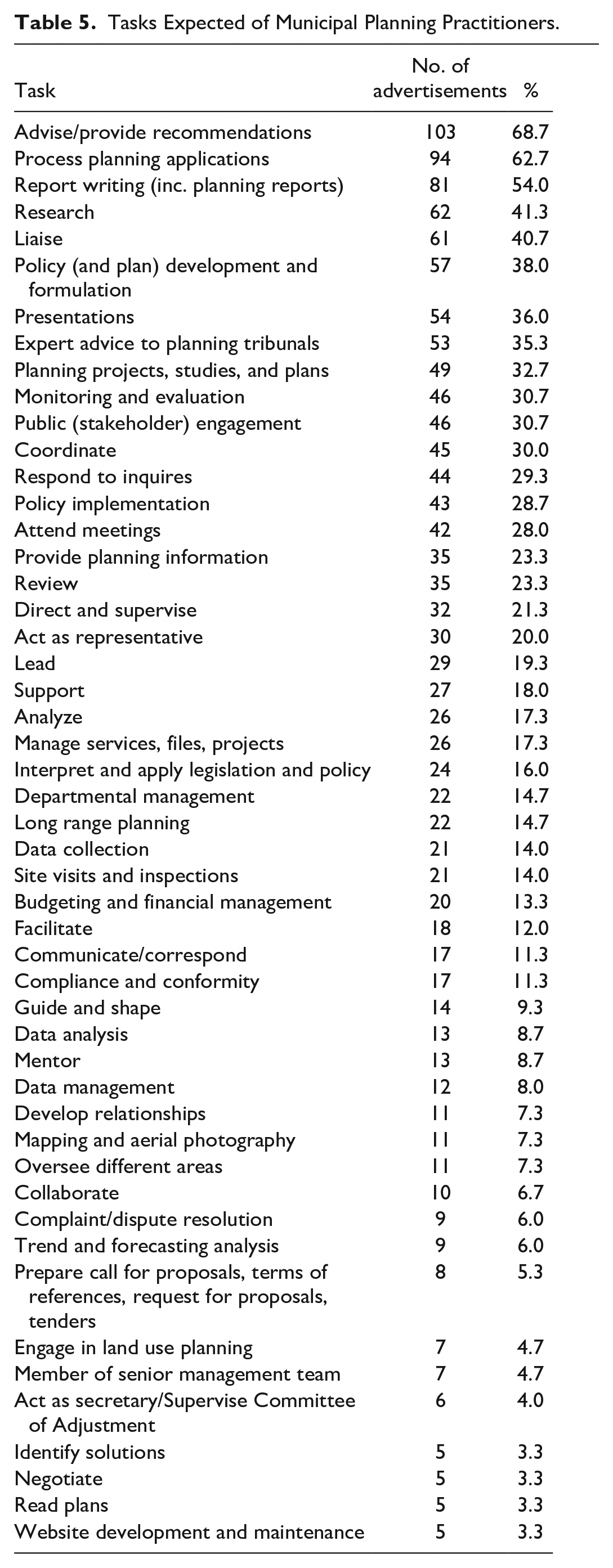
Another thirty-eight advertisements (25.3%) explicitly mentioned processing consent/severance applications, minor variances, and part lot control. Planning practitioners were also expected to write reports (54% or eighty-one postings), conduct research to support the planning function (41.3% or sixty-two postings), and liaise with various stakeholders including consultants, developers, elected officials, politicians, and other municipal departments and government agencies (40.7% or sixty-one postings).
Discussion
This section discusses three key themes that emerged from the analysis. First, municipal employers overwhelmingly prefer prospective planning employees with a planning degree either at the graduate or undergraduate level. Second, the skills demanded by municipalities generally align with the competencies identified by the CIP and the skills identified in the existing literature. Third, municipal employers target mainly well-rounded planners with broad knowledge of land use planning. The remainder of this section discusses these themes in greater depth.
Planning Graduates Are Preferred
The overwhelming majority of municipal employment advertisements specified a degree in Planning either at the graduate or undergraduate level as the core education credential. The emphasis on a Planning degree is not surprising given its focus on training planners with the knowledge and practical skills they need to succeed in the planning profession (Dawkins 2016; Rosier et al. 2016). This is especially important for programs accredited by the planning profession, which are reviewed regularly by independent bodies to ensure they teach professional and discipline competencies (Baldwin and Rosier 2016).
Undergraduate and graduate planning programs in Canada can apply for accreditation through the PSB. The PSB assesses planning programs against the key functional competencies (i.e., specific knowledge areas in planning) and enabling competencies (i.e., specific skillsets) discussed above. Similar to the PAB in the United States, the PSB includes representatives from planning practice to ensure that standards for accreditation reflect current planning practice. Planning programs can be accredited for up to five years, after which the PSB completes an extensive audit to ensure they continue to meet the standards for professional planning. Planning programs are also subject to annual reviews to ensure compliance with the competency standards, and to determine whether the program should continue to be accredited. Serious deficiencies resulting from an annual review may require corrective action to maintain accreditation status (PSB, n.d.).
A key benefit of an accredited Planning degree is that it provides graduates with a direct route to obtaining a professional planning designation. Graduates from an accredited graduate or undergraduate planning school are eligible to sit for the professional planning examination with only two years of planning experience. Another benefit is that graduates from an accredited Planning program are more likely to use a broader skillset in practice (Dawkins 2016).
Rosier et al. (2016) argue that the regular assessment of planning education against local and national professional competencies has a significant influence on Planning program curriculum, including course content and the knowledge and skills that courses target. Accrediting bodies such as the PSB generally do not require specific pedagogical approaches to deliver knowledge and competencies, but a common recommendation is that planning practitioners should be involved in educating future planners through guest lectures, work-related planning projects, and other means (Baldwin and Rosier 2016; Fischler 2012; Frank 2010).
Studio-based courses are one well-established approach to involving planning practitioners in educating future planners (Baldwin and Rosier 2016; Frank 2010; Pojani et al. 2018; Rosier et al. 2016). Studio courses, which are common in many Planning programs across the United States and Canada, place a strong emphasis on experiential learning, meaning “a purposeful process of engaged, active learning in which the learner constructs knowledge, skills or values by means of direct experiences in authentic, ‘real world’ contexts” (Pojani et al. 2018, 11). These courses help to equip future planners with many of the skills demanded by the planning profession, such as consulting, research and problem solving, and working with different stakeholder groups.
Alignment of Planning Demand and Supply
The analysis revealed that the competencies demanded by municipal employers generally align with the functional and enabling competencies set out by the CIP, as well as the skills identified in the existing literature. This suggests there is general consensus among practitioners, educators, researchers, and accreditation bodies about the key skills and competencies that are necessary for effective planning practice. A strong communication capacity was among the most frequently sought-after skills, which included written and verbal communication, presentation, teamwork and team-building, customer service, and report writing. The CIP (2011) considers communication skills to be a key enabling competency for professional planners that subsumes listening, writing, oral and visual presentation, understanding information and knowledge required to support decision making, use of information technology, and internal and external relations. Communication has also been recognized consistently as an important generic skill in the planning literature since the 1970s (Contant and Forkenbrock 1986; Dalton 2007; Dawkins 2016; Greenlee, Edwards, and Anthony 2015; Guzzetta and Bollens 2003; Miller 2019; Ozawa and Seltzer 1999; Seltzer and Ozawa 2002).
The CIP (2011) identifies critical thinking (including problem solving and decision making, research and analysis, innovation and creativity, political awareness, and change management) and interpersonal skills (includes integrity and trust, diversity and inclusiveness, facilitation, negotiation, collaboration and consensus-building, and conflict management) as important skills for professional planners. These are also notable skills identified by Miller (2019) and Greenlee, Edwards, and Anthony (2015) in their research. Our analysis found that the majority of employment advertisements mentioned these skills as important, the most notable of which were interpersonal skills, analytical capacity, problem solving, collaboration, research, innovation and progressiveness, facilitation, consensus-building, and dispute resolution. Professionalism is also an important trait for planners, which was found frequently in our analysis of employment advertisements and is highlighted by the CIP (2011) as a key enabling competency.
Ozawa and Seltzer (1999) and Seltzer and Ozawa (2002) found that familiarity with laws, ordinances, and policies, and the ability to read and interpret zoning legislation, were highly desirable skills among planning practitioners. An understanding of relevant planning legislation is also an important functional competency identified by the CIP. Our analysis supports these findings, particularly the need for knowledge of planning laws and regulations, and a general understanding of the municipal operating environment.
Well-Rounded Planners with Specialized Knowledge of Land Use Planning
A third key theme revealed by this analysis is that municipal employers mainly target well-rounded planners with specialized knowledge of land use planning. The knowledge areas and skills identified in planning employment advertisements tended to be broad, focusing on general areas such as knowledge of planning laws and regulations, the ability to communicate effectively, strong interpersonal skills, and analytical capacity. The professional qualities described in advertisements highlighted professionalism, a demonstrated capacity to manage confidential matters, sound judgment, and a commitment to providing innovative and progressive solutions to planning issues. The tasks specified in the planning advertisements also support the contention that employers seek well-rounded planning generalists who can provide advice and recommendations on planning matters, write reports, conduct research, and liaise with different stakeholders.
We also found that employment advertisements that require specialized planning skills, such as urban design, heritage planning, transportation planning, conservation planning, and parks planning, require generalist planning knowledge including planning laws and regulations and general planning principles. However, as our analysis did not specifically target specialized planning advertisements, we cannot assume that the requirements for specialist planning positions are the same as the generalist planner. Future research could look into the specific educational background, knowledge areas, professional qualities, and skills needed for specialist planning positions.
These findings parallel those of Greenlee, Edwards, and Anthony (2015), who noted that more than 80 percent of planning directors preferred entry-level planning recruits to be generalists who possess knowledge about many aspects of planning, rather than specialists in one component of planning, such as economic development. However, unlike Greenlee, Edwards, and Anthony (2015), our analysis suggests that the planning generalist is preferred among both senior- and junior-level planning recruits, at least based on our findings.
Our analysis confirmed Greenlee, Edwards, and Anthony’s (2015) observation that employers prefer planners with specialized knowledge of development and land use planning. Employment advertisements tended to target candidates who possess technical knowledge related to official plans, zoning bylaws, and plans of subdivision, among other aspects of development and land use planning. Municipal employers expect planning practitioners to manage a range of planning processes, including official plan and zoning bylaw amendments, consents, minor variances, severances, part lot controls, plans of subdivision, and site plans. They are also expected to provide expert advice on planning applications at local planning tribunals. Many advertisements called for planners to assist with policy (and plan) development and formulation, policy implementation, and monitoring and evaluation. These findings further illustrate the preference for the planning generalist with specialized knowledge of land use planning. The findings also reveal a critical distinction in planning practice that warrants further investigation. Planning advertisements seem to weigh heavily in favor of the development review function, which tend to require different skill sets than advertisements around public policy formulation and execution. The former tends to emphasize physical planning, to be largely regulatory and reactive, and to be only marginally impactful upon a community’s long-term growth and development. In contract, the latter emphasizes socioeconomic and financial analysis and, at its best, can be more proactive and transformational. We did not consider this distinction in our analysis; however, a future study could explore this relationship in greater detail.
It is important to note that, as we do not consider the full breadth of avenues used by municipalities to recruit planners, we are unable to conclude that students of planning can and should remain generalists based on the findings from this research. The findings are derived from planning advertisements retrieved from municipal websites, the CIP website, and job boards of the provincial planning associations. These are the commonly used avenues for recruiting municipal planners.
Conclusion and Recommendations
This research examined municipal planning employment advertisements to identify expectations regarding education credentials, specific knowledge areas, professional qualities, skills, and tasks of planning practitioners. Four key findings were revealed in the analysis. First, the municipal planning sector overwhelmingly prefers prospective employees with a Planning degree either at the graduate or undergraduate level. Second, the skills demanded by municipalities generally align with the competencies identified by the CIP and the skills identified in the existing literature. Third, municipalities mainly target well-rounded planners with specialized knowledge of land use planning. Finally, it appears that the qualifications demanded by planning recruiters have evolved over time. For instance, our study found that recruiters sought GIS skills, which differed from the earlier findings of Ozawa and Seltzer (1999) and Seltzer and Ozawa (2002), and the ability to write reports for the public, which contradicts an earlier finding of Guzzetta and Bollens (2003) that this was a less important qualification for planners.
These findings have implications for planning education and practice. First, the evidence from this study suggests that a Planning degree holds particular weight in the recruitment of municipal planners. Planning educators and planning practitioners should continue to work together to identify in-demand and emerging skills and knowledge needed to help future planners succeed in the planning profession. This includes equipping future planners with key generic skills such as strong written and verbal communication, making effective presentations, strong analytical and problem-solving capacities, teamwork and teambuilding abilities, and interpersonal and organizational skills. Educators should also train future planners on key knowledge areas and tasks demanded by the municipal sector, including an understanding of planning laws and regulations, and the processes related to official plan amendments, zoning bylaws, plans of subdivision, and site planning.
Planning schools should also continue to work closely with professional accreditation bodies, such as the PSB, to ensure that planning programs are equipping students with the competencies that are deemed necessary for effectiveness in professional planning. There should also be opportunities for planning educators to provide feedback on the professional planning competencies to reflect changes in planning education and scholarship. As Brinkley and Hoch (2018) and Greenlee, Edwards, and Anthony (2015) note, planning practitioners are generally out of step with knowledge generation to predict the evolving nature of planning.
This study presents an opportunity for further discussion and research. One promising avenue is to include other avenues of communication used by municipalities to recruit planners with specialties that extend beyond land use planning. Another is to expand the study’s focus on the municipal planning sector to analyze the knowledge, skills, qualities, and tasks demanded in the nonprofit and private planning sectors. Our analysis considers planning advertisements as accurate and complete reflections that employers consider important. A future study could involve interviews with a valid sample of employers to corroborate the findings from this study. Finally, our study focuses on planning practice in Canada, and it would be beneficial to expand the study to planning practice in the United States. This would allow planning educators, those who set the standards for the planning profession and those who practice planning to gain a mutual understanding about important professional qualifications being demanded by the U.S. and Canadian planning profession.
Supplemental Material
sj-docx-1-jpe-10.1177_0739456X211021151 – Supplemental material for Competing in the Planning Marketplace: An Analysis of Qualifications Demanded by Municipal Planning Recruiters
Supplemental material, sj-docx-1-jpe-10.1177_0739456X211021151 for Competing in the Planning Marketplace: An Analysis of Qualifications Demanded by Municipal Planning Recruiters by Dave Guyadeen and Daniel Henstra in Journal of Planning Education and Research
Footnotes
Acknowledgements
The authors would like to thank the anonymous peer-reviewers for their insightful feedback and comments.
Declaration of Conflicting Interests
The author(s) declared no potential conflicts of interest with respect to the research, authorship, and/or publication of this article.
Funding
The author(s) received no financial support for the research, authorship, and/or publication of this article.

Supplemental Material
Supplemental material for this article is available online.
Author Biographies
References
Supplementary Material
Please find the following supplemental material available below.
For Open Access articles published under a Creative Commons License, all supplemental material carries the same license as the article it is associated with.
For non-Open Access articles published, all supplemental material carries a non-exclusive license, and permission requests for re-use of supplemental material or any part of supplemental material shall be sent directly to the copyright owner as specified in the copyright notice associated with the article.
