




Abstract
Public pressure to take punitive action against human rights violators is often a driving force behind international sanctions. However, we know little about the way in which public support is shaped by varying types of abuse, the costs and effectiveness of sanctions and the differential harm they inflict upon the target population and leadership. Our study specifically addresses this gap by unpicking contextual factors that jointly sway the perception of morality and the cost-benefit calculus. We propose that there is no simple trade-off between instrumental and moral concerns. The context within which violations take place and the interactions between moral and instrumental dimensions shape preference formation. Findings from our paired conjoint experiment suggest that whether respondents support imposing sanctions depends on the category of human rights abuse and its perceived salience. Individuals also prefer sheltering the target population while punishing the leadership, but collective punishment becomes less unacceptable if the majority of the target population support the human rights infringements. The desire to do something against the perpetrators amplifies the appeal of punishing the leadership but assuages the moral concerns of harming the population.
Introduction
Imposing economic sanctions on countries that abuse human rights is a common foreign policy response. Governments may also use sanctions to appease the demands of domestic constituencies (Whang, 2011; McLean & Whang, 2014; Kustra, 2022). For example, bowing to the demands of his Christian support base, President George Bush sanctioned Sudan as a response to gross human rights violations in Darfur (Goldenberg, 2007). Similarly, the Obama administration imposed sanctions on Uganda in 2014 by declaring that the introduction of anti-gay laws was ‘counter to universal human rights’ (BBC, 2014). As policymakers in democracies are receptive to the demands of the public, campaigners aiming to instigate action against human rights violators face the task of mustering public support. This means that studying the micro-foundations of citizen support is important for understanding international sanctions, because drivers of promoting human rights abroad are also rooted in political considerations at home.
In this study, we investigate the factors that influence citizen willingness to impose sanctions on countries that violate human rights. Our starting point is that an individual reflects on instrumental and moral dimensions together as a whole when forming their opinion. Studies grounded in the cost-benefit framework highlight the costs of sanctions for the country imposing them and their effectiveness in inducing the receiver’s compliance as the two primary dimensions that the public consider (Heinrich, Kobayashi & Peterson, 2017; Putnam & Shapiro, 2017). A competing approach draws attention to the dimension of morality to argue that normative considerations, as opposed to instrumental concerns, can sway public opinion to pursue costly foreign policy tools without significant material benefits (Kreps and Maxey 2018). Regardless of their effectiveness at securing compliance, sanctions may have a costly but expressive purpose of reinforcing morality (Galtung, 1967: 412).
Building on this debate, we identify contextual factors that influence citizen opinion. Our key argument is that there is no simple separation between instrumental and normative considerations. When forming their opinion, an individual makes a multidimensional trade-off by reflecting on several contextual factors that jointly affect the perception of morality as well as the cost-benefit analysis (Heinrich & Kobayashi 2020). In particular, we identify the cost of sanctions on the receiver in terms of type and volume (i.e. who is hurting and to what extent) as an influential – but insufficiently investigated – factor.
We also contribute to the empirical study of public opinion formation by recognizing the difference between collective and targeted sanctions. Although this difference is central to both public debate and foundational theory (Drezner 2011; Galtung 1967; Weiss 1999), empirical studies have yet to consider the cost of intervention that is borne by the public of the targeted country as a moral consideration. As Kirshner (1997: 33) argues, a simple distinction between the country imposing the sanctions and the target is insufficient: ‘instead of considering how [economic] sanctions hurt the target state’, research should account for ‘how groups within the target are affected differentially’. We explicitly incorporate such an essential dimension into our study and further propose that citizens use the information on the type of abuse and the political context within which human rights violations occur when they attribute individual or collective accountability.
Our framework sheds further light on the mixed findings in the empirical literature regarding public support for foreign policy instruments. On the one hand, an emerging line of research has challenged the conventional wisdom that public opinion is driven by normative concerns, arguing instead that individuals are more self-serving and goal-oriented than previously assumed (Heinrich & Kobayashi, 2020; Heinrich, Kobayashi & Long, 2018). On the other hand, several recent studies have found that individuals tend to prioritize the humanitarian over the instrumental when asked about military interventions (Kreps & Maxey, 2018; Tomz & Weeks, 2020). Hence, our overarching research question aims to investigate how normative concerns, instrumental goals and the trade-off between the two underlie public support for economic sanctions against countries that violate human rights.
Following this line of thought, we conducted a pre-registered conjoint experiment to test simultaneously the impact of previously omitted factors on citizen preferences towards economic sanctions aimed at promoting human rights. Holding the volatile political environment constant, we reveal a number of key factors – and the interactions between them – that contribute to understanding preference-based third-party punishment. More specifically, we consider the political morality of human rights with respect to different types of infringements, the costs of promoting human rights, the likelihood of success of sanctions, and the juxtaposition of norm enforcement and norm diffusion.
Our most prominent findings can be summarized under three points. First, whether different types of human rights abuses merit international sanctions depend on the degree of their perceived salience. Respondents perceive some types of human rights violations (e.g. torture and ill-treatment by state authorities) to be more worthy of punishment than politically contested ones (e.g. women’s reproductive rights and equal marriage rights). Moreover, we find an interaction between the type of violation and local support for it: individuals are far more willing to punish infringements concerning the language and religious rights of minorities when the target population overwhelmingly support their government’s transgressions.
Second, we find that individuals do differentiate between the target population and its leadership and show a clear preference for punishing the latter more severely while sheltering the former from the harms of sanctions. However, this aversion to harming the target population is dependent on a number of factors. Most notably, when only a small minority of the target population support the transgressions of their government, respondents are even more averse to inflicting harm on the populace, but their willingness to differentiate between the target population and the leadership decreases as the proportion of locals supporting the policies that infringe human rights increases. As expected, we also find that respondents are sensitive to incurring costs when imposing sanctions. Contrary to our expectations, however, their unwillingness to incur higher costs remains remarkably consistent irrespective of the harm that falls on the target population. Individuals neither become more magnanimous nor less averse to incurring costs when the harm caused to the target population by sanctions decreases, reflecting the saliency of sanction costs and the limitations of incentives for protecting the target population. This is a crucial finding for the literature on sanctions because it suggests the limitations of costly altruistic punishment, which refers to the willingness to bear costs to penalize norm transgressors (Fehr & Gächter, 2002).
Finally, our results present support for the expressive function of sanctions in reinforcing morality. Contrary to our initial expectations, the ineffectiveness of previous sanctions does not dissuade individuals from issuing new ones. Similarly, respondents disregard the effectiveness of previous sanctions when evaluating the harm falling on the target population and leadership. Individuals are consistent in their enthusiasm for punishing the leadership and in their disapproval of harming the population, irrespective of previous compliance. However, respondents show a preference for maiden sanctions (i.e. imposing sanctions on a country that has not previously received them). This desire to do something against the offenders may even amplify the appeal of punishing the leadership and, more surprisingly, assuage the moral concerns of harming the target population.
The rest of this article is organized as follows. First, we provide a brief review of studies that have investigated the micro-foundations of public preferences with regard to costly foreign policy instruments for pursuing humanitarian goals. We particularly focus on studies with an experimental design, because our main interest is citizen decision-making. We continue with our theoretical framework from which we derive a series of hypotheses. After explaining our experimental design, we present our most noteworthy results. In the concluding remarks, we highlight the governmental and non-governmental policy implications of our study and explore areas of further research.
Public opinion and foreign policy responses to human rights violations
Public opinion in democracies matters for foreign policy decisions. Leaders often seek domestic support for punitive actions against a foreign country by appealing to the humanitarian values of the public. Such rhetoric can even be used to justify instrumental actions driven by material and strategic goals. Conversely, otherwise uninterested policymakers may find themselves under pressure from the public to do something against those who violate international human rights. An established research tradition has shown that human rights organizations, the media, voters and special interest groups are all influential with regard to how leaders craft and implement foreign policy instruments (Kustra, 2022; McLean & Whang, 2014; Murdie & Peksen, 2013; Peksen, Peterson & Drury, 2014; Whang, 2011). This strong link between domestic public opinion and foreign policy renders the study of the micro-foundations of punitive foreign policy instruments particularly important.
Despite its importance, only a small but growing literature has investigated how contextual factors and key issue dimensions affect individual opinion formation through a causal framework. In the specific context of economic sanctions, Putnam & Shapiro (2017) and Heinrich, Kobayashi & Peterson (2017) are the only studies using an experimental design. In line with the academic debate on economic sanctions, both studies regard the costs borne by the country imposing the sanctions as a central dimension that individuals consider when forming their opinion. As expected, the higher costs of sanctions for the country imposing them result in a decrease in respondent support. Heinrich, Kobayashi & Peterson (2017) further investigate both the short- and long-term effectiveness of sanctions and find a positive relationship. However, neither study varies the type of human rights abuse in its experimental design. 1 Hence, substantive differences in the type of human rights violation is a dimension that has been overlooked by experimental studies so far. Identifying this lacuna in the literature, we will aim to address it in our research design.
Another limitation of extant research is that the differential cost of sanctions for the target has not yet been considered. For example, Heinrich, Kobayashi & Peterson (2017) take the cost of sanctions for the target as a measure of the severity of punishment, but their experimental design does not differentiate between how these costs are distributed within the target. Hence, the extant literature considers the cost of sanctions entirely instrumental rather than reflecting on both the moral and instrumental aspects of their imposition. This remains a limitation because whether the sanctions inflict harm on the leaders or on the general populace of the violating country is central to understanding public attitudes towards economic sanctions.
One strand of the literature focuses on the ways in which USA and UK citizens express moral qualms about waging war against a country that has violated human rights (Kreps & Maxey, 2018; Tomz & Weeks, 2020). Because individuals tend to have strong moral reactions against human sufferings and severe wrongdoings, the public is more likely to justify retribution against those who violate human rights (Stein, 2015; Wheeler, 2000). Following the expansion of human rights through universal declarations, international humanitarian norms enable and encourage citizens and their states to become morally responsible with regard to mistreated strangers (Finnemore, 1996). Nonetheless, the experimental literature often presents human rights violations abroad through wartime-like scenarios by setting the contextual factors aside and ignoring the nuances in political morality, which are linked with contentious types of violations. This causes limitations for studying individual opinion formation more broadly, especially considering that a theory of norms cannot leave the specific social context out of consideration (Granovetter, 1985). In short, further research is needed not only to expand our understanding of contextual factors and the interactions between them, but also to validate earlier findings.
Theoretical framework and hypotheses
We start by proposing that there is no simple trade-off between instrumental and moral concerns. The context within which violations take place influences the cost-benefit calculus, including the willingness to incur costs and the desire to punish violators. In addition, interactions take place between the moral and instrumental dimensions. Hence, it is necessary to account for the severity, kind and target of human rights abuses to uncover how different aspects of the morality of human rights affect individual attitudes towards economic sanctions.
Type of violation
Political contestations for demarcating the boundaries of the right to moral equality and the right to moral freedom may obscure what constitutes a human right (Perry, 2020). The public may prioritize the protection of less contentious and more universally accepted human rights, such as conventions in relation to cruel treatment, rather than politically contested human rights such as reproductive rights, same-sex marriage and the protection of language and religious practices (Wike & Schumacher, 2020). The perceived severity of the violation is likely to be a function of the type of infringement and politically motivated reasoning (Valentini, 2012; Whitmeyer, 2002).
Based on this conjecture, we consider six types of infringements varying in their degree of political contestation. The first two, restricting abortion rights and restricting equal marriage rights are the most contentious violations because these two rights are not universally accepted. The last two, forced child labour and torture and ill-treatment in detention, are the least contentious violations because such abuses infringe rights that are more established and universally accepted. Finally, restricting freedom of expression and restricting the language and religious practices of minorities are located between these two poles in terms of their level of contestation.
Recognizing substantive differences in the types of human rights abuse is a crucial step forward because of two interrelated reasons. First, individuals value some human rights more than others depending on their beliefs and political preferences (McFarland & Mathews, 2005). Second, there is a difference between the human right to moral equality and the human right to moral freedom, which may emerge as a source of controversy and political contestation (Perry, 2020). Taken together, the political context within which distinct types of violations take place is likely to induce different responses. In this respect, we expect individuals to perceive imposing sanctions against some type of violations (e.g. forced child labour) as more morally imperative than targeting others (e.g. restricting abortion rights).
Human rights are indivisible in principle. However, in practice, we expect to see a moral hierarchy of distinct types of infringements in terms of their perceived salience and, therefore, their capacity to attract sanctions. We also expect this perceived salience to interact with other moral and instrumental dimensions and alter the willingness to incur costs and the desire to punish transgressors. In other words, essential differences in the types of human rights abuse should alter the moral vs. instrumental trade-off. Unpacking these interactions is the main purpose of our study, but before turning to conditional expectations, we start by formulating a simple hypothesis on the moral hierarchy.
2
Hypothesis 1.1: Violations of less contested rights will draw a higher level of support for sanctions compared with infringement of rights that are not endorsed by every spectrum of the polity.
Cost of sanctions and their expected effectiveness
Imposing sanctions entails costs for the sender country and its citizens. Relatedly, the literature expects that public support for any foreign policy instrument is driven by the extent of the potential cost as well as the predicted success of the action (Gartner, 2008; Heinrich, Kobayashi & Long, 2018; Heinrich, Kobayashi & Peterson, 2017). Reflecting on the first-order cost-benefit calculus, we expect individuals to support sanctions that are less costly in themselves and have a higher chance of success. We gauge the higher chance of success by the previous effectiveness of sanctions. It is also vital to recognize the international dimension as an instrumental consideration because the behaviour of other states will have an impact on the cost and effectiveness of sanctions. If third-party countries also contribute to protecting human rights through complying with sanctions, which signals that free-riding is not a severe challenge and that sanctions are more likely to be effective, then it is reasonable to behave similarly and be willing to make sacrifices in the hope of a better payoff (Cheung, 2014). This expectation overlaps with the conditional cooperation hypothesis, which refers to a motivation ‘to contribute more to a public good the more others contribute’ (Fischbacher, Gächter & Fehr, 2001: 397).
Hypothesis 2.1: The higher the costs of sanctions to the sender country the lower the support for them.
Hypothesis 2.2: If the receiver country’s previous compliance rate with sanctions is low, the public will be less likely to promote human rights through sanctions.
Hypothesis 2.3: The public are more likely to support imposing sanctions when the number of third-party countries participating in the sanctions regime is higher.
These first-order instrumental hypotheses are direct extensions of the extant literature. By revisiting them, we aim not only to replicate earlier studies but also to use them as a foundation for our study, with the intention of discovering interactions between instrumental and moral considerations. Next, we turn to such interactions, which is where our main contributions lie.
Differential harm inflicted on the target
When discussing the trade-offs involved in implementing an instrument to influence the human rights record of a foreign country, the literature has focused on the costs borne by the country imposing the sanctions and the likely benefits of such policy interventions. However, this approach ignores the costs borne by the public (as opposed to policymakers) in the target country. For example, Kreps & Maxey (2018) consider the cost of intervention for the intervenor, but not the civilian costs due to the humanitarian intervention itself. It is reasonable to expect that any humanitarian intervention, however well-designed and executed, would inadvertently cause civilian casualties. Similarly, public opinion research on economic sanctions excludes the cost of economic sanctions on the civilian population as a factor that influences the moral considerations of respondents. The costs that fall on the violator country are understood only as a factor reflecting the severity of punishment and the expected effectiveness of sanctions (Heinrich, Kobayashi & Peterson, 2017; Putnam & Shapiro, 2017).
We argue that the differential harm of sanctions brings both moral and instrumental considerations. On the one hand, costs inflicted on the target signal effectiveness because the objective of sanctions is to harm the receiver country, especially its policymakers. On the other hand, the humanitarian costs of economic sanctions are a moral concern. Indeed, costs borne by the target are a focal point of discussion in both academic theory and public debate (Galtung, 1967; Malloy, 1995; Weiss, 1999). Normative considerations regarding the collateral damage that sanctions inflict upon the civilian population have influenced how countries design and implement them (Drezner, 2015). Most notably, human rights organizations often highlight the humanitarian crises economic sanctions cause and question the ethics of imposing collective sanctions (McFarland & Mathews, 2005; Wike & Schumacher, 2020). Such ethical considerations, in turn, affect the use of sanctions (Murdie & Peksen, 2013; Peksen, Peterson & Drury, 2014; Whang, 2011). We consider this debate central to studying public opinion and understanding complex trade-offs when faced with moral and instrumental concerns.
Hypothesis 3.1: The higher the level of harm inflicted on the general populace of the target, the lower the support for sanctions.
Hypothesis 3.2: The higher the level of harm inflicted on the leaders of the violator country, the higher the support for sanctions.
We use the distinction between general and targeted sanctions to further unpack the costs borne by the receiver. Note that there are two facets of sanction costs: those that are borne by the country imposing the sanctions, which we call incurred costs; and those that are borne by the receiver, which we call inflicted harm. Our key argument is that given the moral–instrumental trade-off, individuals are more willing to incur the costs of imposing sanctions as long as inflicted harm falls largely upon the leadership, but not on the general populace. This expectation stems from costly altruistic punishment, which refers to the willingness to bear costs to penalize norm transgressors (Fehr & Gächter, 2002). The negative emotions that infringements incite drive this willingness to incur costs to inflict punishment. We expect this mechanism to be stronger when the punishment is more directly targeted at the perceived transgressor, which is the leadership in this context.
Put simply, the altruistic punishment hypothesis expects individuals to be more cost tolerant if the sanctions harm the target leadership to a great extent while shielding the civilian population. The negative impact of sanction costs on public support would be attenuated because the punishment is directed more towards the leadership than the civilian population. This expectation also means that if the sanctions are either hurting the target population more than the leadership or are distributed evenly across the target, then the negative effect of incurred costs on public support would be amplified. In contrast, our altruism argument would be incorrect if aversion towards the costs remains consistent, irrespective of how the harm of sanctions is distributed across the population. We formulate the following hypothesis.
Hypothesis 3.3: Individuals are more willing to accept incurred costs when the inflicted harm affects the target population to a lower extent but affects the target leadership to a higher extent.
The effectiveness of sanctions in influencing violator behaviour is an important consideration both in academic studies and the public debate. Its critics formulate sanctions as an expensive but ineffective foreign policy tool, which can bring detrimental results in terms of democracy promotion and human rights protection (Morgan & Schwebach, 1997; Peksen, 2009; Wood, 2008). Others highlight that regardless of their effectiveness, sanctions play an expressive role, addressing the moral responsibility in taking action against norm violations and punishing the perpetrators (Galtung, 1967; Whang, 2011). The interaction between the cost and the effectiveness is expected to result in low-cost symbolic sanctions, which play an expressive role when influencing the behaviour of the target is unlikely (McLean & Whang, 2014). Addressing this debate, public opinion research also locates the effectiveness as a central factor in the cost-benefit calculation, with an expectation that support for costly sanctions should be low if the target is unlikely to change course; however, if the costs incurred are small, sanctions may play an expressive function regardless of their effectiveness (Heinrich, Kobayashi & Peterson, 2017).
Explicitly recognizing that sanctions may harm civilians of the target country without achieving policy change helps us further unpack the complex cost-benefit analysis that individuals face. We argue that the difference between general and targeted sanctions is again central to this trade-off because individuals are more willing to incur costs to impose sanctions on those to whom they attribute responsibility, even if such sanctions are unlikely to prompt behavioural change. However, sanctions that affect the general public of the target country without having an impact on its leaders are unlikely to play an expressive role and muster citizen support. Based on this reasoning, we formulate the following hypotheses.
Hypothesis 4.1: When the target is unlikely to stop human rights violations, individuals will support sanctions if there is a high level of inflicted harm falling on the leadership.
Hypothesis 4.2: When the target is likely to stop human rights violations, individuals will support sanctions if there is a high level of inflicted harm falling on the target population.
Norm diffusion
Establishing shared moral judgements is culturally and politically bounded; thus, whether a specific human right is homogenously endorsed is a focal point of interest for investigating the causal pathways for supporting human rights protection abroad. Most notably, public attitudes towards supporting a distinct type of human rights vary between countries and people that are affiliated to different political ideologies (McFarland & Mathews, 2005). For example, a significant majority of the public in both the USA and the UK endorse the importance of equal rights to practise religion freely, whereas only 18% of Japanese citizens support such a right (Wike & Schumacher, 2020). Similarly, the conventions of equal treatment for detainees or labour rights are recognized by the majority of UN members, whereas the majority of states do not recognize the full scope of lesbian, gay, bisexual, transgender and intersex (LGBTI) rights (Human Rights Watch, 2019).
Drawing on this challenge, we recognize that third-party punishment for human rights violations not only captures the social preference for enforcing cooperation between the norm protector and the violator, but may also forcibly alter the moral domain of ‘others’. In this regard, norm entrepreneurs with principled ideas, such as human rights advocates, play a vital role in initiating and extending new behaviour through the diffusion of international norms (Finnemore & Sikkink, 1998; Hyde, 2011).
This raises the question of to what extent citizens are willing to extend their third-party punishment to the context of violations in which the majority of the target country’s population morally justifies the human rights abuse being addressed. To the best of our knowledge the relevant literature has yet to reveal such a question; therefore, we prefer to retain an exploratory approach towards understanding it. Nonetheless, given the possibility of the within-design interaction with the type of human rights in our experimental design, we formulate the following hypothesis:
Hypothesis 5.1: The public are more likely to favour sanctions when the majority of the target country’s citizens endorse certain human rights abuses that are more universally condemned, namely, torture and ill-treatment by state authorities, and forced child labour, in contrast to violations of contested human rights.
When making decisions regarding sanctions that would cause collective harm to the target country, individuals may justify their preferences depending on whether the majority of citizens in the target endorse the abusive policy. The third-party punishment for groups is likely to be based on the perceived behaviour of the majority rather than a minority of policymakers in such collective actions. Following this argument, we revisit the discussion on compliance; if people anticipate lower levels of compliance, sanctioning the group rather than individuals may be seen as the most cost-effective means (Whitmeyer, 2002). Although the public in democratic countries should have a moral aversion to harming civilians through sanctions, this disinclination is likely to be conditional on the target population’s perceived level of support for policies that infringe human rights. Therefore, we offer the following hypothesis:
Hypothesis 5.2: The public will be more likely to accept harm being inflicted on the target population as the proportion of the population supporting the abuse increases.
Experimental design
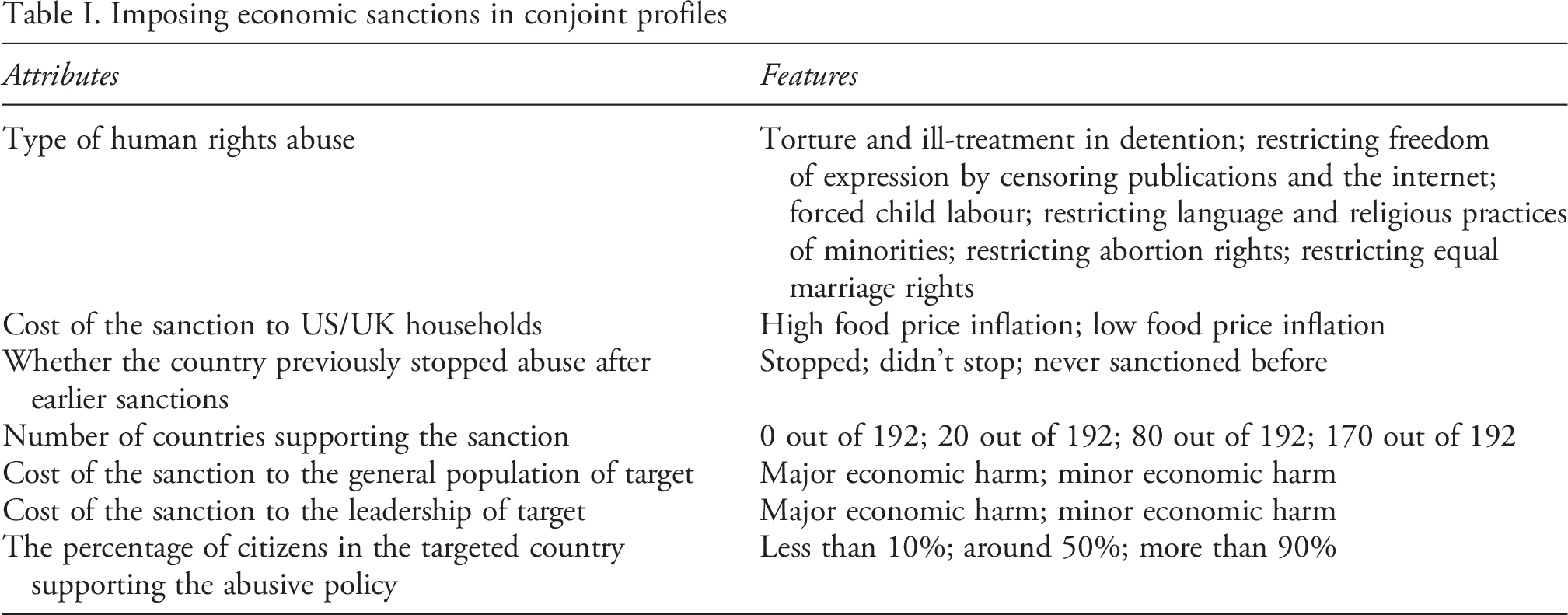
Our empirical strategy employs a web-based paired conjoint experiment with forced-choice design to examine the heterogeneity of third-party punishment regarding the violations of global human rights (see Online appendix A1). Unlike a binary treatment in traditional survey experiments, we simultaneously manipulate seven different attributes of human rights violations (see Table I): the type of human rights abuse; the costs of sanctions to the country imposing them; previous compliance with sanctions; participation of third-party states; the harm inflicted on the civilians and leadership of the target; and public endorsement of human rights abuse. Therefore, we offer a more comprehensive understanding of citizen preference for sanctions.
The conjoint design allows respondents to choose or rate two or more hypothetical choices that have multiple attributes, with the objective of estimating the influence of each characteristic on the respondent’s preference intensity (Green, Krieger & Wind, 2001; Hainmueller, Hopkins & Yamamoto, 2014). Accordingly, our design presents respondents with the hypothetical profiles of two different countries that infringe human rights, and the profiles rotate through a random set of attributes. With respect to the within-subjects design, each respondent is given five pairs of country profiles to evaluate during the experiment.
Imposing economic sanctions in conjoint profiles

Overview of the experimental design
The experiment was designed in Qualtrics and conducted in July 2020 after being pre-registered at https://osf.io/npkbg (see Online appendix B) and granted ethical approval from Durham University (SGIA-2020-06-19T10:07:14-jx85). Because of the masking–satisficing trade-off in conjoint experiments (Bansak et al., 2021), we conducted a pilot study and tested (in conjoint profiles) the number of attributes, their theoretical suitability, their relative strength, the desired level of realism and the efficacy of the instructions before actually fielding the study.
Figure 1 summarizes our experimental design. The experimental setup starts with a pre-treatment questionnaire measuring respondents’ previous attitudes towards human rights and their commitment. To make sure the respondents understood the experimental task, their comprehension was evaluated. Next, the respondents were given the hypothetical profiles of two countries that abused human rights to evaluate in five rounds. The main outcome variable measures the respondent’s preference with regard to imposing economic sanctions on a country that is violating human rights. More specifically, we asked individuals the following question: ‘Which of these countries would you most like your government to impose economic sanctions on?’ In the final stage, respondents completed a post-treatment questionnaire to provide their demographic information. All questions and question blocks were randomly ordered to avoid spillover effects. We also fully randomized the features of attributes for each country profile at each round and the order of attributes across respondents to avoid primacy effects. The experiment was carried out through the participant pool of Prolific Academic, which provided us with a high-quality online opt-in representative sample for both the UK (N = 1009) and the USA (N = 992), based on age, sex and ethnicity (Peer et al., 2017).
Our experimental design is well-powered for both samples (see Online appendix A1.3) and is suited to measuring the effect of any sanction characteristic on respondent preferences. It allows us to estimate nonparametrically the effects of different attributes on the support for sanctions, as well as to compare the intensity of support across different features. In analysing these effects, we follow the same identification strategy suggested by Hainmueller, Hopkins & Yamamoto (2014). We estimate the average marginal component-specific effect (AMCE) as an alternative quantity of interest that gives us the average effect of a change in a country profile on the probability of imposing economic sanctions on the country that is violating human rights. Using this estimand, we look at the effect of an individual treatment component. In other words, we are interested in how different values of the lth attribute of profile j influence the probability that the profile is chosen. However, the effect of attribute l may differ depending on the values of the other attributes. For example, we can be interested in whether respondents tend to choose a certain type of human rights abuse over another to impose sanctions. We focus on how these treatment effects vary across the different characteristics and traits of the research subjects.
Even though AMCEs allow us to disentangle the causal effect of each feature in conjoint profiles, we also report marginal means to describe the level of approval for sanctions for all feature levels without this being interpreted relative to the baseline categories. With regard to analysing subgroup preferences in particular, Leeper, Hobolt & Tilley (2020) demonstrate that conditional AMCEs can be misleading when interpreting the degree of favouring or disfavouring between subgroups, because interactions are sensitive to the baseline category used in regression analysis.
However, the effect of type of human rights abuse might also differ depending on whether the public in the target country approve the violation of that particular human right. Therefore, we also analyse within-design interactions and differences in marginal means. In all our analyses, standard errors are clustered by the respondent to avoid biased estimates of the variance, because the respondents are given two country profiles to evaluate in five rounds.
Results
Figure 2(a) reports the estimated AMCEs based on the entire sample along with 95% confidence intervals that show the effect of change in attributes of country profiles on the probability of imposing economic sanctions. Figure 2(b) reports the marginal means representing the favourability of sanctioning the profile of a certain country that is infringing human rights (i.e. the mean outcome across all appearances of a particular feature of country profiles, averaged across all other features). Note that marginal means have a direct interpretation as probabilities: values above 0.5 indicate that the feature increases approval for the sanction, whereas values below 0.5 indicate it decreases approval for the sanction. In Online appendix A2.1, we also present our main results in a table format.
Starting with the moral mechanisms of imposing economic sanctions, results reveal that the type of human rights abuse matters, and that there is a moral hierarchy for different types of offences in terms of their perceived salience and, thus, their capacity to attract sanctions. Forced child labour and Torture and ill-treatment by state authorities are two categories that receive the highest support for sanctions. Compared with the baseline category of Restricting language and religious practices of minorities, respondents prefer imposing sanctions on these two high-offending categories by 25 percentage points (p < 0.001). Restricting the freedom of expression is not different from the baseline category, whereas Restricting abortion rights and Restricting equal marriage rights are offences that warrant sanctions the least, respectively. These findings are in line with Hypothesis 1.1.
Drawing on the first-order instrumental mechanisms, we find that respondents do not approve of sanctions that result in higher costs being incurred. Respondents prefer low food price inflation by four percentage points (p < 0.001), relative to high price inflation. This result confirms Hypothesis 2.1. On the other hand, we find no convincing evidence for Hypothesis 2.2, which expects that people are less likely to support sanctions if the receiver country’s previous compliance with sanctions is low. We find no meaningful difference between the Did not stop and Stopped categories albeit the direction of the relationship is contrary to our expectations. The results also indicate that compared with sanctioning a repeat offender that had previously changed course due to the effectiveness of previous sanctions, respondents favour imposing sanctions on a country that had not been sanctioned before by three percentage points (p < 0.001). Indeed, Figure 2(b) shows that maiden sanctions, which refer to the first set of sanctions on a country that had not been sanctioned previously, is the most preferred category, suggesting that the expressive role of sanctions and the desire to punish human rights offenders irrespective of the outcome may well be the driving force behind our results.
Evaluating the multilateral cooperation hypothesis, we find that respondent support grows monotonically as the number of countries involved in imposing sanctions increases (see Figure 2). More precisely, relative to no support from other states, the probability of supporting sanctions is 6 percentage points higher when 20 foreign countries are also involved in the action and this difference raises to 15 percentage points if the sanction is supported by the majority of countries (p < 0.001). These results demonstrate clear evidence in support of Hypothesis 2.3.
With regard to the inflicted harm, the respondents clearly differentiate between the target populace and the leadership, preferring to punish the latter while Estimated average marginal component effects and marginal means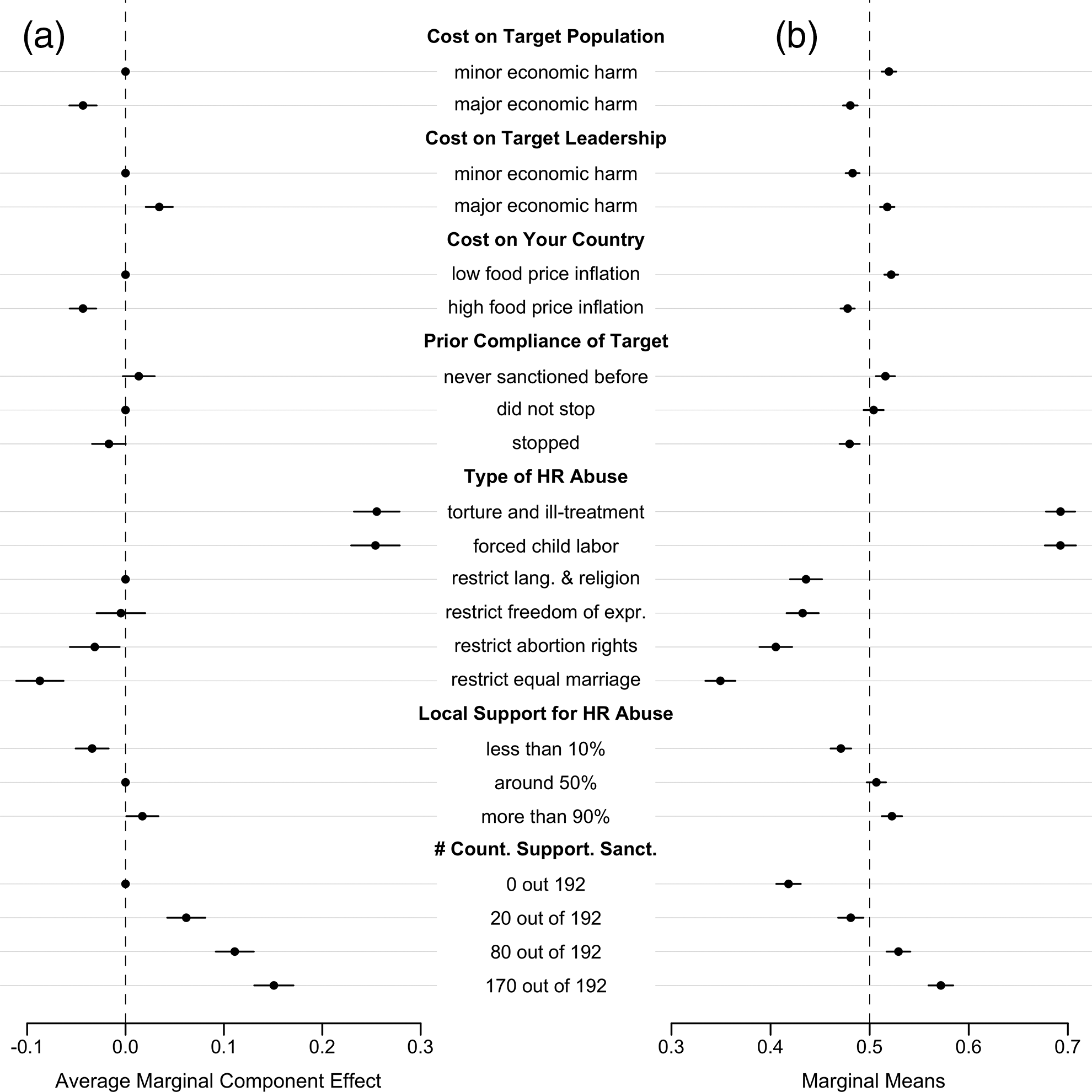
We also expect to see an interaction between incurred costs and inflicted harm (Hypothesis 3.3). Differential harm to the target should alter the cost-benefit calculus of the sender country. To put it simply, individuals should become more willing to incur costs to punish the target leadership and shelter the general populace. Figure 3 presents the results. Contrary to our expectation, we do not find a heterogenous treatment effect of incurred costs with respect to harm caused to the target population. Individuals do not become more willing to incur costs as the harm Average effect of incurred cost by inflicted harm: (a) Harm to the target population; (b) Harm to the target leadership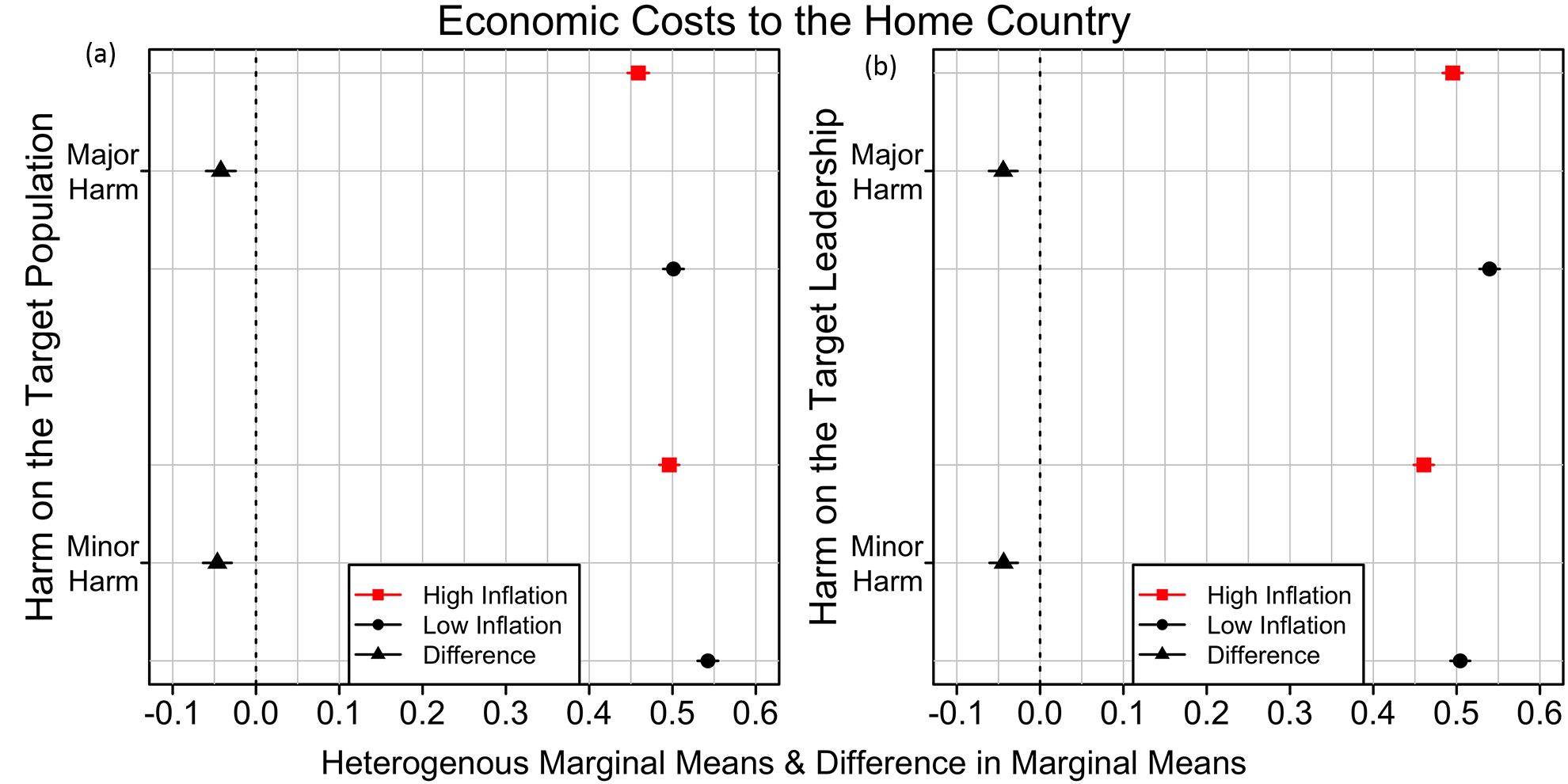
Next, we evaluate Hypotheses 4.1 and 4.2, which propose an interaction between differential harm and the expected effectiveness of sanctions in Figure 4. We do not find support for either hypothesis. Respondents disregard the effectiveness of previous sanctions when considering inflicting harm on the target population or leadership. They remain consistent with their desire to punish the leadership and their aversion to harming the population, irrespective of previous compliance. In this respect, the evidence is against our expectation that individuals would become more averse to harming the civilian population when compliance is unlikely. The difference between major and minor harm to the civilian population is virtually the same for both the Did not stop and Stopped categories. In other words, there is no evidence that the expressive function of sanctions diminishes when the expected compliance is low and the harm inflicted on the population is high. Similarly, individuals are not more motivated to impose sanctions to punish the leadership when the expected compliance is high, as shown by the consistent difference between the major and minor harm categories.
However, the results also suggest that respondents do consider the novelty associated with maiden sanctions. Compared with repeat sanctions, individuals are more likely to support maiden sanctions that would inflict major harm on the target leadership (Figure 4(a)). The difference between major and minor harm to the leadership is 5.35 percentage points for the Never sanctioned category, whereas the same difference is 2.38 and 2.74 percentage points for the Did not stop and Stopped categories, respectively. This difference between maiden sanctions and repeat sanctions is statistically significant at the 90% confidence level. Similarly, the aversion to imposing higher costs on the target population declines for the Never sanctioned category (Figure 4(b)). The difference between major and minor harm to the target population is -2.70 percentage points for the Never sanctioned category, whereas the same difference is -4.75 and -4.28 percentage points for the Did not stop and Stopped
Average effect of inflicted harm on target population by previous compliance: (a) Economic harm to target leadership; (b) Economic harm to target population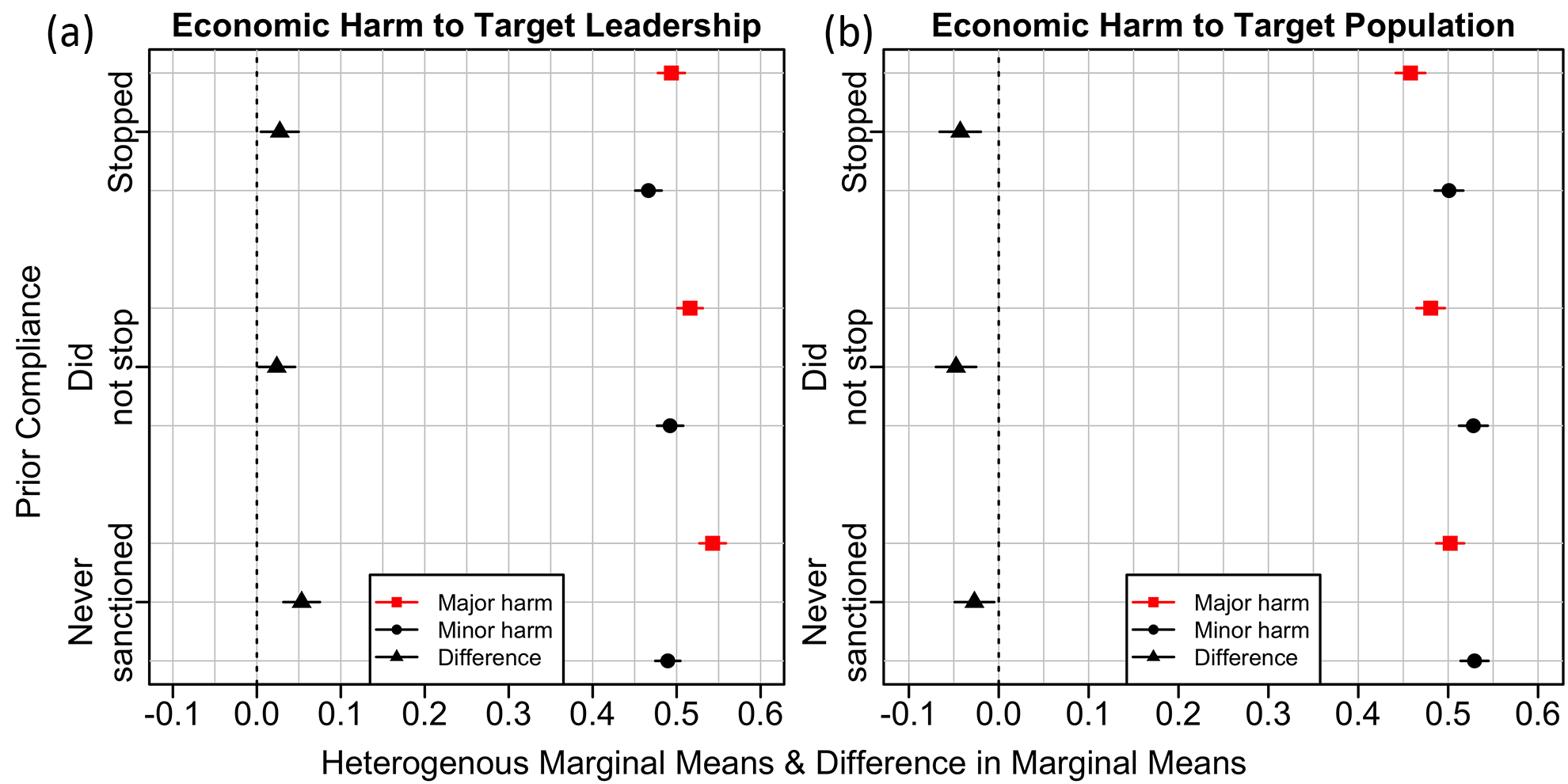
Contrary to our initial expectations but overlapping with the rest of our findings, these results reflect the consistent appeal of maiden sanctions, which is likely to be linked with the expressive function of punishment irrespective of its ability to influence policy outcomes. The novelty associated with maiden sanctions combined with the desire to punish the offenders is a plausible alternative explanation behind this heterogeneous treatment effect. In Galtung’s (1967: 380–381) terms, this result may reflect a preference for punishment even when there is lack of compliance because respondents favour issuing the very first set of sanctions instead of supporting sanctions on a country with a history of yielding under pressure. Based on this interpretation, we conjecture that the distinctive character of the initial set of sanctions may augment their expressive function and fuel the appeal for punishing the target leadership as well as attenuate the desire for sheltering the civilian population. Subsequent research may shed light on this surprising result.
Continuing with norm diffusion, Figure 2 illustrates that the proportion of local support for the human rights abuse significantly affects the probability of supporting sanctions. Relative to the polarized condition (i.e. around 50%), respondents are less likely to back imposing sanctions if the proportion of local support for the human rights abuse is less than 10% but more likely to do so if the local support is more than 90%, by margins of two and three percentage points, respectively. However, the within-design interactions show that this relationship is conditional on a number of factors, as formulated in Hypotheses 5.1 and 5.2.
Respondents are more willing to impose sanctions against two specific types of abuses, namely Torture and ill-treatment by state authorities (Figure 5(a)) and Restricting language and religious practices of minorities (Figure 5(c)), once the majority of locals support government policies that infringe human rights. This result only partially confirms Hypothesis 5.1 because a higher level of local support for Restricting freedom of expression does not affect respondents’ willingness to impose sanctions. More interestingly, we find that a higher level of local support for contentious human rights abuses such as Restricting abortion rights and Restricting equal marriage rights can also lead respondents to further skew their support for imposing sanctions (Figure 5(e) and (f)). Respondents are more likely to play the norm entrepreneur role, according to which they are willing to alter the moral domain of the target forcibly for both more universally endorsed and contentious human rights.
Next, we turn to the interaction between local support for policies that infringe human rights and the harm inflicted on the target population (Figure 6). In line with Hypothesis 5.2, we find that the degree to which Average effects of type of human rights abuse by proportion of local support: (a) Torture and ill-treatment by state authorities; (b) Forced child labour; (c) Restricting language and religious practices; (d) Restricting freedom of expression; (e) Restricting abortion rights; (f) Restricting equal marriage rights Average effect of cost on the target population by proportion of local support: (a) Economic harm to the population; (b) Difference in major and minor harm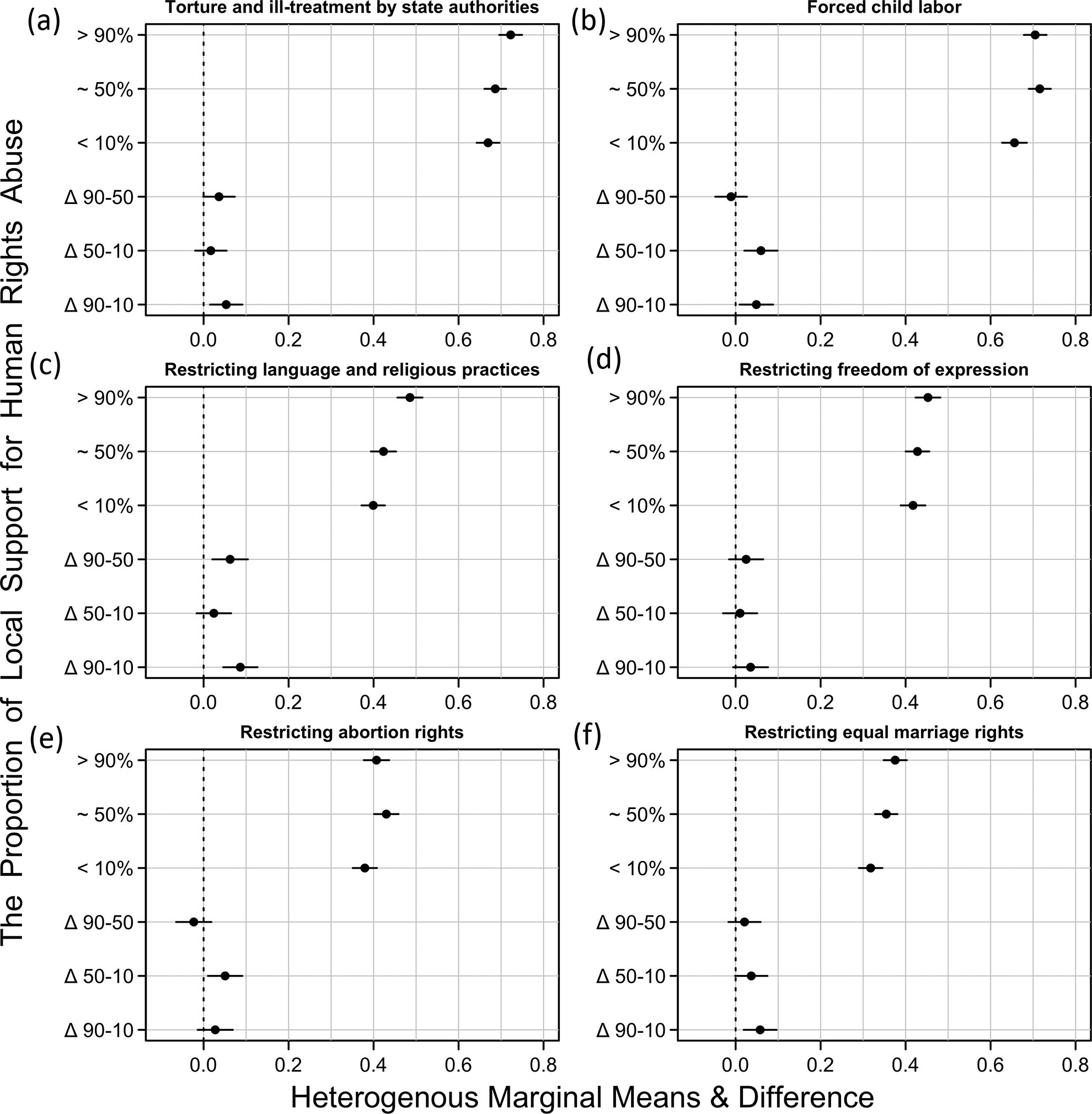
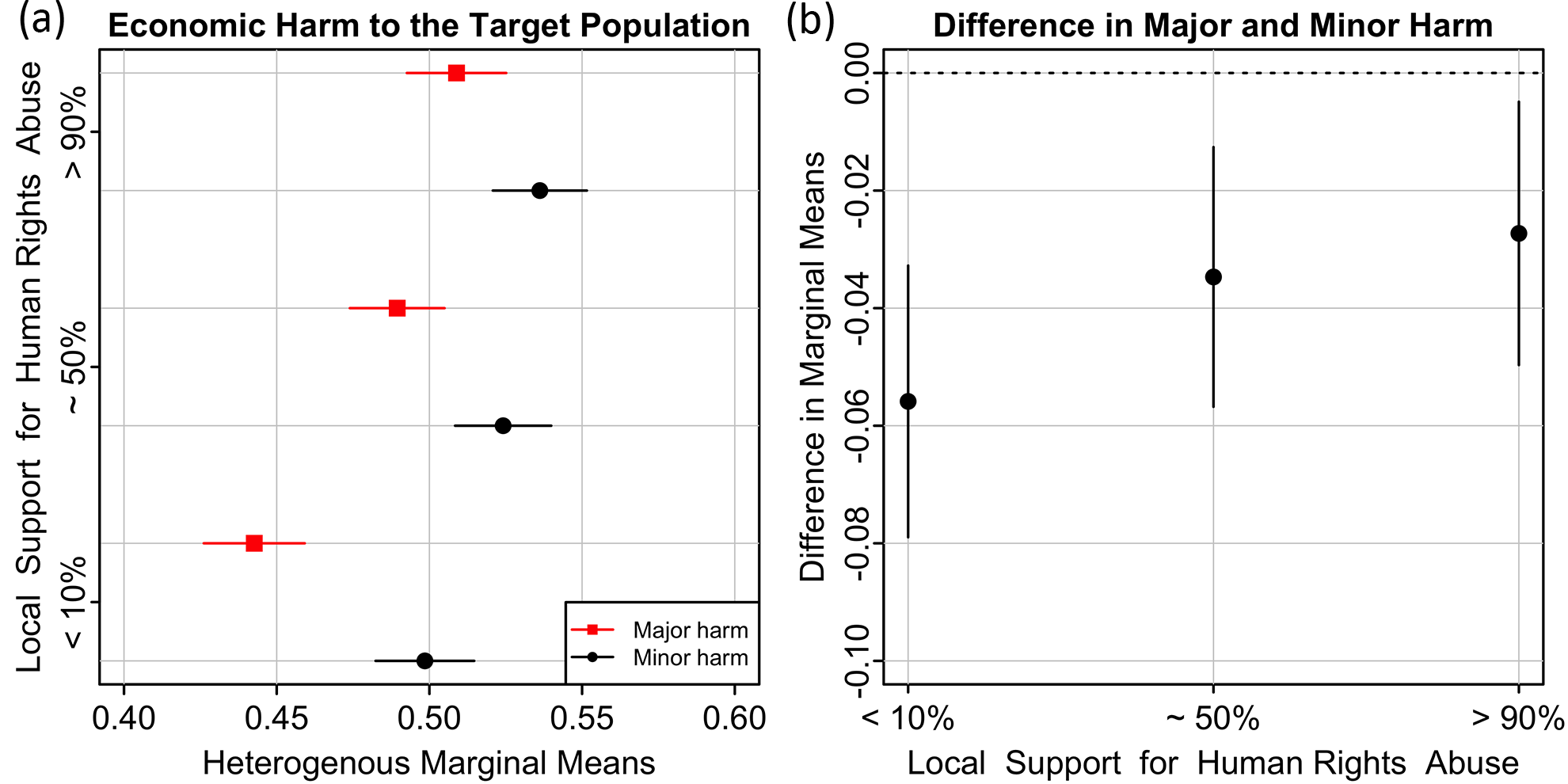
Revisiting Hypothesis 3.3, although we find no evidence for amplified altruism in relation to sheltering the target population, this null result is indicative of respondent preferences, especially when juxtaposed with the findings on the interaction between local support and the cost of sanctions on the target population. When faced with incurring higher costs, individuals remain consistent with their aversion irrespective of the context. However, they do consider the strength of local support for government transgressions when inflicting harm.
In the Online appendix, we evaluate the robustness of our main results in multiple ways. First, we report the effect consistency within countries by estimating our main model for each country separately (see Online appendix A3.1). Second, we evaluate the sensitivity of our findings to the forced-choice design by using an alternative seven-point scale variable as the outcome (see Online appendix A3.2). Third, we investigate whether respondents’ previous attitudes towards human rights and commitment influence our results (see Online appendix A3.3). Finally, we test whether our experimental design holds its assumptions to ensure that inferences about the causal effects are credible (see Online appendix A3.4). More specially, we look at carryover effects, profile positionality and balance testing. Our main findings remain consistent with these robustness checks.
Conclusion
Our research contributes to identifying how moral concerns and instrumental goals induce public support for protecting human rights abroad. First, it broadens the unidimensional understanding of the morality of human rights. Democracies publicly stress the legal concepts of indivisibility and universality of human rights, and they often reaffirm their continued commitment to protecting human rights abroad regardless of who the perpetrators are and where the abuses occur. 3 However, international responses to human rights violations do differ depending on the perpetrators, and the type and perceived severity of the abuse. Human rights are indivisible in principle, but in practice, our study presents evidence that sanctioning some violations is perceived as more morally imperative than sanctioning others. This finding provides insights into why the principle of indivisibility of human rights does not immediately translate into sanction policies. The impulse to punish the perpetrators varies in intensity according to the type and perceived severity of the abuse. In this respect, avowed ‘red lines’ in international human rights protection are not a mere signal of resolve to potential abusers, but also function as a reassertion, reflecting the moral convictions of the public. Thus, our findings are also relevant for campaigners aiming to instigate action against human rights violators because the way in which a violation is framed plays a key role in mustering public support.
Sanction regimes in the USA and UK, among other democracies, are increasingly moving away from conventional approaches to state-wide punishment and evolving towards targeting human rights abusers directly as a desirable and effective way of protecting the civilian population. In introducing the UK’s first autonomous human rights sanctions regime, Dominic Raab, then the foreign secretary, emphasized that the new legislation would allow the government ‘to target perpetrators without punishing the wider people of a country that may be affected’ and further stressed the cross-party support for such targeted sanctions (Raab, 2020). Our findings indicate an overlap between the emphasis foreign policy makers put on protecting the target population and the public sentiment at home. However, there is a tension between the impulse to punish the perpetrators and the wish to shelter the target population. Even well-designed sanctions have unintended consequences of hurting the target population. Our results reveal that the public are more ready to condone these unintended consequences if the perpetrators enjoy support from their local population or the victims belong to minority groups. To gain the support of the public, when sanction policies are being devised, extra care should be taken to ensure they do not harm the target population when the perpetrators are clearly acting in isolation with regard to their transgressions.
Although respondents adjust their disapproval of inflicting harm on the target population according to the proportion of local support for the government transgression, their instrumental aversion towards the cost of sanctions remains remarkably consistent, indicating a lack of willingness to bear further costs for sheltering the target population. In the context of global protection of human rights, our findings reveal the limits of costly altruistic punishment, in which negative emotions are the mechanism behind the willingness to bear costs (Fehr & Gächter, 2002). On the other hand, sanctions do play a key role in satisfying the impulse to take punitive action against the perpetrators, as shown by the stronger support for maiden sanctions. Thus, emphasizing the novelty of proposed sanctions is an effective strategy for persuading the public to back them.
Similarly, multilateral coordination is a crucial factor in communicating to the public that sanctions are indeed necessary and the right policy to deploy. Democracies often declare sanctions on human rights violators in unison. For instance, the USA, the UK, and Canada all announced sanctions against the Myanmar military on 10 December 2021 as a response to human rights violations and abuses (Foreign Office, 2021). Our results indicate that announcing sanctions alongside other countries is effective at conveying the message that they are being deployed as a vital response.
Although our experimental approach is well suited to identifying public preferences in relation to sanctions, we are mindful of its limitations. A usual caveat with survey experiments is the external validity. The hypothetical decision-making process in paired conjoint designs may increase the artificiality of the task, thereby undermining the ecological validity of the findings. Another limitation lies in our sample. Even though our online quota sample is representative of the US and UK populations based on demographic variables such as age, sex and ethnicity, we cannot completely eliminate the concerns about the generalizability of our findings due to the non-probability sampling method used in this research. However, previous studies show that even descriptively unrepresentative samples constructed with non-probability sampling perform well in replicating many treatment effects estimated through random sampling (Coppock, Leeper & Mullinix, 2018; Mullinix et al., 2015).
Finally, we identify avenues for further research. Studies investigating the micro-foundations of public attitudes have so far isolated sanctions as a stand-alone policy, but further research should progress towards analysing the integration of sanctions into general diplomacy and unpack the connections between sanctions and other foreign policy instruments. Considering that sanctions against human rights abusers are often deployed as a response short of military action, studying humanitarian intervention vis-à-vis economic sanctions is likely to shed further light on the predicaments emerging from navigating the trade-offs between instrumental and moral considerations. In this respect, the harm done to the target population is a crucial dimension worth further investigation because even the well-intended and best-crafted humanitarian intervention would inevitably have some unintended consequences of harming the civilian population.
Footnotes
Replication data

Acknowledgements
Author names are alphabetically listed. Both authors contributed to the study equally. The authors thank Rebecca Cordell, Patrick Kuhn and Patrick Leslie for their useful comments and suggestions.
Funding
The authors disclosed receipt of the following financial support for the research, authorship, and/or publication of this article: This work was supported by the Economic and Social Research Council (grant number ES/T006013/1) and Durham University.