




Abstract
Do leaders in nondemocratic regimes face public backlash when they threaten to use military force and back down? Whether citizens disapprove of empty threats is central to studying the domestic ‘audience costs’ in international crisis bargaining, but there is little experimental evidence of this phenomenon from autocracies. In this research article, I present the results of an original survey experiment investigating the microfoundations of domestic audience costs in the Russian Federation. My findings showed that even in Putin’s Russia, the citizens expressed attitudes in line with the audience costs theory. However, I also demonstrate that the effect of audience costs treatments was significantly stronger for the opponents of the current Russian leadership than for the supporters. The results of this study represent an important contribution to the existing literature by providing micro-level empirical evidence from a personalist nondemocratic regime.
Introduction
Do leaders in nondemocratic regimes face public backlash when they threaten to use military force and back down? The question of whether citizens disapprove of empty threats is central to the study of the domestic ‘audience costs’ in international crisis bargaining (Clare, 2007; Debs and Weiss, 2016; Fearon, 1994; Gartzke and Lupu, 2012; Hauenstein, 2020; Smith, 1998). However, apart from recent survey experiments in China (Li and Chen, 2021; Quek and Johnston, 2018; Weiss and Dafoe, 2019), empirical evidence on the microfoundations 1 of audience costs is mostly limited to Western democratic countries (Davies and Johns, 2013; Evers, Fisher and Schaaf, 2019; Kertzer and Brutger, 2016; Levendusky and Horowitz, 2012; Levy et al., 2015; Lin-Greenberg, 2019; Schwartz and Blair, 2020; Tomz, 2007; Trager and Vavreck, 2011). While previously identified micro-mechanisms behind public disapproval of empty threats (e.g. concern about inconsistency) may be present in both democratic and nondemocratic settings (Weeks, 2008), some scholars argue that many authoritarian regimes operate in a way that undermines the generalizability of earlier experiments (see, e.g. Quek and Johnston, 2018: 13). As such, we need more micro-level evidence on whether citizens’ attitudes in different nondemocratic regimes align with the predictions of the audience costs theory.
To address this gap, I conducted – to the best of my knowledge – the first survey experiment investigating domestic audience costs in the Russian Federation. The authoritarian regime of President Putin frequently resorts to military coercion, brinkmanship and brute force in its foreign policy (McFaul, 2020; Roberts, 2017). However, we know little about whether the Russian public disapproves of empty threats like their counterparts in the United States or China. As other scholars have argued, it is reasonable to assume that the public in different national and cultural contexts has divergent preferences and perceptions regarding the use of military force by their governments (Colgan, 2019; Levin and Trager, 2019; Kertzer, 2021). Building on the literature on Russian political culture and public opinion, I highlight several factors that could, in theory, reduce the size of domestic audience costs in Russia or eliminate them altogether.
I fielded my survey to a large representative sample of Russian citizens shortly before Russia invaded Ukraine in February 2022. I randomly assigned the participants into three treatment groups, which received a slightly modified version of a vignette describing an escalation of a crisis in the Russian neighborhood. In the control group, the Russian president abstained from using military force in this crisis. In the experimental groups, the president first made a verbal threat or displayed force by mobilizing troops near the border and then backed down from intervening militarily.
In line with earlier survey experiments on the microfoundations of audience costs, I tested a hypothesis that there would be more participants disapproving of the president’s handling of the crisis in the experimental groups than in the control group. The difference in disapproval between the control group and the experimental groups represents the absolute audience costs paid by the leader for backing down, given that other aspects of the scenario (including the information that the president did not authorize the use of military force in the end) remained constant across treatments. Furthermore, I examined whether the respondents who disapproved of the president’s handling of the crisis would be more willing to participate in a public demonstration against the government. Finally, building on Kertzer & Brutger (2016), I investigated the heterogeneous effects of experimental treatments on supporters and opponents of the current Russian leadership.
My findings demonstrated that in Russia, the public disapproves of empty threats, in line with the predictions of the audience costs theory. The results were statistically significant for both Verbal threat and Display of force treatments. I also found a significant interaction between attitudes toward the current leadership in Moscow and the effects of both treatments: those participants with negative views toward the Kremlin also expressed stronger disapproval of empty threats than the supporters of the Russian government.
As for the willingness to attend a public demonstration, I did not find statistically significant differences between conditions. These results seemingly suggest that whereas the public in nondemocratic countries sees the empty threats disapprovingly, this attitude does not easily translate to concrete political action against the regime; perhaps understandably, given the level of repression in Russia and the potentially severe consequences for individuals participating in demonstrations against the government. However, an analysis of the interaction between leadership support and experimental treatments painted a more nuanced picture: whereas the regime supporters were not particularly sensitive to the treatments, the opponents were significantly more likely to express their willingness to attend an anti-government demonstration following the president’s threats.
Investigating the microfoundations of domestic audience costs in Russia provides pertinent insights for understanding Russia’s behavior in world politics. Despite the widely held assumption that authoritarian leaders enjoy a free hand in foreign policy decisions, research on autocratic accountability shows that autocracies are much more responsive to public preferences than our field previously assumed (Chen, Pan and Xu, 2016; Horne, 2010, 2012; Kinne, 2005; Meng, Pan and Yang, 2017; Truex, 2016). Even though the repressive Russian regime does not allow free and fair elections where the public could easily vote their leader out, there is ample evidence that the Kremlin closely monitors fluctuations in public opinion and has long been concerned about maintaining popular support for its foreign policy (Efimova and Strebkov, 2020; Sherlock, 2020). If Russian leaders suffer a public backlash for backing down in a crisis, we can reasonably assume that this concern might influence Russia’s decisionmaking and the credibility of its coercive signaling, in line with the predictions of the audience costs theory.
More generally, my findings provide an important contribution to scholarly literature on the domestic constraints on the behavior of democratic and nondemocratic states in world politics (see Hyde and Saunders, 2020 for a recent review). While Weeks (2008) and Brown & Marcum (2011) have previously theorized the logic of audience costs in autocratic regimes, their work primarily focuses on the role of domestic elites and their ability to coordinate and sanction the leader rather than on public attitudes. My study supplements recent survey experiments conducted in China (Li and Chen, 2021; Quek and Johnston, 2018; Weiss and Dafoe, 2019) by investigating the microfoundations of audience costs among ordinary citizens in nondemocratic regimes.
I proceed as follows. First, I review the literature on domestic audience costs in democratic and nondemocratic regimes. Second, I formulate my theoretical expectations and hypotheses concerning Russian public attitudes. Third, I introduce the survey design and experimental setup of my study. Fourth, I present the results of the data analysis concerning each of my hypotheses. I conclude by summarizing the main findings, highlighting the limits of my study and proposing avenues for future research.
Audience costs and regime type
The concept of ‘audience costs’ stands for an increase in the domestic disapproval of leaders who escalate an international crisis, threaten to use military force and subsequently back down from fulfilling these threats. In the foundational audience costs literature, these domestic dynamics have profound implications for the credibility of coercive signaling in international crises. Schelling (1960) and later Fearon (1994, 1997) famously demonstrated that publicly conveyed threats ‘tie hands’: if the opponent does not comply, the leader who issued the public threat cannot easily back down as doing so would result in a loss of popularity at home.
But why would the public punish their leaders for making empty threats in the first place? Some scholars highlight a rational public preference for consistency driven mainly by concerns about reputational damage that could weaken the country’s bargaining position in future crises (Guisinger and Smith, 2002; Levy et al., 2015; Tomz, 2007; Weiss and Dafoe, 2019). Smith (1998) and Ramsay (2004) argued that voters could perceive backing down as a sign of their leader’s incompetence. Others have criticized the audience costs literature by claiming that voters primarily care about the policy content rather than its consistency (Clare, 2007; Debs and Weiss, 2016; Snyder and Borghard, 2011; Trachtenberg, 2012). Some of the more recent accounts have proposed that both consistency and policy content matter for domestic audiences, but whether the former or the latter logic prevails depends on the specific context (Hauenstein, 2020) and the particular segment of the domestic audience (Chaudoin, 2014; Kertzer and Brutger, 2016). To this end, Kertzer & Brutger (2016) proposed that domestic audience costs are composed of ‘inconsistency’ and ‘belligerence’ costs, where the latter stands for public disapproval of their leader threatening to use force in the first place.
With regard to the regime type, much of the existing scholarship has long assumed that audience costs are more likely to arise in democratic countries (Eyerman and Hart, 1996; Fearon, 1994; Gelpi and Griesdorf, 2001). Since then, survey experiments have found that the public in democratic countries does tend to express its disapproval of empty threats consistently with the propositions of the audience costs theory (Davies and Johns, 2013; Evers, Fisher and Schaaf, 2019; Kertzer and Brutger, 2016; Levendusky and Horowitz, 2012; Levy et al., 2015; Lin-Greenberg, 2019; Schwartz and Blair, 2020; Tomz, 2007; Trager and Vavreck, 2011). However, while Fearon’s (1994: 582) ‘plausible working hypothesis’ that ‘democratic leaders on average have an easier time generating audience costs’ is sometimes considered almost as an axiom in audience costs literature, more recent evidence from observational studies suggests that the difference between democratic and nondemocratic countries may be overstated. For example, Crisman-Cox & Gibilisco (2018: 567) found that ‘democracies with rivals have, on average, audience costs that are roughly similar to autocratic regimes with legal provisions for executive removal’. Downes & Sechser (2012: 459) revisited the democratic credibility hypothesis and found it ‘significantly weaker than the conventional view asserts’. Weeks (2008: 59) similarly demonstrated that ‘threats by democracies are not significantly more credible than threats by most autocratic regimes’.
The claim that nondemocratic regimes are less likely to generate audience costs ultimately rests on assumptions about (1) the domestic accountability of leaders and (2) public attitudes toward empty threats. The first assumption corresponds to the traditional argument that democratic leaders are politically more vulnerable as the voters in democratic countries can express dissatisfaction with foreign policy in free elections, a mechanism that is absent or highly restricted in nondemocracies (Fearon 1997). However, despite the absence of free elections, nondemocratic regimes still rely heavily on the support of domestic coalitions for their survival (Brown and Marcum, 2011; Gowa, 1995; Tolstrup, 2014; Weeks, 2008). While some of this literature primarily highlights the role of domestic elites rather than of the general public, a growing body of research on autocratic accountability demonstrates that nondemocratic regimes are also responsive to the preferences of ordinary citizens (Chen, Pan and Xu, 2016; Horne, 2010, 2012; Kinne, 2005; Meng, Pan and Yang, 2017; Truex, 2016).
Moreover, while democratic leaders risk that they will not be re-elected for another term, ousted autocrats often face much more severe personal consequences, which makes them particularly sensitive to even a slight increase in the probability of a successful popular revolt (Efimova and Strebkov, 2020; Weiss and Dafoe, 2019). In most authoritarian regimes, the public has ways of expressing discontent beyond casting a vote on the ballot. For example, Li & Chen (2021) found that Chinese citizens were willing to express their disapproval of foreign policy through different formal and informal channels, including posts on social media. The Chinese government then constantly monitors the online activity of its citizens and pays close attention to the appearance of negative sentiments in cyberspace (Weiss and Dafoe, 2019: 964). On the whole, new research into regime type in international relations suggests that authoritarian regimes are significantly more constrained domestically than previously thought (Hyde and Saunders, 2020).
The second assumption – about public attitudes toward empty threats – then directly concerns the main research question investigated in this research article. If the public in an autocracy does not disapprove of empty threats, backing down will not be costly for the leader, and no audience costs will arise, regardless of whether public attitudes influence the leader’s decisionmaking. But is there a reason to expect that citizens in nondemocratic regimes would see backing down differently than the public in democracies?
Recent scholarship in the field of comparative politics shows that while democratic and nondemocratic regimes are built on different functional logics, individual-level sources and processes behind regime support are strikingly similar (Mauk, 2020). Survey-based evidence demonstrates that citizens in autocracies carefully evaluate the performance of their leaders and commonly voice critical attitudes when it falls short of their expectations (Mauk, 2020). Highlighting the traditional micro-mechanisms of domestic audience costs, Weeks (2008: 42) adds that there is no apparent reason why domestic audiences in autocracies should value consistency or competence less than their democratic counterparts and, therefore, why they should see empty threats more approvingly.
However, it is still possible that autocrats are more capable of convincing their citizens that their ‘bluff’ was the best course of action in the crisis. As Quek & Johnson (2018: 13) note, ‘the generalizability [of audience costs experiments in the United States] to other countries and political systems is unclear, particularly as regards authoritarian societies where regimes have tried explicitly to socialize their populations into uncritical support for nationalist and sovereignty-centric foreign policies’ (see also the discussion in Kertzer, 2021: 25–26). This factor is arguably relevant for many existing nondemocratic regimes, and could conceivably shape public attitudes to decrease or even eliminate the domestic disapproval of empty threats.
Audience costs scholars also identified other factors that may be particularly applicable to some nondemocratic countries that face external threats. For example, Fearon (1994: 580) suggests that ‘leaders of small states may be rewarded for escalating crises with big states and then backing down’, a kind of ‘standing up to a bully’ dynamic that ‘may be praised even if one ultimately retreats’. Ashworth & Ramsay (2022) argue that whether the public punishes the leader for escalating and backing down depends on situational factors such as the value of the status quo and the costs of war. Kertzer & Brutger’s (2016) dispositional theory of audience costs suggests that foreign policy ‘hawks’ evaluate their leader’s belligerent threats more favorably than ‘doves’. How exactly these factors influence public disapproval of empty threats in individual cases is potentially dependent on the more general attitude toward the use of force in foreign policy, which is a dispositional characteristic that varies cross-nationally (Colgan, 2019; Levin and Trager, 2019).
Notably, a series of recent survey experiments in China provided crucial empirical evidence that the public in this particular authoritarian regime disapproves of empty threats in line with the audience costs theory (Quek and Johnston, 2018; Weiss and Dafoe, 2019; Li and Chen, 2021). Li & Chen (2021) even identified public concern about inconsistent foreign policy damaging China’s international reputation as the micro-mechanism behind audience costs in their study, corresponding to the earlier experimental evidence from the United States (Tomz, 2007). It is less clear, however, whether these findings on microfoundations of domestic audience costs will hold similarly in other autocracies where the institutional and cultural factors discussed above operate differently than in today’s China.
Russian public opinion and empty threats
This research article investigates the microfoundations of audience costs in the Russian Federation, a country governed by a personalist autocratic regime (Geddes, Wright and Frantz, 2014). The government in Moscow exercises control over nominally democratic institutions and concentrates a significant amount of power firmly in the hands of a single individual, President Vladimir Putin (Lewis, 2020; McFaul, 2020; Wegren and Herspring, 2009). However, despite the clear patterns of authoritarian rule, there is a close link between domestic and foreign policy in contemporary Russia (Gudkov, 2019; Sirotkina and Zavadskaya, 2020; Snegovaya, 2020). Scholars have found evidence that the Kremlin does not merely attempt to shape public attitudes but, to an extent, it is also responsive to public preferences in its conduct of foreign affairs (Efimova and Strebkov, 2020; Horne, 2012; Mishler and Willerton, 2003; Zimmerman, 2002). The Russian leadership has been highly sensitive to the fluctuations in public opinion and potential signs of domestic backlash (Oliker et al., 2015; Sherlock, 2020), and regular polling of public views has become a standard practice for the regime (Efimova and Strebkov, 2020; Hale, 2010). Overall, existing scholarship suggests that the Kremlin is concerned about domestic audience costs, and the public disapproval of foreign policy can play a meaningful role in its decisionmaking process.
But can we also expect the Russian public to disapprove of empty threats in line with the audience costs theory? There are potentially several reasons for Russia being a hard case for finding an effect of audience costs treatments. First, many ordinary Russians tend to see President Putin through an idealized lens and fully trust his expertise in foreign policy (Efimova and Strebkov, 2020: 108). This could make them less likely to question his specific decisions in international crises, believing there was a strategic purpose behind escalating and backing down. As Volkov & Kolesnikov (2022) note, there is a strong tendency toward ‘passive conformism’ in Russian society, which makes large segments of the public a priori submissive to decisions made by those above them in the social hierarchy.
Second, there are cultural factors that could underpin somewhat different views on ‘inconsistency’ in foreign policy among the Russian public than elsewhere. Kurowska & Reshetnikov (2021) highlight the deeply ingrained cultural archetype of a ‘trickster’ that provides a particular understanding of Russia’s liminal position and transgressive behavior in international affairs. In this context, Kurowska et al. (2018) suggest that strategic deception is broadly understood by the Russian public as a legitimate practice, particularly in the context of foreign policy where Russia stands up against the more powerful West. This could imply that escalating and backing down could be seen by Russian citizens as a purposeful attempt at deception tied to strategic goals rather than an inconsistent or incompetent policy.
Third, Kertzer & Brutger (2016) found that while domestic audience costs are generally composed of inconsistency and belligerence costs, more hawkish audiences may reward the leaders for threatening to use force rather than punish them (Kertzer and Brutger, 2016: 243–244). Weiss & Dafoe (2019: 966) suggest that, some audiences may interpret tough talk as strength and value the appearance of strength more than consistency or action […]. A leader who makes loud, confident demands may appear to be advancing the national interest, absent persuasive claims to the contrary. In low-information environments, individuals may reflexively trust their leader and discount critics who criticize the lack of follow-through as biased.
The salience of military coercion in Russia’s foreign policy and preference for strong and harsh leaders (Pipes, 2004) could indicate that large segments of the Russian population are sympathetic to such ‘blusters’ in foreign policy, with the ‘belligerence reward’ ultimately offsetting the audience costs.
To test whether empty threats generate public disapproval in Russia despite these assumptions, I formulated an alternative hypothesis, H1:
Hypothesis 1: Russian citizens are more likely to disapprove of their president’s military restraint following empty verbal threats to use military force.
Earlier scholarship observed that rather than issuing verbal threats and commitments, leaders sometimes escalate the crisis by mobilizing their military forces as a signal of resolve (Fearon, 1997; Slantchev, 2005). In survey experiments in the United States, such displays of force generated audience costs comparable to empty verbal threats (Tomz, 2007). In China, audience costs paid for the display of force were substantially lower than those for verbal threats, but their effect was still statistically significant (Li and Chen, 2021). To test whether the mobilization of troops has an impact on public approval, I formulated my second hypothesis:
Hypothesis 2: Russian citizens are more likely to disapprove of their president’s military restraint following a display of military force.
Kertzer & Brutger (2016) also proposed that the intensity and the micro-level logic of disapproval (i.e. whether the disapproval is driven more by concerns about inconsistency or belligerence) varies considerably with the leader’s constituency. Existing opinion polls suggest that despite Russia being a nondemocratic country, Russian public opinion on foreign policy is not monolithic. As such, we can expect a substantial within-country variation in views on their leader escalating and backing down.
A significant cleavage here could be between the supporters and opponents of the current leadership in Moscow. In line with the logic discussed above, I expect that, unlike the opponents, the supporters will be more trusting in the wisdom of their president’s ‘strategic deception’ and less likely to see it as inconsistent (or incompetent) foreign policy. Moreover, academic surveys and public opinion polls have previously found that the level of support for the current Russian leadership is strongly associated with support for Kremlin’s military interventions in the Russian neighborhood (Stoycheff and Nisbet, 2017; Volkov and Kolesnikov, 2022). Another survey fielded in Russia recently demonstrated the positive relationship between leadership support and approval of military strikes, including the use of nuclear weapons (Smetana and Onderco, 2023). Furthermore, the supporters of the current Russian regime tend to be, on average, more nationalistic, making them more likely to prefer strong leaders and belligerent attitudes in foreign policy (Chiozza and Stoyanov, 2018). 2
The discussion above suggests that supporters of the Russian leadership are less likely than its opponents to find the leader’s handling of the crisis inconsistent or incompetent, implying lower inconsistency costs for this segment of the Russian population. Given their support for belligerent foreign policy, the supporters are also less likely to react negatively to the belligerent nature of the president’s threat, leading to lower belligerence costs. If these expectations hold, the audience costs treatment effects should be, on average, larger for the opponents than for the supporters of the Russian leadership. As such, I proposed a hypothesis that relates to the dispositional characteristics of the specific audiences:
Hypothesis 3: Those opposed to the Russian leadership are especially likely to disapprove of their president’s military restraint following empty verbal threats or a display of military force.
Finally, if the Russian public sees empty threats disapprovingly, it is not clear how strongly it will be willing to communicate this disapproval to the Russian leadership. Without free and fair elections, Russian citizens have a risky yet relatively common way of expressing disapproval: street protests and anti-government demonstrations (Hale and Colton, 2017; Tertytchnaya, 2020). The significant drop in Putin’s approval rating in 2011–2012 accompanied public protests against rigged elections that made the Russian leadership visibly concerned (Oliker et al., 2015). However, it is unclear whether the president’s mishandling of an international crisis also has the potential to bring a significant number of Russian citizens to the streets. If it has, Russian threats of using force in an international crisis could be perceived as a costly signal akin to those made by their democratic counterparts (Weiss, 2013).
Engaging in public protests in Russia carries a risk of personal harm, which could make some citizens express their disapproval merely passively. Although we cannot experimentally test whether the leader’s suboptimal handling of the crisis will ultimately lead to tangible political action against the government, the experimental survey method at least allows us to measure an expressed willingness to attend such anti-government demonstrations. To test this willingness empirically for the two treatments (Verbal threats and Display of force) and different segments of the population (regime supporters and opponents), I proposed the remaining three hypotheses:
Hypothesis 4: Russian citizens are more willing to attend a public demonstration to protest the president’s military restraint following empty verbal threats to use military force.
Hypothesis 5: Russian citizens are more willing to attend a public demonstration to protest the president’s military restraint following a display of military force.
Hypothesis 6: Those opposed to the Russian leadership are especially likely to attend a public demonstration to protest the president’s military restraint following empty verbal threats or a display of military force.
Experimental design
I designed an original survey experiment with short vignettes describing the Russian president’s handling of a foreign policy crisis. In the pretreatment section, I collected the data on a priori-selected baseline covariates: gender, age, region (federal district) of residence, income, education, nationalism, and interest in politics. 3 As a measure of Leadership disapproval (see H3 and H6), I asked how much the participants generally approved or disapproved of the current leadership in Russia on a five-point Likert scale from 1: strongly approve to 5: strongly disapprove. These items served as control variables to test the robustness of the results in the regression analysis and increase the precision of my estimates.
The participants then read a vignette describing massive anti-government protests in Georgia, after which several municipalities declared independence. 4 In this scenario, the Georgian president mobilized the army and threatened to use military force to suppress these protests. The remaining vignette varied according to the treatment group to which the participant was randomly assigned. In the control group, the Russian president said Russia would stay out of the conflict (No threat). In the first experimental group (Verbal threat), the Russian president declared that Russia would send troops to protect the protesters if the Georgian government used military force against them. In the second experimental group (Display of force), the Russian president deployed Russian troops to the border with Georgia. The remaining vignette remained the same for all the participants: the Georgian government eventually sent an army to fight the protesters, while Russia refrained from using force to protect them.
After reading the vignette, the participants stated whether they approved, disapproved, or neither approved nor disapproved of how the Russian president handled the situation. I used the response to this survey item as the outcome variable for hypotheses H1 – H3, with the assigned treatment as the predictor. In the data analysis stage, I calculated the absolute audience costs by subtracting the percentage of ‘disapprove’ responses in the control group from the percentage of such responses in the experimental group. This procedure allowed me to identify the level of disapproval that directly concerned the president’s empty threats rather than general dissatisfaction with Russian inaction in the crisis or with the president as such; in other words, it allowed me to calculate the domestic audience costs for escalating and backing down. To collect additional qualitative evidence on the micro-mechanisms behind public disapproval, I also provided the participants with an open question asking why they approved or disapproved of the president’s handling of the crisis.
Finally, I asked the participants to imagine a public demonstration to protest how the Russian president had handled the situation described in the vignette. They indicated how likely it was that they would attend such a demonstration on a five-point scale. I used their response as a dependent variable to address hypotheses H4 – H6. The survey then concluded with a debriefing item to explain the research aims behind the study and to counteract the conditioning effects of the experiment (Carpenter, Montgomery and Nylen, 2021).
I worked with a local branch of an international polling company, Ipsos, which partnered with Ipsos Interacted Services to administer the survey to a sample of adult Russian citizens representative of the population in gender, age, and administrative region of residence. For the main effects, I aimed at a minimum N = 1182 across the three treatment groups (each n = 394) to detect differences between groups at an effect size of .2 with a power of .8. 5 To reduce the social desirability bias, I used the computer-assisted web interviewing data collection method (Chang and Krosnick, 2010).
Ultimately, I received responses from 1219 participants. The polling company had collected 92% of surveys by February 24, 2022 (the day of Russia’s invasion of Ukraine), 97% by February 25, and the remaining 3% by March 2 as it was still short of several responses from older-aged participants to complete a representative sample. Importantly, both supporters and opponents of the current Russian leadership participated in the survey: 29% disapproved of the current Russian leadership, 42% approved, and 29% stated that they neither approved nor disapproved. 6 Online appendix 6 shows the results of balance tests for this and other pretreatment measures.
As suggested by one of the reviewers, the timing of the survey around the 2022 invasion of Ukraine could have exacerbated the salience of foreign policy issues for the participants in my survey experiment. If so, it is conceivable that the timing further enhanced the external validity of the experiment, as the impending crisis is likely to have made the participants more capable of establishing their views on the developments in the fictional crisis scenario, and their attitudes in the survey would probably be a closer match to those they have in real life. However, an additional analysis showed no statistically significant differences in responses to outcome variables between those who had completed the survey by February 24 and after this date. 7
Experimental results
In Figure 1, I show the differences in the level of approval for the Russian president’s handling of the situation in the control group (No threat) and the two experimental groups (Verbal threat and Display of force). There were statistically significant differences between treatments overall (χ2 (4) = 34.31, p < .001), as well as between the control group and the first experimental group (p < .001), and the control group and the second experimental group (p < .001). In line with the domestic audience costs theory, the percentage of respondents disapproving of the president’s actions was substantially higher in the experimental treatments (21%) than in the control group (10%). The differences between the two experimental groups were not statistically significant (p = .216).
As a robustness test, I conducted an ordinal logistic regression with the two experimental treatments as predictors, Level of disapproval as an outcome variable, and baseline covariates as controls. Figure 2 shows the coefficient plot.
8
The effects of the experimental treatments were significant at p < .001 before the inclusion of control variables (Model 1) and after their inclusion Approval of the president’s handling of the crisis across treatments.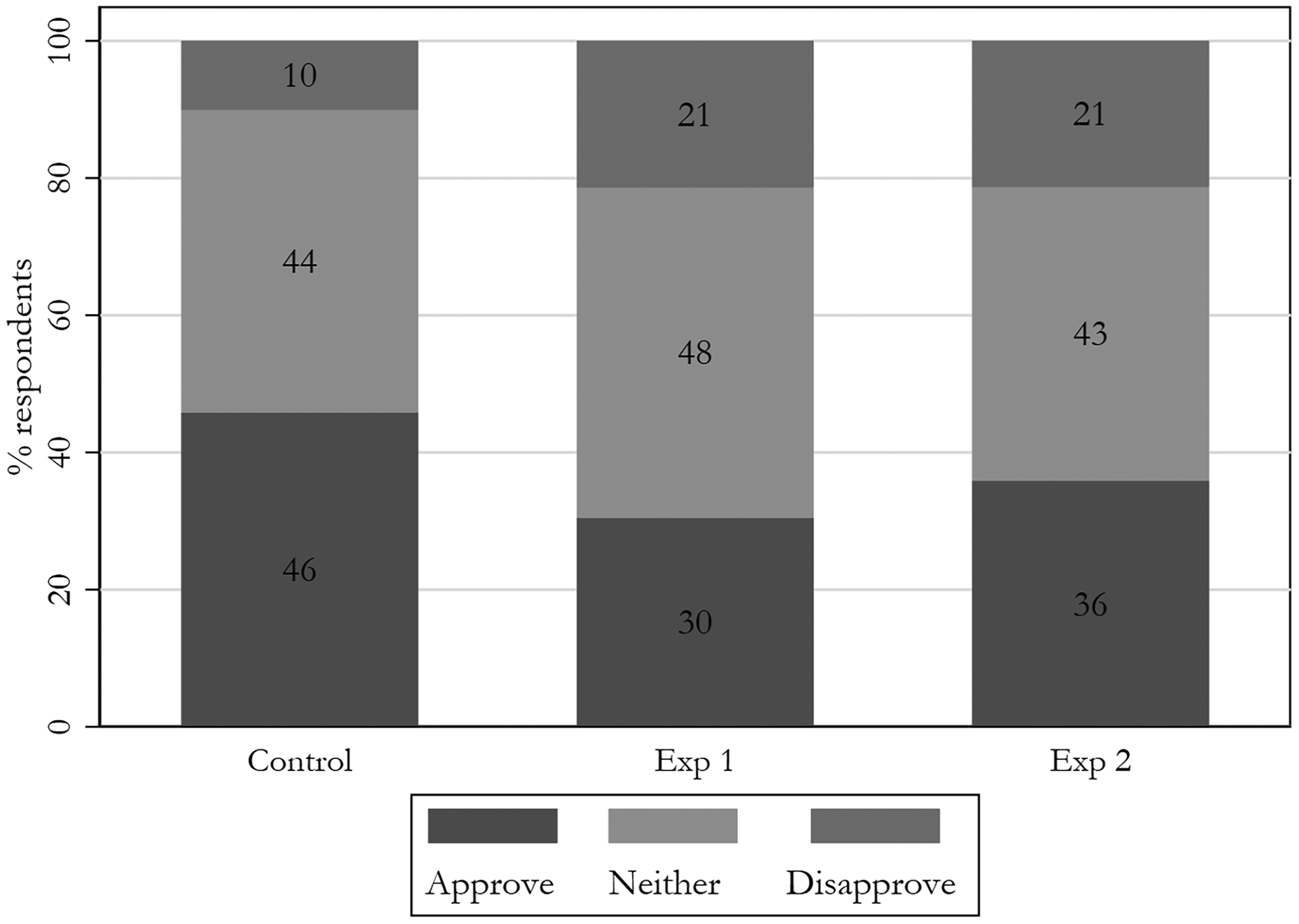
Figure 2 also includes Model 3 with interactions between the treatments and general Leadership disapproval. Both interactions were statistically significant (p < .001): the effect of experimental treatments on domestic audience costs was relatively stronger for the citizens who generally disapproved of the Russian leadership than for those who approved of it.
Figure 3 illustrates this dynamic through predicted probabilities of disapproving of the crisis handling contingent on the treatment and Leadership disapproval. For the leadership supporters (low values on the Leadership disapproval axis), the probability of disapproval with the president’s restraint was similar across the three treatments. However, as general disapproval of the Russian leadership increased, so did the difference in the probability of disapproval in the control condition (did not change significantly) and experimental conditions (increased significantly). As such, I gained empirical support for hypothesis H3, that those opposed to the Russian leadership are especially likely to disapprove of their president’s military restraint following empty verbal threats or a display of military force.
Next, I examined whether empty threats were associated with a higher willingness to participate in an anti-government demonstration. Figure 4 shows that although there was a slight surge in the number of respondents who claimed that they would be likely to participate in a demonstration in both experimental groups, the overall differences between the control group and the experimental groups were not statistically significant (χ2 (4) = 6.55, p = .162).
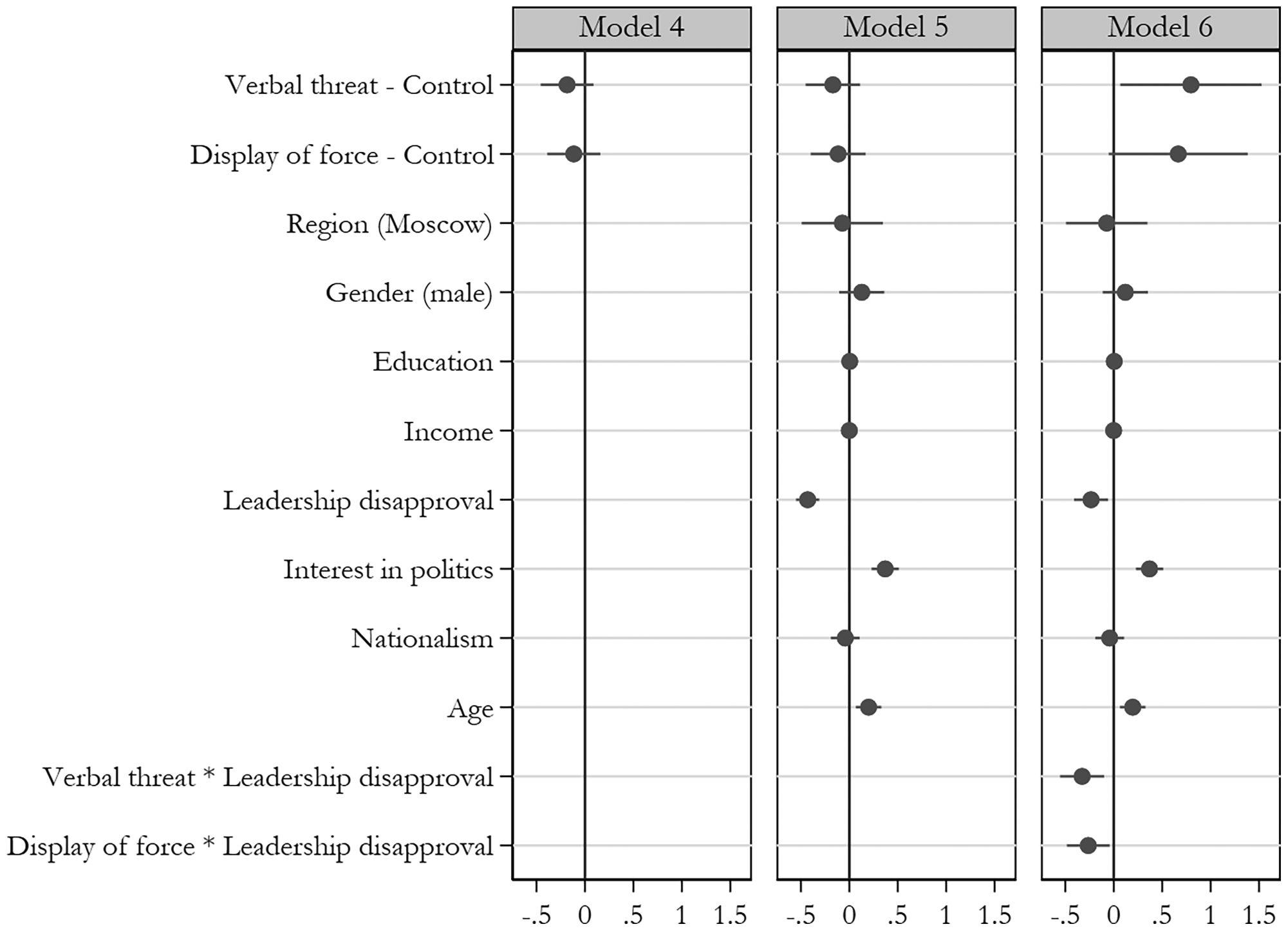
Correspondingly, Figure 5 shows that the effects of the experimental treatments were not statistically significant in an ordinal logistic regression either without control variables (Model 4) or with controls included (Model 5).
9
As such, the hypotheses that Russian citizens Ordinal logistic regression estimates.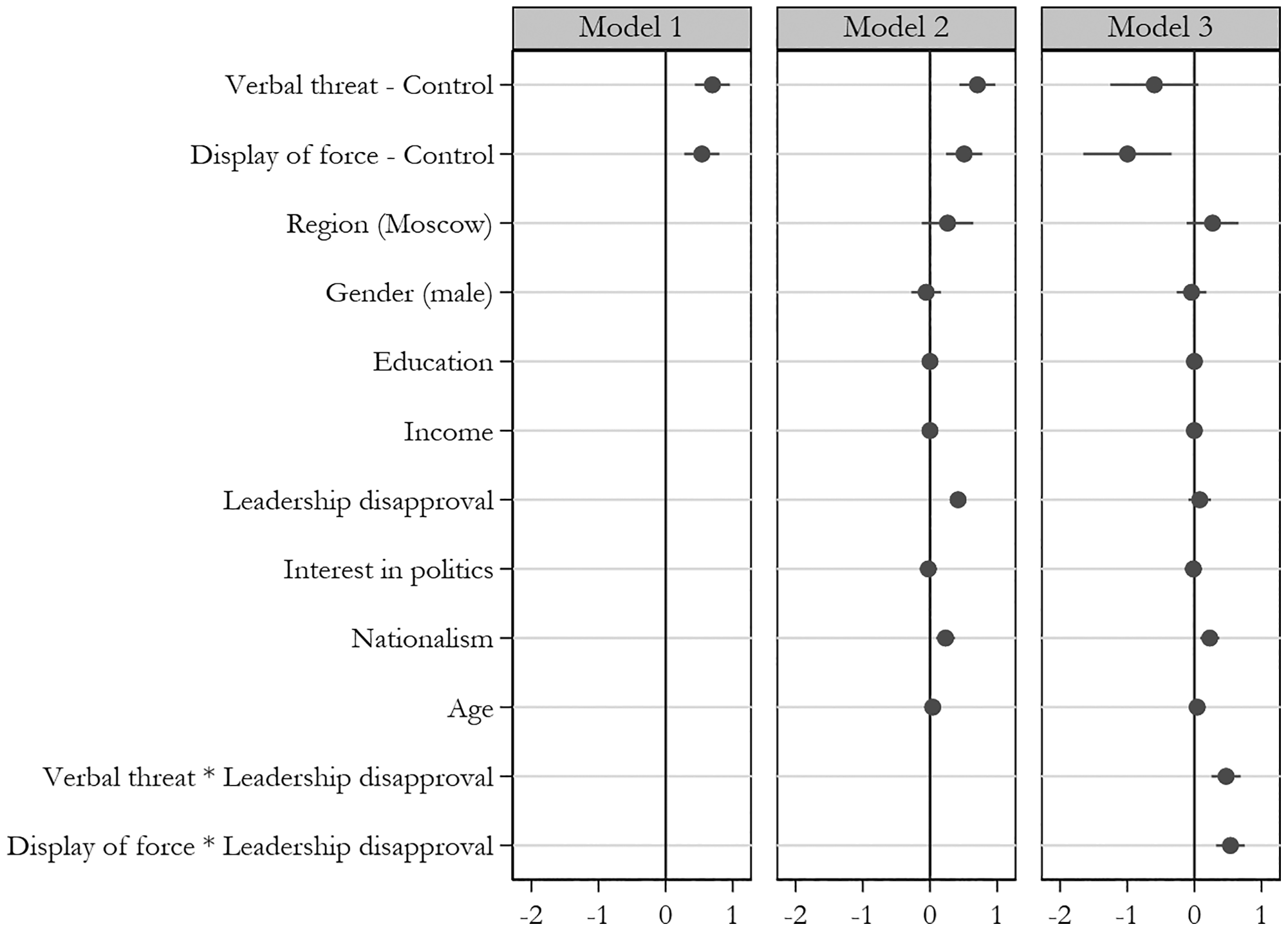
At first glance, the interpretation of these results appeared straightforward: even though empty threats led to audience costs in the form of public disapproval, the disapproval did not easily translate to concrete political action, given the level of domestic repression in Russia. However, Model 6 painted a more nuanced picture by showing the interactions between the treatments and the disapproval of the Russian leadership: the effect of experimental treatments on domestic audience costs was, once again, relatively stronger for the citizens who generally disapproved of the Russian leadership than it was for those who approved of it. The interactions were statistically significant at p = .005 for Verbal threat and at p = .016 for Display of force.
Figure 6 shows the predicted probabilities of expressing the likelihood of attending the demonstration contingent on the treatment and Leadership disapproval. As general disapproval of the Russian leadership increased on the x-axis, so did the difference in the probability of attending the demonstration in the control condition (did not change significantly) and experimental conditions (increased significantly). As such, I gained empirical support for hypothesis H6, that those opposed to the Russian leadership are especially likely to attend a public demonstration following their president’s empty verbal threats or a display of military force.
It is, nonetheless, important to stress that these results should not be interpreted as clear evidence that empty threats made by Russian leaders will lead to anti-government demonstrations in Russia. While the effect I found was statistically significant and substantive, it merely showed the change in the subjective willingness to attend a demonstration among the participants, who were generally more inclined to express a strong anti-government stance in the survey. It is unclear whether the president’s handling of a foreign policy crisis resembling the one in experimental treatments would be Predicted probabilities of disapproving of the president’s handling of the crisis.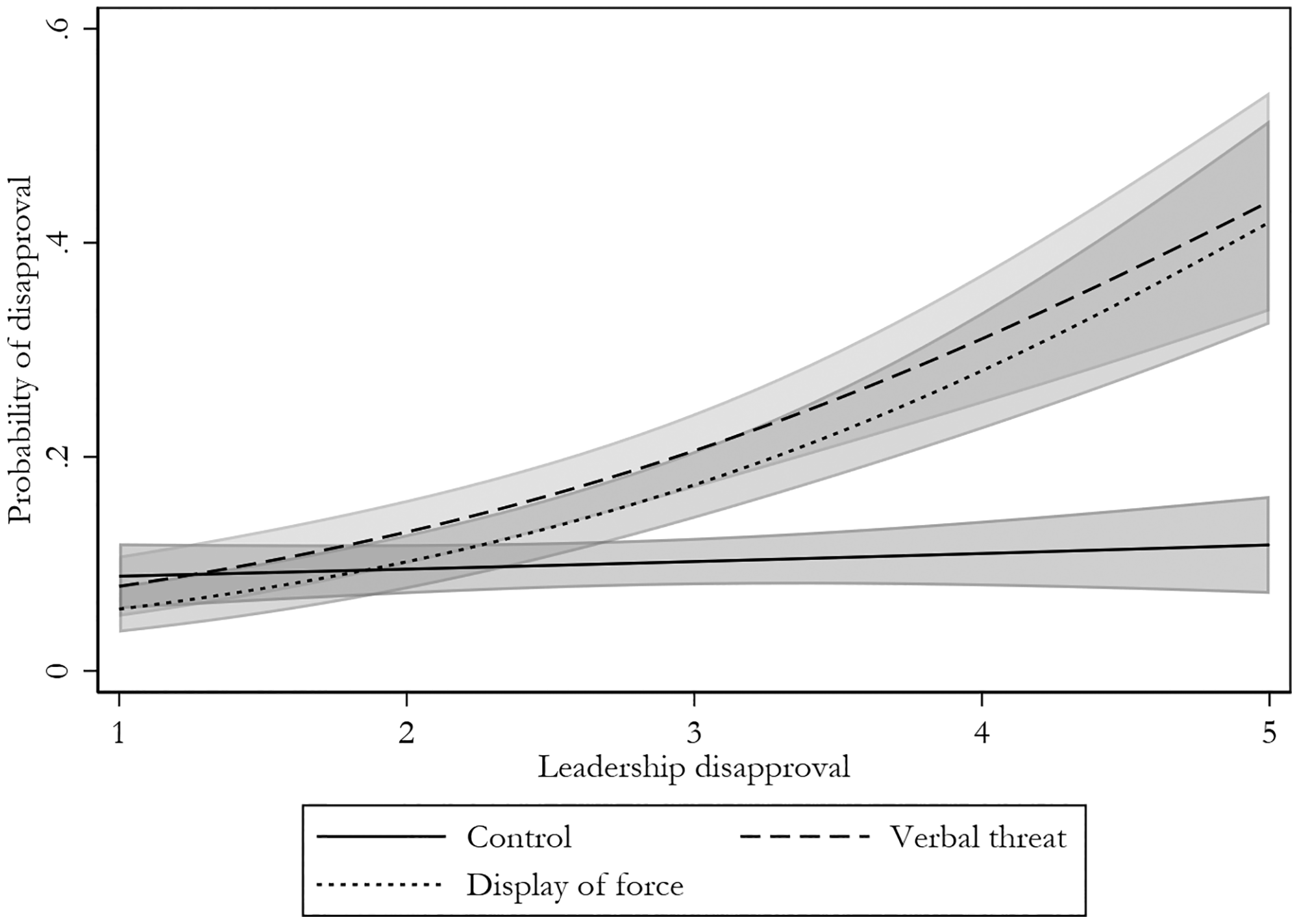
Open responses
The open responses in my survey supported the finding that Russian citizens were more critical of leaders who make empty threats than of those who do nothing. A majority (67%) of survey participants provided a short commentary on the reasons behind their approval or disapproval. Among those participants who responded to an open-ended question and simultaneously disapproved of the president’s handling of the crisis (n = 159), I found some qualitative evidence for both the costs concerning inconsistency (the ‘traditional audience costs’) and belligerence costs, as proposed by Kertzer & Brutger (2016).
Half of those participants (50%) expressed their concern with the escalation itself (e.g. ‘you can’t interfere in the affairs of another country like this’, or ‘it is not our business to meddle in their internal affairs’), consistent with the belligerence cost logic under which the audience punishes a leader for threatening to use force in the first place. This concern was particularly visible (66%) in the second experimental group (Display of force). The concerns about inconsistency were much less present (9%), and almost all such statements (e.g. ‘he should not have promised to bring in troops, and then not to do it’, ‘you must keep your word or keep silence’, or ‘words are not thrown around’) appeared in the Verbal threat group, where they consisted of about one-fifth (18%) of responses. Beyond these two categories, about 15% of participants expressed a reverse logic of dissatisfaction with the restraint itself, along the lines of stating that helping the protesters was ‘the right thing to do’. About 26% of participants provided reasons unrelated to the audience costs theory, such as merely expressing their Likelihood of attending a public demonstration across treatment groups.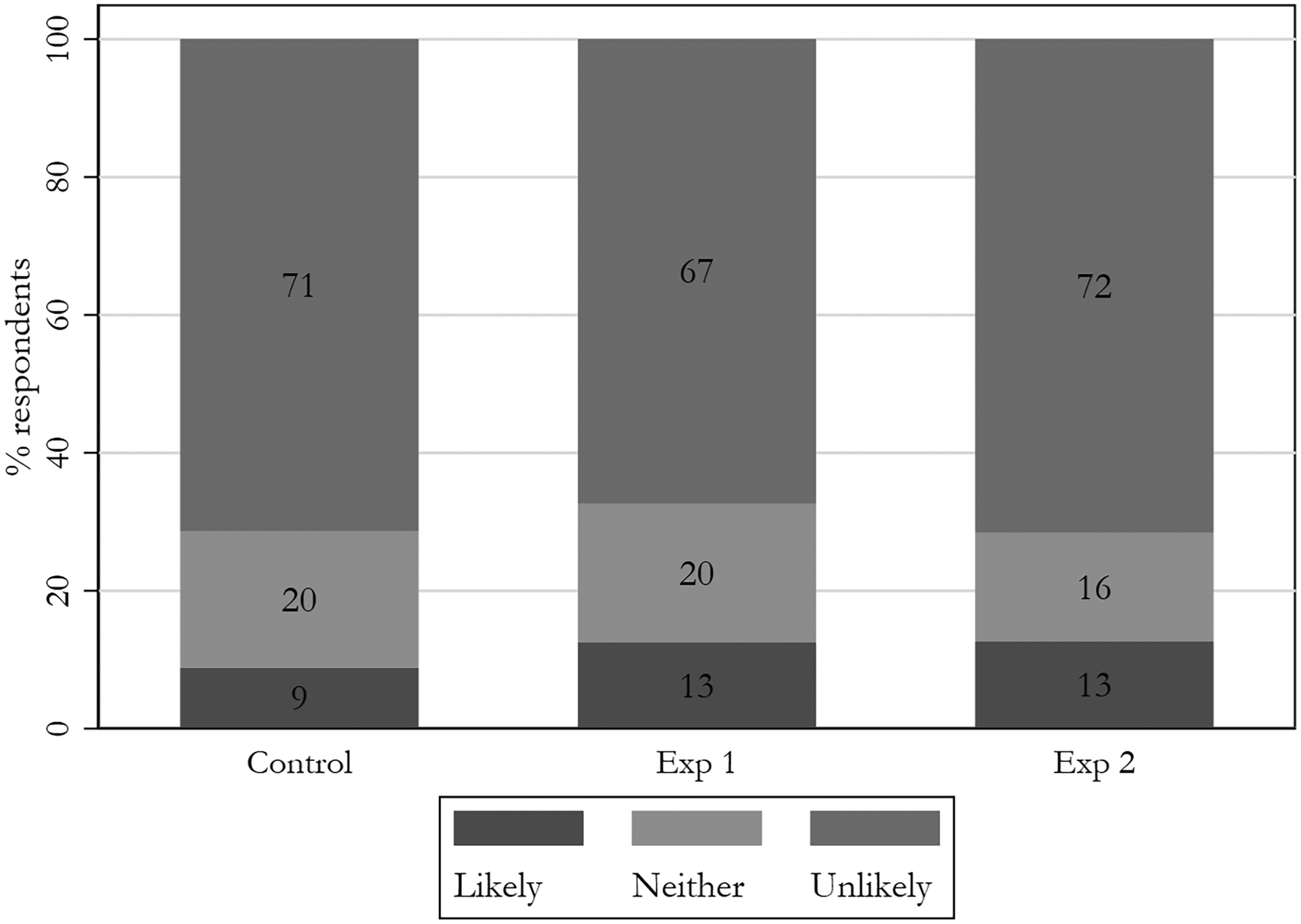
Although these numbers should be treated cautiously as merely illustrative evidence to supplement the experimental results, they suggest that the micro-mechanisms spelled out in the audience costs literature are also at play in the Russian context. With regard to the dual inconsistency–belligerence costs logic, the qualitative evidence suggests that both underpin the audience costs paid following empty verbal threats. The belligerence costs dominated concerns about inconsistency when the president displayed military force and then backed down from using it.
In the final step, I analyzed the open responses separately for the opponents and the supporters of the current leadership in Moscow. The regime opponents primarily expressed concerns about the Russian president’s belligerent behavior (57%). Less common were concerns about inconsistency (6%) and there was even less disapproval of the president’s lack of direct military involvement in the crisis (4%). In contrast, 44% of regime supporters expressed dissatisfaction with the lack of military intervention, 21% with the belligerent nature of the threat, and 15% with inconsistency. Overall, these responses were consistent with the assumption that the experimental treatments had more significant effects on the regime opponents due to the significantly higher belligerent costs generated in this subgroup.
Discussion and conclusions
In this research article, I presented the results of my survey experiment on the microfoundations domestic audience costs in Russia. My investigation demonstrated that Russian leaders are likely to suffer public disapproval when they make empty threats to use military force. However, the effects of experimental treatments were contingent on respondents’ support for the Russian leadership, with regime opponents being more likely to express their disapproval and their willingness to engage in anti-government demonstrations.
Likelihood of attending a public demonstration across treatment groups.
These findings suggested that the foundational logic of the domestic audience costs that earlier scholarship investigated in the United States (e.g. Tomz, 2007) and China (e.g. Li and Chen, 2021) also applies to the Russian case. Given the differences in the experimental setup, timing and choice of scenarios in survey vignettes, we should be cautious about directly comparing the absolute values of audience costs across these studies. However, as a rough illustration, the audience costs the leader paid for empty threats in my experiment in Russia (11%) were somewhat smaller than those in the United States (16%), although they were still substantial (and, in fact, within the range of the Bayesian 95% credible intervals in the US study). The audience costs for the verbal threat in Russia were comparable to those in China (12%). For the scenario involving the display of military force, the audience costs were about 50% higher in the Russian study (11%) than in the Chinese one (7.5%).
Evidence from the open survey responses suggested that both belligerence costs and inconsistency costs played a role in the reasoning of Russian citizens, in line with the earlier work of Kertzer & Brutger (2016). However, it is conceivable that other micro-level factors could also help us explain the disapproval of backing down in a crisis. About 15% of participants who disapproved of the president’s handling of the crisis expressed dissatisfaction with his decision not to help the protesters. This factor is controlled for in the traditional audience costs experimental setup, as the lack of military action is held constant across the control and experimental groups (Tomz, 2007). Nevertheless, it is possible that the president’s threat also raises public expectations about the military intervention, ultimately leading to disappointment when the leader backs down from fulfilling it. Priming the Russian citizens on the possibility of military action potentially mobilizes nationalist sentiments, with some segments of the population becoming more supportive Predicted probabilities of attending an anti-government demonstration.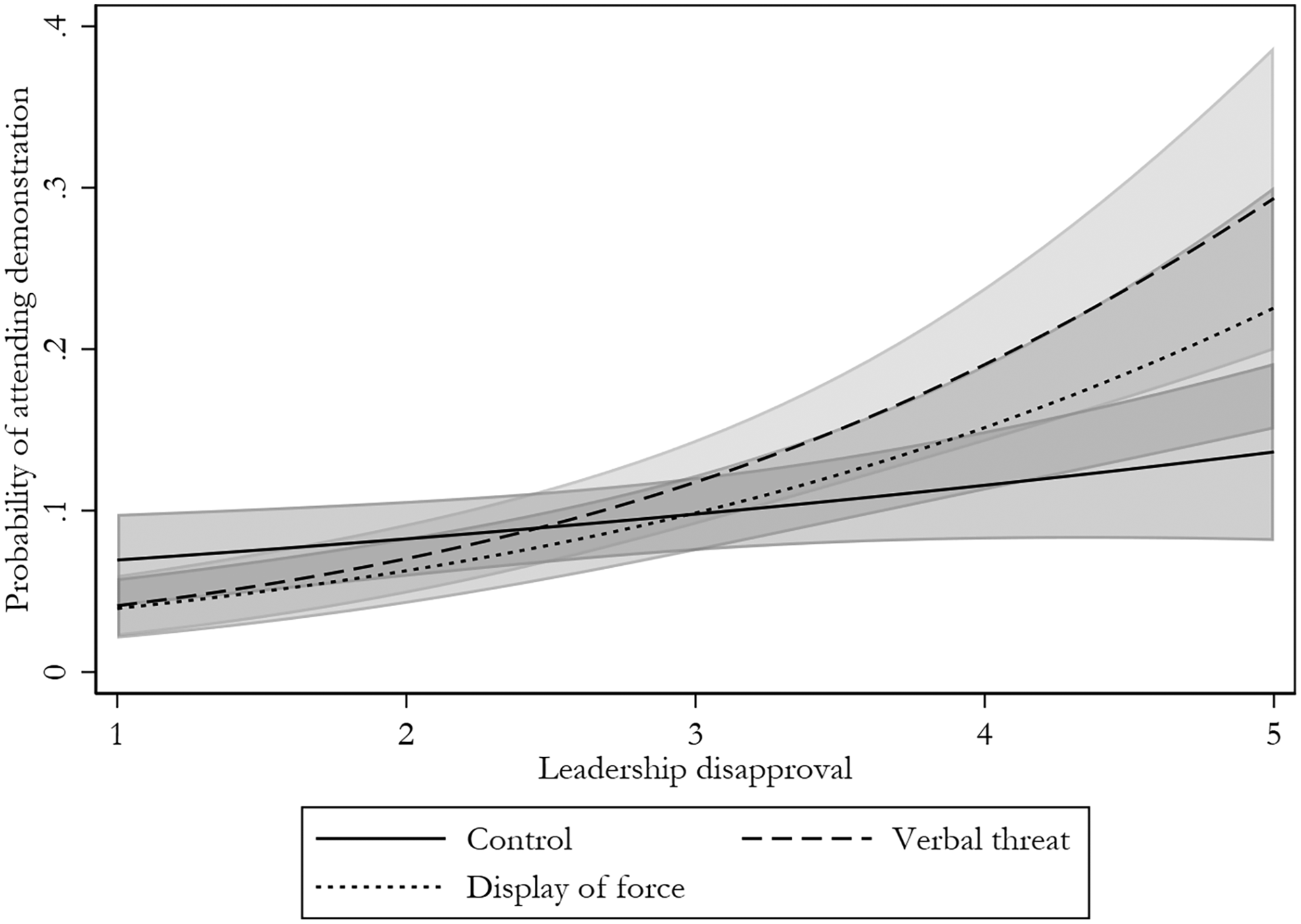
My study has provided important new experimental evidence for how domestic audience costs operate in nondemocratic regimes. The crucial finding was that, even in a personalist autocracy and culture generally more supportive of certain levels of hawkishness and deception in foreign policy, leaders suffered public disapproval for escalating and backing down in a crisis. That micro-level concerns about inconsistency and belligerence played a role in the reasoning of ordinary citizens was another finding that appeared to generalize beyond democratic countries, possibly indicating that these concerns are broadly relevant to forming public attitudes irrespective of regime type. However, less clear was whether my findings about the divergent effects of audience costs treatments on regime supporters and opponents could be replicated in other types of nondemocratic regimes. To this end, future students of autocratic audience costs could include this dispositional characteristic of respondents in their analysis and unpack the complexity of domestic attitudes toward autocratic leaders.
Beyond the broader scholarly relevance, studies of this kind can provide important lessons for policymakers confronting autocratic leaders in world politics. The most recent example of the Russo-Ukrainian war is a case in point. Before the February 2022 invasion, Russia amassed many of its troops near the Ukrainian border, creating a high-stakes bargaining crisis involving both the government in Kyiv and the NATO countries. In several pre-invasion debates I attended, numerous experts and journalists suggested that Putin was merely bluffing and could easily withdraw the deployed forces without suffering any costs domestically. My study suggests that such a move could generate sizable costs vis-à-vis domestic audiences, thereby influencing the payoff structure of strategic bargaining dynamics.
It is conceivable that events following Russia’s 2022 invasion of Ukraine will have impacted Russian public attitudes in several aspects relevant to my study. Due to new strict measures imposed by the Kremlin in the wake of the invasion, willingness to participate in the protests against the government has declined significantly (Volkov and Kolesnikov, 2022). Moreover, it is difficult to predict how the current war will impact public support for using force in future crises. The outcome of the war and the costs incurred on Russian society could shape how Russian citizens will view escalation and militarized threats in scenarios commonly used for audience costs experiments.
At the time of writing this conclusion, conducting further experimental research in Russia would be challenging. As discussed above, the laws adopted following the Russian invasion of Ukraine make expressions of disapproval of the government’s policies a risky endeavor, and the results of public opinion surveys are consequently likely to have limited reliability (Chapkovski and Schaub, 2022; Reisinger, Zaloznaya and Woo, 2023).
If the situation improves in this regard, there are avenues where scholars could explore the microfoundations of audience costs in the Russian context further. First, my study has provided merely illustrative evidence of the mechanisms behind audience costs in Russia. Researchers should conduct focus groups, interviews and survey experiments that would test these mechanisms explicitly to shed more light on the reasoning behind disapproval of empty threats among the different segments of the Russian public. Second, scholars could investigate how strategic framing and propaganda mitigate domestic audience costs. Survey experiments by Quek & Johnston (2018) and Weiss & Dafoe (2019) found that in China, the government has multiple options for reducing public backlash through skillful rhetoric. While some scholars argue that Russian citizens display a higher autonomy from the government’s manipulation than is commonly assumed (Sherlock, 2020), the Kremlin exercises control over Russian media to the extent that allows it to reframe the development of the future foreign policy crisis with a high level of societal impact (Efimova and Strebkov, 2020). After the 2022 invasion of Ukraine, the Kremlin’s grip on controlling information flows has become even tighter, making access to unbiased news ever more difficult for the Russian public.
Supplemental Material
Supplemental Material, sj-docx-1-jpr-10.1177_00223433231220252 - Microfoundations of domestic audience costs in nondemocratic regimes: Experimental evidence from Putin’s Russia
Supplemental Material, sj-docx-1-jpr-10.1177_00223433231220252 for Microfoundations of domestic audience costs in nondemocratic regimes: Experimental evidence from Putin’s Russia by Michal Smetana in Journal of Peace Research
Footnotes
Replication data

Acknowledgments
I thank Jessica Weeks, Michal Onderco, Marek Vranka, Ondrej Rosendorf, Tomas Weiss, Michal Parizek, Vojtech Bahensky, Jan Ludvik and attendees of the Peace Research Center Prague and Karl W Deutsch research seminars at Charles University for their valuable feedback.
Funding
The author disclosed receipt of the following financial support for the research, authorship, and/or publication of this article: This research received funding from the Charles University grant, PRIMUS/22/HUM/005 (Experimental Lab for International Security Studies – ELISS).
Notes
References
Supplementary Material
Please find the following supplemental material available below.
For Open Access articles published under a Creative Commons License, all supplemental material carries the same license as the article it is associated with.
For non-Open Access articles published, all supplemental material carries a non-exclusive license, and permission requests for re-use of supplemental material or any part of supplemental material shall be sent directly to the copyright owner as specified in the copyright notice associated with the article.
