



Abstract
Due to the COVID-19 pandemic, new rules forced public servants to work remotely or under strict guidelines at the office. These rules were often perceived as red tape, creating a compliance burden and limiting flexibility. While red tape is commonly seen as a job demand associated with reduced well-being and performance among public servants, the effects of COVID-19-related red tape remain unexplored. This research investigates how perceived COVID-19-related red tape is associated with public servants’ well-being and self-perceived performance and examines the moderating roles of coping strategies (supervisor support) and recovery strategies (work detachment, relaxation, mastery, and control). Data from 3,332 Dutch public servants reveal two key findings. First, COVID-19-related red tape, shaped by rapidly changing work conditions, can foster adaptation and inspire extra effort despite its challenges. Second, recovery strategies are more effective than coping strategies in mitigating the negative associations of perceived COVID-19-related red tape with employee well-being.
Introduction
The COVID-19 pandemic imposed unprecedented rules that reshaped public servants’ work environments, introducing significant administrative burdens and challenges (Giauque et al., 2022; Schuster et al., 2020). For example, COVID-19 rules limited collaboration and on-site work, reducing the compound knowledge of task-specific intelligence, scientific knowledge, and policy rules, leaving public servants unsure of how to make the best decisions in client encounters (Møller, 2021). Also, remote work mandated stringent ICT policies to ensure secure handling of sensitive data, such as frequent software updates and restrictions on personal device usage (Bauwens & Meyfroodt, 2021; Muylaert et al., 2023). Moreover, various rules around complex reporting requirements, like logging office attendance for contact tracing or ambiguous terms in sanitation regulations like washing hands “frequently,” allowed for ambiguity in compliance, further adding to confusion (Alcadipani et al., 2020; Schuster et al., 2020). While these measures were essential for public health, they often created a compliance burden and possibly a sense of limiting functionality for public service delivery (Van der Meer et al., 2024), fitting the definition of red tape (Blom et al., 2021). However, it remains unclear whether public servants viewed the new COVID-19 rules as typical red tape—burdensome and non-functional—or as red tape that carried mixed implications, either evoking connections with stress and ineffectiveness or providing necessary functionality to support public service delivery during uncertain times (cf. Van der Meer et al., 2024).
Understanding this specific form of red tape is particularly important because it provides a unique opportunity to examine how crisis-induced rules and regulations are experienced by public servants and how it relates to their well-being and performance. Traditionally, red tape has been associated with negative outcomes, such as feelings of powerlessness, alienation, diminished well-being, and impaired performance (Blom et al., 2021). However, the context of COVID-19 presents an opportunity to explore whether red tape shaped by crisis conditions is perceived differently. Indeed, research has shown that various red tape subsystems—such as procurement, ICT, and HRM—affect employee outcomes differently (Blom et al., 2021; Muylaert et al., 2023). This highlights the nuanced nature of red tape and the importance of examining its specific contexts and applications. By studying red tape within the novel subsystem of crisis-induced regulations, researchers can gain valuable insights into how public servants respond to such challenges. In a time in which crises such as natural disasters, financial collapses, terrorist attacks, and unprecedented diseases increase, this seems all the more important (Kim et al., 2022).
Traditionally, red tape is conceptualized as a job demand, following the reasoning central to the Job-Demands Resources (JD-R) model. It is hypothesized that through a health-impairment process and a demotivational process, job demands such as red tape, are related with lower public servants’ well-being and their perceived performance (Blom et al., 2021; Muylaert et al., 2023). Through the health-impairment process, scholars have demonstrated that public servants who perceive red tape tend to feel alienated from their work, as evidenced by positive associations with emotional exhaustion and negative associations with their perceived performance (Blom et al., 2021; Borst & Knies, 2023; Muylaert et al., 2023). Moreover, through the demotivational process, scholars have also shown that public servants who perceive red tape experience feelings of powerlessness and meaninglessness, illustrated in negative associations with work engagement as well as their perceived performance (Brewer & Walker, 2010, 2013; Jacobsen & Jakobsen, 2018).
Although evidence from various studies confirms the existence of health-impairment and demotivational processes, recent research offers a more nuanced perspective, suggesting that red tape is not always negatively associated with well-being and individual performance among public servants (Blom et al, 2021; Migchelbrink & Van de Walle, 2022; J. Taylor, 2016). As mentioned earlier, the nuanced perspective demonstrate that various red tape subsystems—such as procurement, ICT, and HRM—show different relations with employee outcomes (Blom et al., 2021; Muylaert et al., 2023). Applied to the subsystem of crisis-induced regulations, a study during the COVID-19 pandemic found that red tape is unrelated with work engagement and emotional exhaustion among public servants (Van der Meer et al., 2024). This counter-intuitive result may stem from public servants’ familiarity with rules, as they often develop and apply judicial frameworks themselves (Borst, 2018). Indeed, because COVID-19 rules were-created by public servants themselves, they may not have been perceived as entirely burdensome. Also, the pandemic context may have shifted focus to other pressing demands (e.g., work-life conflict) or provided compensatory resources like greater autonomy to deal with red tape (Van der Meer et al., 2024). By conducting an in-depth analysis of the perceptions about crisis-induced COVID-19 related red tape, this study tests these mechanisms, advancing our understanding of how red tape operates in a dynamic and high-pressure situational context.
This nuanced perspective clarifying why red tape might not be associated with demotivational and health-impairment processes in all instances aligns with the JD-R model which identifies two main strategies for managing negative job characteristics: through coping strategies by usage of job resources, and/or through recovering strategies (Demerouti et al., 2019). Regarding coping strategies, supervisor support is recognized as a key resource in both general JD-R research (Schaufeli & Taris, 2014) and red tape-specific studies (Moynihan et al., 2012; Muylaert et al., 2023). Supportive supervisors who address public servants’ needs and show empathy can help reduce red tape’s adverse relations with well-being and performance (Muylaert et al., 2023). Regarding recovery strategies, these approaches might also be helpful in dealing with the negative associations of public servants’ perceptions about red tape and their well-being. Recovery strategies are off-job activities including psychological detachment (i.e., physical and mental disengagement from work activities), relaxation, mastery (i.e., learning something new during off-job time), and control (i.e., ability to choose which activity to pursue during leisure time, as well as when and how). These might help in dealing with red tape by providing employees with the opportunity to mentally disengage from work-related demands (Kinnunen et al., 2011).
Applied to the subsystem of crisis-induced regulations, it could be argued that coping resources, such as supervisor support, are even more effective in the context of COVID-19-related red tape than with general red tape, whereas recovery strategies may yield mixed results. Supervisor support might be more helpful in dealing with COVID-19 related red tape because these rules are subject to constant adaptation (Muylaert et al., 2023). Due to constant changes in rules and regulations, the communication and support of the supervisor might be extra important (Demerouti & Bakker, 2023). Also, due to the COVID-19 rules, the boundaries between work and home roles have faded but scholars showed that psychological strategies were protective mechanisms against increased need for recovery in a situation of role conflicts. At the same time, recovery strategies are often experienced as “switching off” during off-job time (Sonnentag & Bayer, 2005). Therefore, it could be the case that, since switching off is harder due to forced homeworking as a result of COVID-19 rules, recovery strategies may be less effective to deal with red tape. However, these mechanisms in the JD-R model are only theoretically conceptualized but have not been empirically tested (see, e.g., meta-analyses Blom et al., 2021; George et al., 2021), let alone in a context of crisis (Demerouti & Bakker, 2023).
In sum, it is (1) unclear whether public servants’ perceived COVID-19 related red tape indeed instigates both a health-impairment and demotivational process though lower well-being and self-perceived performance, and (2) whether and how (a) coping strategies through supervisor support and (b) recovering strategies through work detachment, relaxation, mastery, and control might buffer these processes. This study will fill these gaps by answering the following questions: What is the relationship between public servants’ perceived COVID-19 related red tape through their well-being with their perceived performance? And To what extent do coping strategies (through supervisor support) and recovering strategies (through work detachment, relaxation, mastery, and control) moderate these health-impairment and demotivational processes?
These questions are answered through a structural moderated mediation analysis using data collected from 3,332 Dutch public servants. The data were collected in December 2020, and respondents were asked to reflect upon their first 8 months of dealing with COVID-19 rules. In these first 8 months of the pandemic (since March 2020), Dutch public servants were required to adapt to various COVID-19 regulations to ensure public health and continuity of services. The Netherlands introduced numerous measures to manage COVID-19, including an “intelligent lockdown” in March (“people were urged to stay at home, however, they were still allowed to move around freely as long as they kept a distance of 1.5 m to others”; De Haas et al., 2020: 1), which switched to a complete lockdown in November, ensuring limited social interactions. Remote work became the default wherever possible, with only essential roles performed on-site under strict health protocols. Meetings were shifted online, and physical distancing measures were mandatory in workplaces. Travel and non-essential interactions were restricted, and employees were urged to adhere to evolving guidelines. Public servants were instrumental in implementing and communicating policies while adapting to changing rules (Dreef et al., 2021).
Theory
COVID-19 Related Red Tape Defined
Since the seminal works of Kaufman (1977) and Waldo (1964), two main approaches to red tape have emerged. The first, an system-centric approach, views red tape as an objective element within organizations, as reflected in Bozeman’s (1993) definition: “rules, regulations, and procedures that remain in force and entail a compliance burden for the organization but do not advance the legitimate purpose the rules were intended to serve” (p. 283). This approach focuses on the legitimacy of rules based on their costs and benefits (Jacobsen & Jakobsen, 2018). The second approach, the psychological process approach, argues that red tape is subjective, as seen in Pandey’s (2021) definition: “Bureaucratic red tape is a role-specific subjective experience of compliance burden” (p. 264). Unlike the system-centric approach, this approach emphasizes the perceptions of those affected by red tape (Pandey, 2021). Based on this, Van Loon et al. (2016) developed a job-centered definition: “rules that employees perceive as burdensome and not helpful in achieving the rules’ functional objective in their respective job” (p. 663). Like Bozeman (1993), this definition includes both the compliance burden and lack of functionality dimensions. Our study builds on this psychological approach and the multidimensional perspective on red tape by including the perceptions of public servants regarding both the compliance burden and the lack of functionality of rules.
In line with this job-centered and multi-dimensional definition of red tape, the crisis-induced COVID-19 rules also seem to create a compliance burden and possibly a sense of limiting functionality for public service delivery (Van der Meer et al., 2024). As mentioned in the introduction, these crisis-induced rules limited collaboration and on-site work, reducing knowledge and leaving public servants uncertain in client interactions (Møller, 2021). Remote work required strict ICT policies for secure data handling (Bauwens & Meyfroodt, 2021; Muylaert et al., 2023), while complex reporting requirements and ambiguous sanitation rules added confusion and uncertainty in compliance (Alcadipani et al., 2020; Schuster et al., 2020). However, although these crisis-induced COVID-19 rules seem truly detrimental as they hinder the public service delivery and increase the administrative burden (Alcadipani et al., 2020), it is important to consider that the COVID-19 rules are public health measures which are inherently part of public service delivery. This raises the question of whether public servants might see these rules as lacking functionality or as a necessary aspect of their work. Indeed, public servants in governmental organizations (e.g., central and local government) might be socialized in working with rules because they themselves develop and apply these judicial frameworks (Borst, 2018).
COVID-19 Related Red Tape in the JD-R Model
While it can be debated whether the crisis-induced COVID-19 rules can be fully characterized as burdensome and lacking functionality, most public administration scholars generally agree that, if confirmed as such, red tape is detrimental by definition (Borry, 2016; Bozeman, 2012). This consensus is not surprising, as numerous studies have found that red tape is negatively related to public servants’ well-being (including work engagement and emotional exhaustion) and their self-perceived performance (see meta-analysis by Blom et al., 2021). The reasons are often ingrained in the overarching JD-R theory and are predominantly connected to the health-impairment process and demotivational process.
First, according to the JD-R model, the health impairment process starts with hindering job demands which are the physical, psychological, social, and/or organizational aspects of a job that require sustained cognitive and emotional efforts and which are associated with certain psychological and/or physiological costs for employees. These demands gradually drain the mental resources of public servants which are associated with emotional exhaustion, and in turn, lower employee performance. By definition, red tape is a typical hindrance stressor that requires sustained cognitive and emotional effort (Borst, 2018; Muylaert et al., 2022). In accordance with the health-impairment process, public servants need to cope with the compliance burden of red tape which is connected to emotional exhaustion and inherently lower performance (Blom et al., 2021).
Second, the demotivational process is actually an in-between-form in the JD-R model. It holds the middle between the widely studied motivational process on the one hand and the health-impairment process on the other hand. While the motivational process connects job resources, work engagement, and performance, and the health-impairment process links job demands, emotional exhaustion, and performance, Schaufeli and Taris (2014) suggest studying in-between forms, such as job demands, work engagement, and performance. In this study we call this in-between form the “demotivational process.” Applied to red tape, Jacobsen and Jakobsen (2018) argue that red tape demotivates public servants by increasing feelings of powerlessness and meaninglessness in their work which relates to lower work engagement and inherently lower performance.
However, despite the fairly strong consensus about the detrimental relations of red tape, scholars adopting a more nuanced view also find that the dimensions of red tape are not always negatively related to the well-being and self-perceived performance of public servants (Blom et al., 2021; Migchelbrink & Van de Walle, 2022; J. Taylor, 2016; Van Loon, 2017). For example, Van Loon (2017) found that while both the perceived compliance burden and lack of functionality are negatively related to perceived organizational performance, the perceived compliance burden effect disappears when both are analyzed together. Similarly, Migchelbrink and Van de Walle (2022) showed that the perceived compliance burden negatively impacts attitudes toward public participation, while the perceived lack of functionality positively influences them, possibly because public servants use discretion to involve citizens to work-around the lack of functionality and inherently to overcome organizational inefficiency. Applied to COVID-19 related red tape, both dimensions might potentially relate differently to employee well-being and self-perceived performance as well. Studies show that public servants reported more autonomy in prioritizing tasks under COVID-19 rules due to fewer opportunities to consult management (Møller, 2021). Public servants may have used workarounds to address the lack of functionality, without experiencing negative consequences for their well-being or performance perceptions.
Moreover, scholars adopting a more nuanced view also show that the extent to which red tape as a whole is health-impairing and demotivational depends on the focus of the particular red tape subsystem, such as procurement, ICT, or HRM (Muylaert et al., 2023; Van Eijk et al., 2019). Indeed in the context of the novel subsystem of crisis-induced regulations, Van der Meer et al. (2024) found that red tape did not negatively impact public servants’ well-being at the start of COVID-19, suggesting that they may have viewed it as functional for managing changing work conditions. This implies that COVID-19 related red tape may be less harmful to well-being then expected in the classical health-impairment and demotivational processes. J. Taylor (2016) looks at the same time more specifically to performance and argues that it depends on the type of performance whether red tape has a health-impairing effect. She shows that in contrast to in-role performance, red tape positively affects the extra-role performance of public servants (discretionary behavior that goes beyond assigned tasks) because red tape stimulates public servants to compensate for inefficiencies due to red tape. This line of reasoning might also apply to COVID-19 related red tape since many public servants tried to compensate for inefficiencies and keep the public service delivery going. At the same time, extending the line of reasoning from above, it would suggest that public servants are capable of working around red tape and still perform well. However, this may come at the cost of more work stress and inherently lower wellbeing, which in the long run will also lead to lower performance (Blom et al., 2021). However, these complete health-impairing and demotivational mechanisms between red tape, well-being and performance are so far not tested, let alone in the particular subsystem of crisis-induced COVID-19 regulations. Indeed, COVID-19 related red tape might still instigate such processes as these rules oblige public servants to develop impersonal remote citizens interactions and increased disturbing rules associated with the use of new digital tools due to mandatory homeworking (Muylaert et al., 2023; Schuster et al, 2020).
Based on the discussion above, this study adopts a nuanced approach to examining the health-impairment and demotivational relations between perceived COVID-19 related red tape, well-being and perceived performance of public servants. While we anticipate negative relationships between these concepts, we also consider the specific subsystem of crisis-induced rules and explore whether the compliance burden and lack of functionality of these rules have similar relations with more proximal outcomes such as employee well-being and more distal outcomes such as perceived performance. Moreover, we acknowledge that red tape might have different relations with perceived in-role and extra-role performance, in such a way that perceived extra-role performance may be less hindered. Based on the above, we propose the following hypotheses:
Hypothesis 1a: Both the perceived compliance burden and lack of functionality of COVID-19 related rules are negatively related to employee well-being.
Hypothesis 1b: Both the perceived compliance burden and lack of functionality of COVID-19 related rules are negatively related to perceived performance, and this relationship is stronger for in-role than extra-role performance.
Hypothesis 1c: The negative relations of both the perceived compliance burden and lack of functionality of COVID-19 related rules are stronger for employee well-being than for perceived performance.
Hypothesis 1d: Employee well-being is a significant negative mediator between both the perceived compliance burden and lack of functionality of COVID-19 related rules and perceived performance.
Strategies to Deal With Unfavorable Effects of COVID-19 Related Red Tape
Although it is hypothesized that COVID-19 related red tape instigates health-impairment and demotivational processes, it does not mean that public servants are passive receivers of such an external influence. They actively modify their work environment through cognitive interpretation and intentional behavior (Demerouti et al., 2019). In the JD-R model, scholars distinguish between two main strategies to deal with the unfavorable effects of job demands (such as red tape) and inherently to overcome health-impairment: through coping by usage of job resources, and/or through recovering strategies, including work detachment, relaxation, mastery, and control (Demerouti et al., 2019). Both these strategies are discussed below and it is explained how these could help in softening the negative relations of COVID-19 related red tape with employee well-being and perceived performance.
Coping Strategy Through Supervisor Support
Coping is defined as cognitive and behavioral efforts to manage (reduce, minimize, master, or tolerate) the job demands that are appraised as taxing or exceeding the employees’ resources (Demerouti et al., 2019). Job resources can be integrated in the JD-R theory as moderators in the health-impairment process. Indeed, job resources are defined, as aspects of the job that helps in achieving work goals and reduces job demands and their negative consequences (Bakker et al., 2005). Studies therefore show that coping particularly takes place in the job-demands to employee well-being link because job demands firstly affects personal well-being before it also has consequences for performance Demerouti et al., 2019). It is therefore expected that coping with COVID-19 related red tape takes place in the red tape-employee well-being link.
JD-R scholars show that supervisor support is one of the prominent coping resources to deal with job demands (Schaufeli & Taris, 2014). It is argued to affect job demands in two ways. First, it has been found to reduce or minimize the (perceptions of) job demands (Luchman & González-Morales, 2013). Here, higher supervisor support makes the environment seem less demanding and, as a result, employees perceive less job demands. Supervisor support can also be more instrumental in reducing actual job demands, as supervisors are primarily responsible for the daily tasks that employees perform and the structure of the work. Second, supervisor support is found to mitigate the negative associations of job demands with employee outcomes (e.g., Bakker et al., 2005). In particular, perceptions of high supervisor support are stated to alleviate the negative associations of workload with employee well-being, protect employees from the consequences of stressful events, and help employees to reappraise demands (Bakker et al., 2005, pp. 171–172).
Parallel to the general JD-R literature, the red tape literature also highlights supervisor support as one of the most promising job resources to cope with red tape (Moynihan et al., 2012; Muylaert et al., 2023). It can even be argued that supervisor support is even more helpful in dealing with COVID-19 related red tape, compared to general red tape. Moynihan et al. (2012) argue that support through good communication provide public servants with information that helps them understand the rule purpose, and as a result, they feel less burdened or hindered by the rules in the work environment. Due to the loss of direct connection as a result of forced homeworking, the communication and support of the supervisor regarding the new COVID-19 rules might therefore be extra helpful. This is in line with the work of Demerouti and Bakker (2023) who argue that supervisor support can act as a negativity buffer of new demands during the COVID-19 crisis because they can reduce the ambiguity regarding issues related to the pandemic. Also, Muylaert et al. (2023) confirm that supervisor support is even more helpful with fast changing rules and regulations in a quickly changing work environment. Moreover, Moynihan et al. (2012) argued that through their support, supervisors provide more role and goal clarity as they can affect employee perceptions of red tape by altering how employees interpret or understand rules commonly categorized as red tape. Employees are likely to perceive more red tape when the established organizational policies or procedures lack clarity. Especially in the beginning of the COVID-19 lockdown, supervisors were required to provide clarity about the COVID-19 rules and help employees to deal with them. Consequently, scholars argue that supervisors who support public servants in fulfilling their needs, show concern for their feelings, communicate, and provide clarity can help public servants cope with the presence of red tape and overcome negative consequences for their well-being, and in turn performance (Muylaert et al., 2022). This results in the following hypotheses:
Hypothesis 2: Supervisor support has a positive significant relationship with employee well-being.
Hypothesis 3: Supervisor support significantly weakens the negative relation between perceived COVID-19 related red tape (including the perceived compliance burden and lack of functionality of COVID-19 related rules) and employee well-being.
Recovering Strategies Through Work Detachment, Relaxation, Mastery, and Control
Similar to coping strategies, recovering strategies can also be integrated as moderators in the health-impairment process. Recovery strategies are the processes during which employees’ functional systems that have been activated in order to deal with the job demands return to their pre-stressor levels (Demerouti et al., 2019). In contrast to coping strategies, recovering strategies take place in an off-work situation. Scholars studied and tested several recovery strategies and identified four main categories: psychological work detachment (i.e., physical and mental disengagement from work activities), relaxation (i.e., a state characterized by low activation and increased positive affect), mastery (i.e., learning something new during off-job time), and control (i.e., ability to choose which activity to pursue during leisure time, as well as when and how; Kinnunen et al., 2011; Sonnentag & Fritz, 2007). In line with coping strategies, these recovery strategies directly improve employee well-being as they charge energy levels (Demerouti et al., 2019). Furthermore, these strategies are argued to prevent negative spillover from stressors at work from one day to the next day and allow for positive spillover from off-work time to work time (Kujanpää & Olafsen, 2024). Given the above, we posit the following hypotheses:
Hypothesis 4: Psychological work detachment (a), relaxation (b), mastery (c), and control (d) are positively related to employee well-being.
Moreover, recovery strategies are also particularly helpful in the job demand-well-being link because they may disrupt the exposure to demands (e.g., red tape) that may lead to strain accumulation (i.e., emotional exhaustion) before they affect performance (Demerouti et al., 2019). Although recovery strategies have not yet been studied in the context of red tape, JD-R scholars do show that recovery strategies are relevant in protecting well-being against several other job demands (Kinnunen et al., 2011; Siltaloppi et al., 2009; Sonnentag, 2012). In general, it is argued that when employees experience demands at work and do not distance from these demands during non-work time, it is likely that employees continue to think about it when being at home (Sonnentag, 2012). Applied to red tape, public servants may ponder about how to overcome rules/regulations that forbid an employee to help a client, which in turn impairs their well-being. In contrast, by detaching from work during non-work time, public servants can temporarily forget about the experienced red tape at work, or the home situation might help to come up with new ideas about how to solve the demand (Sonnentag, 2012).
Applied to the context of the crisis-induced COVID-19 regulations, the separation between work and non-working events was less clear due to forced homeworking. In this situation, simply finishing work at the end of the day was not enough to start recovering, as it did not involve physical detachment from work. Therefore, proactive recovery activities became more critical to adequately recover from work and alleviate the negative impact from demands such as red tape (Dolce et al., 2020). Given this, we expect that (Figure 1):
Hypothesis 5: Psychological work detachment (a), relaxation (b), mastery (c), and control (d) significantly decrease the negative relation between perceived COVID-19 related red tape (including the perceived compliance burden and lack of functionality of COVID-19 related rules) and employee well-being.
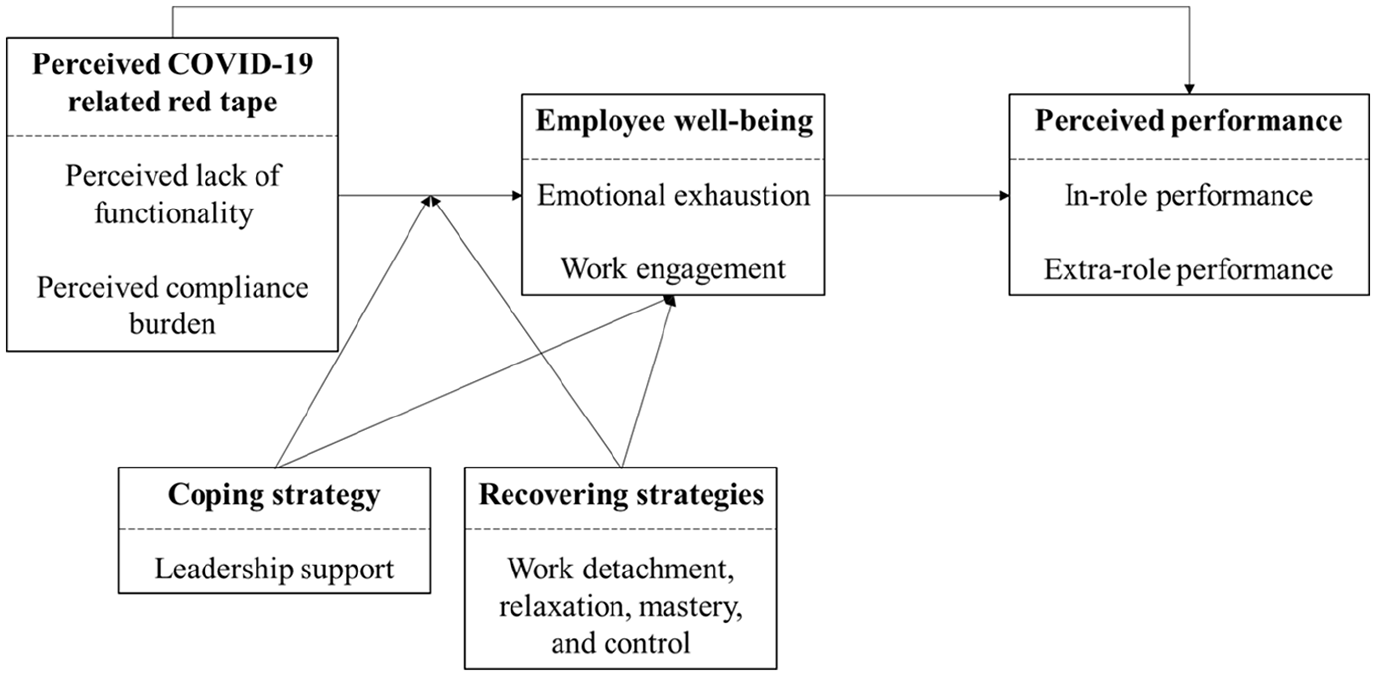
Conceptual model.
Methods
Participants
To test the hypotheses, a survey was developed, which was distributed among 64,530 subscribers to the mailing list of Binnenlands Bestuur, a bi-weekly magazine for higher educated employees in the Dutch public sector. On December 3rd 2020, Binnenlands Bestuur sent the e-mail containing the invitation to the survey. A reminder was sent on January 4th 2021. In total, 6,012 respondents started the survey, but the data of several respondents were removed as they did not provide information about the central and demographic control variables. The final sample consisted of 3,332 respondents. The significant dropout rate raises potential concerns about nonresponse bias, which could impact the generalizability of the findings. Specifically, if respondents who did not complete the survey differ systematically from those who did, the results may not fully represent the target population. To address this, we compared the demographics and characteristics of the removed respondents (N = 2,067), with those included in the hypothesis testing. The removed group had a mean educational level of 7.26, client contact of 2.12, gender of 0.44, and age of 51.73. These values were compared to the included group (see Table 2 in the results), showing no statistically significant differences. While 613 respondents are unaccounted for in this nonresponse analysis because we have no demographic information, we can cautiously conclude that the dropout does not have substantial implications for the validity of the study’s results.
Table 1 shows the demographics of the sample in comparison to the demographics of the latest “Personnel and Mobility Survey,” which is a representative survey conducted every other year by the Dutch Ministry of the Interior and Kingdom Relations (2017; Personeels en Mobiliteitsonderzoek; POMO).
Descriptive Statistics Sample.

6=Higher professional education bachelor, 7=University education bachelor, 8=Higher professional education master, 9=University education master.
The vast majority of the respondents worked for a municipality (n = 2,433; 73%), the other respondents worked for national government (n = 268; 8%), provinces (n = 172; 5.2%), waterboards (n = 108; 3.3%), and others (e.g., semi-autonomous agencies and municipality owned corporations [n = 351; 10.5%]). As Table 1 shows, the distributions regarding gender and age are fairly similar to the representative data. However, the educational level of both the municipalities and other governments is somewhat higher than the representative data. This is also visible in a slight overrepresentation of respondents in managerial positions.
Although managers are overrepresented in our sample, it is known from the literature that both managers and non-managers can experience red tape and suffer its negative consequences. Some studies suggest that perceptions of red tape differ between managers and non-managers (e.g., Jacobsen & Jakobsen, 2018; Walker & Brewer, 2008), while others find no such difference (e.g., Campbell, 2017). However, this variation is likely less relevant when dealing with externally imposed red tape rather than internal red tape. While perceptions of red tape may vary, we assume its associations with employee well-being and self-perceived performance remain consistent across different groups.
Measures
The participants answered all measures on a 5-point Likert-type scale. The Likert scales regarding employee well-being (i.e., emotional exhaustion and work engagement) ranged from 1 (never) to 5 (always) while the Likert scales regarding red tape, the four recovery strategies and supervisor support ranged from 1 (totally disagree) to 5 (totally agree). In Table 2, means, standard deviations, and correlations between all study variables are presented. With every measure below, the average variance extracted (AVE) as well as two different measures to test for construct reliability (composite reliability [ω] and Cronbach’s alpha [α]) are included. AVE represents good convergent validity when the value is above .5, ω represents good reliability when the value is above .6, while α shows good reliability when the values are above .7 (Fornell & Larcker, 1981).
Means, Standard Deviations, and Correlations.

p ≤ .05. **p ≤ .01. ***p ≤ .001.
Perceived performance was measured through two constructs: perceived in-role and extra-role performance. Although there is critique regarding self-reported measures since they could be prone to bias, it is still an often-used way to give the employees perspective as an important internal stakeholder of their performance (Van Loon et al., 2017). Moreover, the actual impact of such bias is also unclear (Conway & Lance, 2010; Meier & O’Toole, 2013) and objective measures are hard to fully grasp the complete work of employees (Brewer, 2006). In addition, we are not interested in the performance of employees as such, but more how it is related to the health-impairment process from COVID-19 related red tape through well-being. We measured public employees’ perceived in-role and extra-role performance with two scales of respectively three and two items which were previously validated in the Dutch public sector context (Van Loon et al., 2017). Example items for respectively in-role performance and extra-role performance are “I consistently meet the formal performance requirements of my job” and “I help colleagues if they have a too high work pressure.” While both in-role performance (AVE = .423; ω = .655, α = .650) and extra-role performance (AVE = .487; ω = .685, α = .680) showed fairly good construct reliability, the convergent validity measures were somewhat below the threshold. However, the square root of the AVE of both in-role performance (.65) and extra-role performance (.70) are much higher than the inter-construct correlations between all other constructs (see Table 3). Thus, convergent validity is still demonstrated. Also, the items loaded sufficiently (λ > .300) on their hypothesized constructs. Therefore, we decide to retain both concepts in the analysis.
Fit Statistics of the Four Measurement Models.

Well-being was measured through two constructs: work engagement and emotional exhaustion. Work engagement was measured with the validated short measure (UWES-3) of the Utrecht Work Engagement Scale (Schaufeli et al., 2019). It takes three items from the UWES-9, one for each dimension: (1) “At my work, I feel bursting with energy”; (2) “I am enthusiastic about my job (Dedication); and (3) “I am immersed in my work” (Absorption). The scale showed good convergent validity and reliability (AVE = .506; ω = .752; α = .751). Also, the items loaded sufficiently (λ > .300) on their hypothesized constructs. Moreover, we measured emotional exhaustion using six items from the Dutch version of the Maslach Burnout Inventory (MBI) called the Utrecht Burn Out Scale (UBOS) which is specifically designed for use in human services organizations such as governmental organizations. Example items are “I feel like I am at the end of my rope” and “I feel burned out by my work.” The scale showed good convergent validity and reliability (AVE = .610; ω = .903; α = .899). Also, the items loaded sufficiently (λ > .300) on their hypothesized constructs.
COVID-19 related perceived red tape was measured through the validated two-dimensional job-centered red tape scale (Van Loon et al., 2016) which we adapted to reflect the COVID-19 related rules. Both dimensions are measured with the original three item scales. An example item regarding the lack of functionality dimension is: “Looking back at the last 8 months of COVID-19 rules, regulations, and procedures with which I have to comply in my core activities . . . had a clear function for my job activities (reversed). An example item regarding the compliance burden dimension is: “Looking back at the last 8 months of COVID-19 rules, regulations, and procedures with which I have to comply in my core activities . . . caused much pressure at work.” Both the lack of functionality (AVE = .544; ω = .782; α = .766) and compliance burden (AVE = .737; ω = .893; α = .889) showed good construct reliability. Moreover, the items loaded sufficiently (λ > .300) on their hypothesized constructs.
Supervisor support was measured through Rhoades et al.’s (2001) four item validated scale. An example items was “My line manager really cares about my well-being”; and “My line manager strongly considers my goals and values.” The scale showed good convergent validity and reliability (AVE = .680; ω = .894; α = .888). Moreover, the items loaded sufficiently (λ > .300) on the hypothesized construct.
The four recovery strategies are measured through the validated shortened version of the Recovery Experience Questionnaire (Sonnentag & Fritz, 2007; Virtanen et al., 2020). For almost all strategies, three items were used. However, regarding relaxation, the three items showed no reliable model due to the low loadings of two out of three constructs (λ < .300). Consequently, one item is used to measure relaxation: “After/outside work I kick back and relax.” An example item for work detachment is “After/outside work I distance myself from my work.” The convergent validity and reliability are good (AVE = .667; ω = .857; α = .848). An example item for mastery is “After/outside work I seek out intellectual challenges.” The convergent validity and reliability are good (AVE = .621; ω = .831; α = .830). An example item for control is “After/outside work I determine for myself how I will spend my time.” The convergent validity and reliability are good (AVE = .723; ω = .886; α = .882). Moreover, the items loaded sufficiently (λ > .300) on their hypothesized constructs.
Control variables. In line with previous studies focused on red tape and its relations with well-being and self-perceived performance (e.g., Davis & Pink-Harper, 2016; Muylaert et al., 2023), we included gender, age, and educational level as control variables in the analyses. Moreover, we particularly included the amount of client contact because this might be of particular importance in a COVID-19 context (Van der Meer et al., 2024). Probably, the COVID-19 rules had particular influence on employees who had many physical contacts with clients to do their job. Age was expressed in number of years. Gender was included as a dichotomous variable indicating whether respondents were female or male. Educational level included 11 subsequent categories ranging from primary education to postgraduate education. Amount of client contact was operationalized through the question: “How often do you have contact with citizens/customers/stakeholders for your work? This may involve personal or telephone contact, but also contact via letters, the internet or social media.” There were four possible answers: daily; multiple times a week; ones a week; never.
Data Analysis
Our hypotheses were tested using structural equation modeling performed in Mplus version 7.4. As standard, a two-step structural equation modeling approach was adopted where, first, the measurement model was examined, followed by the analysis of the structural model (Anderson & Gerbing, 1988). To test the measurement model, a confirmatory factor analysis (CFA) with a robust maximum likelihood (MLR) estimator was conducted. The MLR estimator corrects the standard errors (SE’s) of the standard ML coefficients for nonnormality of ordinal indicators (5-point Likert scales). Since many indicators have skewed or flooring effects, MLR is a stronger estimator. The results showed good model fit (comparative fit index [CFI] = 0.96; Tucker–Lewis index [TLI] = 0.95; root mean square of error [RMSEA] = 0.035). Given the fact that the data come from a single source, common-method variance (CMV) may be an issue (Podsakoff et al., 2003). Consequently, a Harman’s single factor test was performed to check whether CMV is a problem. Although criticized, this test can be used to indicate the possible presence of CMV (George & Pandey, 2017). This model had a significantly worse fit compared with the measurement model (CFI = 0.35; TLI = 0.31; RMSEA = 0.132).
Although the complete measurement model shows good fit, it is statistically impossible in the structural model to estimate the effects of all five moderators at once with two mediators and two outcomes. Consequently, four models were estimated in which the complete mediating model with both mediators and both outcomes was estimated, including the coping strategy through supervisor support as well as one recovery strategy. All four models therefore give the opportunity to compare the coping strategy and a recovery strategy. The four measurement models using the MLR estimator are shown in Table 3.
Since the four measurement models show good fit, the corresponding moderated mediation structural models are estimated using the MLR estimator as well. Since the MLR estimator is used, automatically the “Delta method” is applied by Mplus to estimate the mediating effects. Where the bootstrapping method is used with the ML estimator, the Sobel method (Sobel, 1982) is its sister which is used with the MLR estimator. Moreover, the Sobel method is a commonly applied conservative method to test latent models with two or more mediators where bootstrapping is used with one mediator (MacKinnon, 2008; A. B. Taylor et al., 2008). Besides the estimation of the mediating effects, the interpretation of the significant moderating estimators is done through the interaction plots with simple slopes.
Results
The results of the direct and moderation effects beyond the control variables can be found in Table 4 while the mediation effects can be found in Table 5.
Structural Models Direct and Moderation Effects.

Note. All SE’s are all below .04.
p ≤ .05. **p ≤ .01. ***p ≤ .001.
Structural Models Indirect (Mediation) and Total Effects.
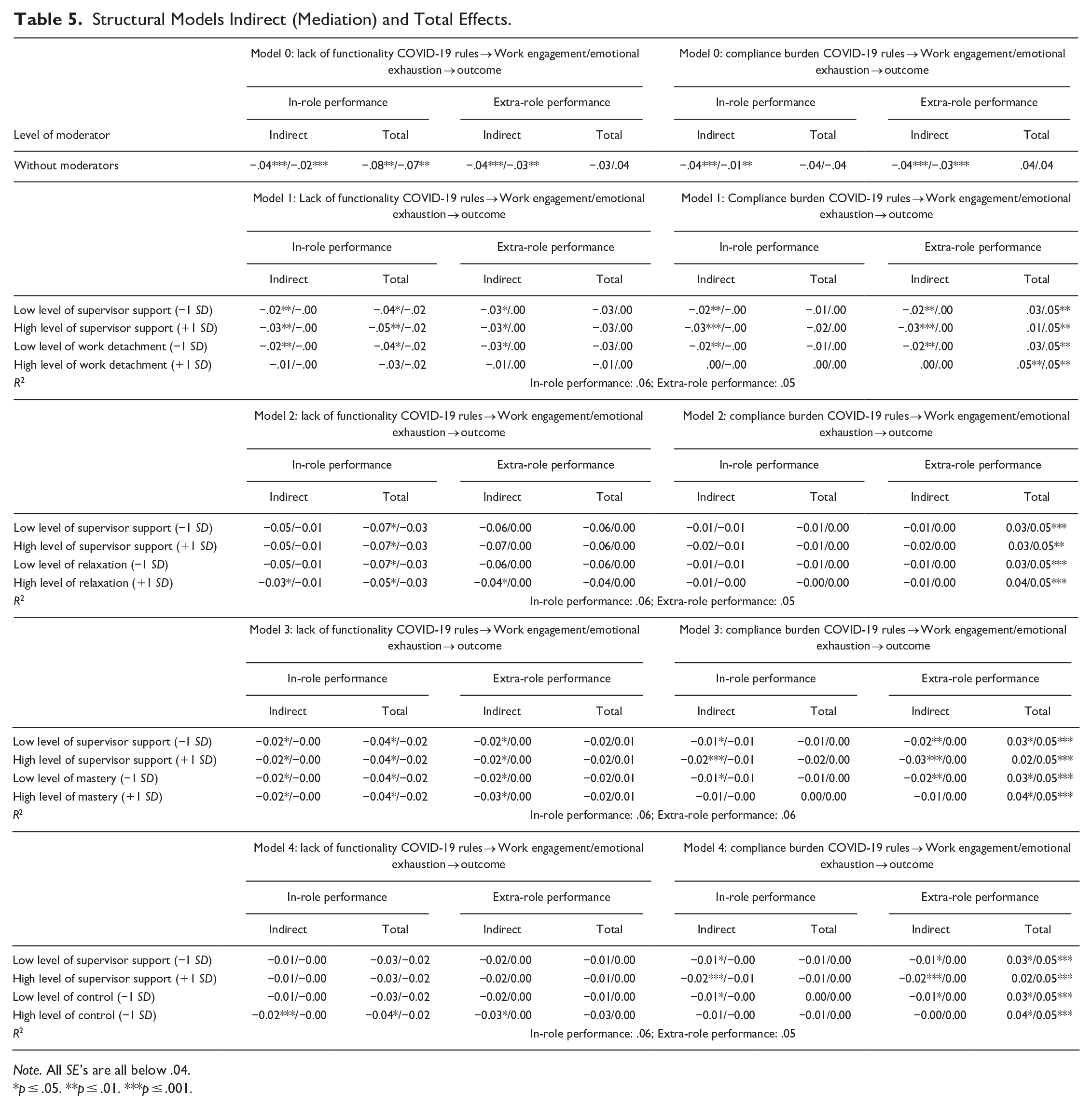
Note. All SE’s are all below .04.
p ≤ .05. **p ≤ .01. ***p ≤ .001.
Health-Impairment Demotivational Processes COVID-19 Related Red Tape
As the results in Table 4 show, the models explain between 22.5% and 26.5% of the variance in work engagement and between 27.5% and 38.6% of the variance in emotional exhaustion. Moreover, as the results in Table 5 show, the models explained 6% of the variance in perceived in-role performance and 5% of the variance in perceived extra-role performance.
According to hypothesis 1a, it was expected that both dimensions of perceived COVID-19 related red tape are negatively related to employee well-being. As Table 4 shows, both the perceived lack of functionality and the perceived compliance burden due to COVID-19 rules are indeed negatively related to work engagement and positively related to emotional exhaustion. Hypothesis 1a is therefore supported.
According to hypothesis 1b, it was expected that both dimensions of perceived COVID-19 related red tape are negatively related to perceived performance, and that the relationship is stronger for in-role than extra-role performance. However, the perceived lack of functionality of COVID-19 rules is not significantly related to perceived in-role and extra-role performance. Moreover, the perceived compliance burden of COVID-19 rules is also not significantly related to perceived in-role performance and even significantly positively related to perceived extra-role performance. As a robustness check, we also tested a model that includes the dimensions of perceived COVID-19 related red tape and perceived performance without including employee well-being and the moderators. These results show that the perceived lack of functionality of COVID-19 rules is negatively and significantly related to perceived in-role performance but insignificantly related to extra-role performance. Moreover, the perceived compliance burden of COVID-19 rules is not significantly related to in-role performance but positively and significantly related to extra-role performance. Hypothesis 1b is therefore rejected.
According to hypothesis 1c, it was expected that the negative relations of both the perceived administrative burden and lack of functionality of COVID-19 related rules are stronger for employee well-being than for perceived performance. Based on the tests of hypotheses 1a and 1b, this hypothesis is indeed supported.
According to hypothesis 1d, it was expected that employee well-being is a significant partial mediator between perceived COVID-19 related red tape and perceived performance. While Table 4 shows that almost all direct relations between perceived COVID-19 related red tape and perceived performance are insignificant, the correlation table (Table 2) did show significant negative (bivariate) relations. This prompts further investigation into the suggested mediations in the literature to better understand the complexity of the underlying mechanisms in the relationship between perceived COVID-19-related red tape and perceived performance. As Table 5 shows, both work engagement and emotional exhaustion indeed significantly mediate the relations between both dimensions of perceived COVID-19 related red tape and both forms of perceived performance. Almost all direct relations are non-significant, meaning that work engagement and emotional exhaustion fully mediate almost all relations between perceived COVID-19 related red tape and perceived in-role and extra-role performance. Only the direct relationship between the perceived compliance burden and perceived extra-role performance is significant and, against expectations, positive. Consequently, hypothesis 1d is supported.
Coping Strategy Through Supervisor Support
According to hypothesis 2, supervisor support is positively related to employee well-being (i.e., a positive relation with work engagement and a negative relation with emotional exhaustion). As Table 4 shows, supervisor support is indeed positively related to work engagement and negatively related to emotional exhaustion. Hypothesis 2 is therefore supported.
Next, it was expected according to hypothesis 3 that supervisor support significantly weakens the negative relation between perceived COVID-19 related red tape and employee well-being. However, as Table 4 shows, supervisor support is a non-significant moderator meaning that public servants do not perceive supervisor support as a helpful resource to cope with the perceived lack of functionality and perceived compliance burden of COVID-19 rules. Hypothesis 3 is therefore rejected.
Recovering Strategies Through Work Detachment, Relaxation, Mastery, and Control
According to hypotheses 4a until 4d it was expected that all four recovery strategies are positively related to employee well-being (i.e., positive relations with work engagement and negative relations with emotional exhaustion). Except for the non-significant relation between work detachment and work engagement, the recovery strategies are indeed positively related to work engagement and negatively related to emotional exhaustion. Hypothesis 4a (work detachment) is therefore rejected while hypothesis 4b (relaxation), hypothesis 4c (mastery), and hypothesis 4d (control) are supported.
Besides a direct relation with well-being, it was expected according to hypothesis 5 that respectively work detachment (H5a), relaxation (H5b), mastery (H5c), and control (H5d) would significantly decrease the negative relations between perceived COVID-19 related red tape (including the perceived administrative burden and lack of functionality of COVID-19 related rules) and employee well-being. As Table 4 shows, work detachment, mastery, and control significantly moderate the relation between the perceived compliance burden of COVID-19 rules and emotional exhaustion. Moreover, work detachment also significantly moderates the relation between the perceived compliance burden of COVID-19 rules and work engagement. In contrast, relaxation is a significant moderator in the relation between the perceived lack of functionality of COVID-19 rules and emotional exhaustion. To aid interpretation of the direction of the moderation, interaction plots are presented in Figures 2 and 3.
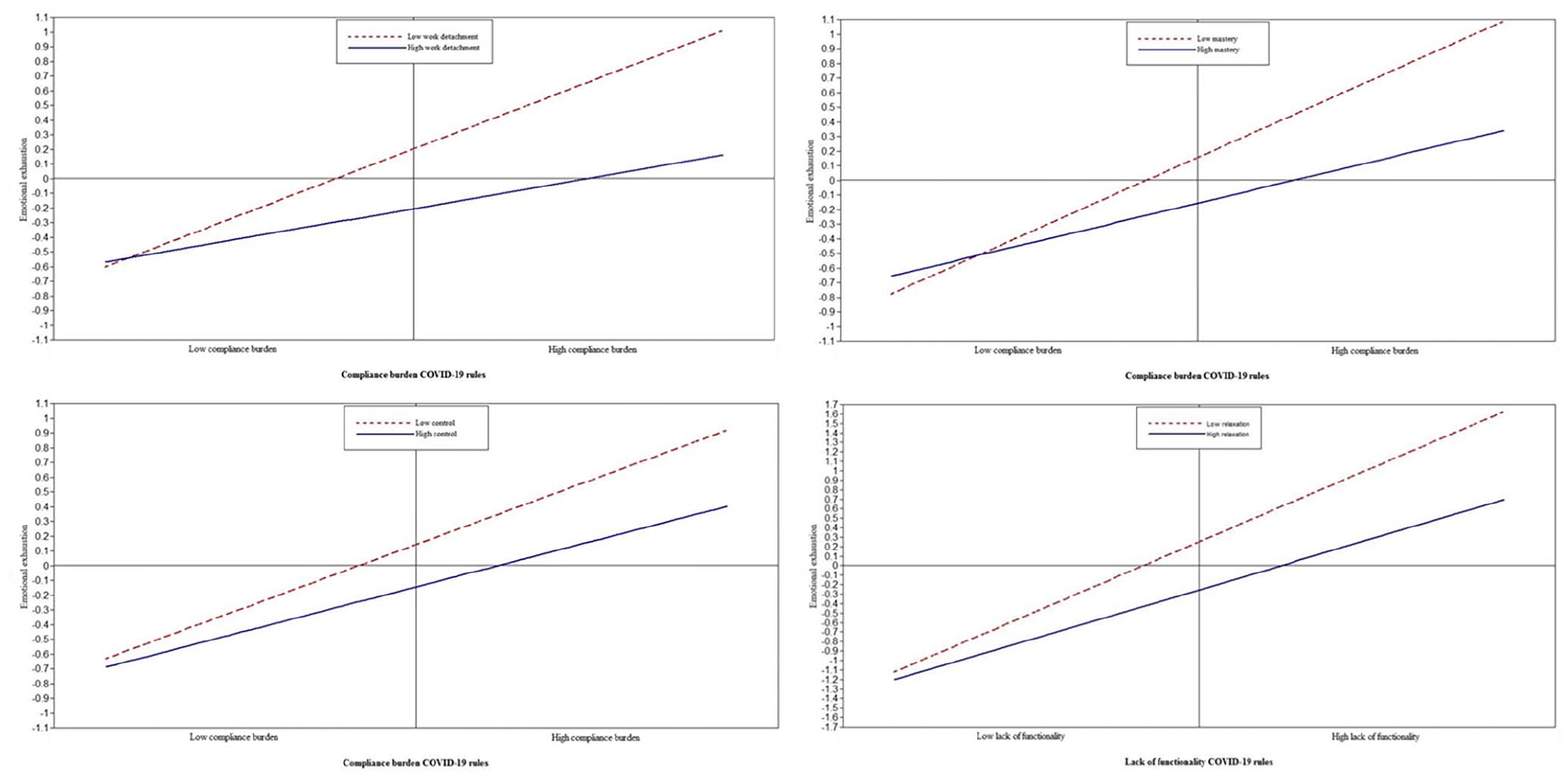
Significant simple slopes regarding recovery strategies and emotional exhaustion.
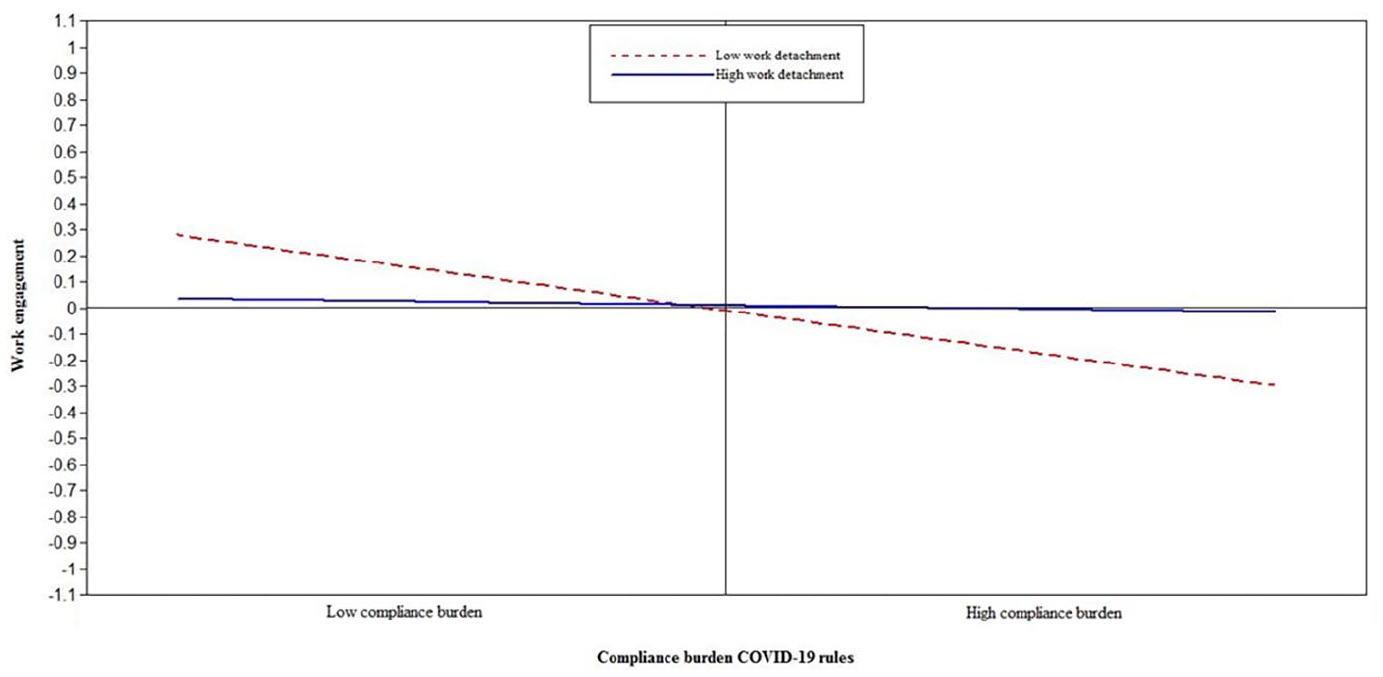
Significant simple slope regarding the recovery strategy work detachment and work engagement.
Every plot shows the estimated effect sizes between the red tape and well-being dimension for respondents who score low (−1 standard deviation above the mean) or high (+1 standard deviation of the mean) for recovery strategies. Respondents with low scores indicate that they are using the specific recovery strategy less than most respondents, while respondents with high scores indicate that they are using the specific recovery strategy more than most respondents. In line with hypotheses 5a to 5d, the four simple slopes in Figure 2 show that, for each recovery strategy, the negative relations between one of the perceived COVID-19 related red tape dimensions and emotional exhaustion is weaker for respondents who scored above average than for respondents who scored below average. Also, in line with hypothesis 5a, the simple slope in Figure 3 shows that the negative relation between the compliance burden of COVID-19 rules and work engagement is weaker for respondents who scored above average for work detachment than for respondents who scored below average. However, the recovery strategies do not moderate all relations between COVID-19 related red tape and well-being. This means that hypotheses 5a to 5d all need to be rejected.
In Figure 4, the results of the four structural models discussed above are summarized figure 4.

Structural models.
Discussion and Conclusion
We set out with the following two central questions: “What is the relationship between public servants’ perceived COVID-19 related red tape through well-being with their perceived performance?” and “To what extent do coping strategies (through supervisor support) and recovering strategies (through work detachment, relaxation, mastery, and control) moderate these health-impairment and demotivational processes?”
For the first question, our finding that COVID-19 red tape is negatively related to well-being corroborated previous studies (Borst, 2018; Blom et al., 2021; George et al., 2020), but we found no negative relation with perceived performance. For employee well-being, COVID-19 related red tape might introduce impersonal citizen-public servant contact and mandatory use of new digital tools due to forced homeworking (Muylaert et al., 2023; Schuster et al, 2020), which may be associated with increased feelings of powerlessness and meaninglessness (Van Loon et al., 2017) and, in turn, lowered well-being. For perceived performance, both in-role and extra-role, we found no direct negative relation with perceived COVID-19 related red tape. We even found a positive relation for extra-role performance. As Van der Meer et al. (2024) suggest, it may be that public servants view COVID-19 related red tape as helpful in handling the quickly changing working conditions during the pandemic and stimulates them to make up for the inefficiencies (J. Taylor, 2016), thereby overcoming negative consequences for in-role performance and even elicit extra-role performance.
In addition, we found that work engagement and emotional exhaustion are, in almost all situations, significant full mediators in the relation between COVID-19 related red tape and both dimensions of perceived performance. In other words, COVID-19 related red tape is indirectly associated with lowered perceived performance due to lowered well-being. Given the positive relation between the perceived compliance burden of COVID-19 rules and perceived extra-role performance, we only found partial support for the full health-impairment and motivational processes.
For the second question, we found that recovery strategies indeed are associated with weaker negative relations between COVID-19 related red tape and well-being. Employing recovery strategies seem to be particularly helpful to buffer against emotional exhaustion. In other words, recovering during off-work time may help public servants to develop new perspectives towards their work and ways to not letting red tape get under their skin (Sonnentag, 2012). In contrast with previous literature, supervisor support seems to be unhelpful in overcoming the negative relations between COVID-19 related red tape and employee well-being. It was expected that supervisors are able to provide public servants with information that helps them understand the rule purpose, and as a result, feel less burdened or hindered by the rules in the work environment (Moynihan et al., 2012). Especially in the context of forced homeworking and the quickly changing new COVID-19 rules and regulation, the supervisor is the first point of contact (Moynihan et al., 2012; Muylaert et al., 2023). An explanation as to why supervisors turn out to be unhelpful despite this coherent and understandable reasoning might lie in the fact that supervisors themselves also must cope with the COVID-19 related red tape (Muylaert et al., 2023). Consequently, they are unable to provide solutions to deal with the red tape because they have to figure out how to deal with the red tape themselves. That might also underline the fact that recovering strategies happen in an off-work situation in which red tape has no pass-through (Sonnentag, 2012).
The findings summarized make three main contributions to the literature as well as offer suggestions for future research.
Despite the future research directions that can be derived from our study’s contributions, we can also distill future research suggestions from the limitations of this study. The data used in this study is cross-sectional which does not allow us to claim cause-and-effect relationships. While scholars applying the JD-R model show that the health impairment process starts with demands, followed by lower well-being and in turn lower performance, it is also acknowledged that reciprocal relationships might exist. Due to the cross-sectional nature, CMV might also form an issue. While the Harman’s single factor tests carried out indicates that CMV is not a concern, future studies could employ longitudinal or experimental designs to overcome CMV. In the context of crisis-induced red tape (like COVID-19 related red tape) this might be particularly interesting as one could argue that the introduction of these type of rules (as was the case during the COVID-19 pandemic) was unpredictable due to the gradual and escalating pace. This might lead to the introduction of insecurity about which rules apply now and perhaps tomorrow that might have a detrimental effect on public servants’ wellbeing and performance. The focus of this study has primarily been on the extent of experienced COVID-related red tape and its relationships with employee outcomes, but the time dimension might offer an interesting research opportunity to further deepen our understanding of red tape (e.g., through diary studies). In other words, while this study shows interesting results regarding the psychological processes around red tape, the study also raises new questions that suggest avenues for future research.
The findings of our study point towards two main implications for public servants who experience crisis-induced red tape that is difficult if not impossible to eradicate. First, almost all types of recovery strategies, can help in mitigating the negative relations between perceived red tape and employee well-being. Whether it is detaching from work, relaxing, participating in activities outside of work or taking control of off-work time, these strategies may all help the mitigation of the positive associations between perceived red tape and emotional exhaustion. Morover, engaging in activities outside of work, particularly those involving others, is associated with greater work engagement, while physical and mental detachment may mitigate the negative association of perceived red tape perceptions with work engagement. Middle and line managers can foster these recovery strategies through initiatives like online self-training modules (Demerouti, 2023) to support healthier, more engaged employees (Demerouti, 2023). Second, crisis-related red tape, like the rules introduced during COVID-19, may unexpectedly be positively related with public servants’ perceived performance. Although managers cannot change externally imposed rules, they can frame them as challenges that help employees overcome obstacles, learn, and grow. This approach allows organizations to find benefits in situations that might otherwise seem entirely negative (Demerouti & Bakker, 2023).
Footnotes
Declaration of Conflicting Interests
The author(s) declared no potential conflicts of interest with respect to the research, authorship, and/or publication of this article.
Funding
The author(s) received no financial support for the research, authorship, and/or publication of this article.
