




Abstract
Work engagement refers to an active energetic state of mind that is characterized by vigor, dedication, and absorption. Despite practitioner’s attention for work engagement, few public administration scholars have studied public servants’ work engagement empirically. The goal of this study is to extend the job demands–resources (JD-R) model of work engagement using insights from the public administration literature. The analysis of a large-scale survey (N = 9,465) shows that (a) work and personal resources, including public service motivation, are positively related to work engagement; (b) red tape moderates these relationships; and (c) work engagement mediates the relationship between JD-R and job outcomes. In conclusion, public organizations can potentially increase work engagement and inherently employee outcomes by increasing work-related resources (autonomy, cooperation with colleagues) and selecting personnel with a proactive personality and high levels of public service motivation.
Introduction
Work engagement—defined as “[ . . . ] a positive, fulfilling, work-related state of mind that is characterized by vigor, dedication, and absorption” (Schaufeli, Salanova, González-Romá & Bakker, 2002, p. 74)—has become a popular research topic within the management literature (Albrecht, Bakker, Gruman, Macey, & Saks, 2015; Saks & Gruman, 2014). Studies show that employees who experience high levels of work engagement are physically healthier, experience more satisfaction of their psychological needs, are more satisfied, and are more committed than employees with little work engagement (Barret-Cheetham, Williams, & Bednall, 2016; Ryff, 1989). Vigoda-Gadot, Eldor, and Schohat (2012) therefore argued that work engagement is an important complement to this field of research. Despite the attention for work engagement in public organizations across the world (e.g., Cotton, 2012; Jansen, Van den Brink, & Kole, 2010; Kernaghan, 2011; Lavigna, 2013), there is a dearth of research examining work engagement in the public administration literature (Kernaghan, 2011; Tummers, Steijn, Nevicka, & Heerema, 2016; Vigoda-Gadot et al., 2012).
The work engagement concept was developed in combination with the job demands–resources (JD-R) model (Bakker & Demerouti, 2007). At the heart of this model lies the assumption that all aspects in work environments can be categorized into job demands and job resources that either positively or negatively affect work engagement (Bakker & Demerouti, 2007). From the main idea of the JD-R model, it can be deduced that it is a general model developed within the realm of “positive psychology” (Bakker & Demerouti, 2008).
Interestingly, studies applying the JD-R model in combination with work engagement do not take the specific circumstances of certain occupations and contexts into account (Bakker, Demerouti, & Sanz-Vergel, 2014; Bickerton, Miner, Dowson, & Griffin, 2015; Gorgievski, Moriano, & Bakker, 2014). However, Lavigna (2013, 2015) argued, for example, that the complex bureaucratic organizational structures in public organizations, the frequent changes of political leadership, and specific motivations to work as a public servant might influence work engagement. Several public administration scholars therefore call for more thorough scholarly attention to analyze the meaning and practical usage of work engagement in the public sector context (Kernaghan, 2011; Lavigna, 2015; Perry & Vandenabeele, 2015; Vigoda-Gadot et al., 2012). The goal of this study is to extend the JD-R model of work engagement by introducing insights from public administration literature. Simultaneously, by introducing work engagement in public administration literature, we bring in a “positive psychology” perspective into public administration (Tummers et al., 2016).
Specifically, our contribution to the JD-R model of work engagement is threefold. First and foremost, we extend the JD-R model by clustering job resources into two levels—organization-related resources and work-related resources. The premise of existing studies is that the more job resources employees have, the more engaged they will be (Saks & Gruman, 2014). Although clusters of job resources are proposed by some scholars (Schaufeli, 2015), all resources are treated as equally important in the empirical literature so far (Saks & Gruman, 2014). Instead of treating all job resources in the work engagement theory equally, it might be worthwhile to create classes of job resources and analyze if these classes vary in their importance for facilitating work engagement (Bakker & Leiter, 2010; Saks & Gruman, 2014).
Second, we introduce two new factors into the existing JD-R model of work engagement—red tape and public service motivation (PSM). Lavigna (2013), among others, argued that several specific factors in the public sector might influence the work engagement of public servants. The two most important factors mentioned are the bureaucratic structures and especially the perceived red tape, and the specific motivation of public servants to work in the public sector (PSM; Kernaghan, 2011). Despite the attention to these factors in public administration literature (Loon, van Leisink, Knies, & Brewer, 2016; Perry & Vandenabeele, 2015), they have barely been empirically related to the JD-R model in general (an exception is Giauque, Anderfuhren-Biget, & Varone, 2012), let alone to the JD-R model of work engagement in particular (Bakker, 2015).
Finally, work engagement is often analyzed as a mediating variable between the JD-R model and outcomes (Schaufeli, 2015). Drawing on this theory, we analyze the mediating role of work engagement between these two classes of job resources and public sector–specific factors on one hand and the affective organizational commitment and turnover intention of public servants on the other hand. Although the direct effects of PSM and red tape on commitment (e.g., Vandenabeele, 2009 and Stazyk, Pandey, & Wright, 2009, respectively) and turnover intention (e.g., Campbell & Im, 2016, and Quratulain & Khan, 2015, respectively) have been studied, the mediating effect of work engagement has not been taken into account before. As we know little about intermediate factors between, for example, PSM and individual outcomes (Loon, Kjeldsen, Bøgh Andersen, Vandenabeele, & Leisink, 2016), there has been a recent call for research that links the JD-R model of work engagement and PSM (Noesgaard & Hansen, 2017; Vandenabeele, Brewer, & Ritz, 2014). The integration of the JD-R model of work engagement might contribute to the understanding of the psychological mechanisms through which PSM leads to positive attitudes and behavior. To fill these research gaps, the following question will be answered:
This question will be answered by means of an empirical analysis of a large sample of Dutch government employees (N = 9,465). The remainder of this article is structured as follows. The “Theory” section presents the theoretical background resulting in five hypotheses. In the “Method” section, the method to test our hypotheses will be presented. The results of the analyses will be presented in the “Results” section. Finally, in the “Discussion” section, we explore several avenues for further research on work engagement in the public sector.
Theory
JD-R Model of Work Engagement Defined
Positive psychology broke the trend of vocational psychology in the 1990s by focusing on what employees are doing right instead of what they are doing wrong (Bakker & Daniels, 2011). Drawing upon positive psychology, scholars started to investigate constructs such as work engagement, which are in line with this positive energetic view (Tummers et al., 2016). Work engagement refers to an active energetic state of mind that is characterized by vigor, dedication, and absorption (Schaufeli et al., 2002). Vigor is defined as having high levels of energy and mental resilience while working; dedication is defined as feeling a sense of significance, enthusiasm, pride, and inspiration toward one’s work; absorption is defined as being fully engrossed in one’s work (Schaufeli et al., 2002).
Together with the development of the work engagement construct, the study of its antecedents and consequences is based on the JD-R model. According to this model, job characteristics can be classified as either job demands or job resources. Job demands are factors that cost energy to deal with, such as high workload and role ambiguity (Bakker, 2015). Job resources are factors that help individuals to deal with these demands including social- and supervisor support, developmental opportunities, and autonomy (Bakker & Demerouti, 2008). While the JD-R theory proposes that job demands and resources directly affect work engagement, they can also interact in shaping the work engagement of employees (Bakker & Demerouti, 2008; Hakanen, Bakker, & Demerouti, 2005). Scholars show that the effect of job resources on work engagement becomes more salient and gains motivational potential when employees are confronted with high job demands as job resources can help goal achievement.
As most psychological approaches assume that human behavior results from an interaction between personal and environmental factors, it is deemed necessary that personal resources are integrated into the JD-R model (Schaufeli & Taris, 2014). Indeed, Xanthopoulou, Bakker, Demerouti, and Schaufeli (2007) extended the JD-R model by incorporating these personal resources—next to job resources—which are psychological characteristics or aspects of the self, including self-efficacy and proactive behavior.
The JD-R model described is extended below by integrating public administration literature and inherently several phenomena of the public sector.
Red tape: A key job demand in the public sector
Although the effects of many job demands on work engagement have been studied, a key job demand in the public sector has been ignored. One of the most studied job demands within the public sector is the perceived unmanageable paperwork by public servants, also known as red tape (Bozeman & Feeney, 2011; Brewer & Walker, 2010; DeHart-Davis & Pandey, 2005; Walker & Brewer, 2008). When public servants encounter rules, regulations, or procedures that seem pointless yet burdensome, they become alienated of their work, less creative, and less productive (DeHart-Davis & Pandey, 2005). Red tape can therefore be framed as hindrance job stressors that are appraised as those job demands or work circumstances that involve excessive or undesirable constraints that inhibit an individual’s work engagement (Crawford, LePine, & Rich, 2010; Quratulain & Khan, 2015). It has also been shown by Vermeeren and van Geest (2012) that perceived red tape negatively affects the pride of public servants being an important part of work engagement. We therefore posit the following hypothesis:
Effect of classes of job resources on work engagement
Although the JD-R model treats all resources as equally important, several scholars in public administration developed classes of characteristics to investigate their effect on, for example, job motivation, pride, job satisfaction, and organizational commitment (Moynihan & Pandey, 2007; Steijn, 2004; Vermeeren & van Geest, 2012). These scholars make a distinction between work-related characteristics, organization-related characteristics, and personal characteristics. As mentioned before, the JD-R model also recognizes personal resources as a separate class (Xanthopoulou et al., 2007), but ignores the importance of clusters of job resources on work engagement as well as how they are perceived by employees (Noesgaard & Hansen, 2017). As personal resources are a separate part in the JD-R model, we will discuss these resources in the next paragraph.
Within public administration literature, next to personal resources, two classes of job resources are often identified—work-related resources (e.g., teamwork with colleagues, content of the job, autonomy) and organization-related resources (supervisory support, developmental opportunities, and performance measurement; for example, Vermeeren & van Geest, 2012). The present study argues that the effects of public servants’ perceptions about these clusters of resources have divergent effects on work engagement.
Several studies have shown that public servants are more motivated by work characteristics than by organization-related characteristics. It is explained by the assumption that public servants are intrinsically motivated by the job instead of extrinsically motivated by organizational stimuli (Buelens & Van den Broeck, 2007). It is therefore expected that when public servants are satisfied about their work-related resources, they become more engaged than when they are satisfied about their organization-related resources.
Various scholars show that public servants indeed are mostly motivated by work-related resources, including job content, recognition, autonomy, and interesting work (Buelens & Van den Broeck, 2007; Houston, 2000). Organization-related resources such as career development opportunities, supervisory support, and performance management have a positive but weaker effect on work engagement than job resources (Conway, Na, Kathy, Kerstin, & Bailey, 2016; Lavigna, 2013). Lavigna (2013) argued that supervisors in the public sector are often put in difficult situations by politically elected top executives to force public servants to develop and implement ambiguous and conflicting policies, which results in lower work engagement. Conway et al. (2016) also showed that performance management within the public sector has no effect on work engagement. Public servants find themselves doing less of what they consider pleasurable or fulfilling because first of all they have to reach the standards set by the supervisors (Conway et al., 2016). In addition, Borst, Lako, and de Vries (2013) showed that career development opportunities only have a relatively small effect on the satisfaction of public servants. We can therefore state the following hypothesis:
Moreover, as argued by the JD-R model, job demands, including red tape, moderate the impact of job resources on work engagement. Specifically, the more job demands employees experience, the higher the motivational potential of job resources on work engagement because they can help goal accomplishment (Bakker & Demerouti, 2008; Bakker, Hakanen, Demerouti, & Xanthopoulou, 2007). Normally, red tape is a hindrance job stressor that is assumed to have a negative impact on the work engagement of public servants. However, in situations where job demands coincide with the availability of job resources, job demands are more likely to be experienced as challenges rather than hindrance job stressors (Bakker, Van Veldhoven, & Xanthopoulou, 2010). In the case that public servants have job resources, they can be used to cope with this challenging demand (i.e., red tape). According to this coping mechanism, it might therefore well be the case that high-perceived red tape increases the effect of the perceived resources by public servants on their work engagement.
Personal resources
PSM is seen as a “key psychological resource” (Bakker, 2015, p. 729) that is expected to drive high levels of engagement (Lavigna, 2015). However, the actual effect of PSM on work engagement is understudied. PSM refers to the predisposition of individuals to serve the public interest (Perry & Hondeghem, 2008). It is a personality trait of individuals who are willing to engage in sacrificial behavior for the good of citizens without reciprocal benefits for themselves (Perry & Vandenabeele, 2015). Many employees enter public service because they are already committed to the mission of government (Lavigna, 2013). PSM is therefore a relatively stable, higher level individual variable that is only subject to slow change (Bakker, 2015). This means that PSM helps public servants to do their work full of energy and dedication—that is, work engagement (Bakker, 2015). However, this effect might depend on the degree to which employees feel that a particular organizational environment allowed them to fulfill their public service motives (Bright, 2007). A good fit between the PSM of a person and the organization is therefore necessary to reach high work engagement. Despite this nuance, PSM is a trait that gives public servants energy and therefore probably positively affects work engagement (Bakker, 2015).
Two other personal resources that are not entirely new to the JD-R model but have not been studied in a public sector context are professional expertise and proactivity. First, professional expertise refers to the personal qualities and capabilities that are needed to reach given attainments (Van der Heijden, 2000). Second, proactive employees demonstrate initiative and perseverance (Crant, 1995). These are preconditions of vigor (Schaufeli et al., 2002). The three personal resources mentioned are expected to directly influence work engagement (Christian, Garza, & Slaughter, 2011; Lavigna, 2015). This results in the following hypothesis:
Outcomes of Work Engagement
Kahn (1990) proposed that individual and organizational factors influence work engagement, which drives individual attitudes and behavior such as turnover intention and affective commitment. In other words, work engagement is believed to mediate the relationships between the JD-R model and job outcomes (Kahn, 1990; Schaufeli, 2015).
Within public administration literature, emphasis is being placed on the importance of organizational commitment. It is called a “hedonic indicator” that refers to happiness, pleasure, and enjoyment (Diener, Scollon, & Lucas, 2009; Ryan & Deci, 2001; Tummers et al., 2016). In contrast, work engagement is a so-called “eudaimonic” indicator that refers to purpose, meaningfulness, and psychological well-being (Diener et al., 2009; McGregor & Little, 1998; Ryan & Deci, 2001). Although organizational commitment might have some minor overlap with work engagement, Vigoda-Gadot et al. (2012) showed that work engagement is theoretically but also empirically a different concept from organizational commitment. Work engagement is a more encompassing and deeper construct than affective organizational commitment as it connotes the process of the active investment of an employee’s entire self (psychically, cognitively, and emotionally) to its work (Tummers et al., 2016, Vigoda-Gadot et al., 2012). In contrast, hedonic concepts such as organizational commitment are called passive employee attitudes as employees can be committed to the organization, but they might simultaneously be passive in their behavior (Tummers et al., 2016). Organizational commitment connotes calmness and contentedness (e.g., “I feel at home in my organization”), which might lead to low activation, whereas work engagement leads to enthusiasm and excitement, which lead to high activation (adapted circumplex model of Russel, 1980, in Schaufeli, 2013).
Comparable with commitment, turnover intention is often characterized as a passive employee attitude although it has a negative connotation (Harrison, Newman, & Roth, 2006). Cohen, Blake, and Goodman (2016) showed in a study among federal U.S. public agencies that this turnover intention often does not lead to actual turnover. It is passive as it often does not lead to actual behavior.
Studies show that employees who experience high levels of components of eudaimonic well-being (e.g., work engagement) are physically healthier, experience more satisfaction of their psychological needs, and also experience hedonic well-being (e.g., commitment) compared with employees with low eudaimonic well-being (Barret-Cheetham et al., 2016; Ryff, 1989). As work engagement is indeed a deep state of mind that connotes the satisfaction of basic psychological needs (physically, cognitively, and emotionally), it might well lead to higher hedonically defined happiness and pleasure including affective organizational commitment and lower turnover intention. It is therefore expected that organizational commitment and turnover intention are outcomes of work engagement.
Moreover, while it is expected that organizational work engagement is a determinant of these job outcomes, several scholars in public administration show that individual and job resources are also determinants of organizational commitment and turnover intention (Cohen et al., 2016; Moynihan & Pandey, 2007). It is therefore expected that work engagement partially mediates the relationship between individual and job resources, and job outcomes. This brings us to Hypothesis 5:
These hypotheses lead to the conceptual model as presented in Figure 1.
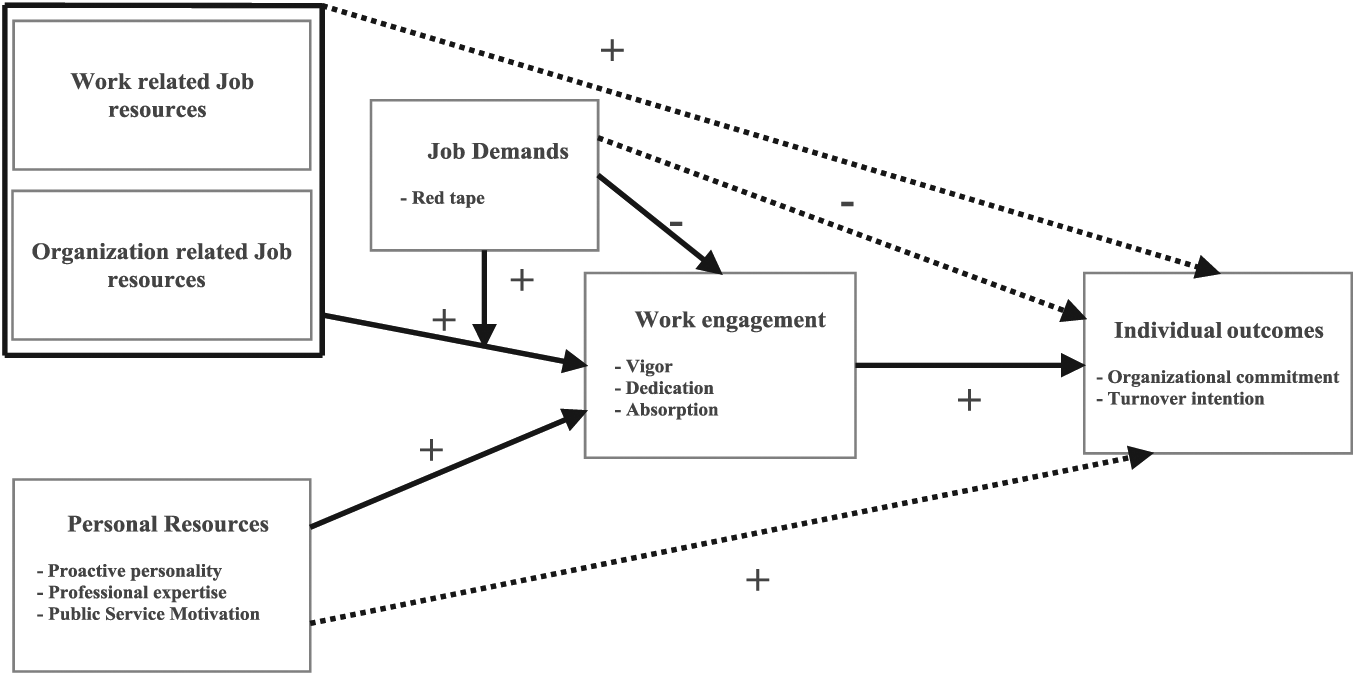
Conceptual model.
Method
Participants
To test the hypotheses, we used a survey carried out in 2014 by the Dutch Ministry of the Interior and Kingdom Relations (2015). In total, 31,181 questionnaires were sent to public servants employed in municipalities, provinces, water boards, central government, and the legal authorities. Of these questionnaires sent, 9,503 were returned (response rate = 30.5%). In total, 38 respondents with missing values on the variables needed for our research were excluded (all missings were on the control variables). After deleting participants with missing values on the research variables, data of 9,465 public servants were used.
Measures
The participants answered all measures on a 5-point Likert-type scale ranging from 1 (totally disagree) to 5 (totally agree) except for turnover intention, individual resources, and organization-related resources. The work- and organization-related job resources were measured using 5-point Likert-type satisfaction scales ranging from 1 (totally dissatisfied) to 5 (totally satisfied). Turnover intention was dichotomized into “yes” and “no.” All items of the used constructs can be found in the appendix.
Work engagement
Work engagement was measured using six items of the validated nine-item short version of the Utrecht Work Engagement Scale (Schaufeli et al., 2002). Work engagement is a higher order construct composed of the three dimensions, namely, vigor, dedication, and absorption. Because the three dimensions of engagement are highly intercorrelated (i.e., intersubscale correlations over .50), it is a common approach to combine the subscales into an aggregate measure of work engagement (e.g., Halbesleben, Harvey, & Bolino, 2009). A high score indicates that an employee is engaged in his or her work.
Red tape
Red tape was measured with a validated six-item scale applied before within a large Dutch public sector survey (Vermeeren & van Geest, 2012). A high score indicates that an employee perceives a high level of red tape.
Satisfaction with work-related and organization-related job resources
According to the Dutch Ministry of the Interior and Kingdom Relations (2015), these two measures are based on theoretical concepts and controlled for unidimensionality by means of factor analysis and reliability analysis. A high score on both variables indicates than an employee is satisfied with, respectively, work-related resources and organization-related resources.
PSM
PSM was measured with 10 items from the validated PSM scale of Vandenabeele (2008b) and previously applied by Loon, Kjeldsen, et al. (2016). This scale is an adapted version from the original scale of Perry (1996), which Vandenabeele (2008b) developed to make it compatible within contexts such as the Dutch public sector. Vandenabeele (2008a) found that a model of three dimensions performed better than a four-dimension model of PSM (with “public interest” and “self-sacrifice” collapsed into one dimension). We therefore used a second order three-dimensional construct that includes the dimensions of attraction to public policy (APP), compassion (COM), and commitment to the public interest/self-sacrifice (CPI).
Affective commitment
Affective commitment was measured with four items from the validated affective commitment scale of Allen and Meyer (1990). A high score indicates that an employee feels committed to the organization.
Turnover intention
Turnover intention was measured with a single item: Are you currently looking for another job? Although a single-item measure precludes analyses of reliability, it is a frequently applied measure in studies of turnover intentions (e.g., Conklin & Desselle, 2007; Grover & Crooker, 1995).
Professional expertise
Occupational expertise was measured with three items from Van der Heijden’s (2000) validated occupational expertise scale. A high score indicates that an employee perceives that he or she has high occupational expertise.
Proactive personality
Proactive personality was measured with five items from Bateman and Crant’s (1993) validated proactivity scale. However, instead of measuring general proactivity as in the scale of Bateman and Crant (e.g., “I am constantly on the lookout for new ways to improve my life”), it is applied to the work environment (e.g., “I try to continually improve myself in my profession”). A high score indicates that an employee has a proactive personality.
Control variables
Several control variables were also included. We dummy coded gender (0 = male, 1 = female). Age was categorized into five cohorts (1 = 15-24 years, 2 = 25-34 years, 3 = 35-44 years, 4 = 45-54 years, 5 = 55 years and older). Tenure was included as a continuous variable, expressed as the number of years employees have worked for the organization. We also included education, which was subdivided into seven categories, reflecting the Dutch educational system (1 = primary education, 2 = prevocational secondary education, 3 = senior general secondary education and preuniversity education, 4 = secondary vocational education, 5 = higher professional education, 6 = university education, 7 = academic education). Age and education were treated as continuous variables in line with Vermeeren, Kuipers, and Steijn (2014).
Strategy of Analysis
Our five hypotheses were tested using structural equation modeling performed in Mplus Version 7.4 (Muthén, Muthén, & Asparouhov, 2016). A two-step approach was adopted where, first, the measurement model was examined followed by the analysis of the structural model (Anderson & Gerbing, 1988). As the measurement model included a large number of categorical variables of which many had skewed answer distributions (floor and ceiling effects), we applied the weighted least squares means and variance adjusted (WLSMV) estimation method. The WLSMV estimation method does not assume normally distributed variables and provides the best option for modeling categorical data (Brown, 2006). After the development of the measurement model, all the created factors for the structural model are automatically corrected for skewedness and made continuous.
To test the measurement model, several fit measures were analyzed. In large samples (as in this research), the chi-square test almost always leads to the rejection of the model because the difference between the sample covariances and implied population covariances lead to a higher chi-square value when the sample size increases (Hu & Bentler, 1999). As a result, a number of alternative fit measures have been developed from which we use one of every “family” (Hu & Bentler, 1999). The comparative fit index (CFI), Tucker–Lewis index (TLI), and root mean square of approximation (RMSEA) are used to assess whether the model fits the data. The measures of CFI and TLI indicate fit with a threshold above .90 and excellent fit above .95. An RMSEA value indicates good fit below .08 and excellent fit below .05 (Byrne, 2012; Hu & Bentler, 1999; Kline, 2010). In addition, construct reliability (CR) and average variance extracted (AVE) were calculated to test, respectively, the reliability and validity of our variables.
To analyze the relationships between the constructs, two structural models were developed. Within the first model, the mediation model was developed. A second model, including simple slopes, was calculated to test the moderating effects. The reason for this separate model is twofold. First, the inclusion of latent interactions into the first model with eight latent variables cannot lead to a reliable estimation. Second, latent interactions do not lead to fit measures, which would make the interpretation of the structural model less powerful. As latent interactions do not lead to fit measures, we analyze the additional variance explained and the significance of the interaction to tell whether the moderating effects matter.
To test the mediating effects, the popular method of bootstrapping is applied (Bollen & Stein, 1990; Shrout & Bolger, 2002). This method is based on resampling with replacement that is done many times. The indirect effect from each subsample is computed, which leads to the computation of an overall confidence interval. If zero is not in the interval, then the researcher can confidently conclude that the indirect effect is different from zero (Bollen & Stein, 1990). The reported results are based on bias-corrected and accelerated confidence intervals set at 0.95 with 1,000 resamples.
Results
In this section, the results of the study are presented. First, a measurement model of the study’s central variables is constructed to assess its measurement quality and convergent and discriminant validity. Then, descriptive statistics and correlations are reported. We then examine our hypotheses by means of a structural equation model.
The Measurement Model
The model consists of eight latent variables—work engagement, work-related job resources, organization-related job resources, occupational expertise, proactive personality, PSM, red tape, affective commitment—and one observed, single-item variable—turnover intention. The values of the measurement model were .937 (CFI), .931 (TLI), and .052 (RMSEA), which indicate model fit. A Harman’s single-factor test, in which all items are loaded onto one dimension, was performed to test for common method bias. This model had a significantly worse fit (people-changing: CFI = .460, TLI = .434, RMSEA = .150) compared with the measurement model, indicating that common method bias is unlikely to influence the results (Podsakoff & Organ, 1986; George & Pandey, 2017).
All items significantly loaded onto the appropriate factor (loadings ≥ .52). In addition, the CR of all constructs were higher than .60 and the AVE of all constructs, except PSM (0.46), were higher than 0.50 (Fornell & Larcker, 1981). An explanation for the low AVE of PSM might be that the first order factor (Attraction to public policy making) scores considerably lower than the other first order factors of PSM. Still, the indicators loaded higher on this first order factor than on other constructs, and both the CR and composite reliability of the dimension (Cronbach’s α) are good (respectively, .80 and .74). We therefore chose to retain the low scoring factor in the PSM construct. We conclude from the above statistics that the reliability of our constructs is sufficiently warranted.
Furthermore, the AVE of seven of eight constructs exceeds the squared correlations between the other constructs, which means that their discriminant validity is sufficiently warranted. One exception is the measure of satisfaction with organization-related resources, which has an AVE of 0.53 while the squared correlation of satisfaction with job resources is .56. The difference is negligible, so multicollinearity is checked via the variance inflation factor (VIF). In Table 1, the means, standard deviations (SD), and correlations of the studied variables are presented. As is shown in Table 1, the correlation between the two resources is .75. However, the VIF between the two constructs is 2.4, which indicates that the value is within acceptable range (Bowerman & O’Connell, 1990). Besides the absence of multicollinearity between the two constructs, the Cronbach’s alphas of both constructs are good (respectively, α = .72 and α = .86), and the fit measures of the confirmatory factor analysis (CFA) of these measures are also good (TLI = .934, CFI = .950, RMSEA = .072). Thus, for this model, discriminant validity has been demonstrated.
Descriptive Statistics and Correlations (N = 9,465).
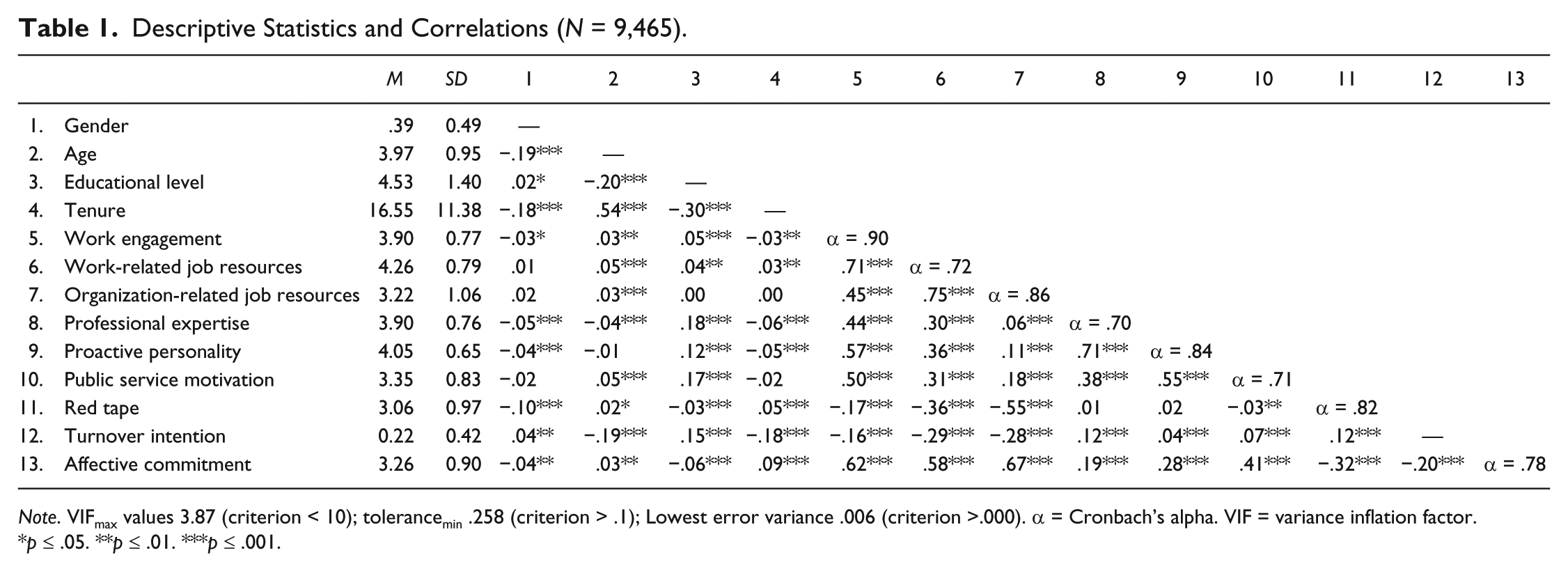
Note. VIFmax values 3.87 (criterion < 10); tolerancemin .258 (criterion > .1); Lowest error variance .006 (criterion >.000). α = Cronbach’s alpha. VIF = variance inflation factor.
p ≤ .05. **p ≤ .01. ***p ≤ .001.
Structural Equation Models
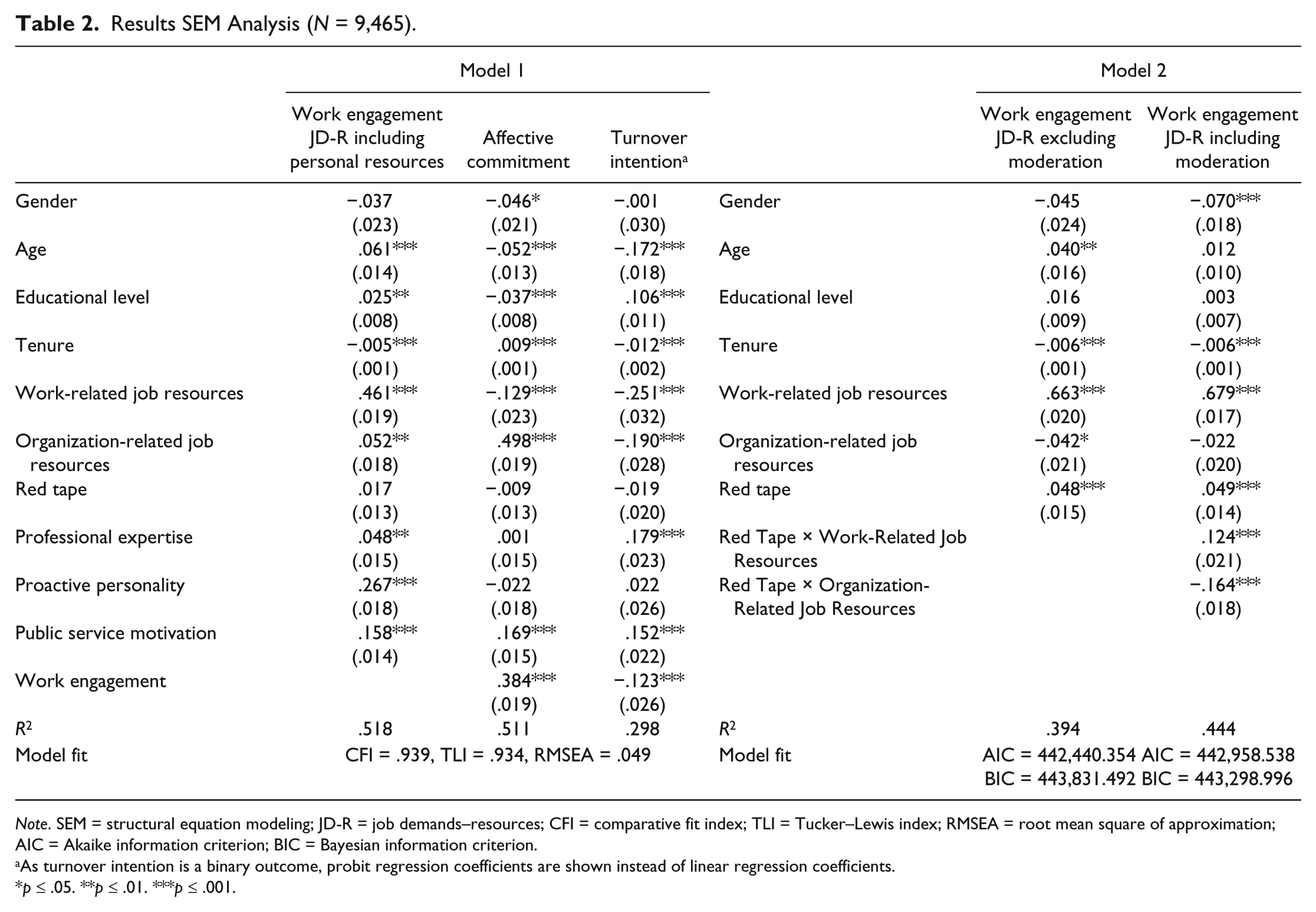
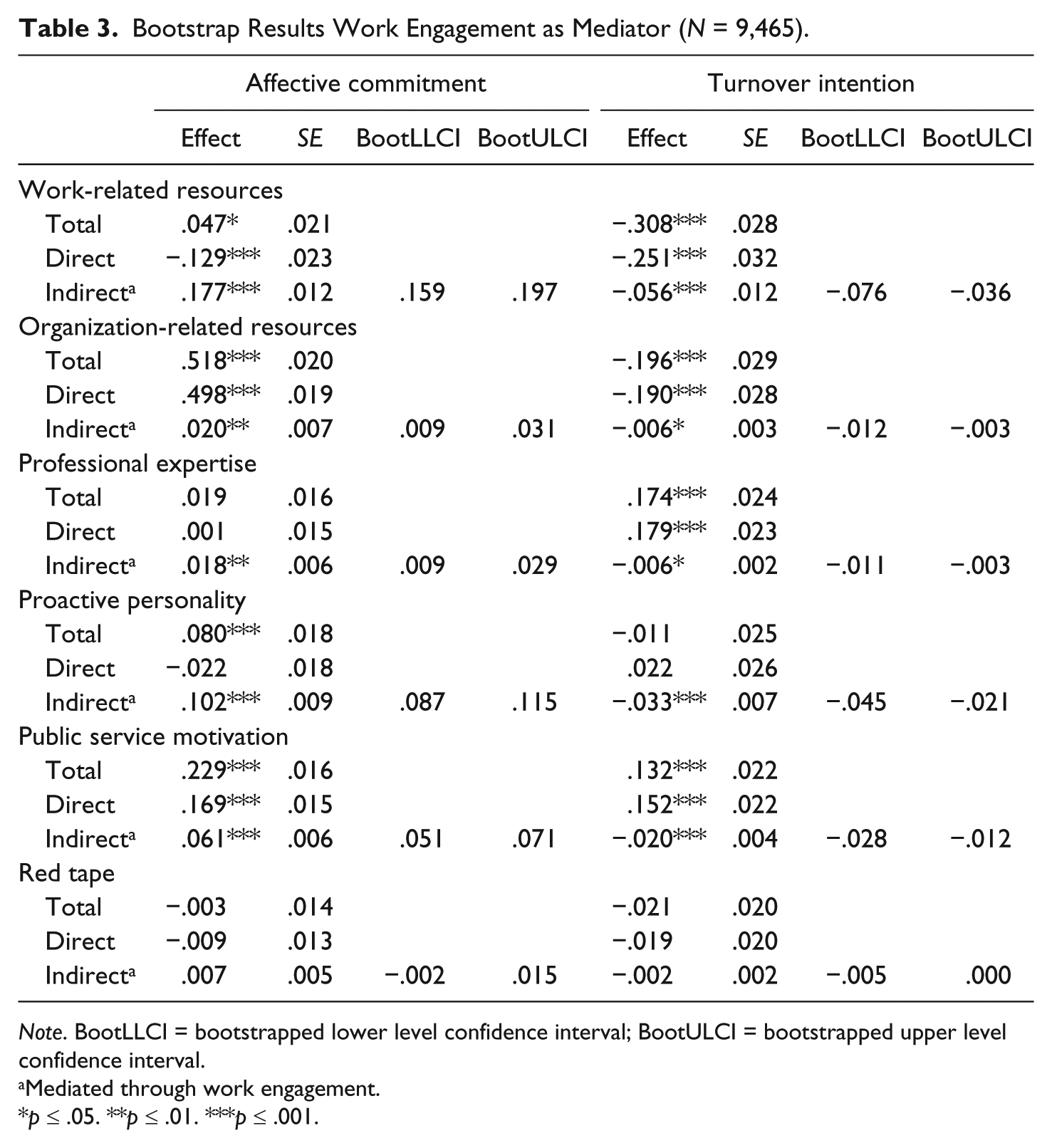
Two structural models were constructed to test our five hypotheses. The results of the direct effects are shown in Model 1 of Table 2. We report the moderated relationships in Model 2 of Table 2 and the bootstrapped indirect (mediating) effects of Model 1 in Table 3.
Results SEM Analysis (N = 9,465).
Note. SEM = structural equation modeling; JD-R = job demands–resources; CFI = comparative fit index; TLI = Tucker–Lewis index; RMSEA = root mean square of approximation; AIC = Akaike information criterion; BIC = Bayesian information criterion.
As turnover intention is a binary outcome, probit regression coefficients are shown instead of linear regression coefficients.
p ≤ .05. **p ≤ .01. ***p ≤ .001.
Bootstrap Results Work Engagement as Mediator (N = 9,465).
Note. BootLLCI = bootstrapped lower level confidence interval; BootULCI = bootstrapped upper level confidence interval.
Mediated through work engagement.
p ≤ .05. **p ≤ .01. ***p ≤ .001.
The fit measures of the first model in Table 2 were .939 (CFI), .934 (TLI), and .049 (RMSEA), implying that the model has a good fit. A large proportion of the variance in work engagement of public servants is explained by our JD-R model (R2 = .518). As Model 1 shows, Hypothesis 1 is rejected because the perceived red tape of Dutch public sector employees does not have a significant effect on their work engagement.
In contrast, the results show that the job resources do have a significant and positive effect on work engagement. As hypothesized, work-related resources have a notably strong positive effect on work engagement (β = .46, p < .001), whereas organization-related resources have a small positive effect on work engagement (β = .052, p < .01). In other words, teamwork with colleagues, content of the job, and autonomy lead to higher work engagement among public servants than supervisory support, developmental opportunities, and performance measurement. Hypothesis 2 is therefore accepted.
According to Hypothesis 3, it was expected that these job resources become even more salient when perceived red tape is high. Comparing the models with moderator and without moderator (Model 2), we note that the R2 increased with 5%. This provides an indication that the explained variance of work engagement increases as a result of the added interactions. For the interaction with work-related job resources, the regression coefficient is β = .124 (p < .01), while the interaction with organization-related job resources is β = −.164 (p < .01). In Figures 2 and 3, we plot the interaction effects to interpret the results.
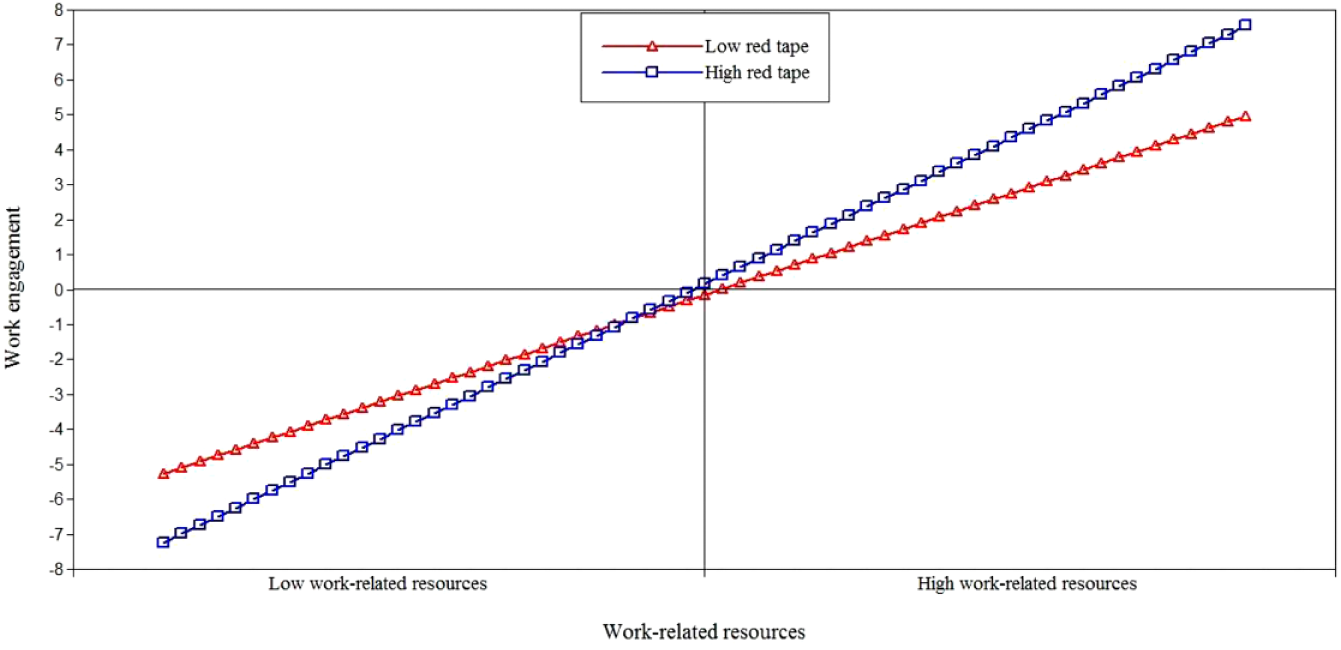
Interaction of red tape on the work-related resources–work engagement relationship.
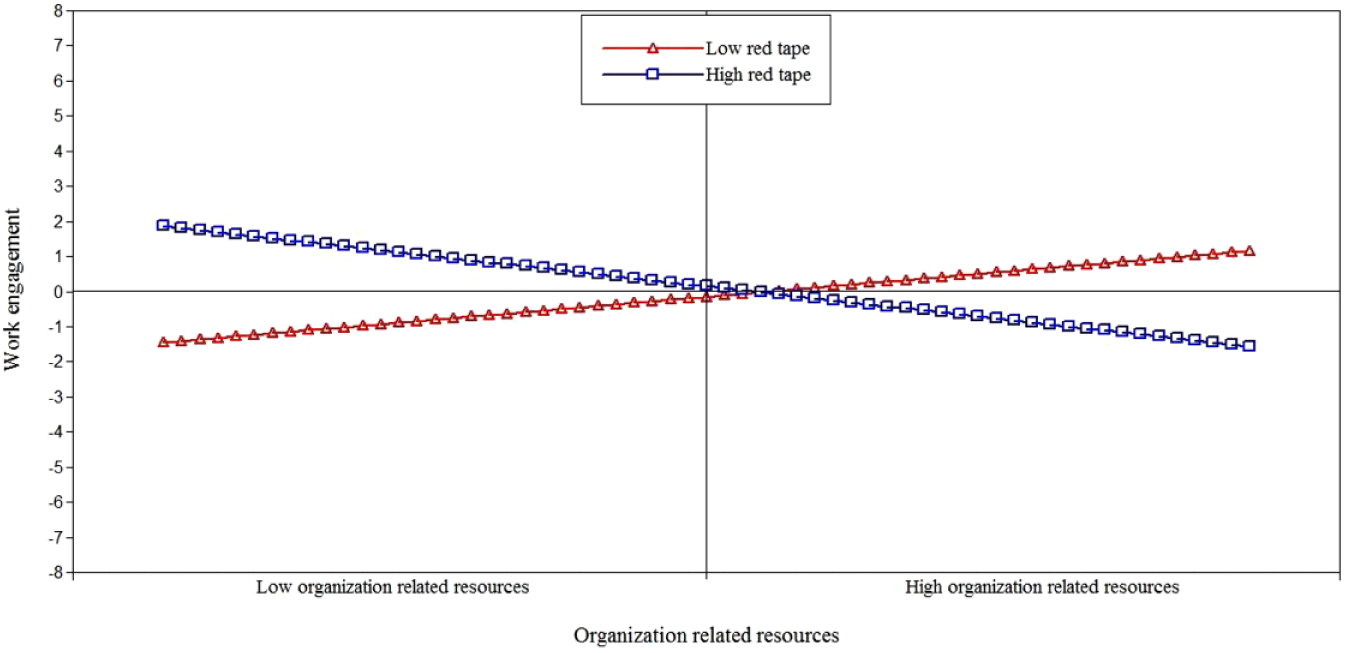
Interaction of red tape on the organization-related resources–work engagement relationship.
Figures 2 and 3 show the estimated moderation effect of low (+1 standard deviation above the mean) and high red tape (respectively, –1 and +1 standard deviation of the mean) on the relationship between, respectively, work-related resources and work engagement, and organization-related resources and work engagement. In accordance with Hypothesis 3, the effect of work-related resources on work engagement is stronger with high red tape than with low red tape. However, the effect of organization-related resources on work engagement is weaker with high red tape than with low red tape. Hypothesis 3 is therefore partially accepted.
According to Hypothesis 4, it was expected that the personal resources proactivity, professional expertise, and PSM also have a positive effect on the work engagement of public servants. The results in Model 1 indeed show that being a proactive person, as well as having professional expertise and PSM, positively affects the work engagement of Dutch public servants (respectively, β = .267, p < .001; β = .048, p < .01; and β = .158, p < .01). Hence, Hypothesis 4 is accepted.
We partially accept Hypothesis 5 as Table 3 shows that work engagement is a significant (partial) mediator between five independent variables and both turnover intention and affective commitment. Interestingly, the direct effects of proactive personality and professional expertise on affective commitment are insignificant, whereas their indirect effects through work engagement are significant. In other words, work engagement fully mediates the effects of proactive personality and professional expertise on organizational commitment. Moreover, the personal resources PSM and professional expertise have a positive significant effect on turnover intention instead of an expected negative effect (respectively, β = .152, p < .01; and β = .179, p < .001). However, the indirect effects of these personal resources through work engagement are positive. In contrast, work engagement is not a significant mediator in the case of the relationship between red tape and organizational commitment, and turnover intention, respectively.
Discussion
This article had two aims. In the first place, we aimed to extend the JD-R model of work engagement by bringing in the public administration literature. In the second place, we wanted to contribute to the public administration literature by integrating work engagement literature and inherently a positive psychology perspective.
The work engagement concept is developed in combination with the JD-R model. We extended this model in three ways. First, our analysis shows that satisfaction with work-related resources (autonomy, colleague support, and job content) leads to higher work engagement among public servants than satisfaction with organization-related resources (supervisory support, developmental opportunities, and performance measurement). An explanation might be that public servants become especially engaged due to intrinsic motivational resources. Job resources are assumed to play either an intrinsic motivational role because they foster employees’ growth, learning, and development, or an extrinsic motivational role because they are instrumental in achieving work goals (Bakker & Demerouti, 2008). Work-related job resources especially fulfill an intrinsic motivational role as they foster basic human needs, such as the needs for autonomy, relatedness, and competence (Deci & Ryan, 1985), while organization-related job resources, including performance feedback and training, increase the likelihood of being successful in achieving one’s work goals (Bakker & Demerouti, 2008). These findings confirm that—relative to private sector employees—public servants become the most engaged by intrinsic factors including work-related resources (Buelens & Van den Broeck, 2007).
Moreover, the personal resources of public servants, including proactive personality, professional experience, and PSM, positively affect their work engagement. However, the extent to which public servants have a proactive personality and professional expertise does not matter for their organizational commitment. Moreover, the rate of PSM and professional expertise of public servants have a positive significant effect on their intention to leave their organization instead of an expected negative relation. The finding that PSM positively relates with turnover intention corroborates with the findings of Quratulain and Khan (2015) who also demonstrate this possible “dark side” of PSM. A possible explanation for this mechanism might be that there is a misfit between individuals with high PSM and their organizational environment. When individuals with high PSM work in a particular organizational environment that does not allow them to fulfill their public service motives, there is no so-called PSM-fit (Steijn, 2008). This incompatibility might lead to negative behaviors and attitudes including turnover intention (Quratulain & Khan, 2015).
Second, our analysis shows that work engagement significantly mediates the relationship between the job resources and personal resources of public servants on one hand and their commitment and turnover intention on the other hand. While the rate of proactivity and PSM of public servants directly affects their turnover intention, the indirect effects through work engagement are negative. Moreover, the rate of proactivity and professional expertise of public servants only affects organizational commitment when their work engagement is taken into account. In other words, work engagement fully mediates the effects of proactive personality and professional expertise on organizational commitment. These results show that commitment and turnover intention are rather superficial employee attitudes that are determined by environmental factors but barely by the personality of individuals. In contrast, work engagement is determined by personality characteristics and environmental factors, which confirm the idea that work engagement is a more encompassing and deeper state of mind of public servants than commitment and turnover intention.
Third, our results show that the perceived red tape by public servants does not have a negative effect on work engagement. The perceived red tape by public servants does not affect their organizational commitment or turnover intention, either. However, the effect of work-related resources on the work engagement of public servants is stronger when they perceive high red tape than when they perceive little red tape. In addition, the effect of organization-related resources on the work engagement of public servants is weaker when they perceive a lot of red tape than when they perceive little red tape. In other words, the coping hypothesis is confirmed in case of work-related resources but not in case of organization-related resources (Bakker & Demerouti, 2008). A possible explanation might be that public servants, under conditions of high red tape, become increasingly engaged by their work-related job resources (including colleagues, autonomy, and the content of the job) as these resources are the only ones that could form an (emotional) buffer against the perceived red tape. In contrast, although employees can be, for example, satisfied with the feedback of their supervisor and the developmental opportunities, they often need to fill out, respectively, the annual performance report and declare the course fees, which really decreases the effects of the satisfaction with these organizational resources on their work engagement. In other words, it seems to be the case that organization-related resources in the public sector are automatically accompanied with more red tape which de facto lead to the evaporation of the positive effects of these resources on work engagement.
These results give some interesting opportunities for public personnel managers to enhance engagement and employee outcomes. Public personnel managers might, for example, focus especially on autonomy, cooperation with colleagues, and the content of jobs if they want to improve outcomes. Public personnel managers could also enhance work engagement by selecting personnel with a proactive personality and PSM. Although, by the selection of employees with PSM, public personnel managers should take the possible “dark side” of PSM into account.
Despite these contributions, our study also has some limitations. Our study includes the use of cross-sectional data, which does not allow us to claim causal inferences concerning the presented results. As such, the possibility exists that work engagement is, for example, not only an antecedent but also an outcome of organizational commitment. In addition, as the questions on all the factors were asked in the same survey, the data could be subject to common source bias (CSB). Despite several precautions, future studies could employ longitudinal or experimental designs to overcome CSB. Furthermore, we made use of secondary data. The downside of using secondary data is that the operationalizations of some factors, such as red tape, were fixed beforehand. However, there is much debate about the operationalizations of red tape. Moreover, several interesting contextual factors could not be included such as variables related to person–organization fit and job demands such as role and goal ambiguity.
These limitations do hint at possible future research directions. Our study focused merely on the effects of work engagement on the outcomes “turnover intention” and “organizational commitment.” As mentioned before, it is expected that work engagement is the most robust predictor of job performance. Future studies might therefore focus on the effect of work engagement on the in-role and extra-role performance of public servants as well. Furthermore, we included PSM as a personal resource and the results show that PSM positively affects work engagement. Simultaneously, our results also show that PSM positively affects turnover intention. In terms of the JD-R model, PSM might therefore be seen as a job demand as well. As this mechanism might be explained by PSM-fit, it could be a fruitful endeavor to integrate the PSM-fit concept into the JD-R model of work engagement in future research. In addition, future research might also focus on other public sector contexts such as education and health care to validate our results. The work engagement of public servants in classical public sectors (people-processing service providers) might not be affected by red tape because it is more institutionalized in this context (Van Loon, 2015). However, public servants in other institutional contexts such as education and health care (people-changing service providers) might experience much more negative effects of red tape (Van Loon, 2015). Although this research has been able to present interesting outcomes though integrating work engagement and inherently a positive psychology perspective in public administration, there is more to discover.
Footnotes
Appendix
Declaration of Conflicting Interests
The author(s) declared no potential conflicts of interest with respect to the research, authorship, and/or publication of this article.
Funding
The author(s) received no financial support for the research, authorship, and/or publication of this article.