




Abstract
Occupational stress and burnout remain largely unexplored as red tape repercussions, even though they can jeopardize public servants’ wellbeing, motivation, and performance. Using a survey experiment with 354 school principals conducted between November 2018 and January 2019 in Chile, we provide evidence that red tape foments burnout risks. More red tape increases emotional exhaustion, depersonalization, and a sense of low personal accomplishment, while cutting red tape reduces emotional exhaustion but does not attenuate depersonalization and low personal accomplishment. These experimental results further prior observational findings about employee responses to red tape and are particularly pertinent for public services struggling with effectively cutting red tape.
Introduction
The literature has underscored various repercussions of red tape on quintessential attitudes of public servants (e.g., Borst, 2018; Bronkhorst et al., 2015; Cooke et al., 2019; Davis, 2013; DeHart-Davis et al., 2015; DeHart-Davis & Pandey, 2005; Kjeldsen & Hansen, 2018; Stazyk et al., 2011; Steijn & van der Voet, 2019; Wright, 2004). Nonetheless, notwithstanding a few observational studies have contributed toward addressing this question (Brunetto et al., 2017; Giauque et al., 2013; Quratulain & Khan, 2015; Siverbo, 2023; Whiteoak, 2021), the effects of red tape on stress and burnout remain largely unexplored. This elusiveness persists despite the severe consequences occupational health problems produce on government employees and the confirmed benefits of their prevention and curbing (e.g., Bacharach et al., 1991; Barboza-Wilkes et al., 2023; Eldor, 2018; Golembiewski et al., 1998; Linos et al., 2022; Salvagioni et al., 2017; Vella & McIver, 2019). Further, the substantial heterogeneity of red tape effects across different public servants’ outcomes, as confirmed by recent meta-analyses and meta-regressions (Blom et al., 2021; George et al., 2021), suggests that the existent evidence-based negative attitudinal responses to red tape cannot be easily extrapolated to understand red tape’s impacts on occupational stress and burnout.
More studies are thus needed to precisely understand the repercussions of red tape on public servants’ occupational health, as red tape specialists have urged recently (e.g., Pandey, 2021). Theoretically, research in this area could contribute to contextualizing human resource management (HRM) in the public service since red tape is one distinctive feature that poses equally particular people management challenges in government (Knies et al., 2024).
Our paper thus examines the influence of red tape on burnout. We primarily draw on ideas from the Job Demands-Resources (JD-R) model (Demerouti et al., 2001) and the conservation of resources theory (COR) (Hobfoll, 1989) to argue that red tape foments burnout as it represents a hindrance demand whose compliance burden threatens public servants’ valued existing resources and their access to more or better resources. More specifically, we argue that red tape jeopardizes public servants’ emotional resources and thereby causes their emotional exhaustion, and it triggers defensive behaviors leading them to depersonalization. Red tape also hinders public servants’ autonomy and opportunities for development and mastery at work, hence their low sense of personal accomplishment as a result.
Balancing the dual priorities of studying the effects of red tape on burnout experimentally (Pandey et al., 2017) and in a relatively unobtrusive manner (Aguinis & Bradley, 2014; Jilke & Van Ryzin, 2017), we conducted a vignette experiment with 354 school principals in Chile. Our vignette experiment is grounded on the participants’ work reality to elicit their real subjective experiences with red tape and compliance burden (Campbell, 2019; Campbell et al., 2023; Davis & Pink-Harper, 2016). We first primed principals with the actual compliance requirements they regularly deliver to key educational stakeholders of the school system’s governance, including educational, administrative, human resource management, and financial requirements. Then, in the vignette, we exposed respondents to a randomly manipulated scenario indicating either a continuation, an increase or a decrease in those requirements at different intensities. Subsequently, given the scenario presented, we measured participants’ burnout through questions capturing attitudes and emotions of exhaustion, depersonalization, and sense of personal accomplishment. As such, our vignette experiment not only addresses the need for more experimental research when testing red tape effects in the public service (Bozeman, 2012; Carrigan et al., 2020; Grimmelikhuijsen et al., 2017; Pandey et al., 2017) but also calls for more realism of survey experiments with actual officials (Jilke & Van Ryzin, 2017).
Additionally, the Chilean public service, which motivated and shaped this research, provides a mostly hitherto unexplored specimen of public service institutions through which to examine red tape repercussions and, particularly, its impact on occupational stress and burnout. Almost all of the existing studies on this area are from the United States (U.S.) or a few developed European countries (Brunetto et al., 2017; Giauque et al., 2013; Siverbo, 2023; Whiteoak, 2021). Meta-analyses and meta-regressions have also concluded that red tape effects vary significantly across institutional contexts and, while most evidence on this area comes from a few developed countries with Germanic, Anglo-American, or Nordic European administrative and cultural traditions, red tape is indeed more harmful in unresearched countries (Blom et al., 2021; George et al., 2021).
The following section briefly describes the institutional context motivating this research. Next, in the literature review, we discuss red tape’s general consequences on public service employees and its association with occupational health. We also develop our hypotheses linking red tape to emotional exhaustion, depersonalization, and personal accomplishment. Then, we explain the experimental design, variables used, participants, and analytical procedures of our study before presenting the results. We finally analyze our findings, discussing their limitations and contributions to a better understanding of the consequences of red tape in public service.
Research Context
The Chilean public service offers a propitious institutional setting to study the consequences of red tape. When compared globally, the country just ranks in the upper middle in comparative indexes related to government administrative simplification and digitalization, mainly because of an extensive heterogeneity at the organizational level in these areas and the existence of major unsolved sources of government red tape (OECD, 2016, 2020a). 1
One major source of red tape in the Chilean public service is the school system, whose governance operates at national and subnational levels and through various agencies. Schools, especially those funded by public subsidies, are accountable to several overseeing organizations and follow fairly standard rules, regulations, and procedures (see Appendix A). Chilean schools are mainly funded by a voucher system and receive resources from the Ministry of Education according to students’ attendance. This scheme of public subsidies comprises municipal schools and private-voucher schools, representing 89% of the total student enrolment and 87% of all schools in the country. There are also fully private schools that do not receive public subsidies and technical schools owned by the Ministry of Education that are administered by non-profit organizations linked to entrepreneurial organizations.
Evidence from a variety of sources, including major policy reports from the government, international and non-profit organizations, and university research centers, has pointed to red tape at schools as an unsolved obstacle to improving educational quality in Chile (e.g., Educación 2020, 2018; Santiago et al., 2017). These reports especially underscore the excessive number of administrative, regulatory, and accountability requirements schools and their principals must comply with. Further, survey evidence shows that school principals declare the excess of regulations and the complexity of the educational regulations as the top obstacle to performing their role (Centro de Desarrollo del Liderazgo Educativo [CEDLE], 2018a).
Moreover, these excessive requirements are mostly dysfunctional since their compliance implies a deviation of valuable organizational resources, particularly from principals, that should be otherwise focused on school improvement and pedagogical leadership (Educación 2020, 2018; Santiago et al., 2017). Further, some of these requirements, as policy evidence based on school principals’ surveys and interviews indicate, “border on the absurd,” such as showing various proofs of every minor expenditure, the duplication, and even triplication of requirements demanded by supervising agencies, or the changing criteria to approve reported expenditures (Educación 2020, 2018; Quevedo, 2018).
Although red tape had been a challenge for Chilean schools for years, it became more pronounced and was salient in the policy agenda in early 2018. Further, the Chilean government launched a national plan in the middle of 2018 called “All to the Classroom” (“Todos al Aula”) to de-bureaucratize schools (Ministry of Education, 2018). As part of this de-bureaucratization plan, the Superintendence of Education analyzed and systematized all extant ruled-based obligations of schools, finding no fewer than 2,500 requirements and resolving to reduce this number by 50% (Superintendence of Education, 2018; Yévenes, 2018).
Literature Review
Red Tape Effects on Public Servants
Several theoretical and empirical advancements have contributed to defining and understanding red tape (Bozeman, 2000, 2012; Bozeman & Feeney, 2011; Pandey et al., 2017; Pandey & Scott, 2002). Most of those descriptions refer to burdensome and pointless rules and procedures that produce more harm than good. Scholars have focused on red tape as a “psychological process” and conceive red tape based on individuals’ organizational experiences and subject-dependent evaluations of rules, regulations, and procedures (Campbell, 2019; Campbell et al., 2023; Davis & Pink-Harper, 2016; Pandey, 2021). 2 According to Pandey (2021, p. 264), red tape is a “role-specific subjective experience of compliance burden imposed by an organization.” Thus, this psychological process approach holds that red tape exists to the extent that someone in the organization subjectively perceives a compliance burden. This is also supported by recent experimental evidence (Hattke et al., 2020).
Recent meta-analyses and meta-regressions show a negative association between red tape and key public servants’ attitudes and behavior (Blom et al., 2021; George et al., 2021). Red tape has a small to medium negative influence on role clarity, autonomy, commitment, work satisfaction, work motivation, and intention to stay. The same meta-analyses confirm a small to moderate negative influence of red tape on various organizational behavior outcomes, including risk culture, innovation, organizational support, leadership, goal clarity, and communication (Blom et al., 2021; George et al., 2021). These studies also show mixed or no effect on organizational performance.
Red Tape and Occupational Health
The Job Demands-Resources (JD-R) model offers a comprehensive framework to study how red tape affects occupational stress and burnout (Demerouti et al., 2001). Demands are physical, social, or organizational features involving employees’ continuous physical, cognitive, or emotional efforts. Resources refer to physical, psychological, social, or organizational aspects contributing to people’s attainment of work goals, the reduction of job demands and their costs, and the stimulation of individual learning and development.
Red tape is a hindrance job demand imposing a burden whose sustained compliance undermines public servants and leads them to burnout (Demerouti et al., 2001; Giauque & Weissbrodt, 2021; Yao et al., 2015). As opposed to challenge job demands—which can promote personal development, mastery, or future benefits—hindrances are demands that preclude goal attainment, learning, and improvement (Cavanaugh et al., 2000).
Recent observational studies provide evidence of red tape as a hindrance job demand on the burnout of Chinese school teachers and Finnish local government officials (Harju, 2021; Wu et al., 2020). As noted, recent meta-analytic evidence points out that red tape has a medium to large negative association with public servants’ health-related wellbeing outcomes (Blom et al., 2021). Additionally, research has shown a strong positive association between red tape and stress and burnout-related outcomes. Giauque et al. (2013) confirmed that red tape increased officials’ perception of stress among Swiss municipal employees, while Brunetto et al. (2017) found no effects when testing this relationship in U.S. police officers. Quratulain and Khan (2015) showed that excessive hierarchy and procedural compliance in agencies increase on Pakistani public officials’ perceptions of stress. Freitas et al. (2019) conducted an observational study confirming a positive association between red tape and employee job stress within a Brazilian public university.
Red Tape and Emotional Exhaustion, Depersonalization, and Personal Accomplishment
Burnout is a three-dimensional model characterized by emotional exhaustion, depersonalization, and reduced personal accomplishment, usually among human service and frontline professionals (Maslach, 2003; Maslach & Jackson, 1981). Emotional exhaustion refers to workers’ feeling of being emotionally overloaded and their resources undermined. Depersonalization corresponds to subjects’ negative or excessively disconnected responses to others, often regularly service users or beneficiaries of their organizations. Reduced personal accomplishment concerns a decline in employees’ feelings of competence and achievement in work (Maslach, 1993; Maslach & Jackson, 1981). Research has consistently shown the negative consequences of job demands and the preventative influence of job resources on all three burnout dimensions (Alarcon, 2011; Lee & Ashforth, 1996).
As the conservation of resources (COR) theory posits, individuals strive to obtain, protect, and develop those resources they essentially value (Hobfoll, 1989; Hobfoll et al., 2018). Thus, burnout occurs when these central resources are threatened with loss, when central or key resources are actually lost, or when there is a failure to get anticipated essential resources following significant effort (Hobfoll, 1989; Shirom, 1989). Resources include objects (e.g., infrastructure, tools for work), conditions (e.g., tenure, autonomy, learning, and development opportunities), personal characteristics (e.g., optimism, self-efficacy), and energy (e.g., money).
The compliance burden involved in red tape threatens the emotional resources of individuals or, indeed, leads to their loss. For example, experimental evidence from a laboratory study by Hattke et al. (2020) demonstrates that red tape and especially the compliance burden it means for individuals evoke negative emotional responses, including feelings of anger, frustration, and confusion. In certain public service occupations, employees might even need to suppress and mask the negative emotions produced by red tape (e.g., Henderson & Borry, 2023), which could lead to further erosion of their emotional resources. Observational studies on public servants also show a positive association between red tape and work exhaustion and emotional exhaustion (Lockey et al., 2022; Muylaert et al., 2023; Shim et al., 2017). Further, emotional exhaustion has been acknowledged as the central construct of burnout and the most vulnerable to job demands (Gmelch & Gates, 1998), and hence the burnout dimension that might be most vulnerable to red tape. Against such a background, we hypothesize that:
According to COR theory, employees who suffer resource-draining situations tend to enter a defensive mode to preserve the self, which might even be characterized by aggressiveness and irrationality (Hobfoll et al., 2018). Further, Ashforth and Lee (1990) argue that depersonalization represents one form of defensive behavior in organizations when individuals intend to reduce a perceived threat or avoid an unwanted demand. The authors also argue that rules, regulations, and procedures could lead to defensiveness as they convey “what is not [expected at organizations], providing a justification for avoiding actions which do not match [them]” (p. 632).
When facing or even threatened by red tape and its compliance burden, employees might thus protect their available resources by detaching themselves from other resource-draining tasks, including problem-solving interactions with people, especially with users and beneficiaries. For instance, based on a study of Dutch child welfare professionals, Steijn and van der Voet (2019) show that red tape reduces the time public servants devote to users. Following this line of reasoning, we hypothesize:
Red tape also threatens public servants’ capacity to influence their work environment virtuously since it primarily decreases their perceived autonomy (Blom et al., 2021). Management systems that restrict autonomy as well as job crafting hinder employees’ exposure to challenge job demands promoting mastery at work—as qualitative evidence from Australian teachers at public schools suggests (Whiteoak, 2021). Moreover, the use of skills at work and autonomy are positively associated with personal accomplishment (Lee & Ashforth, 1996).
The autonomy reduction and the missing opportunities for challenging job demands produced by red tape limit public servants’ experiences, giving rise to feelings of efficacy or their “effectance motivation” (White, 1959). Indeed, red tape could lead to work alienation—characterized by feelings of powerlessness and meaninglessness—and to employee withdrawal behavior (DeHart-Davis & Pandey, 2005; Quratulain & Khan, 2015; Wong, 2023). Therefore, red tape ultimately threatens public servants’ self-perceptions of competence and achievement, as observational evidence from the Australian public service suggests (van Acker et al., 2018; Whiteoak, 2021). Although personal accomplishment seems to be consistently less prone to being affected by organizational factors compared to emotional exhaustion and depersonalization (Alarcon, 2011; Lee & Ashforth, 1996; Schaufeli & Taris, 2005), we nonetheless hypothesize:
Our study is targeted at school principals since managerial roles in schools are particularly susceptible to red tape effects (Borst, 2018). School principals perform many complex tasks, including making strategic decisions about their schools’ curriculum and instruction, managing personnel and budgets, and establishing school policies (OECD, 2020b). These responsibilities usually involve a level of operational detail beyond the principals’ capacity (Friedman, 1995). The duties also require networking with various stakeholders, including teachers and other school staff, students, parents, and central and subnational public sector agencies, which might also mean higher exposure to red tape (Torenvlied & Akkermann, 2012). Administrative constraints such as interruptions, urgent paperwork, and meetings have been identified as organizational predictors of school principals’ burnout (Mazur & Lynch, 1989; Van Droogenbroeck et al., 2014). Principals are generally interrupted more by administrative hassles than by administrative responsibilities (Poirel et al., 2012).
Research Design
Experimental Design
Red tape could both influence and be influenced by various individual and organizational factors (e.g., Brunetto et al., 2017; Pandey & Kingsley, 2000). Further, endogeneity concerns have motivated calls for more experimental research when testing red tape effects on public servants (Bozeman, 2012; Carrigan et al., 2020; Grimmelikhuijsen et al., 2017; Pandey et al., 2017). On the other hand, a gold standard empirical approach, a field experimental manipulation of red tape to induce a real burnout experience on public servants, raises ethical concerns of its own.
We thus designed a vignette experiment, balancing the dual priorities of studying the effects of red tape on burnout experimentally and in a relatively unobtrusive manner (Aguinis & Bradley, 2014; Jilke & Van Ryzin, 2017). Our experimental design is grounded on specific participants’ institutional context features to boost their levels of immersion in the situation described in the vignette (Aguinis & Bradley, 2014), therefore eliciting their real subjective experiences with red tape and compliance burden (Campbell, 2019; Campbell et al., 2023; Davis & Pink-Harper, 2016; Pandey, 2021)
As detailed below (see Figure 1), after the informed consent and screening questions, the experiment primed participants about their regular exposure to red tape by leveraging the regular requirements they had to comply with in various management and educational areas. Then, we exposed them to randomly manipulated red tape intensities by presenting hypothetical scenarios in which the number of regular requirements shown increased, decreased, or was maintained. Subsequently, a set of questions assessing principals’ burnout was presented.
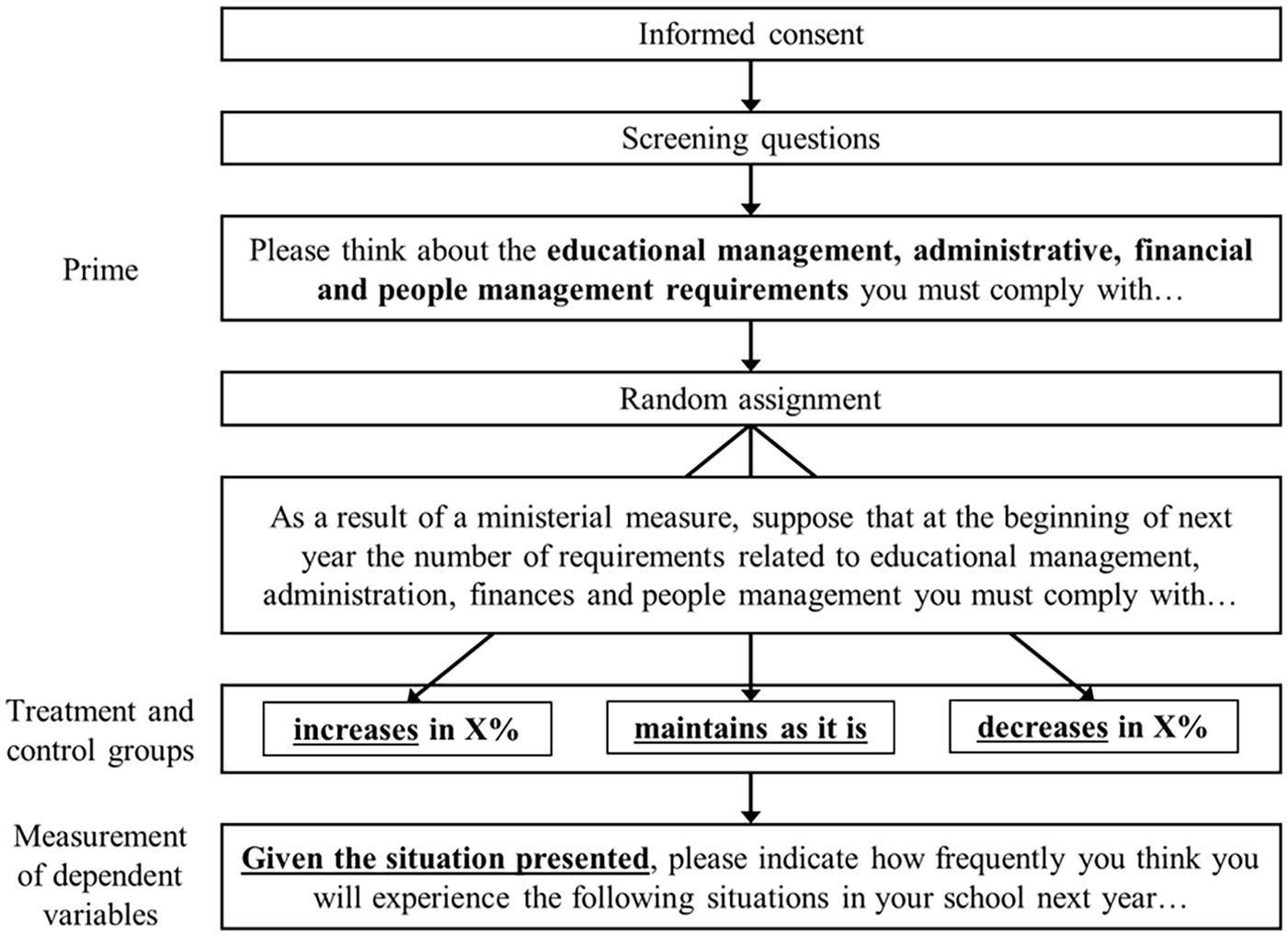
Survey flow of the vignette experiment.
The experiment initially primed respondents to recall the red tape levels they regularly face (see Figure 2 emulating the priming instrument as shown to respondents and Appendix B for the English translation of this figure). We first asked them: “Please think about the educational management, administrative, financial and people management requirements you must comply with in your work as a principal at your school.” As a reference, we provided them with a list of the most standard compliance requirements school principals regularly face around administrative, financial, educational, and human resource management areas. Most of these requirements are formally established by the Ministry of Education, and a variety of stakeholders demand them. These include educational agencies and their subnational units, parents, school administrators (e.g., municipalities), school councils, teachers’ councils, and organizations providing support to schools, such as NGOs, consultants, and universities. The identification and listing of requirements were grounded on the regulations of the educational system in Chile, internal documents from the Agency for the Quality of Education, and three major policy reports about the administrative burden schools’ principals experience (CEDLE, 2018b; Educación 2020, 2018; Ministry of Education, 2018). Finally, the list was developed with feedback from the Agency for the Quality of Education to ensure that it accurately included all the standard compliance requirements of publicly funded schools in Chile.
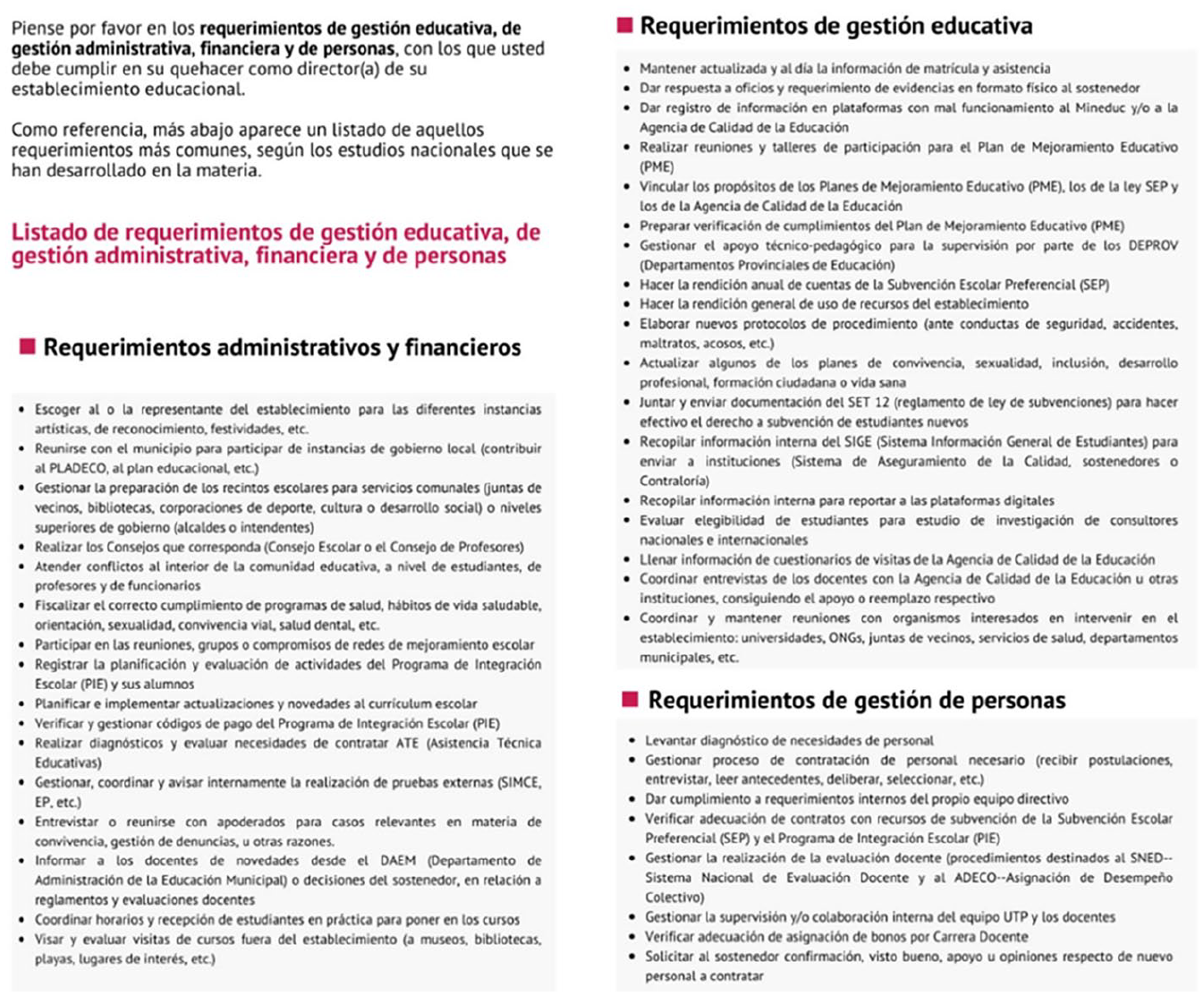
Priming instrument including school principals’ regular compliance requirements.
After the priming with the list of requirements, we presented respondents with one out of three randomly assigned hypothetical scenarios: one increasing the requirements, one decreasing the requirements, and the other maintaining the requirements as a control group. This latter, eliciting a continuation of respondents’ own regular compliance requirements, was designed to capture baseline burnout levels due to red tape. In the prime, we thus asked participants: “As a result of a ministerial measure, suppose that at the beginning of next year, the number of requirements related to educational management, administration, finances and human resource management you must deliver increases (or decreases or continues as it is, depending on the randomly assigned scenario).” Scenarios showing a rise or decline in the requirements for principals also included a percentage to quantify the magnitude of the increase or decrease. This percentage was a random variable with a uniform distribution, ranging from 5 to 50. Respondents were presented with only one scenario. The use of a broad range of various percentages, rather than fixed percentages reflecting high and low red tape increases or decreases, aimed at more effectively representing the participants’ real work reality. However, we acknowledge the limitation this approach poses on reflecting more clearly a high or low treatment intensity.
The operationalization and experimental manipulation of red tape, as noted, were heavily informed by the work environment of school principals participating in the study. The volume of compliance requirements that school principals face—at least 2,500, according to the Superintendence of Education (2018)—has been highlighted as the epitome of red tape within the Chilean educational system by specialized public, non-profit, and academic organizations (CEDLE, 2018a; Educación 2020, 2018; Ministry of Education, 2018). More importantly, policy evidence from various sources suggests that school principals not only perceive the number of compliance requirements they regularly face as excessive but largely as dysfunctional (CEDLE, 2018a; Educación 2020, 2018; Quevedo, 2018). Moreover, as a primary goal of the de-bureaucratization plan of the educational system (“All to the Classroom”), the Chilean government resolved to reduce this excessive number of compliance requirements by 50% (Superintendence of Education, 2018; Yévenes, 2018). To be sure, notwithstanding some compliance requirements could certainly still be necessary and interpreted as effective by school principals, they are hardly affecting school principals’ subjective experience with red tape substantially. As shown, this subjective experience is fundamentally driven by a high volume of excessive compliance requirements interpreted as dysfunctional overall.
After each vignette, the survey asked respondents: “Given the situation presented, please indicate how frequently the following situations would happen to you in your school during next year.” A set of 14 items was shown in random order below this question, describing respondents’ attitudes and emotions toward their work and the people they serve. These items were inspired in their wording by a validated burnout questionnaire in Chile, which is an adaptation by Olivares-Faúndez et al. (2014) of the Maslach Burnout Inventory translated into Spanish (Gil-Monte, 1994; Gil-Monte & Peiró, 1997; Maslach & Jackson, 1981). Olivares-Faúndez et al. (2014) validated this adapted burnout questionnaire using a sample of human service employees, including primary and secondary school teachers. We conducted a focus group in November 2018 to pretest our burnout questionnaire as well as the list of compliance requirements in the prime. Participants comprised eight professionals of the Agency for the Quality of Education, mostly former school principals or teachers. We did not pre-measured respondents’ occupational burnout before the vignette experiment in the survey.
The items exhibited included questions measuring the three burnout dimensions: six for emotional exhaustion, four for depersonalization, and four for personal accomplishment. They were worded into conditional form to be consistent with the headline question and, hence, the hypothetical scenarios presented in the vignettes. The questions around emotional exhaustion contain items such as “I would feel overburdened by my work,” the depersonalization statements include “I would treat some people as if they were objects,” and the personal accomplishment items comprise “My work would influence other people’s life positively.” Respondents thus rated how frequently they would experience each attitude and emotion using a 7-point Likert scale, starting from never (0), a few times a year (1), once per month or less (2), more than once per month (3), once per week (4), more than once per week (5), to every day (6).
The adjustment of the statements to conditional forms shaped the outcome variables as they measured the anticipated burnout—emotional exhaustion, depersonalization, and personal accomplishment—that school principals would experience in the hypothetical scenarios presented in the vignettes. The use of anticipated burnout measures as proxies of burnout represents a limitation of our study. However, they certainly represent a valid measure of burnout risks and can provide insights into real burnout, as shown by correlational evidence (Ross & Seeger, 1988). Further, as research on attitude strength suggests (Howe & Krosnick, 2017; Krosnick & Petty, 1995), our study design stresses crucial determinants of attitudes’ persistence, stability over time, and influence on cognition and actions. More particularly, the significance of the attitude (i.e., burnout) and attitude object (i.e., red tape) for individuals, their information about the attitude object and how easily the attitude comes to their mind. Red tape and the occupational health consequences it may produce are, indeed, of particular importance for school principals in Chile. Also, they are knowledgeable about red tape and its implications and hence highly sensitive to the attitudes red tape evokes.
Independent, Dependent Variables, and Covariates
The independent variable in our analysis is the group that respondents were randomly assigned in the vignette experiment (i.e., increase red tape, maintain red tape, decrease red tape). Our three outcome measures were the average of all the corresponding responses to emotional exhaustion, depersonalization, and personal accomplishment. We developed a measurement model (Confirmatory Factor Analysis—CFA) to check that our burnout measures are meaningful in the Chilean setting and test the reliability of each burnout dimension (see Appendix C). The model fits the data reasonably well (
We also gathered information on a series of schools’ and principals’ covariates to help improve the efficiency of our average treatment effect estimates. School characteristics include administrative dependence and region, while principals’ characteristics encompass gender, age, education, and experience as a principal at school.
Finally, for the exploratory analyses of treatment intensity, we use a continuous red tape treatment variable consisting of the interaction of the treatment group assigned and the percentage shown to participants in the vignette. Therefore, this variable is just the multiplication of both variables—including a zero percent change for the group exposed to a continuation of their regular compliance requirements. The continuous red tape treatment variable thus ranges from −50 to 50.
Participants
The Agency for the Quality of Education of the Ministry of Education in Chile distributed the survey via email. This organization sent four email invitations to 6,025 school principals between November 2018 and January 2019. They were later reminded about the chance of voluntary participation during in-person training sessions conducted by the Agency in meetings across Chile in December 2018.
Even though participants were guaranteed anonymity in their responses, our burnout metrics may be affected by social desirability biases, as the Agency for the Quality of Education in Chile helped to distribute the survey and offered in-person reminders. This may lead to deflated means of depersonalization and inflated means of personal accomplishment since fewer respondents are willing to indicate high depersonalization and low personal accomplishment. What is socially desirable is more diffuse for emotional exhaustion, and hence, this burnout metric is arguably less susceptible to these biases. Anyhow, while we thus do not generalize descriptively about burnout levels of depersonalization, personal accomplishment, and emotional exhaustion, social desirability bias should not affect our treatment effects other than attenuating effect sizes (i.e., biasing them downwards). This is because most respondents select (regardless of treatment assignment) socially desirable response options.
In addition, the inherent costs of participating in our study, as in any other similar study demanding time from respondents, could have caused selection bias and potentially burned-out participants could have opted out. Were this self-selection bias true, we could expect our estimated average treatment effects to be higher in sample populations including more overwhelmed participants. In other words, we could interpret our findings as what we could at least expect in a sample population including school principals who have more difficulties handling burnout.
A total of 469 people participated in the survey, representing a 7.8% response rate. However, an initial screening question excluded 94 individuals in other managerial roles since the survey was targeted only at school principals. In addition, the compliance burden in the experimental design was primarily targeted at public schools and those private schools that were publicly subsidized. Thus, 17 principals from private schools and 4 heading schools with delegated administration were excluded from the sample.
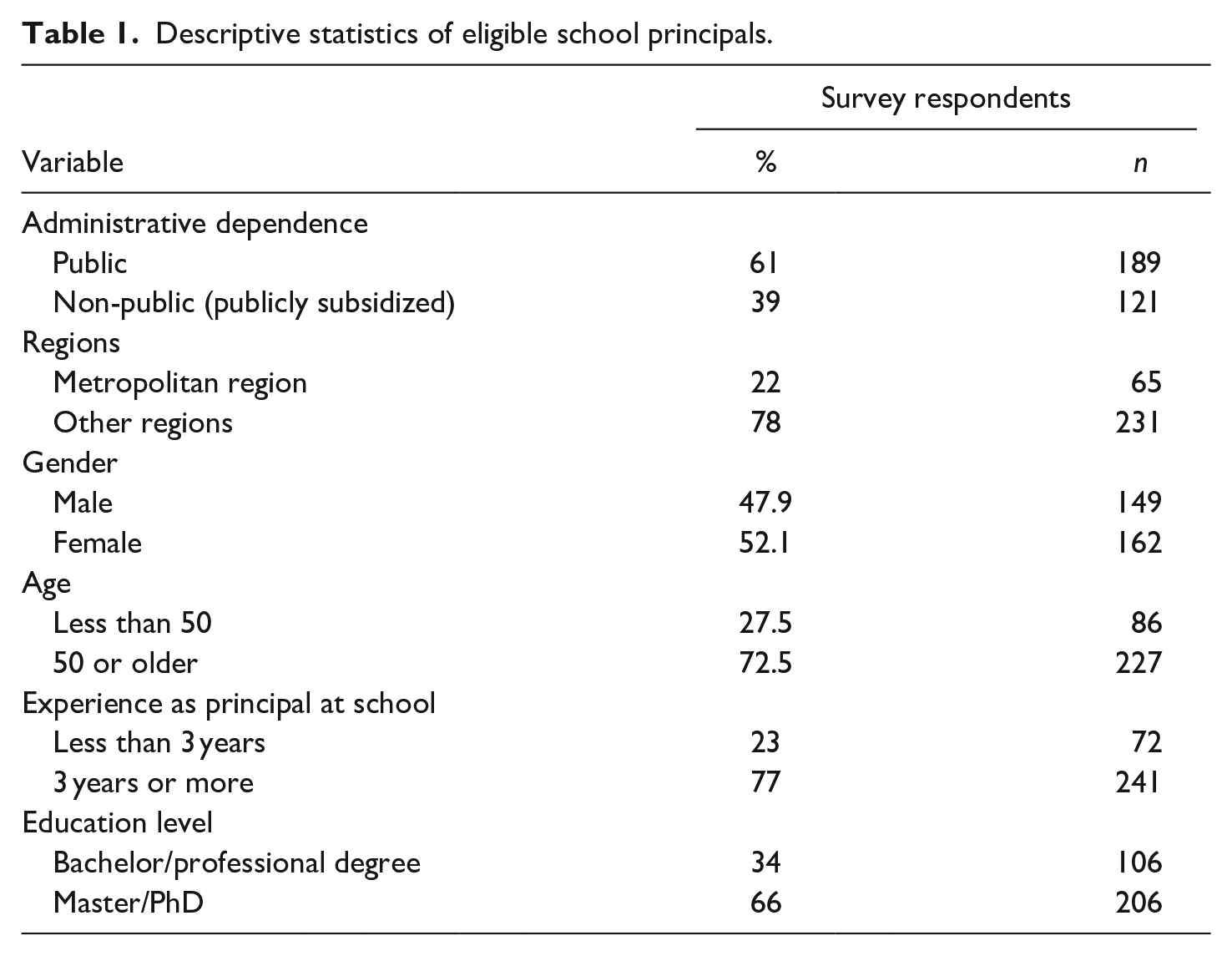
Table 1 exhibits the statistics for the final 354 eligible subjects. Participants were mainly 50 years or older (73%), and more than half of them were female (52%). Most had completed a master’s or a doctoral degree (66%) and were not inexperienced in working as school principals at their schools, as the majority had 3 years of experience or more in these roles (77%). Their schools were predominantly public rather than publicly subsidized (61%) and from many regions in Chile outside the Metropolitan Region (78%), representing 15 of the 16 regions of the country. As Appendix D indicates, our sample of eligible respondents is more from public schools, male and older than the target population of publicly-funded school principals in Chile. We added demographic controls in our analyses to adjust for non-response based on the abovementioned observable characteristics, and our findings were not substantively affected by this.
Descriptive statistics of eligible school principals.
Analytical Procedure
Our analyses proceed as follows. We first show through balance tests that randomization appears to have been successful. Subsequently, we examine the three burnout measures, ignoring treatment group differences. Descriptively, we show substantial variation in school principals’ emotional exhaustion, depersonalization, and personal accomplishment. To explain this, we next turn to the main analysis of the experimentally manipulated red tape treatment variable. We use ordinary least squares (OLS) regression models to estimate the effects of red tape on each burnout measure, including just the red tape treatment variable assigned to school principals, but then add the aforementioned set of covariates to examine whether the results remain robust. Our analyses also include the exploratory examination of the effects of the continuous red tape treatment variable on the tree burnout metrics. We also use OLS regressions with and without schools and principals’ covariates.
Results
As illustrated in Appendix E, balance tests suggest that randomization was successful for the observable characteristics of participants. This means the treatment and control groups were not significantly different in respondents’ gender, age, education, and experience as principals at their schools. The administrative dependence and geographic location were also not significantly different. The mean percentages were not statistically different, comparing both treatment groups in which they were indeed shown to respondents.
Appendices F1, F2, and F3 show that school principals’ burnout outcomes vary substantially when analyzing their three burnout measures, ignoring treatment groups. However, responses tend to be slightly concentrated on lower scores across these indexes, especially for depersonalization. Emotional exhaustion ranges from 0 to 5.83 (on a 0–6 scale), and its mean and standard deviation are 1.76 and 1.43, respectively. Depersonalization ranges from 0 to 5.75 (on a 0–6 scale), and its mean and standard deviation are 0.87 and 1.14. Personal accomplishment (reversed) ranges from 0 to 6 (on a 0–6 scale), and its mean and standard deviation are 1.18 and 1.16, respectively. Burnout measures’ distribution visualizations and measures of dispersion demonstrate a significant variation in school principals’ emotional exhaustion, depersonalization, and personal accomplishment.
Moving on to the primary analysis of experimental effects, Figure 3 exhibits the means of the three burnout outcomes for each treatment and control group with 95% confidence intervals (C.I.s). Table 2 presents the corresponding ordinary least squares (OLS) regressions for the main treatment effects (increase or decrease in red tape), using the control group as the reference (maintaining red tape). As noted, to boost the precision of our average treatment effect estimates and as a robustness check, we control for the schools’ and principals’ characteristics also collected by the survey, including gender, age, education, and experience as a principal at school, while school covariates correspond to administrative dependence and region. As Table 2 indicates, none of them are statistically significant except for the region of principals’ schools (when estimating the effects on personal accomplishment) and their gender (when estimating effects on depersonalization).
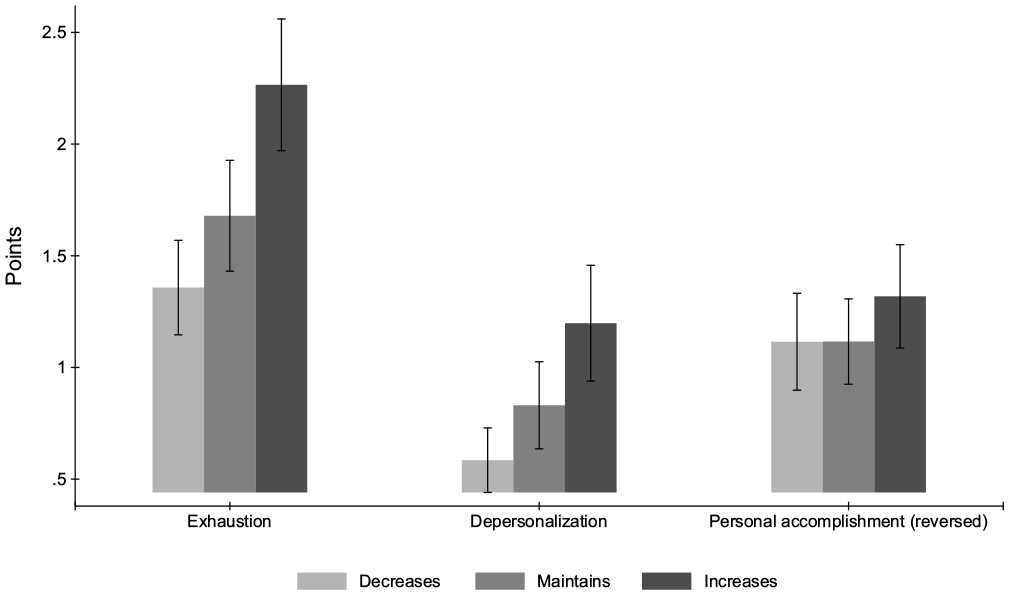
Differences in means for each burnout measure with 95% confidence intervals.
Regression results.
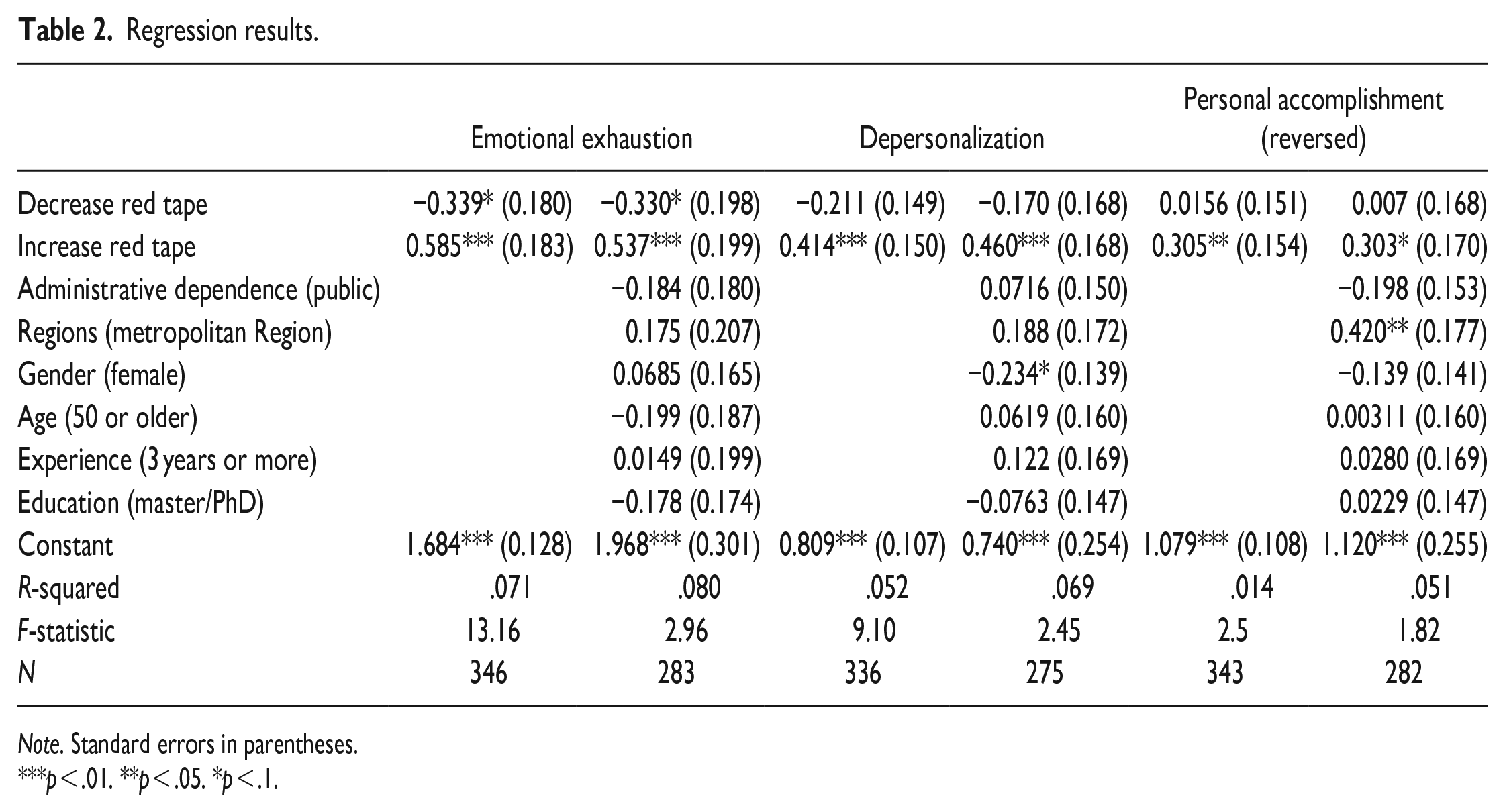
Note. Standard errors in parentheses.
p < .01. **p < .05. *p < .1.
In support of
Red tape rise also leads to an increase in principals’ depersonalization by 0.41 points on average (
The effect of increasing red tape on respondents’ sense of personal accomplishment also offers support for
In sum, as our regression analyses indicate, increasing red tape leads to higher emotional exhaustion and depersonalization and lower personal accomplishment in school principals. Moreover, decreasing red tape also reduces school principals’ emotional exhaustion, although it does not reduce their depersonalization or increase their sense of personal accomplishment. 3 All our main inferences remain robust after covariate adjustment.
We examined the effects of treatment intensity by moving on to Appendix G, which exhibits the treatment effects estimated using an OLS regression on the three burnout metrics and using our continuous red tape treatment variable. The estimates are presented with and without the set of controls used in our previous analysis. As the regression coefficients indicate, a 1% increase in school principals’ regular red tape leads to an average increase of 0.013 points of increase in their emotional exhaustion and 0.009 points of average increase in their depersonalization. Although, as expected, the increase of 1% in red tape diminishes school principals’ sense of personal accomplishment, this effect is not statistically significant (
Discussion and Implications
This study provides further insight into the consequences of red tape on occupational stress in public service, a crucial yet mostly unexplored outcome of red tape. In a survey experiment with Chilean school principals, we found overall support for our hypotheses that red tape leads to burnout. As theorized, our findings show that red tape causes emotional exhaustion, depersonalization, and low personal accomplishment. More specifically, exposing school principals to information indicating an increase in their regular compliance burden requirements raises their emotional exhaustion, depersonalization, and sense of low personal accomplishment, whereas showing them information signifying a reduction of requirements decreases their exhaustion. We found no evidence that a potential lessening of compliance burden requirements would decrease participants’ depersonalization and sense of low personal accomplishment.
These red tape repercussions on public servants’ burnout represent a key people management challenge and add evidence to understand more realistically the linking mechanisms between human resource management (HRM) strategies, policies and practices, and public employees’ expected attitudinal and behavioral outcomes (Knies et al., 2024). Moreover, beyond merely urging the need to transform government administrative structures to improve rules’ and procedures’ functionality and burden, our findings suggest basing those transformations on HRM priorities, especially occupational health goals.
Our results also suggest that red tape causes burnout but affects burnout dimensions differently. As noted in the literature review, emotional exhaustion is substantively more vulnerable to red tape, followed by depersonalization and then personal accomplishment (Gmelch & Gates, 1998; Hakanen et al., 2008; Schaufeli & Taris, 2005). This means that participants respond to red tape mostly feeling overloaded and emotionally undermined, as well as entering in a defensive mode by disengaging from people in their organization. To a lesser extent, they also react with a sense of low competence and achievement.
The relative differences in the effects of red tape across burnout dimensions are consistent with recent metanalytic evidence alluding to a lower detrimental effect of red tape on performance-related outcomes while leading to a higher deterioration in attitudes associated with health-related wellbeing and engagement (Blom et al., 2021, p. 18). According to this meta-analysis, public servants work around red tape to achieve their jobs’ goals, mainly internalizing its repercussions. Furthermore, school principals’ sense of low personal accomplishment could be interpreted as a long-term red tape consequence, whereas emotional exhaustion and depersonalization represent a more immediate reaction and a mid-term defensive strategic response, respectively (Kristensen et al., 2005). These results ultimately stress the distinctiveness of each burnout dimension as manifestations of the same syndrome and the need to study them in their own right (Maslach et al., 2001)
This study also shows that burnout worsening due to red tape rises is substantially higher than the potential relief experienced from cutting it. The size effect of the increase in emotional exhaustion due to greater red tape is substantially higher than the magnitudes in the decline of this burnout metric owing to less red tape. Further, whereas we found that increasing red tape increases depersonalization and a low sense of personal accomplishment, decreasing it does not result in an improvement in these burnout metrics. These asymmetric effects are suggestive of a non-linear response of school principals’ occupational stress and burnout to red tape fluctuations.
These asymmetric effects and their implications are, in part, the results of studying red tape fluctuations in a research context experiencing already high red tape base levels. As noted, the school system in Chile demands, especially from publicly funded schools and their principals, an excessive volume of dysfunctional compliance burden requirements (CEDLE, 2018a; Educación 2020, 2018; Ministry of Education, 2018). This illustrates the importance of testing red tape repercussions in hitherto unexplored models of public service institutions where red tape is more predominant and harmful than those widely examined by earlier studies in developed European countries and the U.S. (Blom et al., 2021; George et al., 2021).
Red tape’s heterogeneous effects across burnout dimensions and the asymmetric impact of its increase and reduction add to the literature on human resource management in the public service as these findings provide a deeper understanding of the underlying psychological process through which red tape affects employees’ occupational health (Pandey, 2021).
More generally, the findings of this research might reach public services in many countries, which, like Chile, are part of the way toward effectively cutting red tape, or they serve as a guide for public services from countries at earlier stages of this journey. The high compliance burden faced by school principals participating in the study, which motivated and shaped this research, is a fairly common problem, one that is experienced globally across many governments struggling with achieving administrative simplification and digitalization (e.g., Roseth et al., 2018). These generalizations should nonetheless be made judiciously. A potential downside of our experimental design approach, which is deeply rooted in the school principals’ work environment participating in the study to resemble as closely as possible their regular subjective experiences with red tape, is the limitation it poses on the generalizability of our results.
We also acknowledge that our vignette experiment, albeit as close as possible, does not represent a real increase or decrease in regular red tape levels as experienced by public servants. Nevertheless, red tape operationalizations capturing their real regular experiences with red tape in field experiments, an evident alternative empirical approach in this sense, are difficult to achieve and not exempt from ethical considerations. One particular apprehension is the potential and perhaps irreversible damage that inducing greater red tape could have on officials and public service delivery. Additionally, because of our experimental design, our post-treatment survey measures burnout through anticipated attitudes and emotions of participants given the hypothetical scenarios presented in the vignette. Nonetheless, as noted, these anticipated burnout metrics certainly represent an effective measure of burnout risks and can provide insights into real burnout, as shown by correlational evidence (Ross & Seeger, 1988) and research on attitude strength suggests (Howe & Krosnick, 2017; Krosnick & Petty, 1995).
Finally, the experimental evidence provided expands the recent rise in behavioral approaches to strengthen the research on emotional and attitudinal responses to red tape and complement the pervasiveness of observational studies in this area (Blom et al., 2021; Bozeman, 2012; Carrigan et al., 2020; George et al., 2021; Grimmelikhuijsen et al., 2017; Pandey et al., 2017).
Footnotes
Appendix
Effects of Red Tape as a Continuous Variable on Burnout Measures.
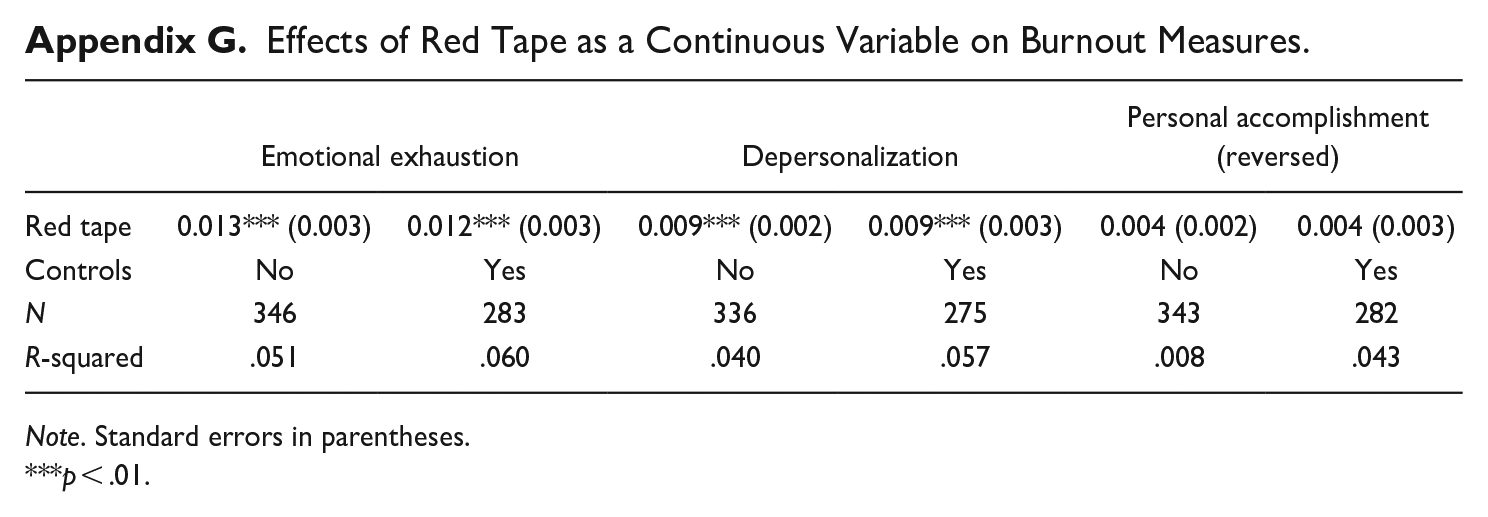
| Emotional exhaustion | Depersonalization | Personal accomplishment (reversed) | ||||
|---|---|---|---|---|---|---|
| Red tape | 0.013*** (0.003) | 0.012*** (0.003) | 0.009*** (0.002) | 0.009*** (0.003) | 0.004 (0.002) | 0.004 (0.003) |
| Controls | No | Yes | No | Yes | No | Yes |
| N | 346 | 283 | 336 | 275 | 343 | 282 |
| R-squared | .051 | .060 | .040 | .057 | .008 | .043 |
Note. Standard errors in parentheses.
p < .01.
Acknowledgements
Gregg Van Ryzin, Christian Schuster, Martin Williams, Manuel Sepúlveda, Gonzalo Muñoz, David Saavedra, three anonymous referees, senior professionals from the Agency for the Quality of Education of the Ministry of Education in Chile and  , and seminar participants at the University of Chile made valuable comments and suggestions. We also thank the Agency for the Quality of Education and Alexis de Ponson for their assistance during the data collection process. Tomás Soto, Cristóbal Alarcón, Felipe Medina, Valentina Palma, Matías Peralta, and César Dios provided superb research assistance. Any errors are ours alone.
Declaration of Conflicting Interests
The author(s) declared no potential conflicts of interest with respect to the research, authorship, and/or publication of this article.
Funding
The author(s) disclosed receipt of the following financial support for the research, authorship, and/or publication of this article: We gratefully acknowledge the financial support from the People in Government Lab, Blavatnik School of Government, University of Oxford; the Center for Research in Inclusive Education, funded by the Chilean National Research and Development Agency (ANID) Grant SCIA ANID CIE160009; and the ANID Millennium Nucleus on Intergenerational Mobility: From Modelling to Policy (MOVI) Grant NCS2021072 (to L. Gutiérrez).