




Abstract
Fractions are challenging for both typically achieving children and adults. Although some prior research has focused on fraction difficulties of children with mathematics difficulties (MD), persistent difficulties encountered by adults with MD remain unknown. It is possible that these adults may be able to compensate for some deficits. In this study, we administered an un-timed, paper-based fraction achievement test to French adults with and without MD to compare their knowledge of fractions. Compared with controls, adults with MD performed worse in fraction number lines, fraction concepts, fraction arithmetic, and word problems. However, no difference in performance between the two groups was observed on symbolic representations. This suggests that adults with MD might be able to perform rote procedures such as transcoding from a verbal to a symbolic representation but are severely impaired for fraction number line, fraction concept, and fraction arithmetic. Exploratory error pattern analyses for fraction number line and fraction arithmetic further revealed mistakes similar to those observed in prior studies on children with MD, indicating core deficits in fraction understanding in individuals with MD.
Despite their importance and widespread usage, fractions are typically hard to grasp for adults and children across the world (Chan et al., 2007; Ni, 2001; Yoshida & Sawano, 2002). First, fractions are difficult because of the complexity of their subconstructs (ratio, measure, part–whole, and operator as conceived by Kieren, 1980) and the limited understanding of the part–whole model (Pitkethly & Hunting, 1996). For instance, frequently used part–whole relationships in school may hinder the acquisition of other concepts such as improper fractions, fair shares, and, the property of infinite divisibility of fractions (Behr et al., 1983; Pitkethly & Hunting, 1996 as in Misquitta, 2011). Second, because the bipartite structure of fractions (two natural numbers separated by a horizontal line) is different from that of whole numbers, learners may struggle to understand the overall magnitude of fractions (Hiebert, 1985). Instead, they might overly rely on fraction components (numerator and denominator) to estimate fractional magnitude. This phenomenon, known as the “whole-number bias,” often leads to errors in problems that require holistic processing of fractions (Ni & Zhou, 2005; Vamvakoussi et al., 2012; Van Hoof et al., 2013). Third, the procedures required to solve fraction arithmetic are varied and complex (Lortie-Forgues et al., 2015). For instance, adding fractions with common denominators (e.g., 2/6 + 3/6) requires one to maintain the denominator constant and add the numerator, whereas multiplying the same fractions (e.g., 2/6 × 3/6) requires one to multiply both the numerator and denominator. Thus, arithmetic procedures may be an important source of difficulty for individuals when manipulating fractions.
Mathematics Difficulties and Fractions
As should be clear from the review above, learning and understanding fractions are difficult for most typically achieving (TA) children and adults. Yet, fractions might be even more difficult for individuals with mathematics difficulties (MD), which represents both students with low performance as well as students with a diagnosed math disability (Nelson & Powell, 2018). Indeed, a growing number of studies suggest that children who experience MD appear to struggle with many aspects of fraction skills, including fraction concepts, arithmetic, estimation of fraction magnitudes, and word problems (Bailey et al., 2015; Hansen et al., 2017; Hecht & Vagi, 2010; Hunt, 2015; Ikhwanudin et al., 2019; Malone & Fuchs, 2016; Mazzocco & Devlin, 2008; Mazzocco et al., 2013; Morano et al., 2019; Newton et al., 2014). These studies provide important insights into the general relationship between fraction knowledge and low mathematics achievement.
For instance, Mazzocco and colleagues (2013) noted that students with MD struggled in a fraction magnitude comparison task until Grade 7 as compared with TA and low achieving students who had achieved ceiling effects for accuracy by Grades 5 and 4, respectively. In addition, children with MD find it difficult to identify equivalent ratios, name decimals, rank order fractions, and decimals, and consistently prefer visual models to symbolic notations to represent fractions (Mazzocco & Devlin, 2008). In another study, children with MD were found to have poorer performance than TA peers in tasks involving fraction arithmetic, fraction estimation, and fraction word problems (Hecht & Vagi, 2010). At-risk fourth graders also applied whole number logic to fractions leading to errors on fraction ordering tasks (Malone & Fuchs, 2016). Finally, not only do students with MD perform poorly on fraction-based tasks but they also start and stay far behind their TA peers in school. For example, using growth trajectory analyses, Hansen et al. (2017) showed slow growth for students with MD on fraction concepts. This slow growth further adds to the achievement gap by the time students reach high school. Therefore, there is emerging evidence that children with MD significantly struggle with fraction knowledge.
To our knowledge, there is very limited quantitative research on fraction skills in adults with MD. One recent study noted that adults with persistent MD perform poorly on a timed-match to sample fraction task as compared with controls (Bhatia et al., 2020). In another study on two adults with MD, the error patterns on fraction tasks were shown to be similar to those obtained for students in the study by Mazzocco et al. (2013) (Lewis, 2016). However, there are two main limitations of the abovementioned studies: (a) in the first study, the task employed was timed and the focus was on the property of equivalence/matching which could have been achieved using estimation strategies, and (b) the second study had a very limited sample size (N = 2) and focused on specific misunderstandings of adults with MD. Thus, both these studies fail to provide a detailed exploration of the struggles faced by adults with persistent MD on different types of fraction competencies. Given the persistence of mathematics difficulty in adult life and the importance of fraction knowledge for academic and professional success, it is imperative to improve our understanding of the fraction difficulties faced by adults with MD.
Fraction Magnitude Knowledge Deficit: Main Cause for Fraction Impairments in Individuals with Mathematics Difficulties?
The integrated theory of numerical development (Siegler & Lortie-Forgues, 2014; Siegler et al., 2011) suggests that a major source of fraction difficulties in those individuals might be a poor grasp of fraction magnitudes. Indeed, fraction magnitude knowledge may play a critical role in learning fraction concepts and arithmetic (Tian & Siegler, 2017). As emphasized by Tian and Siegler (2017), “numerical development involves learning about the characteristics that unite all types of real numbers as well as the characteristics that differentiate them” (p. 615). Notably, the main feature uniting whole numbers and rational numbers is that both represent numerical magnitudes and, as a result, can be mapped onto number lines. Thus, the theory posits that difficulties with many fraction concepts and procedures may be traced back to a poor understanding of fraction magnitudes.
Studies typically measure fraction magnitude knowledge using number line estimation tasks, in which fractions have to be mapped onto lines (usually marked from 0 to 1 or 0 to 5; Jordan et al., 2017). Consistent with the integrated theory of numerical development, these studies have found that children with mathematics difficulties tend to exhibit poorer performance than their TA peers on fraction number line tasks. For example, students with MD (who score below 35% on state assessment tests) were less accurate than TA students on fraction number line estimation tasks (0–1 and 0–5; Siegler & Pyke, 2013). In a recent study, students with diagnosed learning disabilities also showed poor performance on number line estimation tasks as compared with circular models (measure part–whole understanding) (Morano et al., 2019). The number line estimation task also showed stronger relation with mathematics achievement and fraction magnitude comparison tasks than circular models, indicating that the part–whole knowledge usually acquired through circle models might be easier to develop but magnitude knowledge (number line tasks) is more important for learning of fraction concepts (Morano et al., 2019). Intervention studies also show that practicing number line tasks may lead to improved fraction knowledge in individuals with MD (Barbieri et al., 2020; Fuchs et al., 2013, 2016; Saxe et al., 2013). Therefore, consistent with the integrated theory of numerical development, several lines of research suggest that limited understanding of fraction magnitude may be at the core of struggles with fractions in individuals with MD (Amalina et al., 2019; Morano & Riccomini, 2020; Tian & Siegler, 2017).
Current Study Rationale
Previous studies that examined the relationship between fraction skills and MD, however, have at least two main limitations. First, prior studies almost exclusively focused on children who are in the process of learning about fractions in school. This raises the possibility that at least some identified fraction difficulties might not necessarily be persistent. For instance, adults might be able to develop compensatory strategies that might mask some of the difficulties identified in children (Lewis & Lynn, 2018b). This is suggested by both neuroimaging and behavioral studies. For instance, Cappelletti and Price (2014) found adults with MD (as compared with TA adults) to exhibit stronger frontal activations associated with faster response latencies, suggesting compensatory mechanisms to make up for the inefficient activation in the number-related parietal regions (Cappelletti & Price, 2014). This echoes with compensation mechanisms that may be used in adults with reading difficulties (Hancock et al., 2017). Therefore, it is important to perform research on skills of adults (not only children) with MD, as they may have different profiles of difficulties (Lewis & Lynn, 2018a). Second, previous studies on adults with MD largely focused on specific fraction competencies and a trial-by-trial analysis of their difficulties (Lewis, 2016; Lewis & Lynn, 2018b). These studies did not necessarily provide a broad assessment of the difficulties that adults with MD exhibit on different fraction competencies taught at school and required for understanding higher mathematical concepts. In other words, a quantitative analysis of the performance of adults with persistent MD on a variety of fraction skills remains necessary to determine which skills remain impaired, and which skills can be compensated for.
To fill this gap in the literature, we designed a paper-based fraction achievement test that assessed fraction knowledge. The test was based on the French curriculum standards for fraction learning. In France, fractions are introduced to students in fourth grade as one of the first rational numbers to aid in the holistic development of mathematical knowledge. During elementary school (Grades 4 and 5), students are introduced to the part–whole and measure concepts of fractions. The fractions studied during this phase are relatively simple (e.g., half, third, quarter, fifth, sixth, tenth, hundredths). Fourth and fifth graders notably work on transcoding different representations of fractions, understanding equivalence, comparing fractions with the same denominator, and adding fractions with the same denominators. Starting in Grade 6, students are taught to use fractions as quotients and work on increasingly complex problems involving how to reduce a fraction, compare them, and manipulate them in arithmetic problems. Other aspects of fractions such as ratios and use as operators on other numbers are introduced in Grade 7. The fraction achievement test designed in the lab encompassed almost all fraction skills that are learned in the French school system (and are required for proficiency in fractions). It notably assessed four major competencies that have also been evaluated in Rodrigues et al. (2019): fraction concepts, fraction arithmetic, fraction number line, and word problems. In addition to these competencies, we also assessed the symbolic representation of fractions (i.e., transcoding between Arabic numbers and numeral). This was because transcoding skills are important to the development of mathematical skills (Geary et al., 2000; Moeller et al., 2011; Moura et al., 2015) and emphasized in the French national curriculum standards (see above). The correspondence between the French national curriculum standards for fractions and each question in the fraction achievement test is shown on Online Supplemental Table 1.
Demographic Information for All Participants in the Fractions Study.
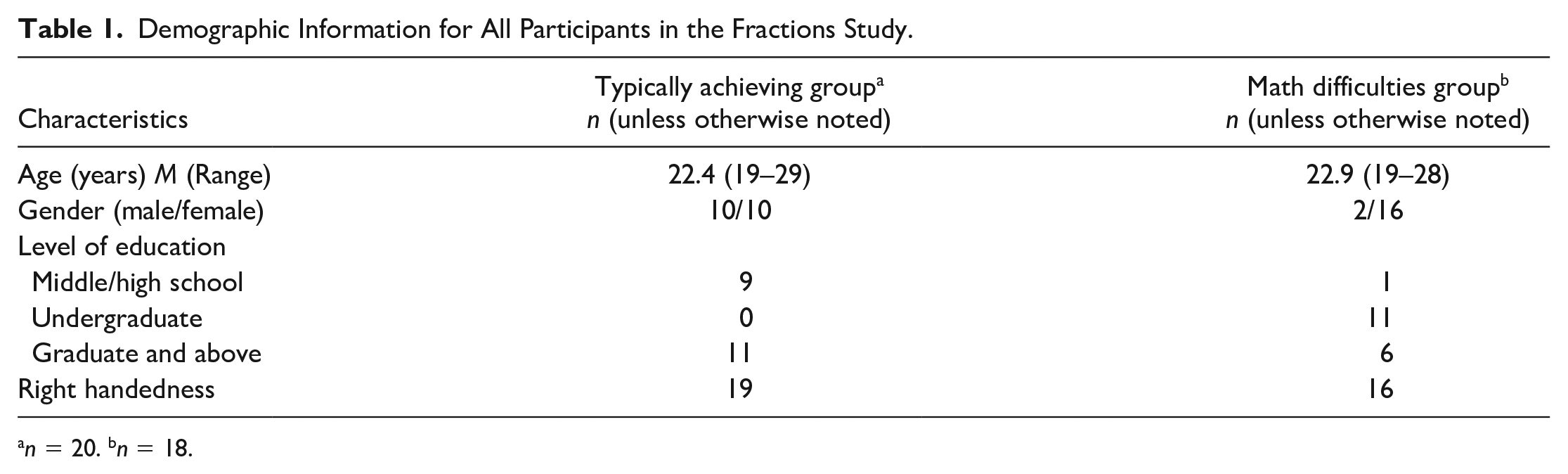
n = 20. bn = 18.
Here, we used this assessment of fraction skills to compare the performance of adults with MD to TA adults who were matched for age, reading skill, and verbal IQ. We specifically aimed to test which fraction competencies remained the most impaired in adults with MD, despite years spent following the same standardized fraction curriculum in school. Consistent with prior studies in children with MD, we expected that adults with MD would be impaired in many of these competencies, though adults might be able to mask some impairments with compensatory strategies (as compared with children). According to the integrated theory of numerical development, one would notably expect that adults with MD might still show important deficits in fraction number line estimation, as difficulties with understanding fraction magnitude have been posited to be the main source of fraction impairments in children with mathematics difficulties.
Method
Participants
Twenty typically achieving individuals (M = 22.4, range = 19–29, 10 females) were recruited through generic advertisements on social media, a mailing list sent to several universities in Lyon, France, and by word of mouth. Twenty-two participants with MD were recruited in three different ways: (a) through the “mission handicap” program at the University of Lyon (a program aimed at helping college students with disabilities), (b) by sending a targeted email to neuropsychologists and clinicians in the Lyon area, and (c) by advertisements on social media targeting adults who either had been formally diagnosed with developmental dyscalculia or had experienced MD. However, only 18 out of these 22 participants met our criteria for MD (see below) (M = 22.9, range = 19–28, 16 females). The performance of a subsample of these MD participants (n = 13) on a more restricted fraction match-to-sample task was already analyzed in Bhatia et al., 2020. All participants were native French speakers and did not report a prior history of neurological disease or psychiatric disorders. Written informed consent was given by each participant before the experiment. Participants were given 30 euros for participating in the study. The experiment was performed in accordance with the ethical standards established by the Declaration of Helsinki (see Table 1).
Procedure
Data collection (approximately 3 hours) was done in the laboratory. Participants were administered various tests to assess their cognitive, mathematical, and reading skills. Verbal IQ and spatial IQ were estimated using the Verbal Reasoning and Matrix Reasoning subtests of the Wechlser Adult Intelligence Scale (WAIS-IV; Wechsler, 2008). Mathematics skills were assessed using two subtests (Mathematics Fluency and Applied Problems) of the third edition of the Woodcock–Johnson Test of Achievement (WJ-III; Woodcock et al., 2001). The Mathematics Fluency subtest is a timed test in which participants have to solve as many single-digit additions, subtraction, multiplication, and division problems as they can within 3 minutes. The Applied Problems subtest is un-timed and measures the ability to analyze basic numerical concepts and oral word problems. This test stops after six consecutive errors or when the last item is reached. We chose to use the third edition of the WJ rather than the more recent fourth edition because only the former has been translated into French (Schwartz et al., 2018, 2020) Reading fluency was assessed with the Alouette-R test (Lefavrais, 1967). This test requires participants to read a 265-word text aloud in 3 minutes and measures the number of words read, the time required, and the number of pronunciation errors to evaluate the reading speed and efficiency, respectively. Finally, participants were administered a paper-and-pencil–based and un-timed Fraction Achievement Test developed in the lab (see below). A 10-minute break was given between the tests such that the WAIS-IV and WJ-III were carried out before the break and Alouette and Fraction Achievement tests were carried out after the break.
Criteria for Defining MD
To be classified as having MD, participants had to have been diagnosed by a clinical specialist and/or complained of mathematics difficulties since school. They also had to perform (a) above the 25th percentile on the Verbal Reasoning subtest of the WAIS-IV (therefore indicating normal verbal IQ), (b) at or below the 10th percentile on at least one of the mathematics subtests of fluency and applied problems and (c) below the 25th percentile on the average of the mathematics subtests of fluency and applied problems. Using these two mathematics subtests allowed us to assess a range of mathematical skills, such as single-digit arithmetic, calculating money, time, applying basic formulas (Pythagoras theorems), and equation solving. Further, the use of both a stringent (i.e., 10th percentile on at least one subtest) and more lenient (25th percentile on both subtests) cutoff criteria allowed us to adopt a relatively strict definition of MD while maximizing sample size (Geary, 2004; Murphy et al., 2007). Four participants diagnosed by clinical specialists did not have a score below the 10th percentile on either of the subtests and were excluded from the analysis. Of the 18 MD participants, seven participants scored below the 10th percentile on both the mathematics subtests and nine participants scored below the 10th percentile on only the Mathematics Fluency subtest. All 18 participants scored below the 25th percentile on the average of both the subtests. In addition, the 18 MD participants also had average to superior verbal IQ, as reflected by standardized scores ranging from the 25th percentile (i.e., 90) to the 98th percentile (i.e., 130) on the verbal reasoning subtest of the WAIS-IV.
Of the 18 participants included in the MD group, nine had been diagnosed by a clinical specialist (speech therapist, occupational therapist, and/or neuropsychologist) using a variety of behavioral assessments at one or more time points before the age of 18. The remaining nine participants reported that either they or their teachers (or professors) suspected they had MD. They were interviewed by a clinical specialist (i.e., neuropsychologist), who notably asked these participants about their onset of mathematics difficulties and the different areas in which they were impacted in their daily lives. The participants complained of mathematics difficulties since Grades 4 and 5 in the school and reported difficulties in performing one or more of the basic daily activities such as grocery shopping, banking, reading analog time, and filing taxes. All participants had reading scores above the cutoff criterion for dyslexia (i.e., reading speed score above 8.7 and/or reading efficiency score above 402.26; Cavalli et al., 2018).
Fraction Achievement Test
The Fraction Achievement Test consisted of 24 questions with different items/subparts assessing five main competencies. Example questions are shown in Figure 1 and the entire translated version of the test is included in the Supplementary Material.
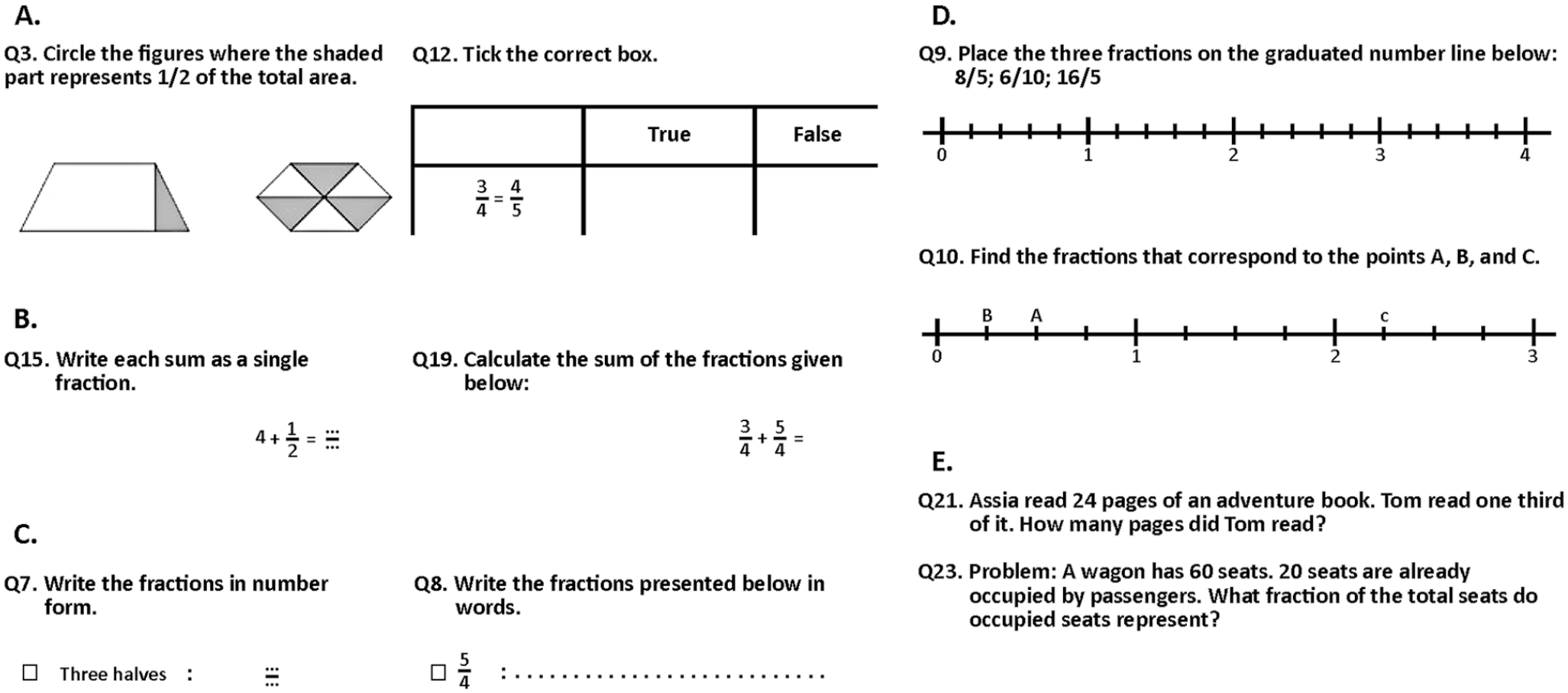
Example questions from the Fraction Achievement Test for (A) Fraction Concepts, (B) Fraction Arithmetic, (C) Fraction Number Line, (D) Symbolic Representations, and (E) Word Problems
First, fraction concepts (see Figure 1A) were measured using a total of 13 questions (Questions 1, 2, 3, 4a, 4b, 5, 6, 11, 12, 13, 16, 17, 18). The items assessed part–whole understanding of area models, set models, equivalence, comparing fractions, ordering fractions, and mixed fractions. For example, the part–whole understanding task included items where participants had to construct and color fractions like 1/2 and 5/4 (Q4a, b) and circle 2/5 of the figure (Q5). The equivalence task included seven items (i.e., 3/4 = 4/5, 3/5 = 35/10, 2/1 = 1, 3/2 = 6/4, 4/4 = 1, 5/3 = 3/5, 2/3 = 12/13; Q12) in which participants had to choose the correct pair. Second, fraction arithmetic skills (see Figure 1B) were measured using four questions (Qs 14, 15, 19, and 20). Each question had three to five items and participants were presented with an addition problem written in symbolic form. Problems consisted of proper fractions, improper fractions, and whole numbers (e.g., 4 +1/2, 1+ 7/2, 3/4 + 5/4, 2 + 2/3). Third, the symbolic representation of fractions (see Figure 1C) was tested using two types of questions (Qs 7, 8) consisting of four items each. The first type was identifying the verbal representations of fractions (e.g., three halves) and writing the symbolic form (3/2). The second type was identifying the symbolic form and writing verbal representation. Fourth, the fraction number line (see Figure 1D) was assessed using two questions (Qs 9, 10) with three items each. Three items involved placing three fractions on the number line (8/5, 6/10,16/5; Q9), and the other three involved finding the three fractions marked on the number line. Fifth, word problem-solving skills (see Figure 1E) were measured using four-word problems (Qs 21–24). For example, one of the problems read, “Assia read 24 pages of an adventure book. Tom read one-third of it. How many pages did Tom read?” Cronbach’s α ranged from 0.771 to 0.965 across all five measures (fraction concepts: 0.860, arithmetic skills: 0.965, symbolic representation: 0.944, number line: 0.873, word problems: 0.771), indicating acceptable to excellent internal consistency. The inter-rater reliability for categorization of questions by three independent researchers for all the above measures was very good (Cohen’s κ = 0.84). All fractions were presented vertically with a horizontal bar between the numerator and denominator (a notation used in the French curriculum).
Scoring Test Items
The Fraction Achievement Test was scored using a template with correct answers created by a neuropsychologist and rechecked by two other researchers. Data entry was also checked independently by these two researchers to identify incorrect entries as well as correction errors on the paper-based tests. Any discrepancy in scoring or data entry was discussed among the three coders, and if one of the coders was not convinced, the item was marked for rechecking by a researcher in mathematics education in the lab. The inter-rater reliability between the final two researchers was very strong (Cohen’s κ = 1). For each item, the correct response was scored 1 and the incorrect/no response (marked as “Do not know/?” by the participant) was scored 0. The percentage correct was calculated for each of the five competencies.
Error Pattern Analysis
An exploratory follow-up analysis was carried out to examine the errors made by adults with MD for the competencies that differed significantly between the two groups (i.e., fraction arithmetic, fraction number line, and word problems). For each of the items attempted, the errors were recorded in detail for each participant. Identifiable error patterns with maximum frequency were then examined and compared with prior literature on fraction knowledge in children with MD. This was done to identify the most common and persistent difficulties encountered by individuals with MD. For instance, prior literature on children with MD notes difficulties in ordering fractions, using whole number strategies for fraction arithmetic, and the inability to represent fractions on the number line (Mazzocco & Devlin, 2008; Morano et al., 2019; Siegler & Pyke, 2013). While prior literature informs some common misconceptions in both children and adults with MD, this analysis is posteriori and the findings should be interpreted with caution. In addition, some items could not be examined for errors as either they were not attempted (marked as “Do not know/?”) or the steps for the computation were not shown by the participants. The number of adults with MD that exhibited the error pattern, did not attempt the questions, did not list the steps of computation, and/or, solved the questions correctly have been mentioned in the results.
Analyses
Statistical analyses were conducted using the Jamovi software (The Jamovi Project, 2020). Shapiro–Wilk tests indicated that none of the fraction measures except fraction concepts (i.e., fraction arithmetic, symbolic representation, fraction number line, and word problems) were normally distributed (all ps < .001). Nonetheless, because ANOVAs are known to be robust to violations of normality given our sample sizes (Schmider et al., 2010), percentage scores associated with all fraction competencies were analyzed using ANOVAs with the between-subject factor group (MD and TA).
The test (in the original French and a translated version in English), as well as the scored data and the anonymized scan of the questionnaire for each participant, are available via the Open Science Foundation (OSF) at https://osf.io/dhkzc/?view_only=4656f9c57a9144699ebe1cf1e3646805.
Results
Demographics and Psychometric Measures
A preliminary analysis was conducted to check for between-group differences in background measures (see Table 2). There was no significant age difference between the two groups, F(1, 36) = 0.17, p = .67. Although the groups differed in terms of matrix reasoning, F(1, 36) = 19.33, p < .001, there was no significant difference in terms of verbal reasoning, F(1, 36) = 2.11, p = .15. We also found no significant differences for reading efficiency, F(1, 36) = 2.72, p = .108, and reading speed, F(1, 36) = 2.75, p = .106, between the two groups. Thus, the groups were matched in terms of age, verbal IQ, and reading skills. In addition, there were significant differences between the Woodcock–Johnson III subtests of mathematics fluency, F(1, 36) = 98.40, p < .001, and applied problems, F(1, 36) = 85.81, p < .001, between adults with and without MD. Thus, individuals with MD had lower mathematics skills than TA participants.
Psychometric Measures for Typically Achieving and Math Difficulties Groups.
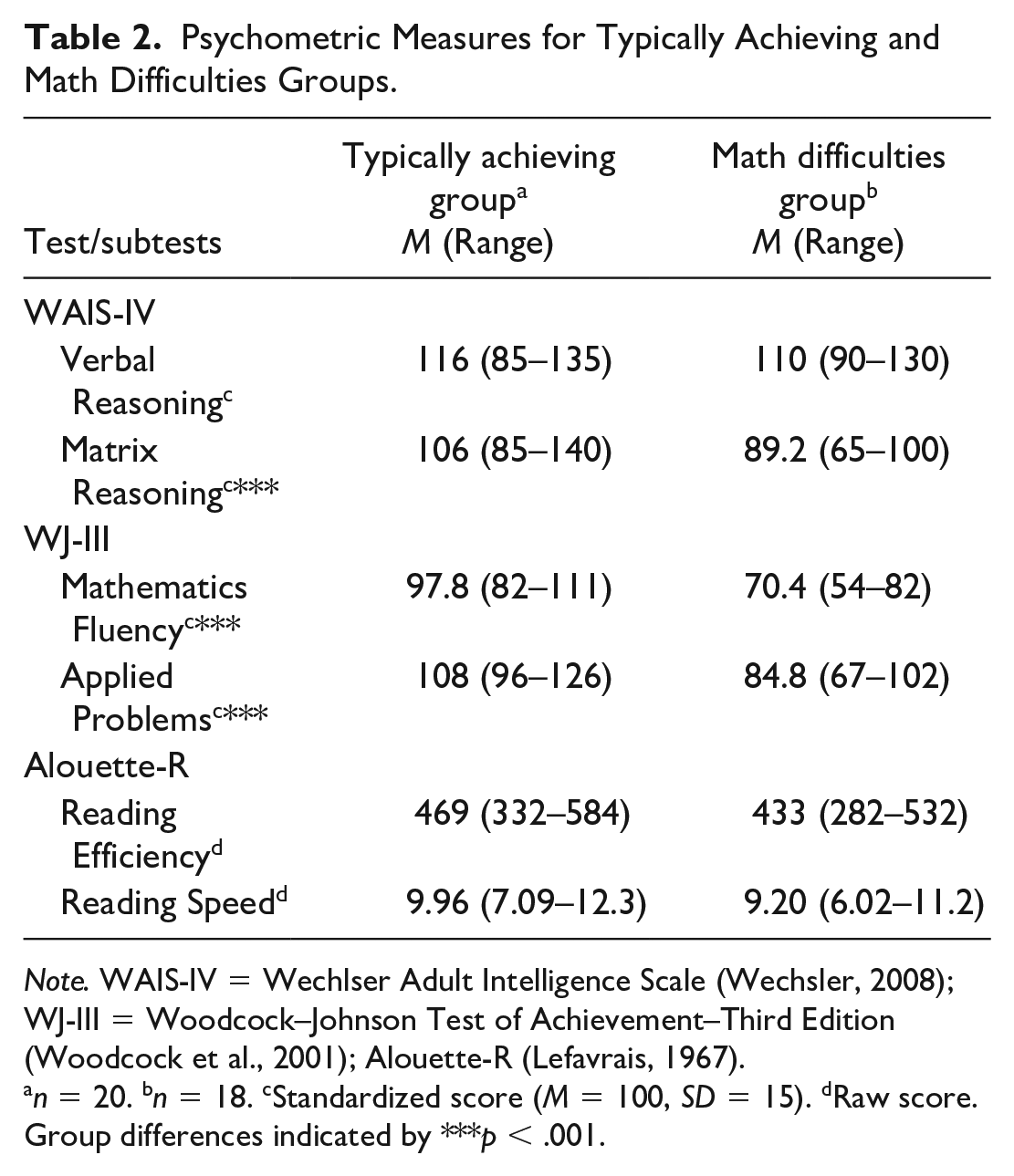
Note. WAIS-IV = Wechlser Adult Intelligence Scale (Wechsler, 2008); WJ-III = Woodcock–Johnson Test of Achievement–Third Edition (Woodcock et al., 2001); Alouette-R (Lefavrais, 1967).an = 20. bn = 18. cStandardized score (M = 100, SD = 15). dRaw score.
Group differences indicated by ***p < .001.
Fraction Knowledge
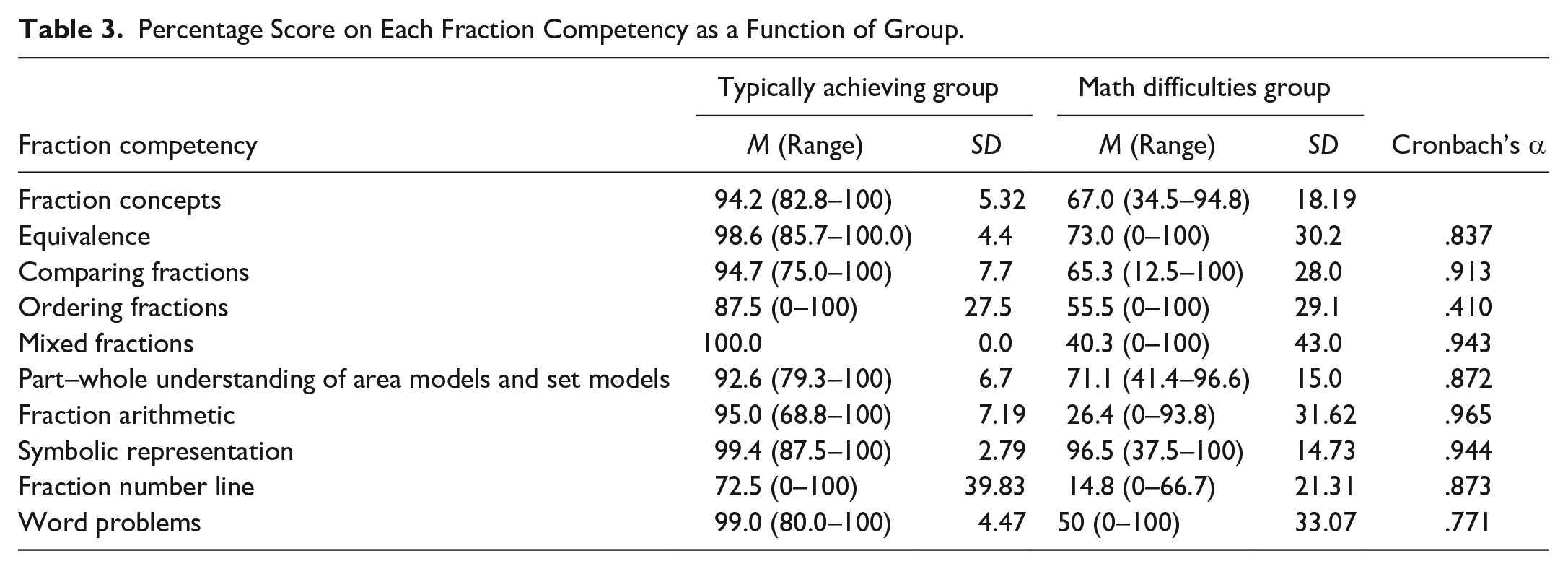
Scores for each fraction competency as a function of the group are displayed in Table 3. Scores associated with each fraction competency were analyzed using between-subjects ANOVA. A statistically significant effect of Group was observed for fraction concept, F(1, 36) = 40.84, p < .001, η2p = .53; fraction arithmetic, F(1, 36) = 89.29, p < .001, η2p = .71; fraction number lines, F(1, 36) = 29.97, p < .001, η2p = .45; and word problems, F(1, 36) = 43.14, p < .001, η2p = .54. This indicated lower scores for the MD group than for the TA group. However, there was no significant difference between TA and MD participants for symbolic representation, F(1, 36) = 0.72, p = .402, η2p = .02. Thus, differences between MD and TA individuals were specific to some competencies.
Percentage Score on Each Fraction Competency as a Function of Group.
Percentage of Adults With Math Difficulties With Similar Error Patterns.
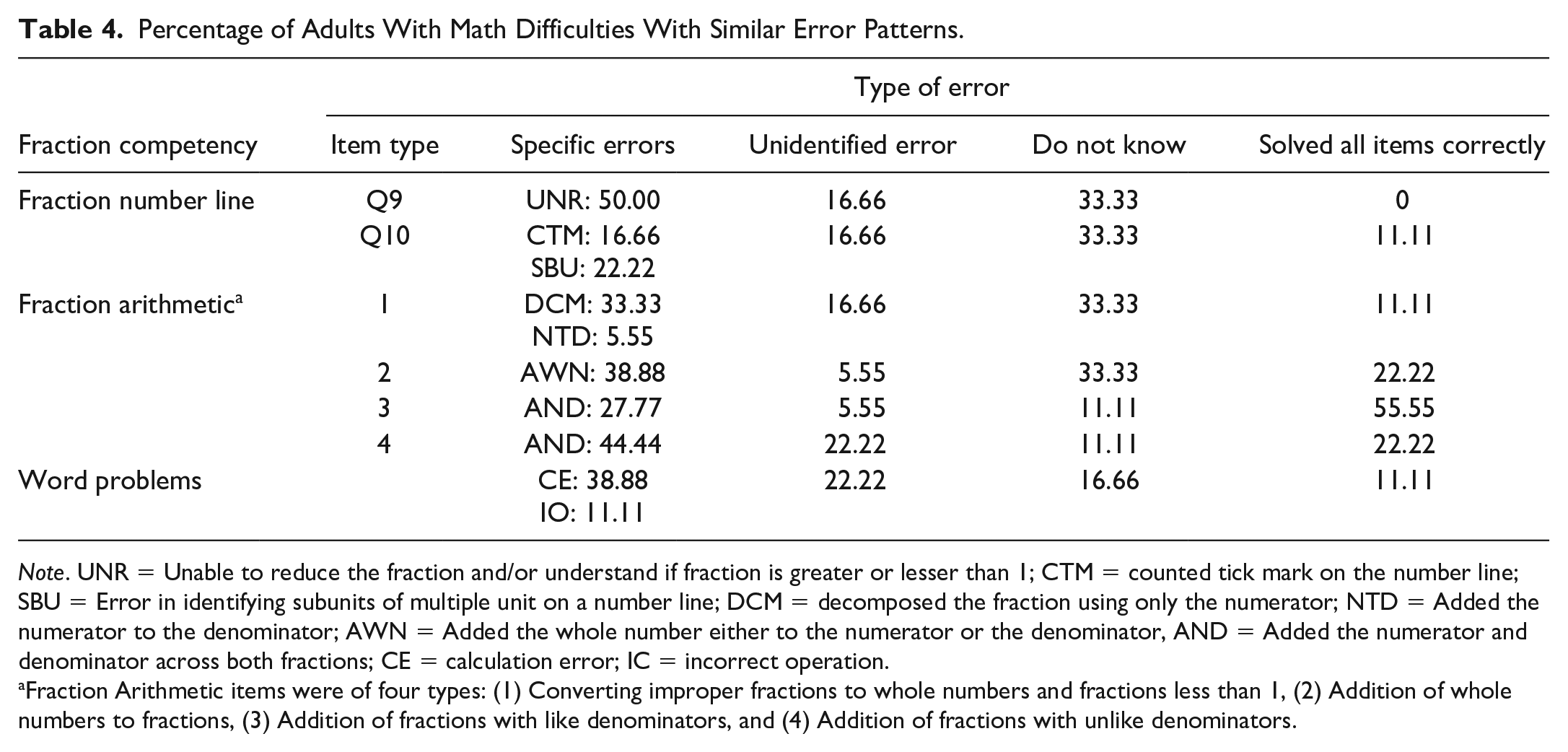
Note. UNR = Unable to reduce the fraction and/or understand if fraction is greater or lesser than 1; CTM = counted tick mark on the number line; SBU = Error in identifying subunits of multiple unit on a number line; DCM = decomposed the fraction using only the numerator; NTD = Added the numerator to the denominator; AWN = Added the whole number either to the numerator or the denominator, AND = Added the numerator and denominator across both fractions; CE = calculation error; IC = incorrect operation.
Fraction Arithmetic items were of four types: (1) Converting improper fractions to whole numbers and fractions less than 1, (2) Addition of whole numbers to fractions, (3) Addition of fractions with like denominators, and (4) Addition of fractions with unlike denominators.
Exploratory Analysis of Error Patterns of Adults With MD
An in-depth exploration of error patterns of adults with MD was also conducted for items related to the fraction number line, arithmetic, and word problems. The distributions of the most consistent error patterns for the MD group are shown in Figure 2.
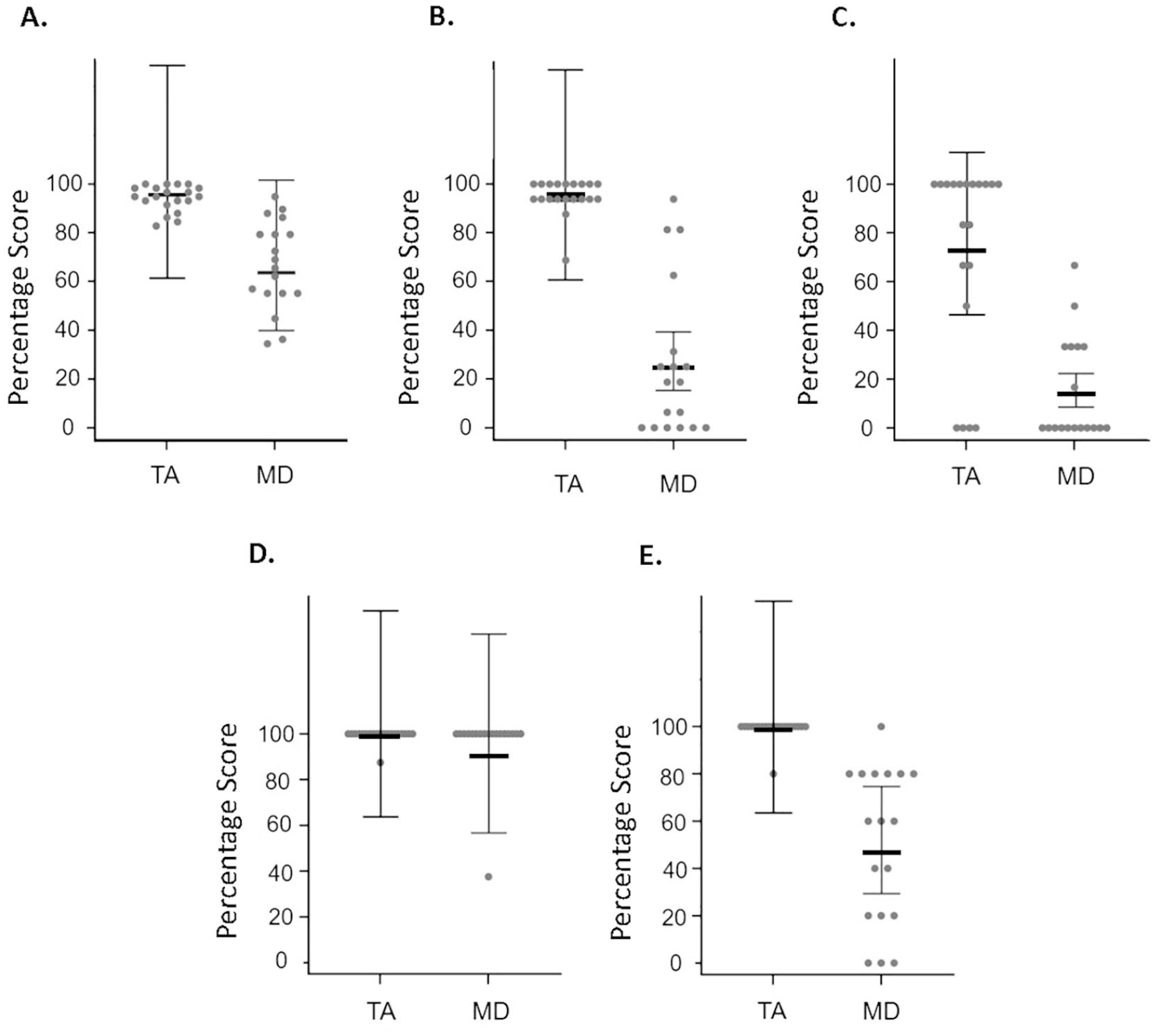
Percentage correct scores of adults with and without math disabilities for (A) Fraction Concepts, (B) Fraction Arithmetic, (C) Fraction Number Line, (D) Symbolic Representations, and (E) Word Problems
Fraction Number Line
Fraction number line knowledge was tested on Q9 and Q10. In Q9, participants were asked to place the fractions 8/5, 6/10, and 16/5 on a graduated 0 to 4 number line consisting of four units (0–1,1–2, 2–3, 3–4) segmented into five parts each. Six adults with MD “did not know” how to solve all three items on Q9 and hence did not attempt the question. Of the remaining 12 adults, six adults struggled to place the fraction 6/10 on the number line. The most common errors that could be interpreted pertained to finding the equivalent fraction 3/5. This might have led to the participants placing the fraction at either less than or more than 1 mark, revealing an inconsistency in understanding the magnitude 6/10. Four participants out of these six were able to place the other two fractions correctly. Thus, revealing an understanding of magnitude when the fraction and the parts on the number line were the same or equal. Because the participants were not asked about their reasoning behind placing the fractions these errors are mostly interpreted by comparing participants’ responses on other items. Therefore, these exploratory findings should be taken with caution. In Q10, participants had to find the fraction corresponding to the points 1/4, 1/2, and 9/4 on a 0–3 number line with subunits segmented into four parts. Six adults with MD did not attempt the question and two adults solved all the items correctly. Of the remaining 10 participants, three mistakenly counted the tick mark as a unit on the number line similar to the unit of a ruler. This faulty strategy led adults with MD to count the tick marks starting with 0 (instead of counting the number of parts divided by the tick marks), which resulted in fractions with a denominator of 5 instead of 4 on the 0 to three number line (segmented in four parts; see Zhang et al., 2017 for details on ruler-tick-mark-counting strategy). Others (n = 4) counted the total number of parts as 12 on the 0 to 3 number line (subunits segmented in four parts) and marked the points as multiples of 1/12, indicating that the participants might have erred at making the distinction between 0 to 3 number line made up of three 0 to 1 units, leading them to count the total number of parts as 12 instead of four. This finding is in line with prior research showing students struggling with multiple levels of units (Boyce & Norton, 2016; Hackenberg, 2013; Hackenberg & Lee, 2015 as in Zhang et al., 2017). For the rest of the participants (n = 3), the errors could not be identified.
Fraction Arithmetic
Fraction arithmetic problems were of four types: (1) converting improper fractions to whole numbers and fractions less than 1, (2) addition of whole numbers to fractions, (3) addition of fractions with like denominators, and (4) addition of fractions with unlike denominators. For Type 1, only two adults were able to solve all the items correctly; six adults did not attempt any of the items. Of the remaining 10 participants, six adults with MD showed a classical error (whole number bias) by working separately with the components of the fraction. For example, to convert 10/3, the participant decomposed the numerator 10 to the whole number 8 and fraction 2/3, without considering the role of the denominator (10/3 = 8 + 2/3). One adult with MD added all the numbers together (10/3 = 13), indicating a misunderstanding about fractions as a distinct number form. The remaining three adults either solved the problems incompletely or made errors that could not be deciphered. For Type 2, six adults did not attempt the question and four adults were able to solve one or more items correctly, revealing an understanding of the addition of whole numbers to fractions. Of the remaining eight adults with MD, six adults added the whole number to the numerator (e.g., 4 + 1/2 = 5/2). One adult added the whole number arbitrarily to either the numerator or the denominator or both (e.g. 4 + 1/2 = 5/3), showing the classical whole number bias by operating on the components of fractions separately, and thus revealing a lack of understanding of holistic fraction magnitudes. The addition of fractions with like and unlike denominators (Types 3 and 4) was also challenging for adults with MD. Two adults with MD did not attempt both types of problems. Ten adults with MD were able to add the fractions with like denominators and four were able to add with unlike denominators correctly. Six adults with MD were not able to solve the addition of like denominators, five adults added the numerators and denominators across the two fractions (e.g., a/b +c/b = a + c/2b), and one adult showed a non-classical error. For the unlike denominator items, eight adults with MD added the numerators and denominators separately (e.g., 2/2 + 1/6 = 3/9). Interestingly, only one adult with MD was able to correctly solve all types of fraction arithmetic problems.
Word Problems
For word problems, the most common errors were found in calculations and the use of wrong operations. Nine adults with MD made a calculation error and two among these also showed difficulty in the choice of operation utilized. Five adults with MD were unable to understand “one-third of 24.” The rest of the participants did not show their computation steps; therefore, their error patterns were unidentifiable. Except for three adults with MD, all the remaining participants were able to solve one or more than one word problems correctly.
Discussion
In the present study, we used an un-timed paper-based fraction test to compare the fraction skills of adults with and without MD. We found that adults with MD showed large deficits in fraction magnitude knowledge (as measured by the number line task), fraction concepts, and fraction arithmetic as compared with TA adults. In addition, adults with MD displayed poorer performance on word problems than did TA adults. Interestingly, no difference was observed in symbolic representations, suggesting that adults with MD may be able to compensate for some difficulties with fractions.
Deficits Displayed by Adults With MD
Our finding that fraction number lines are one of the most challenging tasks for adults with MD could partially be accounted for by the integrated theory of numerical development. This theory posits that fraction magnitude knowledge is (a) central to the development of fraction learning and (b) impaired in children with mathematics difficulties (Siegler et al., 2011; Tian & Siegler, 2017). As such, the theory places great emphasis on fraction number lines because number lines are an important tool for measuring fraction magnitude knowledge (Hansen et al., 2017; Jordan et al., 2017). Overall, the theory is supported by studies showing that children with mathematics difficulties often exhibit poor performance on number line tasks (Bailey et al., 2015; Siegler & Pyke, 2013). It is also supported by intervention studies in which number lines were used to develop fraction magnitude knowledge in children with mathematics difficulties (Barbieri et al., 2020; Fuchs et al., 2013, 2016; Saxe et al., 2013). These studies revealed an improvement in fraction magnitude knowledge (as well as enhanced learning of other fraction competencies) for children with mathematics difficulties.
To our knowledge, however, only one previous quantitative study to date had examined the fraction magnitude knowledge of adults with MD. In Bhatia et al. (2020), adults with dyscalculia were shown to perform poorly on a fraction matching/equivalence task compared with controls, indicating a possible impaired fraction magnitude knowledge. However, the task used in Bhatia et al. (2020) was timed and was limited in that it only assessed fraction or ratio equivalence. Thus, no specific conclusions could be drawn about the type of competencies that were challenging for adults with MD from that study. The present findings significantly extend these previous results by providing a comprehensive survey of fraction impairments in adults with MD.
In addition, it might have been argued that adults with mathematics difficulties may be able to compensate for their difficulties in fraction magnitude knowledge. Indeed, we found that impaired fraction magnitude knowledge as measured by the number line task in individuals with MD is pervasive and persists through adulthood. Interestingly, the most common errors observed in most of the adults with MD on the fraction number line task were similar to those observed in children in prior studies. For instance, most adults with MD counted either the tick marks (not the segmented parts) or the total number of parts on the entire number line (not the subunits), which is a common error pattern observed in prior studies on children with MD (Zhang et al., 2017). These overlapping findings might suggest the pervasive challenges on number line tasks where identifying the number of parts and understanding the multiple levels of units on a number line is difficult for both adults and children with MD. Interestingly, a majority of TA adults did not show these error patterns indicating a sound magnitude understanding. This finding adds to the emerging evidence that fraction number line tasks may be an interesting tool to diagnose fraction impairments in both children and adults. For example, a recent study aimed at identifying middle school students who might be at a risk for developing mathematics difficulties found fraction number lines to be an accurate screener for later risk status (Rodrigues et al., 2019).
Individuals with MD also showed lower performance on other fraction magnitude knowledge items such as ordering and comparing fractions as measured by the fraction concept measure. As compared with the TA group, the MD group showed a much larger variability in their performance on fraction concepts as compared with fraction number lines, indicating differential challenge to access fraction magnitudes depending on the type of task. Indeed, a prior study on children with learning disabilities shows persistent difficulties on the fraction number line task as compared with tasks that are comparing fractions (Morano et al., 2019). These findings seem to suggest that difficulties in fraction knowledge could also potentially be explained by the type of task measuring fraction magnitudes. Past studies on fraction concepts have also shown a weak understanding of similar tasks in students with MD (Hecht & Vagi, 2010; Mazzocco & Devlin, 2008). Therefore, it is not surprising that adults with MD in our study find fraction concepts challenging especially complex concepts like mixed-fractions.
Fraction arithmetic is another domain in which MD participants performed worse than TA participants in our study. Studies on middle school children with mathematics difficulties have previously shown poor performance on fraction arithmetic tasks as compared with TA students (Bailey et al., 2015; Hansen et al., 2017; Ikhwanudin et al., 2019; Morano et al., 2019; Newton et al., 2014). Errors with fraction arithmetic may have different sources. For example, students with mathematics difficulties may select incorrect procedures, such as applying the denominator procedure for the same denominator problems (e.g., 1/3 + 1/3 = 2/6; Ikhwanudin et al., 2019; Newton et al., 2014). Adults with mathematics difficulties may also add the numerators and denominators separately (e.g., 1/3 +2/5 = 3/8) similar to children with mathematics difficulties (Lewis, 2016). A closer look at the error patterns of MD adults in our study indicates that 44% of the adults added denominators and numerators separately for both common and different denominator problems (e.g.,
Last, adults with MD showed poorer performance in word problems than did TA adults. To our knowledge, no prior studies have examined fraction word problem skills in adults with MD. Our findings are in line with studies on students with MD. For instance, a study involving fourth graders found poorer performance on fraction word problems for children with MD as compared with TA children (Hecht & Vagi, 2010). In addition, the study also showed less improvement in word problem skills from Grade 4 to Grade 5 in children with MD as compared with TA children. Recently, Hughes and colleagues (2020) noted difficulties in fraction word problems in 51 children with MD in Grades 4 and 5. About 45% of the students could not give the correct answer to the problem, and of those who were accurate, only one student was able to explain their reasoning. Thus, difficulties with fraction word problems in individuals with MD are likely to originate early in school and persist through adulthood.
Adults With MD Did not Display Severe Deficits in Symbolic Representation
Interestingly, both adults with MD and TA adults showed near ceiling performance on symbolic representations of fractions. In other words, adults with MD had no difficulty naming fractions represented in symbolic form and writing the symbolic fractions that were represented in numeral form. To our knowledge, this is the first time that this fraction transcoding competency has been measured in adults with MD. One plausible explanation for the level of performance adults exhibited on this task could be the rote memorization of procedures involved in naming fractions. This may indicate that adults with MD are not impaired when it comes to naming fractions and may do so with rote procedures that are not based on an understanding of integrated fraction magnitudes.
Limitations and Future Research
The current study has limitations that might be addressed in future research. Although the Fraction Achievement Test was matched on competencies to the French national curriculum standards and categorized similarly to the screener in Rodrigues et al. (2019), it had two drawbacks. First, we initially developed the test for assessing children in late elementary and early middle school. As a result, it did not include problems involving fraction subtraction, multiplication, and division (which are learned in later grades). Thus, we do not have a clear picture of all fraction arithmetic skills as the findings are limited to fraction addition problems. Second, the high performance of adults with MD on symbolic representations clearly indicates that they did not have issues transcoding the symbolic fractions we presented. Importantly, task difficulty in the task was varied by including an equal proportion of proper and improper fractions (improper fractions are more complex than proper fractions). Nonetheless, these problems were mostly limited to simple one-digit fractions with relatively easy denominators (e.g., thirds and halves). Thus, it is likely that adults with MD might have experienced more difficulty with larger and more difficult fractions.
The sample might also have two limitations. First, our sample size remains limited. Therefore, future studies would need to replicate the present findings with independent and larger samples. Second, we ensured that adults with and without MD were matched for age, reading skills, and performance on the WAIS-IV Verbal Reasoning subtest. Nonetheless, the groups differed significantly regarding performance on the Matrix Reasoning subtest. Therefore, in addition to mathematical difficulties, adults with MD in our sample might also have weak non-verbal abstract and spatial reasoning skills (measured by the Matrix Reasoning subtest).
Last, due to our fraction test being quantitative, it was difficult to understand the exact reasoning used to solve different fraction questions by adults with MD. Thus, we were limited in identifying their misunderstandings and compensatory strategies. More generally, although the fraction achievement test gives us an exhaustive picture of the different types of competencies practiced at school and reveals specific persistent difficulties for adults with MD, it is not a tool designed for understanding the reasoning behind these difficulties. Therefore, future studies might need to systematically examine (a) the relation between nonverbal reasoning abilities and fraction understanding of adults with MD and (b) an item-wise qualitative assessment of reasoning strategies underlying different fraction competencies.
Implications for Practice
The current study highlights the difficulties adults with MD encounter when solving fraction problems. A closer look at the error patterns reveals that the faulty strategies used by adults with MD when solving fraction number lines and fraction arithmetic are similar to prior studies on children with MD (Ikhwanudin et al., 2019; Newton et al., 2014; Zhang et al., 2017). These persistent challenges might be indicative of an underlying deficit in fractions in individuals with developmental dyscalculia.
Finally, our study also indicates that specific fraction competencies could be used as potential diagnostic indicators for identifying MD in middle/high school students and adult populations. Indeed, one of the reasons for the dearth of research in these populations is the absence of a common or standard instrument to aid in the identification and categorization of MD (Murphy et al., 2007). Interestingly, our results on impairments in fraction number line performance are in line with a study on middle school students that show fraction number lines to be an accurate screener for identifying individuals at risk for dyscalculia (Rodrigues et al., 2019).
Conclusion
This study contributes to the literature on mathematics difficulties by identifying specific, persistent difficulties that adults with MD encounter when solving a variety of fraction competencies. To our knowledge, this is the first study to compare the performance on fraction competencies between adults with and without MD. Findings suggest that adults with MD face difficulties when solving fraction number lines, fraction concepts, fraction arithmetic, and word problems as compared with TA adults. The study also emphasizes the significance of fraction magnitude knowledge as an intervention and diagnostic tool for MD and also adds to growing literature on the importance of number lines in building a holistic fraction understanding.
Supplemental Material
sj-docx-1-ldq-10.1177_07319487231171380 – Supplemental material for Fraction Knowledge in Adults With Persistent Mathematics Difficulties
Supplemental material, sj-docx-1-ldq-10.1177_07319487231171380 for Fraction Knowledge in Adults With Persistent Mathematics Difficulties by Parnika Bhatia, Jessica Léone, Marie-Line Gardes and Jérôme Prado in Learning Disability Quarterly
Footnotes
Acknowledgements
The authors thank Ms. Lea Longo for re-checking the coding of data.
Declaration of Conflicting Interests
The author(s) declared no potential conflicts of interest with respect to the research, authorship, and/or publication of this article.
Funding
Funding for this research was provided by the Région Auvergne-Rhône-Alpes (Pack Ambition Recherche 2017)- Projet Dyscog, France, Grant Number 17 010980 01.

References
Supplementary Material
Please find the following supplemental material available below.
For Open Access articles published under a Creative Commons License, all supplemental material carries the same license as the article it is associated with.
For non-Open Access articles published, all supplemental material carries a non-exclusive license, and permission requests for re-use of supplemental material or any part of supplemental material shall be sent directly to the copyright owner as specified in the copyright notice associated with the article.
