




Abstract
We examined whether children with comorbid reading and mathematics difficulties (RDMD) experience more school, reading, and mathematics anxiety than children with either reading difficulties (RD) or mathematics difficulties (MD). Furthermore, we examined whether attention differences account for these effects. Thirty-three children with RD (51.5% female; Mage = 10.80 years), 35 with MD (60.0% female; Mage = 10.79 years), 37 with comorbid RDMD (45.9% female; Mage = 10.79 years), and 42 chronological-age (CA) controls (64.3% female; Mage = 10.82 years) were assessed on measures of reading, mathematics, general cognitive ability, attention, and school, reading, and mathematics anxiety. The groups did not differ from each other in general cognitive ability, and the RDMD group did not present more severe RDMD than the RD and MD groups, respectively. Analyses of variance revealed that children with RDMD exhibited significantly higher levels of reading and mathematics anxiety compared to the CA controls. The RDMD group also exhibited higher levels in reading anxiety compared to the MD group and mathematics anxiety compared to the RD group. These differences remained significant after controlling for attention. Findings suggest that children with RDMD are at greater risk for both reading and mathematics anxiety, emphasizing the need for targeted, domain-specific interventions.
Keywords
Introduction
In total, 11%–70% of children with reading difficulties (RD) or mathematics difficulties (MD) 1 also experience comorbid challenges in the other area (Moll et al., 2014). Two main theories explain this comorbidity: the three-independent disorder model and the multiple-deficit model (Viesel-Nordmeyer et al., 2023). The former suggests that RD, MD, and reading and mathematics disabilities (RDMD) are distinct disorders, each with a unique cognitive profile (Skeide et al., 2018). According to this framework, children with RDMD are likely to experience more severe deficits in subject-specific abilities and general cognitive functions, such as executive functioning, than what would be expected by simply adding together the difficulties seen in children with only RD or only MD. This idea, known as “over-additivity,” implies that the co-occurrence of RD and MD leads to disproportionately greater cognitive challenges (Viesel-Nordmeyer et al., 2023).
In turn, the multiple-deficit model proposes that these disorders arise from both disorder-specific deficits and shared risk factors (McGrath et al., 2020; Pennington, 2006). Within this framework, the difficulties experienced by children with comorbid RDMD reflect the additive effects of distinct deficits, for example, impairments in word decoding linked to RD and deficits in number sense associated with MD (Wilson et al., 2015). Beyond these domain-specific challenges, children with RDMD also exhibit shared cognitive vulnerabilities, such as weaknesses in memory, attention, and processing speed (e.g., Moll et al., 2014; Raddatz et al., 2017; Slot et al., 2016; Willcutt et al., 2013). Consistent with this perspective, a meta-analysis by Viesel-Nordmeyer et al. (2023) demonstrated additive effects in both reading and mathematics outcomes among children with RDMD, along with shared deficits in executive functioning. Thus, although both models acknowledge subject-specific deficits, the three-independent disorder model suggests that RDMD involves disproportionately more severe and distinct cognitive impairments. In contrast, the multiple-deficit model explains comorbidity as the result of both the combined effect of subject-specific deficits and the influence of shared underlying risk factors.
Regardless of whether they are different disorders or not, research shows that both RD and MD co-occur with internalizing difficulties, such as anxiety (e.g., Aaron et al., 2008; Carey et al., 2016; Norman et al., 2021). Several theories have been proposed to explain the relationship between learning difficulties (LD) and anxiety. The Deficit Theory (e.g., Lin et al., 2013; Tobias, 1986) suggests that academic achievement difficulties lead to negative emotions (e.g., fear, anger, sadness) toward academics, causing anxiety about that situation. Alternatively, the Debilitating Anxiety Model (e.g., Faust et al., 1996; Fitzpatrick & Pagani, 2012) suggests that anxiety leads to learning problems because it impacts executive functioning, which consequently impacts achievement. Growing evidence supports a reciprocal relationship between LD and anxiety (e.g., Carey et al., 2016; McArthur, 2022; Morgan et al., 2008), suggesting that these factors mutually reinforce each other over time, creating a cycle that can further hinder academic success.
Empirical studies comparing individuals with and without LD have shown that children with RD and/or MD experience elevated levels of anxiety (e.g., Alesi et al., 2014; Knivsberg & Andreassen, 2008; Xiao et al., 2022; Zuppardo et al., 2023). These studies, however, have some important limitations. First, most of these studies have focused on generalized anxiety (see Vieira et al., 2024, for a recent systematic review), which refers to a prolonged sense of worry across different areas of life that disrupt daily functioning (American Psychiatric Association, 2022; Gale & Millichamp, 2016), and we do not know if the anxiety of these children is limited to school (i.e., school anxiety) or domain-specific (i.e., reading anxiety or mathematics anxiety). Mathematics and reading anxiety are considered to be performance-based anxieties, meaning that they arise in situations where one’s achievement-related performance is judged or evaluated, carrying a risk of negative evaluation (Hopko et al., 2001).
There is an ongoing debate about whether academic anxieties are general or specific to certain subjects (e.g., Daker et al., 2022; Sasanguie et al., 2024). Being general means that the fear of negative evaluation could occur across all academic areas due to the frequent assessments and inherent performance demands. Alternatively, being domain-specific implies that individuals may experience anxiety only in particular subjects (Sasanguie et al., 2024). Simply put, children with RD should experience only reading anxiety but not mathematics anxiety, and children with MD should experience only mathematics anxiety but not reading anxiety. This distinction is crucial for intervention because it helps tailor support strategies based on the specific types of anxiety children with LD experience. If anxiety is general, interventions should focus on broader strategies; however, if academic anxiety is domain-specific, interventions should target the specific subject of concern.
Another important limitation of previous studies is that only a few have examined if comorbidity in RD and MD raises the risk of experiencing generalized anxiety (Aro et al., 2022; Martínez & Semrud-Clikeman, 2004; White et al., 1992; Willcutt et al., 2013), and none of them have examined different anxiety types. As a result, we do not know if children with comorbid LD difficulties experience more reading anxiety, mathematics anxiety, or both. Assuming the multiple-deficit model (Viesel-Nordmeyer et al., 2023) is correct, then the RDMD children should experience both reading and mathematics anxiety. In contrast, if the Three-Independent Disorders Model (Skeide et al., 2018) is correct, the RDMD children should experience either reading anxiety or mathematics anxiety, but not necessarily both, depending on which academic difficulty is most dominant for them.
Finally, although prior research indicates that inattention is a common factor underlying both LD and anxiety (e.g., Aro et al., 2024; Carroll et al., 2005; Ciuhan & Iliescu, 2021), only a limited number of studies have accounted for these effects in their analyses (Arnold et al., 2005; Carroll et al., 2005; Willcutt et al., 2007, 2013; Willcutt & Pennington, 2000b), and, to our knowledge, no study has controlled for inattention when examining academic-related anxiety (e.g., school, reading, or mathematics anxiety) in children with LD. Thus, the purpose of this study was to examine if children with comorbid RDMD experience more school, reading, and mathematics anxiety than children with either RD or MD or children with no RDMD (chronological-age [CA] controls). In addition, we examined whether any significant group differences are due to differences between groups in attention.
Evidence Linking Reading, Math, and School Anxiety to Learning Difficulties
In their recent systematic review of internalizing problems in individuals with LD, Vieira et al. (2024) found that of the 96 studies included, anxiety was the most frequently studied issue with 62 studies focusing on it. However, only 20 studies assessed academic anxiety, which is related to elevated concerns about an educational context (e.g., school) or a specific subject (e.g., reading, math). Because academic anxieties are not in the Diagnostic and Statistical Manual of Mental Disorders (5th ed.; DSM-5; American Psychiatric Association, 2022), they may be overlooked in assessments, leading to missed opportunities for subject-specific support. Studying them can lead to better-targeted interventions for the students’ needs.
Evidence from studies that examined school anxiety is mixed (e.g., Alesi et al., 2014; Mammarella et al., 2016). For example, Alesi et al. (2014) found that both their MD and the unspecified LD (general LD without specifying their academic domain difficulties) groups exhibited higher school anxiety levels than children without LD (p < .05). In contrast, Mammarella et al. (2016) found that their group with dyslexia experienced significantly higher levels of generalized anxiety (d = 1.42, p = .03) but not school anxiety (p = .70). Novita (2016) examined differences in anxiety and self-esteem between children with dyslexia and their peers, considering generalized anxiety and self-esteem in different contexts: at school, in the free time, at home, and the total score. Overall, the two groups did not differ in generalized anxiety or self-esteem (p > .05). However, children with dyslexia reported significantly higher generalized anxiety (d = −0.42, p < .05) and lower self-esteem at school (d = 0.38, p < .05), but not in other contexts such as free time or home. These results led the authors to suggest that heightened generalized anxiety and reduced self-esteem in children with dyslexia may be influenced by context, appearing more prominently in academic environments.
Besides the need for more studies about the association between types of learning disabilities and school anxiety, Macdonald et al. (2021) highlighted the lack of studies comparing children with and without RD on reading anxiety. After assessing reading anxiety of Grade 4 and 5 children struggling to read, Macdonald et al. found that reading anxiety is related to difficulties in reading tasks that involve higher-level cognitive processes. According to McArthur (2022), RD can initiate reading anxiety, creating a reinforcing cycle once this link is formed.
Compared to the scarce literature on RD and school-related anxiety, there is an extensive amount of research on MD and mathematics anxiety, which is associated with the feeling of apprehension in anticipation of doing mathematics (e.g., Kucian et al., 2018; Wakeman et al., 2023; Wu et al., 2014). Wu et al. (2014), for example, compared second- and third-grade students with math-disabilities or low-achievement to a typically achieving control group on internalizing and externalizing measures. They found that students with math-disabilities or low-achievement exhibited higher math anxiety compared to controls (η2 = .08, p < .001). This result shows that, independently of the severity of MD, children who struggle with math might experience more mathematics anxiety than their CA controls even at an early age. Kucian et al. (2018) reported a similar result comparing 76 primary school children with developmental dyscalculia to 96 CA controls. They found that children with dyscalculia experienced significantly higher levels of mathematics anxiety, as measured by a specific math anxiety interview, and also performed more poorly in arithmetic tasks than their peers without dyscalculia. In addition, mathematics anxiety was equally present in boys and girls, indicating no gender differences. Similar to reading anxiety, the relationship between mathematics performance and mathematics anxiety seems to be bidirectional, although some studies support the Deficit Theory, which suggests that math difficulties lead to math anxiety, and other research supports the Debilitating Anxiety Model, indicating that math anxiety impacts math performance (see Carey et al., 2016, for a review).
Although research has shown that it is common for children with one type of difficulty, such as RD or MD, to also have a comorbid difficulty in the other learning domain (Moll et al., 2014), only four studies (Aro et al., 2022; Martínez & Semrud-Clikeman, 2004; White et al., 1992; Willcutt et al., 2013) have compared RD, MD, and RDMD groups in anxiety. Two of these studies (Aro et al., 2022; Martínez & Semrud-Clikeman, 2004) found that children with LD experienced high levels of generalized anxiety, irrespective of LD type. In contrast, White et al. (1992) and Willcutt et al. (2013) observed differences in generalized anxiety levels, with the comorbid group reporting higher anxiety than those with only one type of disability. However, in Willcutt et al.’s (2013) study, the RD and RDMD groups differed in their reading achievement (i.e., the RDMD group had poorer reading performance than the RD group), and the MD and RDMD groups differed in their mathematics achievement (i.e., the RDMD group had poorer mathematics performance than the MD group). Thus, it is possible that the higher levels of anxiety observed in the RDMD group in comparison to the RD and MD groups may stem from more severe RD or MD rather than from comorbidity itself. In summary, there is conflicting evidence on whether the RDMD group differs from single difficulty groups, and no study has investigated subject-specific anxieties. It is widely known that reading predicts mathematics achievement (Grimm, 2008; Larwin, 2010); therefore, children with MD, as well as children with RD, might also present reading anxiety, but to our knowledge, no study has examined this association either. Understanding whether children with comorbid RDMD experience domain-specific anxieties is important for intervention, as it can inform whether they require targeted support for each subject or broader strategies.
The Role of Attention in Learning Difficulties and Anxiety
The Attentional Control Theory indicates that anxiety disrupts attention, strains working memory, and slows processing speed, negatively affecting academic performance. This makes individuals with anxiety more prone to distractions on academic tasks (Eysenck & Derakshan, 2011). However, only a few studies have accounted for attention or Attention-Deficit/Hyperactivity Disorder (ADHD) when comparing individuals with and without LD on anxiety, yielding mixed findings (Arnold et al., 2005; Willcutt et al., 2007, 2013; Willcutt & Pennington, 2000b). Arnold et al. (2005) found that the trait anxiety differences between groups with and without RD remained significant even after adjusting for ADHD, using both rating scales and structured interviews. Similarly, Willcutt and Pennington (2000b) examined a large community sample of twins with and without RD, and the differences between groups on generalized anxiety remained significant after controlling for comorbid ADHD, different from what they found regarding externalizing problems such as symptoms of aggression, delinquency, oppositional defiant disorder, or conduct disorder. However, Willcutt et al.’s (2007) results show the relationship between RD and generalized anxiety is stronger when individuals with RD also have ADHD comorbidity. They compared four groups on internalizing and externalizing problems (RD only, ADHD only, both RD and ADHD, and control) and found that groups with ADHD (ADHD only and both RD and ADHD) experienced more anxiety, depression, and externalizing problems. This indicates that comorbid ADHD plays a role in the relationship between RD and anxiety, more specifically, the inattentive subtype of ADHD (Condo et al., 2022; Willcutt & Pennington, 2000a).
To our knowledge, only one study (Willcutt et al., 2013) examined the association between different types of LD (RD, MD, and RDMD) and anxiety considering ADHD symptoms. Willcutt et al. (2013) divided their RD, MD, and RDMD groups based on the presence of comorbid ADHD and found mixed results related to generalized anxiety. The MD group with ADHD showed significantly higher anxiety rates, whereas, in the RD and RDMD groups, the rates of generalized anxiety disorder were similar regardless of ADHD status. However, the fact that they did not match their groups on the severity of RDMD might have interfered with these results, and they measured only generalized anxiety. If anxiety is domain-specific, students with LD may experience anxiety primarily in the subjects where they struggle, such as reading or math. In this case, controlling for attention might still reveal significant associations between LD and domain-specific anxiety, indicating that attention plays a lesser role in anxiety related to the particular academic challenges.
The Present Study
The purpose of this study was to compare the levels of school, reading, and mathematics anxiety in children with RD and/or MD. More specifically, we asked the following research questions:
Method
Participants
We initially approached 15 schools from Alberta, Canada, to take part in this study. Grade 5 and 6 teachers were asked to identify students in their class who might fit into one of the four groups (RD, MD, RDMD, and CA) based on screening data available at their school or based on existing LD designations. A total of 280 students were then invited for further screening to determine group placement. Of these, 240 students with parental consent underwent assessment using two reading and two mathematics tests to confirm their group classification. We focused on Grade 5 and 6 students because this stage marks a key transition in academic development. By late elementary school, students shift from learning to read to reading to learn (Chall, 1983), and mathematics becomes more abstract (Sun et al., 2023), increasing challenges for students with LD. Previous studies that compared RD, MD, and RDMD groups in anxiety also used similar age ranges. For example, Martínez and Semrud-Clikeman (2004) recruited students from Grades 6 to 8, and Willcutt et al. (2013) reported a mean age of 10.9 for the RD group and 11.2 for the RDMD group (this age range corresponds to Grades 5 and 6).
In line with commonly used cutoff scores in prior LD research (e.g., Arnold et al., 2005; Chen et al., 2023), to qualify for the RD group, the participants had to score below a standard score of 85 in both Wide Range Achievement Test-5 (WRAT-5) Word Reading (Wilkinson & Robertson, 2017) and Test of Word Reading Efficiency-2 (TOWRE-2; Torgesen et al., 2012) and above a standard score of 90 in both WRAT-5 Math Computation (Wilkinson & Robertson, 2017) and Wechsler Individual Achievement Test-3 (WIAT-3) Math Fluency (Wechsler, 2009). To qualify for the MD group, the participants had to score below a standard score of 85 in mathematics and above a standard score of 90 in reading. To qualify for the RDMD group, the participants had to score below a standard score of 85 in both reading and mathematics. Finally, to qualify for the CA control group, the participants had to score above a standard score of 90 in both reading and mathematics. One participant had missing data on some variables and was excluded from the dataset. The final sample included 33 children with RD (51.5% female; Mage = 10.80, SD = .68), 35 with MD (60.0% female; Mage = 10.79, SD = .66), 37 with RDMD (45.9% female; Mage = 10.79, SD = .65), and 42 CA controls (64.3% female; Mage = 10.82, SD = .63). Sample characteristics are shown in Table 1.
Sample Characteristics.
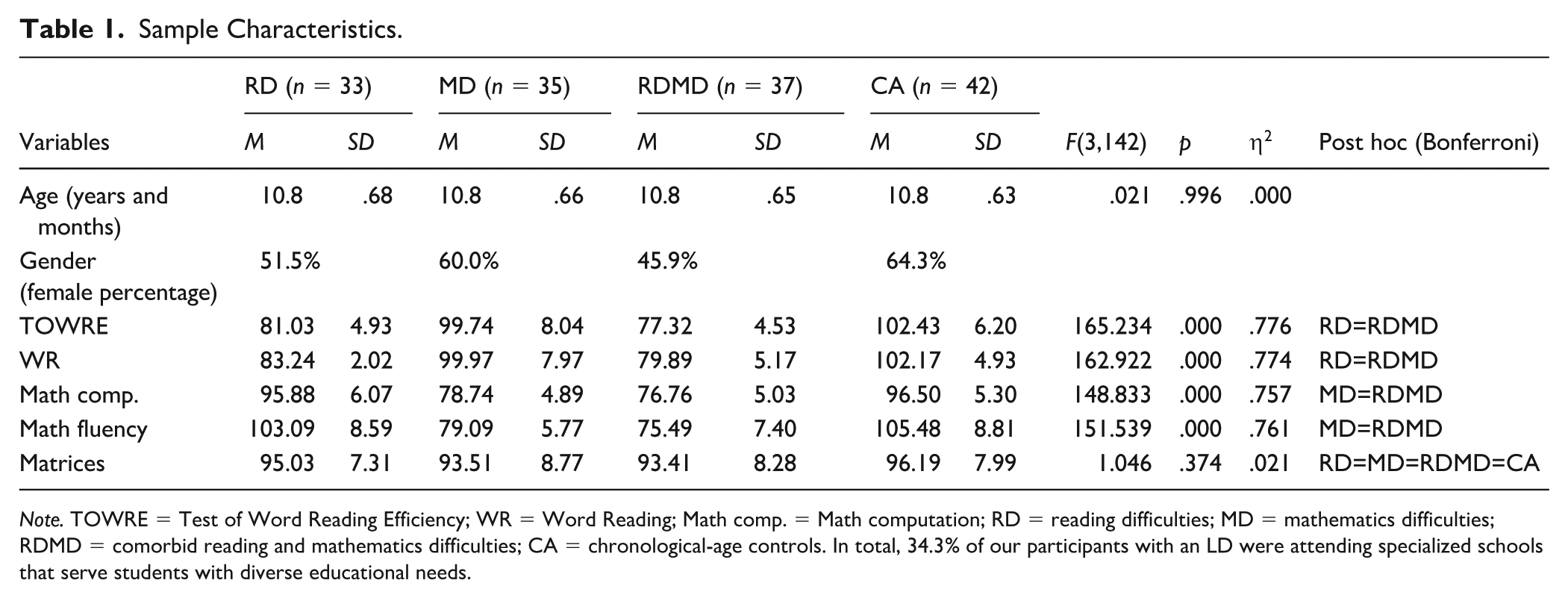
Note. TOWRE = Test of Word Reading Efficiency; WR = Word Reading; Math comp. = Math computation; RD = reading difficulties; MD = mathematics difficulties; RDMD = comorbid reading and mathematics difficulties; CA = chronological-age controls. In total, 34.3% of our participants with an LD were attending specialized schools that serve students with diverse educational needs.
A series of analyses of variance (ANOVAs) with group (CA, RD, MD, and RDMD) as a fixed factor showed that all groups were comparable in age, F(3, 142) = .021, p = .996, η2 = .000, and general cognitive ability, F(3, 142) = 1.046, p = .374, η2 = .021 (see Table 1). Gender distribution was also comparable across groups, χ2(3) = 3.179, p = .365. As expected, children with reading difficulties (RD, RDMD) performed worse on the reading tests compared to children without reading difficulties (MD, CA) (ps < .001). No significant differences were observed between the MD and CA groups, as well as between the RD and RDMD groups on the reading tests. In turn, children with mathematics difficulties (MD, RDMD) performed worse on the mathematics tests compared to children without mathematics difficulties (RD, control) (ps < .001). Also, no significant differences were observed between the RD and CA groups, as well as between the MD and RDMD groups, in the mathematics tests.
Materials
General Cognitive Ability
General cognitive ability was assessed with the Matrices task from the Cognitive Assessment System-2 (CAS-2) Brief (Naglieri et al., 2014). This nonverbal reasoning task requires children to analyze the relationship between shapes and their geometric arrangements, which were interconnected through spatial or logical organization, and identify the missing component, selecting the most appropriate choice from six options. The Matrices task measures fluid reasoning, a key component of general cognitive ability, and is commonly included in Intelligence Quotient (IQ) assessments, although it does not provide a full-scale IQ score. Naglieri et al. (2014) reported Cronbach’s alpha reliability for Matrices to be .88.
Attention
Attention was assessed with the Expressive Attention task from the CAS-2-Brief (Naglieri et al., 2014). Children were first asked to read a sequence of color words (i.e., Blue, Yellow, Green, and Red) arranged in a quasi-random order in eight rows of five. Next, children were asked to name the color of a series of blocks printed as the colors on the previous page. Finally, on the last page, color words were printed in a color different from the word’s name (e.g., the word green may appear in yellow ink), and children were asked to name the color of the ink in which the word was printed (e.g., blue appearing in red ink is read as “red”). The time and accuracy of the last task were recorded and combined to obtain a ratio score. The ratio score was then converted to a scaled score. This behavioral measure provides an objective way to assess attention (Naglieri et al., 2014). This kind of tasks often captures verbal inhibition, a component of attention closely linked to executive functioning (Eysenck & Derakshan, 2011). Naglieri et al. (2014) reported Cronbach’s alpha reliability for Expressive Attention to be .89.
Reading
Reading accuracy was assessed with the Word Reading task from the WRAT-5 (Wilkinson & Robertson, 2017) and reading fluency with the Sight Word Reading Efficiency (SWE) and Phonemic Decoding Efficiency (PDE) tasks from TOWRE-2 (Torgesen et al., 2012). In Word Reading, children were asked to read words arranged in terms of increasing difficulty. The task was discontinued after five consecutive errors, and the maximum score was 70. Wilkinson and Robertson (2017) reported split-half reliability for ages 10 and 11 to be .93 and .95, respectively. In WRE, children were asked to read as fast as possible a list of real words of increasing difficulty (max = 108). In PDE, children were asked to read as fast as possible a list of nonwords (max = 66). In both tasks, a participant’s score was the total number correct within 45 s. Following the instructions in the manual, the raw scores from WRE and PDE were converted to a scaled score and then summed together to obtain a composite score for reading fluency. Torgesen et al. (2012) reported alternate forms reliability to be .91 for WRE and .92 for PDE.
Mathematics
Mathematics accuracy was assessed with Math Computation task from the WRAT-5 (Wilkinson & Robertson, 2017) and mathematics fluency with Math Fluency task from the WIAT-3 (Wechsler, 2009). In Math Computation, children were asked to solve as many calculations as possible, and the maximum score was 55. Wilkinson and Robertson (2017) reported split-half reliability for ages 10 and 11 to be .95 and .91, respectively. In Math Fluency, children were asked to solve as many written addition (max = 48), subtraction (max = 48), and multiplication problems (max = 40) as possible within a 60-s time limit for each type of problem. In the three tasks, a participant’s score was the total number correct. Following the instructions in the manual, the raw scores from addition, subtraction, and multiplication were converted to a scaled score and then summed together to obtain a composite score for math fluency. Wechsler (2009) reported test-retest reliability to be .84 for addition, .89 for subtraction, and .90 for multiplication.
School Anxiety
School anxiety was assessed using the school phobia scale from the child version of the Screen for Child Anxiety Related Disorders (SCARED; Birmaher et al., 1999). It is a three-point Likert scale in which children are asked to rate (not true, somewhat true, or very true) four statements related to school anxiety-related symptoms (e.g., “I get headaches when I am at school,” “I get stomach aches at school,” “I worry about going to school,” “I am scared to go to school”). A higher score indicates more school anxiety. Although the subscale contains only four items, prior studies (e.g., Behrens et al., 2019; Birmaher et al., 1999) have demonstrated acceptable psychometric properties. Birmaher et al. (1999) reported Cronbach’s alpha reliability to be .90 and convergent validity with other anxiety scales such as the Child Behavior Checklist (Achenbach & Edelbrock, 1983). The brevity of this subscale makes it practical for school-based settings.
Reading Anxiety
Reading anxiety was measured using the Abbreviated Reading Anxiety Questionnaire (ARAQ; Katzir et al., 2018). It is an adaptation of the abbreviated Math Anxiety Scale (AMAS; Hopko et al., 2003), a well-established and validated measure for assessing anxiety related to academic subjects, and was developed for children from second to sixth grades. The ARAQ is a self-report survey using a five-point Likert scale (ranging from “not at all” to “always”) with nine items that measure how worried children feel during different reading situations (e.g., “Need to read a page with a lot of words, without drawings,” “think of language arts class,” “start to learn a new subject in language arts class”). A higher score indicates more reading anxiety. This self-reported measure was selected to ensure feasibility within a school setting, without overwhelming participants or requiring significant time commitments from teachers, and due to its acceptable psychometric properties. Katzir et al. (2018) reported Cronbach’s alpha reliability to be .83.
Mathematics Anxiety
Mathematics anxiety was assessed using the modified abbreviated math anxiety scale (m-AMAS; Carey et al., 2017). It is an adaptation of the AMAS (Hopko et al., 2003) for children. It is a self-report survey using a five-point Likert scale (low anxiety to high anxiety) with nine items that measure how children feel during situations related to mathematics (e.g., “Finding out that you are going to have a surprise math quiz when you start your math lesson,” “listening to the teacher talk for a long time in math,” “taking a maths test”). A higher score indicates more math anxiety. Similar to the school anxiety and reading anxiety scales, this self-report measure was chosen for its practicality in a school setting and for its acceptable psychometric properties. Carey et al. (2017) reported Cronbach’s alpha reliability to be .85 and provided evidence for the validity of m-AMAS through confirmatory factor analysis. Their findings indicated that the scale effectively measures mathematics anxiety in a manner consistent with the original AMAS.
Procedure
All the tests were administered individually by trained research assistants in a quiet room in two 20-min sessions. Ethics approval was granted by the institutional research ethics board (Pro00130649). Informed consent was obtained from parents, and approval was also received from the school principals. Finally, children provided their written assent prior to testing.
Power Analysis
Power analysis (one-way ANOVA, four groups, medium effect size, α = .05, power = .80) indicated that we needed a sample of 156 participants. Our final sample of 147 was slightly below this number, but the observed effects for reading (η² = .15) and mathematics anxiety (η² = .11) exceeded a medium effect, providing sufficient power (above .80) for our analyses.
Data Analysis
To compare our groups on the different types of anxiety, we performed ANOVA separately for each type of anxiety (see Table 2, for these results). Prior to conducting this analysis, we also assessed whether the assumptions of ANOVA were satisfied. Both the normality and homogeneity of variance assumptions were violated across all variables. Although ANOVAs are generally robust to such deviations (Blanca et al., 2017), we also conducted nonparametric Kruskal–Wallis tests to ensure the robustness of our results. The Kruskal–Wallis test does not assume normality or homogeneity of variance and is suitable for comparing group differences in ranked data when parametric assumptions are violated (Hecke, 2012). Using both methods allowed us to confirm that the observed group differences were not an artifact of assumption violations.
Group Comparisons on Each Anxiety Type.
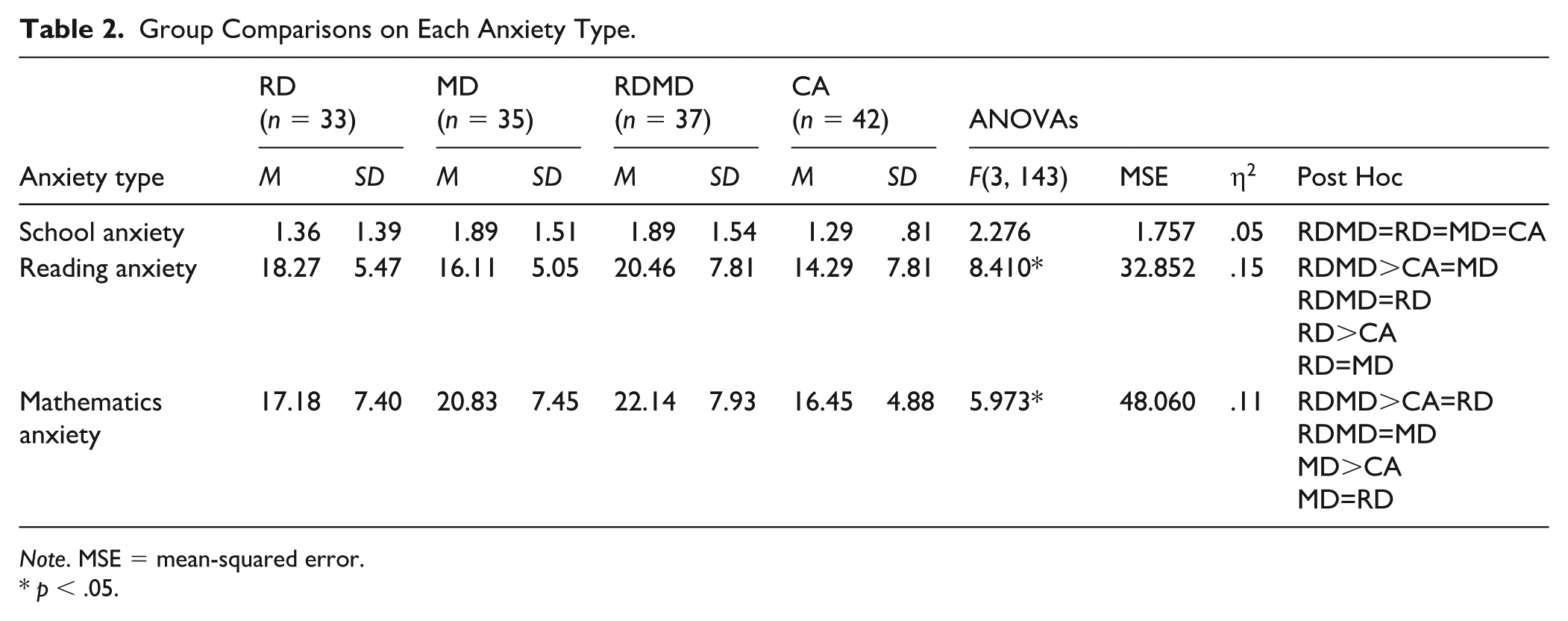
Note. MSE = mean-squared error.
p < .05.
When omnibus ANOVA effects were statistically significant, Bonferroni-corrected post hoc pairwise comparisons were conducted to identify specific group differences. Effect sizes (η²) were computed for all ANOVAs to estimate the proportion of variance explained by group membership, with values of 0.01, 0.06, and 0.14 interpreted as small, medium, and large effects, respectively (Cohen, 1988). Finally, to examine if attention was explaining any of the group differences in anxiety, we performed analyses of covariance (ANCOVA), covarying for attention.
Results
Group Differences in School, Reading, and Mathematics Anxiety
First, we compared the four groups in school anxiety. The results of ANOVA showed no significant effects of group, F(3, 143) = 2.276, p = .082, η2 = .05. The result of the Kruskal–Wallis test did not show a significant effect of group either (Kruskal–Wallis H = 5.133, p = .162). Next, we compared our groups in reading anxiety. The results of ANOVA showed a significant main effect of group, F(3, 143) = 8.410, p = .000, η2 = .15. The results of the Kruskal–Wallis test also revealed a significant effect of group (Kruskal–Wallis H = 20.366, p = .000). Post hoc comparisons revealed that the RDMD group obtained a significantly higher score than the CA group (p = .000) and the MD group (p = .010). The RD group also obtained a significantly higher score than the CA group (p = .020). There were no significant differences between the RDMD and RD groups as well as between the RD and MD groups. Finally, we compared our groups in mathematics anxiety. The results of ANOVA yielded a significant main effect of group, F(3, 143) = 5.973, p = .001, η2 = .11. The Kruskal–Wallis test was also significant (Kruskal–Wallis H = 16.940, p = .001). Post hoc comparisons showed that the RDMD group obtained a significantly higher score than the CA group (p = .002) and the RD group (p = .020). The MD group also obtained a significantly higher score than the CA group (p = .039). There were no significant differences between the RDMD and MD groups as well as between the MD and RD groups.
Group Differences After Controlling for Attention
The results of ANCOVA (using attention as a covariate) showed that the group differences remained significant for both reading anxiety (F(3, 142) = 7.189, p = .000, η2 p = .13) and mathematics anxiety (F(3, 142) = 5.375, p = .002, η2 p = .10). Post hoc comparisons showed that the RDMD group scored higher in reading anxiety than the CA (p < .001) and MD (p = .002) groups and higher in mathematics anxiety than the CA (p = .001) and RD (p = .003) groups. There were no significant differences between the RDMD and RD groups for reading anxiety (p = .12), as well as between the RDMD and MD groups for mathematics anxiety (p = .41). The RD group obtained a significantly higher score than the CA group (p = .004) on reading anxiety. There were no significant differences between the RD and MD groups in reading anxiety. However, results were slightly different for mathematics anxiety, as the MD group obtained a significantly higher score not only when compared with the CA group (p = .007) but also with the RD group (p = .030).
To summarize, compared to the CA group, the RDMD group exhibited higher scores in reading anxiety and mathematics anxiety. The RDMD group also exhibited higher scores in reading anxiety when compared to the MD group and in mathematics anxiety when compared to the RD group. There were no differences in reading anxiety between the RDMD and RD groups, and no differences in mathematics anxiety between the RDMD and MD groups. The RD and MD groups did not differ on reading and mathematics anxieties. After controlling for attention, the group differences remained significant, and the MD group obtained a significantly higher score on mathematics anxiety than the RD group.
Discussion
This study aimed to examine whether children with comorbid difficulties (RDMD) experience more school anxiety, reading anxiety, and mathematics anxiety than children with a single difficulty or no difficulties. Our hypothesis that children with RDMD would experience significantly more anxiety than the CA group across all three types of anxiety (school, reading, and mathematics) was only partially supported. Specifically, children with RDMD reported higher levels of reading and mathematics anxiety compared to the CA group, but no significant differences were found for school anxiety. Our results revealed group differences in reading anxiety and mathematics anxiety with a moderate to large effect size (η2 = .15 and η2 = .11, respectively; Cohen, 1988). Previous studies on the association of RD and/or MD with general anxiety have typically reported moderate effect sizes (e.g., d = 0.61 in Nelson & Harwood’s, 2011, meta-analysis). By comparison, our results indicate a stronger association when domain-specific anxieties are assessed. Moreover, the lack of group differences in school anxiety, which represents a more general construct, further supports the idea that the link between LD and anxiety is stronger for domain-specific forms of anxiety than for broader measures of anxiety.
In addition, our group differences remained significant after controlling for attention, which is in line with what we expected. Most of the studies comparing children with and without LD on anxiety did not find significant group differences when they controlled for inattention or ADHD (e.g., Aro et al., 2024; Carroll et al., 2005). However, these studies were on generalized anxiety, and our results indicate that anxiety in a specific domain (e.g., reading or mathematics) is related to performance within that domain. This finding supports previous research showing that reading and mathematics anxieties are distinct forms of anxiety that are closely tied to performance in their respective areas (Ashcraft & Moore, 2009; Daker et al., 2022; Sasanguie et al., 2024). Students with comorbid difficulties likely have more negative experiences and challenges in both domains, which could lead to heightened anxiety that is less influenced by general attentional factors and more by specific past experiences of difficulty or failure (Ashcraft & Krause, 2007).
Further analysis showed that the RDMD group significantly differed from individuals without LD and with MD on reading anxiety, as well as the RDMD group significantly differed from individuals without LD and with RD on mathematics anxiety. In addition, the RDMD group did not significantly differ from the RD group on reading anxiety and from the MD group on mathematics anxiety. This pattern of results is different from Willcutt et al. (2013), and the difference may be explained by the fact that, contrary to Willcutt et al., our RDMD group did not have worse reading skills than the RD group or worse math skills than the MD group. Our findings suggest that RDMD reflects the combined challenges of single-domain difficulties in reading and mathematics. This combination may heighten anxiety, as students can feel overwhelmed by the demands of performing across multiple subjects (Beilock & Maloney, 2015), aligning with the multiple-deficit framework (e.g., McGrath et al., 2020; Pennington, 2006). The single-domain LD group only differed from the CA group and not from the other single-domain LD group in their domain-specific anxiety. For example, the RD group was not significantly different from the MD group on reading anxiety, and the same happened to mathematics anxiety. Therefore, individuals with MD might also experience reading anxiety, a connection that aligns with research highlighting reading as a critical predictor of mathematics achievement (Grimm, 2008; Larwin, 2010). When solving a math problem, a child has to understand the problem by reading it and using their math knowledge accordingly, involving working memory capacities (Ramirez et al., 2013).
After controlling for attention, the MD group obtained a significantly higher score on mathematics anxiety than the RD group. This suggests that attention may have initially masked the true difference in math anxiety between these groups. Once the influence of attention was removed, the unique relationship between MD and heightened math anxiety became more apparent. This finding implies that, independent of attention, students with MD may experience higher levels of anxiety in mathematics, potentially due to persistent challenges involving working memory capacities (Ramirez et al., 2013). For example, working memory limitations may make it difficult for students to simultaneously hold and manipulate multiple pieces of information, creating a cognitive overload that can then lead to increased anxiety when faced with mathematics tasks that demand sustained mental effort and integration of information. It is important to note, however, that our measure of attention primarily tapped into verbal inhibition. Due to time constraints, we were unable to include measures of other attentional processes, such as orienting or alerting responses. This limitation should be considered when interpreting the findings, as different components of attention may play distinct roles in the relationship between LD and anxiety.
Implications for Practice
This study has important implications for early intervention. Students should learn at an early age how to cope with specific-domain anxieties since mathematics anxiety can escalate over time, contributing to heightened anxiety, aversion, and avoidance of mathematics (Wigfield & Meece, 1988). Meta-analyses on elementary students (Fishstrom et al., 2022) and secondary students (Fishstrom et al., 2025) exploring the impact of academic interventions on both academic performance and academic anxiety have suggested that academic anxiety requires targeted and direct intervention. Fishstrom et al. (2022) reported that academic interventions for elementary students produced moderately large, statistically significant improvements in academic performance but had no significant impact on reducing academic anxiety. Fishstrom et al. (2025) found similar results with secondary students: the interventions were effective in enhancing academic achievement but had minimal effect on reducing academic anxiety. Thus, appropriate interventions for children experiencing both LD and academic anxiety might need to combine both academic (e.g., reading or mathematics instruction) and emotional (e.g., anxiety management strategies) domains to reduce anxiety and to improve academic performance.
Our study contributes to the design of interventions by showing that children with comorbid RDMD experience domain-specific anxieties (reading and mathematics), independent of attentional issues. Therefore, these children may benefit most from a combination of targeted reading and mathematics instruction alongside domain-specific anxiety interventions. Due to the fact that individuals with MD might also experience reading anxiety, early reading interventions are important to prevent reading anxiety problems and MD. Targeted reading interventions can also have positive effects on attention over time (Roberts et al., 2015). It is important to note that these implications are exploratory, as the study did not collect direct data on instructional practices. Future research should investigate how specific pedagogical strategies interact with anxiety, attention, and learning outcomes in students with RDMD.
Our results suggest that students with MD may experience higher levels of anxiety in mathematics that are not solely attributable to attentional difficulties. Research shows that this might be due to persistent challenges involving executive functions (Ramirez et al., 2013). Therefore, it is important to incorporate executive functioning assessments when evaluating mathematics anxiety in students with MD. Children with MD might benefit from interventions targeting both executive functioning and self-regulation skills to help manage cognitive demands, such as the Tools of the Mind Program for preschoolers (Diamond et al., 2007). In addition, teachers could also incorporate working memory and attention-supportive strategies and foster self-regulation skills in students with LD, such as scaffolding instruction by breaking tasks into smaller steps (Larkin, 2001; Pfannenstiel et al., 2015), using visual supports (Carlson et al., 2003), and teaching metacognitive strategies such as guided self-talk (Feeney, 2021). When combined with cognitive strategies, metacognitive strategies have been proven to enhance the comprehension and problem-solving skills of students with mathematics LD (Pfannenstiel et al., 2015).
Limitations
Some limitations of the present study are worth noting. First, the sample size was relatively small, which may have limited the statistical power to detect more subtle group differences and may have also affected the generalizability of our findings. Second, only 41 of the participating children had a formal LD diagnosis, and information on the percentage of students receiving special education services for LD or anxiety issues was not available, which may have influenced levels of academic anxiety. Third, while self-report measures were selected to ensure feasibility within a school setting and to minimize burden on students and teachers, they have some limitations, such as social desirability bias, in which participants may respond in ways they think are socially acceptable. Future studies could include multiple informants to have a more comprehensive understanding of students’ anxiety problems. Fourth, the school anxiety measure consisted of only four items, which may have contributed to the lack of observed differences between groups. In contrast, the reading and math anxiety scales each contained nine items. Measures with fewer items might not capture the construct as comprehensively as those with more items. Future research could employ a more robust school anxiety instrument to address this limitation. This instrument could also distinguish between academic and social concerns, given that academic anxieties such as reading and math anxiety are performance-based and closely tied to social aspects of anxiety (Hopko et al., 2001). Fifth, we did not assess test anxiety even though previous studies have shown that this type of anxiety is also related to LD (e.g., Nelson et al., 2015; Peleg, 2009). Children were already asked to complete three scales on anxiety, and we did not want to overwhelm them. Our reading and math anxiety measures had specific-domain test items, but future studies should look into this variable to check whether children with LD experience test anxiety independent of the subject (i.e., reading or math). Sixth, our study focused exclusively on children in Grades 5 and 6, so the findings may not generalize to other grade levels. Children at different developmental stages may experience and express domain-specific anxieties differently. Finally, although we controlled for attention, our measure of attention was tapping into verbal inhibition. Unfortunately, due to time restrictions, we could not measure children’s performance on orienting or alerting response.
Conclusion
To conclude, our findings contribute to the limited research on the link between comorbid RDMD and anxiety (Aro et al., 2022; Martínez & Semrud-Clikeman, 2004; White et al., 1992; Willcutt et al., 2013) by demonstrating that children with RDMD exhibit higher levels of reading and mathematics anxiety compared to their peers without LD. The RDMD group also exhibited higher scores in reading anxiety when compared to the MD group and in mathematics anxiety when compared to the RD group. These findings suggest that children with comorbid RDMD may be at greater risk for both reading and mathematics anxiety regardless of attentional issues, which highlights the need for domain-specific assessments and interventions.
Footnotes

Funding
The authors disclosed receipt of the following financial support for the research, authorship, and/or publication of this article: Our work was funded by a grant from the Alberta Advisory Committee for Educational Studies (AACES).
Declaration of Conflicting Interests
The authors declared no potential conflicts of interest with respect to the research, authorship, and/or publication of this article.