




Abstract
A palynological study on subsurface Early Cretaceous sediments (1550–1860 m) in well JM-A located in Dhansiri Valley, Upper Assam Shelf has been carried out for determination of age and depositional environment. The palynological investigations resulted into the identification of the characteristic and diversified occurrence of Early Cretaceous dinoflagellate cysts comprising Batioladinium micropodum, Achomosphaera? neptuni, Batiacasphaera asperata, Lagenorhytis sp. cf. L. delicatula, Mendicodinium caperatum and Canningia sp. along with associated dinoflagellate cysts. The significant assemblage of spore-pollen assemblage represented by Cicatricosisporites australiensis, Ceratosporites equalis, Gleicheniidites circinidites, Contignisporites cooksonii, Microcachryidites antarcticus, Podosporites tripakshii and Callialasporites trilobatus has also been recorded. The Early Cretaceous sediments are regarded as Bamangaon Formation in Dhansiri Valley. The occurrence of dinoflagellate cysts suggests marginal marine environment for Bamangaon Formation deposited during the Early Cretaceous period corresponding to the Rift Phase. The Formation overlies the Metamorphic Basement Complex, and it is unconformably overlain by the sediments of Tura Formation of Ypresian (Early Eocene) age, deposited under subtidal to inner shelf environment during the Passive Margin Tectonic Phase.
Introduction
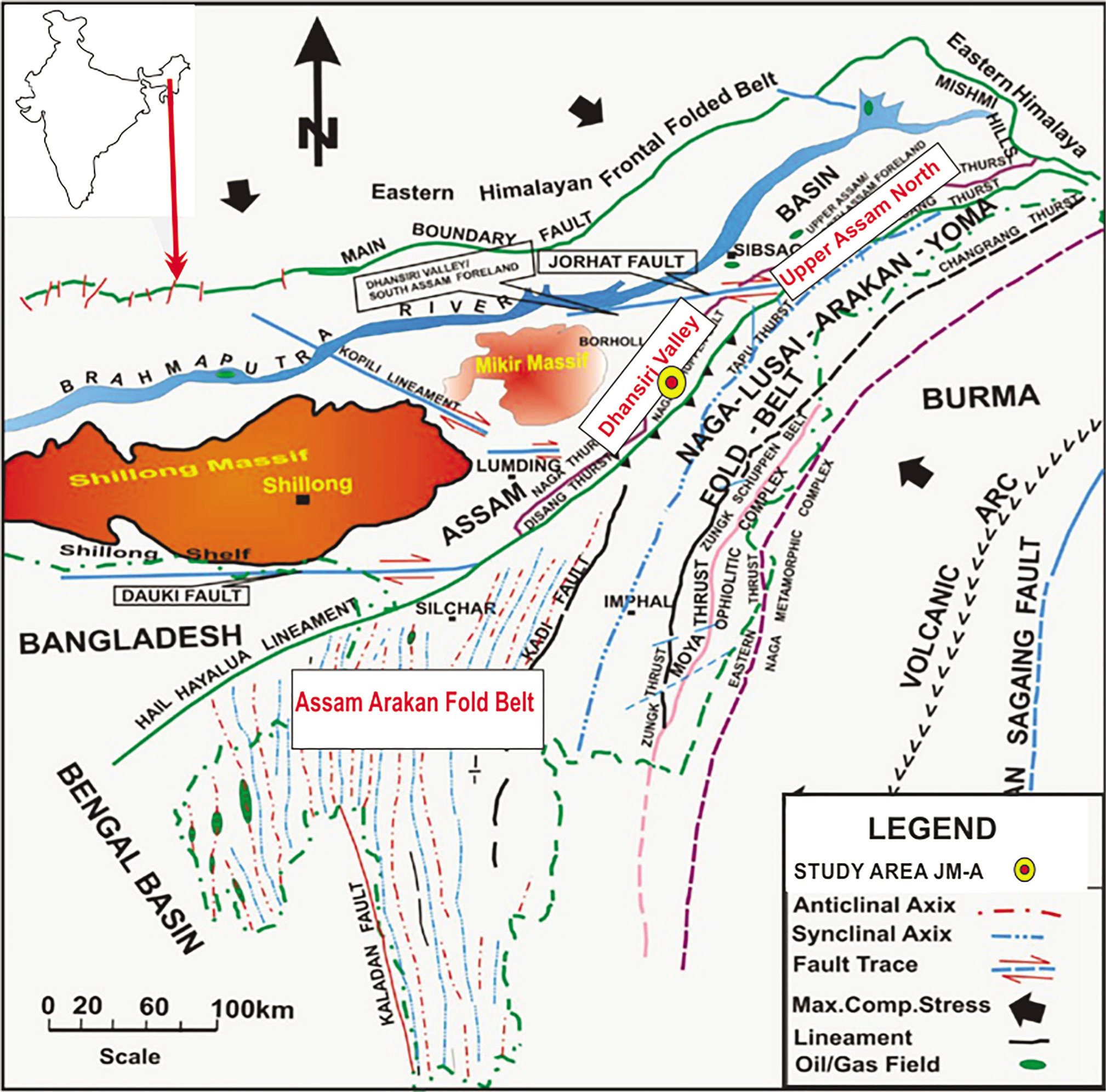
Assam and Assam-Arakan Basin is situated in the north-eastern part of India, covering an area more than 0.1 million sq km extending over Assam, Meghalaya, Nagaland, Mizoram, Manipur, Tripura and a part of Arunachal Pradesh. The basin has various tectonic phases and the major tectonic elements of the basin are the Upper Assam Shelf, Naga Schuppen Belt, Assam-Arakan Fold Belt, etc. NE-SW trending Upper Assam Shelf is further subdivided into Upper Assam North and Upper Assam South. Upper Assam South Block is also known as Dhansiri Valley. The northern limit of Dhansiri Valley is a major E-W wrenching Jorhat fault and the southern limit is the Dauki fault. Towards east and southeast flanked by Naga Thrust and in the west by Mikir Hills and Shillong Plateau (Deshpande et al., 1993; Figure 1). Well JM-A was drilled down to 1865 m touching the Metamorphic Basement Complex at 1860 m, located in Dhansiri Valley, Upper Assam Shelf, Assam and Assam-Arakan Basin (Figure 1). While carrying out palynological studies of subsurface sediments between depth interval of 1550 m and 1860 m in well JM-A, recorded well-preserved, diversified Early Cretaceous dinoflagellate cysts and spore-pollen assemblage corresponding to Bamangaon Formation. The Early Cretaceous sediments are regarded as Bamangaon Formation by Khanna and Srinivasachari (1973). The Early Cretaceous sediments are unconformably overlain by Early Eocene sediments of Tura Formation.
Tectonic map of Assam & Assam Arakan Basin showing the location of JM-A, the studied well in Dhansiri Valley, Upper Assam Shelf.
Materials and Methods
In total, 17 cutting samples at 25m depth interval were collected from well JM-A and the samples were processed by adopting the standard processing techniques employed in the Regional Geoscience Laboratories and Kesava Deva Malaviya Institute of Petroleum Exploration, Oil and Natural Gas Corporation Ltd, Dehradun (Mathur et al., 1991). The samples were investigated for spore-pollen and dinoflagellate cysts under biological microscopes LEICA DM5000B equipped with a digital camera attachment LEICA DFC450. Taxonomic identification of dinoflagellate cyst species is followed after Stover and Evitt (1978), Wilson and Clowes (1980), Williams and Bujak (1985) and Williams et al. (1993). The stratigraphic ranges of key dinoflagellate cysts have been determined by LAD (Last Appearance Datum) and FAD (First Appearance Datum) and followed the works of Wilson and Clowes (1980), Williams and Bujak (1985), Williams et al. (1993), Prasad et al. (1985) and Helby et al. (1987). The works of Jansonius and Hills (1976), Singh (1971) and Thanikaimoni et al. (1984) are used for identification of spore-pollen. Works of Mehrotra et al. (2002), Mehrotra et al. (2005) and Mehrotra and Kapoor (2022) are refered for for interpreting Palynology in Hydrocarbon Exploration of the Indian scenario. Dinoflagellate cysts and spore-pollen assemblages have been considered for interpretation of depositional environment.
Discussion on Early Cretaceous (Bamangaon Formation) Successions in Dhansiri Valley
Diagnostic palynofossils
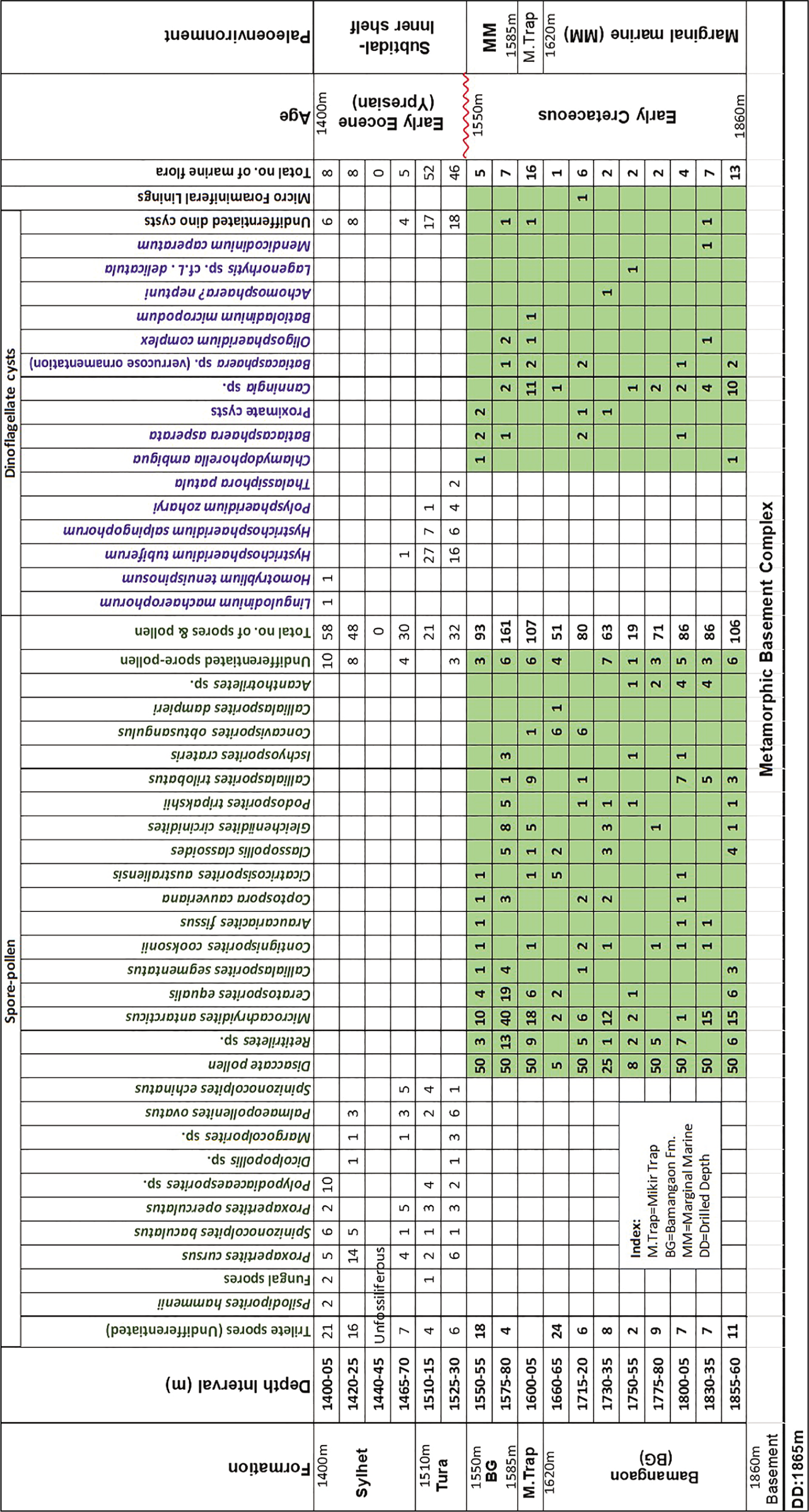
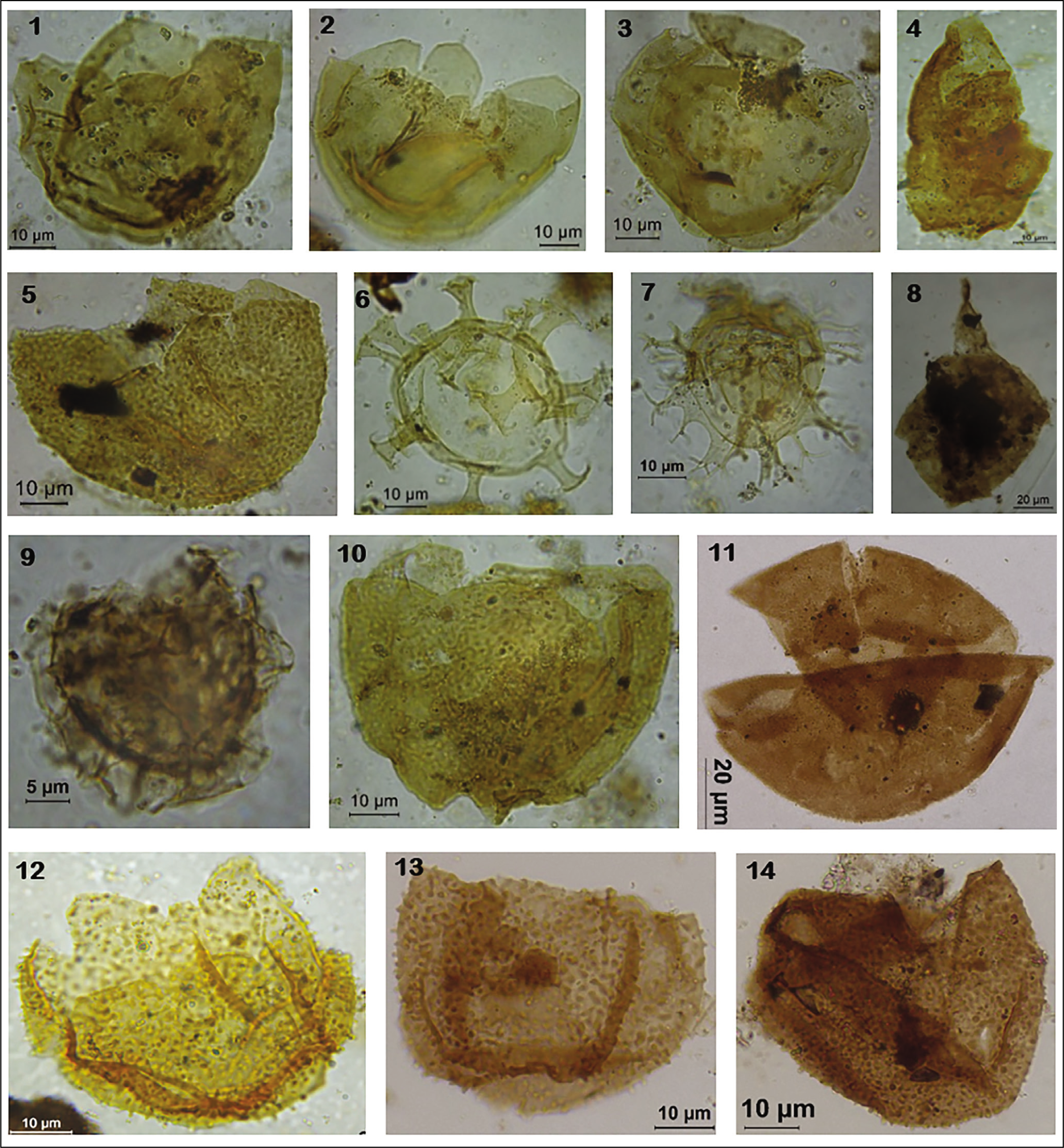
Palynological studies have been carried out on subsurface sediments in the depth interval between 1550 m and 1860 m of well JM-A. These sediments have yielded a significant occurrence of dinoflagellate cysts represented by Batioladinium micropodum, A. neptuni, Batiacasphaera asperata, Lagenorhytis sp. cf. L. delicatula, Mendicodinium caperatum and Canningia sp. Chlamydophorella ambigua and Oligosphaeridium complex. The spore-pollen assemblage is characterised by the occurrence of Cicatricosisporites australiensis, Ceratosporites equalis, Gleicheniidites circinidites, Contignisporites cooksonii, Microcachryidites antarcticus, Podosporites tripakshii, Callialasporites trilobatus, Callialasporites segmentatus, Callialasporites dampieri, Retitriletes sp., Araucariacites fissus, Coptospora cauveriana, Classopollis classoides, Ischyosporites crateris, Concavisporites obtusangulus, along with a significant representation of disaccate pollen. Distribution and frequency of spore-pollen and dinoflagellate cysts, interpreted age and paleoenvironment of Early Cretaceous sediments recognised in wells JM-A are shown in Figure 2. Photomicrographs of characteristic Early Cretaceous dinoflagellate cysts and spore-pollen assemblage recorded in Bamangaon Formation are illustrated in Plates 1 and 2 respectively.
Distribution & frequency of spore-pollen, dinoflagellate cysts, interpreted age and paleoenvironment in Early Cretaceous sediments of well JM-A in Dhansiri Valley, Upper Assam Shelf.
Figs. 1–14. Photomicrographs of Early Cretaceous dinoflagellate cysts recorded from well JM-A of Bamangaon Formation; 1–3. Batiacasphaera asperata Backhouse 1987. 1550–1555 m, 1575–1580 m and 1715–1720 m; 4. Batioladinium micropodum (Eisenack & Cookson 1960) Brideaux 1975. 1600–1605 m; 5. Batiacasphaera sp. (verrucose ornamentation) Drugg 1970b. 1715–1720 m; 6. Oligosphaeridium complex (White 1842) Davey & Williams in Davey et al., 1966. 1575–1580 m; 7. Achomosphaera neptuni (Eisenack 1958) Davey & Williams in Davey et al., 1966. 1730–1735 m; 8. Lagenorhytis sp. cf. L. delicatula (Duxbury 1977) Duxbury 1979b. 1750–1755 m; 9. Chlamydophorella ambigua (Deflandre 1937) Stover & Helby, 1987b. 1855–1860 m; 10. Proximate cyst 1550–1555 m; 11. Mendicodinium caperatum Brideaux 1977. 1830–1835 m; 12–14. Canningia sp. Cookson & Eisenack 1960b. 1600–1605 m, 1830–1835 m and 1775–1780 m.
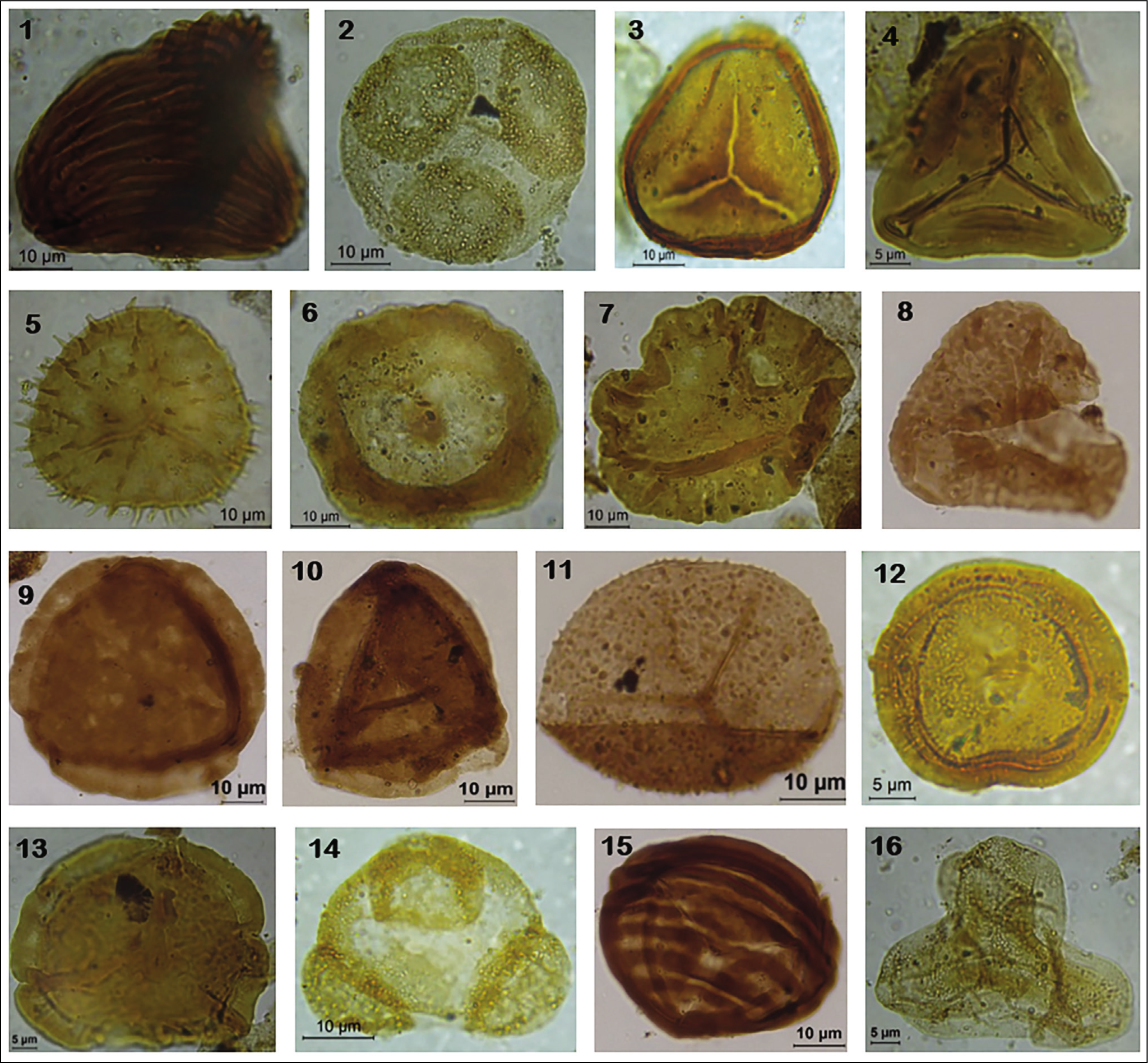
Figs. 1–16. Photomicrographs of Early Cretaceous spore-pollen assemblage recorded from well JM-A of Bamangaon Formation; 1. Cicatricosisporites australiensis (Cookson) Potonie 1956. 1550–1555m; 2. Podosporites tripakshii Rao emend. Kumar 1984. 1575–1580 m; 3. Stereisporites antiquasporites (Wilson & Webster) Dettmann 1963. 1600–1605 m; 4. Gleicheniidites circinidites (Cookson) Dettmann 1963 (1575–1580 m); 5. Ceratosporites equalis Cookson & Dettmann 1958. 1550–1555 m; 6. Coptospora Jain & Subbaraman 1969. 1575–1580 m; 7. Callialasporites segmentatus Dev 1961. 1575–1580 m; 8. Ischyosporites crateris Balme 1957. 1800–1805 m; 9. Callialasporites trilobatus Dev 1961. 1830–1835 m; 10. Araucariacites fissus Reiser & Williams 1969. 1830–1835 m; 11. Acanthotriletes sp. Naumova 1939. 1775–1780 m; 12. Classopollis classoides. Fensome, 1983. 1600–1605 m; 13. Callialasporites dampieri (Balme 1957) Dev 1961. 1660–1665 m; 14. Microcachryidites antarcticus Cookson 1947. 1600–1605 m; 15. Contignisporites cooksonii (Balme) Dettmann 1963. 1775–1780 m; 16. Concavisporites obtusangulus Potonie 1934. 1660–1665 m.
Interpretation of age
The occurrence of characteristic dinoflagellate cysts, B. micropodum, A. neptuni, B. asperata, Lagenorhytis sp. cf. L. delicatula, M. caperatum (whose LADs are within Early Cretaceous) and FADs of Chlamydophorella ambigua and Oligosphaeridium complex along with diagnostic spore-pollen assemblage recorded in the depth interval 1550–1860 m of well JM-A suggest Early Cretaceous age.
Mikir Trap
Mikir Trap is recognised within the Bamangaon Formation in the depth interval between 1585 m and 1620 m and dated as Early Cretaceous. This Trap is age equivalent of the Rajmahal Trap, developed in Mahanadi and Bengal Basins of India (Lal et al., 2009).
Unconformity between Early Cretaceous and Early Eocene sediments
Early Cretaceous palynofossils have been recorded in the depth interval between 1550 m and 1860 m of well JM-A and the overlying samples (1530–1400m) have yielded characteristic Early Eocene (Ypresian) dinoflagellate cysts comprising of Hystrichosphaeridium tubiferum, Hystrichosphaeridium salpingophorum, Thalassiphora patula (whose LADs are within Early Eocene) along with diagnostic spore-pollen assemblage represented by the occurrence of Psilodiporites hammenii, Palmaeopollenites ovatus, Retistephanocolpites sp., Pellicieroipollis langenheimii, Proxapertites cursus, Spinizonocolpites echinatus and Palmidites sp. Occurrence of Early Cretaceous palynofossils (1550–1860m) along with the record of Early Eocene (Ypresian) palynofossils in the overlying samples (1530–1400m) suggest an unconformity with a span of about ~44 Ma between Bamangaon (Early Cretaceous) and Tura formations (Ypresian) in well JM-A of Dhansiri Valley, Upper Assam Shelf (Figure 2). An unconformity of ~44 Ma has been identified between the sediments of Tura Formation (Early Eocene) and Bamangaon Formation (Early Cretaceous) in the nearby wells of JM-A in Dhansiri valley of Upper Assam Shelf by Narsimha et al. (2023).
Depositional environment
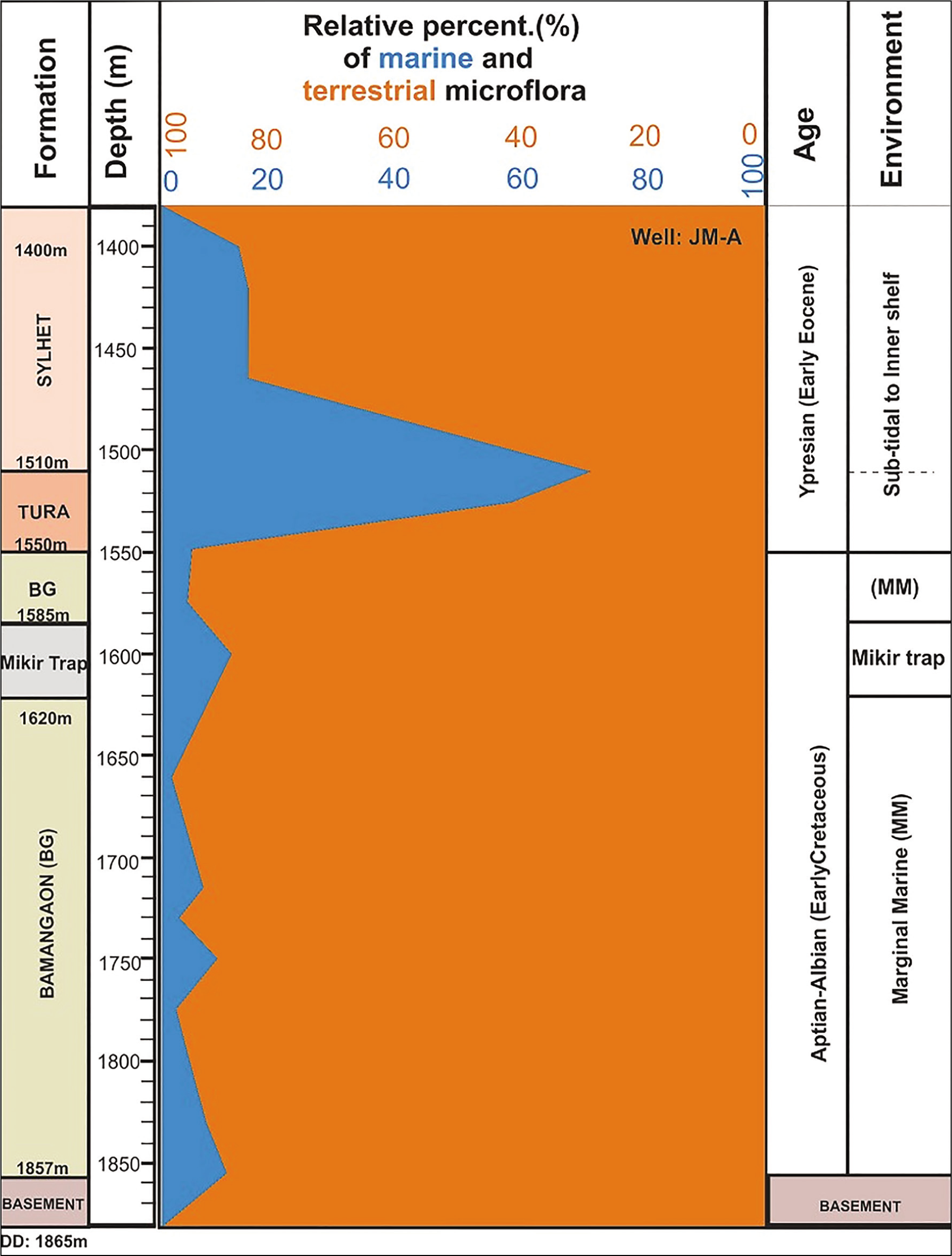
The sediments of Early Cretaceous (Bamangaon Formation) in Dhansiri Valley including the corresponding section in well JM-A were interpreted to be deposited under non-marine conditions in recent studies carried out by Basavaraju and Pundeer (2007). The present palynological analysis carried out on sediments of Bamangaon Formation in well JM-A of Dhansiri valley has yielded a significant occurrence of Early Cretaceous dinoflagellate cysts. Semi-quantitative analysis of marine (dinoflagellate cysts) and terrestrial (spore-pollen) palynoflora suggesting marginal marine environment during deposition of Early Cretaceous and the sedimentary succession unconformably overlain by Early Eocene (Ypresian) of Tura and early part of Sylhet formations in well JM-A indicating subtidal to inner shelf environment. The frequencies of marine flora are increased relatively during the deposition of Ypresian sediments, which resulted into widespread transgression in the basin (Figure 3). The study also suggests that the sediments of Early Cretaceous were deposited under the Continental Rift Phase, whereas the Early Eocene sediments have been deposited during Passive Margin Tectonic Phase.
Schematic diagram showing semi-quantitative analysis of marine and terrestrial palynoflora depicting the paleo-environment of Early Cretaceous and Early Eocene (Ypresian) sediments in well JM-A of Dhansiri Valley, Upper Assam Shelf.
Conclusions
The palynological investigation of subsurface sediments (1550–1860 m) of well JM-A resulted into the record of characteristic Early Cretaceous Dinoflagellate Cysts and diagnostic spore-pollen assemblage. These sediments are corresponding to Bamangaon Formation deposited under marginal marine environment during the Continental Rift Phase.
The sediments of Bamangaon Formation are unconformably overlain by Early Eocene (Ypresian) sediments of Tura Formation deposited under subtidal to inner shelf environment during Passive Margin Tectonic Phase with widespread transgression in the Basin.
Mikir Trap is recognised within the Bamangaon Formation and dated as Early Cretaceous. This Trap is age equivalent of the Rajmahal Trap, developed in Mahanadi and Bengal Basins of India.
Footnotes
Acknowledgements
The authors wish to express their sincere gratitude to Smt Sushma Rawat, Director (Exploration), ONGC, New Delhi, for granting permission to publish this work. The authors are thankful to Shri Gour Mohan Das, Executive Director—Chief Labs, Mumbai for motivation and constant support. The authors are grateful to Shri Vishal Shastri, Executive Director-Basin Manager, Assam and Assam Arakan Basin, Jorhat for assigning the project, motivation and support. The authors are grateful to Sri K. Karvannan, Chief General Manager-Basin Manager, Krishna Godavari-Pranhita Godavari Basin, Rajahmundry for constant support and guidance. The authors are obliged to Dr Rajani Panchang, UGC FRP Assistant Professor, Department of Environmental Science, Convener 28th ICMS-2022, SPPU, Pune and Guest Editor, Special Issue JPSI for consideration of the paper for publication in Special Issue, JPSI. The authors are thankful to Dr R.K. Saxena, Ex CGM, ONGC and another anonymous reviewer, for reviewing the paper and improving the manuscript with their valuable suggestions.
Declaration of Conflicting Interests
The authors declared no potential conflicts of interest with respect to the research, authorship and/or publication of this article.
Funding
The authors received no financial support for the research, authorship and/or publication of this article.