




Abstract
We here report a new freshwater ostracod assemblage comprising 11 species (Frambocythere tumiensis anjarensis, Gomphocythere paucisulcatus, G. strangulata, Limnocythere deccanensis, Zonocypris spirula, Eucypris intervolcanus, Cypria cyrtonidion, Stenocypris cylindrical, Cypridopsis hyperectyphos, Candona amosi, Eucypris sp.) from a newly discovered intertrappean locality at Kesavi, Dhar District, Madhya Pradesh. This locality lies in the lower Narmada Valley of Malwa sub-province, a poorly studied region of the Deccan Traps volcanic province of peninsular India compared to the other volcanic sub-provinces. The ostracod assemblage from Kesavi is similar to those known from different parts of the Deccan volcanic province and lacks any brackish or marine elements. The endobenthic crawler Frambocythere tumiensis dominates the assemblage, indicating a lacustrine freshwater depositional environment.
Keywords
Introduction
The Deccan Traps of India, one of the largest continental basaltic provinces in the world, presently covers approximately half a million km2 of peninsular India, extending across the states of Madhya Pradesh, Maharashtra, Karnataka, Gujarat, Andhra Pradesh and parts of Rajasthan and Uttar Pradesh. The volcanic province is divided into four sub-provinces (e.g., Kale et al., 2020; Verma & Khosla, 2019; Verma et al., 2016): main Deccan-province, Saurashtra sub-province, Malwa sub-province and Mandla sub-province. The Malwa sub-province is considered the region of the oldest lava flow (Kale et al., 2020). The sedimentary deposits found in between the Deccan lava flows (the ‘intertrappean beds’) in the main part of the volcanic province are known to yield fossil remains of fishes, amphibians, lizards, snakes, turtles, dinosaurs and mammals (rare), together with associated ostracods, gastropods and plant fossils, including charophytes (reviewed in Khosla & Verma, 2015 and reference therein). In one instance, planktic foraminifers and brackish water ostracods have been reported from an intertrappean locality in central India in the main part of the Deccan province (Keller et al., 2009b; Sharma & Khosla, 2009). Literature survey reveals that while a diverse faunal assemblage has been reported from the intertrappean beds exposed along the western and eastern edges of the Deccan Traps (Kapur & Khosla, 2019 and references therein), the west–central portion of the Deccan Traps (especially the Malwa sub-province) has received little attention, except for a few recent records, including those of fossil lizards (Yadav et al., 2022) and fishes associated with ostracods, gastropods and charophytes (Kapur et al., 2019; Kshetrimayum et al., 2021).
The present study describes a diverse ostracod assemblage from a recently reported fossiliferous intertrappean locality at Kesavi (Yadav et al., 2022), situated in the lower Narmada valley region of the Malwa sub-province. The study focuses exclusively on ostracods, represented by a rich assemblage of 11 species, dominated by Frambocythere tumiensis anjarensis. The locality has also yielded various other fossil groups, including the recently described lizards (Yadav et al., 2022). The remaining micro-vertebrate fauna is currently under study and will be described separately. Associated invertebrates from this locality include molluscs (Lymnaea, Platyphysa, Paludina and Valvata) and charophytes (Microchara and Platychara).
Previous Work
The Deccan intertrappean ostracod fauna has been more extensively investigated than other fossil groups from these deposits. The earliest work on ostracod is by Sowerby (Malcolmson, 1840) from Sichel Hills, Andhra Pradesh. Subsequently, Carter (1852) and Jones (1860) reported a few new ostracod species from Bombay and Nagpur localities. This early phase was followed by a gap of about 125 years. Bhatia and co-workers (Bhatia & Rana, 1984; Bhatia et al., 1990b, 1996), based on ostracods from various localities, argued in favour of their Laurasian connections. Ostracods have also been documented in Rajasthan and Bombay (Mathur & Verma, 1988). Bhandari and Colin (1999) reported new species with good diversity from the Anjar intertrappean bed. More recently, a series of papers on ostracods was published from Kutch, Gujarat; Gulbarga, Karnataka; Chhindwara, Madhya Pradesh and Kota, Rajasthan, (Bajpai & Whatley, 2001; Bajpai et al. 2004; Whatley & Bajpai, 2000a, 2000b; Whatley et al. 2002a, 2002b, 2002c, 2003a, 2003b, 2003c; Whatley et al., 2012) with a large number of new taxa. Whatley and co-workers refuted previous assertions of the palaeobiogeographic affinities of Deccan intertrappean ostracods with Chinese and Mongolian taxa (Bhatia et al., 1990a, 1996). Whatley and co-workers argued in favour of extensive endemism among Indian intertrappean ostracods. Afterwards, Khosla and Nagori (2005, 2007) and Khosla et al. (2007) reported many ostracod species in the Anjar, Mohgaon-Haveli and Takli Intertrappean beds. Sharma et al. (2008) reported ostracod from the northernmost intertrappean site of Lalitpur, Uttar Pradesh. Another important assemblage of brackish to freshwater ostracods was reported from the Jhilmili intertrappeans of District Chhindwara, Madhya Pradesh (Khosla, 2015; Sharma & Khosla, 2009). More recently, freshwater ostracods have also been reported from the lower Narmada basin around the Manawar and Bagh areas (Kapur et al., 2019; Kshetrimayum et al., 2021; Rathore et al., 2017).
Geological Setting
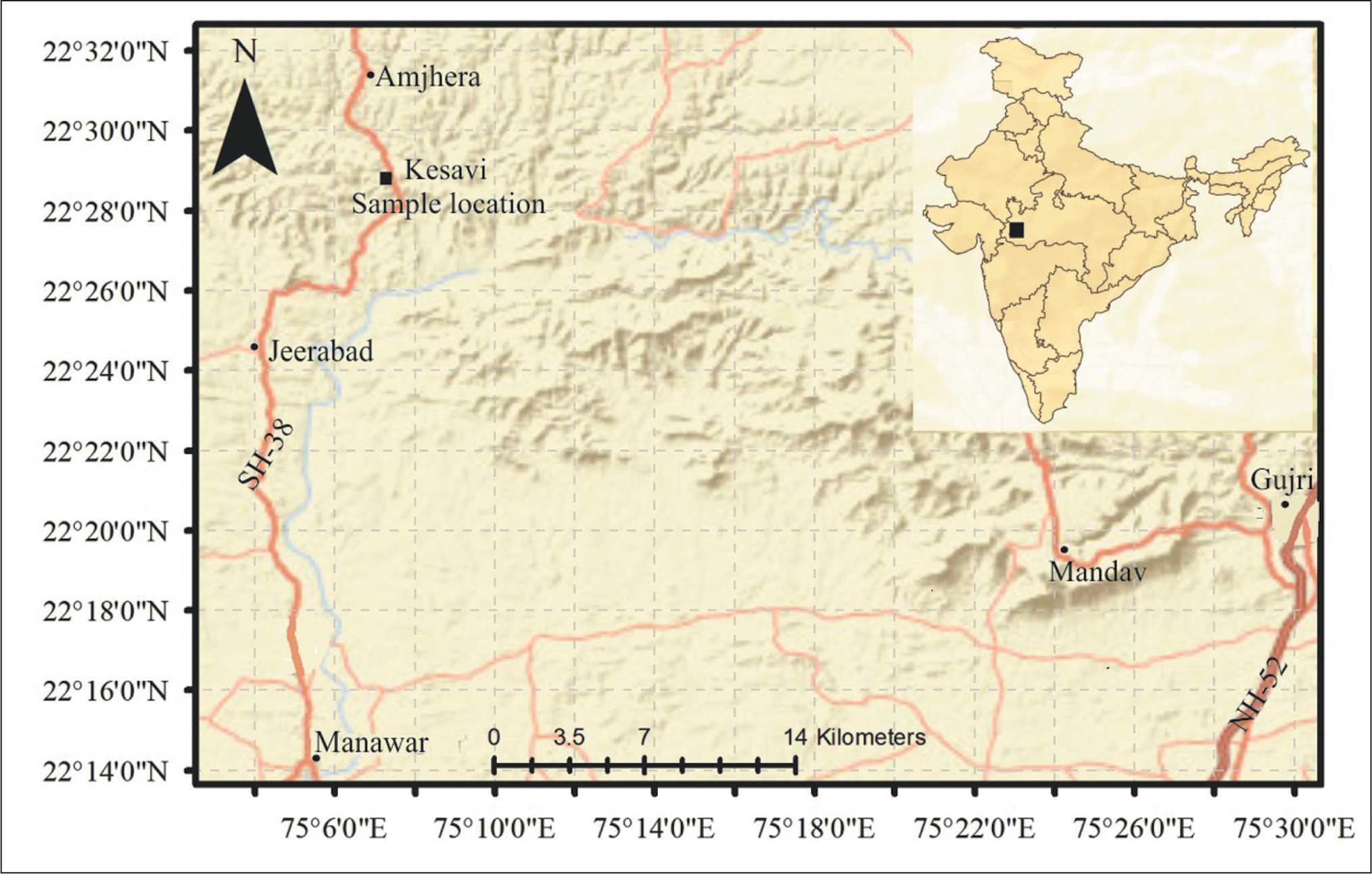
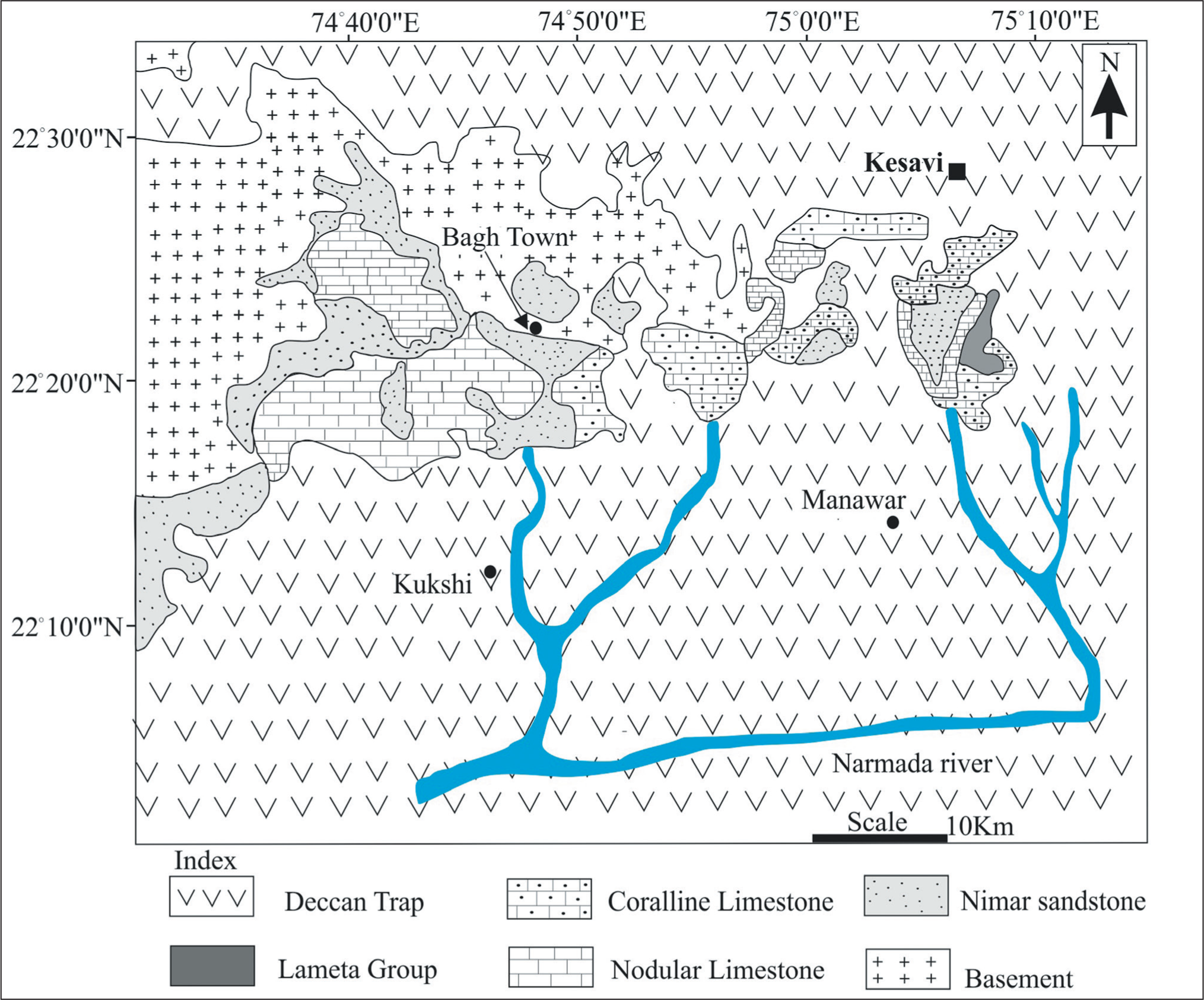
The present intertrappean site at Kesavi (22°28'52.08"N and 75°7'22.69"E) (Figures 1 and 2) is situated in the lower Narmada basin, an ENE-WSW trending intracratonic rift basin. It is part of the Malwa sub-province, the central-western plateau of the Deccan Traps volcanic province. The Malwa sub-province is exposed over an area of 8,000 km2, and the basaltic pile shows a maximum thickness of 800 m. The basaltic pile in this sub-province (Malwa Group), possibly with its independent eruptive foci (Kale et al., 2020; Eddy et al., 2020), overlies the Precambrian Bundelkhand Craton and the Vindhyan Supergroup and is divisible into eight formations based on flow morphology (Rao et al., 1985; summarised in Kale et al., 2020) and five formations based on geochemical parameters, namely Narmada, Manpur, Mhow, Satpura and Singachori formations, in ascending order (summarised in Eddy et al., 2020). The pre-Deccan stratigraphy includes the infratrappean beds (Bagh-Lameta deposits) of the late Cretaceous age. Blanford (1869) was the first to describe the marine Bagh Beds and recognised four lithostratigraphic units, namely the Nimar Sandstone, Nodular Limestone, Deola-Chirakhan Marl and Coralline Limestone, in ascending order (Figure 3). This classification of the Bagh Beds (Bagh Group; Jaitly & Ajane, 2013) was followed by later workers. Since the pioneering investigations of Blanford (1869), the Bagh Beds have been extensively studied by several workers concerning lithostratigraphy, fossils and age. Significant contributions include those by Bose (1884), Rode and Chiplonkar (1935), Roy Chowdhury and Sastri (1962), Dassarma and Sinha (1975), Chiplonkar and Ghare (1976), Guha (1976), Tripathi (2006), Jaitly and Ajane (2013) and Ruidas et al. (2018). The Bagh Beds are overlain by the uppermost Cretaceous Lameta Group, which, in turn, is succeeded by the Deccan Traps volcanic flows, interbedded with intertrappean beds.
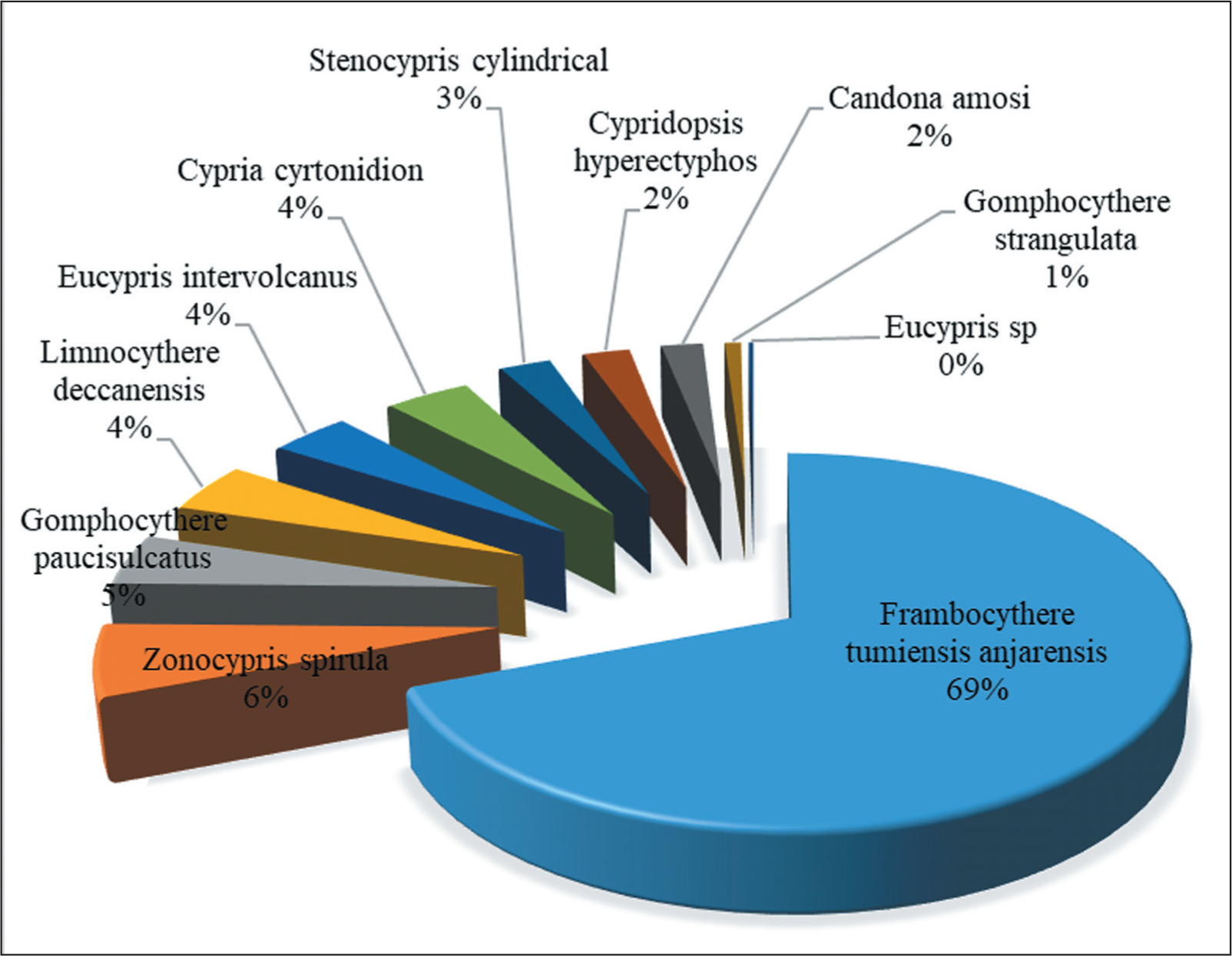
Relative abundance of ostracods at the species level.
Initially, the age of the Deccan volcano was considered early Tertiary (Hislop, 1860; Hora, 1938). Subsequent studies, based on radiometric dating, magnetostratigraphy and macro- and micropaleontology, suggested that most of the eruption (>80%) occurred in less than one million years around the Cretaceous–Paleogene boundary at 65 Ma (Bajpai & Prasad 2000; Bajpai et al., 2013; Chenet et al., 2007; Courtillot et al., 1986; Duncan & Pyle, 1988; Kania et al., 2022; Keller et al., 2009a, 2009b; Khosla & Lucas, 2020a, 2020b, 2020c, 2020d, 2020e; Khosla et al., 2022; Mantilla et al., 2022; Schoene et al., 2019; Self et al., 2022; Vandamme et al., 1991; Verma & Khosla, 2019; Verma et al., 2016; and references therein).
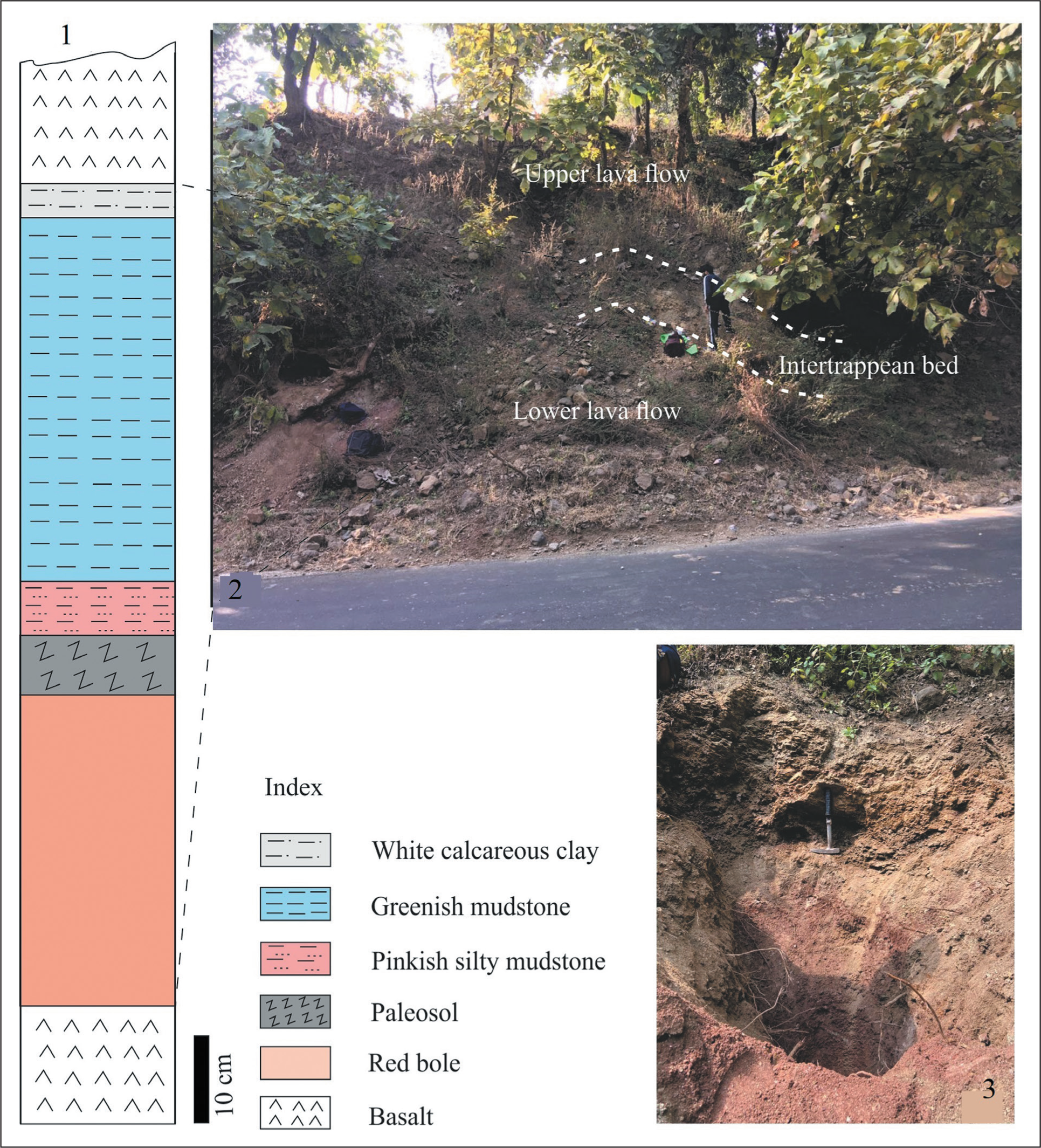
The present intertrappean locality near Kesavi that yielded the ostracod assemblage described here (Figure 2) is situated in the Dhar District of Madhya Pradesh. The fossil site is exposed on the Dhar-Jeerabad road (State Highway 38), about 0.65 km west of Kesavi village. Lithologically, the section consists of the lower Deccan lava flow, red bole, palaeosol, pinkish silty mudstone, greenish mudstone, white calcareous clay and the upper Deccan lava flow in ascending Sequence (Figure 4). The age of this locality has been discussed by Yadav et al. (2022). The basal part of the Malwa sequence is believed to be ~67 Ma based on 40Ar-39Ar data (Schöbel et al., 2014), and the total duration of the volcanic activity in this sub-province probably did not exceed 1.3 Ma (Eddy et al., 2020). The magnetopolarity sequence of the Kesavi intertrappean beds is unknown, but, as discussed by Yadav et al. (2022), these possible beds lie close to normal to the reverse transition of magnetopolarity (? C30n-C29r; see Schöbel et al., 2014) and are likely also close to the boundary between two basal, geochemically defined basalt units, the Narmada and Manpur formations (see Eddy et al., 2020). Thus, these intertrappean beds could be either the latest Cretaceous or earliest Paleocene in age, and it is currently not possible to further resolve their chronostratigraphic position. We believe there is no firm basis for assigning the latest Cretaceous Period to the present study locality, and it could equally be the earliest Paleocene (early Danian) in age. It is to be noted that no dinosaur remains or any other exclusively pre-Cenozoic elements (e.g., the ray fish Igdabatus) have been found in this locality so far.
Map showing the location of examined intertrappean locality.
Geological map of Bagh area, Dhar District, Madhya Pradesh (modified after Jaitly and Ajane 2013).
(1) litholog of Kesavi intertrappean locality; (2) panoramic view photograph of Kesavi intertrappean locality; (3) close view-photograph of Kesavi intertrappean locality.
Materials and Methods
The samples were macerated using standard techniques after systematic sampling at the Kesavi locality. The dried samples were soaked overnight in a 1:3 ratio of H2O2 and water solution. The soaked samples were washed using sieves of different sizes (ASTM 230, 50) and oven dried at 50 °C. A binocular microscope (Leica) was used to pick and sort microfossils. SEM images of selected specimens were taken with SEM at the Department of Earth Sciences, IIT Roorkee. All the specimens are housed in the Palaeontology Laboratory, IIT Roorkee, with the catalogue number CIITOK (Central India Intertrappean Ostracods Kesavi).
Class Ostracoda Latreille, 1802
Subclass Podocopa Sars, 1866
Order Podocopida Sars, 1866
Suborder Cytherocopina Baird, 1850
Superfamily Cytheroidea Baird, 1850
Family Limnocytheridae Klie, 1938
Subfamily Timiriaseviinae Mandelstam, 1960
Genus Frambocythere Colin 1981 (Colin & Danielopol, 1981)
Frambocythere tumiensis anjarensis (Colin & Bhandari, 1999, Plate 1: part 4–8)
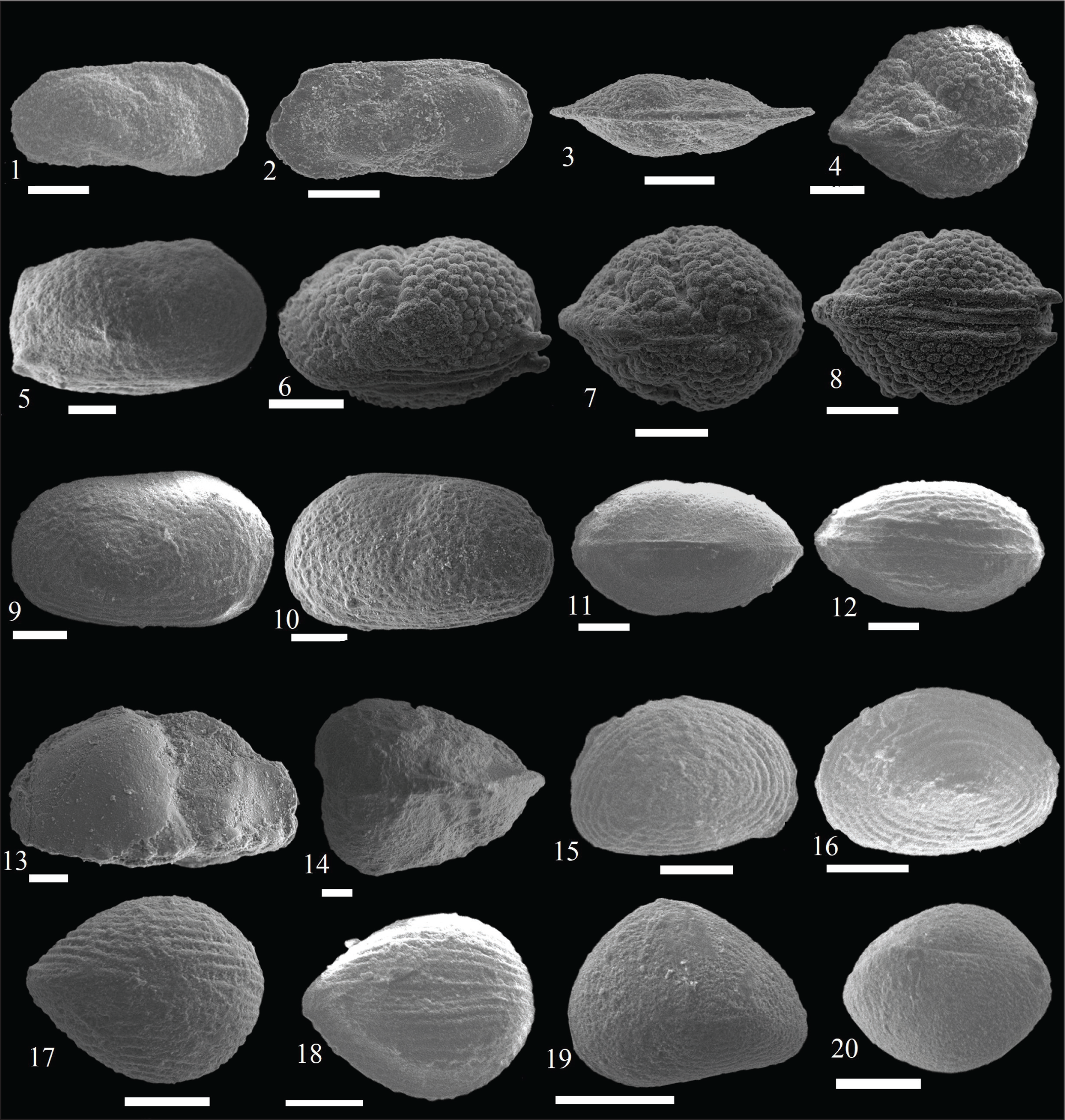
(1–3) Limnocythere deccanensis 1. carapace, right lateral view; 2. carapace, left lateral view; 3. carapace, dorsal view; (4–8) Frambocythere tumiensis anjarensis 4. Female carapace, dorsal view; 5. carapace, right lateral view; 6. carapace, left lateral view; 7. carapace, dorsal view; 8. carapace,ventral view; (9–12) Gomphocythere paucisulcatus; 9. carapace, right lateral view; 10. carapace, left lateral view; 11. carapace, dorsal view; 12. carapace,ventral view; (13–14) Gomphocythere strangulata 13. carapace, right lateral view; 14. carapace, dorsal view; (15–16) Zonocypris spirula 15. carapace, right lateral view; 16. carapace, left lateral view; 17. carapace, dorsal view; 18. carapace,ventral view; 19. Juvelline carapace, right lateral view; 20. Juvelline carapace, dorsal view. Scale-100µm.
Metacypris strangulata (Jones)—Colin and Danielopol (partim), 1981, Plate 2: part 6 & 7.
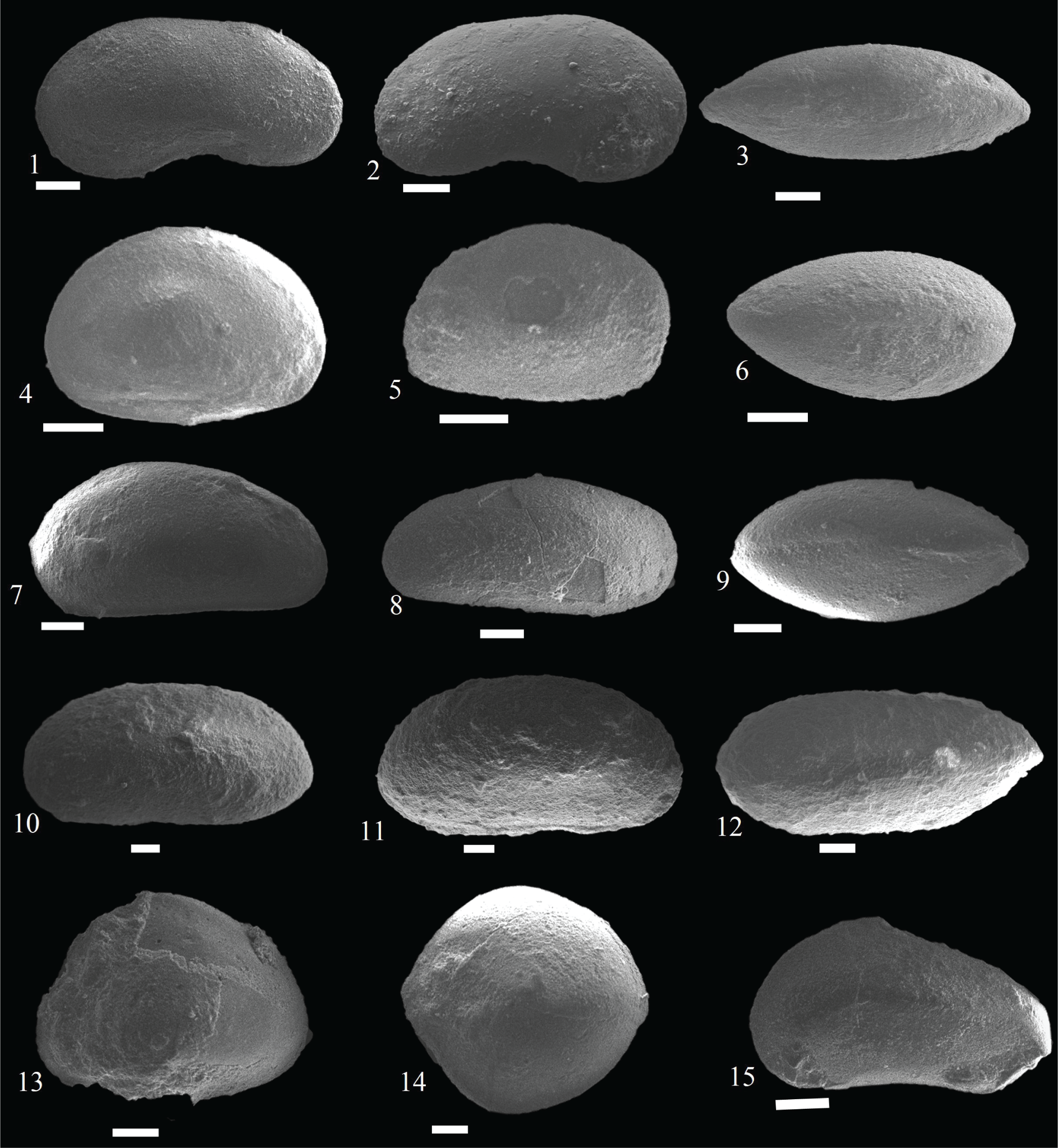
(1–3) Candoan amosi 1. carapace, right lateral view; 2. carapace, left lateral view; 3. carapace, dorsal view; (4–6) Cypria cyrtonidion 4. carapace right lateral view; 5. carapace, left lateral view; 6. carapace, dorsal view; (7–9) Eucypris intervolcanus 7.carapace right lateral view; 8. carapace, left lateral view; 9. carapace, dorsal view; (10–12) Stenocypris cylindrica 10. carapace right lateral view; 11. carapace, left lateral view; 12. carapace, dorsal view;(13–14) Cypridopsis hyperectyphos 13.carapace, left lateral view; 14. carapace, dorsal view; (15) Eucypris sp. carapace, left lateral view. Scale-100µm.
Frambocythere tumiensis anjarensis (Bhandari and Colin)—Bhandari and Colin (1999, pp. 12–13, Plate 1: part 1–10).
Frambocythere tumiensis anjarensis (Bhandari and Colin)—Whatley et al. (2002a, pp. 166–168, Plate 1: part 8 & 9).
Frambocythere tumiensis anjarensis (Bhandari and Colin)—Khosla et al. (2005, p. 137, Plate 1: part 3 & 4).
Frambocythere tumiensis anjarensis (Bhandari and Colin)—Kshetrimayum et al. (2021, p. 6, Figure 3: A–E).
Material: 605 carapaces.
Measurements:
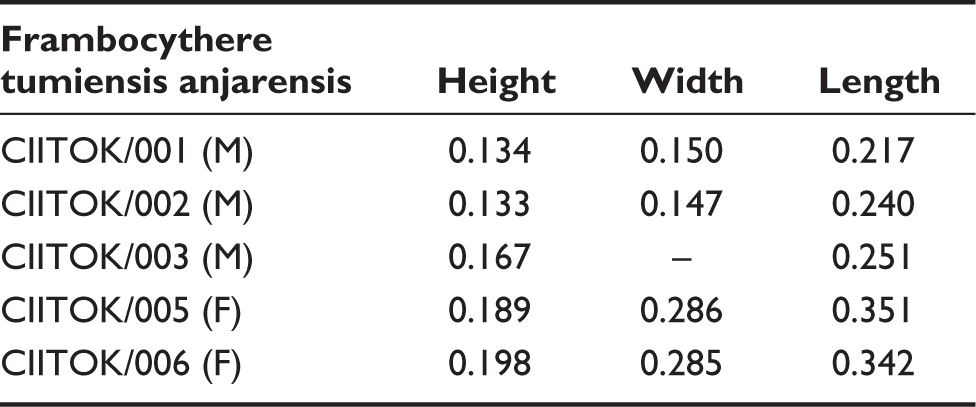
Description: Carapace small and oval; dimorphism present; carapace looks heart-shaped in dorsal view, having two sulci in which a medial sulcus is prominent; anterior margin outline is well rounded than posterior margin outline; dorsal and ventral margin outline is almost straight; surface ornamented by half circle shape (tubercles) structure, which gives the raspberry-like appearance; prominent spines on posteroventral region; rims without tubercles; internal structure not seen.
Remarks: Bhandari and Colin (1999) first described this species from the Anjar intertrappean bed. So far, this species has been reported from various intertrappean sites in Gitti Khadan (Bhatia & Rana, 1984); Chandarki and Yanagundi, Gulbarga District (Whatley et al., 2002a); Mamoni (Whatley et al., 2003a); Mohgaon-Haveli and Takli (Khosla & Nagori, 2007; Khosla et al., 2007); Jhilmili (Khosla et al., 2009a, 2011a); Khar (Rathore et al., 2017); Manawar (Kapur et al., 2019) and recently reported from Gujri (Kshetrimayum et al., 2021). It is also described from the infratrappean bed (Lameta Group) of Dongargaon (Khosla et al., 2005) and Pisdura hill section (Khosla et al., 2011b).
Horizon and locality: Greenish mudstone and calcareous clay, Kesavi intertrappean locality.
Genus Limnocythere (Colin & Danielopol, 1981)
Limnocythere deccanensis (Khosla et al., 2007, pl. I, Figs. 1–3)
Limnocythere deccanensis (Khosla et al., 2007)—Sharma and Khosla (2009, p. 199, pl. 1, Figs. G–J).
Material: 38 carapaces.
Measurements:
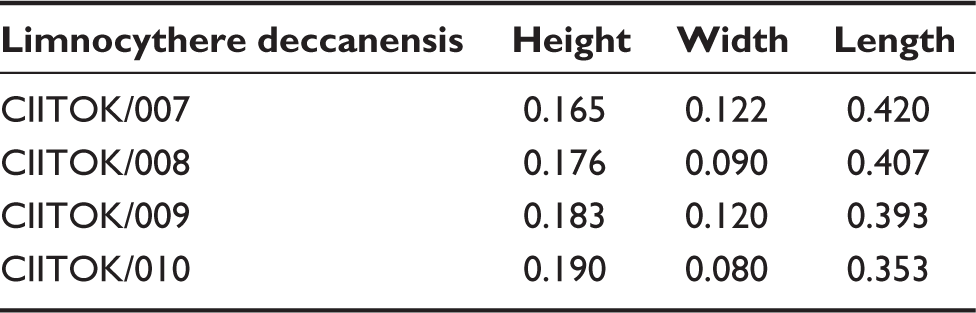
Description: Carapace medium with quadrate in lateral view and fusiform in dorsal view; ventral marginal line medially concave, the dorsal line almost straight with slight inclination posteriorly; anterior margin broad and rounded than posterior margin, both ends compressed; vertical medial sulcus and an arcuate depression on anterior side present; an anteroventral rib present.
Remarks: This species was first reported from the intertrappean bed of Phulsagar, Mandla District, named L. deccanensis by Bajpai et al. (2004). After that, Khosla et al. (2007) pointed out that the species name L. bhatiai was preoccupied with Mathur’s (1976) specimen recovered from the Pliocene Tatrot formation upper Shiwalik. The species name was retained as L. deccanensis (Khosla et al., 2005; Khosla et al., 2007) for the last name L. Bhatiai. The species has been described from the intertrappean bed of Mohagaon-Haveli and Jhilmili, Chhindwara District (Khosla & Nagori, 2007; Sharma & Khosla, 2009); Takli, Nagpur (Khosla et al., 2007); and the Lameta formation of Pisdura hill station, Nand-Dongargaon basin (Khosla et al., 2010, 2011b).
Horizon and locality: Greenish mudstone and calcareous clay, Kesavi intertrappean locality.
Genus Gomphocythere Sars, 1924
Gomphocythere strangulata (Jones, 1860, pl. I, Figs. 13 and 14)
Cypris strangulate—Jones (1860, p. 187, pl. X, Fig. 73a–d).
Gomphocythere strangulata (Jones)—Whatley et al. (2002a, p. 169, pl. 1, Figs. 10 and 11).
Material: Seven carapaces.
Measurements:
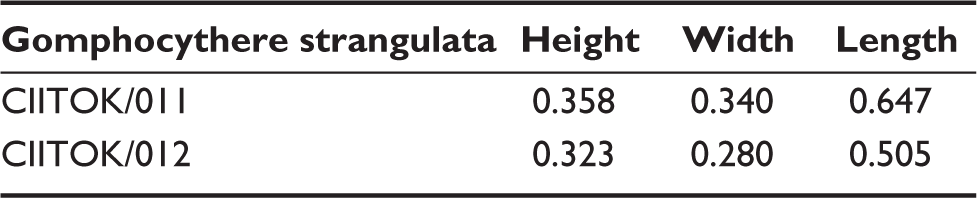
Description: Carapace medium; sub-quadrate shape seen in lateral view; anterior margin well rounded than posterior margin; surface morphology marked by two sulci, one distinguishes medial, long sulci and second smaller, situated anterior–dorsal region; dimorphism present; male carapace with a lensoid outline shape with maximum width at the middle portion; whether female carapace is more inflated in the posterior region; surface ornamentation not seen.
Remarks: This ostracod species has been widely reported from the intertappean bed, such as Takli (Bhatia et al., 1996); Mamoni (Bhatia et al., 1990b); Asifabad (Bhatia et al., 1996); Lakshmipur (Whatley & Bajpai, 2000a); Yanagundi (Whatley et al., 2002a); Jhilmili (Khosla et al., 2009a; Sharma & Khosla, 2009); Anjar (Khosla & Nagori, 2005); Khar (Rathore et al., 2017); Manawar (Kapur et al., 2019); Gujri (Kshetrimayum et al., 2021); Uthawali (Colin & Danielopol, 1981); and the infratrappean bed (Lameta Formation) of Dongargaon (Khosla et al., 2005, 2011b; Udhoji & Mohabey, 1996).
Horizon and locality: Greenish mudstone and calcareous clay, Kesavi intertrappean locality.
Gomphocythere paucisulcatus (Whatley et al., 2002b, pl. I, Figs. 9–12)
Gomphocythere paucisulcatus Whatley, Bajpai and Srinivasan—Whatley et al. (2002b, pp. 107–109, pl. 1, Figs. 1–6).
Gomphocythere paucisulcatus Whatley, Bajpai and Srinivasan—Kshetrimayum et al. (2021, p. 6, Fig. 3K–N).
Material: 39 carapaces.
Measurements:
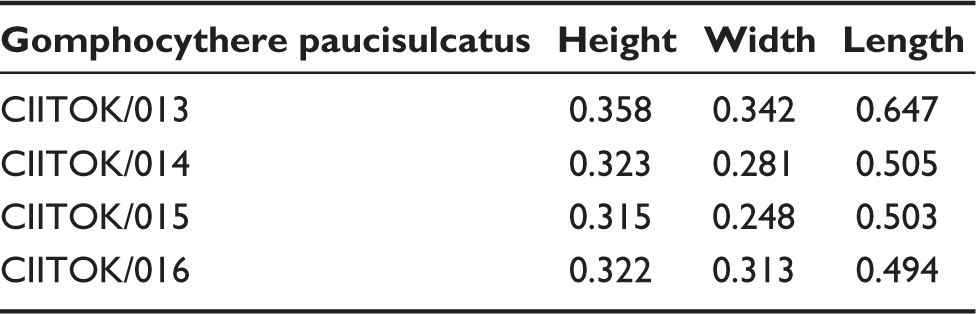
Description: Carapace medium with sub-fusiform outline in dorsal view, which is more acuminate on the anterior side and sub-rectangular shape in lateral view; anterior margin well rounded and posterior margin symmetrically rounded; dorsal margins straight and ventral margin with slightly oral concavity; medial feebly developed sulcus present; large reticulate ornamentation with 1–4 secondary puncta within fossae, the rib-like structure seen along the free margin; rim present along the anterior margin; internal character not seen.
Remarks: So far, this ostracod species has previously been described from many intrertrappean localities of Mohgaonkalan of Chhindwara District (Whatley et al., 2002b); Anjar of Kachchh District (Bhandari & Colin, 1999; Khosla & Nagori, 2005); Takli (Khosla & Nagori, 2007); Lalitpur (Sharma et al., 2008); Jhilmili of Chhindwara District (Khosla et al., 2009a, 2011a); Khar in Khargoan District (Rathore et al., 2017), near Gujri of Dhar District (Kapur et al., 2019; Kshetrimayum et al., 2021); and the infratrappean bed (Lameta Group) of Dongargaon (Khosla et al., 2005, 2011b) and Pisdura hill section (Khosla et al., 2010), Nand-Dongargaon basin.
Horizon and locality: Greenish mudstone and calcareous clay, Kesavi intertrappean locality.
Superfamily Cypridacea Baird, 1845
Family Cyprididae Baird, 1845
Genus Cypria Zenker, 1854
Cypria cyrtonidion (Whatley & Bajpai, 2000a, pl. II, Figs. 4–6)
Cyprios sp.—Bhatia and Rana (1984, p. 33, pl. 2, Fig. 12).
Cyprios sp.—Mathur and Verma (1988, p. 173, pl. 1, Figs. 1 and 2).
Cypria cyrtonidion—Whatley and Bajpai (2000a, p. 404, pl. 6, Figs. 9–14).
Eucypris intervolcanus Whatley and Bajpai—Kshetrimayum et al. (2021 p. 11, Fig. 4J–M).
Material: 36 carapaces.
Measurements:
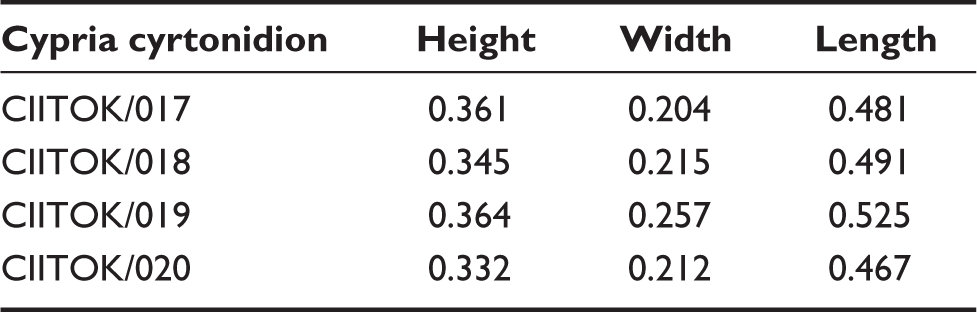
Description: Carapace medium with sub-quadrate to sub-circular in lateral view and fusiform in dorsal view; ventral margin straight and dorsal margin convex shape; anterior margin bluntly rounded; left valve larger than the right valve; overlap all sides except hinge area where RV overlap LV; highest length and width occurred in the middle of carapace; surface smooth.
Remarks: This ostracod species of Cypria has been reported from the intertrappean sections of the Kachchh District of Lakshmipur (Whatley & Bajpai, 2000a); Kora (Bajpai & Whatley, 2001); Anjar (Khosla & Nagori, 2005); Chhindwara District of Mohgaonkala (Whatley et al., 2002b), Mohgaon-Haveli (Khosla et al., 2007); Jhilmili (Khosla et al., 2009a, 2011a; Sharma & Khosla, 2009); Yanagundi and Chandarki in Gulbarga District (Whatley et al., 2002a); Papro in Lalitpur District (Sharma et al., 2008); and infratrappean (Lameta Group) of Dongargaon in Chandpura District (Khosla et al., 2005, 2011b), Pisdura (Khosla et al., 2010, 2011b).
Horizon and locality: Greenish mudstone, Kesavi intertrappean locality.
Subfamily Eucypridinae Bronshtein, 1947
Genus Eucypris Vávra, 1891
Eucypris intervolcanus (Whatley & Bajpai, 2000a, pl. II, Figs. 7–9)
Eucypris intervolcanus sp. nov.—Whatley and Bajpai (2000a, p. 401, pl. 5, Figs. 16–19).
Eucypris intervolcanus Whatley and Bajpai— Bajpai and Whatley (2001, p. 103, pl. 3, Figs. 4 and 7).
Eucypris intervolcanus Whatley and Bajpai—Kshetrimayum et al. (2021, p. 14, Fig. 5K–O).
Material: 34 carapaces.
Measurements:
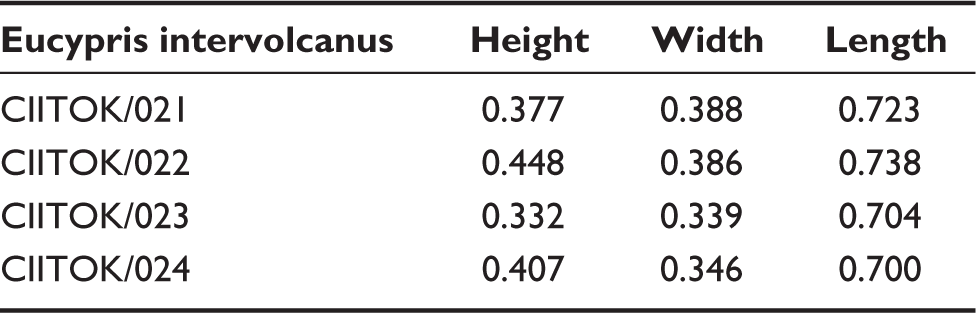
Description: Carapace medium with subovate in lateral view and fusiform in dorsal view; anterior margin narrowly rounded and posterior margin broadly rounded; ventral margin slightly concave and dorsal margin slightly convex with anterior side longer gentle slope; greatest height and length middle of carapace; LV overreaches around the margin of RV; surface smooth.
Remarks: This ostracod species of Eucypris has previously been described from intertrappean localities of the Kachchh District, including Lakshmipur (Whatley & Bajpai, 2000a); Kora (Bajpai & Whatley, 2001); Anjar (Khosla & Nagori, 2005); Phulsagar (Bajpai et al., 2004); Yanagundi and Chandarki in Gulbarga District (Whatley et al., 2002a); Mohgaonkala in Chhindwara District (Whatley et al., 2002b); Takli in Nagpur District (Khosla & Nagori, 2007); Khar in Khargoan District (Rathore et al., 2017); Gujri in Dhar District (Kapur et al., 2019; Kshetrimayum et al., 2021); and from infratrappean section of Chui Hill, Phulsagar (Bajpai et al., 2004).
Horizon and locality: Greenish mudstone, Kesavi intertrappean locality.
Eucypris sp.
(pl. II, Fig. 15)
Material: Two carapaces.
Measurements:

Description: Medium size with sub-fusiform in dorsal view, more acuminate on the anterior side; anterior margin broad and well-rounded comparatively to posterior margin; dorsal margin straight sloping slowly down to the posterior side and ventral side straight to slightly concave; maximum height near to anterior side and length in the middle of carapace; surface smooth.
Remarks: This ostracod species looks like Eucypris verruculosa, which is described from the intertrappean section of Gulbarga and Sichel Hills (Whatley et al., 2002a; Whatley et al., 2003b). But the size of the present specimen is comparatively tiny.
Horizon and locality: Greenish mudstone, Kesavi intertrappean locality.
Genus Zonocypris Müller, 1898
Zonocypris spirula (Whatley & Bajpai, 2000a, pl. I, Figs. 15–20)
Zonocypris spirula Whatley and Bajpai—Sharma et al. (2008, p. 181, pl. 2, Figs. o–p).
Material: 54 carapaces.
Measurements:
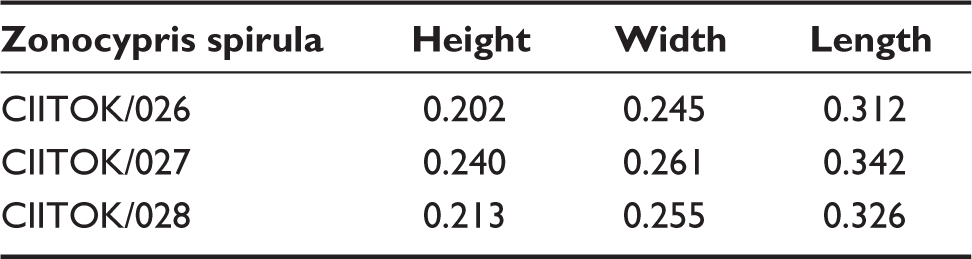
Description: Small size with strongly tumid and biconvex in dorsal view; dorsal margin short, inclined towards the posterior with a fusiform outline; ventral margin straight; anterior margin rounded with apices at mid-height; left valve larger than right valve; single spiral helix comparing a single rib spirally coiled about mid valve; initial coil slightly angular, the later coil more or less circular, adorns the surface.
Remarks: This ostracod species of Zonocypris has previously been described from intertrappean localities of the Kachchh District, including Lakshmipur (Whatley & Bajpai, 2000a); Kora (Whatley et al., 2002c); Anjar (Khosla & Nagori, 2005); Yanagundi and Chandarki in Gulbarga District (Whatley et al., 2002a); Mohgaon-Haveli, Jhilmili in Chhindwara District (Khosla & Nagori, 2007; Khosla et al., 2009a, 2011a; Sharma & Khosla, 2009): Takli in Nagpur (Khosla & Nagori, 2007); Papro, Lalitpur (Sharma et al., 2008); and the Lameta Formation (late Cretaceous) of Dongargaon, Nand-Dongargaon Basin (Khosla et al., 2005).
Horizon and locality: Greenish mudstone and calcareous clay, Kesavi intertrappean locality.
Genus Stenocypris Sars, 1889
Stenocypris cylindrica (Sowerby in Malcolmson, 1840, pl. II, Figs. 10–12)
Mongolianella cylindrica Sowerby—Bajpai et al. (2004, pp. 154–155, pl. 2, Figs. n–o).
Mongolianella cylindrica Sowerby—Sharma and Khosla (2009, p. 204, pl. 3, Fig. K).
Stenocypris cylindrica Sowerby—Rathore et al. (2017,p. 221, Figs. 3 and 4).
Material: 22 carapaces.
Measurements:
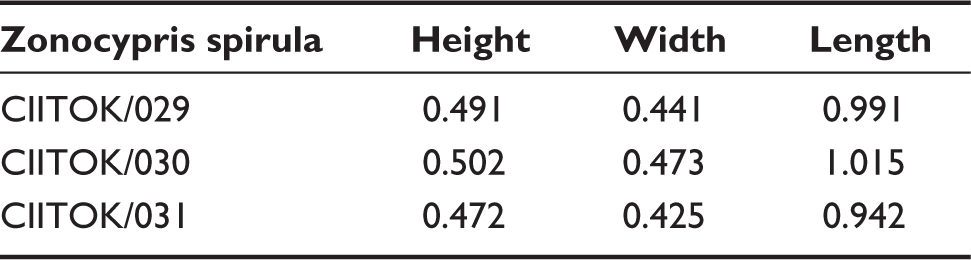
Description: The carapace is large with a cylindrical shape in lateral view and a fusiform shape in dorsal view having a narrow anterior portion; the dorsal margin is straight to slightly convex, and the ventral margin is horizontal to slightly medially concave; the anterior margin is narrowly rounded than the posterior margin; left valve is larger, overreaching on all sides of right valve. The highest length and width occurred medially, while the greatest height was towards the anterior side; the surface was smooth, an internal feature not seen.
Remarks: This ostracod species of Stenocypris was previously first time reported as Cypris cylindrical (Sowerby in Malcolmson, 1840); after that, Whatley and Bajpai (2000a) assigned this species from Lakshimipur with a new name, as Mongolianella cylindrical. Then Khosla et al. (2009b) restudied the Lakshmipur intertrappean bed assigned a new name, Stenocypris cylindrical, based on the specimen’s outline shape and internal features. Apart from this, this species has been described from the intertrappean bed of Kora and Anjar, Kachchh District, Gujrat (Bajpai & Whatley, 2001; Khosla & Nagori, 2005); Chandarki and Yanagundi (Whatley et al., 2002a); Mamoni (Whatley et al., 2003a); Takli (Khosla & Nagori, 2007); Phulsagar (Bajpai et al., 2004); Papro (Sharma et al., 2008); Jhilmili (Khosla et al., 2009a, 2011a; Sharma & Khosla, 2009); Khar (Rathore et al., 2017), Gujri (Kapur et al., 2019); Kshetrimayum et al., 2021); and infratrappean section (Lameta Formation) of Pisdura (Khosla et al., 2010, 2011b) and Chhui hill and Bara Simla hill sections (Khosla et al., 2011b).
Horizon and locality: Greenish mudstone, Kesavi intertrappean locality.
Subfamily Cypridopsinae Kaufmann, 1900
Genus Cypridopsis (Colin & Danielopol, 1981)
Cypridopsis hyperectyphos (Whatley & Bajpai, 2000a, pl. II, Figs. 13 and 14)
Cypridopsis hyperectyphos—Whatley and Bajpai (2000a, p. 397, pl. 4, Figs. 4–10).
Cypridopsis hyperectyphos Whatley and Bajpai—Bajpai and Whatley (2001, p. 96, pl. 1, Figs. 6–8).
Cypridopsis hyperectyphos Whatley and Bajpai—Khosla and Nagori (2005, p. 574, pl. 1, Fig. 17).
Cypridopsis hyperectyphos Whatley and Bajpai—Sharma et al. (2008, p. 178, pl. 2, Figs. A–C).
Cypridopsis hyperectyphos Whatley and Bajpai—Kapur et al. (2019, p. 1148, Fig. 3d and e).
Material: 20 carapaces.
Measurements:
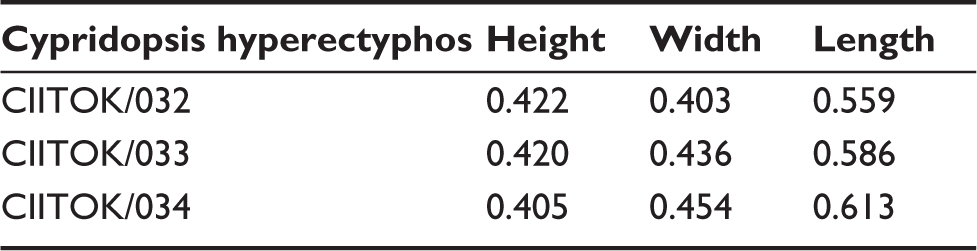
Description: Medium size with enormously inflated; triangularly subovate in lateral side view and almost circular in dorsal side view; dorsal margin convex and ventral margin with slight concavity; length and height almost equal; left valve overlain on right valve except for the dorsal and posterior margin; surface ornamented with fine punctuation.
Remarks: This species has been widely recorded from the intertrappean beds of Lakshmipur (Whatley & Bajpai, 2000a), Kora (Bajpai & Whatley, 2001); Anjar (Khosla & Nagori, 2005), Kachchh District; Yanagundi, Gulbarga District (Whatley et al., 2002a); Mamoni, Kota District (Whatley et al., 2003a); Takli, Nagpur (Khosla & Nagori, 2007); Papro, Lalitpur (Sharma et al., 2008); Jhilmili, Chhindwara District (Khosla et al., 2009a, 2011a; Sharma & Khosla, 2009); and the Lameta Group of Dongargaon (Khosla et al., 2005, 2011b); Pisdura hill section (Khosla et al., 2010, 2011b), Nand-Dongargaon basin and Chui hill section (Khosla et al., 2011b), Jabalpur basin.
Horizon and locality: Greenish mudstone, Kesavi intertrappean locality.
Family Candonidae Kaufmann, 1900
Subfamily Candoninae Kaufmann, 1900
Genus Candona Baird, 1845
Candona amosi (Whatley et al., 2002b, pl. II, Figs. 1–3)
Candona cf. C. sinensis—Bhandari and Colin (1999, p. 13, pl. 2, Fig. 7).
Candona amosi—Whatley et al. (2002a, p. 178, pl. 4, Figs. 20–22; pl. 5, Figs. 1 and 2).
Candona amosi Whatley, Bajpai and Srinivasan—Khosla et al. (2010, Fig. 4h).
Material: 18 carapaces.
Measurements:
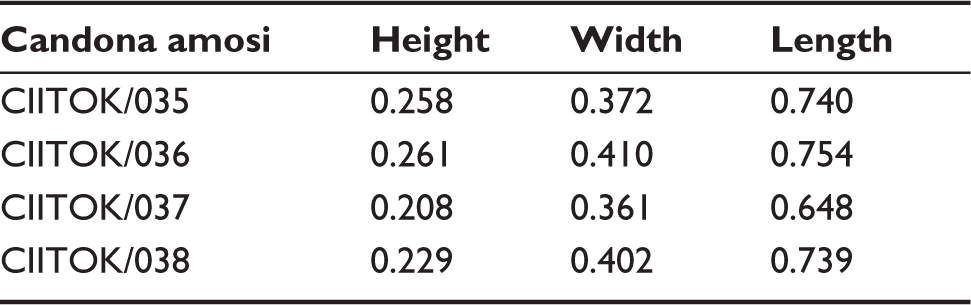
Description: Medium size with sub-horizontal shape seen in lateral view and sub-fusiform shape seen in dorsal view; anterior and posterior margins well rounded, A.R. broad relative to P.R.; dorsal margin almost straight and ventral margin slightly concave; maximum height post medial posterior side.
Remarks: This ostracod species of Candona has been reported from the intertrappean localities of Chandkari and Yanagundi of Gulbarga District (Whatley et al., 2002b); Kora, Kuchchh District (Bajpai & Whatley, 2001) and Takli, Nagpur District (Khosla et al., 2007).
Horizon and locality: Greenish mudstone, Kesavi intertrappean locality.
Discussion
Palaeoecological Aspects
Ostracods occur in abundance at the Kesavi locality and are represented by 11 taxa (Frambocythere tumiensis anjarensis (70%), Zonocypris spirula (6%), Gomphocythere paucisulcatus (5%), Limnocythere deccanensis (4%), Eucypris intervolcanus (4%), Cypria cyrtonidion (4%), Stenocypris cylindrica (3%), Cypridopsis hyperectyphos (2%), Candona amosi (2%), Gomphocythere strangulata (1%) and Eucypris sp. (Figure 1). The assemblage shows an admixture of non-swimming and swimming species but is dominated by the Limnocytheridae, which is a family of non-swimmers and includes the genera Limnocythere, Gomphocythere and Frambocythere. Limnocythere is endobenthic, spending considerable time in sediments and living in temporary pools, while Frambocythere and Gomphocythere are epibenthic, active crawlers/walkers that are usually found in permanent water bodies (Bajpai et al., 2013; Khosla, 2021; Khosla et al., 2015, 2022; Kapur & Khosla, 2016, 2019; McKenzie, 1971; Whatley & Bajpai, 2005). The non-swimmer taxon Eucypris inhabits temporary water bodies that dry out in the summer, and this taxon lays desiccation-resistant eggs that hatch with rain (Whatley & Bajpai, 2005). The swimmers like to live in permanent water bodies. The genus Stenocypris is found in warm, shallow and freshwater environments. Zonocypris is also a swimmer but, with its body, which is heavily ornamented with spiral rings, is probably sluggish. Cypria is a good swimmer and prefers to live in permanent, oligohaline water bodies. At the same time, the recent species of Candona are adapted to a walking/crawling mode of life and inhabit fresh to oligohaline water bodies such as lakes, marshes and coastal lagoons, and even slow-moving streams (Khosla et al., 2010; Whatley & Bajpai, 2005). Cypridopsis is a good swimmer that prefers a weed-rich environment and goes deeper into the lake during the dry season. Overall, the overwhelming dominance of Limnocytheraceans (Frambocythere) in the assemblage, together with Limnocythere tends to favour a permanent water body and generally stable environment during the deposition of Kesavi intertrappeans. Associated faunal remains in the present assemblage, comprising fishes, lizards, anurans (currently under study) and pulmonate gastropods, indicate a freshwater environment (Yadav et al., 2022).
Palaeobiogeographical Implications
Extensive endemism among the Deccan intertrappean ostracod species was noted by Whatley and Bajpai (2006) and suggested relative physical isolation of the Indian plate at 65 Ma around the Cretaceous–Paleogene boundary. These intertrappean assemblages of the late Cretaceous/early Paleocene age, although cosmopolitan at the generic level, do not show similarity at the species level with assemblages in the surrounding landmasses such as China, Mongolia, Madagascar, Africa and South America. Whatley and Bajpai (2006) concluded that the endemism during the Deccan eruptions is evident in at least 92 species of intertrappean ostracods. However, the faunal assemblage, including large and small vertebrates, invertebrates reported from the intertrappean and infratrappean, deposits shows paleobiogeographically complex (both Laurasain and Gondwana) affinity, such as the fossil assemblage (gondwanatherian [sudamericid] mammals; abelisaurid theropods and titanosauriform sauropods; notosuchian crocodiles; nigerophiid and madtsoiid snakes; bothremydid turtles and the myobatracid, leptodactylid, ranoid and hyalid frogs exhibits Gondwana faunal affinity) (Chatterjee et al., 2017; Khosla, 2021). The previously discovered Laurasian affinity fossil assemblage includes frogs (Pelobatidae, Gobiatinae, Costata), lizards (anguimorph), charophytes and palynomorphs, suggesting faunal and floral exchanges between India and Eurasia with the help of sweepstakes dispersal route via Kohistan–Dras island arc system (Ali & Aitchison, 2008; Goswami et al., 2011; Kapur & Khosla, 2016, 2019; Kapur et al., 2019; Khosla, 2021; Khosla & Lucas, 2020a, 2020b; Khosla et al., 2022; Verma et al., 2016). The present assemblage from Kesavi intertrappeans also confirms the pre-sence of endemism concerning the species of Eucypris, Gomphocythere and Cypriodopsis; besides endemism, some of the taxa from Kesavi (Gomphocythere, Limnocythere and Cypria) also support the out-of-India hypothesis, according to which the origin of several elements of Asian biota occurred in India (see Whatley & Bajpai, 2006). Further evidence in support of this hypothesis comes from taxa among vertebrate groups encountered in other intertrappean deposits (see Kapur and Khosla 2016 for a review).
Conclusion
Freshwater ostracods with good diversity and abundance are described for the first time from a newly discovered fossiliferous Deccan intertrappean site (latest Cretaceous/earliest Paleocene) at Kesavi, Dhar District, Madhya Pradesh, in the lower Narmada valley of the Malwa sub-province of the Deccan Traps. Several ostracod species in the assemblage reaffirm the presence of endemism at the species level in the Indian continent around the time of the Cretaceous–Paleogene boundary. Associated fragmentary limb bones of frogs and isolated teeth and osteoderms of lizards indicate a freshwater, terrestrial environment at the Kesavi locality.
Footnotes
Acknowledgements
This research study is part of the ongoing doctoral work of one of us (R.Y.). We are also grateful to Professor Sunil Bajpai (Department of Earth Sciences, IITR) for his generous help with identifications and for improving the manuscript. We also thank Dr Debajit Dutta for reading the manuscript and making linguistic corrections. Additionally, help received from Ritesh Ranjan (Geoscientist, GSI) during fieldwork is thankfully acknowledged.
Declaration of Conflicting Interests
The authors declared no potential conflicts of interest with respect to the research, authorship and/or publication of this article.
Funding
The authors (R.Y.) gratefully acknowledges the financial support from the Indian Institute of Technology-Roorkee (IITR) for this study.