




Abstract
Detailed palynological investigations have been carried out to reconstruct stratigraphy and interpretation of depositional environment of Tura and Pre-Tura sedimentary sections in Dhansiri Valley of Upper Assam Shelf, Assam & Assam-Arakan Basin. Sediments of the Tura Formation dated as Early Eocene and interpreted to be deposited under subtidal to inner shelf environment. Pre-Tura sediments, developed in studied wells, led to the identification of Dergaon, Bamangaon and Moabund formations with intervening unconformities, having different tectonic history and distinct palynofossil assemblages. Early Permian sediments of the Dergaon Formation (=Talchir Formation), the oldest in the basin are deposited under the intracratonic phase, overlie the metamorphic basement complex. The sediments of the Dergaon Formation are unconformably overlain by the Bamangaon Formation deposited during the Early Cretaceous, whereas, in well DR-A, the sediments of the Dergaon Formation are directly overlain by the Moabund Formation corresponding to the Late Maastrichtian age. The sediments of the Tura Formation overlie the Maobund Formation in well DR-A, and they overlie the Bamangaon Formation in the rest of the wells in Dhansiri Valley.
Introduction
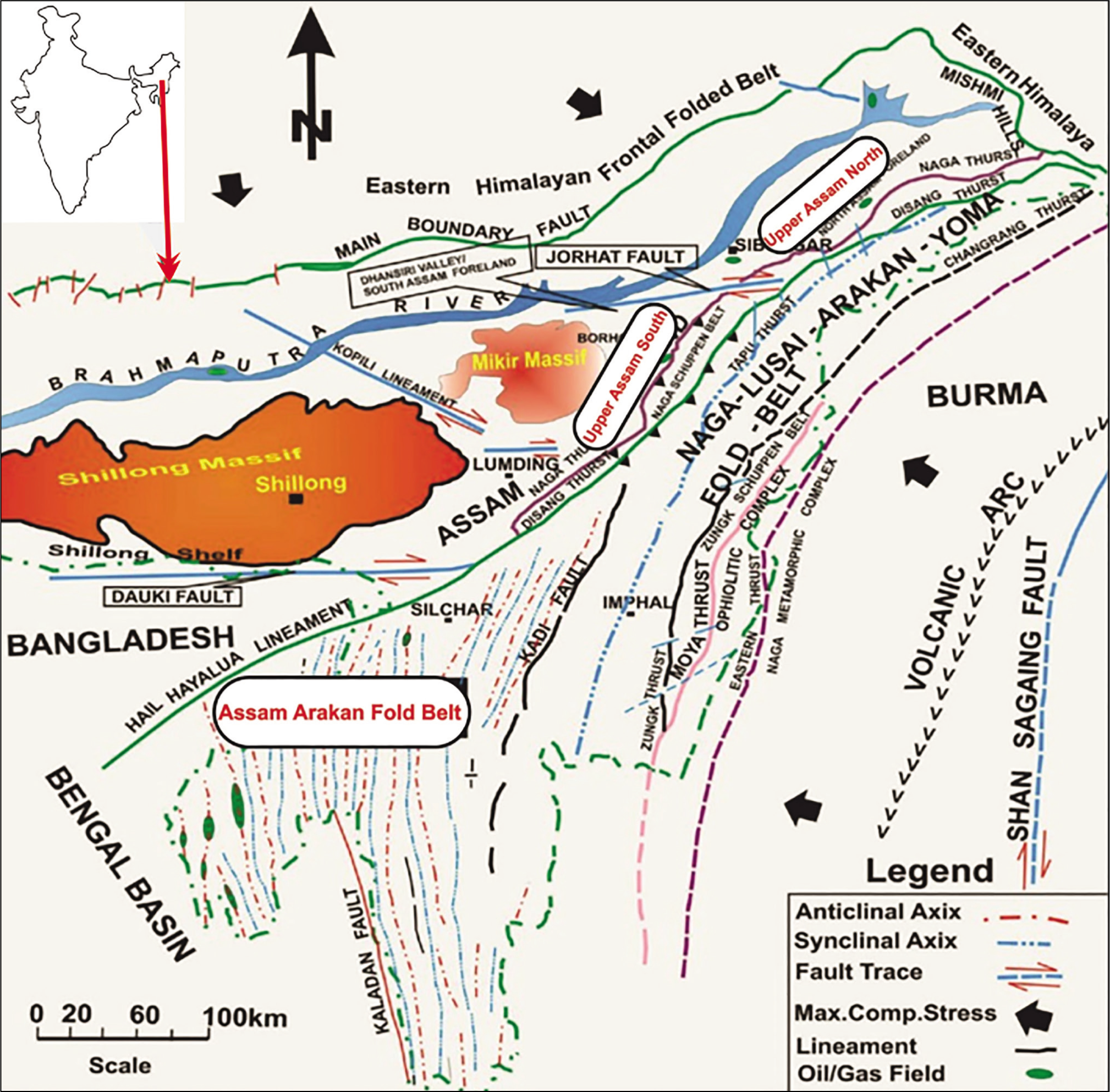
Assam & Assam-Arakan (A&AA) Basin is situated in north-eastern part of India, covering an area more than 100 thousand sq. km. extending over Assam, Meghalaya, Nagaland, Mizoram, Manipur, Tripura and a part of Arunachal Pradesh. The basin is having various tectonic phases and the major tectonic elements of the basin are Upper Assam Shelf, Naga Schuppen Belt, Assam-Arakan Fold Belt, etc. NE-SW trending Upper Assam Shelf is further subdivided into Upper Assam North and Upper Assam South. Upper Assam South Block is also known as Dhansiri Valley. The northern limit of Dhansiri Valley is a major E-W wrenching Jorhat fault and the southern limit is the Dauki fault. Towards east and southeast flanked by Naga Thrust and in the west by Mikir Hills and Shillong Plateau (Figure 1).
Biostratigraphic studies on Pre-Tura sediments have been carried out earlier by many authors in Dhansiri Valley. Foraminiferal studies carried out by Madan Mohan (1973) in well DR-A (1414–1750.75 m) suggest devoid of foraminifera and interpreted not older than Late Cretaceous age for SWCs: 1566.5 and 1596.5 m. Marine Permian and estuarine Early Cretaceous sediments have been reported in well BP-A of Upper Assam (Sharma et al., 1986). Early Permian and Early Cretaceous sediments are recognised in a few wells of Dhansiri Valley, Upper Assam based on palynological studies and also inferred fluvial environment to Early Cretaceous sediments corresponding to the Bamangaon Formation (Basavaraju & Pundeer, 2007). Present work deals with detailed palynological analyses covering most of the area in Dhansiri Valley with an emphasis to understand regional stratigraphy, depositional environment, break in sedimentation and tectonic history of subsurface sediments of Tura and Pre-Tura in Dhansiri Valley as the organisational mandate is mostly on play-based hydrocarbon exploration focusing on deeper sedimentary successions.
Tectonic map of Assam and Assam-Arakan Basin.
Material and Methodology
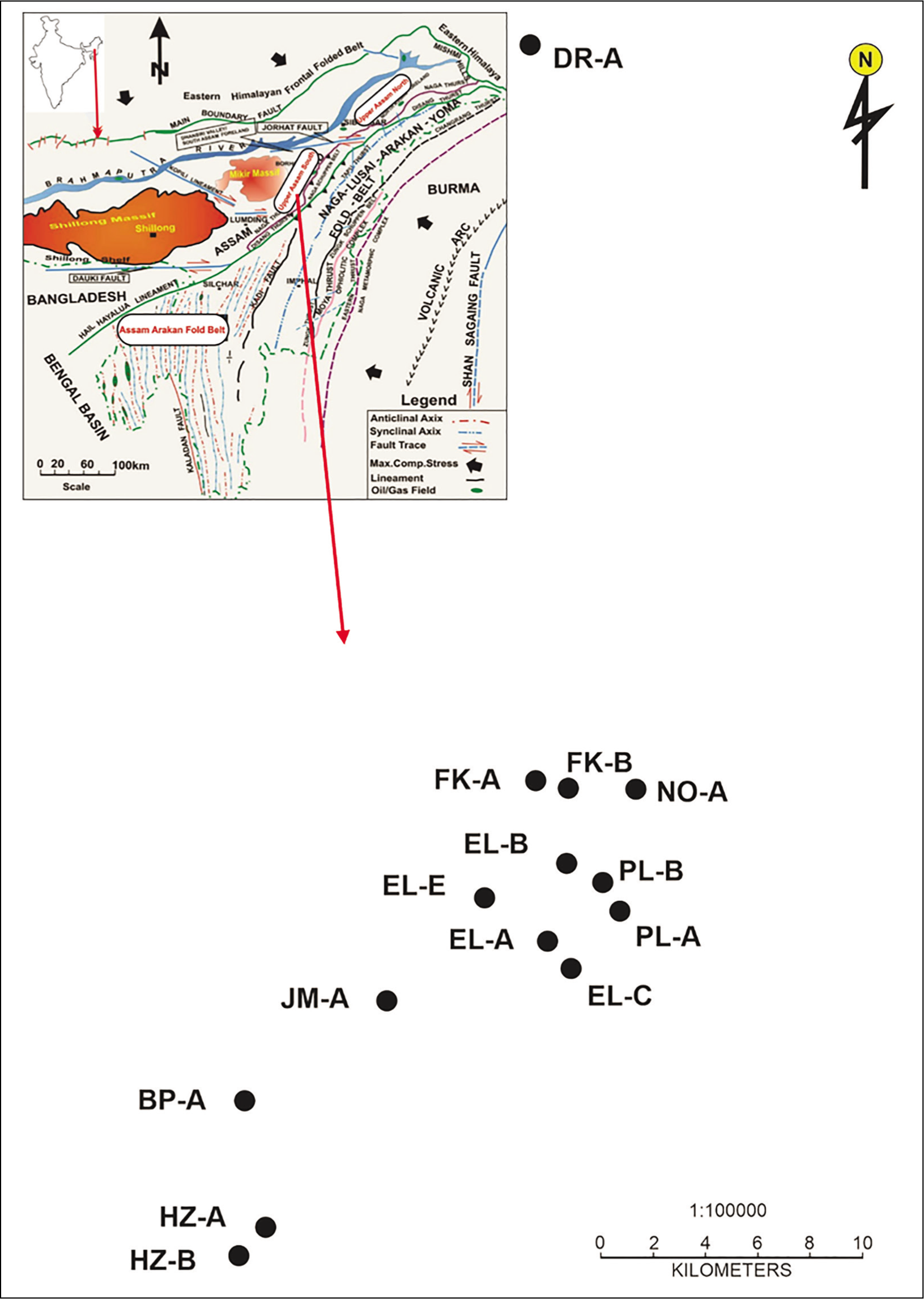
A total of about 200 subsurface samples including conventional cores have been examined for spore-pollen, acritarchs and dinoflagellate cysts from sediments of Tura and Pre-Tura successions in 14 wells, namely, HZ-B, HZ-A, BP-A, JM-A, EL-C, EL-A, EL-E, PL-A, PL-B, EL-B, NO-A, FK-B, FK-A and DR-A located in Dhansiri Valley of Upper Assam Shelf in A&AA Basin (Figure 2).
Location map of studied wells in Dhansiri Valley, Upper Assam Shelf, A&AA Basin.
The samples were processed by adopting the standard processing techniques employed in Regional Geoscience Laboratories and KDMIPE, ONGC, Dehradun (Mathur et al., 1991). Taxonomic identification of dinoflagellate cyst species is followed after Stover and Evitt (1978), Wilson and Clowes (1980), Williams and Bujak (1985) and Williams et al. (1993). The stratigraphic ranges of key dinoflagellate cysts have been determined by Last Appearance Datum and First Appearance Datum and followed the works of Mehrotra et al. (2002), Mehrotra et al. (2005), Mehrotra and Kapoor (2022), Wilson and Clowes (1980), Williams and Bujak (1985) and Williams et al. (1993). The works of Helby et al. (1987), Jansonius and Hills (1976), Nautiyal et al. (2000), Prasad et al. (1985), Singh and Venkatachala (1987), Thanikaimoni et al. (1984), Tiwari and Tripathi (1987) have been used for identification of spores and pollen. Consulted the works of Mehrotra et al. (2002), Mehrotra et al. (2005) and Mehrotra et al. (2022) for interpreting Palynology in Hydrocarbon Exploration of the Indian scenario. Dinoflagellate cysts, acritarchs and spore-pollen assemblages have been considered for interpretation of depositional environment. Data analyses and the results have been described in stratigraphic order.
Discussion on Previous Studies of Pre-Tura Successions in Dhansiri Valley
The Gondwana (undifferentiated) sediments are described from South Shillong Plateau, and the rank of the Gondwana sediments exposed in the Assam-Arakan Basin is uncertain as no full section is developed in the area and only one exposure/occurrence is reported from Singrimari in the Garo Hills of South Shillong Plateau (Fox, 1937). Khanna and Srinivasachari (1973) named the infra-Jaintia Group sediments as the Dergaon Group identified in well DR-A, drilled in Dhansiri Valley. The Dergaon Group comprises of Bamangaon Formation, Mikir Trap and Moabund Formation, in the order of superposition and it is coeval with the Khasi Group of South Shillong and the basal part of Disang Group ranging in age from Early Cretaceous to Maastrichtian.
Discussion on Present Study of Pre-Tura Successions in Dhansiri Valley
Detailed palynological study of Pre-Tura sediments, developed in 14 wells, led to the establishment of biostratigraphy in Dhansiri Valley of Upper Assam Shelf in A&AA Basin by identification of Early Permian, Early Cretaceous and Late Maastrichtian sedimentary sequences with intervening unconformities and having different tectonic history and their distinct palynofossil assemblages in Dhansiri Valley. The results have been presented in stratigraphic order.
Dergaon Formation (Early Permian)
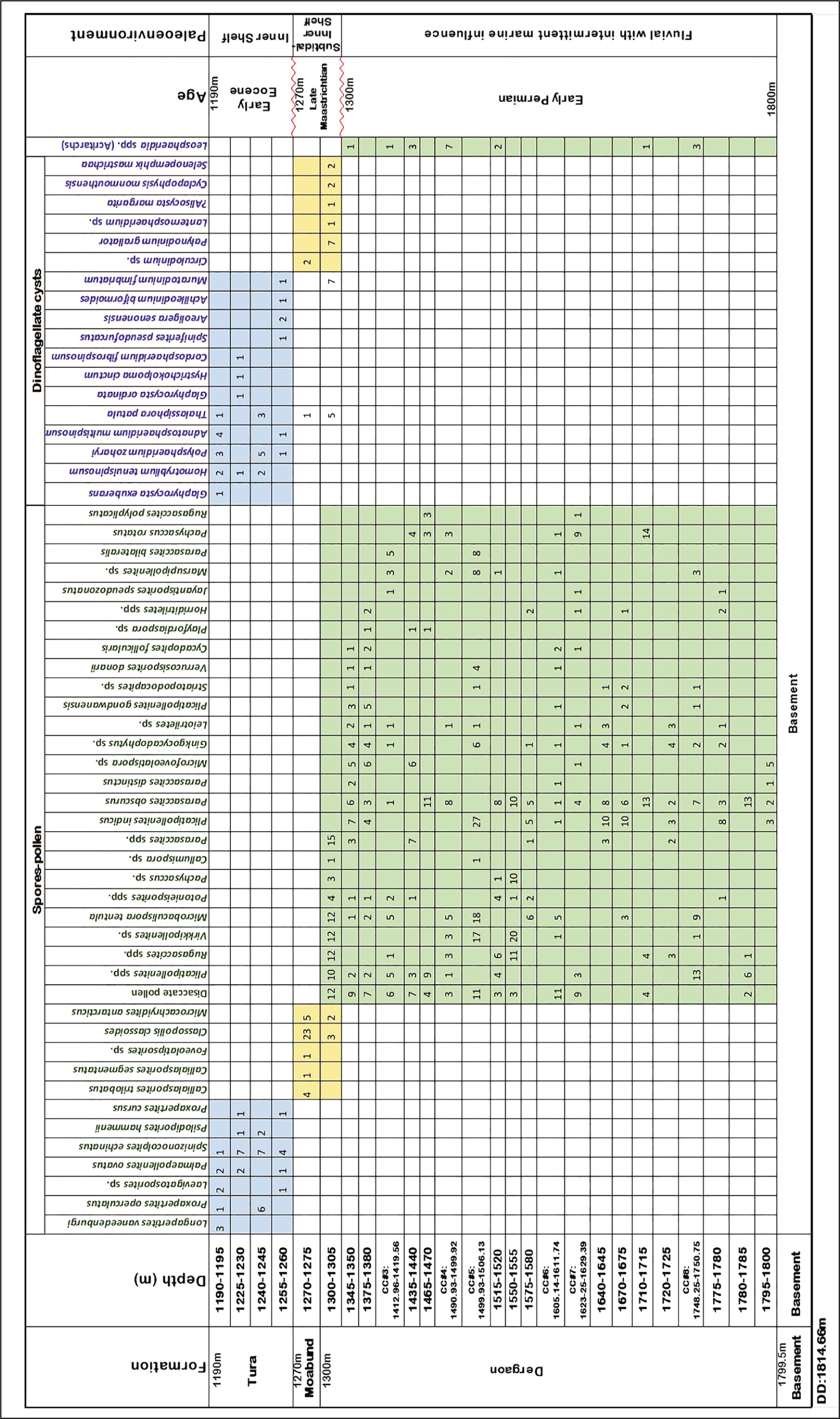
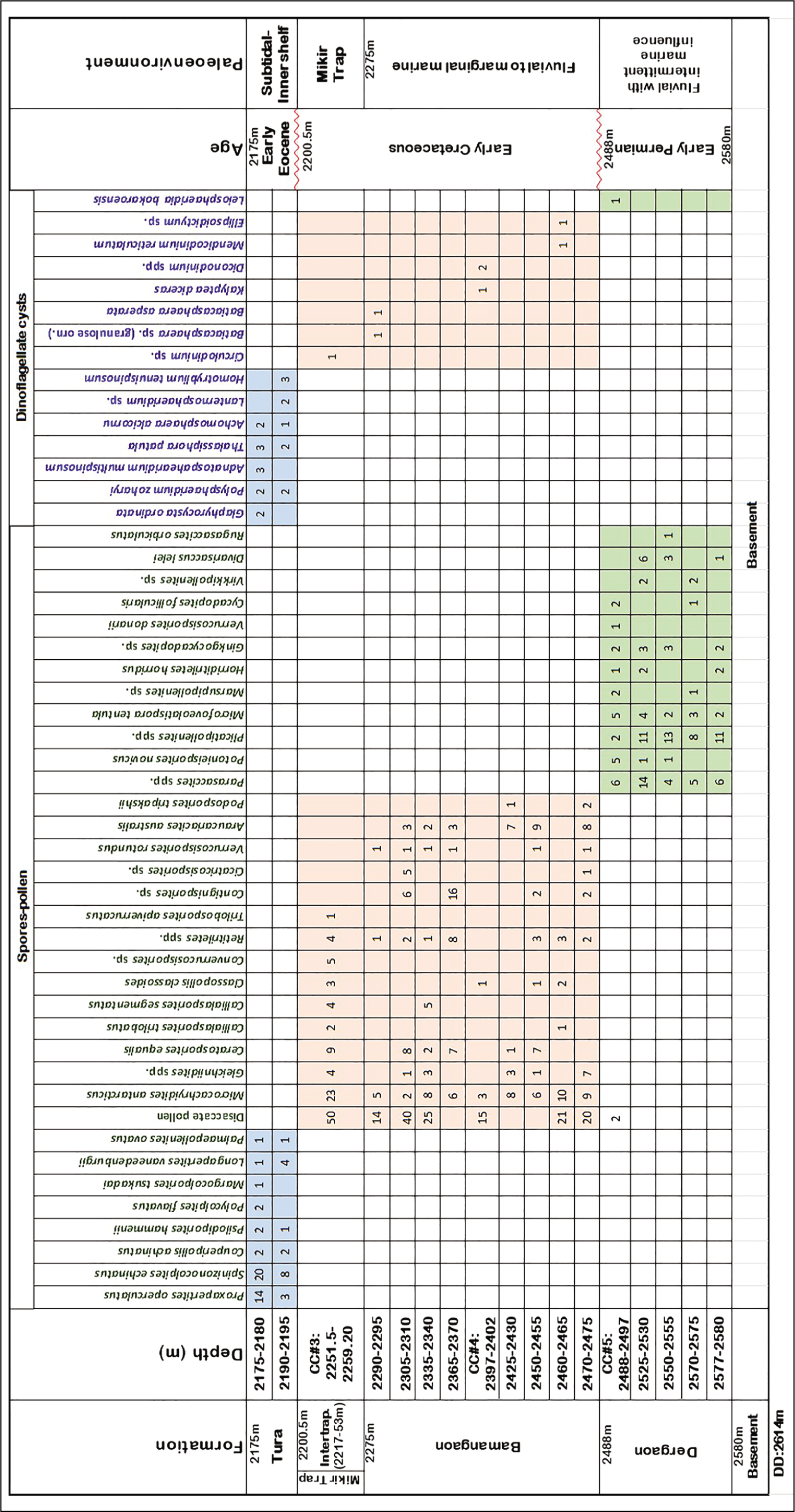
Early Permian sediments, recognised in three wells DR-A (1300–1800 m), EL-A (2406.5–2470 m) and EL-B (2488–2580 m) in Dhansiri Valley are proposed to be designated as Dergaon Formation. Distribution and frequency of spore-pollen and dinoflagellate cysts, interpreted age and paleoenvironment of Early Permian age recognised in wells DR-A and EL-B are shown in Figures 3 and 4, respectively.
The dominant occurrence of radial monosaccate pollen along with trilete spores in association with intermittent occurrence of Leiosphaerids (acritarchs) suggest Early Permian age. Dergaon Formation is inferred to be deposited under fluvial environment with intermittent marine influence as evidenced by the occurrence of spore-pollen assemblages along with Leiosphaerids. Leiosphaerids indicative of marine influence are also known from Umaria coalfield (Srivastava & Prakash, 1984). Leiosphaerids recorded from the Dodhara area of Satpura Basin (Bharadwaj et al., 1978) allow an extension of the marine arm from Umaria and Manendragarh into the Central part of the Indian Peninsula.
Distribution and frequency of spore-pollen, dinoflagellates, interpreted age and paleoenvironment in Dergaon, Moabund and Tura formations of well DR-A in Dhansiri Valley, A&AA Basin.
Distribution and frequency of spore-pollen, dinoflagellates, interpreted age and paleoenvironment in Dergaon, Bamangaon & Tura formations in well EL-B of Dhansiri Valley, A&AA Basin.
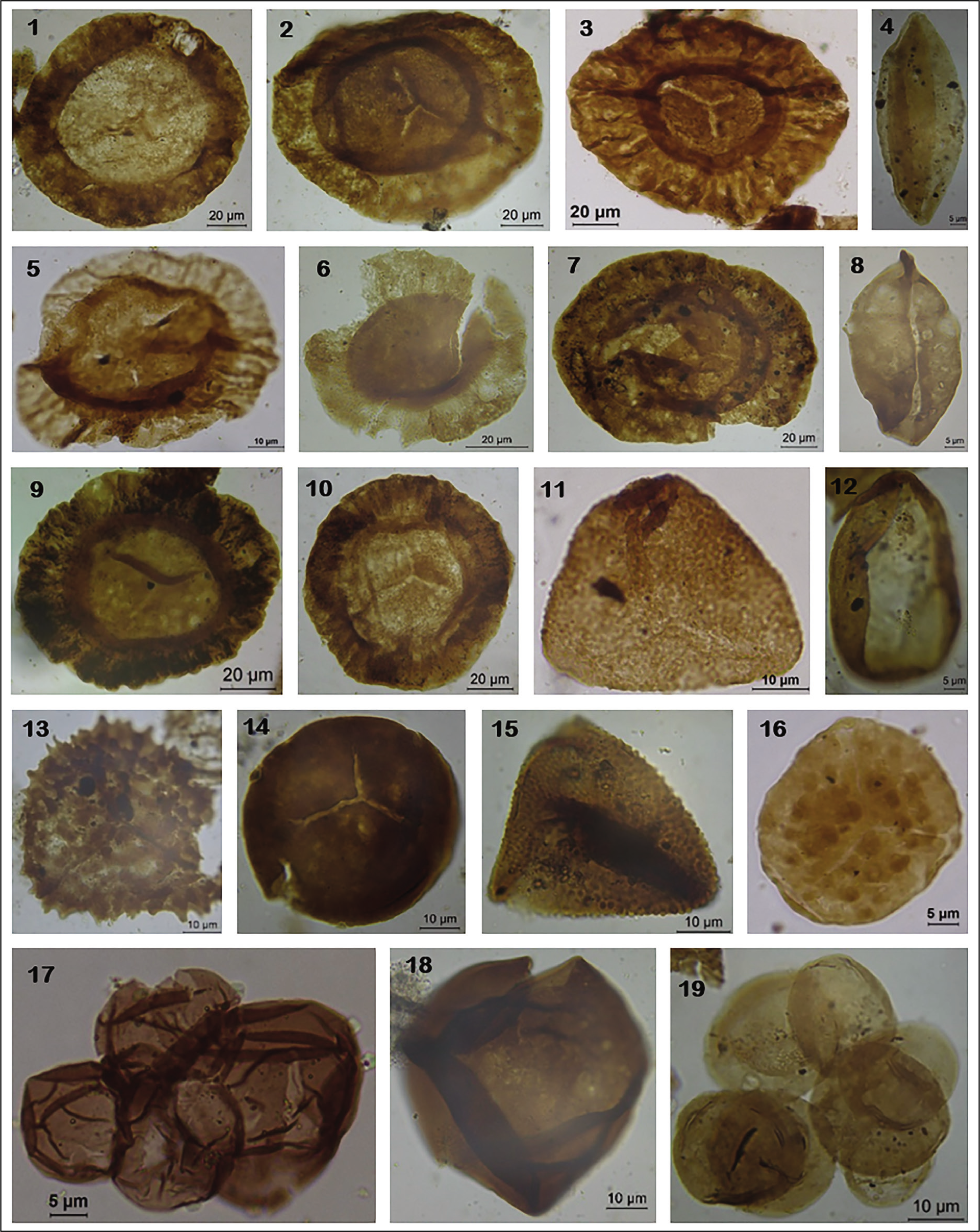
Photomicrographs of characteristic Early Permian palynofossils are illustrated (Plate 1). This Formation is age-equivalent to Talchir Formation. The palynofossil assemblage recovered from Dergaon Formation is closely resembles with Plicatipollenites-Parasaccites Zone of Chandra and Lele (1980). This is also comparable with Potonieisporites neglectus Assemblage Zone of Tiwari and Tripathi (1992) in Peninsular India and Dhraksharama Argillite (=Talchir Formation) of Plicatipollenites indicus-Parasaccites densus spore-pollen zone (Early Permian) in Krishna–Godavari Basin (Prasad et al., 1985).
Early Permian palynofossils recorded from Dergaon Formation; 1. Parasaccites obscurus Tiwari, 1965. DR-A; 2. Plicatipollenites gondwanensis (Balme & Hennelly) Lele, 1964. DR-A; 3. Rugasaccites polyplicatus Lele & Maithy, 1969. DR-A; 4. Ginkgocycadophytus sp. G. cf. cymbatus Lele & Potonie, 1961. DR-A; 5. Plicatipollenites indicus Lele 1964. DR-A; 6. Parasaccites densus Maheshwari, 1967. EL-B; 7. Potonieisporites novicus Bhardwaj, 1954. DR-A; 8. Cycadophytes follicularis Wilson and Webster 1946. EL-B; 9. Pachysaccus rotatus Lele & Maithy, 1969. DR-A; 10. Virkkipollenites triangulaaris (Mehta) Lele, 1964. DR-A; 11. Microfoveolatispora foveolata Tiwari em. Tiwari & Singh 1981. DR-A; 12. Marsupipollenites sp. Balme & Hennelly, 1956. DR-A; 13. Jayantisporites speudozonatus Lele and Makada, 1972. DR-A; 14. Callumispora barakarensis Bharadwaj & Srivastava, 1969. DR-A; 15. Microbaculispora tentula Tiwari, 1965. DR-A; 16. Cf. Simeonospora khlonovae Balme. DR-A; 17. Leiosphaeridia talchirensis Lele & Karim. DR-A; 18. Leiosphaeridia bokaroensis Lele. EL-B and 19. Leiosphaeridia indica Lele & Chandra. DR-A.
Bamangaon Formation (Early Cretaceous)
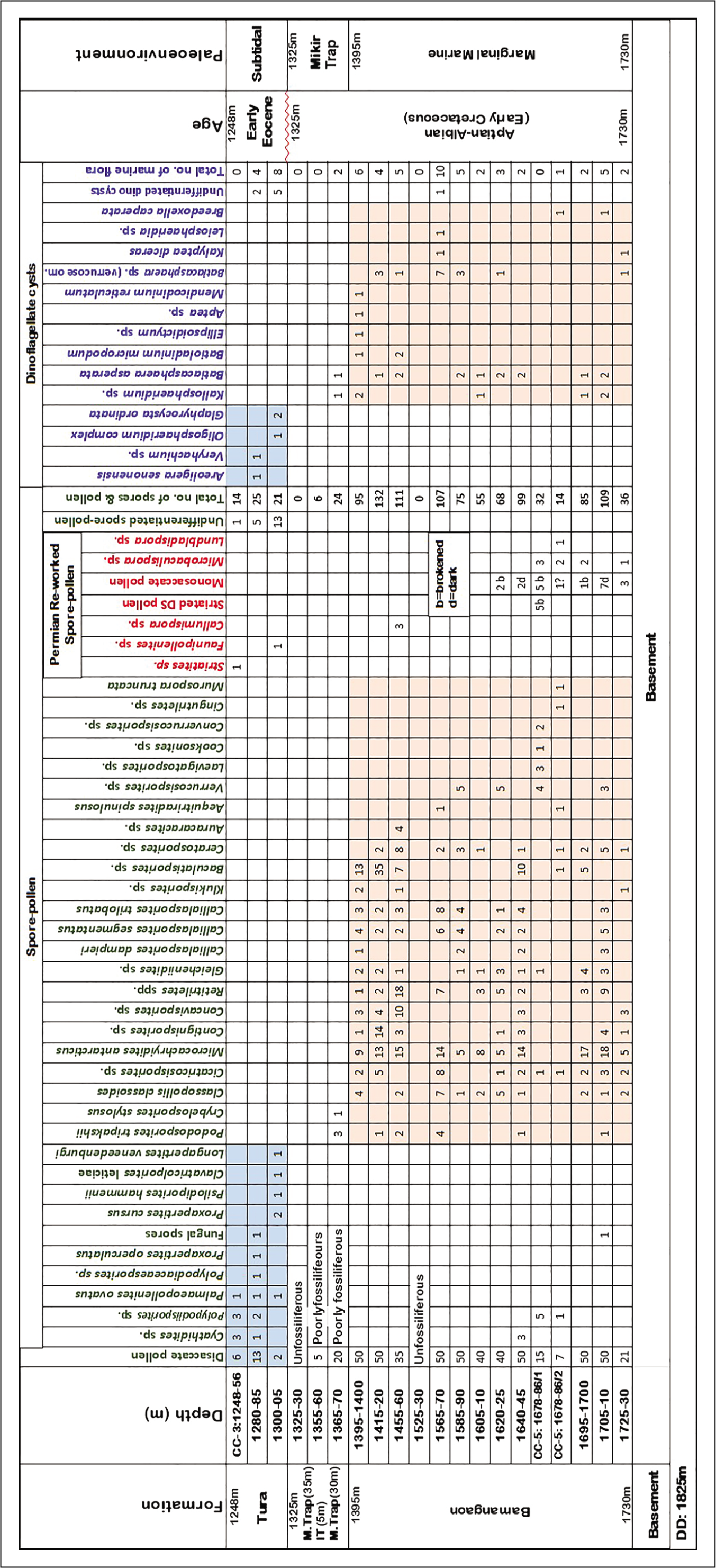
Early Cretaceous sediments, regarded as Bamangaon Formation have been recognised in wells HZ-B (1510–1525 m and 1575–1635 m), HZ-A (1595–1645 m), BP-A (1395–1730 m), JM-A (1550–1585 m and 1620–1860 m), EL-C (2440–2700 m), EL-A (2120–2406.5 m), EL-E (2075–2315 m), PL-B (2625–2705 m), EL-B (2275–2488 m), NO-A (2195–2385 m), FK-B (2040–2170 m) and FK-A (1650–1680 m) except in well DR-A. Based on the occurrence of moderate to rich and diversified spore-pollen and dinoflagellate cysts Early Cretaceous age is assigned. Distribution and frequency of spore-pollen and dinoflagellate cysts, interpreted age and paleoenvironment in well BP-A is shown (Figure 5).
Distribution and frequency of spore-pollen, dinoflagellates, interpreted age and paleoenvironment in Bamangaon and Tura formations of well BP-A in Dhansiri Valley, Assam & Assam-Arakan Basin.
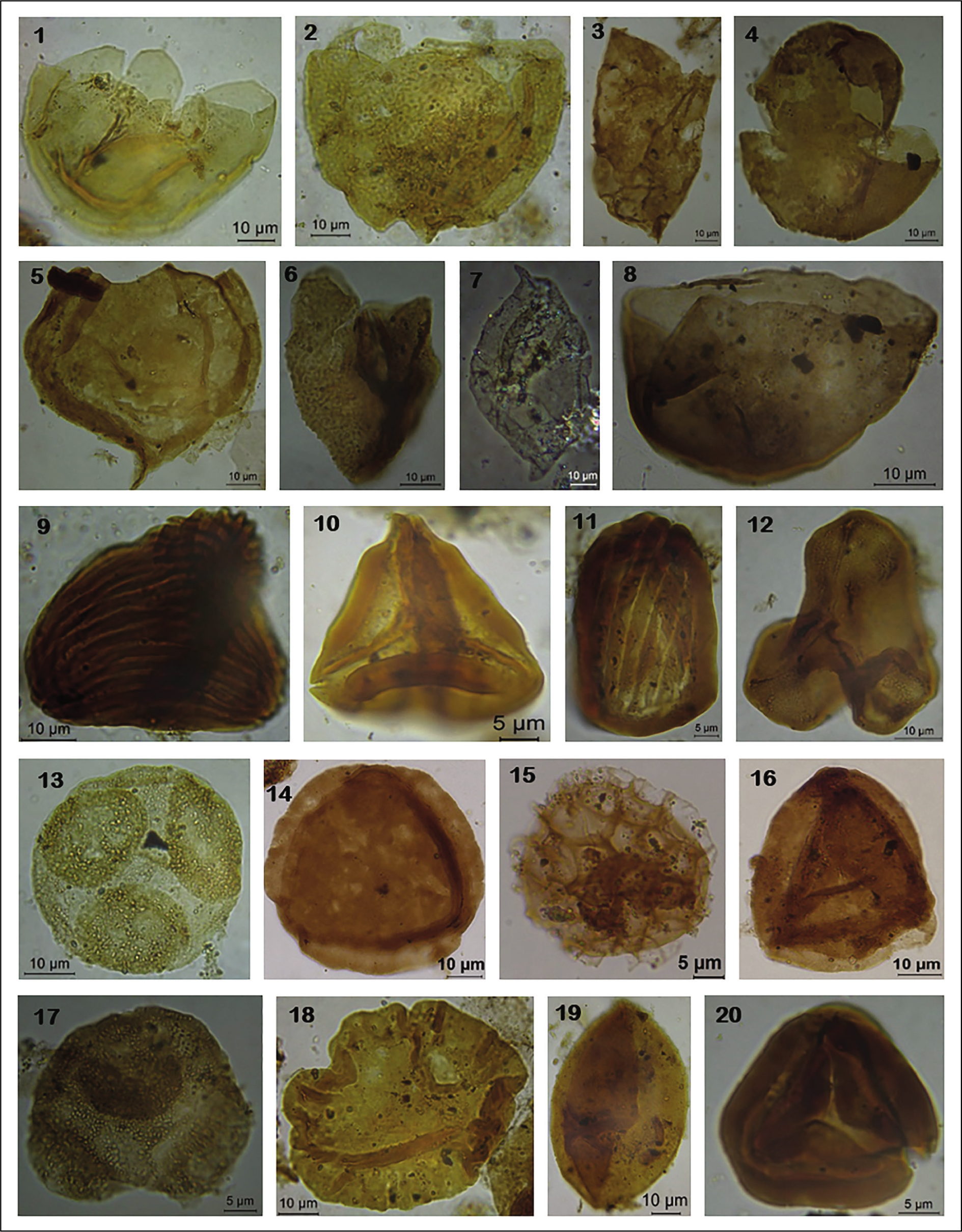
Bamangaon Formation is interpreted to be deposited under marginal marine set-up in wells BP-A and JM-A, in which considerable frequencies of dinoflagellate cysts are recorded, whereas fluvial to marginal marine environment is inferred in wells EL-A, EL-E, EL-B and NO-A as evidenced by intermittent occurrence of dinoflagellate cysts. However, the sediments recognised in wells HZ-B, HZ-A, EL-C, PL-B, FK-B and FK-A are interpreted to be deposited in fluvial environment as no dinoflagellate cyst is recorded. Photomicrographs of characteristic Early Cretaceous palynofossils, corresponding to the Bamangaon Formation are illustrated (Plate 2). These sediments are time equivalent to the Athgarh Formation in Mahanadi Basin, Golapalli Formation in the Krishna–Godavari Basin, Andimadam Formation in Cauvery Basin, Jabalpur Formation in the Satpura Basin and Bhuj Formation in the Kutch Basin.
Early Cretaceous palynofossils recorded from Bamangaon Formation; 1. Batiacasphaera asperata Backhouse. JM-A; 2. Circulodinium colliveri (Cookson and Eisenack 1960b) Helby 1987. JM-A; 3. Batioladinium micropodum (Eisenack & Cookson 1960b). BP-A; 4. Mendicodinium reticulatum (Cookson and Eisenack 1960) Brideaux 1975. BP-A; 5. Aptea sp. Eisenack 1958 emend Davey & Verdier 1974. BP-A; 6. Ellipsoidictyum sp. Klement 1960. EL-B; 7. Kalyptea diceras Cookson and Eisenack 1960b. BP-A; 8. Breedoxella caperata (Brideaux 1977) Norris 1978. BP-A; 9. Cicatricosisporites australiensis (Cookson 1953) Potonie 1956. JM-A; 10. Gleicheniidites circiniidites Dettmann. HZ-B; 11. Contignisporites cooksoniae (Balme1957) Dettmann 1963. BP-A; 12. Trilobosporites sp. Pant 1954 ex Potonie 1956. BP-A; 13. Podosporites tripakshii Rao emend. Kumar 1984. JM-A; 14. Callialasporites trilobatus Dev. JM-A; 15. Retitriletes singhii Srivastava. EL-C; 16. Araucariacites fissus Reiser & Williams 1969. JM-A; 17. Microcachryidites antarcticus Cookson 1947. EL-B; 18. Callialasporites segmentatus Dev. JM-A; 19. Palmidites maximus Couper. HZ-B and 20. Murospora truncata Singh 1971. BP-A.
Mikir Trap
Mikir Trap, overlying Bamangaon Formation, is identified in wells HZ-A (1550–1595 m), BP-A (1325–1395 m), EL-C (2410–2440 m), EL-A (2070–2120 m), EL-E (2045–2075 m), PL-B (2600–2625 m), EL-B (2200.5–2275 m), NO-A (2190–2195 m) and FK-B (2010–2040 m), except two wells FK-A and PL-A, in which the Trap is not recognised. However, the trap is recognised within the Bamangaon Formation in wells HZ-B (1525–1575 m) and JM-A (1585–1620 m). Mikir Trap is dated as Early Cretaceous based on diagnostic palynofossils recorded in Intertrapean sediments recognised in wells EL-B (CC#3: 2251.5–2259.20 m) and BP-A (1365–1370 m). This Trap is age equivalent of the Rajmahal Trap, developed in East Coast basins.
Moabund Formation (Late Maastrichtian)
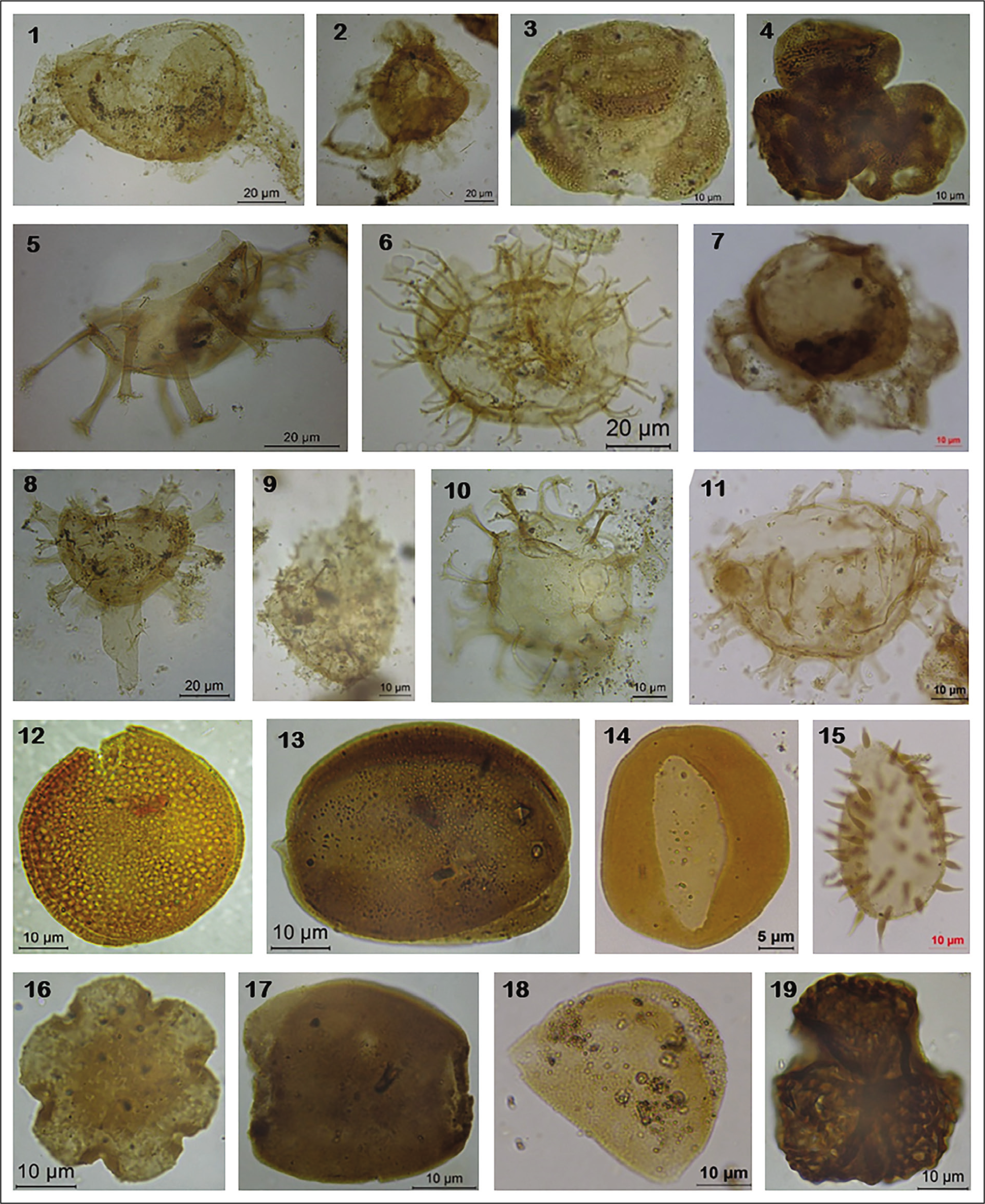
Moabund Formation recognised in well DR-A (1270–1300m) only. Based on the occurrence of characteristic dinoflagellate cysts and spore-pollen assemblage dated as Late Maastrichtian. The Formation is interpreted to be deposited under subtidal to Inner shelf environment. Distribution and frequency of spore-pollen and dinoflagellate cysts, interpreted age and paleoenvironment of the Moabund Formation identified in well DR-A are shown in Figure 3. Moabund Formation is age equivalent to the Langpar Formation of the Khasi Group identified in the Khasi and Jaintia Hills in South Shillong shelf area (Deshpande et al., 1993). Photomicrographs of characteristic Late Maastrichtian palynofossils are illustrated (Plate 3).
Tura Formation (Early Eocene)
The sediments of the Tura Formation are recognised in all the studied wells suggesting Early Eocene age based on the occurrence of characteristic dinoflagellate cysts and spore-pollen assemblages. Tura Formation yielded a rich assemblage of dinoflagellate cysts suggesting marine influence all over the studied area. Photomicrographs of characteristic Early Eocene palynofossils, corresponding to the Tura Formation are illustrated (Plate 3).
Figs. 1–4 Late Maastrichtian palynofossils recorded from Moabund Formation; 1. Palynodinium grallator Gocht 1974a. DR-A; 2. Cyclapophysis monmouthensis Benson 1976. DR-A; 3. Microcachryidites antarcticus Cookson. DR-A; 4. Classopollis classoides (Jansonius) Srivastava. DR-A. Figs. 5–19 Early Eocene palynofossils recorded from Tura Formation; 5. Homotryblium tenuispinosum Davey & Williams in Davey et al., 1966. DR-A; 6. Areoligera senonensis Lejeune-Carpentier 1938. DR-A; 7. Thalassiphora patula (Williams & Downie in Davey et al., 1966) Stover & Evitt 1978. NO-A; 8. Hystrichokolpoma cinctum Klumpp 1953. DR-A; 9. Spinidinium sp. Cookson & Eisenack 1962b, emend. Lentin & Williams 1976. NO-A; 10. Glaphyrocysta ordinata (Williams & Downie in Davey et al., 1966) Stover & Evitt 1978. DR-A; 11. Polysphaeridium zoharyi (Rossignol 1962) Bujak et al., 1980. PL-A; 12. Proxapertites cursus van Hoeken-Klinkenberg. JM-A; 13. Proxapertites operculatus van der Hammen. EL-C; 14. Palmaepollenites ovatus Sah & Kar. JM-A; 15. Spinizonocolpites echinatus (Deflandre 1938b) Stover and Evitt 1978. NO-A; 16. Pseudonothofagidites cerebrus Venkatachala & Kar. EL-C; 17. Psilodiporites hammenii Varma & Rawat. DR-A; 18. Longapertites sp. van Hoeken-Klinkenberg. HZ-B and 19. Margocolporites tsukadai Ramanujam. EL-C.
Biostratigraphic Correlation
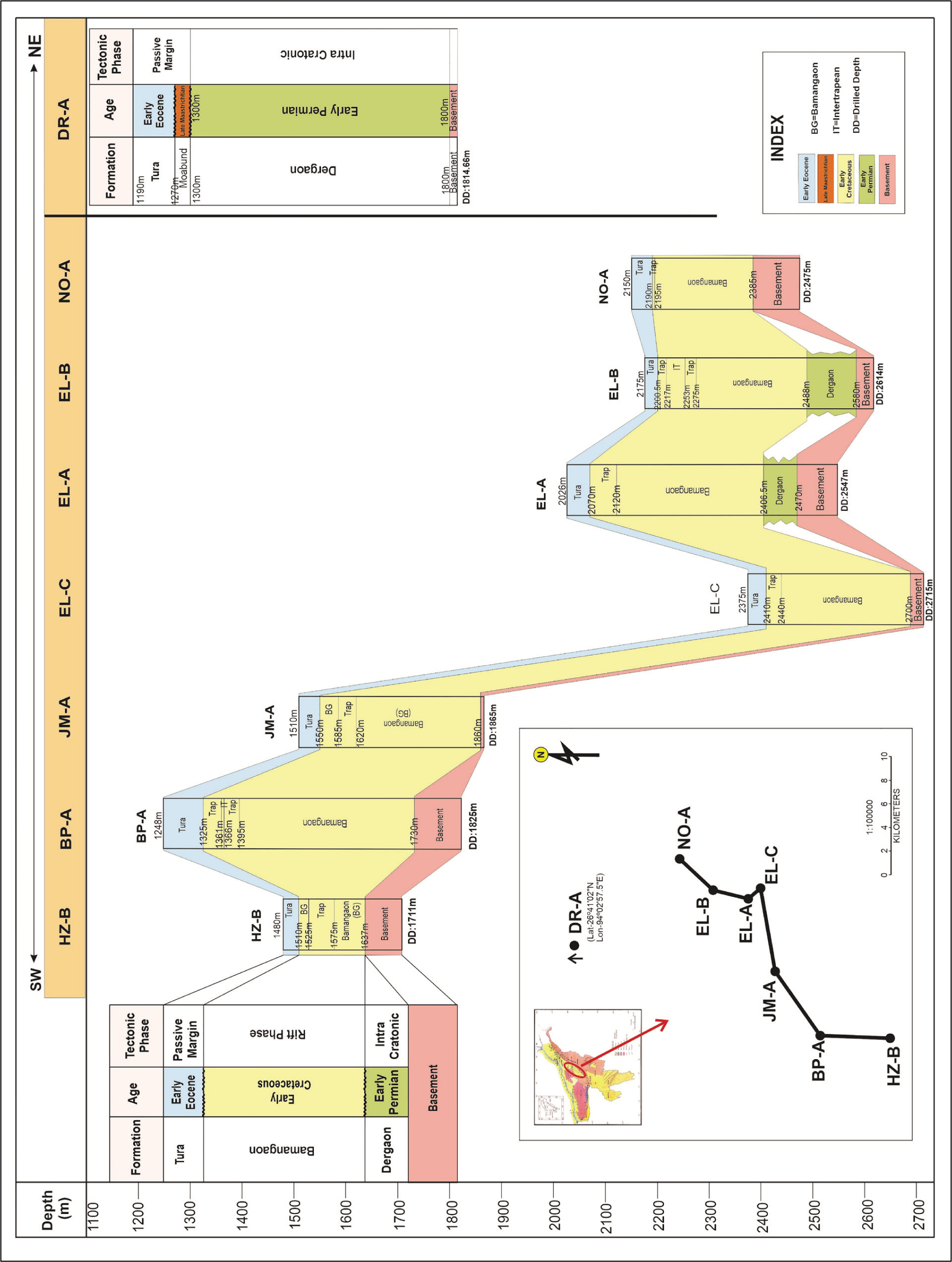
An attempt has been made for biostratigraphic correlation of Tura and Pre-Tura sediments recognised in wells located from SW to NE direction (strike profile) based on palynofossil data. A schematic diagram showing the correlation of Dergaon (Early Permian), Bamangaon (Early Cretaceous), Moabund (Late Maastrichtian) and Tura (Early Eocene) formations recognised in Dhansiri Valley of Upper Assam Shelf, A&AA Basin is shown in Figure 6.
Stratigraphy of Tura and Pre-Tura Formations in Dhansiri Valley
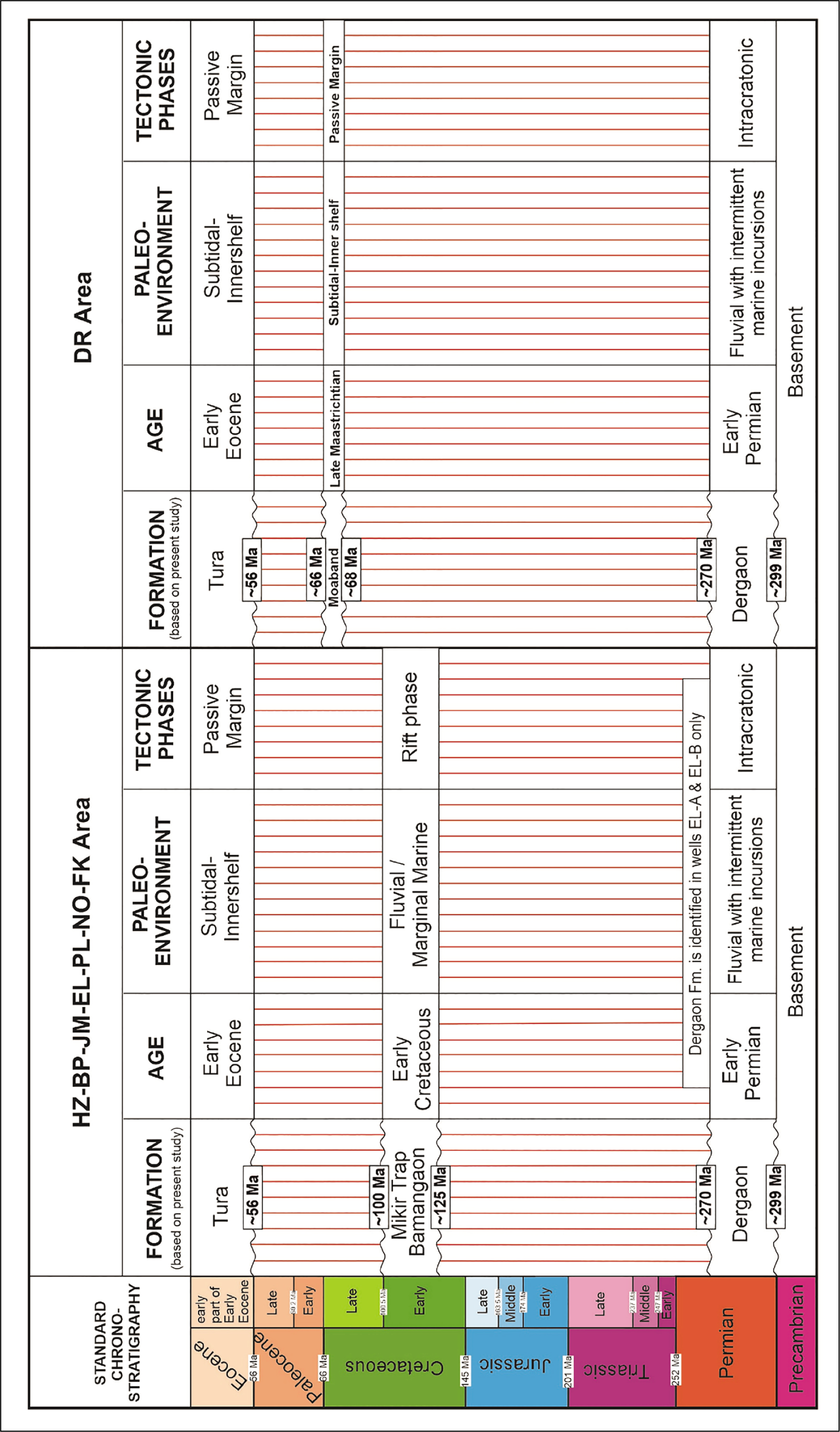
Early Permian sediments, the oldest in the basin, deposited under the intracratonic phase that have been identified in wells EL-A, EL-B and DR-A, overlie the metamorphic basement complex. The sediments of Bamangaon Formation, deposited under the rift phase, overlie Deragaon Formation with an unconformity of ~145 Ma in wells EL-A and EL-B, whereas in the rest of the wells these sediments are directly resting on the metamorphic basement complex with an unconformity of ~174 Ma. In well DR-A, the Early Permian sediments are directly overlain by Late Maastrichtian sediments of the Moabund Formation deposited under passive margin tectonic phase with an unconformity of ~202 Ma. Sediments of the Tura Formation deposited in the passive margin tectonic phase overlie the Maobund Formation with a hiatus of ~10 Ma in DR-A area. However, these sediments overlie the Bamangaon Formation with an unconformity of ~44 Ma in the rest of the wells in Dhansiri Valley (Figure 7).
Schematic diagram showing correlation of Dergaon, Bamangaon, Moabund and Tura formations in studied wells of Dhansiri Valley, Upper Assam Shelf, Assam & Assam-Arakan Basin.
Stratigraphy of Tura & Pre-Tura formations in Dhansiri Valley, Upper Assam Shelf, Assam & Assam-Arakan Basin (Modified after Deshpande et al., 1993).
Conclusions
Detailed palynological study of Tura and Pre-Tura sediments, developed in studied wells, led to the identification of Dergaon (Early Permian), Bamangaon (Early Cretaceous), Moabund (Late Maastrichtian) and Tura (Early Eocene) formations with intervening unconformities, having different tectonic history and distinct palynofossil assemblages in Dhansiri Valley.
Early Permian sediments of Dergaon Formation (=Talchir Formation), the oldest in the basin, are deposited under the intracratonic phase, overlie the metamorphic basement complex and are inferred to be deposited under fluvial environment with intermittent marine influence.
Bamangaon Formation unconformably overlies Dergaon Formation in wells EL-A and EL-B, and the metamorphic basement complex in the rest of the wells, deposited under fluvial-marginal marine environment during Early Cretaceous age of the rift phase.
Dergaon Formation directly overlain by Moabund Formation corresponding to Late Maastrichtian age of passive margin sediments, deposited under subtidal to innershelf environment recognised in well DR-A only with an unconformity of ~202 Ma.
Mikir Trap dated as Early Cretaceous age based on dinoflagellate cysts, overlying Bamangaon Formation, is identified in all the studied wells except wells FK-A and PL-A. This Trap is age equivalent of the Rajmahal Trap, developed in East Coast basins.
Sediments of Tura Formation, overlie Maobund Formation with hiatus of ~10 Ma in well DR-A and they overlie Bamangaon Formation in the rest of the wells of Dhansiri valley with an unconformity of ~44 Ma deposited under passive margin setup during Early Eocene with paleoenvironment ranging from subtidal to innershelf.
The detailed study has led to updation of stratigraphy of Tura and Pre-Tura successions, interpretation of precise age, major breaks in sedimentation, and depositional environment in Dhansiri Valley, Assam & Assam-Arakan Basin.
The results of the study will be helpful in understanding Regional Stratigraphy, History of Plate Tectonics, Basin Evolution, and provide significant inputs for Hydrocarbon Exploration in Dhansiri Valley, Assam & Assam-Arakan Basin.
Footnotes
Acknowledgements
The authors wish to express their sincere gratitude to Smt Sushma Rawat, Director (Exploration), ONGC, New Delhi, for granting permission to publish this work, constant encouragement and valuable suggestions. The authors are thankful to Sri Gour Mohan Das, ED-Chief Labs, Mumbai for motivation and constant support. The authors are thankful to Shri Vishal Shastry, ED-Basin Manager, A&AA Basin, Jorhat for assigning the project, motivation and support. The authors are grateful to Sri K. Karvannan, CGM-Basin Manager, KG-PG Basin, Rajahmundry for constant support and guidance. Dr Naresh Mehrotra and Dr Anju Saxena are thanked for their valuable reviews that helped improve the manuscript.
Declaration of Conflicting Interests
The authors declared no potential conflicts of interest with respect to the research, authorship and/or publication of this article.
Funding
The authors received no financial support for the research, authorship and/or publication of this article.