




Abstract
The present study is the first taxonomical account of Ostracoda occurring in the sediments of the Ashtamudi Lake in Kerala, intending to generate a baseline for future palaeo-ecological or palaeoenvironmental applications. A total of 22 Ostracod species belonging to 16 genera, 11 families, 5 superfamilies and 2 suborders of the order Podocopida have been identified from 66 surface sediment samples collected across the lake. Sedimentological parameters, such as CaCO3, organic matter, sand silt and clay, were estimated and their distribution is discussed. The ratio between the carapaces and open valves has been taken into consideration for determining the rate of sedimentation in the study area.
Introduction
The use of bioindicators proves to be advantageous in estimating the impact of environmental stressors and pollution on biota in ecosystems (Tan et al., 2021). Ostracods are one such sensitive group of inhabitants of all aquatic environments. They are highly sensitive to environmental changes and are increasingly recognised as bioindicators of pollution gradients (Ruiz et al., 2004, 2005, 2006; Vilela et al., 2011; Yasuhara et al., 2012). The physicochemical properties of the water column and substrate nature are the key factors controlling ostracod distribution in estuarine and continental shelf zones (Nishath et al., 2015; Yassini & Jones, 1995). Thus, the present study attempts to document the ostracod taxa from an environmentally stressed waterbody, the Ashtamudi Lake from the southwest coast of India (Hussain et al., 2020; Press Trust of India, 2021).
The coastal areas of Kerala have been bestowed with many estuaries, lakes and backwaters known as Kayals lying parallel to the Lakshadweep Sea. The Kayals of Kerala coast are separated from the sea by elongated sandbars. Before entering the Lakshadweep Sea, the majority of the 44 rivers that flow through Kerala drain into these backwaters (Kayals). The Ashtamudi Lake (locally known as Ashtamudi Kayal) is the largest coast-perpendicular estuary along the western peninsular. There are some systematic studies of recent ostracods in the Kerala coast by Jain (1981), Gopalakrishna et al. (2007), Hussain and Kalaiyarasi (2013) and Hussain et al. (2016). No ostracod systematics has been done on the Ashtamudi Lake surface sediments. Thus, the prime objective of the present study was to generate a baseline data for Ostracoda distribution in the Lake.
Study Area
The Ashtamudi Lake/Kayal is the second largest in Kerala after the Vembanad Lake with depths ranging from 1 m to 5.5 m, located between the latitudes of 8º 31'– 9º 02' N and 76º 31'—76 º 41' E respectively. ‘Ashta’ (eight), ‘Mudi’ (head) Lake is a palm-shaped wide water body with eight distinct extending heads, adjoining the Kollam town. The estuary drains into the Lakshadweep Sea through a 200 m wide mouth that serves as a permanent connection to the Sea (Nair et al., 1983). The Ashtamudi estuary has a length of 16 km with an area of 54 km2. The massive amount of silt-laden inflow from the rivers and the stirred-up sediments brought into the estuary during the flood tides are the major sources of sedimentation in the estuary (Nair & Azis, 1987). The Kallada River that originates in the Western Ghats is the major freshwater input to the estuary formed by the confluence of the Chendurni, Kalthuruthy and Kulathupuzha tributaries. A few individual islets (thuruths) are also observed within the estuary.
Methodology
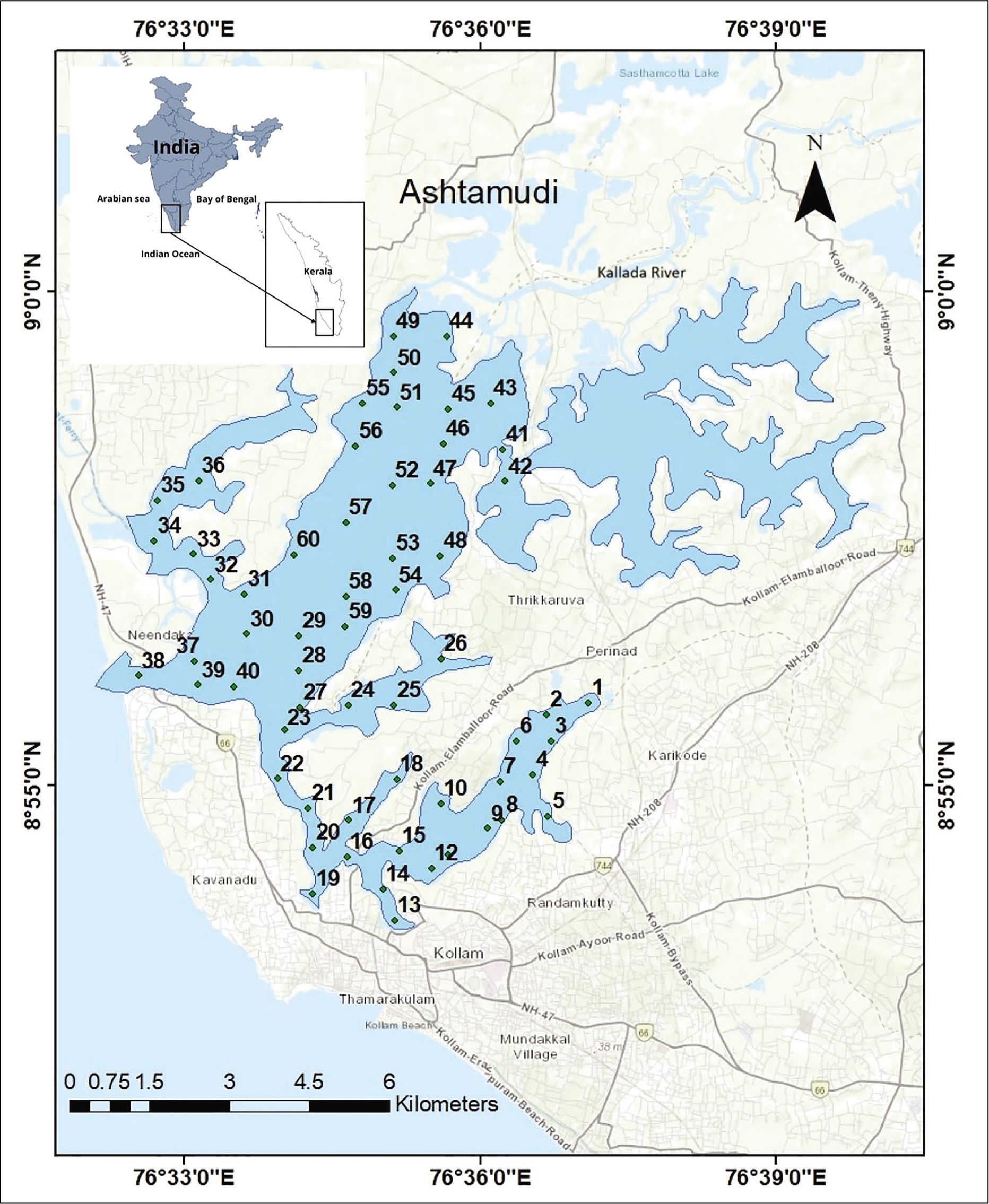
In total, 60 surface sediments were collected from Ashtamudi Lake using a 2 kg Van-Veen grab sampler adopting a fishnet grid sampling pattern, pre-decided using ArcGIS 10.3 and located using GPS Garmin eTrex 30 (Figure 1). The bathymetry of the lake varies from 2 m to 6 m. The top 10 cm of the surface sediment samples were collected for analysis.
Sampling locations in the Ashtamudi Lake, Kerala, India.
Calcium carbonate content (CaCO3 in %) and organic matter (OM in %) in the sediments were determined using protocols suggested by Loring and Rantala (1992) and Gaudette et al., (1974), respectively. Organic matter (OM in %) was determined by exothermic heating and oxidation with potassium di-chromate and concentrated H2SO4. The excess amount of dichromate was titrated with 0.5 N of Ferrous Ammonium Sulphate solution (Gaudette et al., 1974). Sand, silt and clay percentages were calculated using a combination of sieving and pipette procedure, the latter in accordance with Krumbein and Pettijohn (1939) and a description was given to the substrate based on Trefethen’s (1950) textural nomenclature. The classification proposed by Hartmann and Puri (1974) has been followed for the Ostracod taxonomy. For retrieving Ostracoda from the sediment matrix, 5 g of dried sediment samples were soaked overnight in (NaPO3)6 solution of 0.025 N for disintegration and washed through a 63-µm sieve.
Results and Discussion
Environmental Parameters
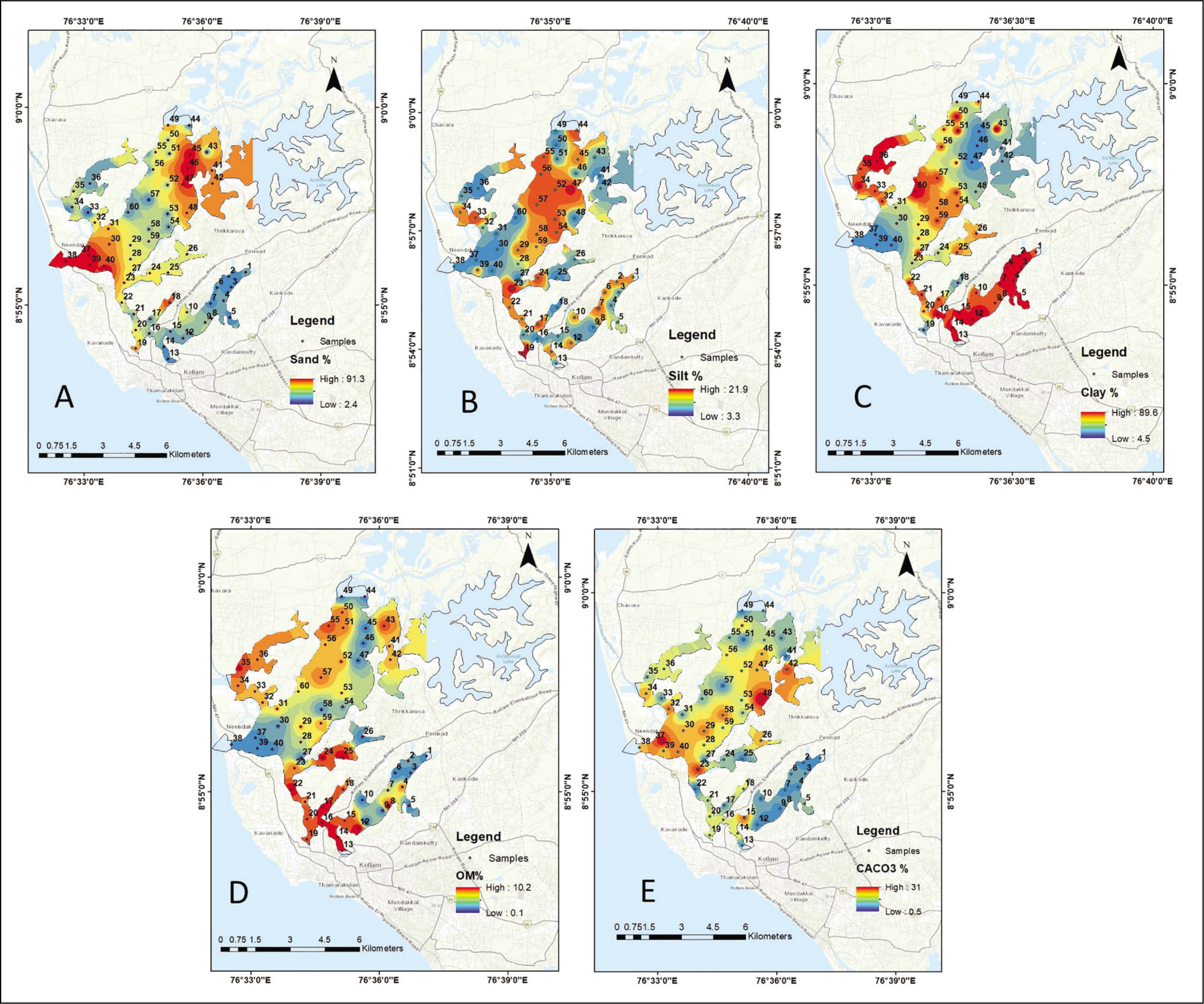
The relative abundance of the sand, silt and clay in the surface sediment samples from Ashtamudi Lake shows different compositions at different places. The results have been illustrated using spatial distribution maps using ArcGIS 10.3 software. The silt and clay percentages range from 3.3% to 21.9% and 4.5% to 89.6%, respectively. The sand percentage ranges from 2.4 to 91.3% at an average of 20.2% (Figure 2A–C). Clay and silty-clay were the dominant sediment substrate in the Lake especially at the extending heads whereas sand percentage is maximum at the estuarine mouth and the lower reach of the Kallada River (Hussain et al., 2020; Sajan et al., 1992).
The organic matter content in the sediments ranges from 0.1% to 10.2% having an average value of 4.5 (Figure 2D). The minimum concentration of the organic matter was observed in the centre of the lake and can be attributed to the constant freshwater influence of the river Kallada into the lake and flushing of seawater in tidal cycles (Jonathan et al., 2004). The maximum concentration of the organic matter (10.2%) was found to be at the extending heads of the lake which could be due to the high terrigenous input in those regions (Hussain et al., 2020). Calcium carbonate in the study area ranges from 0.5% to 31% having an average value of 9.3%. The determined values are plotted in Figure 2E. CaCO3 was higher at the estuarine mouth and reduced towards the centre of the lake and the surficial distribution. Sajan et al. (1992) have reported the CaCO3 content to be indirectly proportional to the organic matter distribution in the lake
Spatial distribution map of (A) sand, (B) silt, (C) clay, (D) organic matter and (E) CaCO3 percentage abundance in the Ashtamudi Lake, Kerala.
Distribution of Ostracods
Classification for Ostracoda proposed by Hartmann and Puri (1974) has been followed in the present study. 22 ostracod species belonging to 16 genera, 11 families, 5 superfamilies and 2 suborders of the order Podocopida (Table. 1) have been identified. Totally 346 ostracod shells were retrieved with 321 open valves and 25 carapaces. As expected, the assemblage is typical tropical brackish to epi-neritic and shallow marine species.
Taxonomic chart of Ostracoda recorded from the Ashtamudi Lake, Kerala, India.
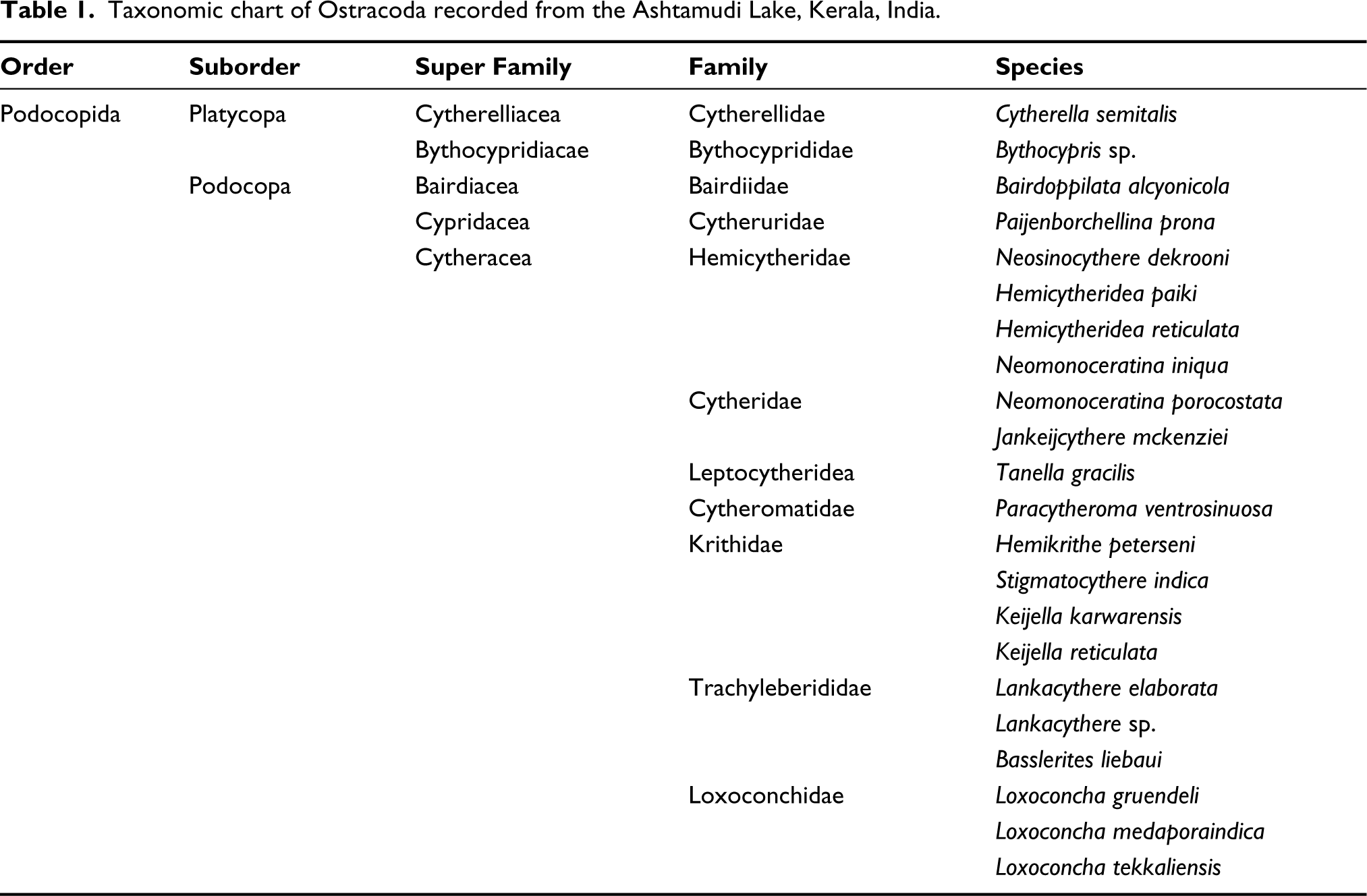
Jankeijcythere mckenziei, Neosinocythere dekrooni, Hemicytheridea paiki, Basslerites liebaui and Paijenborchellina prona are the typical backwater fauna (Bhandari & Singh, 2006; Ganesan & Hussain, 2010; Hussain & Kalaiyarasi, 2013) recovered during the study. The presence of other species, such as Lankacythere elaborata, Bairdoppilata alcyonicola, Keijella reticulata and Neomonoceratina porocostata, in the backwaters of Ashtamudi can be due to the tidal influence (Al-Abdul-Razzaq et al., 1983; Whatley & Quanhong, 1988) in the Ashtamudi Lake. Tanella gracilis found is a cosmopolitan species (Witte, 1993).
Sediment texture and surface ornamentation of Ostracoda
In the present study, four types of ornate forms of Ostracoda (including smooth ones) have been noticed. They are categorised as follows:
Smooth and fragile forms represented by Paracytheroma ventrosinuosa, occurring in clayey substrates. Moderately calcified and pitted forms, constituted by H. paiki, N. dekrooni, B. alcyonicola and B. liebaui, occurring in silty sand areas. Fine to moderately reticulate and ridged forms comprising N. porocostata, Stigmatocythere indica, J. mckenziei, Hemicytheridea reticulata, Keijella karwarensis, Loxoconcha tekkaliensis, L. gruendeli, L. megapora indica and T. gracilis, occurring in silty clay areas. Conspicuously ornate forms (typical box type, spinose, nodose, etc.) represented by K. reticulata, L. elaborata, P. prona and Neomonoceratina iniqua, occurring in sandy areas.
Of the 22 species encountered in the study area, only 4 are smooth forms while the remaining are either moderately calcified, pitted or highly ornate forms. Certain forms are slightly calcified, whereas most of the other forms are ornamented with strong reticulations. The diversity as well as abundance is more in silty clays, followed by the clayey substrate. The substrates carrying organic matter yielded a good number of Ostracoda (stations nos. 18, 19, 23, 25, 29, 31, 32 and 34). The forms, which are smooth and finely pitted, prefer finer substrate, while the highly calcified and ornamented forms prefer comparatively coarse-grained sediments. The substrate texture is known to control types of ostracod fauna (Brasier, 1980). The textural stability of sediment comprising the substrate exerts a strong influence on marine ostracods. Smooth forms are predominant in fine-grained muds, whereas more ornamented forms are found in coarser or more calcareous sediment (Benson-Evans, 1961; Brasier, 1980). The substrate sediment texture has a control on the kind of ostracod fauna that can colonise a particular sediment type (Armstrong & Brasier, 2005).
Carapace to Open valve ratio
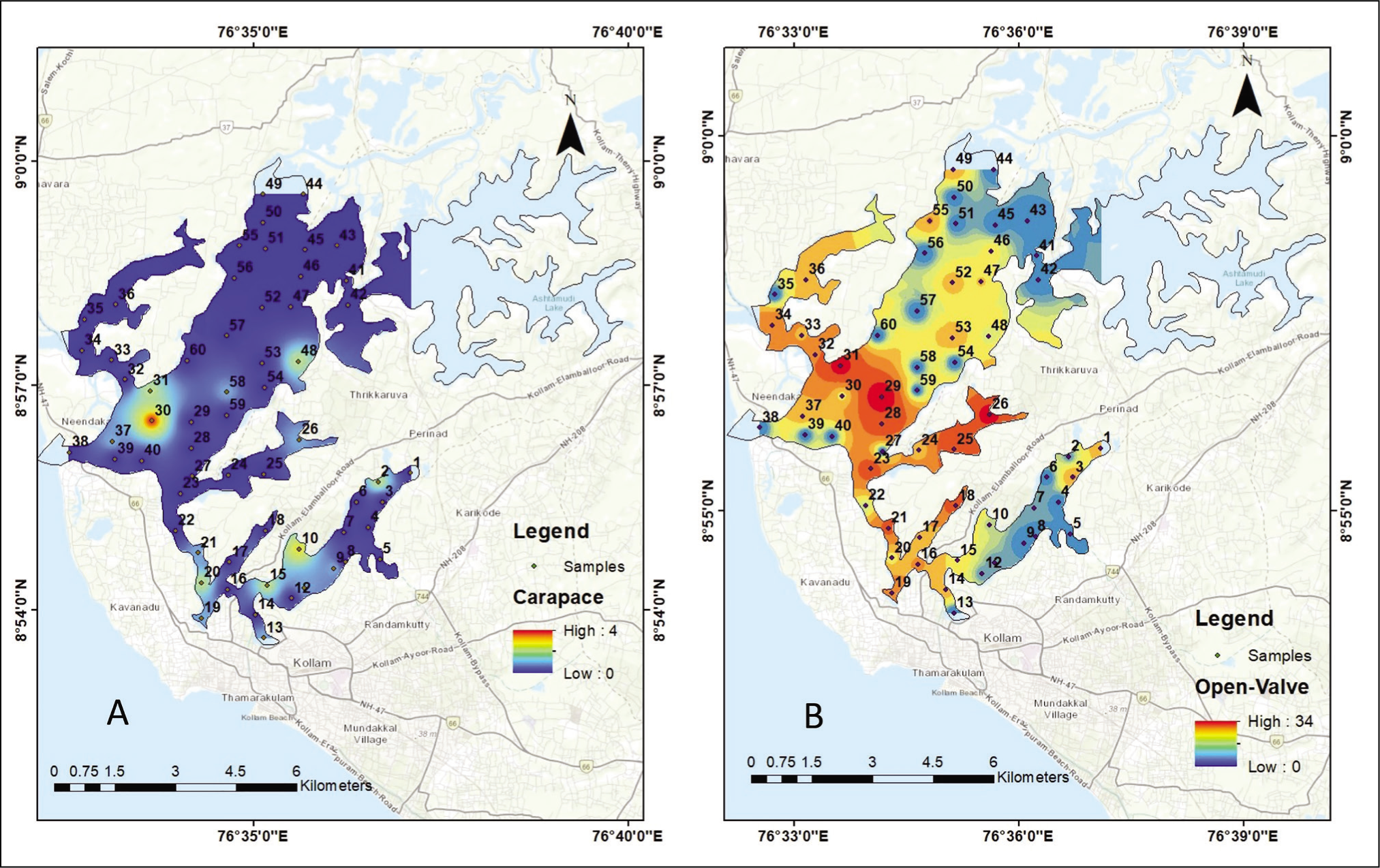
A total of 346 ostracod shells were recovered from the 60 sediment samples collected in the Ashtamudi Lake. Of these, 25 specimens are entire carapaces, while the remaining 321 specimens are open valves (Figure 3). The average ratio of carapaces (7.22%) to open valves (92.77%) is extremely low (0.077) and reveals a very low rate of sedimentation in the Ashtamudi Lake, which is not very conducive to the preservation of organic matter. HJ (1971) reviewed Pokorny’s work (1998) and related the carapace-to-valve ratio to potential information on hydrocarbon. He observed that when this ratio is high, the rate of sedimentation is rapid and disarticulation of the carapace into separate valves is minimal.
Representing the spatial distribution map of (A) carapace and (B) open-valve in the Ashtamudi Lake, Kerala.
Conclusions
The present study reveals a poor abundance of ostracods in the surface sediments of the Ashtamudi Lake represented by 22 species. Of these, certain typically marine species, such as, K. reticulata, Lankacythere elaborate, N. porocostata and B. alcyonicola seem to have been transported into the lake due to the tidal fluctuations. There is a strong correlation between the substrate type and ornamentation of the ostracoda, based on which four different microenvironments can be identified, namely locations characterised by silty clays, silty sands, pure clays and pure sandy substrates. The carapace to open valve ratio suggests a very low rate of sedimentation in the Ashtamudi Lake. This study has provided a sound framework to understand the palaeoenvironments of older sediments, this database may be used.
Footnotes
Acknowledgements
The authors are also thankful to the Department of Geology, University of Madras for extending their support in this work by providing laboratory facilities. The authors are thankful to Dr M.L. Nagori, Professor, Department of Geology, MLSU, Udaipur and an anonymous reviewer for giving valuable suggestions to improvise the manuscript. Dr Rajani Panchang’s efforts in significantly editing the manuscript are highly appreciated.
Declaration of Conflicting Interests
The authors declared no potential conflicts of interest with respect to the research, authorship and/or publication of this article.
Funding
The authors received no financial support for the research, authorship and/or publication of this article.