



Abstract
Background:
Food-based strategies have a high potential of improving the diet quality and reducing the prevalence of nutrient deficiencies in agriculture-dependent communities. Their design is however complex with trade-offs that are rarely systematically presented to allow replication and efficient contextualization.
Objective:
The systematic design of a food-based strategy to improve the dietary diversity of children in rural farming communities in Uganda.
Methods:
The intervention mapping protocol was used to provide a systematic approach to developing theory-based and evidence-based intervention methods and strategy.
Results:
The priority behavioral and environmental determinants identified were related to food production, consumption, and efficacy while the personal determinants focused on knowledge, skills, self-efficacy, attitude, and outcome expectations. The aim of the resulting strategy was set to improve the availability, accessibility, and consumption of diverse foods, with a particular focus on production diversity, production practices, market access, and market diversity. Behaviour change methods were selected to enhance ability and self-efficacy, strategic goal setting, and provision of feedback. The strategy focused on household groups for learning, demonstration, practice, and social support. The validation showed that the determinants and actors incorporated in the strategy were important and relevant for improving the productivity, food availability, dietary diversity, livelihoods, and health of rural farming households and communities.
Conclusion:
Application of the protocol yielded a contextualized food-based strategy that can be adjusted for use in other smallholder contexts in developing countries by piloting implementation plans based on the strategy; reassessing the key determinants and implementing the revised strategy; or replicating the whole design process.
Plain language title
Designing a Food-Based Strategy to Improve the Dietary Diversity of Children in Farming Households in Central Uganda
Plain language summary
Food-based strategies have a high potential of improving the diet quality of communities that depend on agriculture for their food and livelihoods. However, the design of food-based strategies is complex and rarely systematically presented to allow replication and efficient contextualization. The intervention mapping protocol was used to systematically design a food-based strategy to improve the dietary diversity of children in rural farming communities in Uganda. Through this process, the main factors influencing dietary diversity were identified. The factors were related to food production and consumption, knowledge, skills, self-assuredness, attitude, and the expected outcomes. The developed strategy was designed to improve the availability, accessibility, and consumption of diverse foods. The strategy mainly focused on the diversity of foods produced by households, the production practices used, household access to markets, and the diversity of foods available in these markets. Household groups were central to the selected behavior change methods as they would provide an environment for learning, demonstration, practice, and provide social support. The strategy and its development process can be used as per the implementation plan or further adjusted for use in other smallholder settings in developing countries.
Introduction
Smallholder farmers that make up most agricultural producers, not only in Uganda but globally, are increasingly vulnerable to food insecurity, poor diet quality, malnutrition, and climate change, as well as inadequate resources such as land, income, inputs and labor, pests and diseases, and insufficient infrastructure. 1 -3 Although these challenges are being addressed from farm level to national and regional levels, transformation of the food system is further confounded by urbanization, integration, globalization of markets, and climate change. 4 -6 According to the 2016 Uganda National Demographic Health Survey, among children aged 6 to 23 months, only 15% have minimum acceptable diets and 30% consume diets with minimum dietary diversity. In addition, 40% and 67% of children aged 6 to 23 months consume iron-rich and vitamin A-rich foods, respectively. 7 Furthermore, 29% of children under 5 are stunted, while 11% are underweight, 4% are wasted, and 53% are anaemic. 7 This highlights the prevalent gaps in nutrition and the need to contribute to their mitigation.
Food-based strategies have a high potential to improve diet quality and reduce the prevalence of nutrient deficiencies in agriculture-dependent communities. 8 The effectiveness of food-based strategies can be improved by strengthening their design, implementation and evaluation. 9,10 However, designing food-based strategies is complex, involving a number of trade-offs that may not be systematically presented in a manner that allows replication and efficient adaptation of a developed strategy to another context, 11,12 a crucial part of scaling for food systems transformation. This gap can be addressed by using strategy development frameworks that systematically identify pathways to impact, processes, and output and outcome indicators. 13 -15 Locks et al 16 presents the use of quantitative and qualitative findings to identify key behavioral determinants in order to design a context-specific behavior change 4-phase strategy to improve infant and young child feeding practices and nutrition in Nepal. 16 However, the strategy development process is rarely availed in sufficient detail especially in the agri-food system context. The use of systematic approaches and frameworks in different contexts provides the opportunity to understand and unpack the complexity and trade-offs in agri-food system intervention design and scaling, to improve the capacity of contextualization and replication of the design process, and to increase the effectiveness and impact of the interventions.
The intervention mapping protocol is one such framework that provides a systematic approach to developing theory-based and evidence-based intervention methods and strategies. 17,18 It was developed to aid the use of theory, link theory and practice, and respond to challenges in intervention and strategy development, such as those related to determinants of behavior and/or health problems. 19 The impact of strategies and interventions is increased if they are not only guided by social and behavioral theories, but that the theories are applied appropriately and correctly. 17,18 Theories can be used to explain or predict behavior, identify effective change methods, and evaluate why and how the change occurred. 20 Intervention mapping therefore provides a protocol for selecting and applying theories during strategy development in addition to evidence. 11 Intervention mapping has largely been used to design, adapt, implement, and evaluate health and nutrition interventions focused on improving maternal and child nutrition, 21,22 and preventing or addressing overnutrition, and improving lifestyle and diets among children, adolescents, adults, schools, and so on. 23 -31 There is little record of how it has been applied in low-resource agricultural settings.
This study, therefore, presents the systematic design of a food-based strategy that aims to improve the dietary diversity of children aged 12 to 36 months in rural farming communities in Central Uganda that applies the intervention mapping protocol.
Methodology
The development process was primarily informed by results from a quantitative and qualitative situation analysis. Results of the situation analysis showed that among 174 farming households with at least one child aged 6 to 36 months, only 35% of households were food secure and 33% of children were stunted. 32 Dietary diversity was low, with >75% of children consuming ≤3 food groups per day. Households mainly sourced their food from own production and purchase from markets. Although a wide range of crops could be grown locally, low diversity in production was noted with majority of households growing starchy staples and beans. A survey of the most accessed markets found a limited variety of foods, particularly fruits and vegetables.
Focus group discussions (FGDs) with rural smallholder farmers revealed that both men and women were concerned about food insecurity and low dietary diversity and viewed household food production as pivotal to food security. Priority was placed on key crops that alleviate hunger and contribute to household income such as staples that include maize, cooking bananas, sweet potatoes, cassava, and beans. Purchase of food was affected by prices, household income, distance to markets, and diversity of food available in the markets. Gaps in knowledge about nutrition and dietary diversity were noted. The gender influences and differences noted were concerned with allocation and use of harvested food and income within the household; more men than women had a poor perception toward meetings/trainings; and women had limited time for agricultural and nutrition practices that support dietary diversity. 33 The major determinants of dietary diversity included household food production, agricultural and nutrition knowledge and awareness, information access and use, household income, and time. Poor perception toward meetings, insufficient nutrition information, skills and training were also noted. 33
The food-based strategy was designed using the intervention mapping protocol, which provides a systematic approach to developing theory-based and evidence-based intervention methods and strategies. The approach had the following steps: 11
Defining the strategy objectives based on the problem and its determinants. This included identifying the expected changes in behavior and environment that could lead to improved dietary diversity and specifying performance objectives and determinants of target behaviors.
Selection of the intervention methods and strategies required to change the personal, behavior and environment determinants of the target behaviors. This included identification of theoretical methods, linking theories to expected changes and their determinants, identifying the suitable programme methods and corresponding strategies.
Design of the strategy which included identification of production of programme components, design, and production such as scope, sequence, theme, and material list.
Development of the implementation plan that included specifying the: scope of the interventions, adoption and implementation objectives, and their determinants.
Development of the Strategy
The results from a quantitative and qualitative situation analysis 32,33 together with relevant literature and theory were used in the PRECEDE/PROCEED model to define low dietary diversity through an analysis of the causes and determinants of the related behaviors and environment in the study population. 11,34 The Reasoned Action Approach (RAA) 35 -37 and Social Cognitive Theory (SCT) 11,38 -40 were used to understand and tease out the behavioral, environmental, and personal factors and determinants. Figure 1 summarizes the strategy development process.
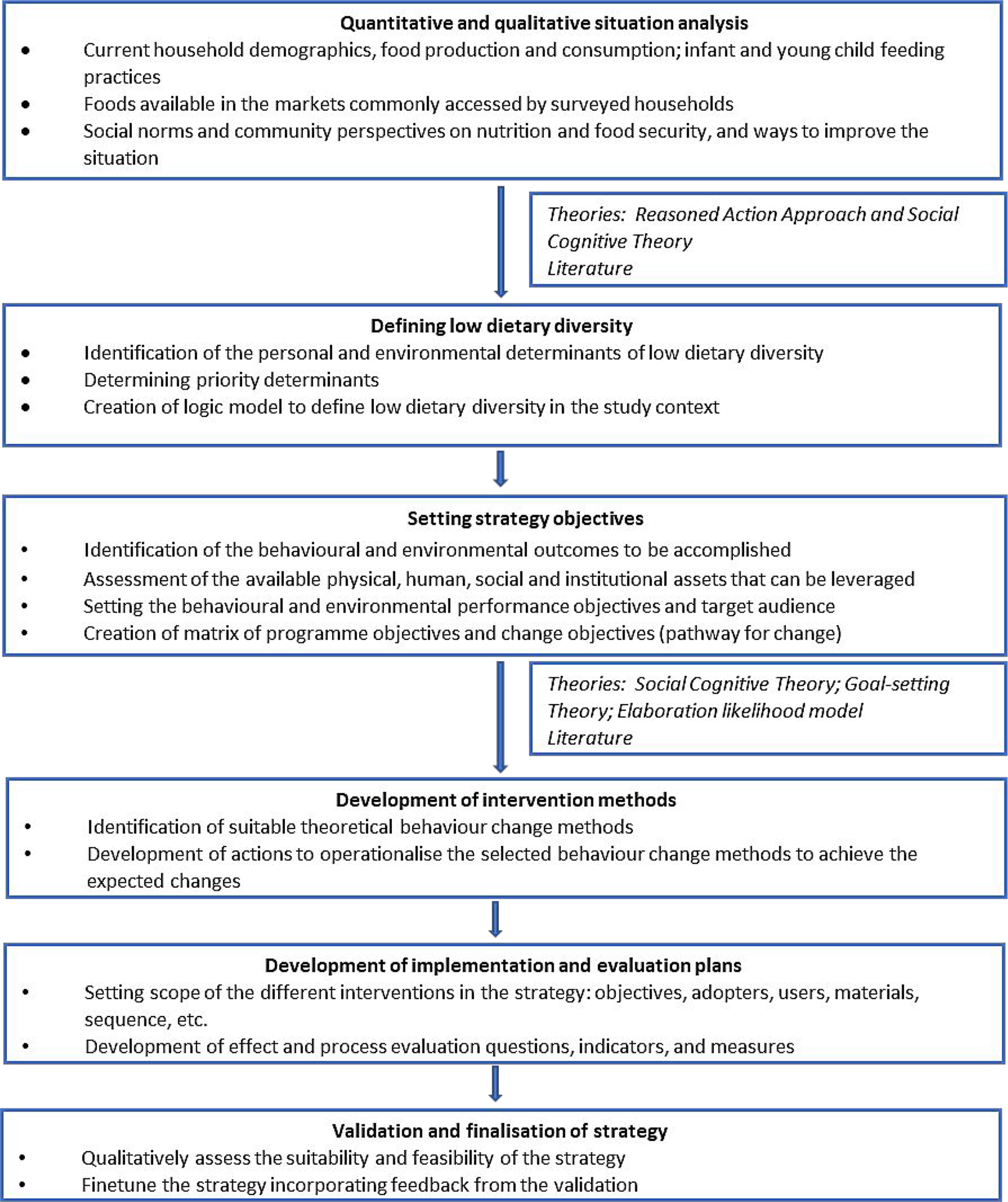
Overview of the strategy development process using intervention mapping.
The main components of the logic model were the health problem—low dietary diversity, the quality-of-life issues that occur because of low dietary diversity, the behavior and environmental determinants that support or inhibit dietary diversity, and the personal determinants of behavior within the households. The environmental determinants were analyzed at 3 levels: (i) the interpersonal level, looking at the individuals or groups that influence the behavior and norms of the households; (ii) the organizational level, looking at how formal structures like schools, religious institutions, health services, and extension services in the community influenced dietary diversity; and (iii) the community level, evaluating the social space shared by different units in the community, such as families, villages, and groups such as farmer groups and saving groups. 11 The personal determinants of behavior were set at an individual level that is, the parents or caregivers of the children.
The identified personal, behavioral, and environmental determinants were ranked based on their relevance and changeability. Relevance was related to the dietary diversity of children in the target households and the quality of life as supported by the situation analysis and related literature. Changeability was related to a factor being sensitive to change within the strategy implementation time frame, and the identified community assets and resources. The more relevant and more changeable determinants were identified as priority determinants for the strategy, followed by those that were ranked as more relevant but less changeable. Less relevant but more changeable determinants had the least priority, but were still incorporated in the strategy because they could be used to demonstrate initial change and build good will in the community and among stakeholders. 11,34 The priority determinants (personal, behavioral, and environmental) were then used to define the strategy outcomes and performance objectives.
A logic model of change that shows the pathways of effects of the strategy was developed. This involved identification of the behavioral and environmental outcomes that the strategy will accomplish, the performance objectives for obtaining the behavioral and environmental outcomes, and the personal determinants of the behavioral and environmental performance objectives. 11 The assumption of the logic model was that a change in the identified behavior and environment determinants would lead to more diverse diets and improve the quality of life of the target population.
This was followed by a search for theories and behavior change methods that have previously been used to influence the identified key personal determinants of the behavioral and environmental performance objectives, particularly in areas of nutrition and health. The selected methods were put together in an implementation plan.
Validation
The developed strategy was validated to assess its suitability and feasibility and identify any gaps and/or possible barriers through FGDs and key informant interviews (KIIs). Two FGDs were conducted, each with 12 participants (6 men and 6 women). Half of the participants were randomly recruited from those who had participated in the situation analysis, while the other half had no prior involvement in the study. The 2 categories of participants were selected to validate the development process and the resulting strategy. The FGD facilitator used a semi-structured discussion guide to evaluate (i) the main determinants and (ii) the target actors and beneficiaries incorporated in the developed strategy. Participants discussed the importance and relevance as well as possible barriers and any additional determinants or actors that should be included.
Fifteen KIIs were purposively selected based on their professional knowledge and experience in nutrition and agriculture and were invited to validate the strategy. A self-administered semi-structured questionnaire, that was sent via email, was used to evaluate: (i) the development approach; (ii) the strategy outcomes, outputs and performance objectives, and critical success factors of change; (iii) the target actors and beneficiaries of the developed strategy; and (iv) the proposed implementation plan. The KIIs rated the importance of the different aspects using a scale of 1 to 5 where: 1 = not important; 2 = of little importance; 3 = moderately important; 4 = important; and 5 = very important. They also provided additional comments on the rating given. Average rating scores were calculated using Microsoft Excel.
The audio recordings for the FGDs and field notes were transcribed, translated to English, and cross-checked by the facilitators to ensure quality. The researcher also cross-checked the transcriptions versus the audio recordings for quality. The transcriptions were analyzed using Atlas.ti software v.8. 41 The framework method of analysis was used to identify patterns and themes in the responses as a way of understanding the research themes and questions. 42 The presence or absence of themes were compared across the FGDs. The study protocol was approved by the Health Research Ethics Committee of Stellenbosch University, Reference Number S16/06/099.
Results
Theory and evidence were used to identify the personal, behavioral, and environmental determinants of low dietary diversity among the target sites, and the corresponding performance objectives that the strategy would address to achieve the set outcomes, as well as the suitable behavior change methods and channels.
Personal, Behavioural, and Environmental Determinants
The determinants of low dietary diversity that were identified by applying RAA and SCT theories to the situation analysis results are given in Table 1. The behavioral determinants can be summarized as: (1) Growing a limited diversity of crops; (2) Limited production and consumption of animal-source foods; (3) Limited focus on the production, purchase, and consumption of fruits and vegetables; (4) Limited attention to foods consumed by children in-between the main meals; and (5) Not attending community meetings and/or trainings. The environmental factors were separated into interpersonal and community level factors.
Application of the Reasoned Action Approach and Social Cognitive Theory to Identify Behavioural and Environmental Determinants Influencing Dietary Diversity.
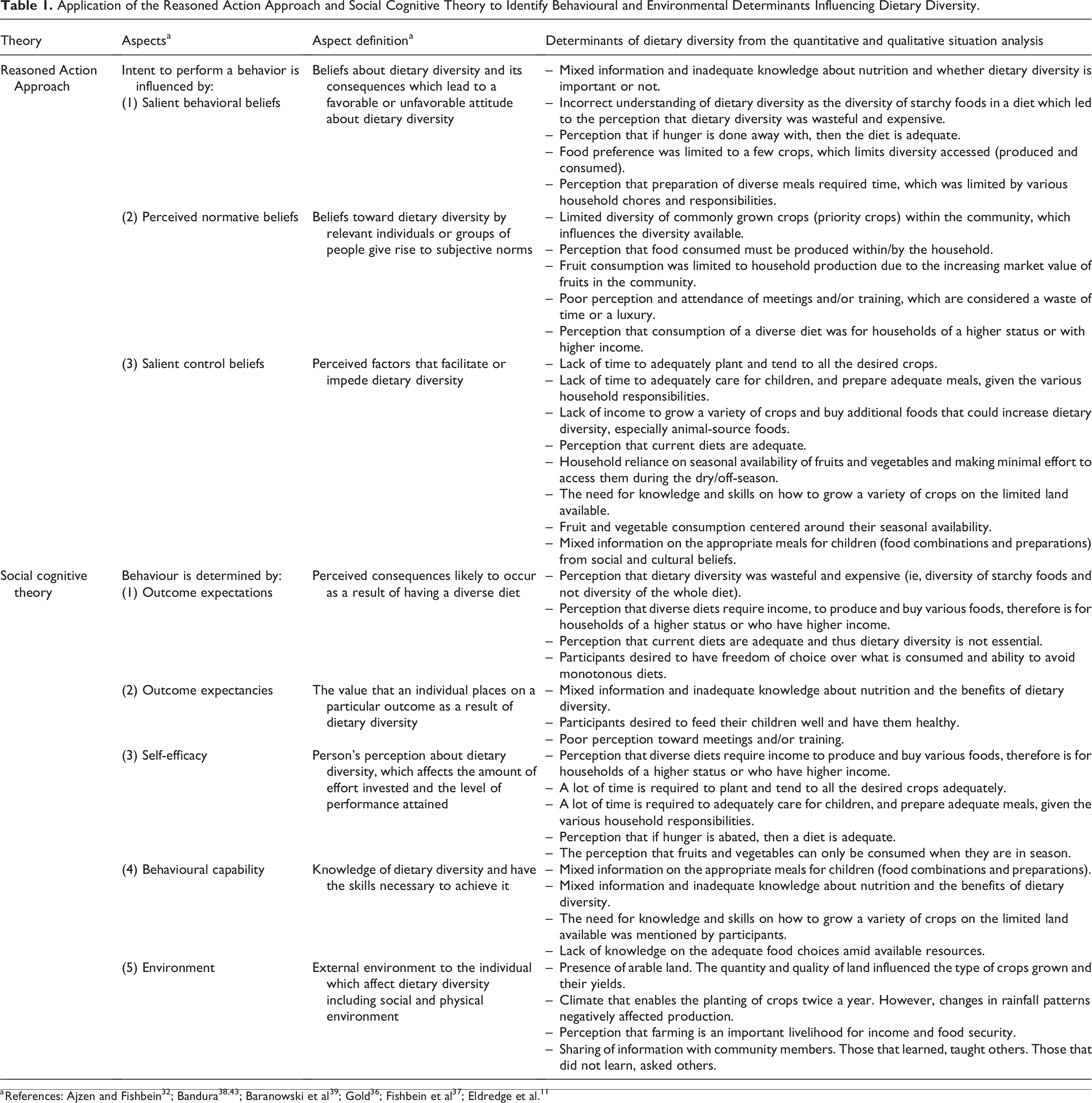
The interpersonal-level factors included (1) Usage of available land for different crops, (2) Limited access to quality agricultural inputs (seeds, manure, fertilizer, pesticides, etc), (3) Low household income, (4) Limited money available for food, and (5) Limited time for food preparation and child feeding. While the community-level determinants included (1) Limited diversity of preferred foods and commonly grown crops in the community, (2) Limited access to nutritional and agricultural information and training, (3) Limited food diversity in the markets, and (4) Increasing market value of fruits grown by households. The personal determinants were (1) Limited diversity of preferred foods, (2) Inadequate knowledge on appropriate farming techniques, (3) Limited focus on and consumption of fruits and vegetables across seasons, (4) Limited knowledge on nutrition, (5) Poor perception toward meetings and/or training, and (6) Need for a push-factor to continue implementation of practices that support diverse food production and consumption.
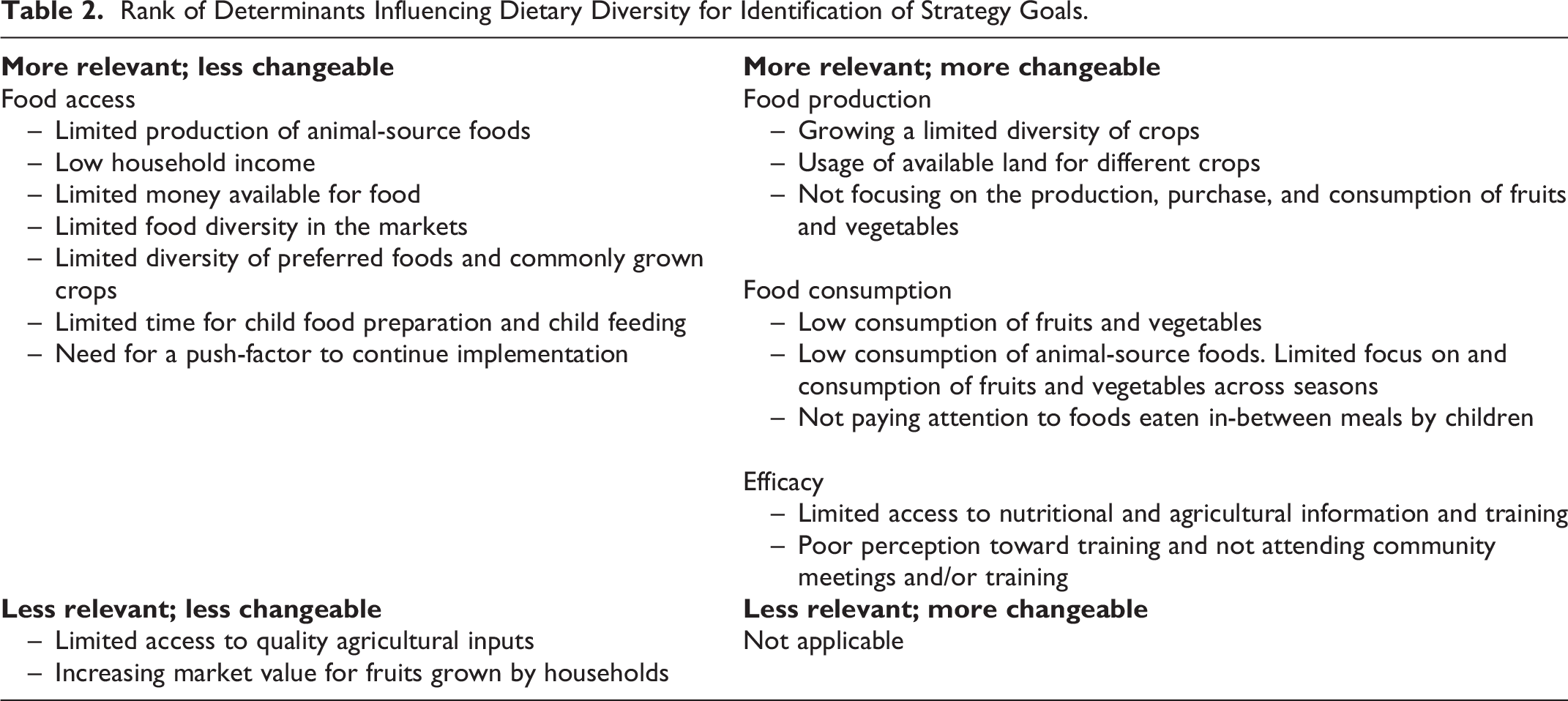
The above personal, behavioral, and environmental determinants were ranked based on their relevance and changeability (Table 2). The ranking showed that determinants related to food production, food consumption, and efficacy were “more relevant and more changeable” and thus a priority for the strategy. The priority determinants were then modified into the strategy outcomes where (a) behavioral outcomes referred to what the individual/household would or would not perform as a result of the strategy, and (b) the environmental outcomes focused on the determinants that influence low dietary diversity among the target population at interpersonal and community levels. The resulting logic model showed the pathway from personal determinants to behavioral and environmental performance objectives and their outcomes, and ultimately to increased dietary diversity (Figure 2).
Rank of Determinants Influencing Dietary Diversity for Identification of Strategy Goals.
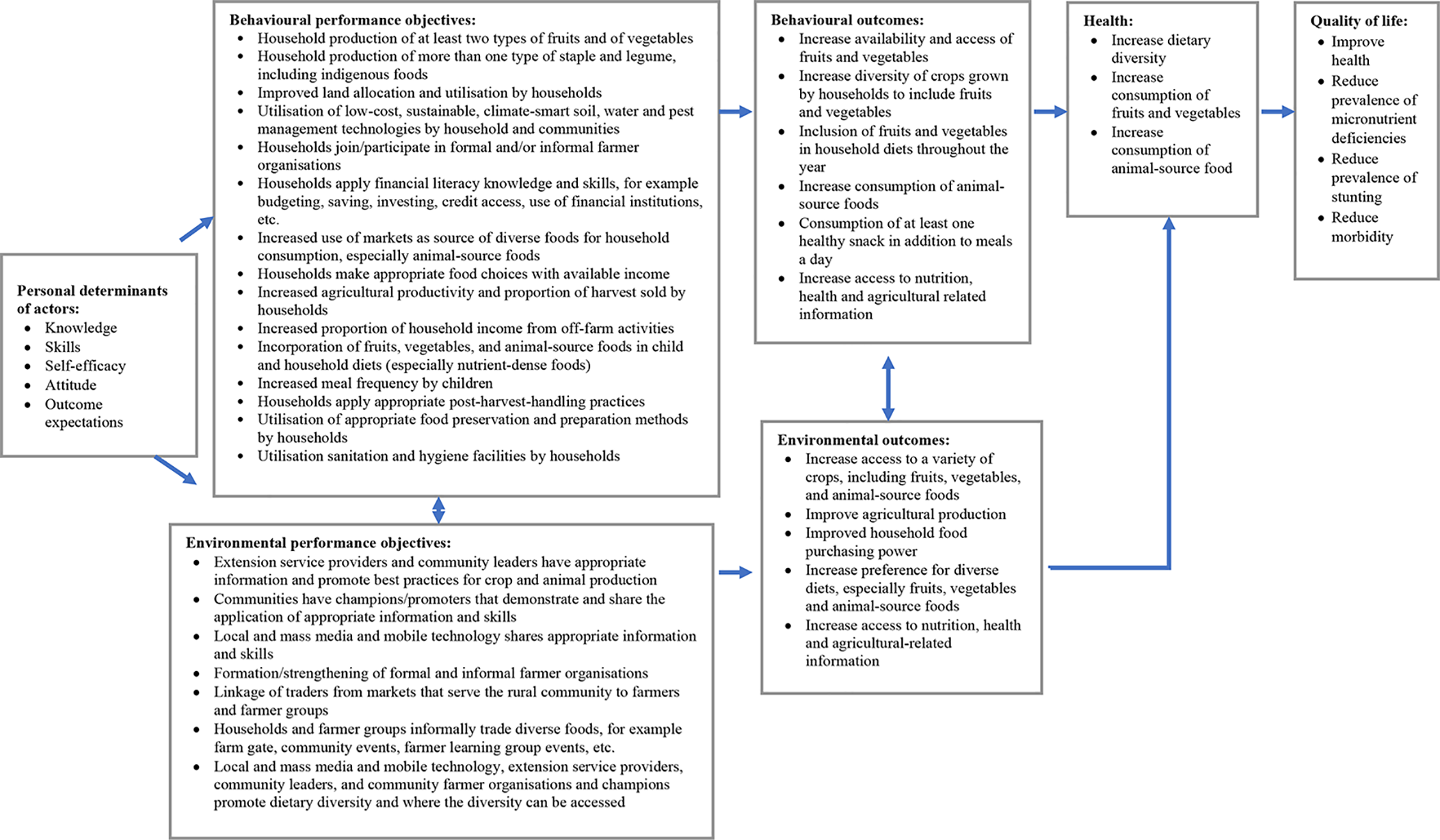
Pathway from personal determinants to behavioral and environmental performance objectives and outcomes.
Performance objectives referred to actions or performances required to achieve the outcomes and ensure appropriateness of the strategy. Performance objectives were set for each behavioral and environmental outcome, with different objectives for different levels or categories of individuals. Focus was placed on knowledge, skills, self-efficacy, attitude, and outcome expectations.
Three theories were selected to inform the design of the strategy particularly identifying the behavior change methods, how the methods would be applied, and strategy aspects such as scope and sequence. The theories were (1) SCT, 40,43 (2) Goal-setting theory (GST), 44 -47 and (3) Elaboration likelihood model. 48,49 The justification for the selected theories is presented in the discussion.
Strategy and Implementation Plan
The resulting strategy was designed for rural smallholder farming communities with children under 5 years as the primary beneficiaries. The goal of the strategy was set to improve dietary diversity of children in smallholder farming households through improved household production, income utilization, and food consumption practices. This included increasing (1) the diversity of foods produced by the households, (2) the diversity of foods in markets that serve the rural communities, (3) household financial literacy to support allocation of income to diverse foods, (4) household income through on-farm and/or off-farm activities, and (5) capacity of households to handle and prepare safe and diverse meals especially for children.
The strategy was designed for use by development and/or community-based organizations, policy makers, and government institutions with a mandate to improve the nutrition and livelihoods of farming communities, particularly in rural areas (the strategy managers). The strategy was conceptualized at 3 levels: at the individual level of the target population (beneficiaries/target beneficiaries of the strategy); at the individual level of change agents (primary implementers of the strategy); and at a community level involving leaders and extension workers (secondary beneficiaries of the strategy). Also incorporated in the strategy was equipping the different actors (and not just the target beneficiaries) with the relevant information, skills, and building social support to encourage the adoption of practices that support diverse diets.
The developed implementation plan considered practical ways in which the behavior change methods could be applied in the given context while ensuring that the parameters that make the selected theories and behavior change methods effective were maintained. The strategy therefore focused on household groups, where small groups of vulnerable smallholder farming households learn, apply information, practice, and adopt the recommended skills in agriculture and nutrition together. Engagement of the beneficiary households would begin with learning and demonstration of information and skills laid out in the selected learning modules. Followed by provision of support throughout the adoption/follow-up period. This would allow for the review of progress, barrier identification, problem-solving, and reevaluation of goals as strategy beneficiaries implement the skills and adopt the behaviors under promotion. The scope and details of the implementation plan and learning modules are presented elsewhere.
Key core components of the implementation plan that enhance the knowledge, skills, positive self-efficacy, and attitude of beneficiary households while ensuring that the theoretical framework related to behaviour change methods were adhered to included: having appropriate information, conducting demonstrations and practice sessions that allow internalization and processing of information, having coping/role models that are adopting the methods/practices, group and individual household interactions that allow active learning and provide social support, setting and reviewing of goals, adequate communication and sharing of information in an informal setting and using various media and materials that allow easy access and internalization, practical and relevant messages that address a given problem and present the required decision, sequencing of information to allow for internalization and processing of information, and reinforcement of information. In addition, both formal and informal learning environments would need to be harnessed.
Social support during enhancement of skills, self-efficacy, and attitude of the actors and beneficiaries was also noted as a key component. Therefore, learning in group settings, building of social networks, and use of models and coping/role models were incorporated in the strategy to enable sharing of experiences, comparison, and encouragement. The channels of engagement and communication materials were also tailored to the different actor groups to correspond to their varying characteristics and roles in the strategy.
Validation of the Strategy
The FGDs with members of a farming community validated the appropriateness of the strategy for the study population. The KIs comprised of experts assessed the robustness of the development approach used and the relevance and feasibility of the resulting strategy and implementation plan.
Both the FGDs and KIIs considered the determinants and actors incorporated in the strategy as important and relevant for improving the productivity, food availability, dietary diversity, livelihoods, and health of rural farming households and communities. They noted the interrelatedness of the determinants and promotion of sustainability, as well as the involvement of the different actors could build a sense of ownership, reduce potential resistance, enhance behavior change, increase access to information and skills in the community, and increase sustainability of the strategy.
The KIIs rated the development approach as important with a median rating of 4 (important). The main determinants incorporated in the strategy were considered as important with the median scores ranging from 4 to 5 (important to very important). The process and methods used were deemed as important and comprehensive.
Following analysis of the results from the validation FGDs and KIIs, the developed strategy was revised to incorporate or strengthen key aspects from the validation process. Some of the recommendations from the validation process that were added/emphasized in the strategy included (1) addressing household relations and decision-making dynamics; (2) actively engaging the community through novel ways to further stimulate sharing of knowledge and skills and address the poor perception toward learning/training; (3) understanding the motivation of extension workers and community-level groups; (4) as well as strengthening the content on nutrient-dense foods especially access to animal-source foods, underutilized indigenous foods, post-harvest handling and food preservation.
Discussion
The ranking of the identified personal, behavioral, and environmental determinants showed that determinants related to food production, food consumption, and efficacy were a priority. The aim of the strategy was therefore set to improve the availability, accessibility, and consumption of diverse foods, with a particular focus on production diversity, production practices, market access, and market diversity. Reports indicate that the production diversity influence on dietary diversity is higher where on-farm diversity is low and market access is poor. 50,51 Though markets are reported to be more important for dietary diversity than household production, it is also noted that the interaction between production diversity, market access, and dietary diversity varies with regard to context. 52,53 The strategy therefore sought to incorporate these synergistic components so that vulnerable smallholder households can achieve dietary diversity. For such households, production diversification is reported to lead to more opportunities for market engagement—as a source of income through “agricultural output markets” where they can sell their food produce and “consumer food markets” where they can purchase diverse foods. 52 Income from off-farm activities also increases access to diverse foods through markets. 51 In addition to household access to these 2 categories of markets, the availability and seasonality of diverse foods, especially nutrient-dense foods, their cost, and consumer preferences all influence the extent to which markets contribute to household dietary diversity. 52,54
Central to the strategy design was identifying the behavioral, environmental, and personal factors and determinants, which later were used to formulate the strategy objectives and outcomes. This process was guided by the RAA and SCT theories. This is because RAA seeks to identify the determinants of a particular behavior of interest where intent to perform a behavior (a precursor to the behavior) is influenced by the salient behavioral beliefs about the behavior and its consequences, the perceived normative beliefs toward the behavior, and the salient control beliefs. 11,36,37 Social cognitive theory adds to this construct as it centers the dynamic nature of behavior depending on the characteristics of the individual and the environment. Where behavior is determined by outcome expectations, outcome expectancies, self-efficacy, behavioral capability, and environment. 11,39 Together, this formed the basis of categories and components of the determinants in the strategy.
A review of behavior change methods considering the identified determinants and performance objectives revealed that the most frequently used methods provided information, created awareness, formed intentions, set goals, included action planning, identified barriers/had problem-solving, included demonstration and practice, provided social support, and had self-monitoring. 55 -60 These were mainly delivered through community/group models, individual counselling, and media, and targeted the individual, household/family, and community (leaders or members).
The theories referred to in published behavior change interventions included control theory, information-motivation-behavioral skills model, theory of planned behavior, operant theory, and SCT. 57,61 -64 Skills and self-efficacy were key personal determinants in the strategy; for this reason, SCT was well suited for the strategy. Self-regulation is a key concept in this theory (SCT) and is achieved through providing the skills and opportunities for self-monitoring, goal-setting, feedback, and problem-solving. 40,43 Self-regulation, mastering of skills, and use of coping/role models to improve self-efficacy particularly related to the personal determinants of dietary diversity, and observational learning were thus incorporated into the strategy.
To elaborate self-regulation in SCT, GST was also applied in the strategy design to further bridge the intention-behavior gap. Social cognitive theory also complements GST given that enhanced self-efficacy leads to setting of higher goals and more effort and persistence, resulting in higher performance of goals and behavior change. 46,47 Therefore, the behavior change methods and applications in the strategy were selected and designed to enhance ability and self-efficacy, strategic goal setting, and provision of feedback. Thirdly, the elaboration likelihood model was used to inform how the identified behavior change methods would be applied in the strategy. This model emphasizes enabling careful consideration of information by beneficiaries, implying that for the priority population, realistic and practical information, informal settings with deliberations, and demonstrations would be beneficial. 49 These elements were therefore built into the strategy.
Though the use of several methods and channels from literature was found to be more effective than a single one, the use of a small set of methods and channels was also noted to be more effective than several different techniques due to the inconsistent quality of delivery that can arise with several techniques. 57 This insight was used to provide to create an implementation plan with a feasible scope.
A poor perception towards training and community meetings was noted in the situation analysis results. 33 This is crucial because for knowledge, skills, self-efficacy, and attitude—the personal determinants targeted by the strategy—individuals and households need to access and be receptive to information that could improve their livelihoods. Nutrition knowledge and education is an important aspect of food-based interventions and positively influences dietary diversity and nutrition outcomes. 65 -67 Interpersonal communication through individual and group sessions is an effective social behavior change approach where information and skills are disseminated and social support is provided or enhanced. 68 It was therefore important that the strategy seeks to increase access to information and skills through various actors, building social support within and between actors and thus increasing information-seeking behaviors and uptake and sharing of information.
It was also important that the strategy is aligned and contributes to national strategies, priorities, and systems. The developed strategy lends to aspects already included in the food and nutrition policies such as developing and providing information and skills to promote proper food and nutrition practices in rural and urban communities, and mobilizing communities to identify and solve their food and nutrition problems. 69 -71 The strategy has the potential to strengthen the agricultural sector goal to transform from subsistence farming to commercial agriculture by ensuring that vulnerable smallholder farmers are not left behind and that sustainable access to food and diet quality is achieved. 72 The strategy also looks beyond the 12 commodities of interest in the Agriculture Sector Strategic Plan to see that smallholder farmers improve their productivity, food security, and dietary diversity. 73 The extension system is a big part of the national agricultural strategies 72,73 and was therefore incorporated within the strategy.
The components of the developed strategy largely correspond to approaches that are not only in use but are also under improvement and scaling in the transformation of sustainable agri-food systems, with varying scope. These range from diversified and integrated farming systems; community initiatives and market based approaches for biodiverse nutritious foods (seed systems, production, value chains, and consumption); nutrition-sensitive post-harvest handling, storage, and processing; incentives and regulations to improve the nutrient value of marketed products; nutrition education and behavior change communication, income generation for nutrition, women’s empowerment, gender equality and youth inclusion, social support and relationships, and information exchange across the system; reduction and management of food loss and waste and enhancing food quality, safety, and hygiene. 74,75 The strategy however brings together different methods and channels to address key barriers among smallholder farming households to provide an enabling environment and support behavior change.
The strategy design largely relied on results from a mixed methods cross-sectional study and thus detailed data across agricultural seasons was not available. Further exploration in the validation process through engagement of key strategy actors such as policy makers, extension workers, and potential community champions was limited by the availability of time and funds. As such, the motivation of these stakeholders to engage in a strategy like the CFBS was only captured in part.
Conclusion
Use of the intervention mapping protocol facilitated a systematic process that identified the relevant determinants of low dietary diversity, outcomes and objectives, and pathway to change. Since no single theory can be applied in all cases, and theories overlap such that more than one theory can be applicable in the design process. 40 The intervention mapping protocol used in the study enabled identification of relevant theories at different stages of the strategy development process. The approach used was not only systematic but transparent which enhances its evaluation, revision, and replication. The implementation plan was followed by a process and impact evaluation plan not presented in this publication. Overall, the process yielded a strategy that has the potential to empower smallholder households to improve dietary diversity through enhancement of their information, skills, and support on agriculture, nutrition, and finances. Using a household approach, as opposed to targeting specific household members enhances this empowerment.
The proposed implementation plan is but one of the plans/projects that can be derived from the developed strategy. Whereby other plans/projects that could be added include those with a larger emphasis on financial literacy and market participation and linkages. It is imperative that the different plans/projects developed are implemented and evaluated in tandem or in a complementary manner. The design process also showed how the intervention mapping protocol could be applied to improve nutrition in developing countries, particularly in rural farming areas. Most applications of the intervention mapping protocol were previously conducted in developed countries or affluent communities.
The strategy developed in this study and its development process can be adjusted for use in other smallholder contexts in developing countries by piloting implementation plans based on the strategy, by reassessing the key determinants in the strategy using the validation process and implementing the revised strategy, or by replicating the whole design process. However, it should be noted that the application of the intervention mapping protocol is lengthy and iterative and thus costly. It therefore may be better relegated to well-funded or high-level strategies within which several implementation plans can be developed. In this case, efforts must be made to ensure that all implementation plans contribute to the main strategy and make appropriate use of the rigorously identified and incorporated theories and methods.
Supplemental Material
Supplemental Material, sj-pdf-1-fnb-10.1177_03795721241240854 - Designing a Contextualized Food-Based Strategy to Improve the Dietary Diversity of Children in Rural Farming Households in Central Uganda
Supplemental Material, sj-pdf-1-fnb-10.1177_03795721241240854 for Designing a Contextualized Food-Based Strategy to Improve the Dietary Diversity of Children in Rural Farming Households in Central Uganda by Deborah Nabuuma, Beatrice Ekesa, Mieke Faber and Xikombiso Mbhenyane in Food and Nutrition Bulletin
Footnotes
Author Contributions
DN developed the research idea, designed the study, and collected and analyzed the data. BE and MF critically reviewed each stage of the study and the manuscript. XM guided the development of the research idea and critically reviewed each stage of the study and the manuscript.
Declaration of Conflicting Interests
The author(s) declared no potential conflicts of interest with respect to the research, authorship, and/or publication of this article.
Funding
The author(s) disclosed receipt of the following financial support for the research, authorship, and/or publication of this article: This work was supported by the National Research Foundation (NRF) reference no: CPRR150612119377, unique grant no: 98954. Opinions expressed and conclusions arrived at are those of the author and are not necessarily to be attributed to the NRF. This work was part of a research study for a Doctor of Philosophy at Stellenbosch University.

References
Supplementary Material
Please find the following supplemental material available below.
For Open Access articles published under a Creative Commons License, all supplemental material carries the same license as the article it is associated with.
For non-Open Access articles published, all supplemental material carries a non-exclusive license, and permission requests for re-use of supplemental material or any part of supplemental material shall be sent directly to the copyright owner as specified in the copyright notice associated with the article.
