



Abstract
Introduction:
Adequate dietary intake is critical for modification of eating behavior and provides nutrients required for growth particularly among adolescents. The evidence revealed the variation and unrelated data on the prevalence of dietary diversity among adolescent girls in Ethiopia.
Objective:
To assess the magnitude of dietary diversity and associated factors among high school adolescent girls at the selected school of Yeka Sub-city, Addis Ababa, Ethiopia 2021.
Methods:
A cross-sectional study was conducted in high schools of the Yeka sub-city. Self-administered questionnaires were used to collect data. Data were analyzed using SPSS and the characteristics of the study participants were reported using descriptive statistics. A logistic regression model was fitted to identify factors associated with dietary diversity.
Result:
The mean score of dietary diversity was 4.9 ± 1.47 with a response rate of 97.2% among a proposed number of participants. The dietary diversity score is high in 56.7% and low among 43.3% of adolescents. Stayed a long time on social media (adjusted odds ratio = 2.6), school type (adjusted odds ratio = 6.5), educational status of mother (adjusted odds ratio = 8.7), consuming more sweet food (adjusted odds ratio = 3.6), occupation of the mother (adjusted odds ratio = 2.3), household security (adjusted odds ratio = 2.3), and fear of obese/worried about shape (adjusted odds ratio = 5.0) were statistically associated with low dietary diversity score.
Conclusion:
The finding of the study revealed that the magnitude of low dietary diversity among adolescent girls was found to be high. Long time social media usage, school type, educational status of the mother, consuming more sweet food, occupation of mother, household food security, and fear of obese/worried about shape were statistically associated with dietary diversity score.
Keywords
Introduction
Adolescence is an important stage in the lifecycle for growth and development. During this time, adolescents achieve 15%–20% of their adult height, up to 60% of their skeletal mass, and half their adult body weight. 1 Offering adolescents appropriate levels of support can improve their chances of maintaining healthful dietary behaviors into adulthood. 2 Adequate dietary intake is critical for modification of eating behavior and provides nutrients required for growth particularly among adolescents. 3
In Ethiopia, 23.1% and 22% of adolescents were stunted and thin, respectively. 4 That is related to the dietary diversity score of <4 food groups. 5 Adolescence represents a window of opportunity to prepare nutritionally healthy food for adult life. 6 It may also be a period to shape and consolidate healthy eating and lifestyle behaviors, thereby preventing or postponing the onset of nutrition-related chronic diseases in adulthood. 1
Inadequate dietary diversity is one of the major public health problems and can result in physical, emotional, and psychological changes among adolescents. 7 Adolescents are risky groups for malnutrition, but they are not part of a target in many intervention strategies. 5 The evidence indicated there was scarce of information about the prevalence and consequences of malnutrition among adolescents population in low- and middle-income countries. 8 The magnitude of low dietary diversity in the Ethiopian context was varied.9,10
Social media engagement by adolescent girls were high. Despite its appeal, there are potential negative consequences for disordered eating and reduced dietary diversity score. 11 Girls who regularly shared self-images on social media, relative to those who did not, reported significantly higher overvaluation of shape and weight, body dissatisfaction, dietary restraint, and internalization of the thin ideal. 11 As another study indicates 58% of girls want to lose weight while just 9% want to gain weight and 85% of young women worry “a lot” about how they look. 12
Consumption of fast foods such as sweets has become increasingly popular among adolescents as a result of urbanization and an increase in the number of supermarkets, lowering the dietary variety score indirectly. 13
The cultural and social factors contribute to the gender difference in the type of food consumed by the adolescent, as of study conducted in India boys are more advantaged and girls tend to consume fewer protein and vitamin-rich foods. 14 There is also a systematic review conducted in sub-Saharan Africa that revealed gender as one of the contributing factors for the difference in nutritional status. 15
The adolescent has typically been considered at low risk of poor health and getting less attention of health care and adequate dietary as well. Dietary diversity is critical in adolescents because they need the energy to grow and develop both physically and mentally. Psychosocial, socio-demographic status, and diet-related behavior are predictors for dietary diversity scores as stated by many studies.6,16–18 In Ethiopia, there is a lack of attention for adolescence as a childhood age group from government and families as well.
Low dietary diversity is also identified to be one of the factors associated with low educational performance. 19 Educational level and quality are the main components that affect the development and economic growth of the country.20,21 So, the adolescents should meet the minimum dietary diversity score (MDDS) to alleviate the related problem. Despite the above facts, limited studies were conducted on dietary diversity of adolescent girls in Ethiopia, and no study was conducted in the study area. Therefore, this study was conducted to determine the magnitude of low dietary diversity score and associated factors among adolescent girls attending schools at Yeka sub-city. The findings of this study are inputs for further studies to be conducted on the nutritional status of adolescents in Ethiopia.
Method
Study setting period
The study was conducted at selected high schools of Yeka Sub-city high schools from 10 February to 10 July 2021. Yeka sub-city is found in the northeastern part of Addis Ababa, which bordered from the west by the Gulale and Areda sub-city, from the north by Kirkos and Bole sub-city while from the east by Lega Tafo Town.
Study design
A cross-sectional study was employed.
Population
Source population
The source population was all private and public high school girls at Yeka sub-city.
Study population
The study population was all schoolgirls who are attending the selected private/public high schools of Yeka sub-city.
Eligibility criteria
Inclusion criteria
Adolescent girls attending school at selected schools during data collection.
Exclusion criteria
Adolescent girls who did not come to school during data collection.
Sample size determination
Sample determination for the magnitude of the low dietary diversity score is as follows.
The sample size (n) required for the study was calculated using the formula to estimate a single population proportion by considering the following assumptions. Zα/2 = critical value for normal distribution at 95% confidence interval (CI) to 1.96 (Z value at alpha = 0.05). According to the study conducted in 2018 at Jima town, about 38.7% of adolescent girls score low dietary diversity. 6
Hence, according to the study, P = 38.7%
d (w) = margin of error of 0.05 with 95% CI level.


Since the total population of adolescents is 964, the correction did by the correction formula


265 with 10% non-response yield 292.
Sample calculation for associated factors
The proportion of the factors was taken from a similar study conducted in Jima. 6 The calculation was done through online insertion in Epi info (www.openinfo.com) that adjusted with power (1 − β) 80%, 95% CI, and 1:1 ratio the proportion of unexposed and exposed accordingly. The obtained sample is presented in Table 1.
Sample size calculation based on factors associated with dietary diversity score, Addis Ababa, 2021.

OR: odds ratio.
The largest sample size was 292.
Therefore, our sample will be 292.
Sampling method and technique
The study was aimed to be conducted at the high schools of Yeka sub-city woredas; therefore, one woreda (woreda 08) was selected by lottery method among 15 woredas available in the sub-city. Woreda 8 has two high schools Tesfa Birhan and mega craft High school and both schools were included. The megacraft had 314 students while Tesfa Birhan had 655 students. The number of students at each high school is known, and the sample size was proportionally allocated to ward schools since the number of the students at each school is not equal. Again among a section of grades 9–12, two-two sections were selected by simple random sampling, and a total of 16 sections were selected from both schools. After sections were selected, the adolescent students were picked by simple random sampling based on the allocated number of samples (Figure 1).

Sampling method hierarchy, dietary diversity score of high school adolescent girls of Yeka sub-city, Addis Ababa, Ethiopia, 2021.
Variable
Dependent variable
Dietary diversity score: Dietary diversity was assessed using a 24-h food recall method by the Food and Nutrition Technical Assistance (FANTA) 2016 version of the woman’s minimum dietary diversity measurement tool. The four or less MDDS was categorized as inadequate (low) dietary diversity. 22
Independent variable
❖ Socio-demographic factors
✓ Family income; ✓ Religion; ✓ Educational status of father and mother; ✓ Employment condition of the family.
❖ Psychosocial factors
✓ Fear of obesity; ✓ Stress; ✓ Culture and belief.
❖ Diet-related factors
✓ Household food insecurity; ✓ Appetite loss.
Operational definition and measurements
Dietary diversity: Dietary diversity as a measure of household or individual food access and food consumption can be triangulated with other food-related information to contribute toward providing a holistic picture of the food and nutrition security status in a community or across a broader area. 23
Household food secure: Among 18 questions of household food access security (HFAS) if the family of the girls respond (Q1a = 0 or Q1a = 1) and respond Q2-9 = 0. 23
Household mildly food insecure: Among 18 questions of HFAS if the family of the girls responds ((Q1a = 2 or Q1a = 3 or Q2a = 1 or Q2a = 2 or Q2a = 3 or Q3a = 1 or Q4a = 1) and Q5 = 0 and Q6 = 0 and Q7 = 0 and Q8 = 0 and Q9 = 0). 23
High dietary diversity score: Adolescent girls aged 10–19 years old who received foods greater than or equal to five food groups out of the nine food groups were assigned a high dietary diversity score. 6
Low dietary diversity score: Adolescent girls aged 10–19 years old who received four or less MDDS were categorized as having inadequate (low) dietary diversity. 6
MDDS: Those scoring five food groups among nine types of food group. 6
Adolescent: Individuals aged 10–19 years old.
Woreda: Districts of Ethiopia, also called woreda are the third level of the administrative division of Ethiopia—after zones and the regional states.
Long stay on social media: Staying more than 2 h per day on social media.
Data collection method and tools
Data were collected using self-administer questionnaires from both family and adolescents. The 24-h dietary recall method was used to collect information for individual dietary diversity and 4 weeks recall method was used for the household food insecure access scale. The questionnaires of individual dietary diversity score and household food insecure access scale are adopted from food and agricultural organization (FAO) 2016. 23
Data quality control
The data quality was assured by applying a properly designed and pre-tested questionnaire. The tool was pre-tested on 5% of the sample size at schools of Bole sub city before the actual data collection to establish its ability to elicit relevant information. In addition, the researchers ensured proper categorization and coding of the questions. The investigators and a supervisor conducted regular supervision and follow-up. In addition, a regular check-up for completeness and consistency of the data was undertaken daily.
Statistical analysis
Data were checked for completeness, consistency, cleaned, coded, and entered the Statistical Package for Social Science (SPSS) software version 25 for analysis. Descriptive statistics were used to describe the study population about relevant variables. Logistic regression was fitted to identify the association between dependent (dietary diversity score) and independent variables. Both crude and adjusted odds ratios (AORs) with their corresponding 95% CIs were used to determine the strength of association. A p-value of less than 0.5 was used to declare the statistical significance of the finding in this study. The results were presented using text, tables, and graphs based on the types of data.
Ethical consideration
Ethical clearance was obtained from Addis Ababa Public Health Research Emergency Management Directorate (A/A/M/13286/227). The permission letters are also taken from the Yeka sub-city education office and the administrative office of each school. The written informed consent was obtained from the legally authorized representatives of study participants and assent was taken from the students. It was ensured that no extra benefit to being taken away from those who refuse to participate or given for those to allow to participate. The data were used for only the purpose of this study.
Results
Socio-demographic and socio-economic characteristics of adolescent girls
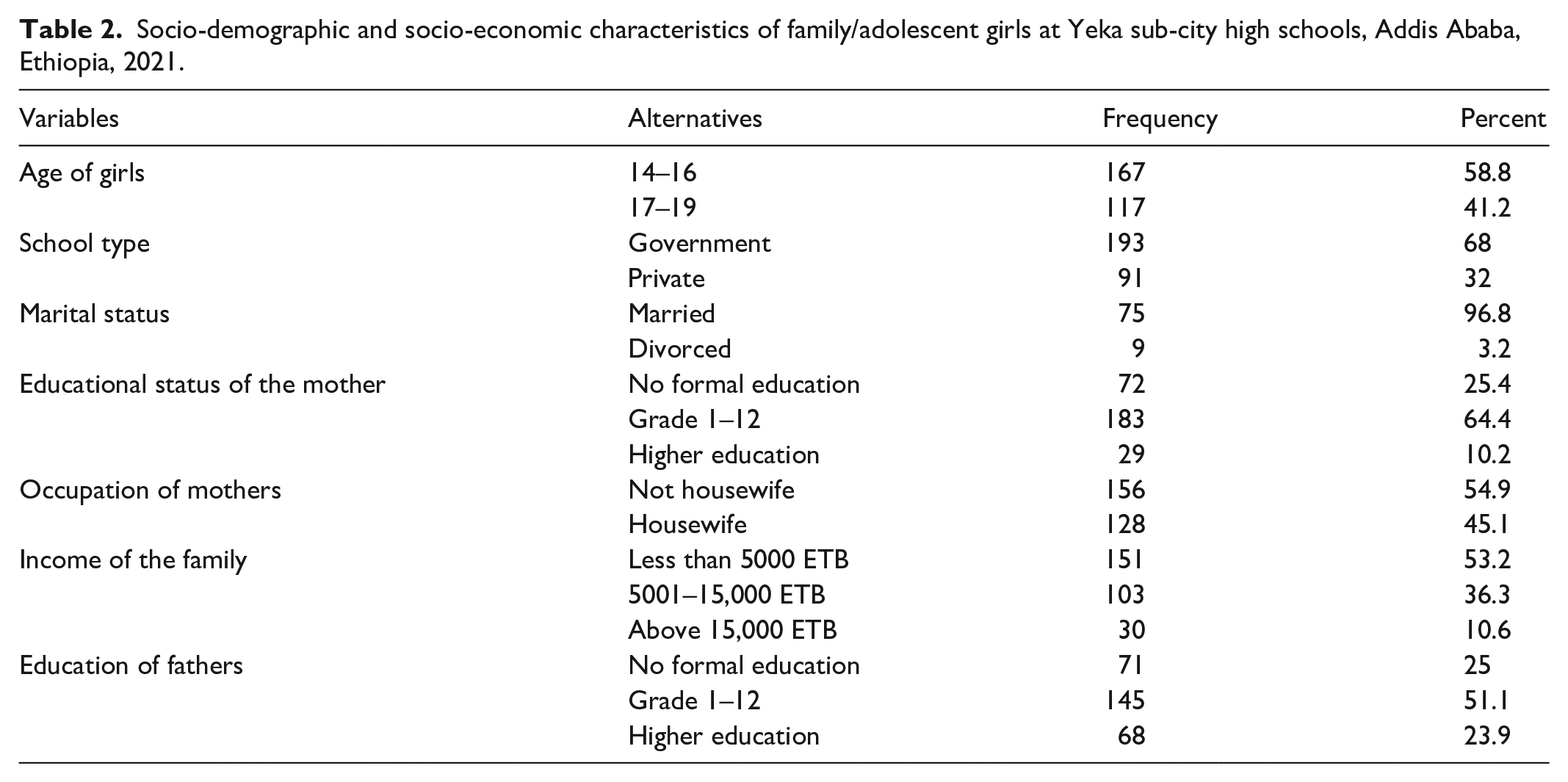
From the desired 292 samples, 284 (97.2%) adolescent girls have participated in this study. The majority (167; 58.8%) of adolescents were found in the age category of 14–16 years, and the median age of respondents was 16 years old with an interquartile range of 2 years. Most mothers have completed the minimum of primary school. One hundred twenty-eight (45.1%) of mothers are housewife and about 53.2% of the family earn less than 5000 ETB per month. Sixty-eight (23.9%) of the fathers joined higher education (Table 2).
Socio-demographic and socio-economic characteristics of family/adolescent girls at Yeka sub-city high schools, Addis Ababa, Ethiopia, 2021.
Psychosocial-related variables of adolescent girls
One hundred four (36.6%) of adolescents stayed a long time on social media while 170 (59.9%) of adolescents fear of obese or are worried about their shape to limit their eating pattern. Seventy-three (25.7%) of adolescents were avoiding some food because they are being female. Ninety-one (32.2%) adolescents were reduced food due to cultural impact (Table 3).
Psychosocial-related variables of adolescents at Yeka sub-city high schools, Addis Ababa, Ethiopia, 2021.

Dietary diversity status and household food security of adolescent girls
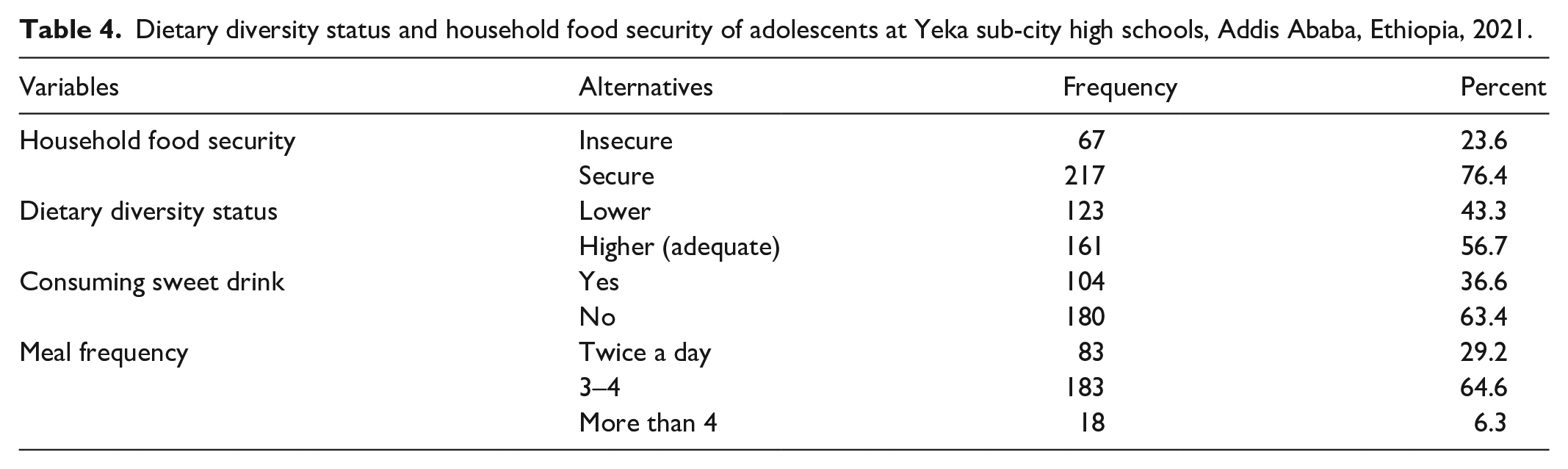
The magnitude of high dietary diversity score was 56.7% (95%, CI: 50.8%–62.4%) while 43.3% (95% CI: 37.6%–49%) of them score low dietary diversity. The mean score of dietary diversity was 4.9 ± 1.47. About 67 (23.6%) of the household of adolescents in the study were difficult accessing food. The majority (183) (64.6%) of adolescents ate food three to four times within 24 h (Table 4).
Dietary diversity status and household food security of adolescents at Yeka sub-city high schools, Addis Ababa, Ethiopia, 2021.
Dietary diversity of adolescent girls
Starch and staple foods are the more consumed type of food; about 237 (83.5%) of adolescents consumed starch and staple food during 24 h while only 57 (19.7%) of adolescents consumed organ meat (Figure 2).

Dietary diversity food of adolescents at Yeka sub-city high schools, Addis Ababa, Ethiopia, 2021.
Factors associated with dietary diversity
Binary logistic regression was carried out and the variables with p-value < 0.25 were entrant for multivariate logistic regression. All variables selected during binary logistic regression remain significant at p-value < 0.05 by multivariate modeling, and those variables are listed in Table 5. The outcome of multivariate logistic regression indicated the adolescents who stayed on social media were 2.6 times more likely to score low dietary diversity as compared with those who do not stay for a long time (AOR = 2.6, 95% CI: 1.23–5.47). Likewise, the students who attend government school were 6.5 times more likely to consume low dietary diversity as compared with those attending private school (AOR = 6.5, 95% CI: 2.87–14.95).
Factors associated with a dietary diversity score of adolescent girls at Yeka sub-city high schools, Addis Ababa, Ethiopia, 2021.

OR: odds ratio; CI: confidence interval; AOR: adjusted odds ratio.
Similarly, the adolescents from illiterate mothers were 8.7 times more likely to consume low dietary diversity as compared with mothers who attend school to the minimum (AOR = 8.7, 95% CI: 3.86–19.67). The adolescents who take a sweet drink in most were 3.6 times more likely to score low dietary diversity as compared with those do not consume sweet drink (AOR = 3.6, 95% CI: 1.67–7.65). Adolescents whose mothers were not housewives were 2.8 times more likely to record lower dietary diversity as compared with those mothers who were housewives (AOR = 2.8, 95% CI: 1.42–5.57). Adolescents from household insecurity were 2.3 times more likely to score lower dietary diversity as compared with those from household food security (AOR = 2.3, 95% CI: 1.04–5.05). The adolescents who fear obese/worried about their shape were 5 times more likely to record low dietary diversity as compared with those who do not (AOR = 5.0, 95% CI: 2.40–10.23) (Table 5).
Discussion
The finding of this study revealed low dietary diversity among 43.3% (95% CI: 37.6%–49%) of adolescent girls, which is in line with a study conducted in South Ethiopia with 46.8% of adolescent girls scoring low dietary diversity score. 24 But our finding was higher than the study conducted in Gondar city (25.5%). 11 The variation might be due to differences in socio-demographic factors.
Likewise, our finding was less than a study conducted in Jima Town (67.3%), 5 Dembo district, Ethiopia 68%, 20 and other studies conducted in North Ethiopia; overall prevalence of low dietary diversity among adolescent girls was 85.5%. 20 The difference might be due to socio-economic variation or due to accessibility of information increased from time to time. Similarly, there may be some cultural difference between the study areas and might be due to the increment of health service quality.
The finding of the study indicated maternal occupation was associated with dietary diversity. According to our finding, adolescents from housewife mothers were 2.8 times more likely to have low dietary diversity as compared with mothers who were not a housewife. The finding can be supported by the fact that housewife mothers may have low education or information on dietary diversity than working mothers. 25 However, this finding was inconsistent with a study conducted in Jima 6 and Dambi district. 20 The variation can be attributed to socio-economic and nutritional education difference of different districts found in Ethiopia.
Correspondingly, the educational status of the mother was found to be associated with dietary diversity scores. In this study, illiteracy was found to be increasing odd of low dietary diversity. This was consistent with a study conducted in Jima, 6 in the Dambi district, 20 and in Gurage Zone. 24 This might be because illiterate mothers lack information on the importance of diversifying local available and affordable foods.
Drink sweeter (soft drink) was found to be significantly associated with dietary diversity. In this study, the adolescents who consume sweeter drinks were 3.6 times more likely to score low dietary diversity. This finding was consistent with a study conducted at Jima that revealed dietary diversity was negatively associated with more frequent consumption of sugar-sweetened soft drinks. 26 This may be because sugar-sweetened soft drink increases blood sugar level and will end up in loss of appetite that results in decreasing the variation of food intake.
School type was another predictor found in this study; according to our finding, the adolescents attending government school were 6.5 times more likely to score low dietary diversity scores as compared with those attending private school. This finding was in agreement with a study conducted in Jima Town. 6 However, there is no clear relationship or evidence why school type and dietary diversity score were associated, but it might be linked to the economic status of the family.
In our finding, the adolescent girls who stayed on social media for a long time were 2.6 times more likely to score low dietary diversity as compared with those who did not stay for a long time. This finding is consistent with study conducted in the United Kingdom that revealed long time stay on social media affects eating behaviors. 27 This may be due to the fact that long stay on social media affects sleeping time that in turn increases stress which ends up in loss of appetite.
Fear of obese or worry about shape was found to be statistically associated with dietary diversity; in this finding, the adolescent girls who fear obesity or are worried about their shape were 5 times more likely to score low dietary diversity when compared with those who did not worry. This was agreed with a nutritional survey conducted, which justifies 85% of young women worry about how they look and need to lose weight. 12 This can be explained by the fact that adolescent girls who intend to decrease weight may prefer some type of food that decreases the variation of food they consume.
Generally, health education on behavioral change of adolescents toward dietary diversity and to give more emphasis for their dietary condition may help to improve dietary diversity. It is better if all types of schools are concerned about the diet of their students. The adolescent girls were recommended to reduce the time spent on social media. Further improving maternal and women education may play great role to increase food diversity using local available and affordable food types. Providing nutritional education by different stakeholders like non-governmental organization for community members may have an impact on increasing dietary diversity.
Limitations of the study
Data were collected by self-reporting and not included qualitative data like the amount of meal and hygiene of food. In this study, we used non-validated questionnaires which might affect the strengths of our recommendation.
Conclusion
The magnitude of low dietary diversity score noticed among adolescent girls was high while stayed a long time on social media, school type, educational status of the mother, consuming more sweet food, occupation of mother, household food security, and fear of obese/worried about shape were statistically associated with dietary diversity.
Supplemental Material
sj-docx-1-smo-10.1177_20503121221094896 – Supplemental material for Dietary diversity score and associated factors among high school adolescent girls in a selected school of Yeka Sub-city, Addis Ababa
Supplemental material, sj-docx-1-smo-10.1177_20503121221094896 for Dietary diversity score and associated factors among high school adolescent girls in a selected school of Yeka Sub-city, Addis Ababa by Lelisa Worku, Konjit Mamo, Teshome Bekele and Daniel Atlaw in SAGE Open Medicine
Footnotes
Acknowledgements
We would like to thank data collectors for their support during data collection period. We also extend our gratitude and appreciation to Addis Ababa Public Health Research Emergency Management Directorate for their assistance.
Author contributions
D.A. and L.W. have made substantial contributions to conception and design, acquisition of data, analysis, and interpretation of data. They have written the draft manuscript and provided final approval of the version to be published. L.W., D.A., K.M., and T.B. have made substantial contributions to the design, acquisition of data, analysis, and interpretation of data. All authors read and approved the final manuscript.
Data availability statement
Data are available upon reasonable request. All data relevant to the study are included in the article or uploaded as supplemental information. Data will be available upon request from the corresponding author.
Declaration of conflicting interests
The author(s) declared no potential conflicts of interest with respect to the research, authorship, and/or publication of this article.
Ethical approval
Ethical clearance was obtained from Addis Ababa Public Health Research Emergency Management Directorate (A/A/M/13286/227). The permission letters are also taken from the Yeka sub-city education office and the administrative office of each school.
Funding
The author(s) received no financial support for the research, authorship, and/or publication of this article.
Informed consent
The written informed consent was obtained from the legally authorized representatives of study participants and assent was taken from the students.

Supplemental material
Supplemental material for this article is available online.
References
Supplementary Material
Please find the following supplemental material available below.
For Open Access articles published under a Creative Commons License, all supplemental material carries the same license as the article it is associated with.
For non-Open Access articles published, all supplemental material carries a non-exclusive license, and permission requests for re-use of supplemental material or any part of supplemental material shall be sent directly to the copyright owner as specified in the copyright notice associated with the article.
