



Abstract
Background:
Inadequate coordination mechanisms and capacity to coordinate are limiting factors for maximizing the ability of agriculture to improve nutrition in Sub-Saharan Africa. Effective coordination requires the availability of a platform for stakeholder convening, planning, operationalization of ideas, communication, and accountability. Nigeria’s Federal Ministry of Agriculture and Rural Development established one such platform to support the institutionalization of nutrition-sensitive agriculture. Platform members include several departments within the Ministry, other ministries, and development partners. While the platform achieved key milestones and fostered collaboration, some gaps remained.
Objective:
This study reports an assessment to understand the perspectives of members of the coordination platform and identify ways of increasing effectiveness.
Methods:
Desk reviews of relevant documents and 18 key informant interviews were conducted. Documents and interview notes were coded and analysed to identify recurring themes. Themes were appraised using a nutrition coordination framework.
Results:
Sufficiently understanding the nutrition role of representatives’ own organization/department and the purpose of the coordination platform and its activities was important for success. The profile and seniority of representing officers also mattered. While the leadership of the Ministry was committed to advancing nutrition through agriculture, the coordination platform could improve its functionality through consistent leadership, increased seniority of member representatives, and appropriate communication.
Conclusions:
Multisectoral coordination platforms are necessary but do not alone achieve nutrition coordination. Effective leadership and investments in time, strategic orientation, and training are critical to achieving a shared purpose, individual sector fulfilment of nutrition roles, and additional coordination success factors.
Plain language title
Needed Factors for Facilitating Collaboration to Ensure Integration of Nutrition Into Agricultural Interventions
Plain language summary
Improving nutrition through the agriculture sector requires collaboration among various departments and stakeholders within the sector and with other sectors that provide complementary services, such as the water and health sectors. Effective collaboration requires a platform through which involved stakeholders can discuss and reach agreements on actions that need to be taken. The Federal Ministry of Agriculture and Rural Development in Nigeria established such a platform as part of efforts to address malnutrition. However, the platform did not seem to be adequately effective because the departments and stakeholders involved were not meeting frequently to discuss and limited collaboration was happening. This research interviewed stakeholders that attended meetings of the platform to identify suggestions for improving the use of the platform. The research found that there was strong interest to participate among all stakeholders, and the platform was useful for the Ministry to increase awareness and support for nutrition-sensitive agriculture. Still, the common vision around the platform’s objectives, among the stakeholders involved was insufficiently articulated and communicated. Actions meeting attendees were required to take often differed from their departmental/organizational mandate and/or were not in their technical area of competence. Participating in activities related to the platform, therefore, increased the workload of its attendees. Furthermore, communication about the roles and expectations of the stakeholders involved in the platform was inadequate. The stakeholders additionally had inadequate clarity about the leadership of the platform. Guidance from a framework for nutrition coordination developed by other authors suggests that improving leadership; creating a shared understanding of the objectives of the platform among all stakeholders; increasing nutrition capacity among all organizations involved; and ensuring that involved organizations find the collaboration to be beneficial for their own mandate; will be important next steps for achieving the purpose of collaboration.
Introduction
Effective coordination of nutrition actions within and across sectors is a fundamental aspect of nutrition governance and an enabling environment for nutrition. 1 -5 Coordination has for a long time been considered to be indispensable for meaningfully addressing malnutrition. 2,6,7 Coordination has been defined as a process in which stakeholders exchange information and alter activities for mutual benefit and to achieve shared goals. 7 Coordination can help achieve nutrition outcomes by facilitating the simultaneous delivery of synergistic interventions, leveraging and maximizing resources, and enabling better intervention coverage. 7 -9 Yet achieving coordination for improved nutrition has remained challenging. 10 -12
Indeed, inadequate coordination mechanisms and capacity to coordinate have been reported to be major limiting factors for maximizing the ability of agriculture to improve nutrition in Sub-Saharan Africa. 13 Agriculture has an important role to play in improving nutrition because of its role in food security, livelihood, trade, women’s empowerment, and sanitation. 14,15 Coordination among departments targeting various agricultural outcomes and between the health and agriculture sectors is especially important for nutrition. 6,8,12,13 Food, health, and care remain fundamental underlying determinants of nutrition and are strongly influenced by the agriculture and health sectors. 16,17 Other sectors are similarly important, including the economic, trade, social protection, education, and water/sanitation/hygiene sectors. 18,19
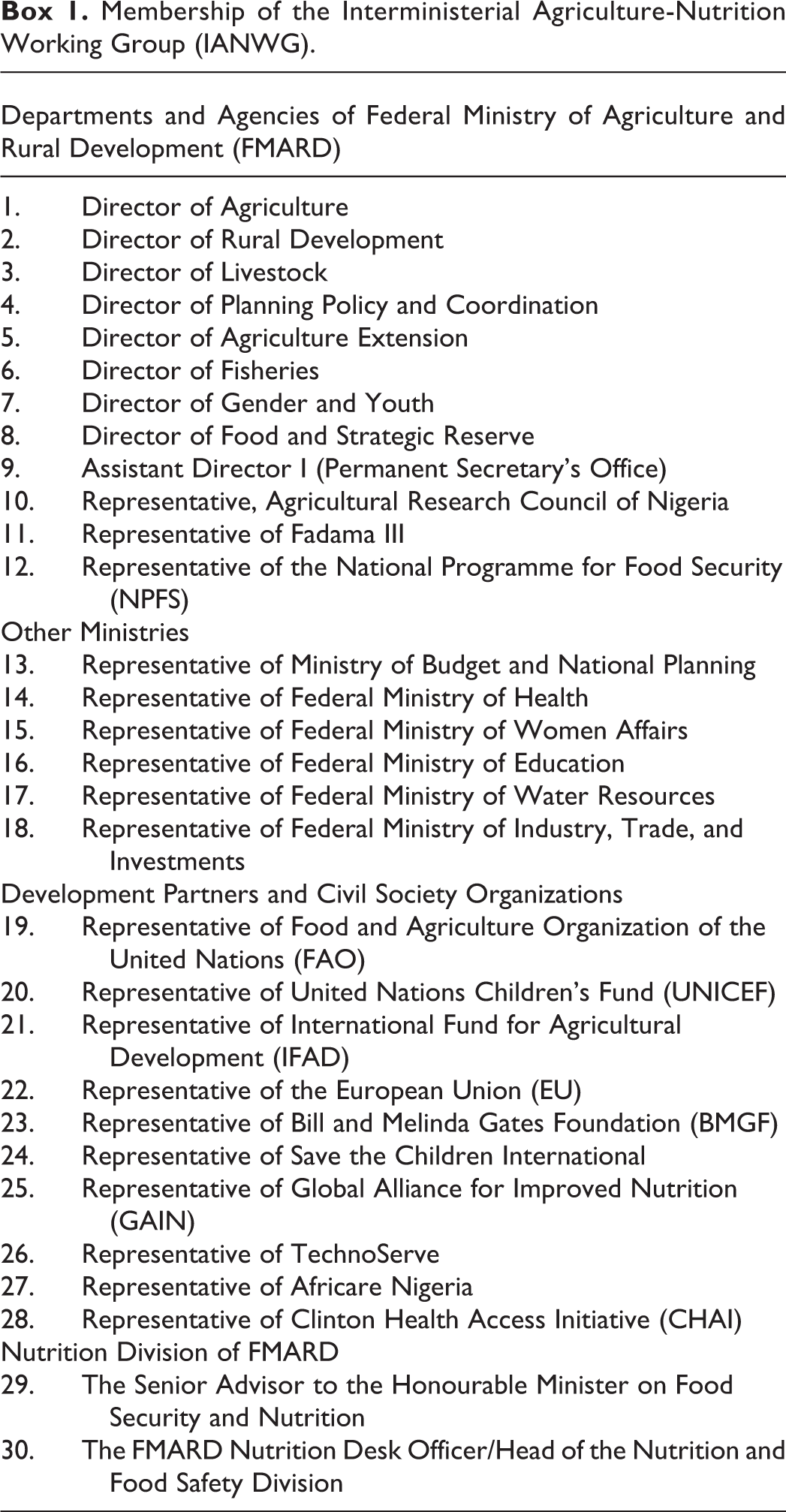
In recognition of the important role of agriculture in preventing and addressing malnutrition, the Nigeria Federal Ministry of Agriculture and Rural Development (FMARD) has been taking serious steps to integrate nutrition within the activities of the agriculture sector in Nigeria. Starting in 2012, FMARD commenced processes that led to establishment of a Nutrition and Food Safety Division to facilitate efforts to make the Nigerian agricultural sector nutrition-sensitive. Federal Ministry of Agriculture and Rural Development also established a Nutrition Transformation Value Chain (NTVC), a multisectoral technical working group, to provide high-level advisory support to the Nutrition and Food Safety Division. With the Division as its secretariat, the NTVC was expected to facilitate the development of an Agricultural Sector Food Security and Nutrition Strategy (AFSNS) and its implementation. 20 The AFSNS expanded the nutrition component of the Nigeria agriculture policy at the time, the Agriculture Promotion Policy, and addressed nutrition-sensitive agriculture within the context of nutrition-sensitive food systems. In addition to actors in the agriculture sector, the AFSNS involves complementary actions by actors in other sectors. Following the successful drafting of the AFSNS by a consultant working with the NTVC, FMARD changed the name of the NTVC to the Interministerial Agriculture-Nutrition Working Group (IANWG), assigned new roles, and inaugurated the IANWG. The membership of the IANWG is made up of directors of various departments in FMARD that provide agriculture-related services to communities and households; representatives of other government ministries, including the ministries of health, education, water resources, environment, women affairs, industry and trade, and budget and national planning; representatives of civil society, United Nations, and donor agencies supporting agricultural development in Nigeria; and private sector (Box 1). 21 The roles of the IANWG included to support and coordinate the implementation of the AFSNS. Specifically, the terms of reference of the IANWG were to: “Drive the development and institutionalization of innovative approaches that will improve nutritional outcomes and raise the level of food and nutrition security; raise the profile of food security and nutrition within FMARD and mainstream nutrition into agricultural policies and programmes; build and strengthen the evidence base for improving nutrition through the agricultural sector; and strengthen the leadership role of FMARD in improving nutrition through multi-stakeholder platforms.” 21 ( p.34 )
Membership of the Interministerial Agriculture-Nutrition Working Group (IANWG).
Various reports emphasize the imperative of a platform to achieve coordination. The purpose of such a platform is to enable effective communication, planning, operationalization of ideas, and accountability among stakeholders. 5,7,9,22,23 Coordination platforms facilitate the development of common purpose and shared understanding and vision for nutrition among multistakeholders. 7 Thus, and as perceived by nutrition-sensitive agriculture stakeholders, 20 the IANWG was a step in the right direction for coordinating the implementation of the AFSNS. Yet, following its March 2015 inauguration, the IANWG did not hold any meetings and was essentially nonfunctioning. In November 2016, the Nutrition and Food Safety Division reinaugurated the IANWG and organized a 2-day event with technical and team-building sessions for IANWG members. The Terms of Reference of the IANWG were redefined for clarity at the reinauguration. These updated Terms of Reference were to: Provide technical advice and support that will enhance mainstreaming of nutrition into all agricultural value chains; facilitate information sharing among all stakeholders on nutrition-sensitive agriculture programmes; facilitate the strengthening of the monitoring framework of nutrition-sensitive agriculture along value chains; and mobilize funding for nutrition along agricultural value chains, by leveraging resources from other subsector allocations, state and LGA budgets, development partners, international funding agencies, nongovernmental organizations and other stakeholders.
The Nutrition and Food Safety Division anticipated that the 2-day meeting would be followed by appointment of expert facilitators to guide deliberations of the IANWG and collate and disseminate conclusions from meetings; and conduct quarterly meetings of the IANWG. The expected deliverables of the IANWG, through the anticipated quarterly meetings, included: Consolidating a multisectoral and multistakeholder platform to promote relevant initiatives toward mainstreaming nutrition into agriculture in Nigeria. Driving a high-profile advocacy effort to raise the profile of nutrition-sensitive agriculture and shape agricultural policy efforts that would enhance nutrition in Nigeria. Creating a shared understanding and engaging expertise and international best practices on nutrition transformative agricultural policies and programmes. Launching a set of finalized policy instruments toward entrenching nutrition in agriculture in Nigeria. Mobilizing critical stakeholders around the policy instruments to ensure that the FMARD is able to access investments, resources, and support around key priorities.
During the 2-day meeting, members of the IANWG were assigned to 1 of 4 subgroups around the AFSNS’s 8 priority areas to facilitate the achievement of these deliverables. Members of the IANWG were assigned to a subgroup based on their organizational mandate. Each subgroup was subsequently supported by a consulting firm, the Nutrition and Food Safety Division, engaged to hold meetings and work on a vision and 2017 implementable work plan. Nevertheless, subgroups did not complete their action plans, meetings ceased, and the IANWG once again became nonfunctioning.
Therefore, the Nutrition and Food Safety Division commissioned an assessment to understand the members’ perspectives of IANWG about the Group and identify ways of ensuring the effectiveness of the group. The assessment was conducted from October to December 2018. Efforts were then made to revive the IANWG in 2019, with initial success (one meeting and follow-up actions undertaken) that was obliterated by the COVID-19 pandemic. This article reports the findings from the 2018 IANWG assessment and reexamines these findings in light of nutrition coordination literature. The objectives of the study were to: Review the findings from the IANWG assessment using a nutrition coordination framework. Identify critical criteria for a coordination platform that could successfully and sustainably advance nutrition-sensitive agriculture in Nigeria.
The methods highlight the approach used in the IANWG assessment, and the results summarizes the subsequent findings. The objectives of the article are addressed in the discussion.
Overview of Nutrition Coordination Conceptual Framework
The study used the conceptual framework for working multisectorally developed by Garrett and Natalicchio. 7 This framework posits that the factors that affect coordination success include the internal and external context of organizations and individuals involved in multisectoral action and the nature of organizational links.
The internal context refers to the characteristics of organizations or individuals involved in the multisectoral action to be coordinated. Intrinsic factors within an organization can affect its ability to work across sectors and support multisectoral efforts. These factors include the following: Leadership—Existence of a champion to lead the multisectoral engagement and the behaviors and characteristics of the leadership and guidance. Vision—Common understanding of the problems to be solved and needed solutions as well as common goals and sense of purpose toward implementing solutions. Capacity—Technical and managerial capacities, experience, and financial resources to design, implement, and evaluate necessary action as part of multisector efforts. Incentives—Tangible or intangible financial, economic, political, or personal incentives that make involved actors perceive that working together is more beneficial for achieving their own organizational and professional goals and support multisectoral action. Organizational characteristics—Structures, values, cultures, and experiences.
The external context encompasses the political, economic, and cultural context in which organizations and individuals operate. This context includes: Development priorities—The issue that should be addressed multisectorally is considered to be a priority for national growth and development. Urgency—Stakeholders perceive that issue requires urgent action. Environmental context, encompassing economic, social, cultural, political, and legal factors.
Within multisectoral engagements, the organizations and individuals involved have different internal contexts and may also operate in different external contexts. This makes the nature of incentives and the existence of enabling institutional links imperative for successful coordination. Organizations and individuals must each be convinced that working together is necessary and compatible with organizational mandates and profession goals. There must further be linking mechanisms that allow the organizations to work together. Enabling institutional links refer to: Shared understanding—Stakeholders involved in multisectoral action share common understanding of the contributions required from each stakeholder to achieve overall goal. Roles and accountability—Organizational and individual roles and responsibilities are clearly defined and there are accountability mechanisms within and among organizations. Participation and partner relations—Decision-making and action mechanisms support inclusivity, consensus building, and ownership by each organization and individual involved. Partnership types—The intensity, structure, level of autonomy, and other characteristics of the partnerships among various organizations working multisectorally matters for coordination.
The internal context, external context, or institutional links factors that would matter most for effective coordination and possible sequencing of these factors, vary from programme to programme. Further, multisectoral actions will occur in at least 3 stages—an exploratory stage, where discussions commence among stakeholders and the conditions and mechanisms for working together are identified; a transactional stage, where the decision to work together has been concluded and planning for operationalization of joint action occurs; and an integrative stage where each stakeholder implements necessary action and coordination mechanisms are institutionalized. These 3 stages may occur at different times between various stakeholders involved in multisector action.
Methods
The IANWG assessment employed qualitative research methods, including desk reviews and key informant interviews. Documents reviewed included documents guiding the set-up and operations of the IANWG and reports of IANWG meetings held. The AFSNS, Agriculture Promotion Policy (2016-2020), the agricultural policy which preceded it—Agriculture Transformation Agenda Blueprint (2011-2015) and the national Economic Recovery and Growth Plan were likewise reviewed.
Using pretested semi-structured interview guides, interviews were conducted with 18 purposively sampled key informants, which included 16 out of the 30 IANWG members. The interviews aimed to understand the history and timeline of activities involving the IANWG, efforts made to operationalize the Group, and members’ perceptions of the functioning of the IANWG. Interviews were conducted both in-person and online and were recorded using detailed notes. These notes were then coded and analysed to identify major themes and subthemes. The study was approved by the Office of the Honourable Minister, FMARD and was conducted in accordance with the principles of the Declaration of Helsinki.
Results
Several key themes and sub-themes about factors affecting the success of the IANWG emerged from the interviews conducted as part of the IANWG assessment. These themes are described in this section.
Interest in the IANWG
Key informants reported strong interest in the IANWG and repeatedly emphasized that the IANWG was useful. The IANWG has been instrumental in increasing their understanding of malnutrition, the need for multisectoral action to address malnutrition, and the role of agriculture in addressing malnutrition. All key informants also expressed their desire to continue participating in the IANWG.
Clarity of Purpose of IANWG
The goal of the IANWG was to build on the strengths of nutrition-related stakeholders, systems, and capacities, to facilitate a shift in how malnutrition was understood and addressed and enable coordinated strategies and collaborative interventions for the prevention of malnutrition through agriculture-related activities. However, some members of the IANWG lacked a clear understanding of the group’s purpose and objectives, affecting their perception of its importance and priority.
IANWG Membership and Representation
The conceptualization of the IANWG was that it would be a forum for high-level policy engagements to create the supportive environment needed to promote and actualize nutrition-sensitive agriculture in Nigeria. Members of the IANWG were drawn from the various ministries, departments, and agencies (MDAs) based on nomination by organizational management upon receiving a letter of invitation to participate. While FMARD members subsequently included largely higher level officers (Assistant Directors and Deputy Directors), non-FMARD members of the IANWG ended up being junior officers. High-level policy engagement with the involved MDAs and organizations was not done, and the appointed officers were not in a position to engage in high-level discourse. Instead, the officers required approvals from within their own organization to attend meetings and carry out tasks related to the IANWG. These approvals were sometimes not granted or the budget/logistics to attend meetings were not provided.
For several MDAs and organizations, different representatives had been involved during the development of the AFSNS from the representatives appointed to attend IANWG meetings. Moreover, about half of the key informants highlighted that the inclusion of some organizational members in the IANWG was due to certain experts in those organizations and not because of the indispensability of the organization in the IANWG. While this had provided some specialist expertise and subject matter leadership for the IANWG, it had also resulted in inconsistencies in the IANWG membership at various times; when these key persons retired or otherwise moved on from their organizations, the representation of the organization ceased.
Understanding of Organizational Roles
The IANWG members were not already knowledgeable about their own organizational role in addressing nutrition, contrary to an implicit assumption underlying the formation of the IANWG. It was then expected that members’ participation in orientation meetings would enable them to understand the AFSNS, its objectives, expected outcomes, and targets; and they will subsequently be able to develop action plans to support the integration of nutrition into agricultural activities. However, although the initial IANWG meetings increased understanding about nutrition and nutrition-sensitive agriculture in general, they did not produce a sufficient understanding of the AFSNS, evidenced by the limited ability of members to relate the AFSNS to their own organizational mandates and develop an action plan for collaborative efforts.
Increased Workload for IANWG Members
Activities that members of the IANWG were required to accomplish in their subgroups did not align with their routine work activities in their organizations, and therefore required members to go out of their way to achieve results. Moreover, because many of the IANWG members had little knowledge of the issues covered by the AFSNS, they had a steep learning curve to be able to contribute to their subgroups. This led to group activities being driven by a few members who understood the tasks while other members played a passive role. The dependency on the few members contributed to an increased work burden for these members.
Bureaucratic Protocols
According to the Nigerian civil service rules, deputy directors head divisions, while directors head departments. The membership of the IANWG included directors of various departments in FMARD. Yet, the Nutrition and Food Safety Division, expected to be the Secretariat and facilitator of the IANWG, was headed by a deputy director. This created bureaucratic challenges for scheduling meetings and led to the directors of the various departments appointing deputy directors or assistant directors (head of a unit) to represent them; seriously limiting the ability of the IANWG to engage in high-level policy discussions.
Financing of the IANWG
Beyond funds to conduct meetings, IANWG members perceived that the Nutrition and Food Safety Division of FMARD did not have a budget to support the group’s activities. Some of this perception arose from a limited understanding of how the group was expected to function, clarity about the roles and responsibilities of members of the IANWG, and communication about any resources available to the group. Further, the absence of clear guidance on making nutrition a focal point of their core ministerial and agency assignments made it challenging for stakeholders to commit to and obtain funding and approvals for plans in their ministries for actions agreed upon at the IANWG. Stakeholders faced difficulties prioritizing nutrition-related initiatives and struggled to secure the necessary approvals and resources to implement them in their respective ministries.
Leadership
More consistent and significant senior leadership from the presiding Ministry, FMARD, and the Nutrition and Food Safety Division were expected. Key informants reported that the Nutrition Division and FMARD did not provide sufficient leadership to the IANWG. There were gaps in follow-up mechanisms for members of the IANWG, and more and better communication outside of the IANWG meetings was expected. There was no clarity about the overall IANWG coordinator at FMARD. The Nutrition and Food Safety Division is part of the Federal Department of Agriculture (FDA) at FMARD, so some members thought the Director of the FDA should be the FMARD lead. However, the constraints for time did not allow for consistent Director-level representation. The members of the IANWG faced uncertainty regarding their role in planning and/or implementing nutrition-related actions. The lack of clarity about whether they were responsible for planning and/or implementing actions contributed to their limited ability to commit fully to securing approvals and/or funding for nutrition plans in their respective ministries.
Discussion
The objectives of this study were to review the findings from the IANWG assessment using a nutrition coordination framework and relevant literature, as well as identify critical criteria for effective multisectoral coordination of nutrition-sensitive agriculture actions in Nigeria. This section addresses these objectives.
Regarding the internal context in the framework by Garrett and Natalicchio, 7 the findings from the IANWG highlight that there were structural constraints that limited expected leadership from the Nutrition Division and other FMARD MDAs. There were perceptions of limited shared vision and a common sense of purpose toward implementing solutions. Similarly, the limited capacity of members of the IANWG was repeatedly mentioned, and members of the Group did not have many incentives for active engagement in the activities related to the AFSNS.
Concerning enabling institutional links, 7 the multisector stakeholders involved in the IANWG appeared to inadequately share an understanding of efforts needed to reduce malnutrition and the contributions of each member. Roles and responsibilities could have benefited from better explanation, definitions, and clarity. Moreover, there was little clarity about decision-making and action mechanisms. Hence, consensus building and ownership among members were not achieved.
Although the IANWG assessment did not include information about the external context, other studies provide needed insights. One study 24 assessed nutrition political and relevant factors, covering the period during which the IANWG assessment was conducted. This study 24 found that multisectoral action for nutrition is considered a priority in Nigeria. However, several sectors still need to better understand their specific roles and how to achieve them within their existing institutional structures. Although there were high-level multisectoral policy engagements for nutrition, they were yet to translate into meaningful multisectoral action and action was still concentrated in the health and, to a lesser extent, the agriculture sectors.
The findings from the IANWG assessment emphasize challenges reported by other countries about operationalizing nutrition coordination mechanisms. A report from SPRING 9 mentions struggles faced in Bangladesh, Guatemala, and Rwanda to define roles and responsibilities among participants in coordination platforms. This report 9 underscores leadership, strategy, communication, accountability, documentation, and reporting, as key success factors for effectively initiating and managing multisectoral coordination. Kim et al 25 reports that shared motivation, shared understanding of roles and responsibilities, and recognized leadership facilitated coordination in India. Still, lack of coordination guidelines, heavy workloads, inadequate communication, and insufficient resources were major challenges. Another study 26 in Burkina Faso reported the existence of a coordination platform and operational planning of multisector activities as facilitators of effective coordination; while infrequent meetings and inadequate communication were among challenges to multisectoral nutrition coordination. 26 Further, Jerling et al 27 stress that coordination goes beyond the establishment of coordination structures; and that both high-level (strongly anchored) and technical platforms are necessary, focal points from each sector have to be committed, working groups must be effective, and the high-level platform must enforce attendance and progress in the technical platform.
The foregoing highlights several strengths of the IANWG and potential areas for improvement. The rationale of the IANWG, having a platform to facilitate the planning and implementation of nutrition-sensitive agriculture activities that require other sector contributions, is well in line with best practices for nutrition-sensitive agriculture. 13,28 Similarly, the forums for communication among members of the IANWG, efforts to rally stakeholders around a common understanding of malnutrition and the need for multisectoral action, the interest in nutrition-sensitive agriculture and the IANWG that was cultivated among stakeholders, and the favorable political climate for multisectoral nutrition activities were key strengths of the Group. 7,9 Nevertheless, the reviewed literature highlights some key factors likely responsible for the limited success and lack of sustaining of the IANWG meetings and activities.
Pertaining to the internal context, the expectations for the provision of additional leadership by the Nutrition and Food Safety Division as well as the FDA despite structural constraints, capacity gaps, and already high workload appears to be a critical limiting factor for progress by the IANWG. As already noted, effective leadership is fundamental for the success of coordination platforms. 7,9,25,27 The challenge of not being a department headed by a director likely contributed to the inadequate leadership by the Nutrition and Food Safety Division. This challenge is now being addressed as the Nigeria Presidency has approved the creation of a Nutrition Department in FMARD, following high-level advocacy, including an overview of the challenges caused by nutrition not being institutionally ranked higher in FMARD and other MDAs. The reported lack of a common sense of purpose among IANWG members indicated the need for clear strategic frameworks that clarify subsector priorities within FMARD and complementary actions from external ministries. In addition to FMARD, the Nigeria Presidency has approved a nutrition department in 9 other MDAs with nutrition roles. This is expected to address issues related to IANWG members not sufficiently understanding their organizational/departmental nutrition roles and the purpose of nutrition coordination.
Regarding capacity, other authors 29 -31 have highlighted individual, organizational, and systemic capacity gaps within the agriculture sector in general as well as for nutrition service delivery in particular. Capacity gaps have likewise been described for multisectoral nutrition action in Nigeria. 24,32 It is important to improve the high-level and technical ability of relevant sectors to understand their role and plan and execute actions to fulfill this role in the agricultural sector and the overall response to addressing malnutrition in Nigeria. 27,33 Indeed, as was noted by Benson, 6 coordination is only important when multiple sectors are performing their nutrition roles. Moreover, Garrett and Natalicchio 7 emphasized that the motives of establishing a coordination platform and the incentives and motivations of members to participate on the platform matter. Therefore, the nascent Nutrition and Food Safety Department at FMARD needs to make concerted and sustained efforts to ensure that expected participants of the IANWG see the benefits of working together; interactions must be mutually beneficial. The structural mechanisms of interactions (enabling institutional links) are also important, including clear definitions of roles and responsibilities, plans and agreements, and a coordination unit within the Nutrition Department. These findings have contributed to ongoing capacity building to enable various actors to implement actions required for their MDAs to improve nutrition in Nigeria. Also, an Agricultural Sector Nutrition Workforce and Other Capacity Development Strategy is being developed and will include capacity building of the IANWG.
This study has several limitations. Firstly, the key informants interviewed had been active in the IANWG and included technical personnel from various organizations. No interviews were conducted with high-level officers whose perspectives may be different from technical officers. 33,34 The study did not address the external context within which the IANWG operates. Although a relevant study 24 was identified to provide information about this, it is possible that the external context for the IANWG was in actuality different. 7 Notwithstanding these limitations, our study contributes to the literature about factors necessary to achieve successful coordination in Nigeria and potentially other low- and middle-income countries working to institutionalize multisectoral nutrition interventions. Several authors highlight that effective nutrition coordination is a persistent challenge globally, 34,35 and in Nigeria. 20,24,36 Yet very few authors have reported how to operationalize or improve coordination. 9 Our findings underscore critical actions that nutrition actors in Nigeria will need to take to ensure that coordination occurs and is sustained.
Conclusions
The existence of a coordination platform is necessary for the effective implementation of nutrition actions that involve multiple departments, subsectors, and sectors. Such a coordination platform incorporates the internal contexts of the departments and sectors involved; the links among departments and sectors; as well as the general economic, cultural, and political climate (external context). Strengthening the internal context of lead institutions should precede and feed into strengthening links across institutions. The fundamental principle highlighted is the criticality of achieving enabling internal contexts to facilitate the effectiveness of a multistakeholder working group. Without first strengthening the internal context, including aligning structures with systemic capabilities (in Nigeria’s case as defined by civil service rules), the establishment of multistakeholder coordination platforms may become complex and inhibit desired outcomes. The IANWG coordination platform in Nigeria has garnered interest from stakeholders and achieved significant milestones, demonstrating its valuable role in the fight against malnutrition. To further enhance the platform’s ability to fulfil its intended purposes, investing more time and resources in developing a better-shared vision and understanding, clarifying incentives for all stakeholders, addressing capacity gaps, and creating a strategic framework with clear role definitions for the various stakeholders involved, is crucial. By focusing on these improvements, the IANWG coordination platform can continue positively impacting nutrition-sensitive agriculture in Nigeria, contributing to a healthier and more prosperous future for all.
Footnotes
Acknowledgments
The authors acknowledge JMSF Agribusiness Nigeria, who conducted the IANWG assessment in 2018. The research assistance of Abiola Ogunwale is also gratefully acknowledged.
Declaration of Conflicting Interests
The author(s) declared no potential conflicts of interest with respect to the research, authorship, and/or publication of this article.
Funding
The author(s) received no financial support for the research, authorship, and/or publication of this article.
