



Abstract
Background:
Although recommendations exist for making agriculture and food systems nutrition sensitive, guidance about how to successfully operationalize these recommendations within national institutions is limited. Over the 13 years from 2010 to 2023, there were several undertakings to strengthen the enabling environment for sustainable nutrition-sensitive agriculture (NSA) and food systems in Nigeria. Some studies were also conducted over the period to foster better understanding of the national enabling environment and facilitate effective actions.
Objective:
This article documents successes and failures from Nigeria’s experiences by reflecting on critical developments, events, policies, and programmes on Nigeria’s journey toward advancing nutrition through agriculture and food systems; as well as findings from conducted studies.
Discussion:
Successes include the existence of a Nutrition and Food Safety Division in the Ministry of Agriculture and an approval for a Nutrition Department, existence of an agriculture sector nutrition strategy, increased private sector engagement and commitment to nutrition-sensitive food systems, and increased funding for nutrition in the agriculture sector. Challenges especially remain for scaling up strategic, operational, and delivery capacity of both organizations and individuals involved in advancing NSA and food systems. Lessons learned include—institutionalizing NSA and food systems takes time; knowledge brokering is indispensable and requires several collaborating entities and stakeholders; and approaches used should be suited to available government capacity.
Conclusion:
More than a decade of efforts targeting different enabling environment factors has resulted in greater political commitment for nutrition within the agriculture sector and an improved enabling environment for NSA and food systems.
Plain language title
The Ability of Nigeria’s Agriculture Sector and Food Systems to Improve Nutrition Has Increased Following Policy, Advocacy, and Capacity Interventions
Plain language summary
Globally, countries are being asked to ensure that their agricultural and food systems promote adequate nutrition and health. There are published recommendations about what countries need to do to ensure such agricultural and food systems, but very little operational guidance about how to implement these recommendations within the context of established, often inert institutions. In the 13 years from 2010 to 2023, Nigeria worked to make recommendations for agricultural and food systems that improve nutrition become the normal practice among relevant institutions and stakeholders. Efforts included policy, advocacy, and capacity-building activities as well as the conduct of research to direct necessary actions. Several successes and failures were encountered in the process. This article documents the successes and failures and summarizes research findings. The goal of the article is to provide lessons to other low- and middle-income countries that would like to develop agricultural and food systems that improve nutrition so that these countries are able to avoid or manage predictable risks. Successes include the establishment of an Office in the Ministry of Agriculture that oversees the incorporation of nutrition considerations into agricultural activities, the development of a strategy to help agricultural stakeholders know what to do to improve nutrition, and increased financing of activities related to the target recommendations. Challenges include difficulties in increasing the knowledge, skills, and motivation of relevant organizations and stakeholders to add new ways of action to their normal routine. There is a need to keep on doing the things that facilitated success and avoid the causes of the challenges. The commitment of the government to implementing the recommendations for agricultural and food systems that improve nutrition remains strong and the government will continue to try different methods to increase required knowledge, skills, and motivation.
Introduction
Malnutrition remains a critical global challenge affecting millions of people, despite the availability of effective interventions and decades of investments to end malnutrition. 1 Inadequate delivery and coverage of a contextually right mix of interventions remain key reasons for the limited progress in malnutrition reduction. 2,3 Although the fundamental role of agriculture and food in eliminating malnutrition has long been recognized globally, this role was frequently overlooked until recently. 4,5 In fact, several nutrition paradigms have existed since the 1950s, and not all these paradigms have prioritized food. 6 The 2013 Lancet Series on Maternal and Child Nutrition, which provides strong empirical evidence on the need for agriculture and food systems that purposefully address malnutrition, 7,8 has, however, galvanized sustained focus on agriculture and food systems. Since 2013, there have been increasing international efforts to promote nutrition-sensitive agriculture (NSA) interventions, and governments, development partners, and donor organizations are devoting greater resources to these interventions. 5,9
Although there is increasing evidence on effective pathways to improve nutrition through agriculture, 5,10,11 and recommendations exist for making agriculture and food systems nutrition sensitive, 12,13 guidance about how to successfully operationalize these recommendations within national systems is limited. 9,14 A recent review of what works for the implementation and scale up of NSA in low- and middle-income countries (LMICs) reported that understanding variations in local context, avoiding predictable risks by learning from the experiences of other countries, and strengthening local structures are key success factors. 9
Nigeria is acknowledged as one of the countries that has recently prioritized NSA. 5 The country has one of the highest burdens of undernutrition globally, 15,16 with limited progress over time. 17 For instance, stunting in children younger than 5 years of age reduced from 48% in 1990 to 37% in 2013 and then stagnated. 17,18 Anemia has little declined and was 62%, 55%, and 86% among children 6 to 59 months old, women 15 to 49 years old, and pregnant women, respectively, in 2021. 19 Although agriculture has been the mainstay of the Nigerian economy for decades, policy and programmatic responses to malnutrition were mostly channeled through the health sector. Agricultural policies prior to 2010 did not explicitly address nutrition and included limited considerations for food security. 18,20,21 Beginning from the National Agricultural Investment Plan (NAIP) 2011-2014 developed in 2010, influenced by the Comprehensive African Agriculture Development Programme (CAADP), 22 and drawing on experiences from a nutrition-sensitive National Programme on Food Security that commenced in 2008, agricultural policies and strategies in Nigeria began to include nutrition objectives, activities, and/or indicators, 23 leading to intentional implementation of NSA.
This implementation of NSA has been through government institutions and structures, and complementary donor-funded programmes, and has involved many stakeholders across a range of relevant initiatives. 23 Activities to facilitate an enabling environment for sustaining NSA and food systems were particularly prioritized, and several studies targeting various aspects of enabling environments 24 were conducted to facilitate effectiveness. This Special Issue is a collection of articles describing some of the studies and efforts made over time. As has been recommended, 9 the overall goal of publishing the Special Issue is to document successes and failures from Nigeria’s experiences, provide lessons to other LMICs working to scale up NSA, and assist them to avoid or manage predictable risks. The purpose of this overarching article is to describe critical developments, events, policies, and programmes on Nigeria’s journey toward advancing nutrition through agriculture and food systems and to provide an overview of the articles in the Special Issue, including the origination and use of the studies and the linkages among them.
The article is structured according to the framework for creating nutrition enabling environments by Gillespie et al. 24 Following this introduction, the article is divided into sections and subsections according to the issues in the 3 domains of the Gillespie et al 24 framework—knowledge and evidence; political economy and governance; and capacity and resources. The article subsequently concludes by reflecting on Nigeria’s processes, outputs, and accomplishments and highlighting lessons that can be learned from Nigeria’s experiences.
Narratives, Knowledge, and Evidence
Framing and Narratives
Changing the national narrative that prioritized the health sector in plans and actions to improve nutrition formed part of core efforts to create an enabling environment for NSA in Nigeria. The Federal Ministry of Agriculture and Rural Development (FMARD) and its agencies are the government institutions responsible for agriculture in Nigeria, and NSA activities have been driven by FMARD. Activities to change nutrition framing and narratives toward emphasizing food included the increasing incorporation of nutrition into all agriculture policies and frameworks such as the NAIP (2011-2014), Agricultural Transformation Agenda (ATA, 2011-2015), Agricultural Promotion Policy (APP, 2016-2020), and National Agricultural Technology and Innovation Policy (NATIP, 2022-2027). A strategy specifically targeted at fulfilling the agricultural component of the National Policy on Food and Nutrition, the Agricultural Sector Food Security and Nutrition Strategy (AFSNS, 2016-2025) was also developed. All these frameworks, beginning from the ATA, were widely publicized at multisectoral nutrition fora. Apart from these framing documents developed by FMARD, the Federal Ministry of Budget and National Planning (FMFBNP) have also developed several documents that frame national efforts for NSA and food systems, building from the FMARD-led policy documents on NSA. These documents include the Economic Recovery and Growth Plan 2017-2020, the National Multisectoral Plan of Action for Food and Nutrition 2021-2025, the National Development Plan (2021-2025), and the National Food Systems Transformation Pathways (NFSTP) 2021-2030. The NFSTP is an output of the 2021 United Nations Food Systems Summit (UNFSS).
Key narratives used in framing the role of agriculture and food systems for improved nutrition include the nutrition conceptual framework, which emphasizes that food, health, and care are indispensable for reducing malnutrition 7,25 ; evidence that nutrition-specific interventions implemented at scale will only reduce 20% of stunting 8 ; limited progress in reducing malnutrition in Nigeria following years of predominantly health sector-led interventions; recent food systems framework that highlights diets and nutrition as an outcome of food systems and maps the different domains linking agriculture to nutrition 26 ; broader framing around the role of food systems in achieving Sustainable Development Goals (SDGs) 27,28 ; and the understanding that nutritious food systems would eliminate hunger while addressing all forms of malnutrition, considers planetary health, and is pro-growth, supporting job creation and livelihoods and sustainable economic development in the long term. 29,30
Advocacy and Focusing Events
A number of strategic platforms were used to raise the profile of nutrition in agriculture in Nigeria and facilitated the joining of voices of different stakeholders and partners to project the significance and promise of NSA. A 2-day National Workshop on Mainstreaming Nutrition into Agricultural Policies, Programmes, and Value Chains was held in August 2014, to provide a wide range of multisectoral stakeholders with a broad overview of the opportunities and motivations for NSA in Nigeria; engage multisectoral stakeholders on current priorities in the evolving ATA Food Security and Nutrition Strategy (which was renamed to AFSNS in 2016); and develop a road map for mainstreaming nutrition and food security into agricultural policies, investment plans, programmes, and value chains at federal and state levels. The AFSNS was launched in May 2017, in collaboration with the Global Panel on Agriculture and Food Systems for Nutrition (Global Panel). Other key events included the World Economic Forum for Africa (Abuja, 2014) where the concept of Transformative Partnerships for High Energy Nutritious Foods for Africa was birthed, 2014 African Green Revolution Forum in Addis Ababa with Nigeria-focused sessions, series of strategic and programmatic engagements, and the recent multilevel and multistakeholder national food systems dialogues that were conducted as part of processes leading up to the UNFSS. Although the FMFBNP was the lead institution for the UNFSS processes, FMARD provided significant sectoral leadership in the context of its mandate and existing work on agriculture and food systems for improved nutrition.
Key advocacy efforts involved engagement with the Agriculture Donor Working Group and the Scaling Up Nutrition Movement Development Partners Network in Nigeria. Advocacy focused on ensuring better incorporation of nutrition considerations into various programmes and expanding the nutrition narrative and policy space to include agriculture and food systems more seriously and strategically. The efforts strengthened engagement on the multisectoral coordination component of a Federal Government of Nigeria (FGN)/World Bank Accelerating Nutrition Results in Nigeria Project (ANRiN), resulting in a collaboration with FMARD to implement NSA initiatives as part of the project. Advocacy efforts also led to greater incorporation of NSA and food-related indicators in national surveys; the decision to conduct a National Food Consumption and Micronutrient Survey (NFCMS) instead of a micronutrient status survey; as well as other outcomes. In this Special Issue, Birol et al 31 emphasize how advocacy has been used to promote biofortification and ensure that biofortification is included in all recent agriculture as well as nutrition policies and strategies.
Data
The need for more, better, and regular data to guide decision-making for NSA and food systems became obvious during the initial development of the AFSNS in 2014 when limitations were observed around available data and indicators related to food systems, food security, and nutrition. A Comprehensive Food Security and Vulnerability Assessment conducted in 2013 32 and data from the Global Food Security Index of the Economist Intelligence Unit were the key data sources available. In 2015/2016, a desk review of agriculture- and nutrition-related national surveys in Nigeria was undertaken to identify relevant indicators already included in the surveys and entry points for incorporating additional indicators. The review clearly documented the need for more information about food security and dietary intake. Increasing data availability and utility, therefore, became part of core activities to advance nutrition in agriculture.
In partnership with the Food and Agriculture Organization of the United Nations (FAO), the twice-yearly Cadre Hamonisé analysis for classifying the severity of food and nutrition insecurity and identifying population areas at risk commenced in June 2015, complementing existing facilities such as the USAID Famine Early Warning Systems Network and other national systems, including data from the National Bureau of Statistics. The Minimum Dietary Diversity Score for Women (MDDW) was introduced, and efforts began to integrate the indicator in national surveys. From 2016, the MDDW was integrated into a Nutrition and Food Security Surveillance System in conflict affected states in North East Nigeria as well as the 2018 Nigeria Demographic and Health Survey. Planning for a NFCMS commenced in 2017, including the identification of priority indicators to assess food security and diets, and the NFCMS was conducted in 2021.
In 2019, collaboration began with the Food Prices for Nutrition Project domiciled at Tufts University to institutionalize the monitoring of the costs and affordability of healthy diets using routine price data collected by the National Bureau of Statistics. Following the launch of the global Food Systems Dashboard in June 2020, stakeholder engagements commenced to develop a Subnational Food Systems Dashboard that would provide NSA and food systems-related data at state level and support more contextualized food systems decisions. In 2021, the Subnational Food Systems Dashboard was adopted by the FGN as a monitoring tool for the implementation of the National Food Systems Transformation Pathways. Further, following the launch of the global diet quality questionnaire (DQQ) in 2021, efforts have begun to incorporate this tool into national data collection systems. Both the indicators on costs and affordability of healthy diets, as well as the DQQ are planned to be included in the Subnational Food Systems Dashboard. They are also included as the priority agriculture and food systems indicators for a Nutrition Scorecard being developed by the Nigeria Governors Forum and a Nutrition Dashboard developed by the FMFBNP.
These milestones in the evolution of data to better support the advancement of nutrition through agriculture have contributed to shape conversations around a National Nutrition Data Framework for Nigeria, a National Nutrition Data Alliance, and the concept of a Food Systems Command Centre.
Implementation Research
Implementation research has been an important part of the process for fostering enabling environments for NSA and food systems in Nigeria, and the papers in this Special Issue are documentation of some of the research conducted. In February 2015, FMARD commissioned a situation analysis to support the mainstreaming of nutrition into agriculture and refinement of the priorities included in the draft AFSNS. The tasks for the situation analysis included mapping of stakeholders and interventions relevant to NSA; reviewing of coordination structures and recommending needed improvements; analyzing FMARD budgets to determine NSA funding; and identifying programmes that had proven to be effective in other contexts and could be targeted as part of the AFSNS. Some of the findings from the situation analysis are reported in the study by Adeyemi et al 23 in this Special Issue. The budget analysis paper in the Special Issue 33 also had its origins in the situation analysis but has been updated using updated methods and budget data from the years since 2015. Large Scale Food fortification and private sector engagement for the development/production of nutrient-dense food products were part of the effective programmes emphasized in the situation analysis, and these became focus areas for the work on NSA and food systems. Two papers in the Special Issue 34,35 highlight work and research that has been undertaken to increase private sector engagement and compliance with fortification standards.
In 2016, another assessment was conducted to determine the readiness of the agricultural sector to act on the findings of the situation analysis and mainstream nutrition into agriculture. The readiness assessment showed that there was genuine interest and political will for NSA, but limited institutional, organizational, and individual capacities were identified as key challenges. Capacity development efforts at federal and state levels were, therefore, conducted in 2017. However, as is described in the study by Adeyemi et al 36 in the Special Issue, and summarized in the capacity section below, the capacity development efforts did not have the immediate outcomes anticipated and discussions commenced around the preparation of an Agricultural Sector Nutrition Workforce Capacity Development Strategy. Initial steps in such a Strategy include an understanding of the nutrition capacity needs of each cadre of workers expected to have a role in implementing NSA and food systems. 37 A study was thus conducted in 2018 to facilitate such understanding for agricultural extension workers in Nigeria. The findings from this study are presented in a paper in this Special Issue 38 and summarized in the section on capacity.
The work around capacity was ongoing alongside advocacy, data, and other efforts. An Inter-ministerial Agriculture Nutrition Working Group (IANWG)—initially named Nutrition Transformation Value Chain—was established in 2014 to facilitate the development and implementation of an AFSNS that comprises roles for multisectoral stakeholders. In the 2015 situation analysis, the IANWG was reported as a key structure for effective NSA actions and coordination. 23 Yet, the IANWG experienced multiple long periods of inactiveness despite efforts to keep it operational. Hence, a study, which is reported in this special issue, 39 was conducted in 2018 to identify approaches for sustaining the activities of the IANWG.
Two papers in this Special Issue 31,40 report studies focused on improving the implementation of specific interventions/programmes, compared to the other 7 studies that focus on cross-cutting topics. Birol et al 31 provide an overview of the evolution and outputs in mainstreaming biofortified foods into Nigeria’s food supply. Their study highlights the importance of strategic partnerships; integration of research into programme implementation to ensure evidence-based implementation; consultation and active engagement of target participants; and addressing demand and supply factors in the delivery of nutritious foods. Ojo et al 40 report a study conducted to identify potential nutrition components and approaches for a planned nutrition-sensitive dairy development project. Their study particularly highlights that local context can be an effect modifier between an intervention and its expected outcomes. The study was conducted in one state each in north and south Nigeria and found that differences in gender roles across states was likely responsible for increased income or training being related to higher MDDW in one state but not in the other. The findings from Ojo et al 40 emphasize that the general efficacy of an intervention will not be the sole determinant of its effectiveness in real-world contexts. Rather, interventions should be selected for their potential to be successful within a context, even if they are not the interventions with the largest effect sizes in efficacy studies.
Political Economy and Governance
Multisectoral Coordination
The already mentioned IANWG was established as the primary coordination mechanism for NSA within FMARD and between FMARD and other ministries, departments, and agencies (MDAs) for the purposes of policy coherence, consistency, and synergy. In the Special Issue, Adeyemi et al 23 highlight the various coordination mechanisms that exist for different purposes, while Ezekannagha et al 39 describe the IANWG and its challenges and prospects. Overall, the FMARD needs to continue to actively participate in national coordination structures such as the National Committee on Food and Nutrition and the National Council on Nutrition. Strong participation in these structures helped shape the agenda for NSA and generate high-level political commitment to NSA. Nevertheless, the role of the IANWG is unique and should be strengthened. As discussed by Ezekannagha et al, 39 greater efforts should be devoted to reinforcing FMARD’s leadership and leveraging on the platform of the National Council on Nutrition to ensure that the internal context in the relevant MDAs recognize and support NSA.
In addition to the existing coordination platforms, plans are underway to develop a Food Systems Command Centre for coordinating multisectoral private, public, and civil society food system actors. The idea of a Food Systems Command Centre is to have a platform for real-time exchange of information across food systems actors and domains, rooted in the principles of systems thinking and resilience, innovations, and coordination. It is expected to facilitate improved supply and demand for nutritious foods, reduce logistics and transaction costs, enable inclusion and competitiveness of currently marginalized actors, and contribute to efforts toward better pandemic or emergency preparedness.
Incentivizing Private Sector Contributions
As indicated above, the efforts to foster an enabling environment for NSA and food systems have included active engagement of the private sector, especially around large-scale fortification of staple foods and condiments and the development of nutrient-dense processed foods. Durotoye et al 34,35 describe several strategies that were used to engage the private sector and incentivize their contributions. The strategies included data generation about product quality and brand performance, strategic engagement with industry leaders, industry commitment building, provision of technical assistance, business advisory services and sector wide training, and fostering governance innovations such as development of a Micronutrient Fortification Index. The approaches considered the need to raise the profile and quality of fortified foods through industry self-regulation, complementing the efforts of existing government regulatory systems. Approaches were tailored to the characteristics and needs of different private sector companies and elevated the engagement around large-scale food fortification across the corporate echelons, while strengthening collaboration with core technocratic cadres. The reports by Durotoye et al 34,35 remind us that the private sector is not one homogeneous group and that differences in the capabilities and resources of various types of companies must be taken into account when delivering NSA and food systems interventions through the private sector. The need to foster trust to achieve successful private sector engagement was underscored.
Vertical Coherence
Achieving vertical cohesion is especially critical in the context of Nigeria that is made up of 36 largely autonomous states and a federal capital territory. Federal level policies and strategies, including the AFSNS are not binding on States. 21,23,41 There is, therefore, a need to actively ensure state-level buy-in and ownership in addition to federal-level processes. One key mechanism for ensuring vertical coordination within the agriculture sector in Nigeria is through the National Council on Agriculture and Rural Development (NCARD). National Councils in any sector in Nigeria are the highest decision-making platform for the sector. Like other National Councils, NCARD convenes annually and involves the Honorable Minister of Agriculture, the Commissioners for Agriculture from each of the 36 states as well as the federal capital territory, other high-level state representatives from the agriculture sector, development partners working in the sector, and national agriculture sector experts. The NCARD is crucial for ensuring nationwide acceptance of an initiative and provides strategic leadership and oversight over implementation of policies/strategies. The AFSNS was, therefore, presented at the NCARD convening in 2016 and was ratified for adoption across all 36 states and the federal capital territory.
The approval by NCARD enabled the costing of the AFSNS and its subsequent launch in 2017. The approval also formed the bedrock of efforts to domesticate the AFSNS at state level, beginning in 2019. Domestication is the process of aligning the strategic priorities of the AFSNS with the context, priorities, comparative advantages, and capabilities of a state. It helps ensure that the budget lines of a state’s agriculture MDAs can be matched with strategic priority areas of the AFSNS. Domestication enables the implementation of NSA programmes with defined goals and the ability to contribute and report data on common indicators of progress. Domestication of the AFSNS has now been achieved in Kaduna, Kano, and Lagos States. Apart from the domestication of the AFSNS in these states, advocacy was conducted across all states to ensure that there is at least a Nutrition Desk Officer within the State Ministry of Agriculture and/or its agencies.
Capacity and Resources
Leadership and Championing
Leadership and championing played particularly important roles in fostering the NSA enabling environment The Nigeria Honorable Minister of Agriculture from 2011 to 2015 was a major champion for nutrition that revolutionized thinking and actions around advancing nutrition through agriculture. This Minister created new structures in FMARD to facilitate NSA, including the establishment of a Nutrition Unit in 2012 and upgrading it to a Nutrition and Food Safety Division in 2015. It was also this Minister who initiated ATA. He further collaborated with donors for the deployment of senior policy advisory support, including a Senior Advisor on Food Security and Nutrition to the office of the Honorable Minister of Agriculture, in 2014, and requested FAO to provide technical backstopping for the Nutrition and Food Safety Division as well as the Senior Advisor on Food Security and Nutrition. This request led to FAO engaging a National Consultant on Nutrition Capacity Strengthening to support FMARD from 2015. Other champions for NSA included several Directors of the Federal Department of Agriculture at FMARD. The Nutrition and Food Safety Division is domiciled in this department, and supportive Directors ensured that budgetary allocations to nutrition were released, and necessary institutional support was provided.
Sustaining the senior policy advisory support to the FMARD since 2014 across political administrations and 4 ministers projects the merits of a long-term perspective toward providing strategic support for advancing nutrition in agriculture through established government mechanisms and institutions. The senior policy advisory support has provided strong leadership for the FMARD Nutrition and Food Safety Division and has been a trigger for many of the actions to improve the NSA enabling environment at FMARD.
Systemic and Strategic Capacity
The systemic and strategic capacity for nutrition at FMARD has been steadily increasing. According to the structure of the Nigerian Civil Service, directors are top management staff, and they head departments. Actions and budgets are compiled by departments, and having a department for a development area raises the profile of that area or subsector and ensures continuous action, appropriate decision-making engagement, and funding for it. Deputy directors are the next cadre of staff below directors, and they head divisions. The deputy director position is followed by the assistant director positions heading units. The creation of the nutrition unit and evolution from a unit to a division enabled systemic capacity for nutrition. Nonetheless, this capacity is being taken further. Building on FMARD’s efforts to strengthen the nutrition enabling environment in the agriculture sector, the Nigerian Presidency in 2022 approved the establishment of a nutrition department in FMARD. This is an extraordinary milestone and reflects both the strong political commitment to NSA and the recognition for the evolving mechanisms, capacities, processes, and support for improved nutrition through agriculture that has been at work since 2011.
The senior policy advisory support has provided strategic capacity to the Nutrition and Food Safety Division, thereby increasing the capacity of FMARD to convene multisectoral nutrition stakeholders, engage in high-level advocacy and formation of partnerships, generate commitment for NSA, communicate strategically, and achieve other aspects of strategic capacity as outlined in the literature. 42,43 The Deputy Director who heads the Nutrition and Food Safety Division also provides strategic capacity, especially around navigating the political and bureaucratic terrain of FMARD to obtain necessary buy-in and approvals to carry out activities.
Delivery and Operational Capacity
In conjunction with the senior policy advisory support for food security and nutrition, other specific partner-supported facilities and services, such as the National Consultant appointed by FAO and other FAO personnel that have been deployed to support FMARD, have contributed to strengthening the nutrition operational capacity at FMARD as necessary over the years. Elements of operational capacity 44 that have improved include the ability to formulate policies/strategies, design/plan programme implementation, train personnel, and monitor and evaluate implementation. Regarding the capacity to deliver services and implement programmes, although there have been multiple interventions to build capacity, large gaps still exist that need to be addressed. Two papers in this Special Issue 36,38 summarize findings related to delivery capacity challenges. Staff at FMARD had not had any nutrition training prior to their involvement in NSA activities, and few days of nutrition training on many topics did not sufficiently build their capacity to execute required tasks. 36 Agriculture extension agents reported receiving some nutrition training and delivering nutrition-related services, but there were too few agents which limited their delivery capacity. Moreover, job aids, necessary logistics, and other organizational support required to deliver services were inadequate. 38 Finalizing and implementing the Agriculture Sector Workforce Capacity Development Strategy, which is in the pipeline is expected to significantly increase delivery and operational capacity. Implementing the forthcoming Workforce Strategy will further institutionalize a range of sector-wide and customized trainings for various cadres of agricultural officers across all relevant departments and domains, to enhance their understanding and contributions toward improved nutrition.
Financial Resource Mobilization
Mobilization of financial resources for NSA is one of the areas in which there has been remarkable progress in the past decade. The budget analysis reported in this Special Issue 33 describes how budgets for NSA and food systems at the federal government level have transformed. Particularly, both the nominal and real budget for NSA increased from 2009 to 2022, and NSA share in agriculture capital budget increased from 0.1% in 2009 to 3% in 2022; while the real value of agriculture budgets as well as the agriculture share out of total FGN budget declined over the same period. Donor financing for NSA, in cash and in kind, has also increased. Many donors and international development partners have in various ways funded the advancement of NSA in Nigeria over the past decade and half. There are indications that the improved funding for nutrition in FMARD across the years is a result of the aforementioned improved visibility and structural changes and mechanisms for NSA. 33
Implementation and Scale Up
The FMARD’s Nutrition and Food Safety Division has collaborated with many partners to implement NSA, but the scale of interventions has been small. Past and ongoing interventions include promotion of biofortified crops; implementing the diet diversity component of the ANRiN project; promoting nutrition-sensitive fisheries and aquatic foods; facilitating a school gardening project; detecting aflatoxin levels in foods and developing and deploying tools to prevent/mitigate aflatoxin contamination; integrating nutrition-targeted actions (based on the recommendations for mainstreaming nutrition in agriculture) 13 into livelihoods projects to transform rural economies; and piloting the field collection of diet quality data using the DQQ. As highlighted by authors in the Special Issue, 36 inadequate capacity has been a major limiting factor for implementing and scaling up interventions.
Summary of Actions to Improve NSA Enabling Environment
To enable the reader understand the time sequence of the events and processes described in the sections above, Figure 1 provides a chronology of events by year. Figure 1 also includes the timelines for studies in the Special Issue, except for the fortification 34,35 and biofortification work 31 which were conducted over several years.
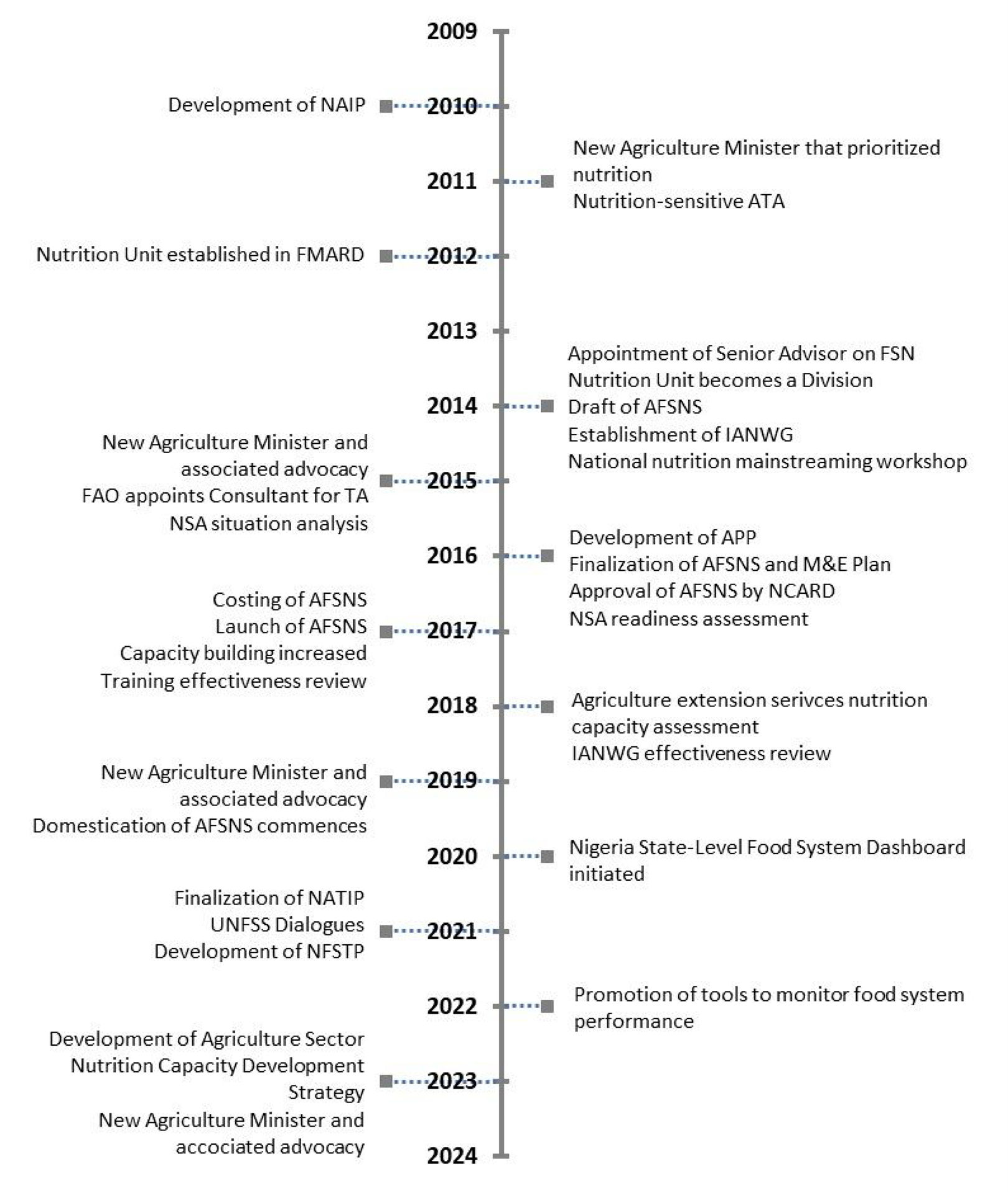
Chronology of key nutrition-sensitive agriculture events in Nigeria.
Lessons From Nigeria’s Experiences
The successes and challenges highlighted in Nigeria’s experiences with fostering an enabling environment for NSA and food systems are similar to what has been reported by other authors. 9,14,45 Still, we would like to emphasize a few factors that is often not explicitly underscored in literature.
Advancing NSA and food systems through established national institutions takes time
The events reported in this Special Issue occurred over the space of more than 10 years, and the NSA enabling environment in Nigeria is still a work in progress. Di Prima et al 9 mentioned “time-related failure factors” and noted that several studies highlighted a long project duration as a success factor for NSA. Other authors have also advocated for long time periods (more than 5 years) for NSA to be implemented adequately and produce expected outcomes. 46,47 In our Nigerian example where NSA is not being implemented as a project, but as a paradigm shift in institutional behavior, the time required can be expected to be even longer. To use the words of one author, “Building and developing the capacity of state institutions is about systems and processes, skills, and knowledge – but also attitudes and behaviour. All these are long-term processes and could not [be achieved in a short time]” (Hamladji N). 48 (p28)
Knowledge brokering is indispensable and requires several entities and stakeholders working collaboratively
Knowledge brokering is a capacity development approach that enables collaboration and partnerships among researchers, policymakers, and programme implementers, thereby strengthening the capacity of implementers to drive progress. Knowledge brokers are individuals or organizations that mobilize and transfer different kinds of knowledge, including research, local, and experiential knowledge, to support policymakers and implementers to achieve their work outcomes. Knowledge brokers generally perform 5 roles–information manager, linking agent, capacity builder, facilitator/backstopping agent, and evaluator. Other terms that have been used to refer to people who perform knowledge brokering roles include implementation support practitioners. 49 -51 The progress so far seen in Nigeria could be attributed to having a set of dedicated stakeholders across cadres in FMARD; donor and international development partner supported facilities, consultancies, and services such as the senior policy advisory support and other consultants; and a range of partners working collaboratively and sharing knowledge assets and other resources toward advancing food systems and NSA in Nigeria. None of these stakeholders could have performed knowledge brokering roles alone and even these stakeholders were insufficient when there were simultaneous demands from multiple activities. As can be seen in Figure 1, activities addressing different aspects of the enabling environment occurred simultaneously.
Capacity assessments should precede NSA interventions and NSA approaches used should be suited to available capacity
A 2013 paper on capacity strengthening for NSA concludes with these words: “Without skilled people with the right tools, working in the right places, doing the right things, policy statements and action plans will continue to be unfulfilled”. 52(p.60) The role and importance of adequate capacity of actors expected to be involved in planning and executing NSA is increasingly being emphasized. 9,14,53,54 Some authors 54 have stated that actors can only be held accountable for action or inaction if they have the capacity and power to act. The experiences in Nigeria contribute to the literature about the imperative for capacity. Even when political will and commitment was high, limited capacity hindered NSA implementation and progress. While the AFSNS has been reported to be a comprehensive strategy, it has remained largely unimplemented 7 years after its ratification. 18 Ensuring that the available capacity can cope in the short term with the scope of NSA activities planned is important.
Institutional and organizational capacity strengthening should precede or be concurrent with individual capacity strengthening
Appropriate sequencing of NSA activities is another success factor that has been noted by other authors. 9 In the Nigerian case study, the issue of sequencing appears immediately pertinent in relation to capacity. Agriculture extension agents 38 who had some capacity to deliver nutrition services were unable to do so because of limiting organizational and systemic capacity. Building the personnel capacity to deliver services prior to building organizational capacity may therefore yield little success. Hence, it is important to identify the cadre of staff that are crucial to organizational structure and capacity and ensure that the capacity of these staff is developed in tandem with or prior to capacity development of frontline service providers. 52
Conclusion
More than a decade of efforts to advance NSA and food systems in Nigeria has resulted in several successes, greater political commitment for nutrition, and improved nutrition enabling environment. These changes are reflected in the existence of a Nutrition and Food Safety Division in the Ministry of Agriculture and an approval for a Nutrition Department, existence of an agriculture sector nutrition strategy, increased private sector engagement and commitment to nutrition-sensitive food systems, and increased funding for nutrition in the agriculture sector. Nevertheless, challenges remain for scaling up strategic, operational, and delivery capacity of both organizations and individuals involved in advancing NSA and food systems. Preparation of an Agricultural Sector Workforce Capacity Development Strategy is, therefore, in progress. The Strategy will target improving nutrition capacity within the context of wider food and agricultural systems strengthening, leveraging on the increasing wave of political will, and commitment for developing nutrition-sensitive food systems.
Footnotes
Declaration of Conflicting Interests
The author(s) declared no potential conflicts of interest with respect to the research, authorship, and/or publication of this article.
Funding
The author(s) disclosed receipt of the following financial support for the research, authorship, and/or publication of this article: Financial support for the research and publication of this article was provided by a grant from the Bill and Melinda Gates Foundation to the Global Alliance for Improved Nutrition (GAIN).
