




Abstract
Household decision-making influences choices related to the production, sale, purchase, and consumption of nutrient-rich foods. The present study assessed the effect of household decision-making in 2 regions of Ethiopia within 2 groups of households, most vulnerable households and model farmer households. The study focused on identifying barriers and facilitators relating to decisions about nutrient-rich foods—in this case fruits, vegetables, and animal source foods. The results provide insights into how future agricultural programs can affect key aspects of decision-making to maximize the positive impacts on diet and food security.
Introduction
Over the past 2 decades, Ethiopia has made significant strides in improving population health outcomes through the reduction of chronic child malnutrition. During this time, the nation has seen a 20% decrease in the prevalence of stunting in children younger than 5 years of age, from 58% in 2000 to 37% in 2019. 1 Although such results appear promising in the fight to improve the nutritional status of the country’s approximately 105 million residents, 2 more progress is needed to combat maternal and childhood undernourishment, including stunting, which still afflicts almost 2 out of 5 children in Ethiopia. Today, more than half of Ethiopian children aged 6 to 59 months and one quarter of women have anemia, and 28% of child mortality in Ethiopia is associated with undernutrition. 1
The implications of widespread child and maternal malnutrition are significant, with heavy social and financial costs incurred across critical development sectors including health, education, and the economy. One report estimates that Ethiopia loses approximately 55 billion ETB (4.7 billion USD) each year to child undernutrition. 3 In response to these elevated figures, the government of Ethiopia launched an initiative called the Seqota Declaration in July 2015, which is aimed at ending hunger and undernutrition by 2030. The Declaration acknowledges the role of childhood undernutrition in loss of productivity and diminished cognition, and names the agricultural sector as one of many with a vested role in combating stunting and childhood malnutrition through improved access to quality, nutrient-rich foods. 4
The majority of Ethiopia’s undernourished children reside within four major regions in Ethiopia (Amhara; Tigray; Southern Nations, Nationalities, and Peoples [SNNP]; and Oromia), where most of the rural population subsists on agricultural production. With only 6% of cultivated land currently irrigated, the annual yields of smallholder farmers are often at the mercy of environmental factors, including highly variable seasonal rainfall, disease, diverse soils, and pest-related damage. 5 Ethiopia also has weak market linkages on both the input and the output sides. Typically, farmers cannot afford improved inputs and often lack the knowledge and/or skills regarding their efficient and effective use. 6
Adequate food availability at the national, regional, and household levels, obtained through agricultural production, domestic and international markets, and other channels is the cornerstone of diet and nutritional well-being for households. Household food security depends on sustained access to adequate income and assets, including land and other productive resources.
Expanding access to diverse, safe, and quality diets involves increasing the production, consumption, and procurement of foods at the household level. This entails a combination of improved inputs and cultivation practices to increase yields, enhanced market availability of diverse nutrient-rich foods, and the availability of well-designed programmatic responses to minimize food contamination and postharvest losses.
Access to nutritionally adequate food, however, neither guarantees adequate consumption by all individuals within the household nor the appropriate biological utilization of the food consumed. 7 Household food security can be translated into good nutritional status if all household members have nutrition security, a condition that combines (1) access to nutritionally adequate and safe food; (2) sufficient knowledge and skills to acquire, prepare, and consume a nutritionally adequate diet, including that which meets the special needs of young children, pregnant, and lactating women; and (3) access to health services and a healthy environment to ensure effective biological utilization of foods consumed.
In response to widespread child malnourishment in Ethiopia and the diverse set of challenges that accompany a household’s decisions to produce, purchase, consume, and utilize nutrient-rich foods, a Feed the Future USAID-funded project called Growth through Nutrition was implemented with the dual aim of improving nutritional status and increasing production of vegetables, fruits, legumes, biofortified crops, and the rearing of small livestock. Another important component of the project was a social and behavioral change communication (SBCC) campaign focused on increasing knowledge, demand, and consumption of diverse, safe, and quality foods.
The purpose of the present research was to better understand the dynamics (ie, barriers and facilitators, key factors influencing decision-making and behavior adoption) of household production, consumption, utilization, sales, and purchasing behaviors of nutrient-rich foods to inform the project’s nutrition-sensitive agricultural (NSA) packages and SBCC strategy. In addition, the research sought to assess how these household dynamics affected household food security and diet diversity. The research was limited to issues related to nutrient-rich foods, in this case defined as fruits, vegetables, and animal source foods (ASFs).
Methods
Study Setting, Design, and Participants
The Growth through Nutrition project provides support to a variety of beneficiaries including 2 groups of farmers, model farmers (MFs), and most vulnerable households (MVHHs). Model farmers are surplus producers targeted by Growth through Nutrition who received NSA training and technical support. The most vulnerable households are a higher risk group based on smaller land holdings and limited agricultural production; the MVHHs reside in the same regions as MFs and received a package of NSA inputs, as well as training and additional support from agricultural extension workers.
Growth through Nutrition operates in 4 regions: Amhara, Tigray, SNNP, and Oromia. However, Amhara and SNNP were the 2 regions selected for the research. Within these 2 regions, 3 agroecological zones were selected, including highland, midland, and lowland areas. The study primarily used Focus Group Discussions (FGDs) and key informant interviews (KIIs) to address the study objectives; 39 FGDs and 43 KIIs were conducted, representing a total of 318 individuals. The study employed a purposive sample of MFs and MVHHs for the FGDs and purposively selected woreda agriculture and health officers as well as kebele-level agriculture extension workers (AEWs), health extension workers (HEWs), and kebele administrators/managers for the KIIs. The FGDs were held at the kebele (village) level, and a semistructured questionnaire was used with probing as appropriate.
It is worth noting that the majority of the MFs were men and conversely the majority of MVHH members were women, as many of the MVHHs are female-headed households and widows. The research team did make an effort to include as many females in the MF FGDs as possible, working with AEWs to specifically recruit females from MF households to participate in the MF FGDs.
Focus group discussions were used to collect in-depth qualitative information at the community level to capture: Knowledge and attitudes related to nutritious food production, consumption, and utilization Information on household decision-making dynamics with regard to the production, consumption, retention, purchase, and sale of nutritious crops/food Major barriers and motivating factors in the production and consumption of healthy foods
Data Analysis
In all surveyed kebeles, FGDs and modified production/consumption barriers analysis were conducted with MVHHs and MFs, and information collected in FGDs was used to triangulate data collected during KIIs. All transcripts were read several times by the investigators separately to bring out the main theme, barriers, and facilitators of nutritious and healthy foods production, consumption, and utilization. The research team used an inductive qualitative data analysis approach and emergent framework to group and analyze the data. The data were reviewed and combined into broader categories in terms of barriers and facilitators of nutritious and healthy foods production, consumption, and utilization; the information was then ordered, reduced, and classified or coded, displayed, summarized, and finally interpreted according to the procedure employed. The study received institutional review board (IRB) clearance from Tufts University as well as from the Ethiopian Public Health Institute. Oral consent was obtained for all focus group participants and individuals involved in the KIIs.
Results
The results are summarized by the barriers, facilitators and key factors related to household decision-making around production, consumption, sale, and purchase of nutrient-rich foods with similarities and differences highlighted between regions, farmer groups, and AEW. The foods are categorized into fruits, vegetables, and ASFs.
In general, many factors were found to shape the production, consumption, retention, purchase, and sale practices of crops and livestock; the most common factors included availability of labor, access to production inputs including water and suitable soil, household consumption preferences, and financial, physical, economic, and seasonal constraints. There were, however, some unique factors among the 3 groups of foods.
Facilitators of production of fruits, vegetables, and ASFs
Unless otherwise specified, the factors affecting the production of fruits, vegetables, and ASFs were similar between the 2 regions. The access to fruit seedlings and the opportunity to attend training provided by Growth through Nutrition dominated the list of factors that facilitated the decision to produce fruits. To a lesser extent, knowledge about the income and nutritional benefits of fruits were factors influencing the decision to produce them.
For vegetables, it was training, provision of agricultural inputs, the availability of land and suitable soils, and continued technical support from agricultural extension workers that were most likely to influence the households’ decision-making. Finally, it was the profitability of vegetable production that was a major factor, as evidenced by the quote below: It is more economical to produce the vegetables such as cabbage which are one of the main relishes produced on own farm than to buy them in the market. (SNNPR FGD participant) In the previous years, farmers used to focus on cash crops such as species, pepper, and onion. However, this trend is changing in the recent years (in the last 4-5 years) and farmers start to produce vegetable with the focus on consumption.
Animals are more than simply a source of food for households; they are assets, signs of affluence, and insurance for financial security in many rural families. According to discussions with MFs in Amhara, animal ownership has decreased over time because of the reduced size of communal grazing land in the rural areas. As such, farmers in the Amhara region are forced to keep a smaller number of animals; maintaining larger numbers is a burden rather than an asset. The shrinking size of communal grazing areas discourages families from keeping cattle, prompting them to focus on smaller animals. Not surprisingly, the provision of small animals to women in the MVHHs and the knowledge gained from training by the agricultural extension workers on modern animal feeding and rearing were key facilitators for the production of ASFs.
Barriers to production of fruit, vegetables, and ASFs
The major barriers to fruit production in Amhara were environmental and physical. The specific physical constraint was mainly soil, specifically black cotton soil that is the most common type, which does not retain water at the depth needed to reach fruit seedlings. Many households were risk adverse and thus gave priority to staple food crops for both consumption and sale. In addition, there was a limited demand in the market for fruits in comparison to food crops, further limiting adoption of fruit production.
The major barriers to vegetable production in both regions were economics and risk. Households tend to produce crops that are less perishable and can be sold relatively quickly at a high price. Damage by insects, rodents, and small livestock was a smaller but still noted constraint, which influenced the perceived risk of vegetable production.
Across both regions, many households still do not consider vegetables a main food and continue to prioritize production of staples for consumption and cash crops for sale. In both regions, shortages of land and water during the dry season were also key production barriers.
For MVHHs, the main barrier to production or rearing of small animals was lack of financial capacity to acquire them; this constraint was true in both regions. For the male MFs in Amhara, the main barriers were a shortage of communal grazing land and lack of knowledge about modern rearing methods.
Animal diseases coupled with expensive veterinary services and medicines were barriers for MVHHs in Amhara. The lack of finances for fencing, hunting by wild animals, and conflict with neighbors over crop damage were repeatedly mentioned by MVHHs in both regions as other barriers to ASF cultivation.
In SNNP Region (SNNPR), MFs and some women rear goats during the winter, however, they are not an important source of food. People there are unaccustomed to milking goats and slaughtering goats for meat, thus, consumption is not very common since the financial benefit from the sale of goats is given priority.
Facilitators for fruit, vegetable, and ASF consumption
There were some differences in factors that encouraged increased consumption of fruits. In the Amhara region, fruits, especially the sweet and tasty ones, are favored by children and viewed as a purchased treat in place of candy. Families in Amhara tend not to purchase fruit for adults but rather consume them from their own production. Worth noting is the observation that fruits are not generally consumed for their nutritional value. In SNNPR, however, avocado is used as a common relish and is a major factor for prioritizing consumption over the sale of this fruit.
Fruit is not considered as important as staples for consumption. Fruits are more commonly consumed in the rainy season, when typically they can be eaten from own production. During the dry season, fruit prices increase dramatically and thus fruit consumption plummets due to market sales.
In both regions, the presence of own farm fruit trees was a main factor for fruit consumption. In addition, seasonal access to fruits, knowledge and attitudes, and price of fruits were other determinants of consumption. Finally, there was a perceived medicinal value for some specific fruits; for example, men in SNNPR use guava to alleviate constipation.
The decision to consume vegetables was shaped by the taste preferences of family members, as was mothers’ knowledge of diet diversification and vegetable preparation. In some cases, children request certain vegetables, so mothers take these preferences into account. Additionally, many women from the MVHHs considered the nutritional value of vegetable foods when preparing meals. Vegetables help children develop healthy brains. They become strong and healthy when they consume different kinds of vegetables. Vegetable and animal products are good for pregnant women as well and make the fetus healthy and strong. (FGD, Amhara)
The knowledge acquired from Growth through Nutrition training was a reported motivator for consuming eggs. For some, especially the MFs, financial and asset security gave them confidence to consume ASFs.
The sale of small animals for meat was very common and considered a reliable source of income at critical times when cash was limited in the household. Milk, on the other hand, was used for home consumption and not sold at the market. This was especially evident in Amhara. In SNNPR, dairy products such as cheese and ghee were sold. Goats and sheep were considered household assets rather than sources of food unless they were slaughtered during holidays. Chickens in both Amhara and SNNPR were important sources of ASF since eggs were priorities for children, however, MVHHs in Amhara were more likely to sell eggs since financial needs were usually high.
Barriers to fruit, vegetable, and ASFs consumption
At the household level, there was competition between consumption and sale of fruits. For both MFs and MVHHs, some fruit trees were prioritized for the sale of fruits. Not surprisingly, the financial gains from sales and the perception of fruits as a luxury good limited consumption when market opportunities were present.
In both Amhara and SNNP, the major barriers to vegetable consumption included insufficient availability of vegetables in the market, priority given to sale rather than consumption (especially when the prices of vegetables were high), and the high cost of vegetables during dry season. In Amhara, lack of knowledge about the importance of dietary diversification was one of the key barriers (most families consume mainly pulses and cereals), followed by lack of production capacity, priority of cash over nutritional security, basic staple foods, and financial insecurity.
Animal source foods were not regularly consumed by most households unless there were religious holidays and other events such as weddings; animals, on average, are sold to earn income. For most MVHHs, the household’s financial insecurity forces them to prioritize the sale of eggs over family consumption.
Goat milk is not typically consumed in either region. Limited knowledge regarding the nutritional value of ASFs was a barrier, and in some cases, ASFs were perceived as a luxury, prepared only for special events.
Facilitators for purchase of fruits, vegetables, and ASFs
In general, higher income, low market price, and market availability of fruits were the key influences of fruit purchases. As previously mentioned, gifts for children, physical remedies, and familiarity with use as a food condiment or relish also may have influenced purchases. Curiously, the health benefits of fruit consumption did not influence their purchase.
The facilitators of vegetable purchase in both regions and across all groups were the same, however, in many households in Amhara, the purchase of coffee beans and alcohol was given priority over vegetables. In all agroecological zones in both regions, vegetable purchase was facilitated by knowledge about the benefits of vegetables (especially among the MVHHs and MFs who do have access to training courses); better finances due to sale of cash crops, availability of vegetables in the market, consumption experience (SNNP), and taste preference.
Barriers to fruit, vegetables, and ASF purchases
The major barrier to the purchase of fruits was limited income. A lesser barrier to purchase but also a factor was knowledge and attitudes about fruits. In Amhara, fruits are considered a treat for children rather than a nutritious food that should be part of a healthy diet.
The main barriers identified to the purchase of vegetables were financial capacity (especially among MVHHs), competing priorities, availability of vegetables at a reasonable market price, traditional food habits that often do not include eating vegetables, food taboos especially among pregnant mothers, and mockery from neighbors or older relatives from the perception that buying vegetables is a waste of money.
In SNNPR, the typical diet consists of vegetables like cabbage, but financial constraints limit families’ ability to purchase them, especially for the MVHHs. A woman in the MVHH group described how the shortage of cash forces them to divert from their normal buying choices: We have a serious cash shortage in my family. My husband works as a daily laborer and he is not healthy and strong due to which we don’t usually have enough cash. Due to this we prefer to buy and eat bread or enjera rather than Enset based foods which is the main staple in the region. You can eat enjera and bread with pepper or tea but you need relishes such as vegetables, avocado, or cheese to eat our traditional food.
Effects of Sale of Production of Healthy Foods on Household Diet and Food Security
The sales of ASFs, vegetables, and fruits were an important source of financial security in SNNPR, but not a main source of income. In Amhara, exchange of crops was a major strategy to balance financial and food security within the household. Households prefer to keep maize and sorghum for family consumption; these crops are relatively inexpensive compared to teff, which when sold garners more cash. Households tend to mix maize and sorghum to increase the volume of stock available for annual consumption.
Importance of Achieving Quality Diet in Household Decision-Making
Food preferences and preparation are influenced by culture, knowledge, and education level. Knowledge and exposure to new approaches to foods and food preparation techniques can be important for achieving diet diversification. Family priorities are mainly influenced by perception and knowledge; the diversification of dietary patterns is not only driven by household income, but by the knowledge and perceptions of a quality diet. As long as the food supply is enough to cover the caloric needs of the household, the study found that dietary diversity is not a top priority. Households tend to retain the cheapest crops while more highly valued crops are sold.
In general, it is the production pattern that affects the nutrition security of the household more than the decision to sell or consume. A change in food patterns may be achieved in the long run, driven by production patterns and changes in the perception toward nutrition security that have resulted from the impact of Growth through Nutrition. Table 1 presents a summary barrier analysis by region for MFs and MVHHs of the factors that influence the production and consumption of healthy foods.
Factors That Influence Production and Consumption Practices Among Study Respondents.
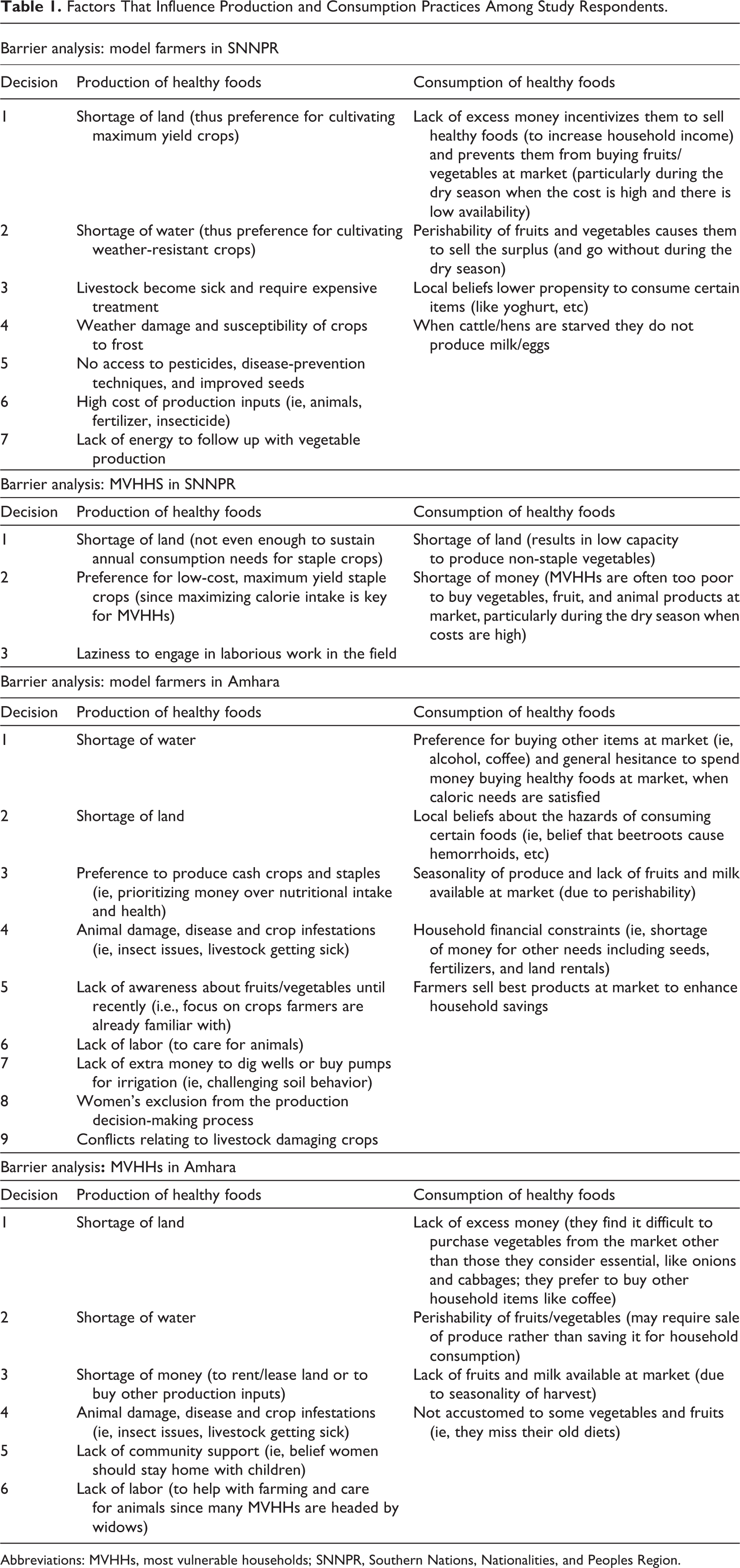
Abbreviations: MVHHs, most vulnerable households; SNNPR, Southern Nations, Nationalities, and Peoples Region.
Discussion
There is limited diet variety in Ethiopia. This is a key constraint to improving health and nutrition in the population, particularly for pregnant women and preschool-aged children. The Growth through Nutrition project has a goal of increasing consumption of nutrient-rich foods through increasing access to a package of agricultural inputs, training, and social and behavioral change campaigns. The effectiveness of this combined package of inputs/services was contingent on the household’s decision-making regarding perception and use of this innovative program.
Many factors collectively influenced household decision-making related to the production, consumption, retention, sale, and purchase of healthy foods. 7 The significance of these factors varied by regions, household type (MF and MVHH), gender, and culture. There was, however, in the Amhara and SNNPR, heavy overlap with regard to the drivers and barriers of decisions related to a household’s agricultural strategies.
One common thread dominated decision-making regarding production of crops. It was only when a household’s food security was ensured that farmers were willing to diversify into cultivation of a wider range of crops, including nutrient dense fruits and vegetables. Production of staple foods was the most critical consideration driving household decision-making regarding agricultural strategies. This has clear implications for national level agricultural and nutrition policies. A recent commentary advocated increased production of nutrient-rich foods as a viable mechanism for achieving many of the food security and nutrition objectives of the sustainable development goals. 8 Indeed, greater farm production diversity has been associated with increased diet diversity in Malawi. 9 In the case of these 2 regions in Ethiopia, it was only the less risk-averse households that were willing to diversify crop production strategies. Not surprisingly, it was the wealthier households that were less risk averse. It is also clear, however, that the early adopters of nutrition-sensitive production strategies were often exposed to heightened environmental risks including disease, unfavorable soil conditions, and damage from insects and pests. These factors impacted the MFs’ and MVHH farmers’ predilection to produce nutrient-rich crops.
The Growth through Nutrition project’s provision of agricultural inputs and training provided the incentives to diversify cultivation of fruits and vegetables, even in the most vulnerable, low-income households. In addition, for the most risk-averse households, financial protection measures for farmers, such as a farmers’ insurance program, may have encouraged increased production of nutrient-rich foods. Innovative postharvest technologies, adapted to the local context, also could be one strategy to deal with the challenge of perishable crops loss.
Another main factor affecting household decisions was the need to produce cash crops to increase disposable income. Related to this is the fact that cash crops tend to be under the control of men. There is a large literature documenting that the expenditure patterns of men and women typically differ. Women’s income is more likely to be spent on home production activities, including food. 10 Research from Ethiopia documents the fact that income from cash crops in female-headed households was a significant determinant of increased diet diversity. 11 This effect was dramatically larger than in male-headed, cash crop–producing households.
The issue of a gender effect on decision-making was only tangentially explored. The results from this research indicate that, either directly or indirectly, women need the concurrence of the husband even when crops are ostensibly under the control of females. Thus, although the empowerment of women is one goal of Growth through Nutrition, this has not yet been universally achieved.
The accessibility of markets, including geographical distances, had an effect on production/consumption decisions. When markets are imperfect, the separability between production and consumption decisions breaks down. One study 12 reported some counterintuitive results. When market access was poor, children in milk-producing households were less likely to be stunted compared to non–milk-producing households. When market access improved, this significant effect on stunting disappeared. The author concludes that when milk cannot be marketed, it is consumed in the household to the benefit of child nutritional status.
Efforts have been deployed by the agriculture office in SNNPR to establish market linkages and decrease the household costs associated with selling production surpluses; these initiatives need to be expanded and enhanced to provide increased market access to the most at-risk households. In addition, establishing small-scale mini markets in villages may be advantageous so that smallholder farmers have a venue in which to market their products and access vegetables, fruits, and small animal products locally.
Nutrition-sensitive agriculture (eg, growing nutrient-rich foods) can result in improved diets for women and children. These approaches, however, are generally more effective when combined with SBCC, women’s empowerment, water and sanitation components, and provision of micronutrient-fortified foods. 13 Culture and attitudes toward food, diets, and child rearing do change, but often these changes occur over a period of time. Nonstaple items including fruits, vegetables, and animal products were often considered a luxury among communities—warranting less interest in their widespread cultivation and purchase. Women from many MVHHs, however, have begun to feed their children fruits and vegetables since learning that these products will help their children grow; their knowledge with regard to the safe preparation of these foods seems to have substantially increased as a result of the education provided to them by health and agricultural extension provided through the Growth through Nutrition project. In turn, some MFs who received training report an increased familiarity with the new vegetable and fruit crop varieties, despite the ongoing reluctance to adopt these new items into their daily consumption patterns.
The widespread misalignment of knowledge and attitudes toward healthy foods has resulted in a low willingness to pay for such items. Social norms governing desirable consumption and purchasing patterns continue to play a role in the high valuation of and inelastic demand for coffee, cooking oil, and other consumables; although progress has been made, more must be done to tailor financial and social incentives in the SBCC packaging to increase the overall desire for healthy foods. 14
Water and land shortages are critical constraints to increased production of nutrient-rich foods. Focusing on water harvesting interventions and the digging of small wells can help alleviate this water constraint. Similarly, land shortages for landless farmers can be circumvented by identifying pragmatic ways to rent land or make communal lands more easily available.
Women from MVHHs who received support for production of nutrient-rich foods indicate that it was the provision of both improved varieties of seeds and help in the rearing of small animals that was most useful. Results from this study reinforce the fact that in order to have production and consumption of nutrient-rich foods, the household decision-making process is critical to meet the nutritional requirement for the household and improving child health and nutrition.
Conclusion
The present research confirms the importance of decision-making strategies for adoption of new agricultural production patterns and for changing consumption patterns. Decision-making is multifaceted and, as such, requires a diverse series of actions to enact change. Investments by Growth through Nutrition in a package of agricultural inputs, training, and a social behavioral change campaign have produced significant, positive results.
Footnotes
Acknowledgments
The authors thank the numerous individuals who supported the study, including Dr Jennifer Coates, Dr Abdulhalik Workicho, and Jennifer Stickland from Tufts University; Getnet Assefa from Land O’Lakes; Lioul Berhanu from Save the Children; and Tsegahun Tessema and Hanna Mekonen from JaRco Consulting PLC. They also thank the contributions of the data collection team and the study respondents who gave of their time to help answer the study questions.
Declaration of Conflicting Interests
The author(s) declared no potential conflicts of interest with respect to the research, authorship, and/or publication of this article.
Funding
The author(s) disclosed receipt of the following financial support for the research, authorship, and/or publication of this article: This publication was made possible through support provided by Feed the Future, the US Government’s Global Hunger and Food Security Initiative, through the US Agency for International Development, under the terms of agreement no. AID-663-A-11-00017. The opinions expressed herein are those of the authors and do not necessarily reflect the views of the US Agency for International Development.
