



Abstract
Objective:
Although emphasis is placed on women’s decision-making power regarding family planning use in Ethiopia, the utilization of contraceptives is low. There are studies conducted in different parts of the country on women’s decision-making power regarding family planning use; however, there are inconsistent findings. Thus, this study aimed to determine the pooled prevalence of women’s decision-making power regarding family planning use and associated factors in Ethiopia.
Methods:
The Preferred Reporting Items for Systematic Reviews and Meta-Analyses guidelines were followed to develop the systematic review and meta-analysis. All observational studies were retrieved from online databases, including PubMed, CINAHL, Google Scholar, African Journal Online and gray literature. The data search was performed from 1 December to 16 May 2022. The quality of the studies was critically assessed using the Joanna Briggs Institute checklist. Heterogeneity among studies was examined using the I2 statistic. RevMan version 5.3 and STATA version 14 software were used for analysis.
Results:
A total of 852 studies were retrieved, and 8 studies were included in the final meta-analysis. The pooled prevalence of women’s decision-making power regarding family planning use was 57 (95% confidence interval: 37, 77). Good knowledge of family planning methods (odds ratio: 2.46, 95% confidence interval: 1.65, 3.67), a positive attitude toward family planning methods (odds ratio: 2.04, 95% confidence interval: 1.3, 3.2), and having primary or higher education (odds ratio: 9.76, 95% confidence interval: 4.36, 21.99) were associated with increased odds of women’s decision-making power regarding family planning use.
Conclusion:
Nearly three in five married women made decisions regarding family planning use in Ethiopia. Women with good knowledge of family planning methods, a positive attitude toward family planning methods, and women having primary or higher education were associated with increased odds of women’s decision-making power regarding family planning use.
Introduction
Women’s decision-making power in family planning use is the ability to freely decide independently or argue with their husbands or partners about family planning needs and choices. 1 Family planning is an effort made by couples to limit or space the number of children through the use of family planning methods. 2 Women’s decision-making power on family planning use is generally characterized by delayed marriage, access to accurate information, free discussions about family planning needs and choices with partners, members of the household and the community, and independent decisions on fertility regulation, including increased health-seeking behavior to contraceptive services.3,4
Increased women’s decision-making power regarding family planning provides benefits such as safeguarding the health and rights of women, reducing maternal and child mortality, avoiding unplanned pregnancy, reducing induced abortion, reducing long-term fertility rates, and improving households’ economic status.4-7 Women in low-income countries are deprived of their reproductive health rights.6,8 In developing countries, contraceptive use is low (40%), and the unmet need for family planning is 225 million people. 9 In sub-Saharan Africa, contraceptive use varies from 6.7% in Chad to 72% in Namibia. 3 In Ethiopia, contraceptive use was low (41.4%), and there was a high unmet need for family planning use (22%). This is lower than the national target of 55% for 2020. 10 This leads to a high total fertility rate of 4.6 children per woman and contributes to maternal mortality of 412 per 100,000 live births, neonatal mortality of 30, infant mortality of 43 and under five mortality of 55 per 1000 live births.11,12 According to the Sustainable Development Goal (SDG) 3.7.1 indicator, the demand for family planning use with modern contraceptives in all countries will be at least 75% by 2030.13,14
Low-up use of contraceptives has many consequences, such as high common child hood illness, lack of appropriate health, poor maternal and child health care, increased maternal and child mortality, increased workload of mothers, and unfavorable impact on economic status and growth.2,15–17 Factors affecting women’s decision-making power regarding family planning use were lack of education, socioeconomic factors, low domestic decision-making power, male partner influence, lack of knowledge, low access to reproductive health services, and gender-based inequalities.17–23
In Ethiopia, although the national 20-year health sector transformation plan 8 and national guidelines for family planning services 2 emphasize women’s decision-making power on family planning use, family planning use is still low, and there is a lack of nationally representative data on women’s decision-making power regarding family planning use.11,12 There are primary studies conducted in different parts of the country on women’s decision-making power in family planning17,18,24–28; however, there are inconsistent findings on prevalence and factors affecting women’s decision-making power regarding family planning use. Thus, this systematic review and meta-analysis aimed to determine the pooled prevalence of women’s decision-making power regarding family planning use and associated factors in Ethiopia.
Methods
Study protocol and reporting
The Preferred Reporting Items for Systematic Review and Meta-analyses (PRISMA) guidelines 29 were used to prepare the systematic review and the meta-analysis. The PRISMA-P 2009 checklist (Supplementary File 1) was used for the review report.30,31 The protocol was registered on PROSPERO CRD42022325150 and available at https://www.crd.york.ac.uk/prospero/#myprospero. The protocol preprint was available online 32 and published in a peer-reviewed journal. 32
Eligibility criteria
All observational studies, including cross-sectional, case–control, cohort and grey literature studies performed in Ethiopia, were included. Case reports, case series, reviews, and preprints were excluded from the study. If studies address both quantitative and qualitative findings on women’s decision-making power in family planning use, we considered the quantitative results. Articles published only in English were included. There were no restrictions on publication date.
CoCoPop/PEO search guide
Condition: Women’s decision-making power regarding family planning use
Context: Ethiopia
Population: Women of reproductive age (15–49 years)
Exposure is determined to increase or decrease the likelihood of women’s decision-making power in family planning use among women of reproductive age in Ethiopia. The determinants can be, but are not limited to, the educational status of the partner, domestic decision-making power, male partner influence, knowledge on contraceptives, gender-based related factors, access to reproductive health services, etc.
Outcome/context: The primary outcome of the study was the pooled prevalence of women’s decision-making power regarding family planning use. Women’s decision-making power regarding family planning was considered whether they had decision-making power regarding delayed marriage, access to accurate information, free discussion about family planning needs and choices with partners, independent decisions on fertility regulation, and increased health-seeking behavior to contraceptives in the primary studies. The selections of independent variables were based on how frequently the variables were reported in the primary studies, and factors reported in more than one study and having consistent classification were included.
Search strategy and study selection
The studies were searched from databases, including PubMed, Google Scholar, African Journal Online, CINAHL, and gray literature. The data search was performed from 1 December 1 to 16 May 2022. The retrieved studies were exported to the Endnote version 8 reference manager to collect, organize, and manage search results. 33 The studies were screened independently by two authors (EW and DK). The process of article selection, including the removal of duplicates, irrelevant titles, and abstracts, was reported using the PRISMA chart. Medical Subject Heading and entry were used to search studies using Boolean operators (OR, AND) from databases (Supplemental File 2).
Quality assessments
Eligible studies on women’s decision-making power in family planning use with full texts were further evaluated for quality appraisal. The Joanna Briggs Institute Meta-Analysis of Statistics Assessment and Review Instrument was used to assess the full-text quality of the studies. 34 The tool emphasizes clear inclusion and exclusion criteria, standard criteria used for measurement of the condition, study subjects and setting, strategies to address confounding, exposure measurement in a valid and reliable way, outcome measurement, and appropriate statistical analysis. A quality scale of 50% and above was considered and included in the final meta-analysis. In addition, cross-reference searching of studies was performed from the included studies. The quality of the full-text articles was assessed independently by two authors (EW and DK). Disagreements among reviewers were resolved by the third author (FY).
Data extraction and management
Independent piloting of the data extraction was carried out in Microsoft Excel (2016) before the beginning of the actual data extraction by all authors. The actual data extraction was performed independently by the two authors (EW and DK). The data extraction tool has information on first author name, publication year, study setting, study design, sample size, response rate, prevalence, study subjects, and predictors of women’s decision-making power regarding family planning use. In case of missing data or incomplete reports, the corresponding authors of the studies were contacted by email. Discrepancies in data extraction were resolved by third author FY.
Statistical analysis
The extracted data were imported into STATA version 14 for analysis. Moreover, event and control data of significant variables were extracted from the Excel sheet to RevMan software version 5.3 for analysis.
A random-effects model was used to determine the pooled prevalence and associated factors of women’s decision-making power regarding family planning use. 35 Forest plots were used to present the pooled prevalence and factors affecting women’s decision-making power in family planning use at a p value of less than 0.05. 36 I2 statistics 37 were used to identify heterogeneity across studies. The I2 statistic estimates the percentage of variation across studies, and I2 values of 25%, 50%, and 75% were representative of low, moderate, and high heterogeneity, respectively. The sources of heterogeneity were determined using subgroup analysis and meta-regression based on region, study area, publication year, and sample size.
Results
Study selection
A total of 852 studies were searched from electronic databases. All studies were imported into version 8 EndNote software manager. In all, 22 duplicated studies were removed. Moreover, 807 studies were removed for not being related to the topic, not being conducted in Ethiopia, duplication, and abstract. Furthermore, 23 full-text studies were assessed for quality, and 15 studies were excluded because the outcome variable was not measured and because of an incorrect methodology. A total of eight studies were included in the final systematic review and meta-analysis (Figure 1).

Flow chart of study selection for meta-analysis of women’s decisions regarding family planning use in Ethiopia, 2022.
Characteristics of the included studies
In this systematic review and meta-analysis, eight studies were included, and the studies were published from 2011 to 2022 in different settings in Ethiopia. A cross-sectional study design was used in all studies. A total of 7823 married women were included in the study. The sample size of the included studies ranged from 344 in the Oromia region 26 to 3668 in a multilevel analysis of the 2016 Ethiopian Demographic Health Survey (EDHS). 38 Of the eight studies, one study was performed in the Tigray region, 25 two studies in the Amhara region,24,39 one study in the Oromia region, 26 one study at the national level, 38 and three studies in the southern region.18,40,17 The prevalence of women’s decision-making power regarding family planning use ranged from 21.6% in a multilevel analysis of the 2016 EDHS 38 to 80% in the Amhara region. 24 Furthermore, eight studies17,18,24–26,38–40 performed an analysis to identify factors associated with women’s decision-making power regarding family planning use in Ethiopia (Table 1).
Characteristics of included studies in the meta-analysis of women’s decisions regarding family planning use among married women in Ethiopia, 2022.

AOR: adjusted odds ratio; CI: confidence interval.
The pooled prevalence of women’s decisions regarding family planning use among married women in Ethiopia
The pooled prevalence of women’s decision-making power in family planning use was 57% (95% confidence interval (CI): 37, 77), with significant heterogeneity between studies (I2 = 99.71, p ⩽ 0.001) (Figure 2). The lowest proportion of included studies was 22% (95% CI: 20, 23) in the Ethiopian demographic survey 216, 38 and the highest proportion was 80% (95% CI: 77, 83) in the Amhara region 24 (Figure 2).

Forest plot showing the pooled prevalence of women’s decisions regarding family planning use in Ethiopia, 2022.
Subgroup analysis
Subgroup analysis was performed based on study area (urban/mixed), region, year of publication, and sample size to investigate the possible source of heterogeneity across the studies. In the subgroup analysis, the source of heterogeneity was the study area, year of publication, and sample size (I2 ⩾ 99.71). However, the subgroup analysis at the regional level was not the source of heterogeneity. At the regional level, the pooled prevalence of women’s decision-making power in family planning use ranged from 22% (20, 23) in the multilevel analysis of the EDHS to 79% (77, 81) in the Amhara region. There was an increase in women’s decision-making power regarding family planning use after 2015, 61% (36, 86) (Table 2).
Subgroup analysis for the prevalence of women’s decisions regarding family planning use among married women in Ethiopia, 2022.

EDHS: Ethiopian demographic health survey.
Meta regression
Meta-regression was performed to identify the source of heterogeneity across the studies by considering continuous and categorical variables, including region, study area (urban/mixed), and sample size. Meta-regression indicated that heterogeneity was associated with sample size (p < 0.05). However, the presence of heterogeneity was not associated with region or study area (p > 0.05) (Supplementary File 3, Table S1).
Factors affecting women’s decision-making power in family planning use among married women in Ethiopia
In this study, women’s primary or higher educational status,18,25 knowledge of women on family planning methods,24,40 and attitudes toward family planning methods18,40 were factors associated with women’s decision-making power in family planning use in Ethiopia.
Two studies24,40 indicated that women’s knowledge of family planning methods was significantly associated with women’s decision-making power regarding family planning use in Ethiopia. The odds of women’s decision-making power in family planning use among women with good knowledge of family planning methods were 2.46 times more likely compared to those who had poor knowledge of family planning (odds ratio (OR): 2.46, 95% CI: 1.65, 3.67) (Figure 3). Two studies18,40 indicated that women’s attitudes toward family planning methods were significantly associated with women’s decision-making power regarding family planning use in Ethiopia. The odds of women’s decision-making power about family planning use among women who had a positive attitude toward family planning were 2.04 times more likely than their counterparts (OR: 2.04, 95% CI: 1.3, 3.2) (Figure 4). Two studies18,25 indicated that having a primary or higher level of education was significantly associated with women’s decision-making power regarding family planning use in Ethiopia. The odds of women’s decision-making power in family planning use among women having a primary or higher educational level were 9.76 times more likely compared to women who had no education (OR: 9.76, 95% CI: 4.36, 21.99) (Figure 5). However, the age of the participants was not statistically significant (Figure 6).

Forest plot showing the association between knowledge women on family planning methods and women’s decisions regarding family planning use in Ethiopia.

Forest plot showing the association between attitudes of women on family planning methods and women’s decisions regarding family planning use in Ethiopia.
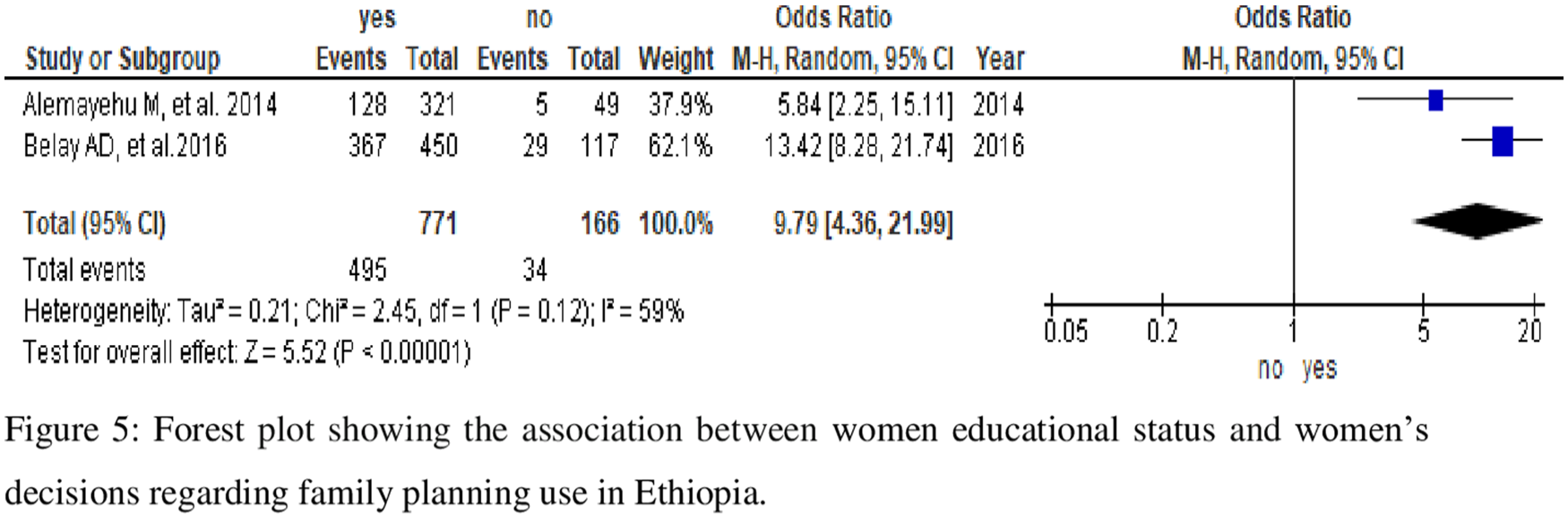
Forest plot showing the association between Women educational status and women’s decisions regarding family planning use in Ethiopia.

Forest plot showing the association between age of participants and women’s decisions regarding family planning use in Ethiopia.
Discussion
This systematic review and meta-analysis aimed to assess the pooled prevalence of women’s decision-making power regarding family planning use and associated factors in Ethiopia. There were no national data on the pooled prevalence of women’s decision-making power regarding family planning use and associated factors in Ethiopia. Therefore, the findings from this systematic review and meta-analysis will help policymakers develop appropriate interventions to increase women’s decision-making power in family planning use.
In this study, the pooled prevalence of women’s decision-making power regarding family planning use was 57% (95% CI: (37, 77). This finding was in line with studies conducted in Indonesia, 63.8%, 41 South Africa, 45%, 42 and Zambia, 65.8%. 43 However, the pooled prevalence of the study was higher than that of studies performed in India (36%). 44 The difference might be due to differences in study period, sample size, study setting, sociocultural differences, and access to health services. This was nearly similar to the national target of 55% for 2020. The achievement might be the emphasis given to the health sector transformation plan, the development of national guidelines for family planning services, and the health extension program implementation at the community level.2,10,45 However, it was lower than the SDG 3.7.1 indicator target of 75% for 2030. 14
In this study, the odds of women’s decision-making power in family planning use among women with good knowledge of family planning methods were 2.46 times more likely compared to those who had poor knowledge of family planning (OR: 2.46, 95% CI: 1.65, 3.67). These findings were in line with studies conducted in Bangladesh, 46 Asia, 47 Mali, 48 Tanzania, 49 and developing countries. 50 This might be because women with better knowledge regarding family planning methods will develop health service-seeking behavior and autonomy to use family planning methods and communicate with their partners on family planning. Moreover, it was noted that access to communication channels on family planning methods significantly improved awareness of family planning and attitudes. 49
The odds of women’s decision-making power about family planning use among women who had a positive attitude toward family planning were 2.04 times more likely than their counterparts (OR: 2.04, 95% CI: 1.3, 3.2). This finding was in line with studies conducted in Asia, 47 Ethiopia, 51 and Ghana. 52 This might be because women with a positive attitude toward family planning methods might know the benefits and side effects of using family planning methods.
The odds of women’s decision-making power in family planning use among women having primary or higher education were 9.76 times more likely to be involved in family planning use compared to women who had no education (OR: 9.76, 95% CI: 4.36, 21.99). This finding was in line with studies conducted in other settings.53,54 This might be because women who were exposed to education have a greater likelihood of meeting their family planning needs and shifting from traditional to modern contraceptives than their counterparts. Moreover, gender-equal decision-making power is one of the positive impacts of education on reproductive health services. 54
This study might have the following limitations, including heterogeneity due to differences in study settings, sample size, and publication year. Articles published only in the English language. As only cross-sectional studies were found, it is difficult to conclude that the temporal relationship and outcome variable might be affected by other confounding variables. Moreover, this study represented only studies reported from four regions and one national survey study of the country. The study has the following strengths. The protocol was registered on PROSPERO and published in a peer-reviewed journal. PRISMA guidelines were used, and more than two authors were included. As a systematic review, it is an important type of evidence for public health practice, as it provides more reliable findings than primary studies.
Conclusion
Nearly three in five married women made decisions regarding family planning use in Ethiopia. It was comparable to the national target of 55% for 2020; however, it was lower than the SDG 3.7.1 indicator target of 75% by 2030. Women with good knowledge of family planning methods, a positive attitude toward family planning methods, and women having primary or higher education were associated with increased odds of women’s decision-making power regarding family planning use. Thus, awareness of family planning benefits and improvement of women’s education are important interventions.
Supplemental Material
sj-doc-1-smo-10.1177_20503121231162722 – Supplemental material for Women’s decision-making power regarding family planning use and associated factors in Ethiopia: A systematic review and meta-analysis
Supplemental material, sj-doc-1-smo-10.1177_20503121231162722 for Women’s decision-making power regarding family planning use and associated factors in Ethiopia: A systematic review and meta-analysis by Etsay Woldu Anbesu, Mussie Alemayehu, Dejen Kahsay Asgedom and Fikru Yigezu Jeleta in SAGE Open Medicine
Supplemental Material
sj-docx-2-smo-10.1177_20503121231162722 – Supplemental material for Women’s decision-making power regarding family planning use and associated factors in Ethiopia: A systematic review and meta-analysis
Supplemental material, sj-docx-2-smo-10.1177_20503121231162722 for Women’s decision-making power regarding family planning use and associated factors in Ethiopia: A systematic review and meta-analysis by Etsay Woldu Anbesu, Mussie Alemayehu, Dejen Kahsay Asgedom and Fikru Yigezu Jeleta in SAGE Open Medicine
Supplemental Material
sj-docx-3-smo-10.1177_20503121231162722 – Supplemental material for Women’s decision-making power regarding family planning use and associated factors in Ethiopia: A systematic review and meta-analysis
Supplemental material, sj-docx-3-smo-10.1177_20503121231162722 for Women’s decision-making power regarding family planning use and associated factors in Ethiopia: A systematic review and meta-analysis by Etsay Woldu Anbesu, Mussie Alemayehu, Dejen Kahsay Asgedom and Fikru Yigezu Jeleta in SAGE Open Medicine
Footnotes
Acknowledgements
We would like to thank Samara University for the HINARY database website and network access.
Authors’ contribution
Conceptualization: Etsay Woldu Anbesu
Investigation: Etsay Woldu Anbesu
Methodology: Etsay Woldu Anbesu, Mussie Alemayehu, Dejen Kahsay Asgedom, Fikru Yigezu Jeleta
Software: Etsay Woldu Anbesu
Validation: Etsay Woldu Anbesu, Mussie Alemayehu, Dejen Kahsay Asgedom, Fikru Yigezu Jeleta
Formal analysis: Etsay Woldu Anbesu
Investigation: Etsay Woldu Anbesu, Mussie Alemayehu, Dejen Kahsay Asgedom, Fikru Yigezu Jeleta
Resources: Etsay Woldu Anbesu, Mussie Alemayehu, Dejen Kahsay Asgedom, Fikru Yigezu Jeleta
Data curation: Etsay Woldu Anbesu, Mussie Alemayehu, Dejen Kahsay Asgedom, Fikru Yigezu Jeleta
Visualization: Etsay Woldu Anbesu, Mussie Alemayehu, Dejen Kahsay Asgedom, Fikru Yigezu Jeleta
Writing—original draft: Etsay Woldu Anbesu
Writing—review & editing: Etsay Woldu Anbesu, Mussie Alemayehu, Dejen Kahsay Asgedom, Fikru Yigezu Jeleta,
Declaration of conflicting interests
The author(s) declared no potential conflicts of interest with respect to the research, authorship, and/or publication of this article.
Funding
The author(s) received no financial support for the research, authorship, and/or publication of this article.
Ethics approval
Not applicable.
Informed consent
Not applicable.

Supplemental material
Supplemental material for this article is available online.
References
Supplementary Material
Please find the following supplemental material available below.
For Open Access articles published under a Creative Commons License, all supplemental material carries the same license as the article it is associated with.
For non-Open Access articles published, all supplemental material carries a non-exclusive license, and permission requests for re-use of supplemental material or any part of supplemental material shall be sent directly to the copyright owner as specified in the copyright notice associated with the article.
