



Abstract
This article summarizes research based on the INCAP Longitudinal Study that demonstrates the positive effects of the atole intervention on prime-age adult cognitive skills and productivities. The findings are interpreted in the context of a life-cycle stages model in which various factors and investments at each stage of life influence outcomes not only in that stage but in subsequent ones. The results point to the likely importance of improvements in adult cognitive skills due to better early-life nutrition on adult male labor market outcomes as well as on women’s “home productivity” in terms of anthropometrics for the next generation. Possible mechanisms are also explored, including the impacts of early-life exposure to atole on children’s height when starting school, on grades of schooling attainment, and on the extent of experience with higher-skilled jobs, as well as the impacts of improved cognitive skills on wages. Not only are investments in early-life nutrition important for immediate welfare but also they have significant productivity payoffs in adulthood.
Introduction
Good nutritional status, in both early and later life, is of high intrinsic value justifying public action to ensure that all children receive access to the resources needed for good nutritional outcomes. In a world characterized by limited public resources, however, appealing only to the intrinsic value of good nutrition may not be sufficient for those actions to be taken. The rationale can be strengthened if it can be shown that such investments also have substantive productivity returns. Put another way, the investment case is strengthened if improved nutritional outcomes in early life also have instrumental value, contributing to broader national and global development outcomes.
Unfortunately, rigorously establishing the long-term benefits of early-life nutrition is challenging. Convincing analysis requires following individuals over long periods of their life course; for example, from birth to the prime of their working lives. Moreover, a plausible means of distinctly identifying the effects of early-life nutrition from other factors correlated with both early-life nutrition and outcomes in adulthood is needed. For example, children growing up in environments where nutritional status is poor may contemporaneously be in environments where school quality is low, making it difficult to distinguish the effects of poor nutrition and low-quality schooling on adult outcomes. Also needed is the ability to develop a coherent conceptual model as to why such effects exist. A few long-term studies have some of these components through early adulthood, see Gertler et al 1 for an example; the INCAP Longitudinal Study is unique in that it has all these components well into adulthood.
This article summarizes research on the links between early-life nutrition and adult cognitive skills and economic outcomes based on the INCAP Longitudinal Study. We begin by sketching a conceptual framework to clarify how such causal links might emerge and the challenges associated with identifying them. We then summarize evidence from the INCAP Longitudinal Study on those links. The first follow-up to the original intervention was carried out in 1988, 2 when participants were 11 to 26 years, with many still attending school and relatively few having entered the labor market. This made it problematic to fully assess adult impacts at that time. However, by the time the Human Capital Study (HCS) was fielded in 2002 to 2004, participants were 26 to 42 years. All had finished school and were old enough to have entered the labor force. A further follow-up in 2007 to 2008, the intergenerational transmission (IGT) study complemented HCS by collecting data on the offspring of participants in the HCS. Hence, in this article, we focus on results based on the HCS, supplemented by the IGT. We begin with impacts on adult cognitive skills, specifically on reading comprehension and on reasoning skills. Next, we consider impacts on economic productivity as measured by wages and income as well as “home productivity” as measured by the next generations’ anthropometrics. We describe the broader influence of this work before concluding.
Conceptual Framework
To help organize and understand the various research findings, we first outline a conceptual framework linking early-life nutrition and adult outcomes; Hoddinott et al 3 provide a more comprehensive version. The framework posits 6 sequential life-cycle stages: (1) in utero and the first 2 years of life (commonly referred to as the “first 1000 days”); (2) early childhood, from age 2 years to normal school-entry age approximately 5 or 6 years; (3) late childhood; (4) adolescence; (5) adulthood; and (6) old age. Children start life with a given set of genetic and environmental endowments. Conditional on these endowments, nutritional status (and other dimensions of early childhood development) are affected by various investments that mitigate 4 broad types of risk factors. These risks include complications during pregnancy and birth, inadequate food intake in terms of both macro- and micronutrients, infection, and inadequate stimulation and nurturing (indicated in the box to the upper left of Figure 1). Investments made to mitigate these risks affect (1) nutritional status in the first 1000 days as well as (2) cognitive skills, (3) socio-emotional skills, and (4) executive function/self-regulation (in the box at the upper right). Familial and public investments, in the center left of the figure in the box, may moderate not only the 4 risk factors and their impacts on early-life outcomes but also how the outcomes of the first 1000 days impact later outcomes over the life cycle.
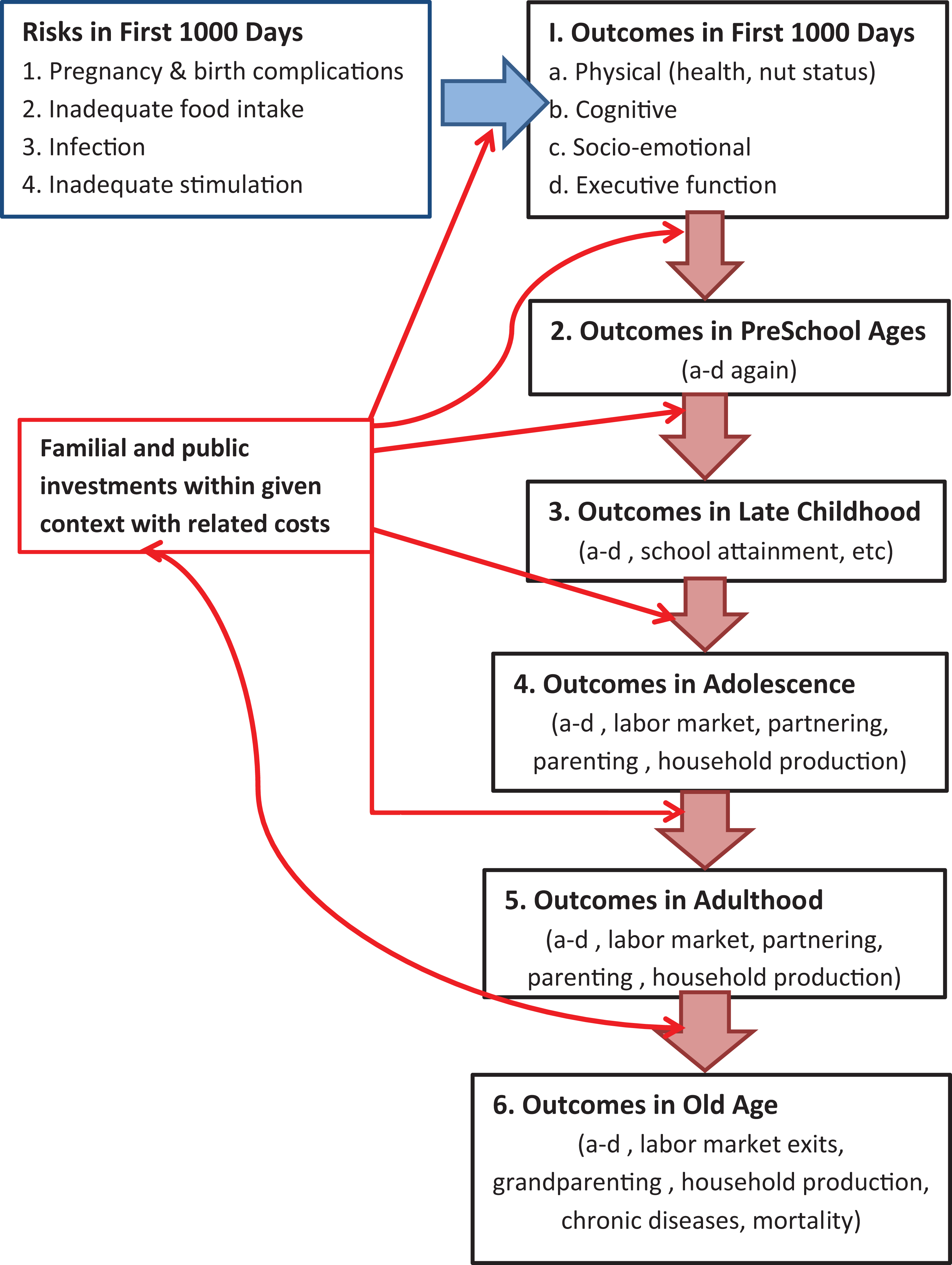
A life-cycle approach to the relationship between early-life experiences and outcomes in adulthood. Source: Hoddinott et al. 3
Within this conceptual framework, parents make decisions that affect child nutrition and other developmental outcomes during the first 1000 days. Outcomes in the next (preschool or stage 2) life-cycle stage reflect the outcomes from the first 1000 days, familial and public investments made during the preschool life-cycle stage, and random factors such as variations in the disease/nutrition/cognitive or socioemotional stimulation environment in which the child lives. Similarly, outcomes in late childhood (stage 3) are produced by the outcomes from the preschool period (stage 2), familial and public investments made during that stage and random shocks—and so on through the 6 life-cycle stages. The outcomes for the adult and old-age life stages include adult cognitive skills, labor force participation, wages and income (and health, which is discussed elsewhere in this volume), as well as the production of “goods” within the household that include the anthropometric status of children.
Thus, this framework serves 2 functions. First, it informs our understanding of the mechanisms by which early-life nutrition interventions and outcomes, particularly in the first 1000 days, can affect adult cognitive skills and economic and household productivity. The provision of a nutritional supplement such as atole fits neatly into this framework. It can be thought of as a public intervention (box in center left of the figure) that affects outcomes in stage 1, the first 1000 days; other articles in this supplement describe those effects in more detail. Second, with the multiple factors and stages, the framework underscores how difficult it is to move from estimating associations between early-life nutrition interventions and outcomes in adulthood to establishing causal relations between the 2, given the many factors that could modify such relations including persistent unobserved factors (eg, genetic endowments, family culture) that might affect nutritional status both directly and indirectly through other channels.
Results
Adult Cognitive Skills
We focus on the stock of cognitive skills individuals have that enhance their ability to perform activities with economic value. Such skills are components of human capital. 4,5 By this definition, schooling, discussed in the contribution by DiGirolamo, is not in and of itself a skill but rather an input into the production of skills. In this article, we focus on 2 skills—reading comprehension and reasoning—that can be causally linked to economic productivity in the INCAP Longitudinal Study.
Data
As described by Maluccio et al, 6 the HCS included a test of reading comprehension skills, the Inter-American Series test (Serie Interamericana [SIA]). It contained a reading comprehension module with 40 questions and a vocabulary module with 45 questions, yielding a maximum possible score of 85 points. Participants with limited literacy skills (less than 4 grades of schooling or having 4 to 6 grades, but unable to pass a literacy screen pretest) were given a score of 0 (18% of the sample) and all others scored with the number of correct answers. The mean score was 36.0 with a standard deviation (SD) of 22.3. Males scored slightly higher (mean, 37.9) than females (mean, 34.4).
All individuals in HCS also were administered the Raven Progressive Matrices test, an assessment of reasoning or nonverbal cognitive ability. 7 The test consists of a series of pattern-matching exercises with the respondent asked to supply a “missing piece” and with the patterns getting progressively more complex. We administered the first 3 scales, each with 12 questions for a maximum possible score of 36. Scores were calculated as the number of correct answers summed across the 3 scales. The mean score was 17.7 with a SD of 6.1. Males scored slightly higher (mean, 19.4) than females (mean, 16.2).
In analyses, the SIA and Raven’s scores were expressed as z-scores standardized to have mean 0 and SD 1 within the sample.
Atole and Adult Cognitive Skills
Impacts
In 2009, 6 we estimated the impact of atole on performance on these 2 tests. In the context of our conceptual framework, we examined whether a nutritional intervention (which would be included in the box indicating familial and public investments) that initially targeted outcomes in the first stage of life had effects that persisted into adulthood, the fifth stage. Doing so is empirically challenging because: (1) while some villages were randomly assigned to receive atole, and others fresco, all villages received access to high-quality medical care free of charge; (2) the social stimulation for children—resulting from their social interactions while attending feeding centers where the supplement was distributed, the observation and measurement of their nutritional status, and the monitoring of their intakes might also affect child nutritional and cognitive outcomes; and (3) while the intervention was randomized, the small number of villages implies that there was a risk that the effects of atole could be masked by subsequent interventions or shocks that affected some villages (but not others) and were correlated with the atole intervention (note 1).
We addressed these challenges using a double-difference (or differences-in-differences) approach as follows. For (1), we constructed a dummy variable reflecting whether an individual was exposed to either the atole or fresco intervention for the entire period from birth to 36 months of age. This variable captures factors common to all children in this age range in any of the villages, including improved medical services and increased social stimulation present under both interventions. Next, we interacted this main effect with an indicator variable of whether the individual lived in one of the 2 atole villages. This interaction term captures the differential effect of being in an atole village in comparison with those in the same cohort in a fresco village or the double difference. Because for the main analyses we use potential exposure, estimates based on this specification yield the intent-to-treat effect of exposure to atole versus fresco. For (2), we controlled for measures of school quality when the individual was aged 7 years and when they were 13 years. In exploratory work, other shocks such as income shocks, changes in infrastructure, and the effect of the 1976 earthquake on specific age-groups were included but these did not alter the results. For (3), we tested the robustness of our estimates to a set of alternative assumptions regarding village-birth cohort effects as well as different exposure periods including 0 to 24 months.
Using this specification, we estimated that exposure to atole between 0 and 36 months increased adult reading comprehension skills by 0.28 SD and adult reasoning skills by 0.24 SD. There were no statistically significant differences in impacts on women versus men. These striking findings were to our knowledge the first of their kind from a prospective survey, demonstrating that improving nutrient intakes in early life can have impacts on adult cognitive skills.
Mechanisms
What explains these impacts? In 2014,
8
we examined the following 3 potential mechanisms linking the atole intervention to adult cognitive skills: Outcomes in preschool (stage 2), specifically height-for-age z scores (HAZ) at 6 years of age. As is widely understood, HAZ is a measure of chronic undernutrition. As discussed by Hoddinott et al,
3
chronic undernutrition has neurological consequences that can lead to cognitive impairments that may well be reflected later on in dimensions of adult cognitive skills. Atole improved early-life nutritional status, as discussed elsewhere in this supplement. Outcomes in late childhood (stage 3), specifically grade attainment. Outcomes in adulthood, including years of work in skilled employment such as white collar or administrative jobs, work requiring specialized skills (eg, mechanics), social service occupations (eg, teachers, nurses), and those working in agricultural or own-enterprise occupations with high-economic returns.
As these mechanisms are themselves (intermediate) outcomes pertaining to different life-cycle stages, we used instrumental variables estimation with exposure to the original intervention between 0 and 36 months of age, exposure to the original intervention between 0 and 36 months age interacted with atole (see above) and natural, economic and policy shocks as instruments. We found the following: HAZ at 6 years had no effect on reading comprehension skills. A 1 SD increase in HAZ at 6 years increased reasoning skills by 0.32 SD. An additional grade of schooling increased reading comprehension skills by 0.09 SD. Schooling attainment had no statistically significant effect on reasoning skills. An additional year of skilled work experience increased reading comprehension skills by 0.03 SD. An additional year of skilled work experience increased reasoning skills by 0.14 SD.
Collectively, these results suggest that early-life nutrition interventions and outcomes have effects on components of adult cognitive skills but that the pathways through which they occur differ by component. There is a pathway from atole to schooling and reading comprehension skills, reflecting the fact that such skills are taught at school. There is a pathway from atole to HAZ to reasoning skills. Speculatively, this pathway may reflect the possibility that atole reduced the likelihood that individuals had cognitive impairment due to chronic undernutrition in early life. It is possible that these skills deteriorate if they are not used. This would explain why working in skilled occupations, where they are more likely to be needed for the tasks this work requires, causes them to increase. This research using the INCAP Longitudinal Study was one of the first to elucidate these pathways into adulthood, demonstrating that improving nutritional status in early life results in improved adult cognitive skills decades later.
Adult Productivity
Research summarized in Hanushek and Wößmann 9 demonstrates that adult cognitive skills, more than school attainment, are what are important for individual earnings, income distribution, and economic growth. Consequently, it is plausible that atole, which influenced adult skills, could also affect measures of economic productivity such as wages and income and “home productivity” such as the anthropometric status of children. Further research undertaken with the HCS data assessed this hypothesis.
Data
Human Capital Study collected detailed survey information on all income-generating activities including wage labor activities (type of work; hours, days, and months worked; and wages and fringe benefits received); agricultural activities (amount of land cultivated; crops grown; production levels and value; use of inputs; hours, days, and months worked); and nonagricultural own-business activities (type of activity; value of goods or services provided; capital stock held; hours, days, and months worked). In 2005, 10 we described how these data were used to calculate annual earned income, hours worked in the last year, and the average wage rate (ie, income earned per hour worked), an important measure of economic productivity. Virtually all (99%) men participated in at least one income-generating activity, with 80% working for wages, 43% working on their own farms, and 28% operating their own business. A smaller proportion (70%) of women participated in at least one income-generating activity, with 33% working for wages, 21% working on their own farms, and 34% operating their own businesses. 11 Intergenerational transmission collected detailed anthropometric information on the children of participants in the original INCAP study.
Atole and Productivity
Impacts
In 2008, 11 within the same conceptual framework, we assessed whether a nutritional intervention that targeted outcomes in the first stage of life had effects that persisted to the fifth stage, adulthood, focusing on economic productivity. We used the same double-difference statistical approach as before 6 and also considered exposure for the period from birth to 24 months of age to more closely align the analysis with exposure during the first 1000 days. We again controlled for the potentially confounding effects of changes in school quality as well as other shocks that might have affected income, hours worked, and wages. Given gendered aspects of the Guatemalan labor market, these models were estimated separately for men and women.
For men, 11 we found that exposure to atole between 0 and 24 months increased wages by USD 0.67 per hour—representing a 46% increase relative to average wages in the sample. Impact estimates were comparable using the 0 to 36-month age window. The point estimate on exposure to atole between 0 and 24 months implied a decrease of 222 hours worked per year that, although statistically insignificant, offset the significant increase in wages per hour, so that the increase of USD 870 per year in annual earned income was also insignificant.
We found no significant impact on women’s wages, annual income, or hours worked. One reason for this might have been differences between male and female labor force participation and work activities. Most women in the sample engaged in low-productivity activities such as agricultural processing (indeed, for these reasons, it would have been inappropriate to model men and women together) where returns to skills such as reading comprehension or reasoning may be limited. In 2009, 12 however, we did find significant impacts on women’s “home productivity” in life-cycle stage 5 as measured by anthropometric impacts on their children. Specifically, offspring of women exposed to atole had 116 g higher birth weight, 0.6 cm larger head circumference, and 0.26 SD higher HAZ. By contrast, exposure to atole for males did not affect their children’s anthropometry. Note that we were not able to identify whether the mechanisms are through the women’s enhanced cognitive skills, biological, or other channels. 12
The results alluded to above 11 and 12 were important because they were, to the best of our knowledge, the first to establish a direct link between interventions aimed at improving nutritional status in early life and productivity in adulthood.
Atole and Economic Productivity
Mechanisms
Although the results reported in Hoddinott et al
11
indicate that the atole intervention increased wage rates for men, they do not explain how. Our conceptual framework offers at least 2 possible explanations. First, as described earlier, by preventing neurological damage due to chronic undernutrition and permitting more effective learning during school, atole caused increases in adult cognitive skills (reading comprehension and reasoning) and these skills in turn increased economic productivity. Second, and as reported by Stein et al in this supplement, atole caused increases in height and there might be economic returns to height, or more broadly to physical capacity for work, in the labor market. As with the consideration of mechanisms for cognitive skills examined above, these mechanisms are themselves outcomes, so our examination of them uses the same statistical approach used in the study by Behrman et al,
8
instrumental variables estimation with exposure to the original intervention between ages 0 and 36 months, exposure to the original intervention between ages 0 and 36 months interacted with atole (see above), price and policy shocks and family endowments (maternal education and height, paternal education) as instruments. In the study by Behrman et al,
13
we find the following, for both men and women: A 1 SD increase in reading comprehension increased hourly wages by 35%. Neither height nor other measures of physical capacity to work (such as fat-free mass) affect wages.
Given the high returns to these adult cognitive skills in the labor market, these results strengthen the economic argument in favor of investments in early childhood nutrition. The critical pathway, however, does not appear to be through improving adult health but rather through improving adult cognitive skills.
Influence
The INCAP Longitudinal Study has deepened our understanding of the impact of nutritional interventions in early life on various dimensions of adult cognitive skills and economic productivity. The impact is considerable as reflected, for example, in over 2000 citations in Google Scholar for the studies reviewed above. Its influence, however, has extended well beyond the academic articles summarized here.
The introduction emphasized that the case for investing in nutrition is strengthened if it can be shown that improved nutritional outcomes in early life contribute to broader national (and global) economic development. The evidence presented earlier demonstrates this, but in a world with many other possibly effective interventions to improve outcomes, that evidence alone does not imply it is a better intervention than possible alternatives. One approach to making such an assessment is to combine the impact results from the INCAP Longitudinal Study with information on the costs of improving children’s nutritional status to calculate a benefit: cost ratio (BCR) of such an investment. Informed by the results summarized above as well as work directly linking the atole-related improvements in childhood HAZ to outcomes in adulthood (see Hoddinott et al 14 ), we undertook such calculations, reporting them in the study of Hoddinott et al. 3,15 Investments in early-life nutrition have BCRs that substantially exceed one. In the study by Hoddinott et al, 3 which estimates these for a range of countries with high prevalences of undernutrition, the median BCR is 18.
These estimates were considered as part of the 2012 Copenhagen Consensus (CC) exercise aimed at setting priorities for addressing major global challenges. Based on these BCRs, the CC panel concluded that “fighting malnutrition should be the top priority for policy makers.” 16 This finding was brought to the attention of a working group—a High Level Panel of Eminent Persons—convened by the then UN Secretary General Ban Ki-moon, who were tasked with establishing new international development goals attainable by 2030. The working group noted that “The benefits of investing in sustainable development are high. Every dollar invested in stopping chronic malnutrition returns $30 in higher lifetime productivity.” 15 -17 (p6, note 13) They recommended that the reduction of stunting should be one of the United Nations (UN) Sustainable Development Goals, 15 when they wrote that “Reducing malnutrition, especially among the youngest children, is one of the most cost-effective of all development interventions. Every $1 spent to reduce stunting can yield up to $44.50 through increased future earnings.” 17 (p40) This recommendation was adopted by the UN in 2015.
Conclusions
In this article, we summarized research based on the INCAP Longitudinal Study that demonstrates the positive effects of the atole intervention on prime-age adult cognitive skills and economic productivity for men, as well as home productivity for women. The findings can be interpreted in the context of a life-cycle stages model in which various factors and investments at each stage of life influence outcomes not only in that stage, but in subsequent ones. The results point to the likely importance of interventions that improve early-life nutrition on later life outcomes. Not only is investing in early-life nutrition important for immediate welfare but it has high payoffs decades later.
Presently, recently collected data are being analyzed to extend our understanding of the long-term effects of nutrition even further, to nearly 50 years. That evidence will shed light on whether the effects reported here persist, fade out, or increase into later adulthood, as well as whether there might be other important effects resulting from the investment in early-life nutrition. We will continue to learn from the INCAP Longitudinal Study.
Footnotes
Authors’ Note
This article was previously published in Spanish as Ramirez Zea M, Mazariegos M, eds. Estudio Longitudinal de Oriente del INCAP: 50 Años Contribuyendo a la Nutrición Publica. Guatemala: Instituto de Nutrición de Centro América y Panamá (INCAP); 2019:39-50.
Declaration of Conflicting Interests
The author(s) declared no potential conflicts of interest with respect to the research, authorship, and/or publication of this article.
Funding
The author(s) received no financial support for the research, authorship, and/or publication of this article.
