



Abstract
The need for improving methods of nutritional assessment and delivering primary health care globally cannot be overemphasized. While advances in medical technology typically create more disparities because of access being limited to resource-rich settings, a transition of health care to a mobile platform is increasingly leveling the field. Technological advances offer opportunities to scale laboratory procedures down to mobile devices, such as smartphones and tablets. Globalization also provides the required infrastructure and network capacity to support the use of mobile health devices in developing settings where nutritional deficiencies are most prevalent. Here, we discuss some of the applications and advantages provided by expanding markets of biomarker measurement coupled with primary health care and public health systems and how this is enhancing access and delivery of health services with significant global impact.
Keywords
Introduction
The ability to accurately and reliably quantify nutritional biomarkers is critical for nutrition interventions and programs. 1 The Biomarkers of Nutrition for Development program managed by the National Institute of Child Health and Human Development has made remarkable progress in identifying appropriate biomarkers and informing the best applications for research, programs, and policy 2 in the last few years.
While much focus has been placed on which markers to measure, relatively fewer resources have been devoted to the development for improved quantification methods. This is despite the fact that numerous international agencies have identified the development of tools to efficiently measure micronutrient deficiencies as a priority (eg, Gates Foundation 3 ). Fortunately, recent advances in technology and biomedical engineering pave the way for improved nutritional assessment tools and techniques. One key advantage emerging from new technology is the ability to scale down the size and cost of biomarker measurement equipment while preserving accuracy and reliability. Increasingly, these approaches are shifting away from clinic-based care toward a more mobile platform. Such mobile health, or mHealth, capability allows for wider distribution to communities and resource-poor settings, which is transformative in the context of nutritional assessment and primary health care on a global scale. 4
Smart System Technology
Smartphone and tablet use is on the rise worldwide, with increasing consumption in developing markets. Operating on cellular networks with relatively low infrastructure requirements, smart system technology can permeate even the most remote regions. These handheld computers have powerful computational potential, yet require little user training. For example, the new iPhones are benchmarked to be as fast as a fully equipped personal computer, the MacBook (http://qz.com/508313/the-new-iphone-is-as-fast-as-a-macbook/). As mHealth devices improve patient access to health-care workers and diagnostic services, populations—particularly in low- and middle-income countries—will see marked benefits.
Smart system technology consequently helps streamline services and mitigate disparities in health provision. In addition, these user-friendly devices offer state-of-the-art imaging and communication capabilities. Compared to existing portable medical devices, smart systems provide a hardware platform that can adapt to various accessory detection systems and custom mobile application software. Smartphones or tablets combined with portable accessory adapters enable a range of techniques including microscopy, genetic testing, colorimetric test strip analysis, and electrochemical detection. 5 As these capabilities expand, handheld molecular analysis of bodily fluids will magnify the scope of physiological information available at the point of care.
In addition to valuable quantitative measurements, these mobile devices have the power to compute and display analyses, as well as transmit data via cellular or wireless Internet communication systems. 6 These systems are also relatively cost-effective because they offset fees for time, transport, and electricity. 7
Recent advances in biomedical engineering of assessment technology reflect a rapidly growing field and the advent of devices that can operate high-throughput microfluidics, 8 -11 portable polymerase chain reaction machines for pathogen detection, 10,12,13 and nanosensors with targeted molecule detection. 14 -18 Now, any smartphone or tablet can become a medical device, capable of sophisticated molecular assays and data processing.
Example Technology: The Cornell NutriPhone
The Cornell NutriPhone has resulted through a collaboration between scientists and engineers in Nutritional Sciences and Mechanical and Aerospace Engineering at Cornell University over a time span of 2 years. When we began this partnership, our initial targets were to develop diagnostic tools that were affordable and accessible for populations in both resource-limited and resource-rich settings. From a technical standpoint, we also decided to focus on adapting conventional laboratory assays and gold standard methods rather than focusing on proxy biomarkers that are widely used in most field-based rapid diagnostic tests.
The result is a rapid point-of-care assessment tool with an ability to accurately quantify micronutrient concentrations from a drop of blood at the point of care in a low-cost fashion for populations in developed and resource-limited settings. 19 -21 We now have prototypes for low-cost accurate quantitative determination of several micronutrients including vitamin D concentrations from a drop of blood at the point of care (Figure 1). The tests are based on competitive antibody recognition, like other standard immunoassays. Instead of using an enzymatic or radioactive label, however, the antibodies are conjugated to 30-nm gold nanoparticles. The nanoparticles have a strong red color characteristic of their surface plasmon resonance. To perform a test, the user incubates a sample and the nanoparticle–antibody conjugates on the detection area. For the quantification of vitamin levels, the brightness change is first captured using the smartphone’s or accessory’s camera after inserting the test strip in the smartphone accessory. The smartphone app then uses an algorithm to scan for a region of most uniform color development, compute an averaged brightness difference, and estimate the vitamin concentration from the built-in calibration curve. 19
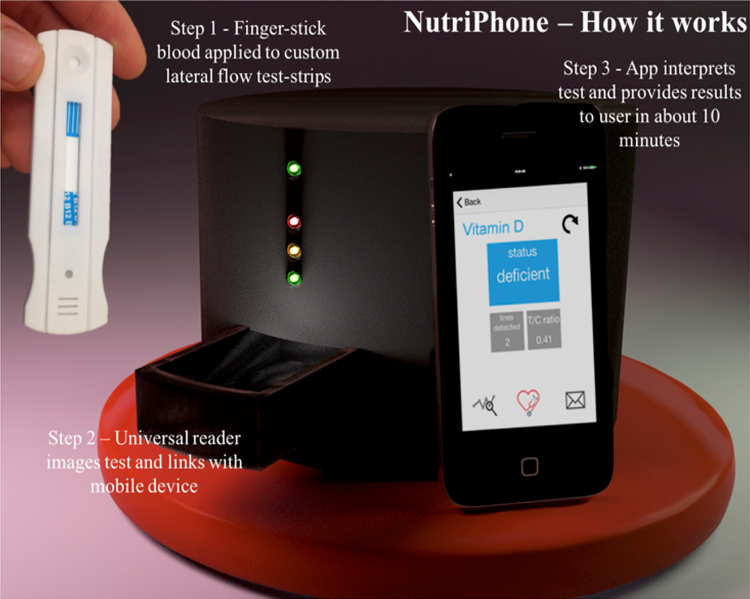
The Cornell NutriPhone.
While in many cases these devices can completely replace the need for a centralized laboratory, in others they can extend the reach and resources of such laboratories. This is particularly important in the case of nutritional assessment, as there are very few laboratories, particularly in resource-limited settings that are equipped to comprehensively test for a panel of micronutrients, for example. The cost saving of this approach is tremendous, as illustrated in Table 1, in addition to the immediate improvement in health-care access for millions if not billions of individuals worldwide.
Cost Comparison for Setting up a Laboratory for Nutritional Assays With the Cornell NutriPhone.a
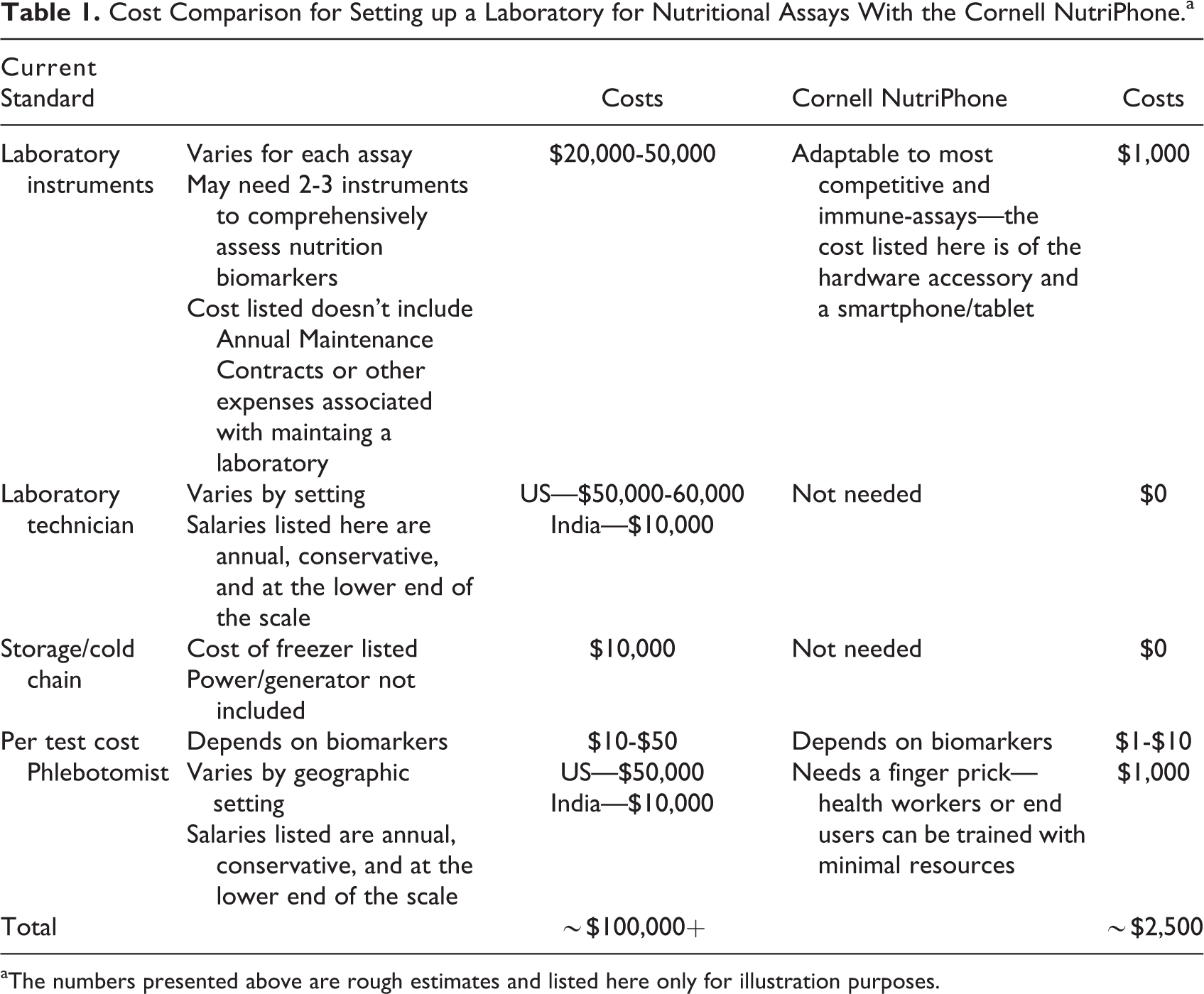
aThe numbers presented above are rough estimates and listed here only for illustration purposes.
Impact on Health Care, Surveillance, and Nutritional Assessment
New developments in smart system biomarker measures highlighted above will significantly improve nutritional assessment and epidemiological surveillance. Replacing laboratory equipment, these portable devices paired with accessories can measure and record vital signs, complete blood counts, lipid panels, and micronutrient profiles. They can also detect markers of infectious disease or noncommunicable diseases. Repeated measures, which can be tracked over time, provide an accurate assessment of diet and nutritional status, as well as the opportunity for tailored treatment plans. Assays designed for these devices are becoming increasingly quantitative with capacity for electrochemical or nucleic acid–based detection. 22
Smart systems also improve communication between patients and health-care providers. The ability to streamline diagnoses reduces time to treatment and mitigates misdiagnoses, thus leading to better health outcomes. Further utilizing communication features, smart system devices can offer targeted health advice and treatment options to patients and help improve patient satisfaction.
With built-in navigation capabilities, smartphone and tablet devices also offer global positioning system and geographic information system mapping capabilities. Spatiotemporal tagging allows accurate, real-time tracking of nutritional deficiencies and disease outbreaks, and notifications can be uploaded to centralized hospital or government servers remotely and immediately. Faster and more reliable tracking and storage of data will transform global surveillance procedures, while simultaneously enabling targeting of resources to the areas and populations most in need.
Summary
Smart system technology, in conjunction with the growing field of mHealth, is poised to revolutionize nutritional assessment and primary health care worldwide. Point-of-care biomarker detection capabilities bring sophisticated laboratory techniques to one’s fingertips while reducing costs and improving accessibility. This versatile device platform will offer an increasing selection of measurement tools, as the global consumer market for smartphones and tablets continues to expand. Equipping primary health-care centers or community health workers with one such device will upgrade laboratory facilities virtually by decades in many parts of the world. Further, mobile communication systems connect patients to health-care providers and streamline data reporting for improved surveillance and health information systems along with enabling health workers even in remote areas to triage and refer patients. In addition to being a sophisticated laboratory in one’s pocket, a smartphone or tablet can truly be the hub of the nutrition and primary health-care universe (Figure 2).
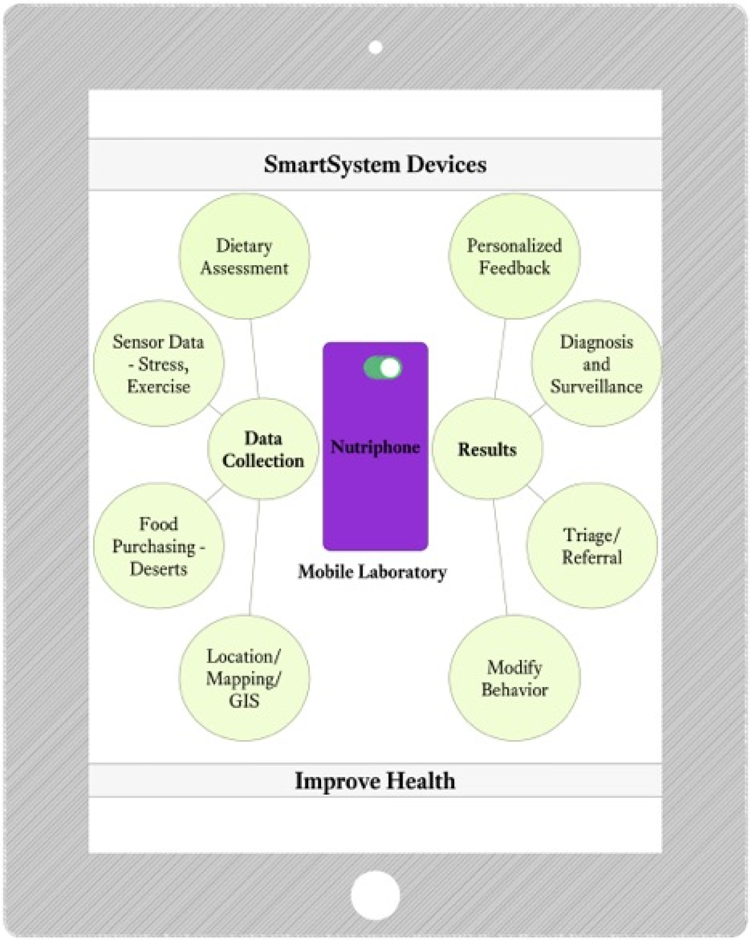
A smart system device can be the hub of the nutrition and healthcare universe.
Footnotes
Author’s Note
SM conceived of the manuscript and SC helped with its first draft. All authors contributed to editing and revising the manuscript and approved the submitted version. Part of this manuscript was also presented at the Rainer Gross Award Ceremony at the Micronutrient Forum Conference in Cancún, Mexico, 2016.
Acknowledgments
SM acknowledges the support of the Rainer Gross Award and the Hildegard Grunow Foundation for making this article possible.
Declaration of Conflicting Interests
The author(s) declared the following potential conflicts of interest with respect to the research, authorship, and/or publication of this article: SM and DE are coinventors of the Cornell NutriPhone and are the cofounders of a diagnostic start-up to bring the technology to market. SC and SL have no conflicts of interest to disclose.
Funding
The author(s) disclosed receipt of the following financial support for the research, authorship, and/or publication of this article: National Science Foundation, USA; Atkinson Center for a Sustainable Future, USA; Nutrition International, Canada.