



Abstract
Background:
Food banks seeking to rescue and redistribute highly nutritious perishable foods to simultaneously alleviate food insecurity and reduce food waste often encounter practical, ethical, and political dilemmas.
Objectives:
We present a case study of “Leket Israel,” an Israeli food bank that uses an effective large-scale logistical model for the rescue and redistribution of perishable food and discuss the challenges and solutions it offers.
Results:
The organization operates in a rich country plagued with poverty and inequality, where the government passively encourages nongovernmental organizations to respond to the serious and growing problem of food insecurity. Operating under a business-to-business model, Leket Israel distributes food via intermediary nonprofit organizations (NPOs), enriching the food they provide with fresh produce. Food is obtained through an Agricultural Gleaning project, Self-Growing Farm project, and Meal Rescue project. The partnering NPOs then distribute the food to people in need. Although the rescue and redistribution of highly perishable food is more costly and complex than acquiring, storing, and distributing dried and staple foods and it requires specialized knowledge and infrastructure in order to maintain rigorous safety standards, it improves the nutritional quality of the aid. In 2015, Leket Israel distributed 15 217 389 kg of food, 90% of which was fruit and vegetables, to 180 partnering NPOs nationwide, reaching an estimated 175 000 recipients.
Conclusion:
“Leket Israel” offers a valuable model that can be studied and emulated by international nutrition scientists, practitioners, and policy makers who are seeking to reduce food insecurity and food waste in other countries.
Introduction
Israel is a rich country with an abundance and surplus of food. 1,2 It receives high scores on the Global Food Security Index for availability, affordability, and quality of food as well as on low prevalence of undernourishment. 3,4 At the same time, Israel has the highest poverty rate in the Organization for Economic Co-operation and Development (OECD) and has one of the highest rates of income inequality. 5 As a result, food insecurity has become a serious and growing problem. 6 Despite formally acknowledging its responsibility for the food (in)security of its citizens nearly a decade ago, the State has failed to deal effectively with the problem. 7,8 In the vacuum it has left, myriad nongovernmental welfare organizations, food pantries, and soup kitchens have sprung up to respond to the crying need. 7 -10 However, most of the organizations involved in alleviating food insecurity are small operations that distribute food to relatively few people. The organizations, which by and large limit their activity to providing dried foods, report difficulties in funding, logistics, management of volunteer personnel, and in a far greater demand for food than they could supply. 10 This response is clearly inadequate. According to the National Insurance Institute (Bituach Leumi), only 56% of those in need receive aid from these organizations. 6 Moreover, according to a study by “Latet,” a large welfare umbrella organization and food bank, 65% of all aid recipients still have food insecurity despite receiving some form of assistance. 11
In the context of the constraints facing Israel’s food security network, which in many ways are similar to those found by food banks everywhere, the “Leket Israel” food bank offers an efficient and effective approach. Turning food safety issues and ease of handling from constraints to opportunities has allowed Leket Israel to identify the widely available and previously untargeted highly perishable foods as a cost-effective target for rescue. This model balances economic efficiency with other values, such as maintaining high nutritional quality of the distributed food along with waste reduction. In response, the organization specializes in dynamically matching surplus supply with demand for perishable food in real time, nationwide. Although this approach does not address the underlying causes of food insecurity or waste, it offers a technical response that can simultaneously and cost-effectively alleviate nutritional deficiencies among the food insecure and reduce significant food loss and waste. 10 This logistic approach has been studied in other resource-rich countries 12 -16 and can be implemented by both governmental and nongovernmental agencies.
The particular implementation of any food bank operation reflects unavoidable tensions between economic efficiency, effectiveness, and other competing values and interests. Leket Israel is committed to providing safe and highly nutritious food to those in need whom it serves. It aims to do so with the broadest possible reach, in an egalitarian, just and culturally sensitive manner. As a central player in the food security network, it attempts to use its position responsibly to influence policy as well to improve the welfare services provided by its client organizations. As a nonprofit organization (NPO) that is entirely reliant on philanthropy, it strives to constantly and transparently measure and improve its efficiency. Its operating model reflects these considerations and the trade-offs between them. In this case study, we describe and evaluate the challenges it faces and the solutions it has developed to address them, which, despite their particular Israeli context, can provide insight for those engaged in addressing these universal problems elsewhere.
The Leket Israel Operational Model of Food Rescue and Redistribution
Leket Israel is the largest food bank in Israel with financial activity (retail price) of New Israeli Shekel (NIS) 131 031 000 (US$34 087 148; see note 1) in 2015, funded 100% from charity. 17 Founded in 2003, Leket Israel now uses 100 full- and part-time employees and oversees the activity of more than 58 000 volunteers annually. Leket Israel has become a vital link in the Israeli food security safety net due to its strong financial status and economic and logistic resilience. Two key elements pervade Leket Israel’s operational model. First, the organization functions as a wholesale operation under a business-to-business model (B2B). It distributes food via intermediary partnering NPOs and therefore has no direct contact with the final aid recipients (Figure 1). The second element is the specialization in the collection and redistribution of highly perishable foods. The entire operation is geared to maintain the rigorous safety standards necessary to distribute such foods including conveyance in a temperature-controlled supply chain.
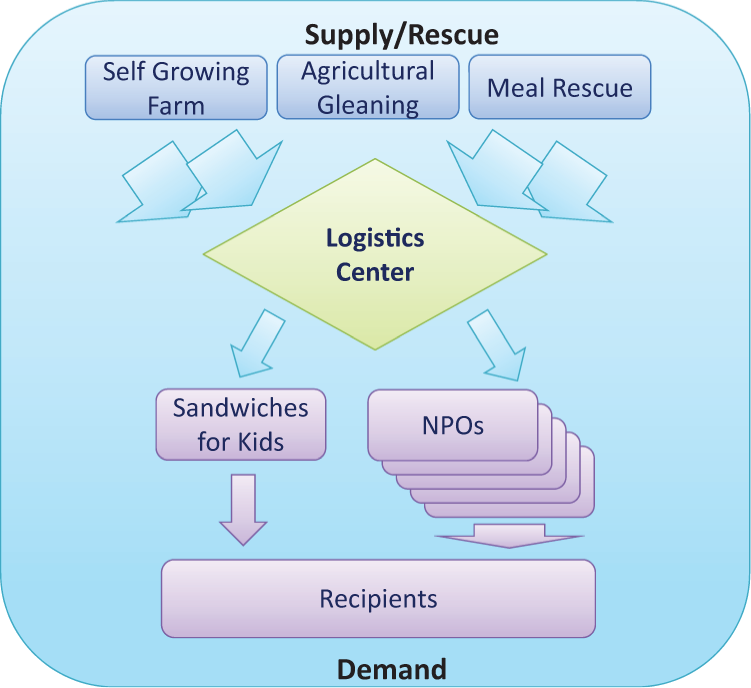
The Leket Israel food supply chain.
Logistic Operations
All of Leket Israel’s activities are orchestrated by the logistics department. 18 The department’s operations are modeled on the supply and distribution systems that are used by large Israeli food corporations. The fact that all of its processes are computerized and centrally managed is a critical element for the scale of the organization’s considerable logistic and economic efficiencies. The department uses the Priority Enterprise Resource Planning software [version 16] (www.priorityerp.com) tailored to the organizational structure and operations, allowing it to match the supply of rescued perishable foods with demand in real time, while avoiding the redistribution of waste down the supply chain. A computerized call center constantly updates the warehouses’ inventory obtained as described below through an Agricultural Gleaning project, Self-Grown Farm project, Meal Rescue project (“Leket to Table”). The call center’s representatives connect the current inventory with Leket Israel partner nongovernmental organizations’ (NGO or NPO) requests. Every day, they phone the partner NPOs to receive a donation delivery, inform them what produce is available, take orders and coordinate delivery. The next morning the deliveries are loaded onto the trucks and are distributed to NPOs all over Israel. The logistics department supervises all the deliveries in real time. The call center divides the rescued food among NPOs according to 3 main considerations—food safety concerns, that is, reducing as much as possible the time between donation and distribution of the food from NPOs to their own clientele, the number of people receiving food from each NPO (1.5 kg or 3.3 lb of each product per family), and trying to provide each NPO with diverse products while maintaining its preferences. The logistics department regulates distribution by weekdays, distributing to about 35 NPOs every day.
Leket Israel maintains 2 warehouses, 1 in the large logistic facility in the center of Israel and a smaller one in the north of Israel, for the sorting, packing, and refrigerated storage of donated fresh produce. These 2 facilities provide for efficient coverage of Israel’s relatively small area of 22 145 km2. The central logistic center has the capacity to store 500 m3 of produce (600 standard produce pallets). When capacity is reached, Leket Israel rents additional refrigerated storage as needed. For conveyance, Leket Israel owns a fleet of 10 refrigerated trucks and 5 refrigerated vans and heat-insulated containers for the cooked meals, as well as outsourcing trucking as needed.
The Agricultural Gleaning Project
It rescues crops that despite their freshness and high nutritional value have been designated as waste for destruction, and after sorting them to ensure that they are appropriate for human consumption, redistributes them via the NPOs to those in need. Leket Israel maintains continuous and close contact with farmers, packing houses, agricultural organizations, and corporations all over the country. Field coordinators and the Gleaning Project call center initiate contact with 100 farmers every day—informing them about the project, receiving up-to-date information about available surplus, and motivating them to donate unmarketable produce. The recruited farmers contact the call center, which sends paid harvest agricultural workers, to harvest the crops. Harvested produce is conveyed to Leket Israel’s logistic facilities where sorting, storage, packing, and distribution are carried out.
The Self-Growing Farm
It aims to ensure a regular supply of high-quality and variety of agricultural produce throughout the year. This innovative and central component of Leket Israel’s operational model aims to enable the organization and its partner NPOs to plan for growing and providing produce in the long term and to manage their budgets accurately. The Farm Project is a magnet for volunteers who are chiefly responsible for picking and harvesting, and Leket Israel’s continually expanding volunteer pool raises awareness and attracts potential donors to the organization. The Farm Project’s crops such as beets and pomegranates are selected based on a number of criteria—high nutritional value, large diversity of crops to match Leket Israel partner NPOs’ demands and preferences, durability, ease of harvesting by volunteers, and estimated ripening time so that the growing schedule also allows continuous volunteer activity.
The Meal Rescue Project
It collects daily surplus nutritious cooked food, mostly protein and carbohydrate rich, from various sources and delivers it to NPOs and soup kitchens all over the country. Leket Israel’s team manages the entire project—recruiting food donors and volunteers, coordinating and overseeing operations, supervising the implementation of strict food safety practices, and documenting and auditing the process. The Meal Rescue project uses 2 methods. Surplus collection from malls, bakeries, banquet halls, and so on, is carried out by approximately 300 volunteers. The venues call Leket Israel and inform them how much surplus food is available before the volunteers arrive. Alternatively, Leket Israel’s employees collect meals with dedicated refrigerated vehicles, usually with the help of volunteers. These vehicles follow fixed collection routes, regularly visiting hotels, army bases, and corporate cafeterias. The team on the vehicles does not know the amount of meals they would receive from each kitchen. The meals are already allocated in advance to soup kitchens in the vicinity that can use the food in a timely manner. Meals collected in the area of the central logistic center are brought to an allocated refrigerated storage and taken by the NPOs the next morning.
Nutrition Safety and Quality
The Nutrition Safety and Quality department employs several registered dieticians and uses the services of external food safety experts who oversee and guide Leket Israel’s operations in 3 main areas (1) strictly supervising the safe handling of the food supplied by Leket Israel to its partners and by its partners to the recipients. Food safety is a matter of particular concern given that “Good Samaritan” legislation is not well developed in Israel and that Leket Israel’s distribution chain from provider to recipient is complex, particularly in the hot meals project; (2) promoting the provision of quality food with high nutritional value; (3) raising awareness of healthy nutrition and instilling good nutritional habits within the NPOs and their clientele; and (4) tracking the performance of Leket Israel and it’s partner NPOs performance from a nutritional perspective.
In practice, the monitoring is carried out by field operators from the NPO relations department. This department manages the relationships with the 180 NPOs that partner with Leket Israel. The field operators conduct frequent inspections of the NPOs compliance with food safety standards, provide instruction for improvement, and receive feedback from the NPOs regarding their interaction with Leket Israel.
The volunteer department manages the recruitment and placement of tens of thousands of volunteers. Most volunteers take part in picking fresh produce from Leket Israel’s self-grow fields and orchards, sorting in the logistic center, or collecting and distributing cooked meals. Although the majority of volunteers are ad hoc, a significant number volunteer regularly including some who fill quasi-permanent back-office roles. The rest of the operation is handled by paid staff, including a team that picks produce. Although volunteers are not essential to the operation, they help render it economically feasible and increase awareness and advocacy.
Challenges and Solutions
The rescue and redistribution of highly perishable food poses many challenges. It is more costly and complex than acquiring, storing, and distributing dried goods and staple foods, and it requires specialized knowledge and infrastructure. While collection of dry food surplus from the industry is common in Israel, especially by the large food bank “Latet”, which complements Leket Israel’s perishable food distribution, no other organization in Israel systematically rescues agricultural produce and cooked meals. The importance of this focus is 2-fold: it is an efficient means of providing food-insecure people with healthful foods of high nutritional value that would otherwise be lacking in their diet, and it reduces waste that currently has no other solution in Israel.
Health and Nutrition
Aid recipients typically have the double burden of food insecurity—they have a high prevalence not only of underweight but also of obesity and chronic disease. 19 -21 Even with adequate caloric intake, their diet tends to be of low quality, characterized by inadequate consumption of protein, iron, folate, calcium, zinc, and vitamins A, C, D, and E, as well as inadequate servings of fruit, vegetables, meats, dairy, and cereals food groups. 22 -24 A study in the United States found that food pantries provide foods with low nutrient density primarily due to logistic reasons, that is, the difficulties related to procuring, storing, and distributing fresh vegetables and fruit, dairy products, and other nutritious foods. 16,25 In Israel, the conventional wisdom is that fresh fruits and vegetables are plentiful and readily accessible to all, but this is not the case. A study by the Taub Center for Social Policy Studies in Israel showed that the combined effect of poverty and high food prices is the same in Israel as in other developed countries, where lower income is correlated with lower absolute spending on fresh fruit and vegetables, 26 such that food-insecure people consume considerably less vegetables, fruits, dairy, meat, energy, protein, vitamins, and minerals compared to the food-secure population. 19 -21
Leket Israel’s approach to rescuing agricultural surplus, supplementing it with self-grown produce, and distributing the produce widely directly addresses this problem. In 2014, Leket Israel collected 11 616 905 kg of food for distribution to needy people. By 2015, they distributed 15 217 389 kg of food, 90% of which was fruit and vegetables, not including the “Nevet” Sandwiches for Kids Project (see note 2; Table 1). The health value, diversity, and crude proportion of clients’ dietary needs that are theoretically met by the food supplied by Leket Israel to the NPOs, are regularly monitored using nutrition indices and parameters, as well as the NPO satisfaction with the types of fruit and vegetables supplied. The healthy food index, for example, evaluates the percentage of nutritious food in the entire amount of food distributed by Leket Israel that month (Figure 2). For the purpose of this metric, the food is divided into several broad categories—dairy, cereal, protein-rich food, and fruit and vegetables that are categorized as healthy versus candies, sweet pastry, soft drinks, and fat-rich food, categorized as unhealthy. Figure 2 shows that in 2014, 93% of the entire amount of food supplied to populations in need was healthy foods; 87% of the food distributed was of the fruit and vegetables group. The Diversity Index (Figure 3) describes the number of fruits and vegetables supplied by the organization each week, in the interest of maintaining a broad selection and exposing needy populations to the widest possible array of vitamins, minerals, and phytochemicals, as recommended by health authorities in Israel and worldwide. In 2014, an average of 22 kinds of fruit and vegetables were provided weekly to the NPOs—a weekly average of 5 kinds to each NPO, with a balanced distribution between 5 color groups (Figure 4).
Food Distribution in Kilogram by Food Group.a
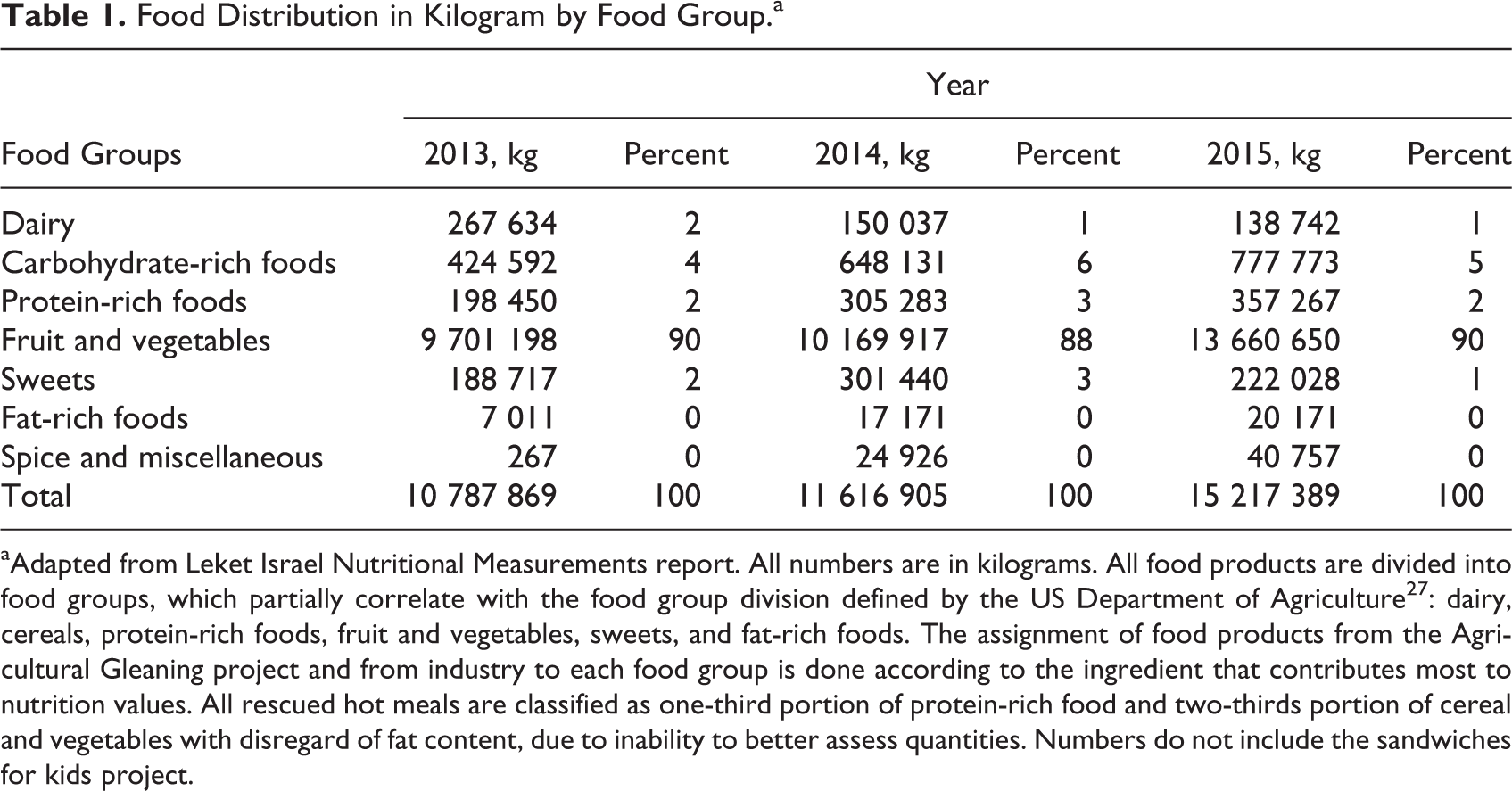
aAdapted from Leket Israel Nutritional Measurements report. All numbers are in kilograms. All food products are divided into food groups, which partially correlate with the food group division defined by the US Department of Agriculture 27 : dairy, cereals, protein-rich foods, fruit and vegetables, sweets, and fat-rich foods. The assignment of food products from the Agricultural Gleaning project and from industry to each food group is done according to the ingredient that contributes most to nutrition values. All rescued hot meals are classified as one-third portion of protein-rich food and two-thirds portion of cereal and vegetables with disregard of fat content, due to inability to better assess quantities. Numbers do not include the sandwiches for kids project.
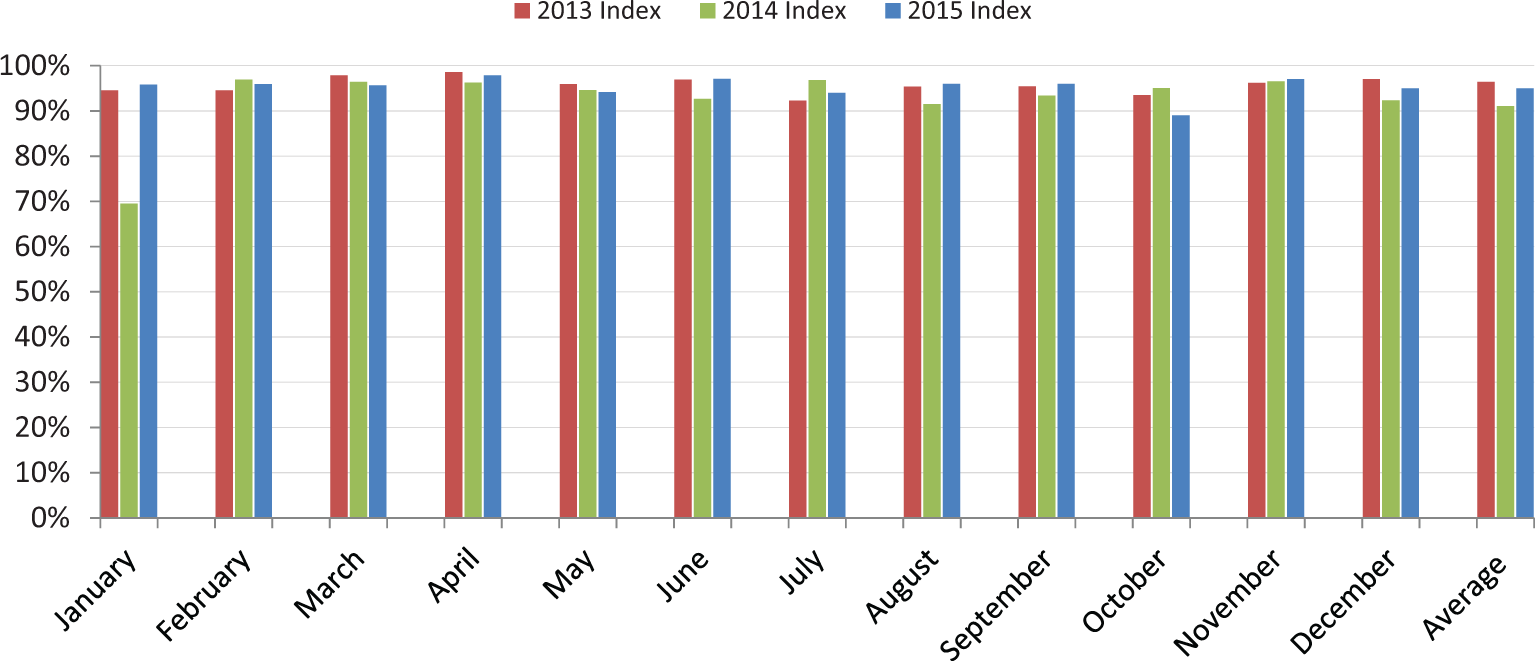
Healthy food index. The proportion of distributed food that is considered healthy by year and month. Sweets and fat-rich foods are considered unhealthy, while the rest enters the healthy food index. Proportion of healthy daily food groups is calculated out of total food supply.
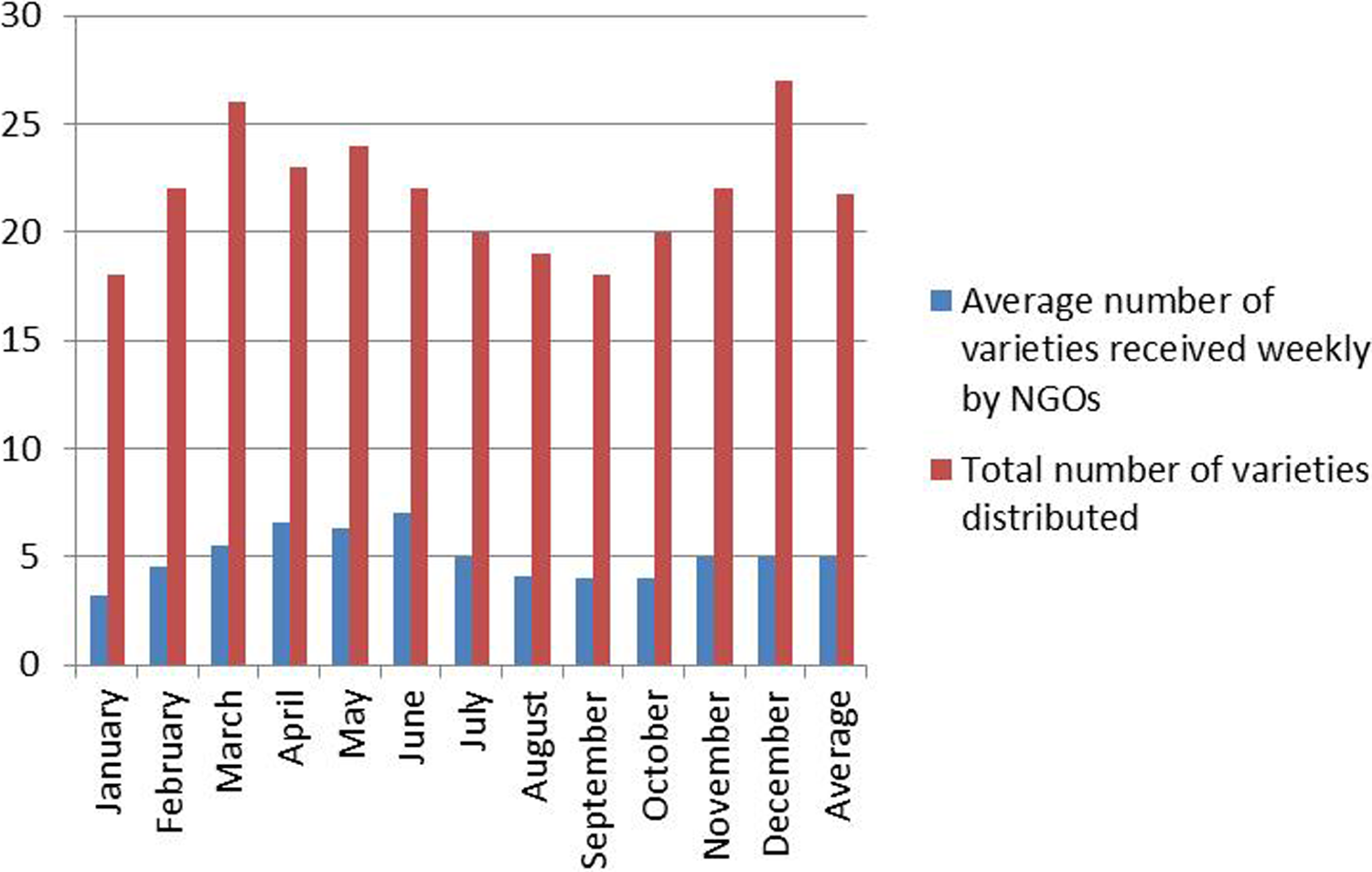
Diversity index for the year 2014.
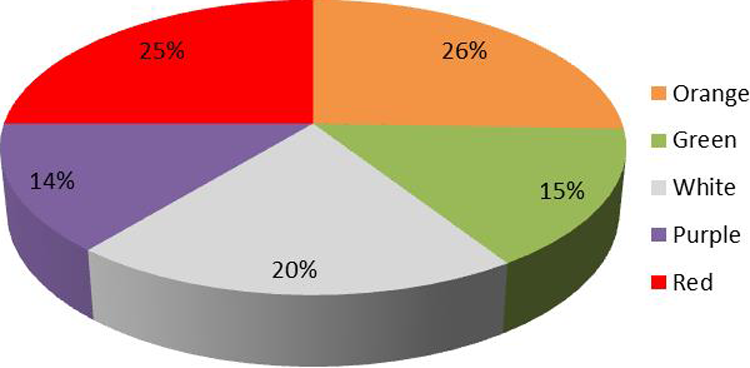
Average distribution of fruit and vegetables sorted by color in 2014.
Because Leket Israel focuses on the quality of the supplied food and its collection policy is not driven solely by the availability of food surplus, the organization must balance competing interests in choosing to accept or reject less desirable donations. Occasionally, accepting large donations of less desirable foods and beverages from the food industry diminishes the quality of the distributed food. For example, whereas the healthy food index is usually very high (Figure 2), a low index in January 2014 reflected the donation of 113, 729 liters in the sweets food group by a large beverage company. Analysis of Leket Israel’s data reveals that almost all sugar and candy products are donated by the food industry. This illustrates the delicate balance Leket Israel must strike in working with the food industry. The aim is to keep the healthy food index as high as possible at all times but without imposing restrictions that would inhibit cooperation and discourage industry partners from donating food or money. Although Leket Israel’s nutrition policy strongly advocates turning down unhealthy donations, this is not always achievable.
Balancing Autonomy and Health
A major challenge faced by food banks everywhere in the world is that in addition to providing safe, nutritious, and healthy food, they must meet the aid recipients’ diverse nutritional, cultural, and personal preferences. One of the difficulties with the diversity policy is that clients and NPOs may lack experience in preparing and eating or even recognizing unfamiliar foods and may be unaware of the effect of diverse nutrition on health. The clients of Leket Israel’s partnering NPOs, and therefore the agencies themselves, are less interested in variety. They demand more dry foods and a stable supply of the 5 basic vegetables in the Israeli diet—potatoes, onions, tomatoes, carrots, and cucumbers. Without proper evaluation, it should be taken into consideration that undesired items are being wasted at the household level, causing double damage of food loss and Leket Israel’s resources. Leket Israel strives to meet the clients’ preferences; however, they are challenged by other factors. The input from the gleaning project is constrained by current yield and surplus in the agricultural sector, affected by seasonality, damage to crops, markets for export, and ultimately the wholesale price for the produce. As a result, the produce that is redistributed can appear to be “randomly” selected. Stability, on the other hand, is hard to ensure even with the self-growing project since the choice of produce for self-growing is constrained by the unskilled labor of volunteers.
The mismatch between available produce and clients’ preferences touches on an ethical issue of the clients’ right to free nutritional choice. It has been argued that as opposed to other assistance methods such as food vouchers, providing rescued food limits the individual exercise of independent food choices. 12,28,29 However, it has also been suggested that enhancing individual choice does not necessarily enhance the nutritional quality of the food choices, 30 thus education and other incentives are needed to ensure desirable health outcomes. 31 -33 While constraining choice, central food banks can play a positive role in improving the nutrition and health of food-insecure populations if they have the knowledge and policy to do so 34 (much as government regulation can do so by authorizing certain foods for supplemental programs). By selectively providing rescued food of high nutritional value, they have the potential to improve the aid recipients’ diet. In this case, Leket Israel constrains the choices provided to its NPOs by offering mainly fresh fruit and vegetables. Each NPO is free to supply the total mix of food according to their resources and their recipients’ financial, cultural, and nutritional needs. This flexibility allows each NPO to better answer recipients’ preferences. However, ultimately, the NPOs awareness of the importance of nutrition will impact the overall healthfulness of the food they provide. Despite Leket Israel encouraging recipient health by providing nutrition training to NPO staff, the impression is that the food choices remain far from ideal. More data are needed on the extent to which Leket Israel’s engagement with the NPOs shifts the aid provided to a healthier profile.
Food Rescue, Waste Reduction, and Economic Efficiency
An estimated 40% of Israel’s agricultural produce is regularly destroyed in Israel every year, as they are worldwide, in every link of the supply chain. 35 It is currently estimated that Leket Israel rescues 10 000 tons out of approximately 200 000 tons of agricultural surplus that could provide healthy food for the needy. 35 The Israeli Government has not acted to prevent the intentional destruction of surplus 36 nor has it implemented policies to encourage the salvage and redistribution of the lost food. Indeed, the recent State Comptroller Reports call on the government to do more to reduce food waste. 36 Where such policies exist, they can be expected to influence the availability of agricultural surplus and the feasibility of Leket Israel’s model of rescue and redistribution. While reliance on rescued food has its own moral value, in economic terms, it allows the food bank to reduce food costs and improve cost-efficiency. In terms of efficiency, for every dollar Leket Israel receives in charitable contributions, it distributes an estimated 3.13 dollars of food. While this estimate factors in the donations of food and voluntary labor, it can be considered a high return on a philanthropic investment. However, such “efficiency” reflects implicit choices and trade-offs. For example, accepting all donations regardless of nutrition and health considerations might improve the return on investment, but at the expense of the nutritional well-being of the aid recipients. Or for another example, an organization that seeks to allow greater autonomy to the aid recipient might prefer to provide food vouchers rather than rescued surplus. In this case, directing the same amount of money to food vouchers would only allow for the retail purchase of about one-third the amount of food. Moreover, it should be noted that Leket Israel treats rescued agricultural produce as free input, while from a broader perspective, these inputs are very costly and have economic and social implications for the agricultural sector. Paradoxically, for the farmers who supply Leket Israel with produce, being unable to sell their crops could put their own livelihood (and food security) at risk.
Despite concerns that channeling rescued food to the market could drive down prices and discourage producers from donating their surplus, market prices have not been adversely affected by Leket Israel. There are 2 reasons for this—(1) the donated surplus is mainly agricultural produce that is aesthetically unacceptable to the Israeli market and (2) the food insecure population is not the target market for these commodities due to their high cost. Rather, the donated surplus supplements their reduced expenditure on fruit and vegetables. 26 If food rescue and redistribution were scaled up significantly, this issue might need to be revisited (see note 3)
Reach, Impact, and Equity
The fact that Leket Israel operates as an umbrella organization with a B2B model makes its success contingent on the number and distribution of its partner agencies, on the quality of collaboration with them, and on how effective those agencies are in providing the aid to their recipients. This not only entails operational constraints but also has bearing on questions of equity and reach of the distributed aid. Leket Israel’s partnering agencies vary in many respects such as their mission, the ethnic background of the population served, the criteria that they use to distribute food to their clients, and their geographic location. Although some employ professional staff, the majority are run by volunteers. The number of clients they serve varies widely—from 15 clients in the smallest organizations to 4000 clients in the largest. Their methods of food distribution vary too—55% distribute food packages, 25% distribute cooked meals from the meal rescue project or are themselves institutional kitchens or soup kitchens, and the rest deliver food both ways. Most of the NPOs supported by Leket Israel do not identify specific recipient populations; however, some NPOs focus on specific groups including Haredim (ultra-orthodox), refugees, women shelters, children, sick, elderly, holocaust survivors, new immigrants, handicapped, and Israeli Arabs. This diversity poses significant challenges to Leket Israel but using the existing infrastructure of the partner NPOs is more efficient than building branches for end point food distribution nationwide.
Leket Israel distributes food to all NPOs that request its assistance and are capable of complying with the terms of its food distribution agreement, namely, a commitment to ethics and respect for human beings, ensuring the safety of the distributed food, and distribution of the food to the needy for free. Leket Israel does not intervene in other aspects of the NPOs distribution practices. Continuous food safety inspections and administrative visits are conducted by Leket Israel’s field coordinators, nutritionists, and food safety personnel to ensure continued compliance and that close cooperation is maintained. The NPOs are provided with feedback, training, and support to ensure that they maintain and improve capacity and standards. Once approved by Leket Israel, food allocation to the NPO is based on an “egalitarian distribution key”, which ensures the needs of the recipients are met. The key includes the number and composition of the population supported (elderly, children, etc), the nutritionist’s recommendation, and the humans storage and physical infrastructure of the NPO. The distribution key does not discriminate by sector served.
In total, through its partner NPOs, Leket Israel’s food reaches an estimated 175 000 individuals or approximately 2% of Israel’s population of 8.3 million people. These are impressive numbers for an NPO whose operating budget depends on donations, especially when considering the high quality of the distributed food. However, there are limitations and challenges still to be met in order to reach the remainder and fill the unmet need. Given the reported prevalence of food insecurity among 18.8% of the population, and 8.6% of the population with severe food insecurity, 6 Leket Israel’s aid reaches between 9% and 20% of food-insecure individuals in Israel. The gap is partly caused since only 50% of those in need contact NPOs for help. 6 Some of these are people who feel that receiving charity is humiliating and are therefore beyond the reach of the voluntary sector. The others lack physical access to an NPO or information regarding existing aid. It can be assumed that under low coverage of population in need, weaker and less organized sectors with less access to civil society organizations may be more vulnerable to being left out of the safety net. This lack of access is tightly related to the operational limitation of Leket Israel’s logistics B2B model, that is, its reliance on the existing NPO network for distribution to those in need and the stringency of Leket Israel’s criteria for partnering with the NPOs.
Interestingly, in contrast to much of the literature which indicates that the supply of donated food is the rate-limiting factor in determining the amount of food distributed by food banks, 10,38 Leket’s Israel estimates that it has the capacity to rescue more food than it can distribute in a timely manner. In other words, it is less limited by supply than by access to recipients. This unusual phenomenon is related to the fact that effective rescue of highly perishable foods requires not only that the food be provided to NPOs once collected but also that recipients can consume the food within a narrow window of opportunity before the food deteriorates. Leket Israel strives to expand this window and increase the number of potential recipients through efficient logistics both on part of Leket Israel and the NPOs. It works with NPOs to build infrastructure and improve their food handling and safety standards. In the absence of partner NPOs in a certain region or populations, Leket Israel does outreach and recruitment of new NPOs or cooperates with alternative agencies such as local municipality welfare departments to build capacity and reach populations in need of aid that would otherwise be inaccessible.
This issue is pertinent to the Arab sector where food insecurity is highly prevalent. 6 According to a survey of Arab organizations involved in food aid that was conducted by the JDC Brookdale in 2009, 39 there is a broad and diverse network of food aid organizations in Arab localities. However, only half of these organizations are registered, most are local, relatively small, and not dedicated solely to food, and they vary by religious and political affiliation. In keeping with religious and collectivist social structures, much of the need in this sector is met by traditional religious zakat (charity) organizations. In response to specific questions, only a minority of these organizations expressed interest in working with a food bank. In comparison with the Jewish sector, these organizations tend to be more locally focused and lacking in necessary infrastructure for food distribution. In response to this need, Leket Israel has worked with municipalities to develop the capacity to distribute food directly through the town welfare department.
Evaluating the effectiveness of such a model is complex and must address ultimately the success in improving the well-being of its aid recipients. Assessment of Leket Israel’s effectiveness in achieving its goal of rescuing all salvageable surplus foods is hampered by the lack of publically available data on agricultural and industrial food waste in Israel.
In keeping with its B2B model, the data collected by Leket Israel have allowed it to develop aggregate indices used to guide its operations, for example, by giving average estimates of the nutritional value of foods distributed with respect to the total client population served by the partner agencies. However, the organization has no direct contact with the partner agencies’ clients and does not collect discrete individual-level data. Thus, it has been difficult to measure the reduction in food insecurity or demonstrate a direct link to improved nutrition and health among Leket Israel’s beneficiaries at the household and individual levels. This issue is common to wholesale food banks and has hardly been addressed in the literature. 40 -42 Furthermore, the paucity of detailed national data on the population in need precludes comparing those who benefit from Leket Israel’s aid to those in need who do not receive such assistance. Such data would facilitate both program evaluation and policy development. As a national umbrella organization and central element in Israel’s food security safety net, Leket Israel can provide this invaluable access to a large number of NPOs as well as to information on various aspects of food insecurity and food-insecure populations in Israel. However, improving the resolution of the data is crucial in order to document the health and nutrition impact of the aid and to optimize its distribution. Similar considerations pertain to the other indices.
Despite these challenges, the high “return on investment” of this model in a developed OECD country like Israel with high inequality suggests that this efficient operating model could be successfully emulated by food banks elsewhere, which are dealing with similar challenges and constraints. 13 -15,43 The differences between Leket Israel and other organizations are mainly the specialization in agricultural produce and the extent of the Gleaning Project, as well as the national outreach in a very geographically small country. The Israeli context, the degradation of the policy and values of the welfare state and their transfer to the voluntary sector, is different than some OECD countries but seems to have much in common with other countries like Canada, for example. 12
Policy Considerations
The solutions that Leket Israel offers to the problem of food insecurity in a rich country can be placed in the context of the “want amid plenty” discourse 44 and the argument over a focus on redistribution of inequality rather than addressing its root causes. The food redistribution approach that Leket Israel has undertaken has been criticized for reducing pressure on government to meet its ethical obligation to provide a policy framework that ensures basic purchasing power compatible with minimal food security. 9,28,45 This might be especially true in Israel, where there is a deep ongoing process of privatization of the welfare service. 46 The state may act as supervisor, regulator, and partial funding source of these services but is far less likely to be cast in the role of service provider. As a result, many services that were once provided by the state are now undertaken by private businesses or NPOs. 47
While Leket Israel does not dispute this and is in fact involved in lobbying government to solve such problems, their actions recognize that food redistribution to those in need solves a real and immediate need in the absence of other practical solutions and waste reduction provides important economic and environmental benefits. The imperative to act stems from the heavy toll that food insecurity takes on Israeli society at present. As in other developed countries, food insecure people typically have “the double burden of food insecurity” 48 including significantly higher rates of obesity and chronic illnesses, associated with increased intake of high caloric density foods with low nutritional value, especially low content of vitamins and mineral micronutrients. 19 -21 Alongside the high prevalence of obesity, underweight, stunting, and nutrient deficiencies also afflict the poorest Israeli populations, as seen in orthodox Jewish and Bedouin children in south Israel. 49,50 Global evidence of food insecurity effect on the long-term physical and mental health and social and economic consequences, especially the acute irreversible effect during the perinatal period until the age of puberty, is alarming. 48,51 -54 In the long run, long-term societal change to reduce poverty will be an essential part of the solution, but ignoring the immediate and critical need to protect the well-being of so many people is unethical. That the state and society have responded to widespread food insecurity by turning the problem over to the private food security safety net poses troubling ethical questions and practical problems. 19 It is beyond the mission and capability of private organizations to assume sole responsibility for planning, overseeing, and carrying out Israel’s national food security and redistribution programs. Rescuing and redistributing the food needed to serve all of Israel’s food-insecure population are theoretically feasible but would still require government funding, legislation, and regulation that are beyond the ken of civil society. For example, the United Nations has called upon nations to reduce food waste by up to 50% by the year 2030, food that could be directed to alleviating need. This can be achieved in part by requiring state-funded bodies with kitchens that cater to large numbers of patrons (ie, army camps, public companies, school catering programs, etc) to provide their surplus food to food rescue organizations as a condition for government support. Legislation and policies are also needed to regulate the obligations and liabilities of participants in the food rescue supply chain. Other policy measures also have bearing on supply and overproduction such as agricultural subsidies, quotas, and trade agreements. Governments in the developed world are also better positioned than food banks to ensure the equitable redistribution of food based on socially acceptable criteria.
Irrespective of who bears responsibility for solving the problems of poverty and food insecurity, Leket Israel’s logistic model can be implemented by private organizations, with or without government regulation and funding or it can be embedded within government agencies according to particular national context. The particular implementation will necessarily reflect the local balance and tensions between competing values and economic efficiency.
For example, the government appointed National Council on Food Security 55,56 which recommended that the government fund and regulate existing umbrella organizations from the private sector to supervise and provide food security services in both routine times and emergencies to all needy populations. According to this plan, Leket Israel was designated to play a key role as provider of fresh agricultural produce and logistic services. 56 Leket Israel’s considerable logistics expertise, its successful implementation of programs of food rescue and distribution, as well as extensive relationships with the stakeholders comprising the food safety net have made it a valuable key facilitator of NPO activity with the infrastructure to make any national program more efficient. The fact that this plan was not implemented underscores the lack of government resolve and the need for the private sector response in the interim.
To the extent that temporary food insecurity is likely to persist even among the most prosperous and social welfare–oriented societies, and to the extent that government resources will always be limited, improving the capacity and infrastructure to effectively rescue and redistribute food can help to ensure adequate coverage for those in need, regardless of whether such operations are publically or charitably funded. Therefore, Leket Israel’s experience, strengths, and challenges in the effort to eliminate food waste and provide sustainable food security make it a valuable model for study, emulation, and adaptation elsewhere.
Footnotes
Authors’ Note
Leket Israel granted a scholarship to Dana Philip to support this research in the framework of her graduate studies at the Hebrew University, School of Nutrition Science. Leket Israel provided free and unfettered access to the data used herein. Dr Troen is a member of the Research Committee of the National Council on Food Security. Any findings and opinions expressed here are the sole responsibility of the authors. For further information, please contact the corresponding author or Leket Israel directly at
Acknowledgments
The authors thank Dr Carol Troen for invaluable editing and insightful comments on the manuscript.
Declaration of Conflicting Interests
The author(s) declared no potential conflicts of interest with respect to the research, authorship, and/or publication of this article.
Funding
The author(s) received no financial support for the research, authorship, and/or publication of this article.