




Abstract
Based on the data collected in Uganda, Nepal, and Ethiopia, the papers included in this supplement fill a critical gap in evidence regarding multisectoral National Nutrition Action Plans. The studies offer new data and new thinking on how and why governance, effective financial decentralization, and improved accountability all matter for nutrition actions in low-income countries. This introductory paper offers an overview of the current state of evidence and thinking on the multisectoral nutrition policy cycle, including how governance and financing support that process. It also explores the benefits of applying a systems lens to understand the dynamic, enabling processes of the policy cycle—from research to knowledge and ultimately action—and to provide more dynamic and accurate information for nutrition advocacy and evidence-based decision-making. It concludes with key findings from the 5 country-level studies included. Several important themes emerge: the egregious gap in human resources needed for effective nutrition actions in most low-income settings, the value of research on bottlenecks and successes, and the need for routine monitoring of national policies and plans to measure their effectiveness in achieving both their own stated goals and global sustainable development goals. Reviewing these studies together provides a path forward in building stronger, evidence-based multisectoral nutrition policies and supporting implementation of the nutrition activities included within them.
Introduction
Working across systems, implementation levels, and sectors is critical to provide practical, sustainable solutions for malnutrition. As stated by Robert Zoellick, former head of the World Bank, “People do not live their lives in health sectors or education sectors or infrastructure sectors, arranged in tidy compartments. People live in families and villages and communities and countries, where all the issues of everyday life merge.” 1 Similarly, the determinants of malnutrition cut across conventional sectors of activity. 2,3
A multisectoral approach to nutrition—one that systematically and comprehensively engages multiple ministries or agencies 4 —is often promoted as the most effective way to address undernutrition. In 2013, the World Bank published a report to assist World Bank task team leaders, donor partners, and country-level implementers with mainstreaming nutrition activities into multisectoral action. They identified several benefits of a multisectoral approach, including acceleration of action on determinants of undernutrition, integration of nutrition considerations into existing programs from multiple sectors, and greater “policy coherence” or “government-wide attention to policies or strategies and trade-offs, which may have positive or unintended negative consequences on nutrition.” 5(p. 31) In addition, multisectoral approaches are often thought to create more sustainable, durable, multifaceted responses to undernutrition. However, there is little empirical evidence or primary research to support the effectiveness of multisectoral approaches.
Despite a lack of hard evidence, there is a resurgence of interest in multisectoral approaches. A number of countries have initiated global- and country-level efforts to implement and scale up multisectoral programs and policies—the United States Agency for International Development (USAID) Feed the Future Initiative, USAID’s Strengthening Partnerships, Results, and Innovations in Nutrition Globally (SPRING) project, the Global Alliance for Improved Nutrition, the World Bank’s Secure Nutrition platform, and the United Nations Reach mechanism are some examples. Two key initiatives—the Scaling up Nutrition (SUN) Movement and 1000 Days—have been endorsed by a range of stakeholders, donors, and countries. As of May 2016, 57 countries had signed on to the SUN Movement, committing to scaling up nutrition efforts and agreeing to abide by several principles of engagement including “open multistakeholder partnerships that bring proven solutions and interventions to scale.” 6
SUN Movement signatories are typically encouraged and supported to develop multisectoral national nutrition action plans (NNAPs) and policies. Such plans and policies come in many forms, but they are unified by a commitment to nutrition, the inclusion of two or more sectors, and the creation or modification of a coordinating structure or mechanism. There is no count of the number of countries that now have multisectoral nutrition plans or policies; however, we know that the number is growing and that as of 2010, 90 of 119 countries had coordination mechanisms (presumably for multisectoral coordination). 7
Unfortunately, countries are still crippled with operational challenges and complexities of coordination and implementation of NNAPs. An evaluation of cross-sectoral national nutrition coordination agencies in Mozambique, Nigeria, and Uganda concluded that these agencies have so far been unable to maintain continued political commitment. 8 Multisectoralism for nutrition requires thoughtful planning, broad stakeholder engagement across a diverse set of stakeholders who may not always speak the same technical language or have the same goals in mind, and sustained coordination throughout policy and program implementation. Just as with any systems strengthening effort, multisectoral nutrition may also take a longer time to get to goals, such as scale-up of nutrition activities, because one has to build alliances and systems to support such a broad-based effort. This can create fatigue and doubt among stakeholders when results are not immediate.
We must ensure that multisectoral policies, plans, and programs are evidence-based and experience-informed both in their design and implementation. This supplement takes a step toward filling the critical gap in evidence regarding multisectoral NNAPs. In this introductory paper, we describe what is known about the policy cycle (how an NNAP is designed and implemented), how good governance can influence a policy cycle, and the role of good budget management and resource mobilization in the success of a policy cycle. We also discuss the benefits of applying a systems lens to better understand the dynamic, enabling processes of the policy cycle—from research to knowledge and ultimately action—and to provide more accurate information for nutrition advocacy and evidence-based decision-making. Finally, we summarize key findings from the articles that make up this supplement.
The Policy Cycle
A multisectoral nutrition policy—like any policy—is often the foundation of change in vital nutrition-related behaviors and practices. A policy can influence organizational practices, interinstitutional collaboration, service delivery, community mobilization, as well as individual knowledge, attitudes, and practices. The policy cycle 9 (see Figure 1) illustrates the steps required for this to happen. In order for policy to result in change, stakeholders must be engaged and capable of multisectoral and multi-stakeholder collaboration at all levels, plans and priorities defined, budgets developed, funds allocated, activities implemented, systems, guidelines, protocol, curricula, and tools revised and/or developed, and progress reviewed. In this supplement, we focus on the governance of the policy cycle as well as the prioritization and budgeting aspects of the cycle.
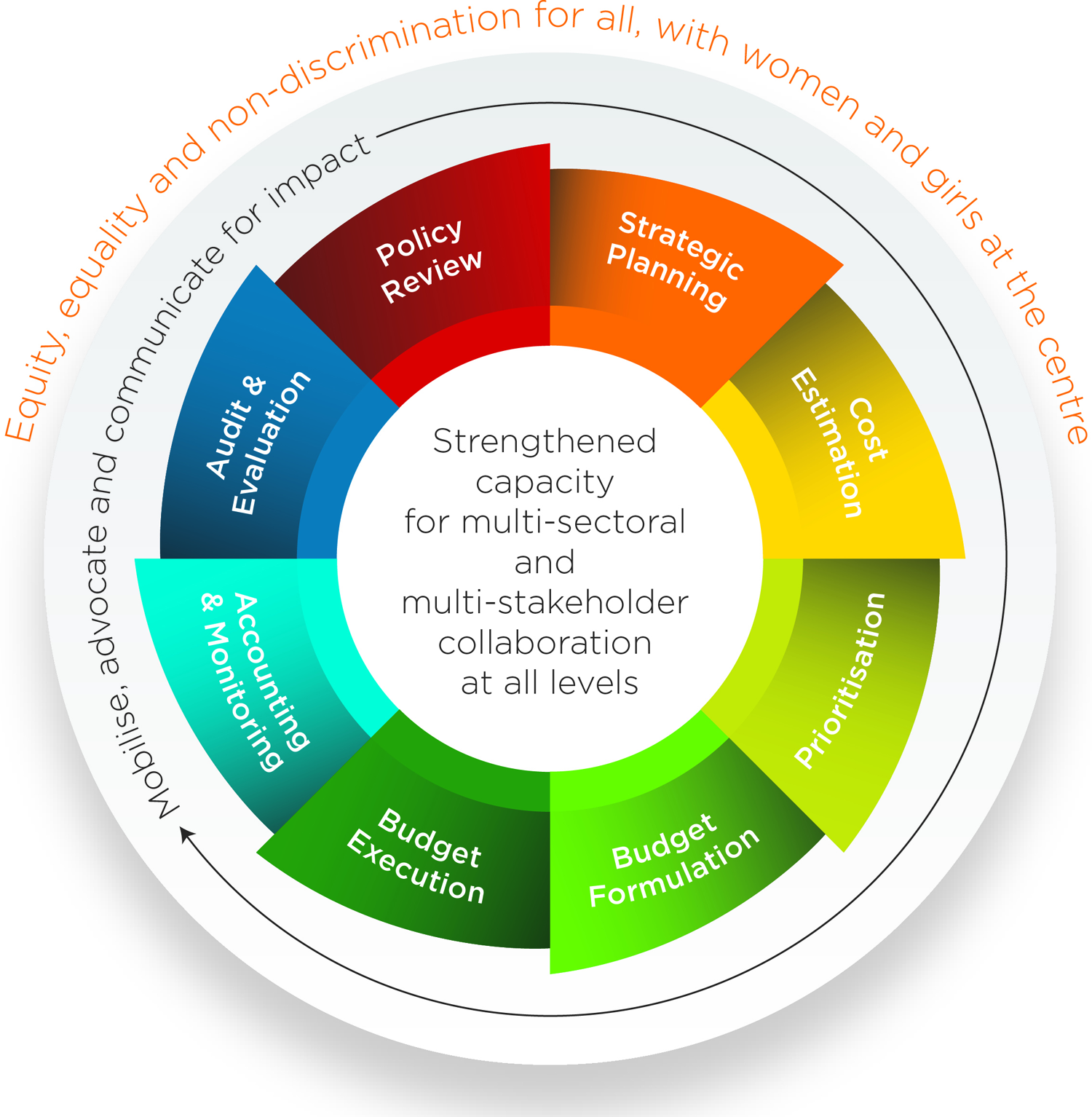
Nutrition policy and budget cycle.
Governance and the Policy Cycle
As stated by the former UN Secretary General Kofi Annan, “good governance is perhaps the single most important factor in eradicating poverty and promoting development.” 10 Good governance requires capacity, collaboration, coordination, and engagement. Good governance is also sometimes referred to as transparent institutions and processes, often also including accountability, equity, efficiency, and participation. 11,12 Others have emphasized the importance of leadership, information, collaboration, institutional flexibility, time, and an ability to value the contributions of others. 4
In the 2013 Lancet series on maternal and child nutrition, Gillespie et al emphasized the importance of the “environment” for the success of nutrition policies. The authors identifed three main determinants of an enabling environment to accelerate the reduction of undernutrition: knowledge and evidence; politics and governance or the political economy of stakeholders, ideas, and interests; and capacity and resources (see Box 1). 13 They explained that capacity includes both “nutrition know-how” and “soft-power skills to operate effectively across boundaries and disciplines” such as strategic and operational capacities, as well as “leadership for alliance building and networking, communication of the case for collaboration, leveraging of resources, and being able to convey evidence clearly to those in power.” 13(p. 554) This is consistent with the findings from a landscape analysis of 36 countries’ “readiness” to accelerate action in nutrition, in which nutrition governance was assessed based on the ten elements that countries themselves identified as essential for successful development and implementation of national nutrition policies and strategies (see Box 2). 14
Interlinked factors crucial for building and sustaining momentum and for turning that momentum into results: Generation, and communication of Politics and governance
Elements of Nutrition Governance. 15
Existence of an intersectoral mechanism to address nutrition
Existence of a national nutrition plan or strategy
Adoption of the national nutrition plan or strategy
Inclusion of the national nutrition plan or strategy as part of the national development plan
Existence of a national nutrition policy
Adoption of the national nutrition policy
Existence of national dietary guidelines
Allocation of budget for implementation of the national nutrition plan, strategy, or policy
Regular nutrition monitoring and surveillance
Existence of a line item for nutrition in the health budget
Indeed, the importance of collaboration and coordination at all levels and across departmental and sectoral boundaries has been widely emphasized in terms of implementing multisectoral NNAPs. 16 Garrett and Natalicchio defined multisectoral coordination as a process in which organizations exchange information and alter activities for mutual benefit and to achieve a common purpose. 4 Their checklist of factors that affect coordination includes leadership, vision, understanding, ownership, responsibility, capacity, organizational structure, priorities, urgency, and the socioeconomic environment (see Box 3). The SUN Movement provides guidance on how countries can create or strengthen multisectoral coordination for nutrition, emphasizing the importance of including multiple sectors across governments as well as stakeholders from outside the government system in the development and implementation of NNAPs. 17 This is also consistent with the emphasis Gillespie et al placed on engagement, accountability, coherence, conversion, and coordination. 13
Checklist of Factors Affecting Multisectoral Coordination. 4
Internal context Leader/champion Vision Capacity Organizational structures/cultures/experiences
External context Nutrition as a development priority Sense of urgency
Environmental context Economic/social/cultural/political/legal
Institutional links Shared understanding Roles and responsibilities Participation Partner relations
Budgeting and the Policy Cycle
Funding is also critical to the success of a national nutrition policy. The USAID Multi-Sectoral Nutrition Strategy states that “political will for nutrition must be reflected through financial support.” 18(p. 24) Similarly, the 2016 Global Nutrition Report asserts “Commitment without funding represents unfulfilled good intentions. If nutrition-promoting actions are to be implemented and targets met, they need to be financed.” 19(p. 76) However, the multisectoral nature of nutrition makes prioritizing, planning, and budgeting for nutrition challenging. Because nutrition work is typically embedded in other sectors rather than comprising its own sector, it is often competing for funds within other focus areas within those sectors. As a result, current funding—from domestic governments, international bilateral and multilateral aid agencies and foundations, and people themselves—does not meet needs and is one of the most significant barriers to reducing undernutrition.
However, countries cannot manage or improve what they do not measure, and there is currently an acute shortage of nutrition financing data. To track nutrition financing data, we must fully understand the funding process. Securing funding is a multistep process that begins in earnest with the estimation of costs and is followed by the prioritization of activities in work plans, the development of budgets for those activities, the allocation of funds, and the expenditure of those funds for implementation of prioritized actions. Nutrition activities are often funded through larger, multicomponent projects and integrated budget lines which means that we must dig into the details of these integrated budget lines.
After finding low rates of budget transparency for child nutrition in five sub-Saharan African countries, a 2013 report, “Budget Transparency and Child Nutrition,” called on governments to publish planned spending and expenditures on child nutrition over multiple budget years and to submit timely annual accounts to independent audit offices. 20 In addition, the Global Partnership for Effective Development Cooperation (Global Partnership), which seeks to improve predictability, transparency, and accountability of donor funds to governments and has been endorsed by 161 countries including the United States, Ethiopia, Nepal, and Uganda, provided guidance to steer development cooperation toward real and sustainable impact on the ground. The Global Partnership encouraged aid to be given directly to countries, managed by government treasuries, and subject to parliamentary scrutiny. 21 Governments and their partners must make efforts to build and strengthen budget and expenditure tracking systems (also called financial tracking systems) for nutrition.
A Systems Approach to Evaluating the Policy Cycle
There is increasing recognition that solving malnutrition can benefit from a systems approach 22,23 —to food systems, health systems, sociocultural systems, and beyond. A systems approach or “systems thinking” to nutrition means paying attention to the unpredictable interactions among actors, sectors, disciplines, and determinants of nutrition. It asks those working on nutrition issues to consider policies and governance, infrastructures and markets, inputs and services, information and communication, financing, household resources, and the sociocultural environment. 24 Such thinking results in new ways of approaching, analyzing, and solving challenges related to program design, implementation, and research by identifying and avoiding unintended negative consequences of nutrition interventions. A systems approach, which has also been described as a “holistic, population-based, ecological approach,” 25(p. 146) can be applied to understanding the policy cycle and the relationship between nutrition research, policy, and practice.
Making of This Supplement
While consensus appears to exist that multisectoral NNAP are needed for addressing malnutrition, we need more evidence of this. With an ever-increasing number of countries adopting multisectoral NNAPs, we must now ask ourselves if and how these NNAPs can have the greatest impact on reducing malnutrition. What challenges are involved in designing and implementing NNAPs? Are NNAPs understood and used by critical stakeholders? How do stakeholders from multiple sectors and levels understand their role in nutrition planning, budgeting, and implementation? Can the commitment and capabilities of policy stakeholders affect collaborative efforts for achieving national nutrition goals? Can NNAPs influence nutrition governance or the extent to which nutrition is prioritized in plans and budgets? Rigorous research is required in order to strengthen and support the global call for reductions in undernutrition and particularly Sustainable Development Goals 2 (SDG 2) to “end hunger, achieve food security and improved nutrition, and promote sustainable agriculture” 26 as well as the global call to action by all government leaders to end malnutrition by 2030. 27
This supplement provides answers to these questions, presenting findings from studies conducted in Ethiopia, Nepal, and Uganda—all of which have a multisectoral nutrition plan or policy in place. These articles apply systems thinking to their evaluations of NNAPs and the policy cycle, providing valuable insights into how we can make multisectoral action more effective for nutrition—through better accountability of financing, more attention to local ownership and improved institutional governance.
USAID funded mixed methods studies in Uganda and Nepal through the Strengthening Partnerships, Results, and Innovations in Nutrition Globally (SPRING) project and the Nutrition Innovation Lab, as well as operations research through the Empowering New Generations to Improve Nutrition and Economic opportunities (ENGINE) project in Ethiopia. This supplement contains five individual country papers, two each from Nepal and Uganda and one comparing Ethiopia and Nepal. With each paper, we learn a bit more about the process of turning policy into action and the effectiveness of national nutrition policies in each setting.
The first paper 28 compares national-level concerns and ambitions relating to implementing large-scale multisectoral strategies for nutrition in Ethiopia and Nepal. It illustrates the importance of understanding the lens through which different constituents view the multisector nutrition planning process in order to more effectively respond to challenges and opportunities.
SPRING project’s Pathways to Better Nutrition (PBN) case studies (papers 2 and 4) document in real time—through a unique prospective longitudinal design—how two countries have overcome barriers to prioritizing, budgeting, implementing, and spending for nutrition. From the study in Nepal, we learn that their NNAP has led to improved coordination, advocacy, and sustainable structures; however, limited human resources, capacity in nutrition, and ownership of nutrition; weak processes for bottom-up planning; and competing priorities remain as challenges. 29 In Uganda, researchers found similar challenges with human resources and that the lack of sustainable structures were barriers to achieving optimal programming and funding for nutrition. Coordination, advocacy, and adaptation to local needs, however, were positively affected by the NNAP there. 30 In both countries, researchers saw that funding followed prioritization; therefore, it is critical to ensure that nutrition activities are prioritized during work planning.
The work of the Feed the Future Innovation Lab for Nutrition (papers 3 and 5) describes national, regional, and local dimensions of nutrition governance; how civil servants, policy makers, and sector-based professionals understand and manage nutrition problems; and where human, financial, and institutional constraints may impair effective implementation of nutrition policies. Findings point to Nepal as a model for improving nutrition governance across sectors and at all levels of administration through trainings, information sharing, and management support. 31 These papers also tell the story of subnational progress in implementing NNAP activities and achieving corresponding objectives. The authors illustrate the gap in national monitoring systems and make the point that national endorsement of NNAPs does not in itself result in desired outcomes, that the quality of implementation can differ widely across different geographies and infrastructural contexts, and that routine district-level data on performance and effectiveness of the NNAP are critical. 32
The supplement concludes with a commentary from officials from Nepal and Uganda regarding the process of developing and implementing NNAPs and the value of, and need for evidence such as that provided by the Nutrition Innovation Lab and SPRING. The authors outline some specific steps that Nepal and Uganda are already taking to strengthen the implementation of their NNAPs. 33
Conclusions
Several key themes emerge from the studies presented in this supplement. First, the design and findings from the PBN case studies illustrate the importance of bottleneck analyses for testing where breakdowns in the policy cycle are occurring and for identifying replicable successes. Across all profiled studies, the lack of human resources—the number of staff assigned to overseeing NNAPs and their knowledge, technical, and financial capacities to manage and advocate for nutrition at all levels and sectors—stands out as a clear weakness. Finally, the importance of the routine monitoring of nutrition—inputs, processes, and outcomes—is sorely lacking and must be strengthened if governments and their development partners are to achieve the goals set out in NNAPs and the wider SDGs.
We hope these findings will be useful as countries like Ethiopia, Nepal, and Uganda develop, revise, fund, and implement national nutrition plans and policies. We hope that lessons learned will result in increased human resources as well as increased capacity for nutrition governance, management, and funding.
Footnotes
Declaration of Conflicting Interests
The author(s) declared no potential conflicts of interest with respect to the research, authorship, and/or publication of this article.
Funding
The author(s) disclosed receipt of the following financial support for the research, authorship, and/or publication of this article: This article was in part made possible by the generous support of the American people through the United States Agency for International Development (USAID) under Cooperative Agreement AID-OAA-A-11-00031 (The SPRING Project), managed by JSI Research & Training Institute, Inc. (JSI). Support for the work of Patrick Webb, Eileen Kennedy and Shibani Ghosh on this paper was provided by the Feed the Future Innovation Lab for Nutrition, which is funded by the United States Agency for International Development (USAID). The contents are the responsibility of JSI and the authors and do not necessarily reflect the views of USAID or the United States Government.