



Abstract
The potential environmental and human health impacts associated with constructing and operating terminal buildings is explored for commercial airports in the United States. Research objectives are to quantify: (1) baseline and mitigated greenhouse gas (GHG) and criteria air pollutant (CAP) emissions; (2) operational costs; and (3) climate change damages from terminal building construction and materials, operational energy consumption, water consumption and wastewater generation, and solid waste generation. An Excel-based decision-support tool, Airport Terminal Environmental Support Tool (ATEST), has been created to allow stakeholders to conduct preliminary assessments of current baseline and potential mitigated impacts. Emissions are quantified using a life-cycle approach that accounts for cradle-to-grave effects. Climate change and human health indicators are characterized using EPA’s Tool for Reduction and Assessment of Chemical Impact (TRACI) factors. ATEST is applied to multiple case study airports— Reno/Tahoe International (RNO), Pittsburgh International (PIT), Newark Liberty International (EWR), Seattle-Tacoma International (SEA), San Francisco International (SFO), and Hartsfield-Jackson Atlanta International (ATL)—to demonstrate its scalability and capability to assess varying spatial factors. Across all airports, electricity mix and construction are significant in determining GHG and CAP emissions, respectively. A sensitivity analysis of GHG emissions for the SFO case study reveals that the electricity mix, amount of electricity consumed within the terminal, terminal gross area, and amount of compostables in the solid waste stream have the most impact on increasing annual GHG emissions. ATEST represents a crucial first step in helping stakeholders to make decisions that will lead to healthier, more sustainable airport terminals.
Keywords
Aviation facilities and infrastructures, such as communication, navigation, and surveillance systems, air traffic control towers, runways, and airport terminals, support the movement of billions of passengers and tens of millions of tons of freight each year ( 1 ). Terminal buildings are an integral element of the airport system boundary, processing passengers from the landside to the airside, and vice versa. The terminal also serves as a vital revenue source, with in-terminal concessions accounting for between 7.1% and 10.6% of total operating revenue and between 12.2% and 24.7% of an airport’s non-aeronautical revenue in 2019 ( 2 ). Even with uncertainty in how COVID-19 will continue to affect the aviation industry, assessments indicate that terminals will still require upgrades to meet changing aircraft and capacity needs ( 3 ). Upgrades are necessary for improving passenger experiences, complying with environmental regulations and reducing the exposure of infectious diseases such as COVID-19. Changes to terminals should incorporate the healthy building concept, emphasizing sustainability for both the environment and people.
Construction, operation, and renovation of terminals consumes resources and releases pollutants to air, water, and soil. Greenhouse gas (GHG) emissions contribute to climate change ( 4 ). Given the relative speed with which other sectors are expected to decarbonize (e.g., electricity generation, on-road vehicles), the aviation industry will be a significant source of GHG emissions throughout the 21st century ( 5 ). There are opportunities for reducing the aviation industry’s emissions. One option is to mitigate aircraft emissions, which can comprise the bulk of an airport’s operational emissions. Reducing an airport’s facility-related emissions will also help meet the governmental GHG emission reduction targets aimed at minimizing climate-related impacts such as sea level rise, devastating storms and wildfires, and population displacements.
Emissions of criteria air pollutants (CAPs), especially fine particulate matter (PM2.5), are associated with negative human health consequences, including lung and cardiovascular disease ( 6 ). In the United States, mitigating air pollution exposure is paramount in supporting compliance with National Ambient Air Quality Standards (NAAQS) for CAPs. As recent research has documented inequities experienced by people of color in exposure to PM2.5 ( 7 ), specifically for communities of color living within the vicinity of airports ( 8 ), it is vital that airports and regulatory bodies work to ensure that historically underserved communities are not disproportionately burdened by airport construction and operation.
Airports are committed to reducing pollution, whether in response to federal, state, or local regulations, market forces, or perceived customer satisfaction. Individual airport frameworks aim to minimize emissions from construction and operations. For example, San Francisco International Airport (SFO) created guidelines to provide contractors with expected and expanded requirements when building sustainable facilities ( 9 ). Similar guidelines are implemented at Los Angeles International Airport (LAX), which has an additional policy requiring new terminals to meet Leadership in Energy and Environmental Design certification ( 10 ). Best practices and support tools developed by the Airport Cooperative Research Program (ACRP) rate the most sustainable strategies at an airport ( 11 ), identify potential operational GHG mitigation opportunities ( 12 ), and develop pathways for minimizing air pollution and other negative impacts on the surrounding environment ( 13 ). Other ACRP efforts include frameworks for managing airport construction emissions ( 14 ) and for overall airport air quality ( 15 ). Airports Council International’s Airport Carbon and Emissions Reporting Tool (ACERT) offers airport managers a free tool for creating a GHG inventory from airport operations ( 16 ). Few studies incorporate life-cycle methodologies to estimate GHG and CAP emissions specifically from airport terminals. Life-cycle studies include efforts to estimate the appropriate wall thickness dimensions to optimize performance while limiting GHG emissions ( 17 , 18 ) and similarly identify optimal floor construction materials ( 19 ). A seminal study estimated life-cycle GHG and CAP emissions from all components of the airport system boundary (airfield, aircraft landing and take-off operations, airport buildings), but did not examine impacts from airport terminals with a high degree of specificity ( 20 ).
A review of recent academic and industry literature supports the need for more holistic decision making for airport infrastructure, as there is a lack of exploration of the significance of embodied and supply-chain impacts on overall emissions ( 21 ). Specifically, there is a gap in quantifying life-cycle impacts from construction and operation of airport facilities, such as terminals, and in mapping how those impacts vary regionally.
The primary objective of this study is to create a customizable, scalable decision-support tool to aid stakeholders in: (1) determining the baseline life-cycle GHG and CAP emissions associated with terminal construction and materials, and annual operational energy consumption, water consumption and wastewater production, and solid waste production; (2) identifying the emission reductions and operating costs and damages associated with selecting mitigation strategies in each category; and (3) understanding how location and temporal factors influence baseline (current conditions without any mitigation) and strategic (applied mitigation) outcomes. The decision-support tool is tested on diverse case study airports in the United States. The case study airports include Reno/Tahoe International (RNO), Pittsburgh International (PIT), Newark Liberty International (EWR), Seattle-Tacoma International (SEA), SFO, and Hartsfield-Jackson Atlanta International (ATL). They represent a mix of small, medium, and large hubs across the country and demonstrate the scalability of the tool. An outcome is the creation of a novel decision-support tool.
Table 1 provides an overview of previous decision-support tools created for airport stakeholders. None integrate life-cycle methods, economic costs, and spatial and temporal factors to assess the emissions footprint of terminals. No existing tools for airports connect emissions to climate change and human health indicators or assess how mitigation strategies affect operational costs and monetized damages.
Overview of Decision-Support/Modeling Tools for Airports
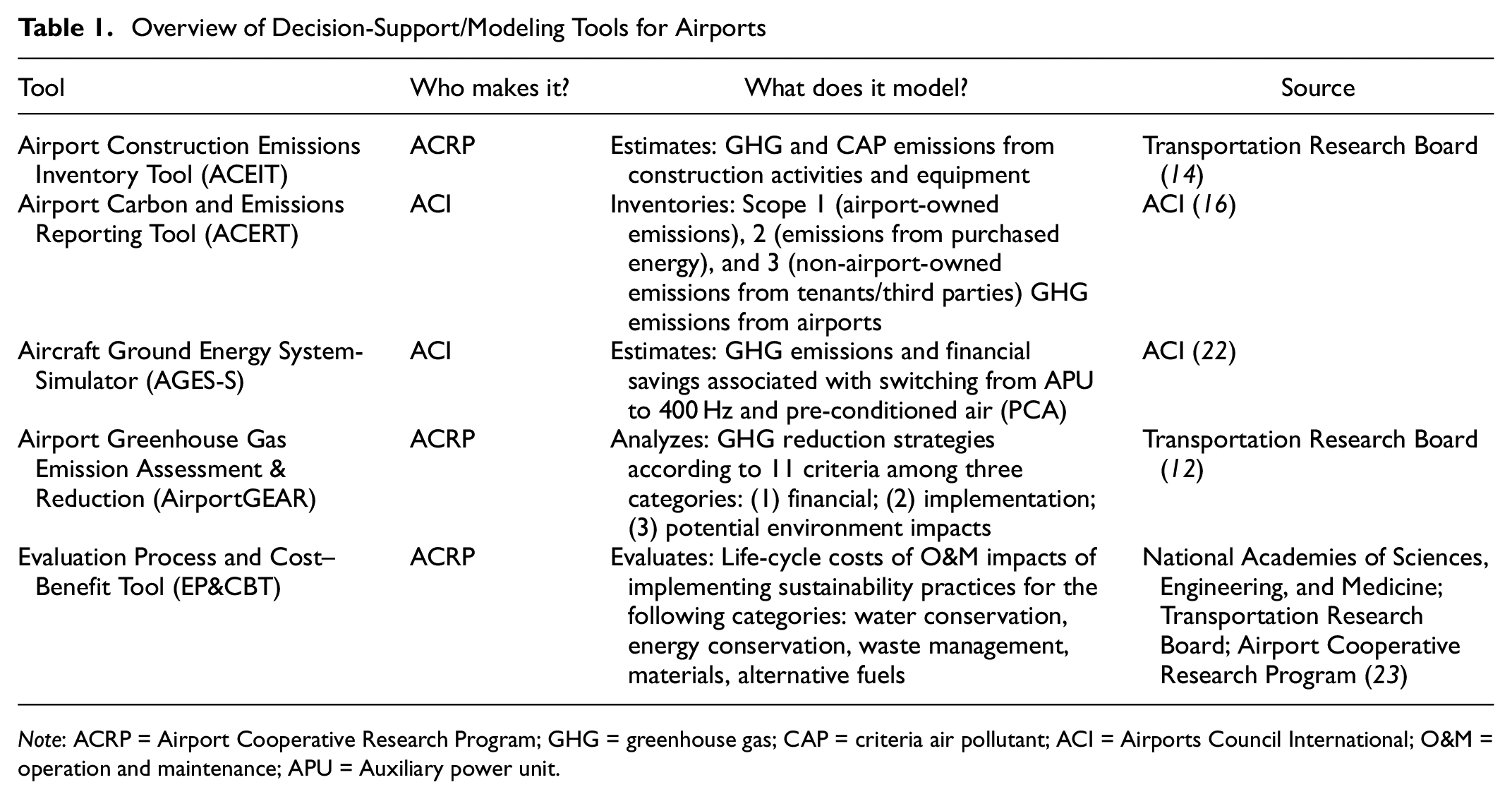
Note: ACRP = Airport Cooperative Research Program; GHG = greenhouse gas; CAP = criteria air pollutant; ACI = Airports Council International; O&M = operation and maintenance; APU = Auxiliary power unit.
The expected benefit of the novel decision-support tool is improved decision-making processes for airport operators, sustainability teams, and environmental management teams to be used at the planning and operating stages of projects. Importantly, the tool focuses on potentially consequential emissions phases, including construction and supply chains. The tool can be used to determine, among the four categories (building construction/materials, operational energy, water/wastewater, and solid waste management), which category is the most impactful from an emissions or cost perspective for a specific airport. Stakeholders can use the tool to assess environmental and human health indicators from construction of brand-new terminals and from both renovations and additions to existing terminals. Given the variability in airport locations, sizes, and budgets, and an appreciation of the difficulties in enacting sustainable policies ( 24 ), the tool serves as a first step for stakeholders in assessing strategies that can contribute beneficial climate change and human health outcomes.
The remaining sections of this study include Methods, Results, Discussion, and Conclusions. The Methods section outlines the analytical models used in estimating impacts from terminal construction and operation as well as the framework for the decision-support tool. The Results section presents the application of the decision-support tool to case study airports. The Discussion section explores the relevance of the tool and limitations of the study. Implications and areas for future research are discussed in the Conclusions section.
Methods
Case Study Airports
The case study airports (RNO, PIT, EWR, SEA, SFO, ATL) represent a range of small, medium, and large hubs with varying flight types (e.g., international, destination, regional) across the United States. Location, annual enplanements, hub designation, and energy supplies for each airport are listed in Appendix D of the Supplementary Information (SI) document. Each airport is currently constructing or planning to embark on terminal projects. As each airport has a distinct electricity supply, the case studies demonstrate the efficacy of different strategies by region. Annual enplanement data reflect levels from 2019, to avoid unrepresentative data arising from COVID-19 ( 25 ) in 2020. Note that RNO has recently been reclassified as a medium hub airport ( 26 ).
Data Collection
All data used in developing the decision-support tool have been collected from individual airport, government, academic, and industry sources. Data used as inputs in the tool application are sourced from individual airport sustainability and annual operating reports and electronic communication with airports. A questionnaire requesting specific input data for the tool was developed and sent to several airports. The questionnaire is included in Appendix E of the SI.
Emission factor data have been collected from government, academic, and industry sources. GHG emission factor data for building materials comes from the Embodied Carbon in Construction Calculator (EC3), an online tool that aggregates industry-reported environmental product declarations for concrete, structural steel, wood and composites, insulation, finishes, and bulk materials such as glass ( 27 ). Within the tool, users have the option of selecting between two methods for calculating electricity emissions. The two methods, which can be used to analyze utility-specific, state-level, and regional electricity supplies, calculate electricity-related emissions using emission factors from an academic report ( 28 ) and from a tool developed by the U.S. Department of Energy (DOE) ( 29 ).
Construction cost data, which account for materials, equipment, and labor, come from RS Means, an aggregated cost database. City-level location factors are applied to adjust the nationally averaged costs. Energy, water, and solid waste utility rates for each case study airport are input by users to estimate changes in annual operating costs after implementing mitigation measures. Climate damage is estimated using the social cost of carbon (SCC) metric, adjusted to 2019 dollars ( 30 ).
Life-Cycle Assessment
Baseline and mitigated emissions are calculated following a life-cycle approach. Life-cycle assessment (LCA) is a method used for estimating the cradle-to-grave environmental impacts associated with a product, process, or project. Impacts are determined by cataloging the inputs (i.e., energy, water, air, materials) and the outputs (i.e., emissions, wastes) associated with each life-cycle stage. The life-cycle stages considered range from raw material extraction/processing, construction/manufacturing, transportation/logistics, operation/maintenance, to end of life. LCA is standardized in ISO 14040 as a four-step process ( 31 ). The four steps include: (1) defining the goal and scope of the study; (2) inventorying relevant environmental impacts; (3) performing an impact assessment; (4) interpreting results. An inventory and partial impact assessment are conducted for this study.
There are two models used to calculate the life-cycle inventory (LCI), process-based and economic input-output (EIO-LCA). Process-based LCI models include relevant processes for a system boundary of interest. These models are detail-rich, but a limitation is the subjectivity of the system boundary of analysis. It can be difficult to capture all relevant processes as well as the interdependencies, or circularities, between certain processes. EIO-LCA combines economic input-output tables, which are matrices that relate interdependent relationships among sectors of the economy, with environmental data matrices to compute the environmental impacts (e.g., GHG emissions) associated with a specified amount of economic activity in a distinct economic sector ( 32 ). The advantage of EIO-LCA is that its system boundary encompasses the entire U.S. economy and it captures the impacts from supply chains, which are difficult to account for with process-based LCI models ( 33 ). Constraints are that data are aggregated at the national economic sector level making it impossible to analyze specific products, regional differences, and process improvements. Additionally, the data are U.S. centric, which can limit their use for analysis of non-U.S. products.
Combining the best attributes of process-based LCI and EIO-LCA results in a hybrid approach that captures relevant specific processes as well as supply-chain and upstream impacts. This research relies on a hybrid method, according to the scope outlined in Table 2. Some system elements are excluded (e.g., infrastructure for water and wastewater treatment plants) because of data unavailability
Scope of LCA by Emissions Type and Tool Module
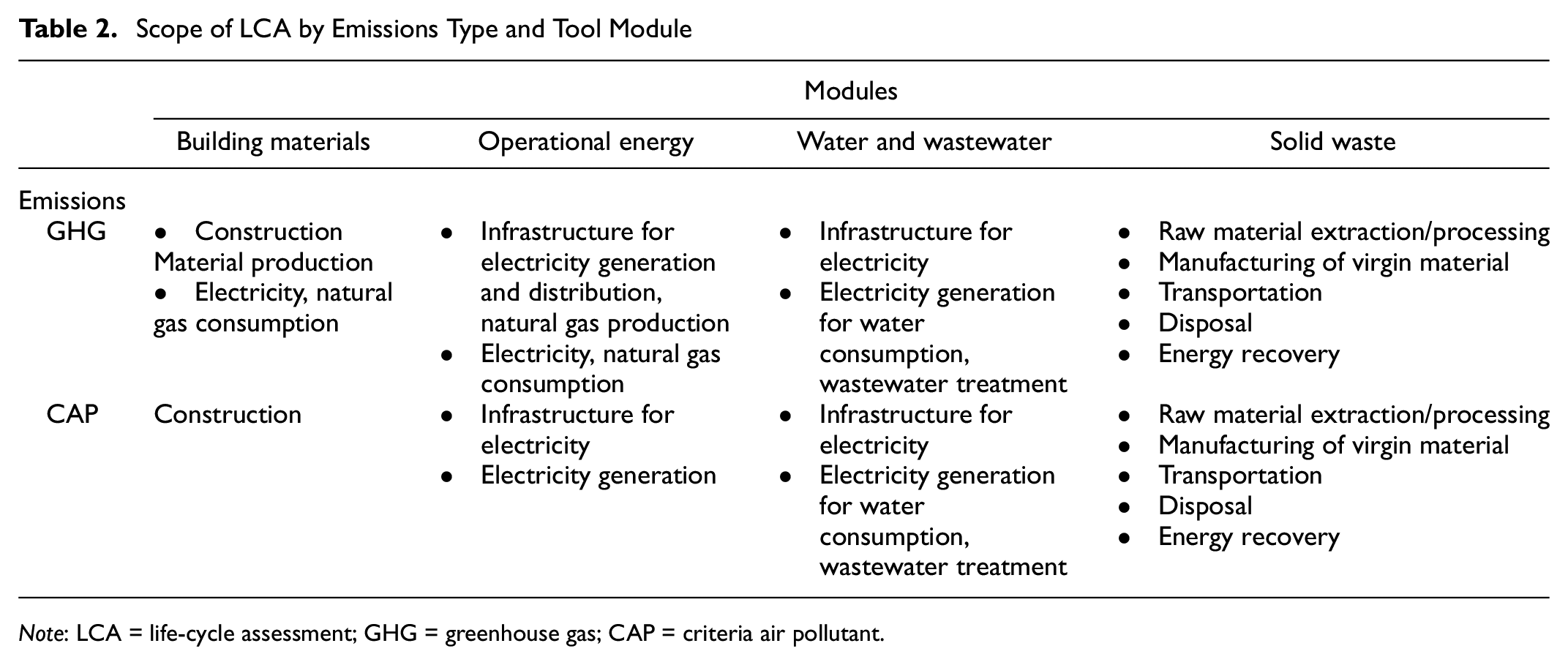
Note: LCA = life-cycle assessment; GHG = greenhouse gas; CAP = criteria air pollutant.
A partial life-cycle impact assessment (LCIA) is conducted to relate the LCI to climate change and human health indicators. An LCIA can answer questions such as how emissions from a project may affect climate change, water quality, or human health. The EPA’s Tool for Reduction and Assessment of Chemicals and Other Environmental Impacts (TRACI 2.1) is used to characterize LCI emissions into impact categories ( 34 , 35 ). We use the 100-year global warming potential (GWP) to estimate carbon dioxide equivalent (CO2e) emissions for the GHGs that contribute to climate change and the particulate matter (PM) formation potential for pollutants that affect human health (SI, Appendix C). We perform a partial LCIA because we do not connect the impact factors to their end-point categories. In a complete LCIA, GWP might be connected to a change in global mean temperature increase and PM formation potential might be linked to an increased number of mortalities, disease, or both. Decision makers might find end-point categories potentially more relevant, but there are documented uncertainties in how the results from impact factors are transformed to end-point categories ( 36 ). The results from impact factors can still be an effective point for decision making and are the accepted units in federally developed LCA tools ( 29 ).
Global warming potential is a metric for comparing the relative impact of different GHG emissions. For example, under a 100-year time horizon, estimates for the GWP of methane range between 28 and 36 ( 37 ), meaning that one ton of methane is around 30 times more potent a GHG than 1 ton of carbon dioxide. In the context of LCIA, GWP is the midpoint between connecting an inventory of emissions to an end-point category (i.e., climate change and resulting increase in global average temperature). Emission amounts have been correlated with projected warming targets, but that effort is beyond the scope of this paper. ATEST users can determine which strategies are more beneficial by seeing which strategy or strategies lead to a lower GWP compared with baseline conditions. Similarly, one can interpret mitigation strategies with relatively low PM2.5 formation as being more beneficial.
Tool Development
The Airport Terminal Environmental Support Tool (ATEST) is an Excel-based tool comprised of four modules: (1) building materials; (2) operational energy; (3) water and wastewater; and (4) solid waste. Figure 1 depicts the scope of each module.
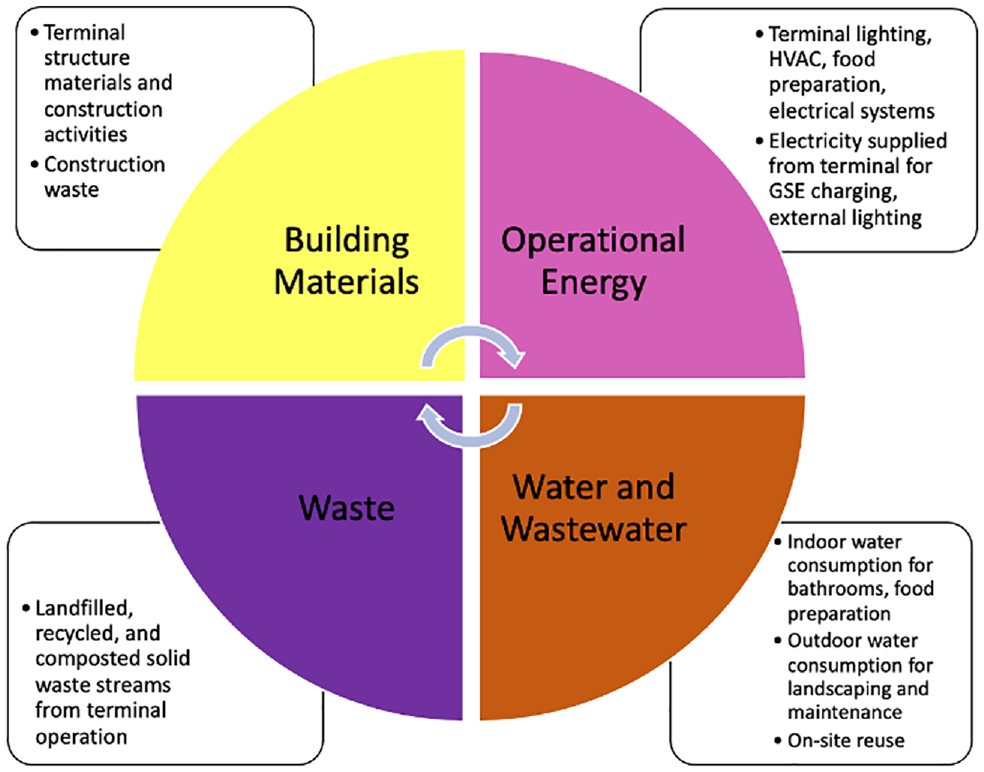
Scope of each module within the Airport Terminal Environmental Support Tool (ATEST).
Users enter characteristics about a terminal, such as state, county, and city location, gross terminal area, and annual number of enplanements and aircraft movements. Users enter relevant data for each of the four modules (Figure 2) and select which mitigation strategies they want implemented.
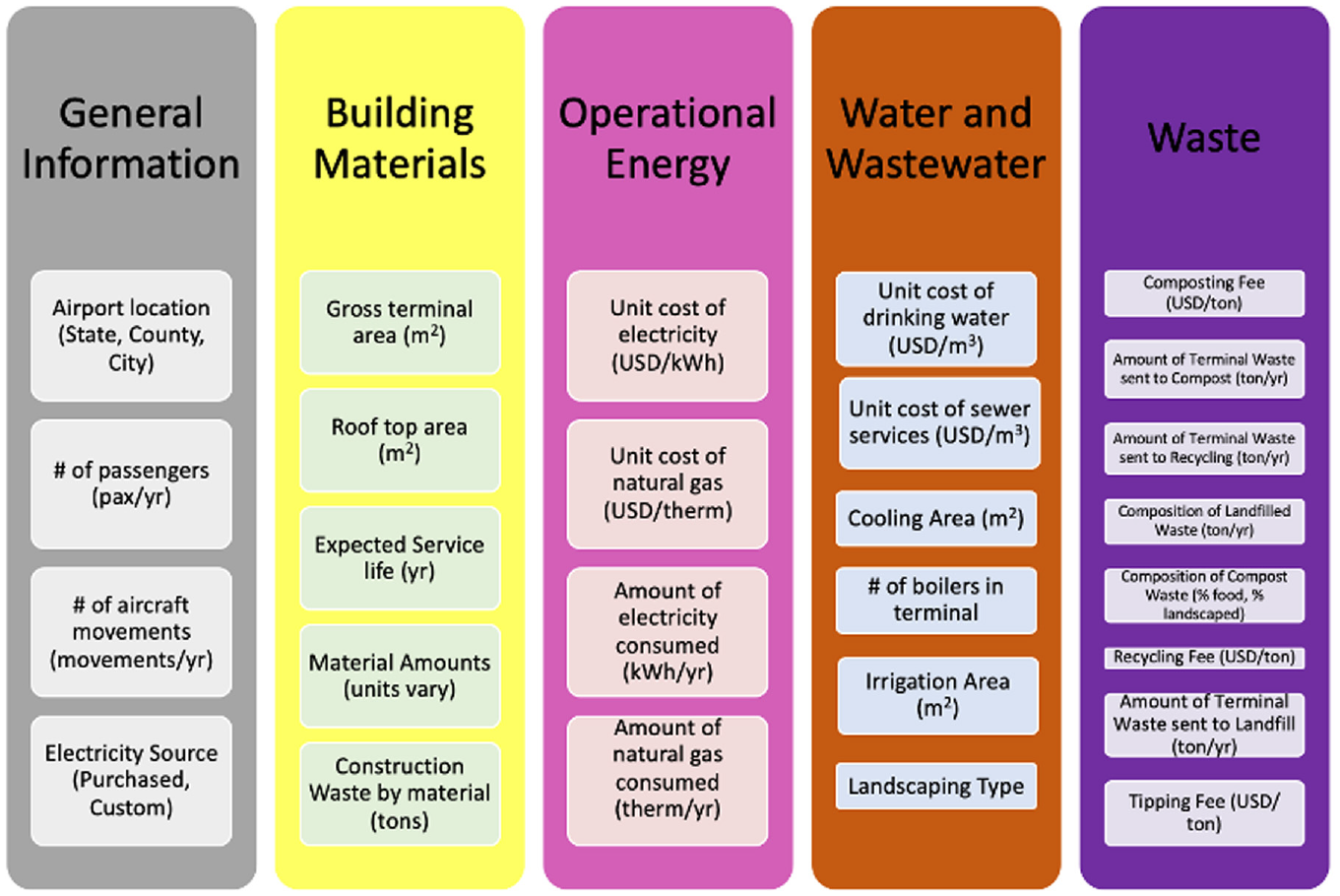
Input parameters for each module in Airport Terminal Environmental Support Tool (ATEST).
Data, calculations, and results are displayed in separate sheets for each module (examples of the sheets are shown in Section 1 in the SI). An additional results dashboard displays results for all modules in one sheet. Mitigation strategies for each module are listed in Table 3. Emission levels after mitigation are estimated by subtracting emissions savings for a strategy from each module’s baseline emissions. Detailed explanations for each tool module are provided in Sections 2 through 5 in the SI. The following subsections outline the methodological steps for each module within ATEST.
Mitigation Strategies for Each Module in Airport Terminal Environmental Support Tool (ATEST)
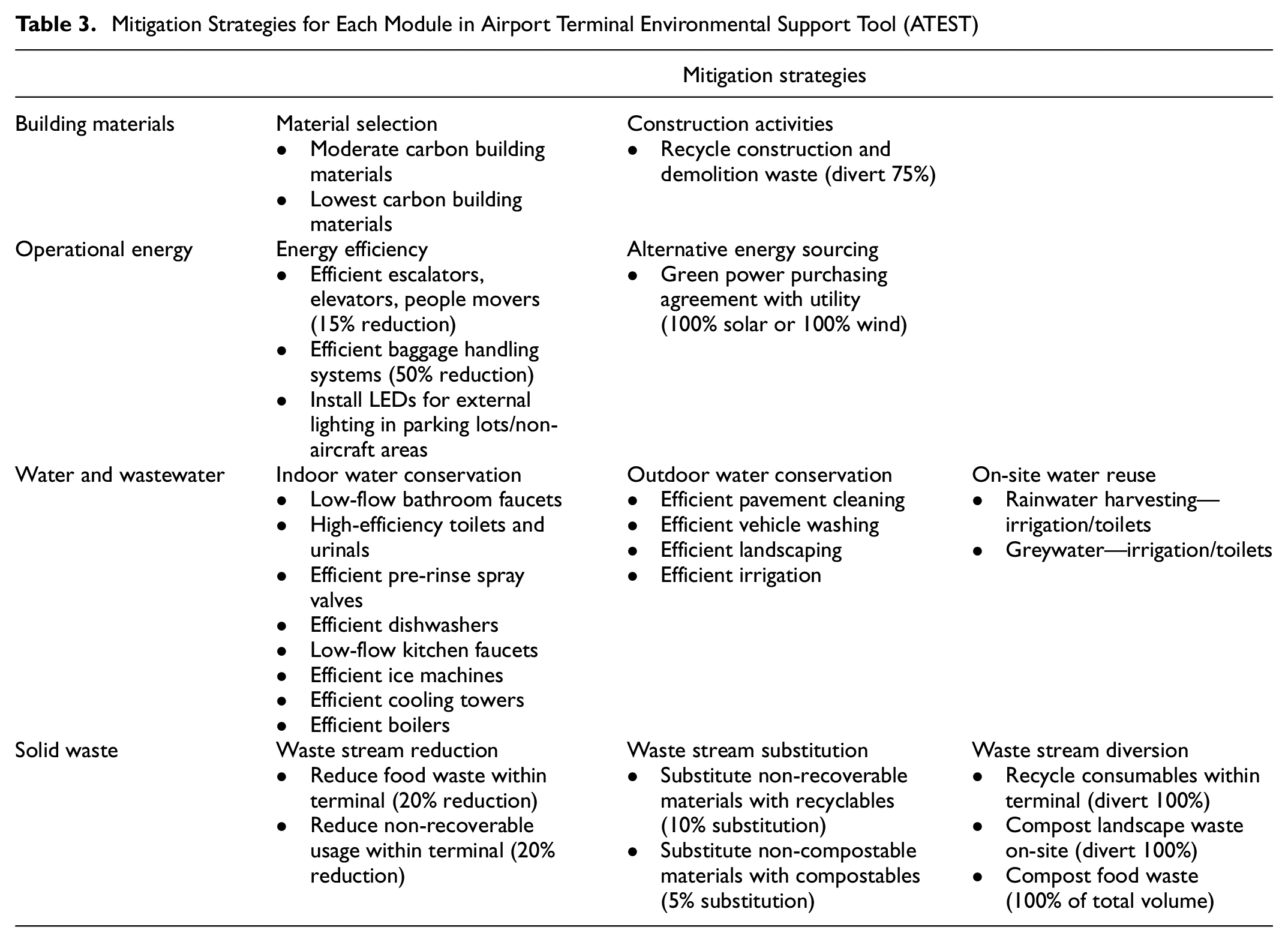
Building Materials
The Building Materials module estimates emissions from construction activities and materials used in the terminal structure. Materials considered include ready-mixed concrete, steel rebar, structural steel, prefabricated steel assemblies (open-web steel joists), wood and composites, insulation, gypsum board, ceiling tiles, resilient flooring (e.g., vinyl or plastic composite flooring), carpet, and flat glass. GHG emissions, or the embodied carbon, from building materials are calculated by multiplying material quantities by their respective emission factors from EC3. Users can estimate material quantities using construction documents or 3-D building information modeling software. For our sample results, we estimate material quantities using approximate estimates developed for a building materials database ( 38 ). An emission factor from a review of building construction LCAs ( 39 ) is multiplied by gross terminal area to estimate GHG emissions from construction activities (e.g., excavation, pouring concrete).
CAP emissions from construction are approximated using a threshold method developed by the FAA ( 40 ) to support compliance with the Clean Air Act General Conformity Rule. The method identifies examples of terminal upgrade projects that can be presumed to conform with the applicable plans adopted and implemented by regulators to improve air quality in areas that do not meet NAAQS (e.g., nonattainment and maintenance areas). EPA designates areas as attainment if ambient concentrations meet the NAAQS ( 41 ). An area that does not meet the NAAQS is in nonattainment. Areas that are previously designated as nonattainment but then meet the NAAQS are classified as being in maintenance. For specific terminal gross areas, the FAA established allowable emission limits for each CAP and for ozone precursors, such as volatile organic compounds (VOCs) and oxides of nitrogen (NOx) ( 40 ). Emission limits depend on the airport’s geographic area and EPA’s classification of the attainment status of the area for specific pollutants. As an example, an airport project to build approximately 70,000 m2 of terminal in a geographic area classified as “Serious” nonattainment for ozone could be presumed to conform if the net increase in emissions from construction and operation of the project would result in less than 50 tons/year of VOCs or NOx. In ATEST, when users enter their state, county, and city, look-up tables are used to identify whether the project is in an area designated as nonattainment, maintenance, or attainment for a specific pollutant. Depending on the area’s attainment status and the specified gross terminal area, allowable CAP emissions can be identified for projects that would presumably conform.
Operational Energy
The Operational Energy module calculates GHG and CAP emissions from the annual electricity and natural gas consumed in the terminal. Users have the option of selecting a “Default” or “Custom” option to calculate baseline emissions. In essence, users can either estimate their emissions from annual electricity and natural gas consumption data from their utility bills (“Default” option) or from estimations based on physical parameters of the terminal such as total area of various zones and type and size of electrical systems (“Custom” option).
If “Default” is selected, baseline emissions are estimated using utility bill consumption data for electricity and natural gas. The “Default” option can account for heating and cooling if they are provided by an on-site thermal plant. If the “Default” option is selected, users are only able to choose the alternative energy sourcing mitigation strategy as ATEST does not disaggregate utility bill input data.
The “Custom” option calculates a baseline electricity and natural gas consumption using methodology developed by ACRP ( 42 ). Total energy consumption is calculated as the sum of energy used to heat, cool, ventilate, and light terminal building zones (e.g., concessions, ticketing, security), to power discrete systems (e.g., escalators, baggage handling systems), and to charge electric ground service equipment (GSE). The ACRP method calculates terminal building zone energy in units of kBTUs. To convert to units of kWh and therms, respectively, we assume in this study that electricity accounts for 75% of terminal building zone energy consumption and natural gas for 25%. The percentage assumptions can be manually changed within ATEST by users to reflect variations in natural gas usage by climate region.
Operational energy GHG and CAP emissions are calculated using Equation 1:

where
EEnergy are emissions attributable to annual energy consumption in the terminal,
AElec is the annual amount of electricity consumed within the terminal,
EFElec, ij is a location (i) and pollutant-specific (j) life-cycle electricity emission factor,
ANG is the annual amount of natural gas consumed within the terminal, and
EFNG is the life-cycle emission factor for stationary combustion of natural gas.
Water Consumption and Wastewater Generation
Baseline emissions from water consumption and wastewater generation are calculated using methods developed by ACRP ( 43 ). Indoor water consumption for end uses such as toilets, faucets, and food preparation is a function of daily passenger counts within the terminal. Outdoor water consumption depends on climate zone and landscaping type; a method developed by the DOE uses a proxy city to approximate outdoor water needs by plant type ( 44 ). Users choose from one of 36 representative cities from 10 different climate zones to determine the yearly outdoor water budget. For all indoor water consumption, GHG and CAP emissions are determined using Equation 2:

where
EIndoor are emissions attributable to annual indoor water consumption in the terminal,
VIndoor is the annual volume of water consumed within the terminal,
EFWater, j is a pollutant-specific (j) life-cycle water emission factor, and
EFWWater, j is the pollutant-specific (j) life-cycle wastewater emission factor.
Emissions from outdoor water consumption are calculated in a similar manner, except that it is assumed that consumed outdoor water does not enter the sewer system and will not enter a wastewater treatment plant. Water and wastewater emission factors are calculated using energy intensities of 0.34 kWh per m3 of treated water and 0.43 kWh per m3 of treated wastewater ( 45 ). These nationally averaged values are a conservative estimate as studies have values ranging from 0.3 to 5 kWh per m3 ( 46 – 48 ). Energy intensities vary by water supply source, level of treatment, treatment technology, and location so users can change these default values as deemed appropriate.
Savings from indoor and outdoor water mitigation strategies (Table 3) are cumulative. Users are limited in selecting one of four on-site reuse options. Harvested rainwater from a rooftop collection system or greywater sourced from terminal bathroom faucets can supply either irrigation or toilet/urinal needs. Savings from an on-site reuse strategy reflect any changes in indoor or outdoor water needs. For example, an efficient bathroom faucet would result in a reduced volume of available greywater, potentially limiting the savings from that strategy. Equations for calculating baseline emissions and emissions savings from on-site reuse are provided in the SI (SI, Section 4.2.).
Solid Waste Management
Users enter details about the composition of the solid waste stream and the volumes of material disposed to landfills and diverted to recycling and composting facilities to estimate emissions associated with terminal waste. There is a “Default” and “Custom” method for calculating emissions. The “Default” method assumes a composition of specific recyclable materials within the solid waste stream from a previous audit report of a terminal’s solid waste stream (49, 50). The “Custom” option allows for an airport to enter solid waste compositions, accounting for recyclables including aluminum, plastics, glass, cardboard, and paper. We use GHG emission factors from the EPA’s Waste Reduction Module (WARM) v.15 ( 51 ). WARM calculates life-cycle GHG emissions for waste management practices (e.g., recycling, composting, landfilling) of recyclable, organic, and non-recoverable materials. We develop CAP emission factors using energy factors in WARM v.15 by making some simplifying assumptions about energy used for transportation and for electricity (see SI, Section 5.1.). GHG and CAP emissions associated with the terminal’s solid waste stream are calculated using Equation 3:

where
EWaste are emissions attributable to annual solid waste consumption in the terminal,
VLandfill is the annual volume of landfilled solid waste consumption in the terminal,
EFLandfill, kj is a material (k) and pollutant-specific (j) life-cycle landfilling emission factor,
VRecycle is the annual volume of recycled solid waste consumption in the terminal,
EFRecycle, kj is a material (k) and pollutant-specific (j) life-cycle recycling emission factor,
VCompost is the annual volume of composted solid waste consumption in the terminal, and
EFCompost, kj is a material (k) and pollutant-specific (j) life-cycle composting emission factor.
Solid waste management strategies across each category (i.e., reduction, substitution, diversion) are interdependent. Since strategies are interdependent, selecting a waste stream reduction strategy will change the amount of solid waste that could be diverted or substituted, which would affect emission savings potential. Savings from waste mitigation strategies are not additive across strategy category in the current version of ATEST. Therefore, ATEST users are only able to evaluate the savings from implementing one waste mitigation strategy over the other. Note that definitions of waste diversion can differ; we follow the EPA’s definition of diversion for recycling and composting in WARM.
Economic Impacts
Operational costs are estimated by multiplying user-input utility costs by respective amounts of electricity, natural gas, water, wastewater, and solid waste. Changes in operational costs are calculated as the difference between baseline and mitigation operating costs. Climate damages, which place an economic value on the harm caused by climate change (e.g., increased intensity and frequency of wildfires), are evaluated using Equation 4:

where Dm are the damages, in U.S. dollars, from the emissions (Em) from a module (m), and SCC2019 is the social cost of carbon adjusted to constant 2019 U.S. dollars. The SCC can be modified as either “Default,” which uses an adjusted 2015 SCC and 3% discount rate from the Interagency Working Group ( 30 ), or as “Custom.” The SCC monetizes the harm of emitting one additional ton of GHG emissions to the atmosphere ( 52 ). The metric provides stakeholders with a more complete understanding of the negative externalities, or total costs to society, caused by terminal construction and operation.
ATEST Application
Decision makers can use ATEST to develop preliminary answers to questions such as:
1) What are baseline GHG and CAP emissions associated with constructing and operating an entire terminal or an addition/renovation?
2) What are baseline and mitigated emissions for each module in ATEST?
3) How do emissions relate to climate change and human health indicators using TRACI impact factors?
4) What are baseline operational costs and climate damages, and how do they change after
mitigation?
5) What are future impacts relative to the current baseline, considering changing conditions such as implementation of renewable portfolio standards (RPS) or mandated solid waste recovery goals?
Results
We present multiple applications of ATEST for each module and for various airports. We demonstrate reductions from each module’s mitigation strategies relative to baseline conditions for one case study airport (RNO). Input data and assumptions are provided in Appendix D in the SI. For each module, users can see baseline, reduced, and remaining emissions and costs associated with selecting each mitigation strategy or combination of strategies. Example output is shown in Appendix D in the SI.
Figure 3 shows normalized results for GWP, PM formation, and monetized climate damages associated with terminal building energy use. We compare changes, normalized to annual number of passengers (pax), associated with switching from each airport’s current electricity mix to electricity either 100% sourced from wind or 100% from solar. We investigate changes when comparing to a future electricity mix, as designated by each state’s renewable portfolio standard or RPS ( 53 ). The RPS for Nevada mandates 50% renewables by 2030 and for Pennsylvania 18% by 2021. No RPS results are analyzed for SFO as their electricity mix already exceeds the state mandate of 60% renewable by 2030. According to Figure 3, 100% wind results in better emissions and monetized damage outcomes for all airports except for PM formation from SFO’s energy use. SFO’s electricity source is almost entirely hydroelectric power, so PM formation from manufacturing of wind turbines or solar photovoltaic systems will exceed baseline emissions. For RNO and PIT, which have fossil fuel-dominant electricity mixes, mitigation is modest when implementing their respective RPS scenarios. It should be noted that Figure 3 does not demonstrate that one airport is more sustainable than the other. Rather, an airport’s impacts vary based on many factors, demonstrating that a “one size fits all” approach to mitigation is likely insufficient for achieving meaningful, targeted mitigation goals.
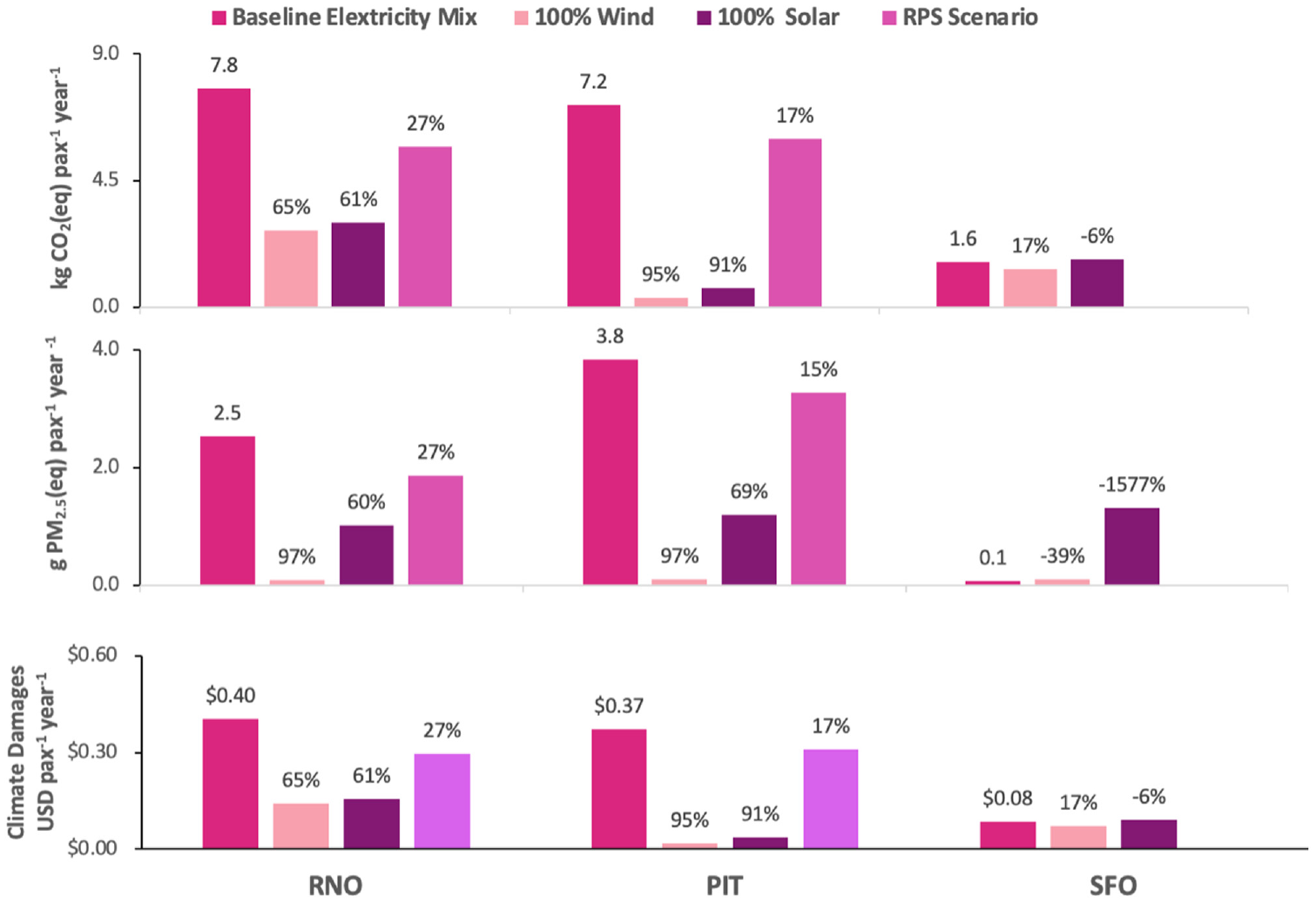
Results from application of operational energy module.
Figure 4 presents normalized GWP from annual water consumption and wastewater generation at RNO, PIT, and SFO. Each bar represents annualized emissions if all mitigation strategies in each strategy category are implemented. For example, if “No on-site reuse” is selected, then the “Indoor” bar accounts for emissions from mitigated indoor water use and from baseline outdoor water use. The “All Sources” bar accounts for emission changes from all mitigation strategies. Results are run for each of five on-site reuse scenarios. Percentage changes in Figure 4 are relative to the “Baseline, No on-site reuse” scenario. As water and wastewater energy intensity, irrigation amount, and plant type are held constant across each airport in this example, it appears that emission reductions in the water module depend on spatial characteristics such as climate zone and electricity mix. Optimum strategies differ by airport location. For RNO and PIT airports, under the default assumptions explained in Appendix D in the SI, indoor mitigation strategies with no on-site reuse consistently yield significant reductions in emissions and monetized climate damages except when all mitigation strategies and greywater (GW) reuse for toilets and urinals is selected. For SFO, rainwater harvesting or grey water reuse for toilets, coupled with indoor and outdoor mitigation, yield greater GHG reductions compared with just indoor and outdoor mitigation. On-site reuse for irrigation yields emissions increases under the inputs and assumptions. Although not analyzed, it is important to explore how combining reuse sources and selecting between on-site reuse or centralized reclaimed water from utilities change results.
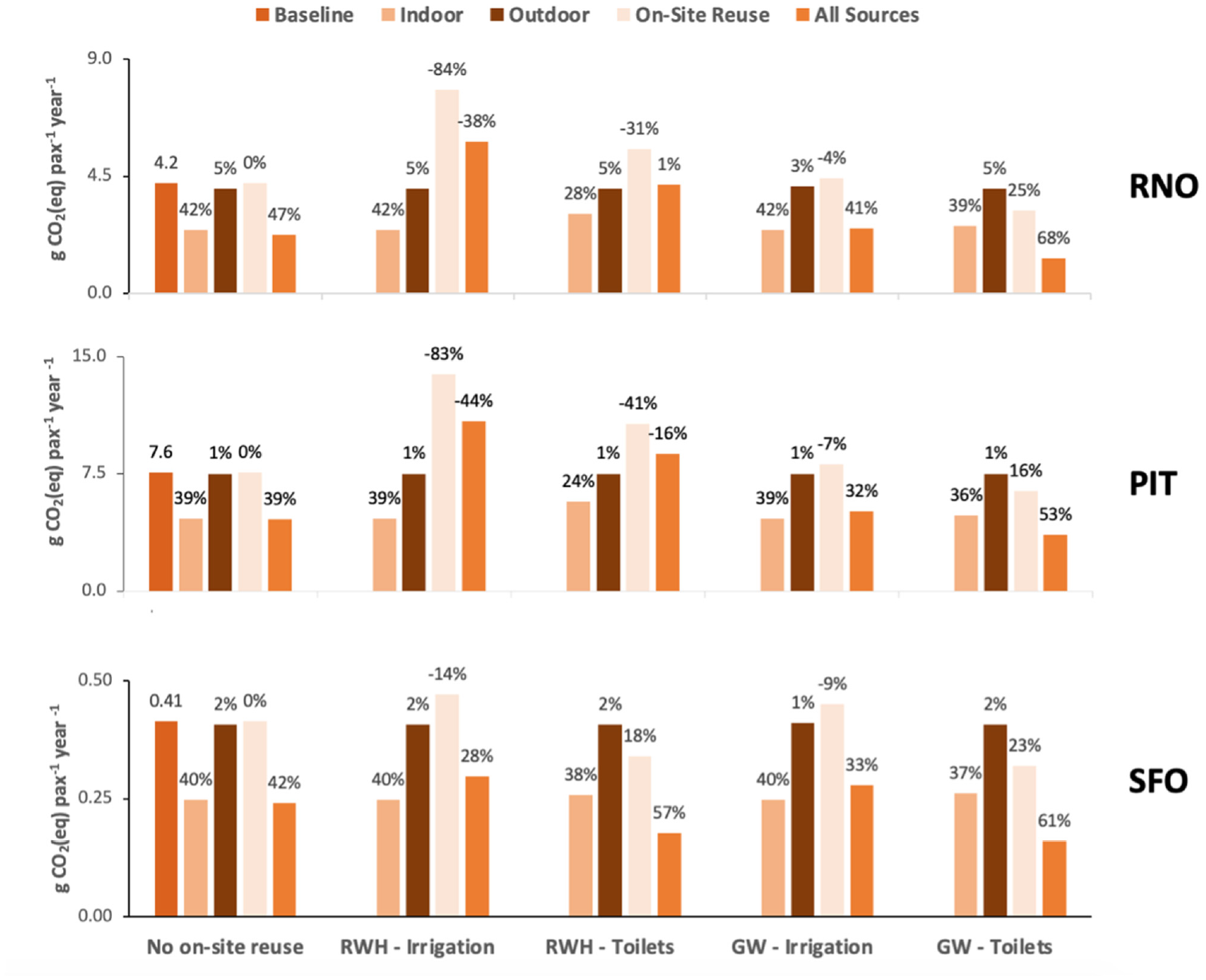
Annualized global warming potential (GWP) for water mitigation strategies.
Annual emissions and operational costs from solid waste management strategies are depicted in Figure 5. Emissions are dependent on quantity and composition of the solid waste stream. Data from each airport indicates that compostables represent a critical component of terminal waste production. Compostables and recyclables tend to have negative life-cycle emission factors, so an airport with a higher composition of compostables and recyclables might result in limited baseline emissions (e.g., RNO). For EWR, SEA, and ATL, waste stream reduction and waste stream diversion yield the greatest reductions in emissions. Diverting 100% of compostable food waste and 100% of recyclables would result in complete emission reductions relative to baseline conditions. Operational costs vary by airport location according to changes in tipping, recycling, and composting fees.
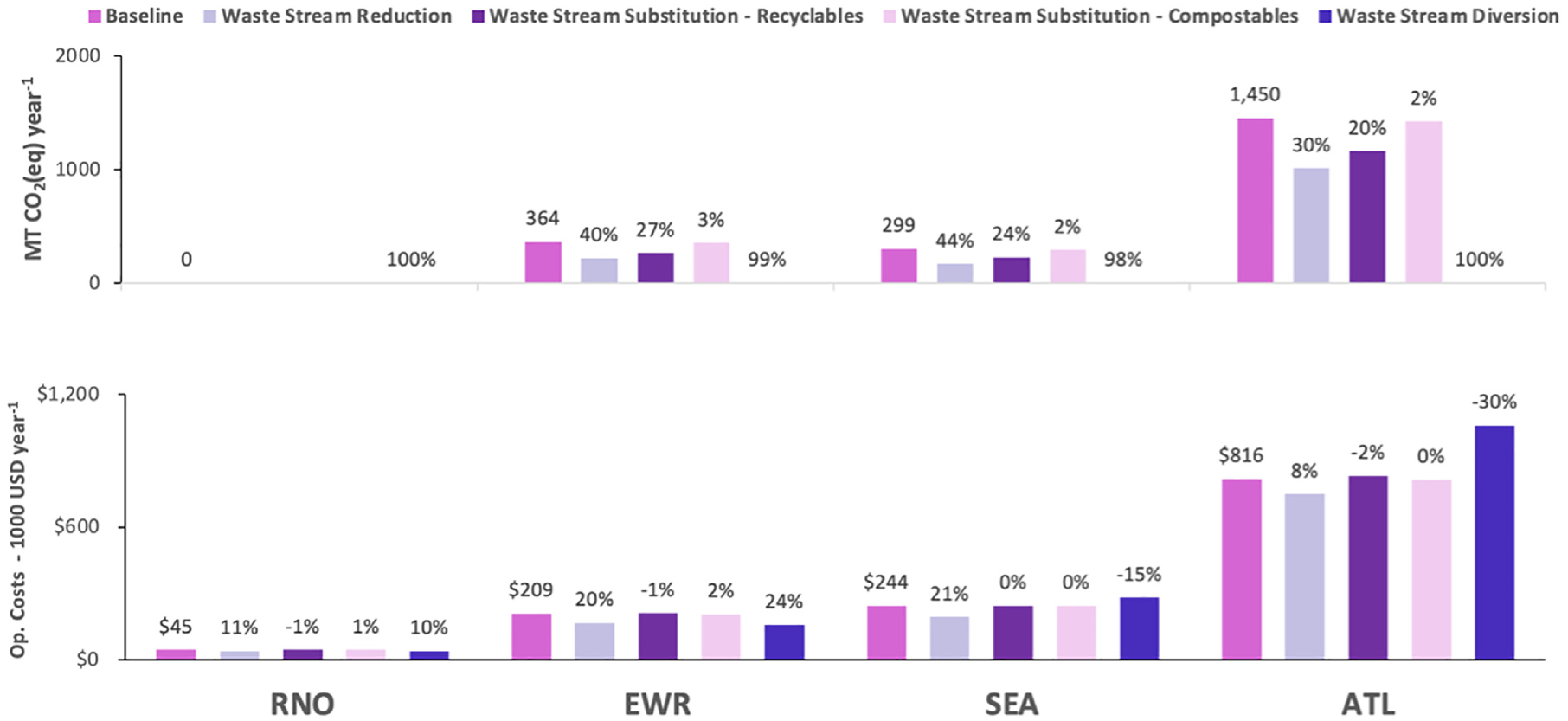
Annualized global warming potential (GWP) and operational costs for solid waste module.
Figure 6 shows baseline GWP and PM formation results for RNO Airport for all four modules. Impacts from energy consumption dominate for both climate change and human health, but embodied emissions from building construction are important for PM formation. Note that cumulative embodied emissions from building materials and construction (which are displayed within the Building Materials module in ATEST) have been annualized according to the airport terminal’s service life, which is assumed to be 30 years in this example. Based on RNO’s terminal gross area of 27,542 m2, if the terminal was to be constructed today the tool provides an indication that the project would conform with all applicable plans to meet NAAQS, except for emissions of NOx, because the area has a “marginal” nonattainment classification for ozone. Figure 6 relates all CAP emissions to fine particulate matter formation using the TRACI impact factors. Results within the Building Materials module also display the normalized human health indicator (i.e., fine particulate matter formation) as well as the emission thresholds for each CAP for the user-inputted airport location.
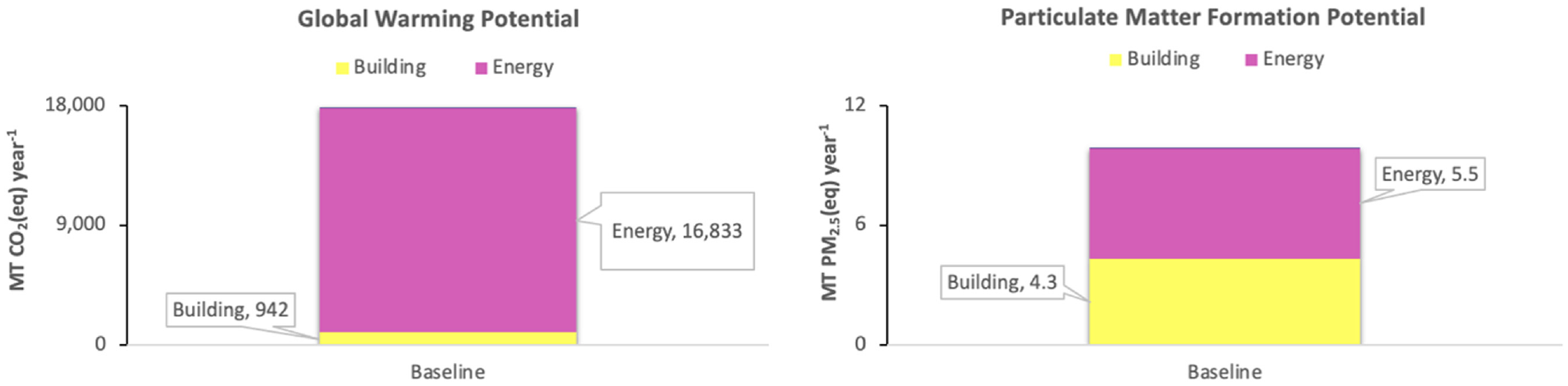
GWP and PM2.5 formation potential for RNO Airport case study.
Within ATEST, users can change the terminal’s service life, allowing for temporal analysis of impacts from materials and construction. Previous work ( 30 ) has indicated that construction and materials emissions can potentially be greater than operational emissions, especially if the building’s design is energy efficient
In Figure 7, we show emission changes relative to the baseline GWP for RNO Airport if all strategies are implemented (except for “Construction,”“Construction & Demolition Waste,”“Energy Efficiency,”“Waste Stream Diversion,” and “Waste Stream Substitution”). Since emission reductions from each waste strategy category are not additive, we consider scenarios where only one category of mitigation strategy is selected by the user (e.g., “All Strategies—Waste Stream Reduction). In this example, switching from the airport’s current electricity source to 100% wind will yield the greatest climate change benefits. Airports with cleaner electricity mixes, such as SFO, might explore investigating mitigation strategies other than energy source (Figure 8).
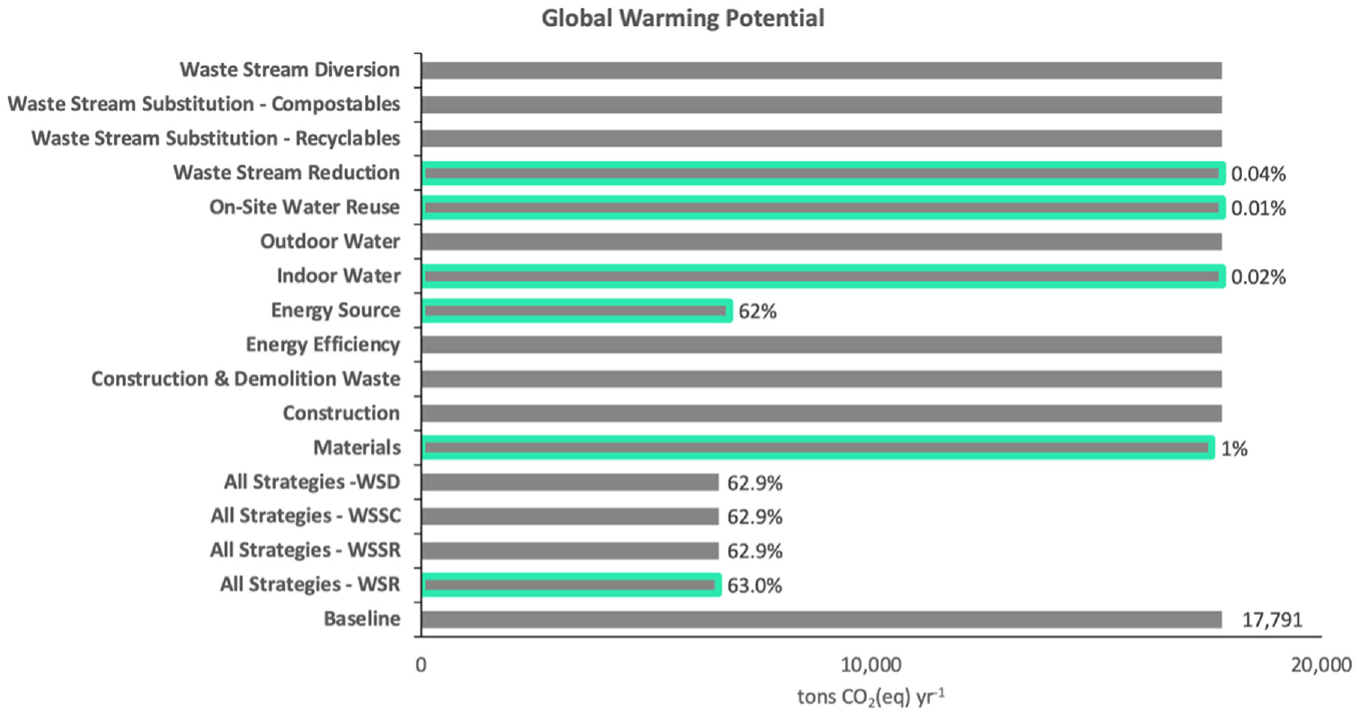
Global warming potential (GWP) for mitigation strategies for Reno (RNO) Airport.
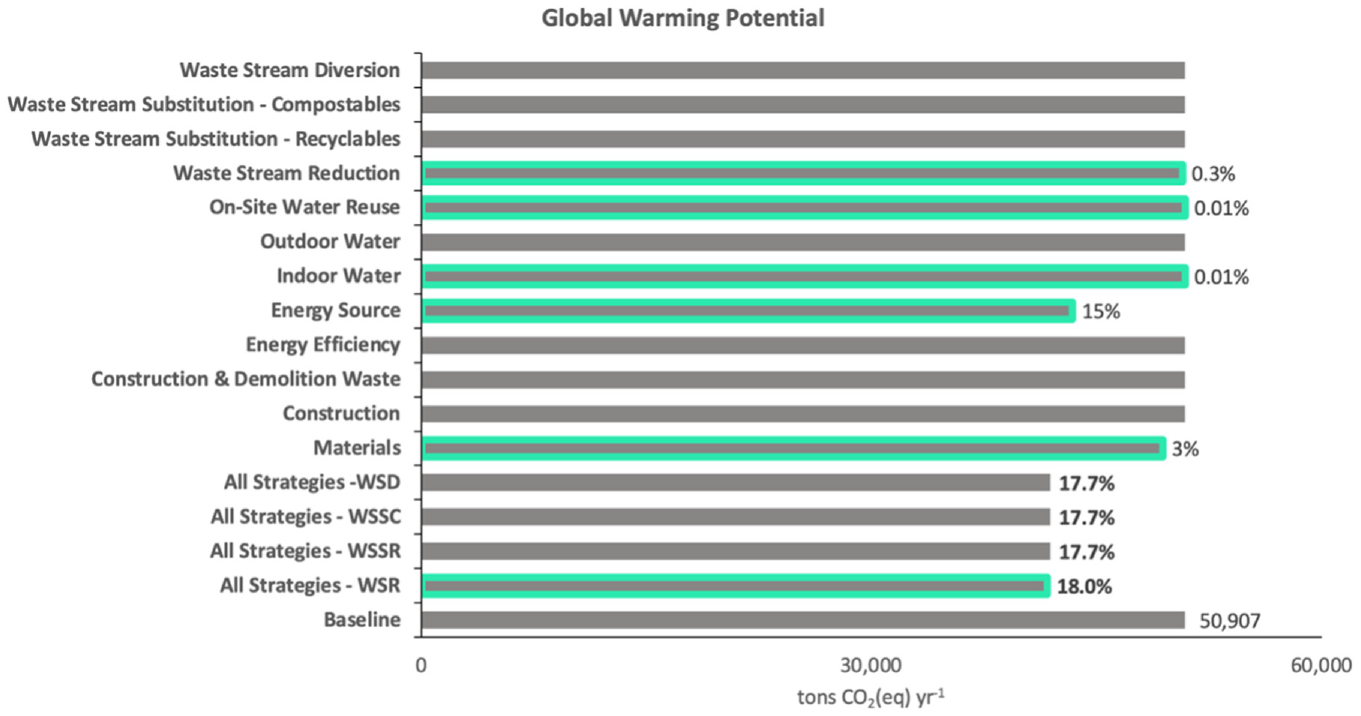
Global warming potential (GWP) for mitigation strategies for San Francisco (SFO) Airport.
Discussion
As demonstrated in the sample results which rely on data collected from the case study airports, mitigation benefits are influenced by airport location, module, strategy type, and impact category. A sensitivity analysis of the SFO case study reveals which parameters change the overall results. Select model parameters are changed relative to their baseline conditions, while all remaining parameters are left unchanged. Figure 9 shows that the electricity mix, amount of electricity consumed in the terminal, terminal gross area, and amount of compostables in the solid waste stream have the most impact on increasing annual GWP for SFO. The electricity mix, demarcated with a yellow square outlined in purple, is especially sensitive to SFO’s overall baseline GWP. SFO’s baseline electricity mix is mainly sourced by hydroelectric power (all cas-study electricity mixes are provided in SI, Appendix D). These critical factors are applicable to SFO; sensitivity analyses would need to be conducted for each airport. Additional analyses should explore the sensitivity of mitigation strategies to specific parameters.
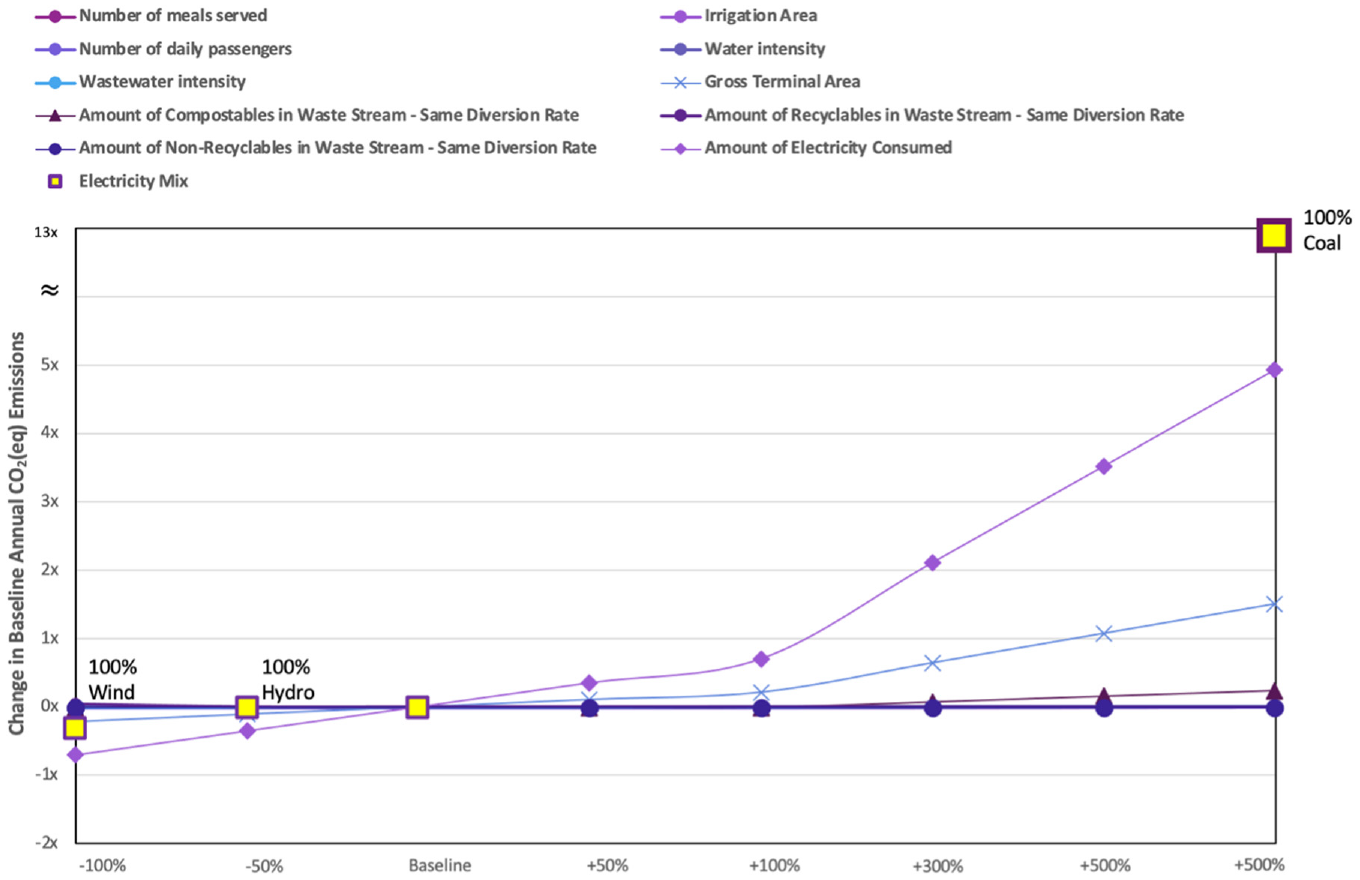
Sensitivity of global warming potential (GWP) to changing model parameters for San Francisco International (SFO) Airport.
ATEST results can be validated in multiple ways. Results are qualitatively validated by comparing model output to previous literature and reports and by using the pedigree matrix approach to assess the uncertainty of underlying data. For example, CAP emissions from building construction in the RNO and SFO results are on the same order of magnitude for similarly sized buildings ( 54 ). While not completely exact, as ATEST calculates emissions using a life-cycle approach, users can compare model output to their airport’s Scope 1 and Scope 2 GHG emissions to determine if model results are of the same magnitude. Users can further validate results by running ATEST using upper and lower bounds for various input parameters and changing default assumptions to reflect custom information.
Pedigree matrices are used to analyze the data uncertainty in LCA studies ( 55 ). Low uncertainty scores in factors such as data age, completeness, and specificity indicate that results are reasonably reliable. Pedigree matrices (Section 7 in the SI) are evaluated for electricity, natural gas, water/wastewater, solid waste, building size/composition, and construction emission data used in ATEST. Uncertainty is relatively low for the energy, water/wastewater, and solid waste data used in ATEST. There is moderate uncertainty for the building size/composition and construction emission data used in ATEST given the age of the data. Overall, all data used are reliable.
Limitations
A limitation of ATEST is centered on its bottom-up approach. While an improvement on efforts that use a per m2 approach to estimate environmental impacts from terminals ( 20 ), the bottom-up approach has some disadvantages. Since ATEST is encapsulated within Excel and relies on limited inputs from users, we are constrained in the types of calculations we run, the emission sources we analyze, and the mitigation strategies we investigate. The bottom-up approach is likely most impactful on the Building Materials module, which has cascading impacts on the Operational Energy module. As an example, we do not investigate any building design strategies (e.g., building orientation or window-to-wall ratio) as they require sophisticated energy simulation software. Given potential limitations in data input by the users, we use proxy emission factors to estimate construction emissions. A more complete approach for estimating emissions would be to use a bill of materials and construction schedule from a terminal project. Effects of airport efficiency improvements on buildings (e.g., from gate electrification) would also require additional work on the tool framework ( 56 ).
Operational costs are calculated on a unit basis and do not account for additional factors such as demand or service charges incurred from utilities. Annualized investment and maintenance costs would provide stakeholders with a more complete economic impact analysis of distinct mitigation options.
Emission results and life-cycle impacts are calculated on an annualized basis, which is useful for comparing progress to previous years and for meeting annual targets/reduction goals. However, as shown by events such as the global COVID-19 pandemic, real-time, locally relevant conditions can have instantaneous and significant impacts on the environment and human health ( 57 , 58 ). ATEST cannot estimate the real-time impacts from indoor air quality within a terminal caused by the spread of infectious diseases or from off-gassing of interior finishes. Quantifying these impacts is a critical component for making terminals as healthy as possible.
Conclusions
We developed a novel decision-support tool for stakeholders to analyze the baseline and mitigated GHG and CAP emissions associated with constructing and operating terminals. The tool, known as ATEST, quantifies life-cycle GHG and CAP emissions, operational costs, and monetized climate damages for four modules: (1) building materials; (2) operational energy; (3) water and wastewater; and (4) solid waste. Using RNO, PIT, EWR, SEA, SFO, and ATL as case study airports, we explore how emissions and economic impacts change for different mitigation strategies in response to varying operational parameters, energy supplies, climate zones, and regulatory mandates. According to the sample application of ATEST, the electricity mix is one of the dominant factors in changing emissions. The construction phase of a terminal is important from a human health perspective as most of the fine particulate matter emissions are attributable to the Building Materials module.
Future research should account for additional life-cycle economic costs and environmental phases, particularly the investment costs and manufacturing requirements from mitigation strategies. For example, choosing to implement an on-site greywater collection and treatment system would result in additional capital costs and emissions from construction. Monetized damages can be expanded to include economic harm to human health caused by terminal construction and operation. It should be investigated how ATEST can be incorporated with existing tools that stakeholders are familiar with, including ACERT and the Airport Construction Emissions Inventory Tool (ACEIT). With the addition of country-specific look-up tables and changes to default settings, ATEST can perform analysis on airports located outside the United States. An ultimate research goal is to explore how ATEST can be modified to select an optimal portfolio of strategies given a performance objective and constraints such as operating/investment budgets.
ATEST can be used by airport operators, sustainability teams, and environmental management teams at the planning and operating stages of projects to assess the emissions footprint of terminal buildings. The tool can be used to provide a preliminary indication of which module (building, energy, water, solid waste) is most important for specific emissions and for operational costs. Such a tool is critical for airports that might have conflicting environmental priorities. ATEST represents a first step for airport stakeholders to evaluate options to mitigate the climate change and human health impacts from constructing and operating terminals.
Supplemental Material
sj-pdf-1-trr-10.1177_03611981221101896 – Supplemental material for Life-Cycle Approach to Healthy Airport Terminal Buildings: Spatial-Temporal Analysis of Mitigation Strategies for Addressing the Pollutants that Affect Climate Change and Human Health
Supplemental material, sj-pdf-1-trr-10.1177_03611981221101896 for Life-Cycle Approach to Healthy Airport Terminal Buildings: Spatial-Temporal Analysis of Mitigation Strategies for Addressing the Pollutants that Affect Climate Change and Human Health by Fiona Greer, Arpad Horvath and Jasenka Rakas in Transportation Research Record
Footnotes
Acknowledgements
Dr. Greer wants to thank the ACRP Graduate Research Award panel for their comments and suggestions. We appreciate the data we received from Port Authority of New York and New Jersey, especially from Clare O’Brien and Andrew Liebowitz, and from Allegheny County Airport Authority, specifically from Kevin Gurchak and Grace Cameron.
Author Contributions
The authors confirm contribution to the paper as follows: study conception and design: F. Greer; data collection: F. Greer, J. Rakas; analysis and interpretation of results: F. Greer; draft manuscript preparation: F. Greer, A. Horvath. J. Rakas. All authors reviewed the results and approved the final version of the manuscript.
Declaration of Conflicting Interests
The author(s) declared no potential conflicts of interest with respect to the research, authorship, and/or publication of this article.
Funding
This study was supported by the 2020–2021 Graduate Research Award Program on Public Sector Aviation Issues of the Airport Cooperative Research Program of the Transportation Research Board of the National Academies of Sciences, Engineering and Medicine. The authors acknowledge Matt Griffin, Mary Sandy, Sarah Pauls, Linda Howard, Dave Byers, Robert Samis, Peter Mandle, Joshua Kneifel, Pamela Vanderbilt, and Kirsten Ritchie for their guidance and support.

Supplemental Material
Supplemental material for this article is available online.
References
Supplementary Material
Please find the following supplemental material available below.
For Open Access articles published under a Creative Commons License, all supplemental material carries the same license as the article it is associated with.
For non-Open Access articles published, all supplemental material carries a non-exclusive license, and permission requests for re-use of supplemental material or any part of supplemental material shall be sent directly to the copyright owner as specified in the copyright notice associated with the article.
