




Abstract
The aim of this study was to determine the ways in which academic libraries in South Africa use community engagement as a strategy to advance the United Nations’ Sustainable Development Goals – specifically Sustainable Development Goals 8 and 11 – in the context of the study. It followed a multi-methods approach to interview and hold focus group discussions with heads of libraries and librarians, respectively, in South African public university libraries. It was found that the libraries advance these Sustainable Development Goals in various ways, such as by employing library student assistants and interns from different backgrounds, and by serving as employers themselves. Furthermore, the libraries serve as custodians of local culture and heritage by curating, digitising and preserving local collections for posterity. However, collaborative efforts between the libraries and other heritage institutions, such as museums, archives and galleries, are few and far between, which is deemed a missed opportunity for more meaningful cultural and heritage impacts for these institutions. More collaborations and partnerships between these institutions are recommended, especially with regard to the digitisation of cultural heritage collections. Therefore, a clarion call is made for libraries to think more expansively about their role and consider including sustainable thinking as part of their mission in line with the American Library Association. The results demonstrate that libraries are uniquely positioned to advance the Sustainable Development Goals.
Keywords
Introduction
The United Nations’ (n.d.) Sustainable Development Goals (SDGs) are described as a global development framework and a blueprint to achieve a better and more sustainable future for all. They were adopted by the United Nations General Assembly in 2015. In describing the SDGs, the United Nations (n.d.) refers to them as a ‘universal call to action to end poverty, protect the planet and improve the lives and prospects of everyone, everywhere’. At their core, the SDGs have 17 goals and 169 targets that seek to address negative trends in global development (Missingham, 2021). The SDGs are both universal and interlinked. Their interconnectedness stems from the dependency of one goal on another. As an example, “gender equality” (SDG 5) cannot be achieved without universal “quality education” (SDG 4), and poverty cannot be completely eradicated (SDG 1) where there are gender disparities. In addition, there cannot be ‘sustainable cities and communities’ (SDG 11) without ‘decent work and economic growth’ (SDG 8). The universality of these SDGs refers to their applicability to all countries, irrespective of their developmental status, to ensure that indeed no one is left behind. SDGs are relevant to each and every stakeholder, including those from the private and public sectors, as well as civil society (Rashed and Shah, 2021). Partnerships remain at the centre of the SDGs (IFLA, 2023).
The European University Association (2018) identifies universities as critical players and key stakeholders in the fulfilment of the SDGs. This is because of the ability of universities to provide cutting-edge research, high-quality education and groundbreaking innovation. At the centre of the academic project lie academic libraries, whose role is to support the academic endeavours and community-engagement strategic ambitions of universities. These libraries provide access to cutting-edge information technologies and information for academics and students. According to Thorpe and Gunton (2022), most SDGs cannot be successfully achieved without information provision, which is the raison d’être of libraries. In most campuses, academic libraries are often regarded as trusted third spaces, which are accessible to new and marginalised members of the university community and beyond, irrespective of their academic or financial status. This makes libraries uniquely placed to contribute to and advocate for the SDGs within universities. There are various ways in which libraries contribute to the SDGs, including through teaching, learning, research and community-engagement support.
In South Africa, community engagement is regarded as a core mission of higher education (Shawa, 2020). The higher education legislative framework of the country, including the White Paper for Post-School Education and Training (Department of Higher Education and Training, 2013) and the Education White Paper 3 (Department of Education, 1997), encourages universities to be socially responsible by moving beyond their walls and contributing to the plight of their surrounding communities. It is a requirement that universities indicate the societal contribution and value of their intended offerings when requesting programme accreditation from the Higher Education Quality Committee. There is a forum for community engagement in higher education called the South African Higher Education Community Engagement Forum (Bhagwan, 2020). Among the objectives of the forum is advocacy for and the promotion and strengthening of community engagement in higher education by fostering partnerships, sharing best practices and ensuring the inclusion of community engagement in the core business of all universities in the country. To sustain interest in the niche research area of community engagement, in 2018, the South African government released funding that aimed at assisting scholars to get to grips with some of the theoretical, philosophical and conceptual underpinnings of community engagement (National Research Foundation, 2016). Despite this, unlike teaching and learning, and research, community engagement remains an unfunded mandate in South Africa.
In line with the developments at universities, community engagement is gaining momentum in academic libraries (Bangani and Dube, 2023). Library bodies have realised that academic libraries could add value to and benefit from working closely with communities. As such, library associations like the Library and Information Association of South Africa and the Committee of Higher Education Libraries of South Africa encourage libraries to be an integral part of their immediate communities by getting involved in community-engagement activities.
This study adopted the American Library Association’s definition of community engagement, which places emphasis on community engagement's collaborative nature. The American Library Association (2020) defines community engagement as ‘the process of working collaboratively with community members – be they library customers, residents, faculty, students or partner organizations – to address issues for the betterment of the community’. Compared to other missions, community engagement is often considered a relatively new mission for universities and academic libraries, having only gained traction in the early 1990s (Strom, 2011). As a result, it remains an under-theorised, under-researched and under-resourced mission of universities (Akpan et al., 2012). Very few studies (e.g. Bangani and Dube, 2023; Ma and Ko, 2022; Sari et al., 2023) have focused on the contribution of academic libraries to the SDGs through community engagement. However, community engagement holds the promise for academic libraries to contribute to the SDGs that are not often considered as falling under the traditional auspices of academic libraries, including SDG 8.
This study is extracted from PhD research, which was carried out in South Africa to demonstrate the contribution of academic libraries to the SDGs, including SDG 8 and SDG 11. The study was motivated by an apparent dearth of literature from the developing world that outlines the contribution of academic libraries to the international development agenda, particularly through community engagement. According to Chuenchom et al. (2022), academic libraries need to shift towards serving wider communities to have a better impact on the SDGs. This study provides distinct perspectives on how academic libraries contribute to SDG 8 and SDG 11. Its recommendations align with those of the American Library Association by encouraging academic libraries to incorporate sustainable thinking in their missions. The study is guided by two objectives: (1) to outline the contribution of South African academic libraries to SDG 8 and (2) to ascertain the contribution of South African academic libraries to SDG 11.
Literature review
This literature review will unpack SDG 8 (Decent work and economic growth) and the contribution of libraries to the actualisation of this SDG. Second, SDG 11 (Sustainable cities and communities) will be unpacked and literature on the contribution of libraries to the realisation of this SDG will be appraised.
According to Dabengwa (2024), libraries are well positioned to contribute to the SDGs through the provision of relevant information and resources. For this reason, SDGs are of interest to all types of libraries. The themes that come up in the literature include studies that focus on the level of awareness of SDGs among librarians (Amadi et al., 2020); how libraries have incorporated the SDGs in their strategic planning (Connaway et al., 2023); studies on the various ways whereby libraries can contribute to the SDGs (Mashroofa, 2022); examples of how libraries are actually contributing to the SDGs (Bangani and Dube, 2023); and how libraries advocate for and promote the SDGs (Hamad and Al-Fadel, 2022). These studies focus on contributions to either several SDGs (Bangani and Dube, 2023; Dabengwa, 2024) or individual SDGs (Bangani, 2023).
Unpacking SDG 8 and the contribution of libraries
SDG 8 seeks to ‘promote sustained, inclusive and sustainable economic growth, full and productive employment and decent work for all’ (United Nations Department of Economic and Social Affairs, 2019). The SDG has 12 targets and 17 indicators. Some of the targets of this SDG were/are set to be achieved by 2020 and 2025, while others are to be achieved by 2030. The two targets that were/are set to be achieved by 2020 and 2025 are the reduction of youth unemployment and increase in access to education and training for youth, as well as ending modern-day slavery such as child labour and trafficking. These are the enablers that may lead to the successful achievement of the other targets of this SDG. Generally, the focus of this SDG is on the two interrelated themes of decent work and economic growth, which influence each other. Higher economic growth holds the potential for the creation of more decent jobs, while more decent jobs have the potential to lead to economic growth. The targets under this SDG are meant to promote the achievement of high economic growth, advancement of progressive economic policies, eradication of child labour and exploitation, and equal pay for women and men, as well as increased youth employment. Ultimately, this SDG seeks to ensure sustainable economic growth and employment for all. According to a University of Cape Town (n.d.a) report, this SDG is particularly relevant in the context of sub-Saharan Africa, where 85% of the total employment is in informal sectors. Many African countries are afflicted with extreme levels of chronic poverty. As a result, Omona (2020) believes that African libraries have a heightened responsibility to contribute to socio-economic development. This is because socio-economic challenges tend to have a ripple effect on other factors that affect the quality of life of citizens (Mojapelo, 2018). The achievement of this goal may lead to addressing many other social ills on the African continent.
The literature states that libraries act as enablers for people to find jobs through exposing them to available job opportunities and assisting them in applying for positions. They can do this by providing information for people through ‘job cafes’, as well as assisting them with preparing their curriculum vitaes (Noh, 2021). A global study carried out by Connaway et al. (2023) found that library spaces are indeed used for conducting mock interviews, so that job hunters can gain confidence in an actual interview situation or attend a virtual interview, due to the stability of the networks and the availability of virtual spaces in libraries. In addition, libraries provide job opportunities for students to work as library assistants. The skills gained are transferrable when they subsequently apply for a job.
In the case of Jordanian public libraries, Tbaishat (2021) reports that these libraries provide the means and skills for people to apply for jobs. This includes providing the information and communications technology necessary to apply for jobs, as well as training and workshops. Prakasan (2020) believes that libraries can play a role in advancing SDG 8 through educational advancement, competitive examinations and providing decent employment. Similarly, Chuenchom et al. (2022) are of the view that libraries can aid with professional development through support for quality education and the provision of work for students. This will help students to gain real work experience.
Unpacking SDG 11 and the contribution of libraries
SDG 11 seeks to make cities inclusive, safe, resilient and sustainable by confronting the challenges of urbanization, homelessness, air pollution, public transport and other city and human settlement challenges (United Nations, 2023). Anchored on 11 targets and 13 indicators, this SDG seeks to address decent housing to reduce or eradicate homelessness, the provision of safe and affordable transportation systems, the creation of inclusive spaces, environmental protection and enhanced rural development. Critically, for libraries, the SDG also seeks to promote social cohesion through the protection and promotion of cultural heritage. This has prompted Noh (2021) to remark that this is one of the SDGs where the intrinsic role of libraries is more pronounced.
For a rapidly urbanising continent like Africa, SDG 11 holds special promise. It is predicted that two-thirds of the population of sub-Saharan Africa will reside in urban areas by 2050 (University of Cape Town, n.d.b). This will require intentional efforts to advance social cohesion in urban areas and protect the environment. Due to rapid urbanisation and other social challenges that threaten social cohesion in Africa, institutions have a heightened responsibility to advance and provide the conditions for SDG 11 to be realised.
Using Australian university libraries as a case study, and similarly to Noh (2021), Missingham (2021) also identifies SDG 11 as an SDG that is highly relevant for academic libraries. This is because these libraries play a critical role in preserving a nation's cultural heritage (Okuonghae and Igbinovia, 2019). They provide access to collections, exhibitions and public lectures, as well as digital literacy training in partnership with other GLAM (galleries, libraries, archives and museums) institutions. Noh (2021), on the other hand, identifies three ways in which libraries contribute to SDG 11: through (1) recording and preserving cultural heritage, using their data repositories to preserve cultural heritage data; (2) keeping cultural heritage records safe, especially during armed conflicts and other disasters; and (3) restoring and preserving these records in case of destruction. In this way, cultural records are preserved for future generations. Kosciejew (2020) is in agreement, pointing out that libraries collect, organise, preserve and distribute the cultural collections of their communities and, indeed, of the world. Due to their originality and uniqueness, these collections are accessible not only to academics, but also to non-academics (Bernabè and Tinti, 2020), leading to cultural accessibility, which in turn nourishes creativity and intellectual activities (Kosciejew, 2020). In the long run, this may lead to the creation of more cultural artefacts and increased protection of indigenous cultural rights (Omona, 2020).
Despite reports on how academic libraries contribute to SDG 8 and SDG 11, there remains a lack of empirical evidence of how academic libraries contribute to the realisation of SDG 8 and SDG 11 in African contexts. The majority of studies in African contexts in this area are often exploratory (e.g. Okuonghae and Igbinovia, 2019) or literature reviews (e.g. Dabengwa, 2024). This study seeks to fill this gap by providing empirical evidence.
Methodology
This study formed part of a broader PhD project, which adopted a multi-methods qualitative research approach. Two data collection methods were used: (1) online interviews with library heads in public university libraries in South Africa and (2) focus group discussions with librarians involved in community-engagement initiatives. South Africa is home to 26 public universities, of which 12 are traditional universities, 8 are universities of technology and 6 are comprehensive universities. Traditional universities are theory-based universities that offer degrees at the undergraduate, Master's and doctoral levels. Comprehensive universities provide ‘a mix of programmes, including career-oriented and professional degrees, research, Master's and doctoral programmes, while universities of technology offer vocational education both at degree and undergraduate levels’ (Council on Higher Education, 2009: 8). The libraries of these universities were the target of this study.
The online interviews and focus group discussions took place between July 2021 and February 2022. They were all conducted via Microsoft Teams, except for one, which was conducted via Zoom following a request by the interviewee to be interviewed using this platform. The justification for choosing these methods is that public universities in South Africa are dispersed across all nine provinces of the country. It would have been a challenge – financially, physically and practically – for the researcher to have visited all the provinces to collect data. In addition, the study was conducted during the COVID-19 pandemic. In this context, online interviews helped to ensure that the necessary social distancing and other COVID-19 protocols were followed.
Regarding the sampling procedures, a census procedure was employed for the library heads, meaning that all 26 of them were contacted, while a snowball sampling procedure was followed for the librarians. The library heads were contacted first. Where they were comfortable, they were asked to refer the investigator to librarians in their academic libraries who had experience of being involved in community engagement. To avoid the participants feeling obliged to participate, the investigator personally contacted them all via email. All of them were informed of their right to choose not to participate in the study without any negative repercussions. In the end, 20 library heads from 20 public universities were interviewed, which was followed by 8 focus group discussions with 33 librarians. In terms of institutional profile, six of the library heads were from universities of technology and five were from comprehensive universities, while nine were from traditional universities. Interview guides were used. The interview guides were divided into six sections: Section A dealt with the general views of the participant with regard to community engagement; Section B dealt with community engagement in the strategic agenda of university libraries; Section C was on community-engagement approaches; Section D dealt with partnerships and social networks; Section E was on trust between university libraries and communities; and, finally, Section F concerned the challenges and benefits for libraries in conducting community engagement.
Before each of the interviews and focus group discussions, the researcher explained the procedure and confirmed that all of the participants had been sent consent forms to sign prior to the interviews and focus group discussions. The researcher then reiterated the participants’ right to withdraw consent at any stage of the interview or focus group discussions. The question that was asked and which was of interest to this study involved a request for the participants to indicate the community-engagement activities or initiatives that their libraries were involved in. Thereafter, they were asked to indicate whether, in their view, these community-engagement initiatives contributed to the SDGs. The participants were able to provide details of several initiatives and align them to the SDGs without much prompting. It was found that some of the initiatives support SDGs 8 and 11.
The interviews and focus group discussions were automatically transcribed using the in-built mechanism of Microsoft Teams and Zoom after the participants had consented to this. However, the transcriptions were not perfect, therefore further cleaning of the data was required. The investigator and a research assistant listened to the transcripts afresh and made the necessary corrections. Once they were deemed satisfactory, they were uploaded on ATLAS.ti. The responses were grouped according to the objectives of the original study. Careful reading of the responses was then carried out and the emerging themes were identified.
The study received ethical approval from the University of South Africa, and permission from the gatekeepers of the various universities was obtained before the interviews and focus group discussions were conducted. All of the universities deemed the research to be low risk but insisted that their and their staff's names should be anonymised. As such, ‘library heads’ is used to refer to the heads of the libraries and ‘librarians’ is used to refer to all those who formed part of the focus group discussions, irrespective of their job title. For practical purposes, the library heads and focus groups were assigned numbers based on the sequence of the interviewing and discussions. Library Head 1, for example, refers to the first library head interviewed, while Focus Group 1 refers to the first focus group that was held. The results are reported in the form of narratives and figures.
Results
With regard to the relevant questions aligned with the objectives of this study, the participants were asked to state how they decided on community-engagement programmes or projects. Thereafter, they were asked to outline the community-engagement initiatives/programmes they had recently worked on and share the extent to which they could say that those initiatives had contributed to advancing the SDGs. The results are reported according to the objectives of the study as outlined in the introduction. As already been mentioned, some of the initiatives aligned to SDG 8 and SDG 11.
Contribution of South African academic libraries to SDG 8
The unemployment rate is a huge socio-economic challenge facing South Africa (Statistics South Africa, 2020). Statistics South Africa (2021) estimated that 34.9% of South Africans were unemployed in November 2021. Addressing work and employment challenges has become one of the ways through which these academic libraries contribute to community challenges. Figure 1 summarises the contribution of South Africa's academic libraries to SDG 8.
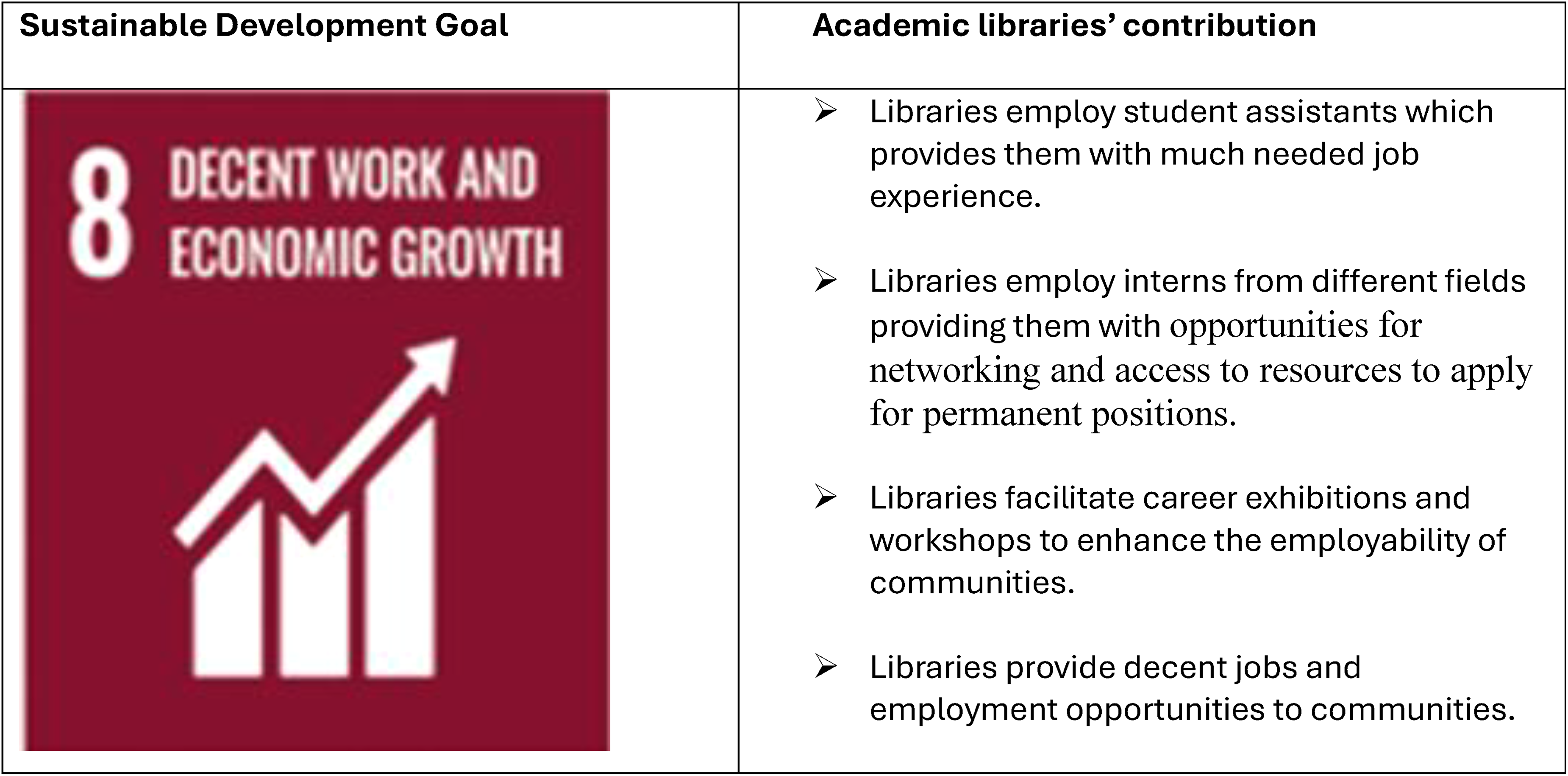
Contribution of academic libraries to SDG 8.
Seventeen library heads mentioned the employment of library student assistants as one way in which libraries contribute to community engagement. While Library Head 12 admitted that the employment of library student assistants was borderline, between internal and external community engagement, she nonetheless was adamant that the employment of library student assistants provides students with much-needed work experience that puts them one step ahead of their peers when it comes to job opportunities after graduation from university. Its impact, therefore, is geared towards solving a ‘general problem of unemployability of graduates … especially because of a lack of work experience … a socio-economic problem’.
Although no scientific tracer study has ever been carried to find out the career paths of these students, Library Head 14 stated that, generally, students who have worked as a library student assistant seem to get a job more quickly than those who have never been a library student assistant. This library head indicated that this was confirmed by the number of requests she received every year to write referee reports for former library student assistants. Library Head 12 agreed, stating: ‘Over the years, we have employed some of our former student assistants … I think I can count a number of our librarians, library assistants and so on who started as student assistants’. Interestingly, Library Head 9 also shared that they sometimes employ former student assistants as library assistants on a permanent basis, even though they may not be qualified librarians at the time of employment. Some have gone on to complete their postgraduate diploma in Library and Information Science (LIS) and are now employed as professional librarians. Another interesting fact was that four library heads whose universities have a LIS programme indicated that their policy is to employ LIS postgraduates first as library student assistants to give them much-needed experience in the field, while the other library heads employ library student assistants from various fields.
In order to contribute to the actualisation of SDG 8, libraries need to be willing to partner with others to access resources and expertise from elsewhere. This is particularly important given the fact that community engagement remains an unfunded mandate in South Africa. As such, Library Head 6 shared details of a partnership between university libraries and the National Research Foundation of South Africa, with the former hosting interns assigned by the latter. The library head was delighted to realise that all the interns who had worked at his university had been integrated within provincial libraries before they could finish their one-year contracts.
However, many library heads reported that these libraries employ not only LIS graduates, but also graduates from other fields such as Public Relations, Marketing, Communications, Computer Science, Graphic Design and Quality Management. This provides the interns with much-needed job experience, as well as opportunities for networking and access to resources that they can use to apply for permanent positions.
Although the librarians shared similar narratives to the library heads, none of the focus groups mentioned the employment of library student assistants as a community-engagement initiative without further prompting. In this regard, a librarian from Focus Group 6 conceded: we never think of it [employment of library student assistants] as community engagement but it really is … it is a contribution to the students’ work experience and we pay them a stipend … this helps them to pay their fees and the rest is used for daily needs.
On further questioning, all of the focus groups conceded that their libraries do employ library student assistants, and some even admitted that library assistants and interns can end up being employed in their libraries.
Contribution of South African academic libraries to SDG 11
In respect of SDG 11, it was clear that academic libraries mainly contribute through the custodianship of cultural and national heritage. The initiatives that were categorised under contributing to national heritage include panel discussions, exhibitions and other activities that are held to promote languages during International Mother Tongue Language Day, and engagement with other heritage institutions like archives and special collections and museums. Interestingly, the investigator was reminded that some library buildings are themselves heritage sites. The activities are outlined in Figure 2.
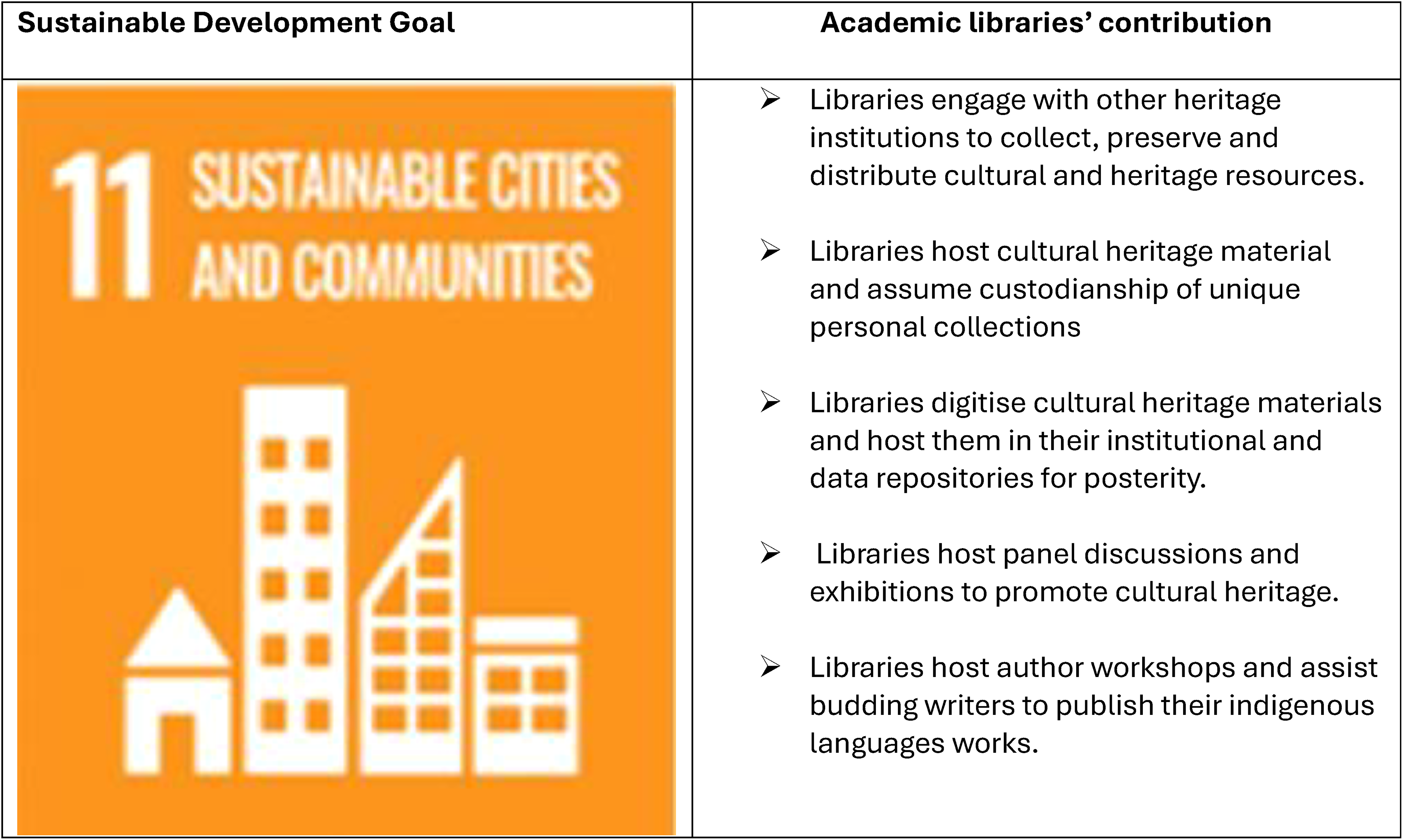
Academic libraries’ community-engagement activities in contribution to SDG 11.
It was the view of five of the interviewed library heads that academic libraries contain national heritage resources that should be conserved and preserved for future generations. Information gleaned from the five library heads shows that academic libraries’ special collections are used to reach out or reach in to communities. University libraries contain unique collections in the form of personal, political, church and national documents. The five library heads who raised this point added that members of the public come to their libraries to use these unique collections. The purposes for using these documents vary, including to support land claims, to claim or know their heritage and for research purposes. Three library heads added that as part of their community-engagement strategies, their university libraries actively make requests to prominent local communities to consider donating their collections to the library. To this effect, Library Head 14 told about a signed memorandum of understanding with an Afrikaans language museum. This opened the door for researchers affiliated with the museum to access and use the library for Afrikaans research, and vice versa. Regarding the preservation of heritage, Library Head 9 commented: ‘We are entrusted with personal collections … they know libraries are trusted spaces and we have the preservation skills that we have built over years … to preserve this material’.
The librarians mostly corroborated the narratives of the library heads. However, they added another relevant initiative. The participants in Focus Group 3 declared that they had held a panel discussion on African languages in line with the government theme ‘Celebrating South Africa's literacy classics in the year of indigenous languages’ (Diko, 2019). The theme itself was in alignment with UNESCO, which declared 2019 the Year of Indigenous Languages. The panellists and attendees included library staff, students and community members.
In support of the contribution to heritage, a Focus Group 3 participant stated: ‘we host unique heritage collections of the [local] community … the conservation and preservation of heritage material is also a way by which we contribute to the community engagement’. According to the participants in Focus Group 5, a similar initiative led to the publishing of two African-language books with the assistance of the African languages department at their university.
However, it was noteworthy that at least one library head and three focus group members highlighted meaningful joint digitisation efforts as lacking between libraries and other GLAM institutions. The participants believed that enhanced collaborative digital preservation efforts would lead to more depth in their collections and the sharing of expertise and resources to the benefit of users.
Discussion
Similar to the findings, the discussion section is divided according to the two objectives of the study.
Community engagement as academic libraries’ approach to contributing to SDG 8
The results of this study show that the library heads and librarians were in agreement on the employment of library student assistants as an approach to actualise SDG 8 in academic libraries, as well as providing internships, decent jobs and opportunities for graduates. These university libraries were shown to employ library student assistants and interns from various fields; organize careers fairs and workshops to enhance the employability of communities; and themselves act as employers, providing decent jobs and employment opportunities to communities. Several examples exist in the literature where other academic libraries carry out community engagement through the employment of library student assistants (Appleton, 2020; Gikandi and Ndungu, 2018; Missingham, 2021; Thorpe and Gunton, 2022).
Employing these students helps to enhance their employability and open doors to future career opportunities. This work experience serves to enrich library student assistants’ résumés and help them gain valuable transferable skills, making them more employable. This not only helps students open doors to future employment, and personal and professional development, but they also benefit financially. Mthembu (2018) insists that library student assistants benefit from the work both financially and professionally. Yates (2014) points out that student work provides a great opportunity to work with people from diverse cultural and socio-economic backgrounds. In further agreement with the results of this study, Mthembu (2018) observes that employing student assistants is a way of closing the gap between the theory that students learn in class and the practice that students gain from being exposed to ‘the real world of working’.
The second aspect that addresses SDG 8 as identified by the participants is offering internship opportunities to the unemployed to give them practical work experience. The literature shows that this is not peculiar to South Africa. German and LeMire (2018) share numerous examples of community engagement through the employment of high school students as interns in American academic libraries. These internships provide excellent learning opportunities, with some of the interns considering a potential career in librarianship at the end of their programme.
The literature also shares instances where non-LIS interns (Dahl, 2011) and high school learners (Batts et al., 2020) are employed in US academic libraries. In Dahl’s (2011) study, the interns were supplied and paid for by the academic departments, while the library hosted them and assigned them duties. This is not dissimilar to this study's findings where, in one university, interns were paid for by a non-governmental organisation, while the academic library was responsible for hosting them and assigning them duties. In another library, the LIS academic department paid for interns, who were sent to work in a library that had been set up by an academic library. This is in support of partnership as an approach not only to community engagement, but also to actualising the SDGs.
The results of this study therefore compare well with the literature with regard to the employment of library student assistants and interns, and providing decent work and opportunities as an approach to community engagement in academic libraries. Elsewhere, academic libraries also offer internship programmes to give the unemployed practical work experience.
Community engagement as academic libraries’ approach to contributing to SDG 11
In respect of SDG 11, it was clear that academic libraries mainly contribute through the custodianship of cultural and national heritage. The initiatives that were categorised under contributing to national heritage include panel discussions, exhibitions and other activities to promote languages during International Mother Tongue Language Day, and engagement with other heritage institutions such as archives and special collections and museums.
This is supported by other research (LeMire et al., 2018; Liauw, 2014; Lucky and Harkema, 2018). Engaging with other heritage institutions such as museums and archives can lead to wider and richer access for both universities and communities. Similarly to the results of this study, Liauw (2014) reports that a project was undertaken in the Philippines by the Petra Christian University's library to preserve and promote the cultural heritage of indigenous people using the university's institutional repository and other initiatives. The project involved reading folklore books to children, storytelling, exhibitions in shopping malls, organising workshops for teachers and the digitisation of the content of value to Subaraya City. Prior to the project, the collection was accessible to a select few and not open to the general public. However, with the digital heritage project that was carried out as part of the project, the collection was made more widely accessible.
For Lucky and Harkema (2018), forming collaborative partnerships with heritage groups such as museums can be productive for both academic libraries and heritage institutions. Not only does it provide an opportunity for libraries and heritage institutions to have access to more diverse collections; it also gives libraries the opportunity to mobilise resources from the wider community, while heritage institutions can benefit from an organisation that will ensure the long-term preservation of their cultural heritage and also expose the items in their collection to a wider academic audience.
Another unique partnership, between Illinois State University Library, a children's museum, a county history museum, a state historical site and two large public libraries, is discussed by Tucker (2009). The partnership was initially driven by the requirement to apply for a grant for a travel exhibition from the USA's National Endowment for the Humanities, which required the university library to look beyond its university for partners. Besides the exhibition, this partnership led to a fundraising initiative involving the children's museum and the university library. Partnerships can also move beyond national borders, as demonstrated by the work done by the National Library of South Africa in support of the restoration of the Timbuktu Archives, with staff training their Malian counterparts in the preservation and restoration of rare collections (Maepa and Maruma, 2016).
The literature advocates for engagement through exhibitions of material from special collections for the general public. Studies in this area include Bahde et al. (2019), Lemire et al. (2018) and Nkondo et al. (2014). Swanick et al. (2015: 3) encourages libraries to use ‘exhibitions as a way to showcase their collections and to appeal to the larger community’. Although Swanick et al. (2015: 1) say this is hardly new, they go on to concede that these ‘exhibitions offer librarians an engaging means of reaching out to academic communities and the public’.
Examples of engagement through special collections and panel discussions in South Africa have been reported in the LIASA-in-Touch magazine. This has included Stellenbosch University Library (Mofu, 2021), North-West University Library and Information Service (Masilo, 2020), the University of Pretoria Library (Haw, 2020) and the University of South Africa Library (Molebatsi and Naidu-Hoffmeester, 2018). In the case of Stellenbosch University Library, Mofu (2021) reports that Sir Claude Hanks donated a collection of significant historical, political and socio-economic value about the South African debt crisis of 1985–1986. The donation of such an important collection demonstrated the stewardship role of Stellenbosch University Library. At the University of South Africa Library, Maise Maponya, a prominent South African playwright, director, poet and activist donated his private works and collections (Molebatsi and Naidu-Hoffmeester, 2018). This involved an exhibition of his work during heritage month. This information was of historical value, especially with regard to South African theatre. The authors maintain that this collection will go a long way towards bridging the gap between academia, the arts and communities. The University of Pretoria Library collaborated with South African Heritage Publishers to translate indigenous-language manuscripts in the university's institutional repository, donated by Dr Van Warmelo, into English and publish them in a book for wider accessibility (Haw, 2020).
With regard to community engagement through contributing to the preservation of heritage, a comparison of the results of this study with the published literature brought mixed results. Based on reports in LIASA-in-Touch, university libraries in South Africa engage with other heritage institutions through curating joint exhibitions of their special collections, and some of these relationships have resulted in joint digitisation projects. Affirmation by some of the library heads indicated that such initiatives may be in the pipeline as part of their digital humanities projects; however, no practical evidence was provided.
Conclusion
In conclusion, this study has been an attempt to demonstrate the contribution of academic libraries to advancing the United Nations’ SDGs, particularly SDGs 8 and 11, through community engagement. Aspects that were indicated as contributing to these SDGs include the employment of library student assistants and interns. Libraries themselves were identified as employers that provide decent work for graduates and non-graduates from different fields. Regarding SDG 11, these libraries act as knowledge banks for heritage collections and facilitate discussions on heritage matters, including by digitising and preserving these materials for future generations. Through these initiatives, libraries empower communities and prepare them to be future-ready for the job market, as well as acting as catalysts for positive development by contributing to decent work and economic growth, and the preservation of institutional, national and global heritage, history and culture. Through their community-engagement initiatives, libraries promote better understanding and mutual respect between community members and universities by strengthening the bonds between them. They build connections across diverse communities, ultimately fostering a more inclusive and cohesive society. This will ultimately lead to equitable and sustainable societies for future generations.
The results of this study have practical implications. The lack of widespread digitisation initiatives between academic libraries and other GLAM institutions has been identified as a missed opportunity for a more meaningful contribution to the preservation of cultural heritage and history. This is contrary to Nkondo et al.’s (2014) advice in the Library Charter. Nkondo et al. (2014) advise that, given that South African academic libraries contain holdings of national interest and value, they are in a better position to engage through forming partnerships for the digitisation of community collections. Therefore, the results of this study may be used as justification for carrying out such collaborations in the future. Despite this, the results generally demonstrate the meaningful contribution of academic libraries to the SDGs through community engagement, therefore academic libraries can use the SDGs as a powerful framework for conducting, assessing, reporting and demonstrating library impacts. This study serves as a clarion call for libraries to think more expansively about their role and consider including sustainable thinking as part of their mission in line with the American Library Association. The results demonstrate that libraries are uniquely positioned to advance the SDGs.
The main limitations of this study are methodological due to the health environment at the time of the interviews and focus group discussions. Methodological adjustments had to be made due to the COVID-19 pandemic, which also conspired against the effective recruitment of participants and the smooth running of the interviews and focus group discussions. The closure of universities and library buildings during this period not only impacted the researcher's ability to effectively recruit participants, but also accounted for challenges associated with the digital divide, where some library staff and library heads struggled to connect from their homes. In addition, higher education in South Africa is offered in private and public universities, as well as technical and vocational education and training colleges. The study does not cover community engagement in private universities and technical and vocational education and training colleges. The focus is on public university libraries because, unlike private university libraries, they operate in an environment where their parent body is mandated by the government to participate in community engagement (Department of Higher Education and Training, 2015). With regard to technical and vocational education and training colleges, very few have any form of library, and the existing libraries are poorly resourced (Nkondo et al., 2014).
For the future, a more global study that assesses the contribution of libraries to the SDGs covering all aspects, not just community engagement, would provide a more complete picture of academic libraries’ contribution to the SDGs. This study could also cover the libraries of private universities, as well as technical and vocational education and training colleges.
Footnotes
Declaration of conflicting interests
The author declared no potential conflicts of interest with respect to the research, authorship and/or publication of this article.
Funding
The author received no financial support for the research, authorship and/or publication of this article.
