



Abstract
This paper reports on a study which sought to assess the community engagement (CE) initiatives of academic libraries in South Africa. The research approach adopted was qualitative using online interviews with 20 heads of libraries in South Africa and 8 online focus group discussions with library staff as data collection methods. It was found that South African academic libraries’ CE initiatives can be construed as support for the Sustainable Development Goals (SDGs), particularly SDG 4 on quality education and life-long learning in the context of this study. Initiatives that were interpreted as a contribution to SDG 4 were the imparting of information literacy skills to schools and librarians from other sectors, promotion of reading and writing, library visits by school learners, donation of school shoes and uniforms to learners, as well as donation of computers and computer literacy training to schools. The results of this study are a testament to the potential of academic libraries to change lives of ordinary citizens beyond the academy through CE. They provide fresh insights on the contribution of academic libraries to SDGs. This study can open new avenues for studying the contribution of academic libraries in the SDGs. Given that the phenomenon of CE is itself a fairly new area of study in academic libraries, this study will add a lot of value in this niche.
Keywords
Introduction
Quality education is a major concern for international organisations (Organisation for Economic Co-operation and Development 2019), governments (South Africa 2012) and Non-Governmental Organisations (NGOs) (Slade 2021).
It is regarded as the most powerful vehicle for the achievement of sustainable development (United Nations Educational, Scientific and Cultural Organisation 2017). In 2021, UNESCO referred to quality education “as appropriate skills development, (required to achieve) gender parity, provision of relevant school infrastructure, equipment, educational materials and resources, scholarships or teaching force.”
Quality education occupies a salient position as one of the 17 United Nations (UN) Sustainable Development Goals (SDGs). SDGs are often described as a blueprint to achieve a better and more sustainable future (United Nations 2015). To demonstrate the centrality of education to sustainable development, it is also mentioned in three other SDGs, which are SDG 3 on good health and well-being, SDG 5 on gender equality and SDG 8 on decent work and economic growth (United Nations 2015). According to Nilsson, Griggs & Visbeck (2016) there are undeniable linkages between education and other SDGs although these are not well articulated. SDG 4 on quality education seeks to “ensure inclusive and equitable quality education and promote lifelong learning opportunities for all”. Quality education cannot be achieved without targeting the vulnerable members of the society including the poor.
The International Federation of Library Associations and Institutions (IFLA) (n.d.) is concerned with the role of libraries in SDGs. IFLA galvanised libraries of all types to be involved in initiatives that seek to contribute to the success of the SDGs. In mapping the contribution of libraries to the SDGs, IFLA reflected that libraries contribute to SDGs through support for information literacy (IL) programmes, spaces, and support for teaching, learning and research, among other initiatives. One way of doing this has been through community engagement (CE) (Ma & Ko 2022).
CE are ongoing networks, partnerships and mutual beneficial relationships formed between university libraries and the communities and utilised to collectively deal with societal problems (American Library Association 2020). This study is situated within the context of South Africa where CE refers to social responsiveness to communities outside the university's walls (South Africa 2012). It does not cover initiatives to internal university communities that are often regarded as teaching, learning and research support. Omona (2020) insists that the actualisation of SDGs requires a holistic approach that should also involve libraries.
CE is well supported in South African libraries. The Committee of Higher Education Libraries of South Africa (CHELSA) is a body consisting of all 26 public university libraries in South Africa together with the National Library of South Africa, the Council for Scientific and Industrial Research library and the Medical Research Council library (Committee of Higher Education Libraries of South Africa 2020). According to CHELSA (2019) academic libraries could partner with local communities and support activities that seek to contribute to development. South African academic libraries also belong to the Library and Information Association of South Africa (LIASA), a professional body tasked with uniting, developing and empowering all library and information professionals in the country (Library and Information Association of South Africa 2020). Nkondo, Teffo, Nassimbeni, Seleti, Dick, Hart & Brown's (2014) challenges libraries to play a significant role in the development of the country, by offering access to information and through engagement in literacy programmes to close the prevailing literacy gaps. Participation in literacy programmes is often touted as one of many ways by which libraries contribute to SDG 4 (Mojapelo & Modiba 2021).
However, despite the calls locally by CHELSA and LIASA and internationally by IFLA, the role of academic libraries in quality education beyond the traditional support for teaching, learning and research is not always obvious. Mojapelo and Modiba (2021) implore academic libraries to go beyond their traditional roles and find new and innovative ways to contribute to the SDGs. The scholars claim that the position of academic libraries as relatively well-endowed entities with state-of-the-art technologies and highly qualified personnel places them in a unique position to play a role in initiatives that contribute to enhancing the quality of education through CE. This study therefore seeks to assess the contribution of academic libraries in South Africa to SDG 4 through CE. This study is novel in two ways. Firstly, unlike previous studies in this niche area (e.g., Mojapelo & Modiba 2021), this study sought to provide empirical evidence of the contribution of academic libraries to SDG 4 while previous studies tended to be exploratory in nature. Secondly, both SDGs and CE are relatively new areas of interest in academic librarianship which have not yet been widely explored. Therefore, through this study, the author is able to provide a contribution to two niche areas that are not yet widely researched in literature. This study is guided by a single objective:
To determine the contribution of CE initiatives in South African public university libraries to SDG 4
Literature review
Literature identifies quality education as a foundation and panacea for sustainable development to be realised (Dei & Asante 2022). According to Ma and Ko (2022), libraries contribute to quality education in various ways, but these often rely on their staff's expertise mainly through provision of digital and information literacy (DIL) skills training, spaces, collections, reading and writing promotion, donations and other programmes (Ma & Ko 2022).
Academic libraries around the world are involved in initiatives that seek to impart digital and information literacy skills beyond their walls. Studies in this area include Graham (2005), Kamau & Gichohi (2018), Kranich (2012), Mataranyika and Mlalazi (2016), Rust and Brown (2018) and Silbert and Bitso (2015).
While researching the outreach needs of public librarians from the Jacksonville State University Library in the United States, Graham (2005) realised that participants would like the academic library to offer them IL training, among other CE initiatives. In another study conducted at the United Kingdom universities, Rickard (2016) found that university libraries were engaging through provision of IL. The author labelled information literacy as a critical skill to support the successful completion of learners’ Extended Project and other school-leaving qualifications thus contributing to quality education in general. This engagement through IL is not unique to the United States. Asian countries also rely on IL to educate non-university patrons. In India, for example, Majumdar (2022) discoursed about an IL initiative of the Sir Gurudas Mahavidyalaya that sought to educate not only university students but also those of adjoining colleges. The author maintains that the programme led to university and college students’ satisfaction.
In the context of African countries, academic libraries also contribute to CE through IL. Reported cases include Kamau & Gichohi (2018) in Kenya and Mataranyika and Mlalazi (2016) in Zimbabwe as well as Coetzer (2018a) and Silbert and Bitso (2015) in South Africa. Mataranyika and Mlalazi (2016) reported that the University of Zimbabwe (UZ) Libraries targeted Tokwe Mukosi Primary School for information literacy training for teachers. The success of the CE initiative was demonstrated by the high attendance levels. A South African study by Silbert and Bitso (2015) reported an initiative of the University of Cape Town Libraries that partnered with the Bookery NGO and schools in Khayelitsha near Cape Town and offered training to library assistants to run libraries. All these initiatives were aimed at ultimately improving the quality of education in the country.
As a contribution to quality education through CE, academic libraries also act as spaces for community engagement. Dole and Hill (2012) and Sweeney (2020) lists the privileges provided to external users at two universities in the United States as building access, borrowing, use of reference material and access to computers with Internet. Dole and Hill (2012) went on to cite Courtney (2001) in claiming that the majority (80%) of academic libraries in US provide restricted access to computers for community members thereby contributing to addressing the digital divide. In Sutherland (2013), an academic library provided computer literacy training to the homeless people to enhance their digital literacy skills and close the digital divide. Kelvin Smith Library (KSL) is the main library of Case Western Reserve University (Adeyemon 2009). KSL runs a programme called “Partnering to Bridge the Digital Divide” which provided Information and Digital Literacy training to middle school learners.
Examples of academic libraries contributing to closing the digital divide of the communities in South Africa exist Reports include those by Coetzer (2018b); Mahlangu (2022) and NWU Libraries (2016). A UJ Library's CE flagship programme seeks to empower school libraries and librarians and prepare them for the changing library landscape (Mahlangu 2022). As part of this ambition, UJ Library decided to hold annual workshops in partnership with the Department of Education at UJ. Adeyemon (2009) supports a partnership approach to addressing the digital skills gap for the marginalised. In the case of UJ Library, Mahlangu shared that in 2021 UJ Library held a four-day workshop for teachers to enhance their digital literacy skills. The programme targeted teacher librarians mainly from resource poor schools around the University of Johannesburg.
To play its part in addressing the digital divide, NWU Libraries (2016) also contributed by donating a library system and a book trolley to Sunrise View Primary School in Rustenburg. Upon realising that the primary school library did not have a system, the Senior Manager in charge of CE at North-West University Library and Information Service committed to engage other members of senior management of her library with the possibility to donate a library system to this primary school. This came to fruition on 27 November 2018.
Although evidence exists in literature to demonstrate the contribution of academic libraries to SDG 4 through CE, most of the published literature is case studies of individual universities. There remains a shortage of countrywide studies on how libraries contribute to quality education through CE. As already stated in the introduction, previous studies in this area also tend to be exploratory. In addition, Very few studies have tried to findout the contribution of CE to SDGs not only in libraries but in other fields as well. This study, therefore, sought to address these gaps in literature.
Methodology
The research approach adopted was qualitative using online interviews with Library Heads (LHs) and online focus group discussions with Librarians.
The process of data collection kicked off with the investigator sending e-mails to all 26 public university LHs in South Africa in June 2021 informing them about the study, and further requesting them to indicate if they would be interested to participate in a study of this nature and seeking guidance on the procedure followed when researchers seek permission to collect data from staff from their universities. Where no responses were received, two reminders were sent.
Although 24 of the 26 LHs responded, others could not be interviewed for various reasons including inexplicable delays by their research bodies in issuing permission to the investigator to collect data, follow-up messages being ignored after the LHs had initially agreed to participate and LHs deciding they no longer want to participate.
Despite the stated challenges, 20 LHs participated in the study. This was to be followed by eight online focus group discussions with 33 Librarians. Two focus groups had 3 participants, three had 4 while the other three had 5 participants. All in all, there were 53 participants in this study. Forty-four of those participants were female and nine were male. Based on these samples, the researcher was able to formulate general conclusions.
To conduct focus groups discussions with Librarians (composed of library staff members at all levels with hands-on experience of working in CE projects), the researcher relied on referrals from LHs. Therefore, the suitable method for focus groups discussions with Librarians was the snowball sampling technique. This entailed interviewing the LH first followed by the Librarians if permission given by the LH and consent provided by the Librarians.
Before all the online interviews and online focus group discussions, procedures for the interview and technical aspects of the video-conferencing facility being used were explained to the participants. Participants were informed that the interview was to be recorded and automatically transcribed and as such permission was requested from them. Participants were requested to switch on their video facility when speaking to provide some “in-person” experience. This also served to confirm the identity of the person that is speaking. Most of the interviews and online focus group discussions were held between the months of July and December 2021. However, the last interview was in February 2022 after one university took long to issue a letter of permission to conduct research.
The first stage was interviews with LHs using an interview guide prepared according to the objectives of the original PhD study from which this study was extracted. The interview guide was divided into seven sections. Section A sought to findout the general view of the participants with regards to CE, Section B sought to determine the institutional commitment of academic libraries to CE, Section C sought to determine CE approaches in South African public universities, Section D dealt with partnerships and social networks, Section E sought to determine whether and how CE helps academic libraries to develop trust between university libraries and communities, Section F sought to determine challenges and benefits encountered by libraries in conducting CE. The results reported in this paper stemmed from a single question that asked: What are some of the CE initiatives/programmes that you or your library worked on? The interviews were conducted virtually using MS-Teams and Zoom, in one instance, 19 of the 20 LHs agreed to be recorded.
The second stage consisted of online focus group discussions via MS-Teams that were recommended to the author by LHs using a prepared guide. The division of sections in the focus group interview guide were similar to those of the online interviews. Similar to online interviews, online focus groups were conducted to ensure a broader reach and to conform to COVID-19 regulations and protocols.
The online interviews and focus group discussions were automatically transcribed into verbatim written formats using the in-built mechanisms of the two software programmes (MS-Teams and Zoom). However, in downloading and reading the transcripts, the investigator realised that the two software's transcription was not hundred percent correct due to difference in voice accent and other external factors. Together with a research assistant, the investigator listened afresh to the recordings from the interviews and focus group discussions and corrected the transcripts, where necessary. Once the investigator and research assistant were happy with the quality of the transcripts, these were uploaded to ATLAS.ti. To avoid confusion, all responses addressing a particular objective were grouped together in a single folder. These were then read and coded. Key words and themes that emerged were then grouped as guided by the research objectives. The investigator then checked for relationships among the emerging themes. The themes were then integrated and grouped together according to similarities.
During the interviews, many participants stated that their CE initiatives align to the SDGs. To test the veracity of these claims, the researcher compared the emerging themes with the SDGs to identify such alignments. Some of the themes that emerged form the basis for the results reported below. The focus of this study is only on those themes that are aligned to SDG 4. Since two methods were used to collect data, it was hoped that this will improve trustworthiness and authenticity of the data. The results are report in the form of narratives.
This study was ethically cleared, and permission sought and received from data gatekeepers of all universities concerned to conduct research with their staff. However, all universities insisted on their names and staff not to be named in conformity with South Africa's Protection of Personal Information Act 4 of 2013.
Findings
Figure 1 below is a visual depiction of the contribution of the CE approaches to quality education. These contributions were coded into information literacy training, donations of clothing items and school shoes, libraries as spaces for CE, donation of computers, printers and other electronic items and support for school libraries.
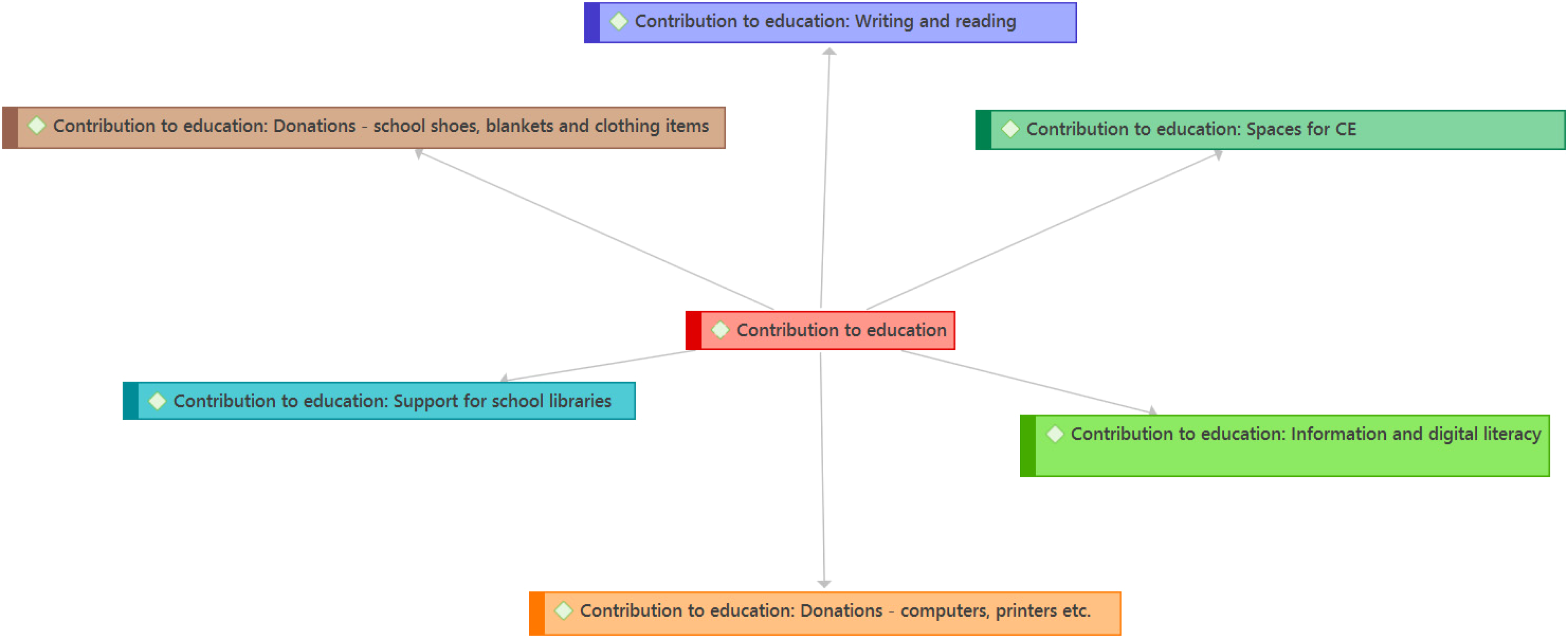
Visual showing the network of quality education related codes.
Empowering learners and teachers through information literacy training
Many narratives were shared by the LHs about initiatives that sought to impart IL skills to learners and teachers. The interventions included an academic library that organised an IL workshop for teacher librarians with 40 of them attending (LH 13). Additionally, LH 4 and 8 stipulated that their two university libraries worked in partnership with community libraries to place university level books and computers in those community libraries for school learners. Since community librarians are responsible for offering contact services, they are trained on database searching skills and other related IL skills.
Numerous other interventions were reported where public librarians (community and provincial) received IL skills training from public university librarians.
LH 6's comment best represents the views of LHs with regards to empowering the communities (learners, teachers and other librarians) through IL. The LH stated: “we are now busy developing an information literacy program that will be compatible to the school level … For instance, in school libraries … we train teachers, especially during Mandela days. When we go to schools we start with training.”
Librarians corroborated LHs by also sharing numerous initiatives where schools and other community entities were targeted for IL training.
One unique intervention involved Librarians working with a school to teach Grade 10 learners information literacy skills annually before they write term assignments. The learners are taught about referencing, plagiarism, finding relevant sources of information and differentiating between credible academic information, fact, opinion and fake news. The learners are also taught the structure of an academic and discursive assignment. Three Librarians from Focus Group 7 added that during sessions, teachers also attend and take notes. In agreement with what was stated by their LH, members of Focus Group 2 indicated that they are developing an IL programme for schools.
In support of IL training to schools, a Librarian from Focus Group 6 indicated that “our involvement must focus on our strengths and that is why we train the students (learners) and communities in information retrieval and information dissemination skills. It is our strength.”
Fostering a culture of writing and reading
Responses of LHs showed that through their reading initiatives, libraries target the vulnerable from the aged, children and the incarcerated.
LH 13 provided an account of a reading intervention at an old age home. The LH is of the view that the elderly in old age homes are socially excluded with some not even getting visits from family and friends. It was for this reason that an academic library entered into an agreement with an old age home wherein they read books to the elderly every Friday.
At least two LHs claimed their libraries run reading and writing competitions for local primary schools. Prizes are provided for by the university libraries with the assistance of donors. In both instances, language departments (English and vernacular) are partners with some of the lecturers acting as judges of those competitions. According to the participants’ accounts, books for the CE projects are donated by the libraries, librarians, university staff members and community members.
In support of reading and writing, LH 12 commented: “we try to use published authors in the province… we try and organize book launches, where we invite the whole province to attend. We invite schools, children to be involved in reading and writing … so that they can see the beauty of reading and writing and be inspired.”
Similar to the shared narratives of LHs, Librarians concur that libraries support reading and writing in schools. A member of Focus Group 8 commented that they received positive feedback about their reading initiatives with teachers sending them pictures of children reading and commenting that the donation of reading material and the activity of reading to the learners promoted a reading culture.
In support of writing, one university library organises author workshops targeted at emerging writers, shared Focus Group 2. The Librarians were able to share that at least two books have been published out of these efforts. Focus Group 5 members added panel and book discussions as one of the strategies used to promote reading and writing.
Participants also shared accounts of libraries donating reading material to schools and other organisations. Librarians use a number of strategies to source books for donation towards CE activities, including placing book drop boxes in libraries where university community members can donate either old or new books as well as selecting relevant fiction books from the university libraries’ weeded collection and donating them to the relevant communities.
In support of reading and writing, a Librarian from Focus Group 3 stated, “they wanted us to donate leisure reading materials. So we went and collected leisure reading material from the university community, from our library's discarded collection, we donated towards their (reading and writing club) reading and writing initiatives.”
University libraries as spaces for community engagement
Four LHs claimed to use the library space for engagement purposes with high schools. In one library all grade 12 learners are allowed full access to the library when it is open while other high school learners can only access the library after 15h00. In another university library only grade 12 learners are allowed access and they can make use of some computer labs. Two other libraries allow access for grade 12 learners only outside exam times.
Further, three LHs indicated that they are open for all members of the public. One is completely open without any restrictions provided they produce their identity document upon entering the library. The other two allow community members free access provided they make prior arrangements with the library.
Other forms of engagement through library spaces include visits by high school learners. According to participants’ accounts these are meant to be inspirational. Through these visits, LHs hope that the high school learners will find inspiration and aspire to be part of something big. As a result, staff from academic departments, other units such as the career centre and admissions offices are often invited to address the learners and talk about available study programmes within the universities.
In addition, at least four LHs identified institutional repositories (IRs) as spaces for virtual public engagement. The LHs view the act of making university research outputs freely available as a community engagement act. This is because through IRs communities are able to access quality university content free of charge. LH 8 pointed out that their IR does not only curate documents of academic interest but also documents that are of interest to the community. By curating and preserving community documents, for example, this is a form of engagement.
LH 8 stated that her library “ … engages through Open Access initiatives including by making research output from the university available through the institutional repository. That's available of course to everybody anywhere in the world by making that more freely accessible. For me, that's a form of community engagement.”
Librarians repeated the initiatives that were mentioned by LHs. However, they added that besides using their own spaces for engagement, academic libraries also formed partnerships with other library types to use the other libraries’ spaces for engagement. One unique initiative shared by Focus Group 6 involves a university-school-public library partnership. Through this initiative, the university library provided resources and material and computers to a community library. In turn, the community library provided space and expertise of their staff to assist university students. A memorandum of understanding (MoU) was also signed with local high schools to accommodate their grade 12 learners in the agreement.
A Focus Group 6 Librarian conceptualised this as follows: “ … but we actually borrowed space … our computers and books were placed in the public library … we supplied the books and computers and furniture while the public library provided the physical resources, staff and space, the local high schools were involved in the MoU. It turned out wonderfully. I was sad to see the MoU expire. This turned out very well, it turned out to be mutually beneficial, we had the space for our books and the community had access to our resources”
Establishing and contributing to improving other libraries
Two LHs (3 and 15) shared that they serve in project teams that work on establishing community libraries. LH 3's involvement stretched from working on the designs of the building to assisting with the setting up of the floor plans and other related activities. She added that she has numerous examples of her involvement in such teams including at a nursing college without expecting to be paid for it.
In addition, three LHs (LH 1, 5 and 9) averred that their libraries donated library systems to schools. Two of these systems were bought for the schools while the other was open access. A fourth LH's (LH 7) library assisted by creating spreadsheets on one of the computers donated to a primary school library. This “system” is still being used to issue out and return books.
LH 5 stated that “Yes, you know, we had a lot of good intentions, we saw this primary school library, it was during SA Library Week, we saw the hard work of the teachers and the principal, we decided to donate a library system at (that primary school). It cost us, I think it cost R30 000.”
Furthermore, two Librarians (from Focus Group 5 and 8) with four LH's agreeing noted that churches have also been recipients of some of the university libraries’ goodwill. In one instance a pastor decided to establish a library in an informal settlement. After books were bought with donations from church members, he then realised that the church did not have enough funds to also buy shelves and other furniture. As a result, the church requested a donation of shelves and furniture from the university library. To avoid being bogged down to religious politics, the university library manager responsible for CE visited the area to satisfy himself that the library is open for everybody not just the congregants. It was only after extensive investigations were conducted and reports written that the project was approved at the highest levels of the university.
LH 8 stated “ … even churches are opening libraries, we had a request from a church in (informal settlement). This church wanted to open a library. Investigations had to be done before setting it up. There were visits by (manager) to ensure that everything was in order. There were fears that other congregations, churches in the area may complain … we had to make sure the library would be open to all community members, even children from other churches….”
Donation of clothing items
Forms of engagement that fell under this theme included contributing to Santa Shoe Box initiatives, donating blankets, scarves, shoes, clothing stuffs and uniforms
For this reason, 5 LHs shared stories of how their libraries participate in initiatives that seek to donate shoes and clothes to school learners. Some of the stories included an LH whose library started a school shoes project upon encountering learners who went to school barefoot. The other example given was sanitary towels projects which came about in response to an implicitly expressed need by female students at one university. However, the sanitary towels project will form part of another study on the role of libraries in gender equality (SDG 5). No further discussion of this will be carried out in this study.
Librarians also identified the donation of shoes, uniforms and other clothes to school children as an important contribution to quality education. One unique initiative involved Librarians placing collection boxes in the library and requesting donations of school shoes and clothes from university staff and communities according to Focus Group 5. In addition, businesses were contacted and the Librarians also used their social ties to request donations from alumni. Out of this initiative, a donation of more than 20 pairs of shoes was received from a single law firm whose owner is a former student of the university and whom they knew to be a friend of the library during his study days.
In support of this initiative, a Focus Group 6 participant states that “There was this friend of mine, who was an alumnus, having studied at the university. He is a lawyer, he used to be a student, we requested a donation from him and he bought more than 20 pairs of shoes for the kids … we do donations of school shoes to school children at the beginning of each year.”
Addressing the digital divide
According to Bornman (2016), digital divide refers to “disparities in access to, distribution of and use of ICTs (Information and Communication Technologies)”. It refers to the existing gap between those who have access to ICTs and those who do not have access … and “imbalances in physical access to technology as well as the imbalances in resources and skills needed to effectively participate as a digital citizen” (Nkondo et al. 2014). Numerous studies (Bornman 2016; Nkondo et al. 2014; Satgoor 2015) have identified the digital divide as one of the impediments to the realisation of the South African constitutional imperative of access to information for all and the realisation of many development aspirations.
During the interviews and focus group discussions, LHs and Librarians shared narratives of either facilitating or donating computers to schools (pre-schools, primary schools and high schools) and community libraries, facilitating computer literacy training sessions and opening up their computer laboratories for use by high school learners and some members of the public.
Donation of computers to schools is perhaps the most common method by which university libraries contribute to closing the digital divide. These include a testimony of LH 4 whose library facilitated the donation of two computer labs (each with 25 computers) to two local high schools. The computers came from the library's old stock but because the Information Technology (IT) department is a custodian of IT devices at a university, they had to request their assistance. This resulted to a collaboration where the library converted the schools’ book storerooms into libraries donating shelves, books, chairs and tables while the IT department donated computers with educational software pre uploaded.
LH 3 and 16 shared that in two libraries, grade 12 learners are allowed to come to the library to use computers in some of the library's computer labs. In at least one of those university libraries (LH 3), the high school also requested permission for their school's grade 10 learners to write IT exams in the library's computer laboratory, a request which the library acceded to after requesting assistance from the university's IT department.
LH 4 conceptualised this as follows: “ … you know, there was that drive to roll out libraries and support our communities…, we had a project at (two high schools) where we donated computers. We had to appeal to the university IT to assist us set-up computer laboratories in those schools. Fortunately, these were taken from our old stock.”
Librarians also shared many narratives of donation of computers but they also added computer literacy skills training. Believing that computer literacy skills are critical to succeed at a university and having observed first year students struggling to use computers, Focus Group 8 participants resorted to partnering with computer science students at their university to hold computer literacy classes for grade 12 high school learners in computer laboratories within the library. The Focus Group participants shared that the classes are well attended by learners. They are either sent by the local schools as a class or they can come individually.
In relation to computer literacy skills, a Focus Group 8 participant expressed that “I believe computer literacy skills is a foundation … to do your daily duties, internet banking, studying and even to acquire other literacy skills you do need to be computer literate … we worked with our computer science students to provide computer literacy skills to grade 12 students (learners) … we also try to impart information literacy skills.”
Discussions
Findings of this study showed that as part of their CE initiatives, university libraries contribute to quality education through partnering with others to impart IL skills to teacher and public librarians as well as high school learners. Information literacy is critical in the highly digital environment. Dei and Asante (2022) are of the view that for quality education to be realised, there has to be concerted effort to improve the IL skills of the citizenry. Therefore, by offering IL training, academic libraries in South Africa demonstrate a concern and willingness to be part of the solution to the country through contributing to quality education.
Another contribution to quality education was found to be through reading and writing support. There are three ways by which these libraries were shown to contribute to reading and writing. Those are through involvement in reading campaigns, school reading competitions and through book donations. According to Mwesigwa (2013) reading can foster better understanding of social issues and problems. Thus a reader will be able to effectively participate in public affairs including the cultural and intellectual life of the community (Sidorko & Yang 2011; Jackson-Brown 2011). Jackson-Brown (2011) further believes that writing and reading can help facilitate the process of learning. Where there are no libraries or books in schools, reading and writing abilities are often negatively affected while the reverse is true when books are introduced (Nassimbeni & Desmond 2011). The European Bureau of Library, Information and Documentation Associations (EBLIDA) (2020) is of the view that inculcating a culture of reading is still a critical role for libraries that ultimately result to improvement in the quality of education. In support of reading and writing South African academic libraries also donate books to schools and other community entities in the hope that this will help to enhance the reading and writing abilities of learners. Nassimbeni and Desmond (2011) are of the view that there is a relationship between availability of books and reading and writing abilities. Thus availability of age appropriate books can improve the reading and writing abilities which in turn contributes to quality education.
Findings also showed that many academic libraries contribute to CE through opening up their libraries for visits by high school learners, converting empty school classrooms into libraries and painting them, donations of: books, shelves, trolleys, computers and other IT equipment; furniture; televisions; and educational toys, among others. Establishing libraries in schools can serve to address the shortage of school libraries in the country and also contribute to improving the culture of reading and writing and ultimately the literacy and comprehension skills of learners. All these are a direct contribution to quality education. Elsewhere (Buchansky 2021) it is argued that high-school visits are an excellent way of demonstrating the commitment of academic libraries to quality education, sends a good message of a welcoming library, serves to prompt learners to aspire to study at a university and gives them early exposure to the university environment. Visits can serve as an inspiration for school learners (Mataranyika & Mlalazi 2016) and they can serve to decrease learners’ library anxiety of using an academic library when they start at university (Martin et al. 2012). High school visits can serve to inspire learners, especially first-generation learners, who have never had role models attending a university within their families.
Furthermore, the findings showed that academic libraries contribute to quality education through attempts that seek to address the digital divide. Those include donation of computers and software to schools and other organisations, digital literacy training and opening computer lababoratories for use by learners. One theme that cuts across all the donations is that they are made towards schools and communities that are deserving and in need. The computers help to address the inequalities and the digital divide as well as bridge the gap between the universities and the surrounding communities.
Conclusion
The results showed that academic libraries contribute to SDG 4 through several CE initiatives, which are: empowering learners and teachers through information literacy training, fostering a culture of reading and writing, use their spaces for CE, establish and contribute to the improvement of other types of libraries, donate shoes and clothes to school children and contribute to initiatives that seek to address the digital divide.
Appraisal of the literature showed that most studies in this area are exploratory with only a handful of them providing empirical evidence of the actual contribution of academic libraries to CE. Additionally, the studies tend to focus on contribution through the traditional roles of teaching, learning and research support. This study, on the other hand, mapped CE initiatives of South African academic libraries and found that some of them can be interpreted as a direct contribution to SDG 4 beyond the academy.
The results of this study are a testament to the potential of academic libraries to change the lives of ordinary citizens beyond the academy through CE. In this study, academic libraries have been able to contribute to SDG 4 on quality education and lifelong learning in schools, old age homes and other institutions. CE, therefore, can enhance the social standing of university libraries and strengthen their role. These results affirm the critical role that CE can play not only in academic libraries but universities at large. CE, therefore, remains a low hanging fruit for academic libraries that can assist them to contribute to SDGs through non-traditional ways.
The results of this study have both theoretical and practical implications for academic libraries. Practically, these results demonstrated that academic libraries can contribute to SDG 4 through CE. Therefore, it is important for libraries to communicate this contribution when reporting their impact. Academic libraries should be explicit about how their initiatives contribute the the SDGs. Without this being explicitly stated, it will remain unknown by the general public and the authorities alike. Theoretically, these results provide fresh insights on the contribution of academic libraries to SDGs. This has opened new avenues for studying the contribution of academic libraries in the SDGs. Given that the phenomenon of CE is itself a fairly new area of study in academic libraries, this study will add a lot of value in this niche and the topic is surely of interest not only to the national audience but also internationally.
