




Abstract
Women by virtue of their being are confronted with many challenges. This is particularly the case in South Africa where gender-based violence, women abuse and femicide are pervasive. This study sought to highlight the contribution of academic libraries in South Africa to SDG 5 on gender equality through Community Engagement (CE) initiatives. The study followed a multi-methods qualitative approach and online interviews with 20 heads of public university libraries, and focus group discussions with 33 Librarians in eight focus groups were its data collection methods. Findings showed that academic libraries in the country contribute to SDG 5 through visits and donations to safe houses and prisons, Take a Girl Child to Work initiative, providing internship opportunities to females, collection and donation of sanitary towels in schools, and panel discussions, visits and displays that tackle women’s issues. These results affirm the contribution of academic libraries to the SDGs through CE. CE can be adopted in academic libraries to provide direct contribution to the SDGs that are not always associated with their traditional teaching, learning and research support role.
Keywords
Introduction
Gender equality is a concern for several international organisations including the United Nations (2015), European Union (2020), African Union (2021) and the Southern African Development Community (1997). It is often conceptualised as a human right (Southern African Development Community, 1997) and a development concern (United Nations, 2015). Gender equality occupies a grand position as one of the 17 international Sustainable Development Goals (SDGs). SDG 5 is concerned with the achievement of gender equality and the empowerment of all women and girls. The African Union articulates that ‘gender equality is a fundamental human right and an integral part of regional integration, economic growth and social development’. Gender empowerment and elimination of all discrimination against women is often touted as the best path to development (Southern African Development Community, 1997).
South Africa has made great strides in recognising gender equality as a fundamental human right since 1994 when the country became a democracy. Section 9(3) of the Republic of South Africa’s Constitution prohibits any discrimination based on gender, sex, pregnancy and marital status (South African Government, 1996a). As a result, the country is home to the Commission for Gender Equality which was provided for by the Commission on Gender Equality Act of 1996 (South African Government, 1996b). In a nutshell, the Commission seeks to ensure that gender equality is realised in the country. In 2013, a Women Empowerment and Gender Equality Bill was gazetted (South African Government, 2013). The Bill seeks to establish a legislative framework for the empowerment of women and gender equality, among other aims. Another relevant piece of legislation is the Promotion of Equality and Prevention of Unfair Discrimination Act 4 of 2000 which prohibits all unfair discrimination in South Africa including based on gender (South African Government, 2000).
However, despite the great strides made, Gender-Based Violence (GBV) remains rampant in the country (Saferspaces, 2020). The United Nations (1993) describes GBV as any act of ‘violence that results in, or is likely to result in physical, sexual or psychological harm or suffering to women, including threats of such acts, coercion or arbitrary deprivation of liberty, whether occurring in public or in private life’.
According to the Non-Governmental Organisation (NGO), Saferspaces, most of the GBV experienced is a result of the patriarchal culture. Patriarchy is a culture and society that subordinates women to men. It is ‘the unequal distribution of power between men and women in certain aspects of society’ (Facio, 2013). The underlying causes of this are socio-economic disparities between men and women as well as between boys and girls (Majola, 2019; Saferspaces, 2020). Statistics South Africa (2021: 2) agrees pointing out that the ‘biggest challenge facing women is educational inequality’. This is despite women being in the majority in the country (Statistics South Africa, n.d.).According to Statistics South Africa, some of the gender inequalities can be addressed by ensuring that girl children are empowered. The high levels of violence against women and girls in the country and the general killings that often accompany the violence have been labelled a femicide (Ramaphosa, 2018). Femicide is understood to involve intentional murder of women based on their being women (Statistics South Africa, n.d.). It is closely related to misogyny.
Universities are a microcosm of the society they operate within. This is because the majority of students who form the core student population of a university often emanate from surrounding areas. Thus, as in the rest of the country, GBV in and around South African universities is pervasive (Department of Higher Education and Training, 2020). South Africa’s Department of Higher Education and Training’s (2020) ‘Policy Framework to Address Gender-Based Violence in the Post-School Education and Training System’ identified empowerment of women as one of the key solutions to the GBV problem in universities. To stem the tide of GBV, it is not uncommon for South African universities to enact policies and legislation that have a direct bearing to gender equity and redress (Davids, 2020).
Meanwhile, in 2018 a summit was held between the South African government and civil society to find solutions and try to stem the tide of GBV and deal with the femicide scourge. Among the strategies identified by President Ramaphosa (2018) was the empowerment of girls and women through provision of quality education. Calls were made for everybody to play a role in the fight against GBV and femicide.
The South African government’s calls are in alignment with the International Federation of Library Associations and Institutions (IFLA). In 2020, IFLA expressed its support for ‘global efforts towards gender equality and women’s empowerment’. According to IFLA, libraries can play a critical role in gender equality and empowerment through raising awareness and combating negative gender stereotypes, developing programmes that are meant to address the underlying causes of gender inequality and playing a role in improving the literacy levels of women and girls. The International Federation of Library Associations and Institutions (2017) refers to women as central to the well-being of a society. Women’s challenges and struggles, therefore, are the challenges and problems of society as they ‘trickle down into her community and society at large’. This is why it is important for academic libraries to take a keen interest to women’s issues. For academic libraries, women’s issues have a potential to affect the university students who emanate from these communities. The Library and Information Association of South Africa (LIASA) added its voice against GBV. In a statement issued by Nikki Crowster, former LIASA president, in 2020, LIASA expressed its support for efforts to stem the tide of GBV in South Africa. In this statement, the library and information profession was charged with forming partnerships with civil society to raise awareness about gender inequality and to ensure that libraries remain safe spaces for women and girls.
In their exploratory study on the role of libraries in the actualisation of SDG 5, Olayemi and Olayemi (2019) support the use of community engagement (CE) to advocate for as well as support and contribute to gender equality. Olatoye et al. (2021) believe that libraries can only directly contribute to some SDGs through CE. This prompted Osuchukwu (2019) to encourage librarians in Nigeria to participate in CE as a way of contributing to the SDGs and national development. However, evidence in literature demonstrates that the role of academic libraries to gender equality is not always well articulated. Oboh (2020), for example, laments the absence of academic libraries in debates about the actualisation of SDG 5. This could be as a result of the perception that universities, and by implication academic libraries, are somehow insulated from the harmful effects of gender inequality and other gender related social ills. However, evidence from literature demonstrates otherwise (e.g. Davids, 2020; Saferspaces, n.d.). Universities and academic libraries are as affected by this scourge as the rest of society.
Despite the calls by government and universities to stem the GBV through promotion of gender equality, it was not clear if academic libraries play any role in efforts to empower girls and women beyond the traditional role of information support to students and researchers some of whom happen to be women and girls. As far as the author is concerned there had been no empirical research conducted in this niche area in the country and the role of libraries in gender equality remains anecdotal. The aim of this study, therefore, is to plug this existing gap by assessing the efforts of academic libraries in South Africa towards the actualisation of SDG 5 on gender equality through CE. Some evidence of the role played by the national and public libraries to actualise this SDG exists (Jiyane and Mostert, 2008; Maepa and Marumo, 2016). It is critical, therefore, to also understand the role of academic libraries in this arena.
Methodology
This study was extracted from a PhD project that adopted a multi-methods qualitative research approach using online interviews with Library Heads (LHs) and online focus groups discussions with Librarians as data collection methods. These two methods were complemented with the review of and comparison with literature.
The sampling procedures followed were census for LHs and snowball sampling for library staff. In the end, 20 LHs were interviewed, followed by eight focus group discussions with library staff members.
Twenty-six LHs from all public university libraries in South Africa were invited to participate in the study via e-mail in June 2021. The researcher also requested to be furnished with details of the application procedure from the LHs’ universities’ research data gatekeepers should they wish to participate in the study. The study was ethically cleared at the University of South Africa, and permission was granted from data gatekeepers of all universities where online interviews and focus group discussions were conducted. Ultimately 20 LHs were interviewed via MS-Teams and Zoom in one instance. The second stage consisted of eight online focus group discussions via MS-Teams with 33 Librarians that were referred to the author by LHs. In both instances, interview guides were prepared. All online interviews and focus group discussions were carried out between July and December 2021, except one interview which happened in February 2022 owing to inexplicable delays in granting permission for collecting data from the university concerned.
This part of the study stemmed from a single question asked from both the LH’s and Librarians during online interviews and focus group discussions, respectively. The question was:
What are some of the CE initiatives/programmes that you or your library worked on?
Without much prompting LHs and Librarians provided several CE initiatives/programmes that were then analysed and interpreted thematically, independent of each other, using ATLAS.ti. It was then realised that the initiatives and programmes could be successfully mapped out against the SDGs as also pointed out by some LHs and Librarians during the online interviews and focus groups. This study reports on those initiatives that were aligned to SDG 5 as already pointed out.
Data is presented in the form of narratives and verbatim quotations from the participants. In addition, photographs were added to ‘enhance the richness of data. . . and strengthen the trustworthiness of the findings’ (Glaw et al., 2017: 1). Neuman (2014: 177) supports the use of (conceptual) maps, photographs or diagrams in qualitative research analysis as this enhances the credibility of such data.
In presenting the findings, a number that corresponds with the sequence of the interviews and focus group discussions was allocated to each of the LHs and Librarians. Thus, LH 1 refers to the first LH to be interviewed while LH 20 is for the last one while Focus Group 1 refers to the first focus group to be held and Focus Group 8, the last. Librarians with capital ‘L’ refers to the participants of focus groups.
Findings of the study
There were several CE initiatives that were categorised as a contribution to SDG 5. Those are visits to safe houses and female correctional centres; contribution through work and internship; participation in Take a Girl Child to Work initiative; collection and donation of sanitary towels; and panel discussions, visits and displays that tackle women’s issues.
Visits to safe houses and female correctional centres
Besides housing abused children (Amadea, 2021), safe houses also house women who are victims of GBV (Women’s Shelter Movement, 2022). While many women are abused, a few are themselves perpetrators of crimes and end up being imprisoned. According to Agboola (2016), by 2015 female prisoners made between 2.2%and 2.3% of the total South African prison population. Agboola (2016) cites Gordin and Cloete (2013) to describe prison conditions in South Africa as horrifying. For women offenders (prisoners) there is poor health care, sanitation, food provision, access to education, reading materials and overcrowding. Institutionalised women may feel socially excluded from the rest of the community hence some academic libraries direct their CE initiatives towards these vulnerable groups.
In this study, only two LHs mentioned visits to an abused women’s safe house and a female correctional centre (prison) as part of their libraries’ CE initiatives. Focus groups did not provide any information about visits to women’s safe houses and correctional centres.
Responses of library heads
LH 5 narrated a CE contribution where the library visited a safe house for abused women that is closer to the university in 2018. The LH identified three reasons why they thought it was a good idea to visit the safe house, which was to demonstrate solidarity with the abused women, secondly, to provide moral support to them during their hour of need and thirdly, to give library staff a reality check of the situation outside the safety walls of the university. The safe house was selected because of its proximity to the university.
The legal clinic of the university was also already involved in a parallel CE initiative for the women in the safe house hence it made sense for the library to also contribute. Sanitary towels and groceries were donated to the safe house.
On the other hand, LH 13 shared that her library worked closely with a female correctional centre to set up a library and donate books. This was to show solidarity with female offenders (prisoners), provide reading materials and hopefully counter social exclusion. LH 13 conceptualised this as playing a role in the rehabilitation process of the female offenders.
LH 5 stated “In 2018, we visited a safe house. . . it is hardly 500 metres from the university. We thought it was good to give librarians a reality check of this GBV scourge. You could see some of the stories had a lasting impact to our staff. They now have first account of GBV, the femicide in our country. . . it really is sad. . . ours is to support women.
As already stated, Librarians did not share any CE initiative that could fall under this theme.
Contribution through work and internship
In South Africa, levels of unemployment for women are higher than those of men, and women tend to earn lower salaries than men. Statistics South Africa (2019: 124) observed that ‘while women are less likely to participate in the labour market as compared to men (53.6% for women and 66.1% for men in 2017), their unemployment rates were higher (29.6% for women vs 25.7% for men in 2017)’ which confirms inequalities in the labour market.
Responses of library heads
Five LHs stated that they contribute to employment by employing interns from various fields such as Library and Information Science, Public Relations, Marketing, Communications, Computer Science, Graphic Design and Quality Management. However, only LH 4 talked about an initiative that targetted women specifically.
LH 4 shared a unique initiative involving a partnership between a university library and an NGO via the provincial libraries. In this initiative an NGO was referred to by the provincial public libraries after they realised they did not have the capacity to employ interns within their libraries. As part of the agreement, the NGO sent an all-female cohort of interns to work in the university library. The role of the university library in this partnership was to host and assign the interns duties while the interns got practical experience. The NGO paid the stipend. To make their experience worthwhile, the LH maintained that the interns were drafted to every department of the library and each of the departments had to come up with a specific programme and assign them worthwhile duties. LH 4 cited this as a good demonstration of social justice as women are a historically oppressed group not just in South Africa but worldwide.
LH 4 stated that: ‘I would like to comment on the internship programme in relation to social justice. . . it is a unique way by which 100% of the interns were women. It does contribute to social justice in terms of closing the gender gap, addressing gender equality’.
Responses of librarians
The all-female internship programme was also mentioned by Librarians from a focus group from the same library as LH 4.
In describing the all-female internship programme, Librarians from Focus Group 3 were adamant that this demonstrates a contribution of the library towards addressing gender imbalances and skewed unemployment figures. Targetting women was a deliberate effort as women are more affected by unemployment compared to men. In support of this, a Librarian from Focus Group 3 stated that ‘in terms of previously disadvantaged genders, mostly women are not properly represented. So in this case, with regards to the internship that we have had, it sought to contribute to gender balance’.
Participation in Take a Girl Child to Work initiative
One of South Africa’s answers to the many challenges faced by girls has been the Take a Girl Child to Work initiative. The Department of Women, Youth and Persons with Disabilities (2017) explains this as an initiative which was started by one of South Africa’s top cell phone companies to empower girl children.
Held in the last week of May each year, the aim of this initiative is to expose girl children to role models and career options as they visit different businesses and workplaces. It is hoped that the exposure and meeting the role models will inspire the girls. This is a uniquely South African initiative.
Responses of library heads
Ten LHs identified Take a Girl Child to Work initiatives as one of the ways they engage with the communities. Wikipedia (2022) describes the Take a Girl Child to Work initiative as an annual corporate social investment event, held in South Africa. The aim of the event is to expose girl children to different aspects of work and hopefully expose them to different careers and professions in order to inspire them. It is hoped that through this initiative, libraries will contribute to addressing gender disparities in the country. Through these initiatives, the girl children are exposed to library and other university careers.
LH 4 conceptualised her library’s participation in the Take a Girl Child to Work initiative as follows: ‘we participate in the Take a Girl child to Work initiative that is held nationally. So, we bring the girl learners to our library and we speak about the profession and the opportunities that are available for them . . . we enlist the services of motivational speakers to empower the girls’.
Responses of librarians
Librarians corroborated LHs’ accounts of how their libraries go about addressing issues pertinent to women. Librarians also mentioned Take a Girl Child to Work initiatives, among other initiatives. Three focus group participants stated that their libraries are involved in some Take a Girl Child to Work initiatives. The Librarians also felt that participation in this initiative helps to empower the girls to know about the different careers and is a demonstration of libraries that care about the plight of the girl child and women’s issues. One Librarian from Focus Group 6 stated that ‘Yeah, we also participate in Take a Girl Child to Work initiative. . . we have participated in, it’s been years now. We empower the girls through exposing them to different careers on campus’.
Figure 1 is a picture copied from a newspaper report showing girls visiting an academic library during the Take a Girl Child to Work Day.
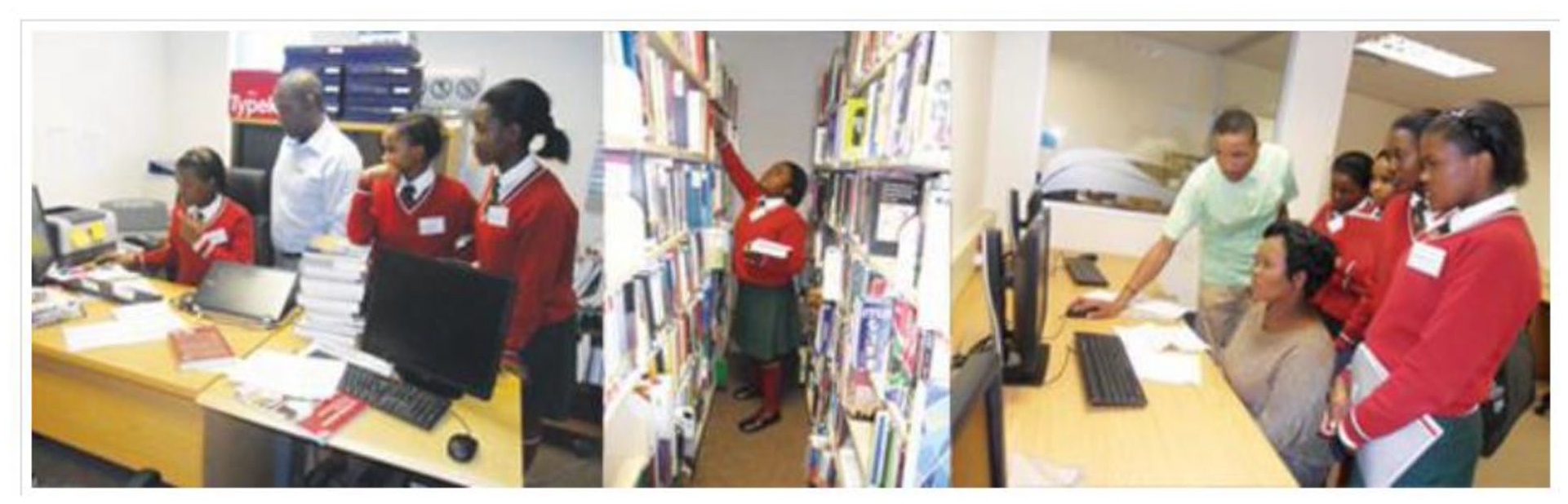
School girls visited UNISA’s Rustenburg Library Branch as part of the ‘Take a Girl Child to Work’ initiative (Source: Rustenburg News, 2013).
Collection and donation of sanitary towels
According to Crankshaw et al. (2020), many learners in South Africa do not have adequate supply of sanitary pads when on their periods. Results of this study show that some academic libraries have now taken up this issue and are contributing to this challenge.
Responses of library heads
Thirteen LHs asserted that their libraries have participated in collection and donation of sanitary towels to schools. This was done either as an on-going project or occasionally. Five university libraries collect sanitary pads and donate to learners when they visit schools to set-up libraries while four others treat the project as an on-going project of the library. The rest participate when the university or one of the academic departments or faculties within the university requests them to do so.
According to LH 8, not having sanitary towels can have far-reaching consequences for female students and learners which may result in them eventually dropping out of school. Providing them with the sanitary towels demonstrates that the library cares about their plight. This in turn will address gender inequality, gender-based violence and other social ills afflicting women in South Africa in the long run.
In support of collection and donation of sanitary towels for donation to learners’ initiatives, LH 7 stated: ‘the person who wants to get involved, the librarians, they identify a need in the community and decide to engage in initiatives that are meant to address that need. The sanitary towels project is a good example of this’.
However, the projects faced sustainability challenges when COVID-19 hit. LH 6 stated: We also have a sanitary towels project in the library, it only stopped because of COVID-19. . . so yes certainly, COVID-19 is a challenge.
Responses of librarians
In agreement with LHs, three focus group participants stated that their libraries are involved in some form of sanitary towels projects. Accounts from Focus Group 3 discussion relayed humble beginnings of a sanitary towels project in an academic library.
According to the Librarians, this started when library staff at the circulation and reference desk noticed a pattern where female students made requests for sanitary towels from female staff members. Upon realising that this was becoming a norm, they decided to start a project wherein all university staff members could contribute. The response was so good that they ended up also donating to local schools.
Librarians also identified COVID-19 as a challenge for sanitary towels projects. Focus Group 4 participant articulated the challenge as follows: ‘When COVID-19 hit we had planned to donate sanitary towels to three high schools around our university. This only stopped when COVID-19 came. . . it was going to be an amazing experience for us, it always is’. . ..
Figure 2 is a picture of happy high school learners after receiving sanitary towels from a university library.
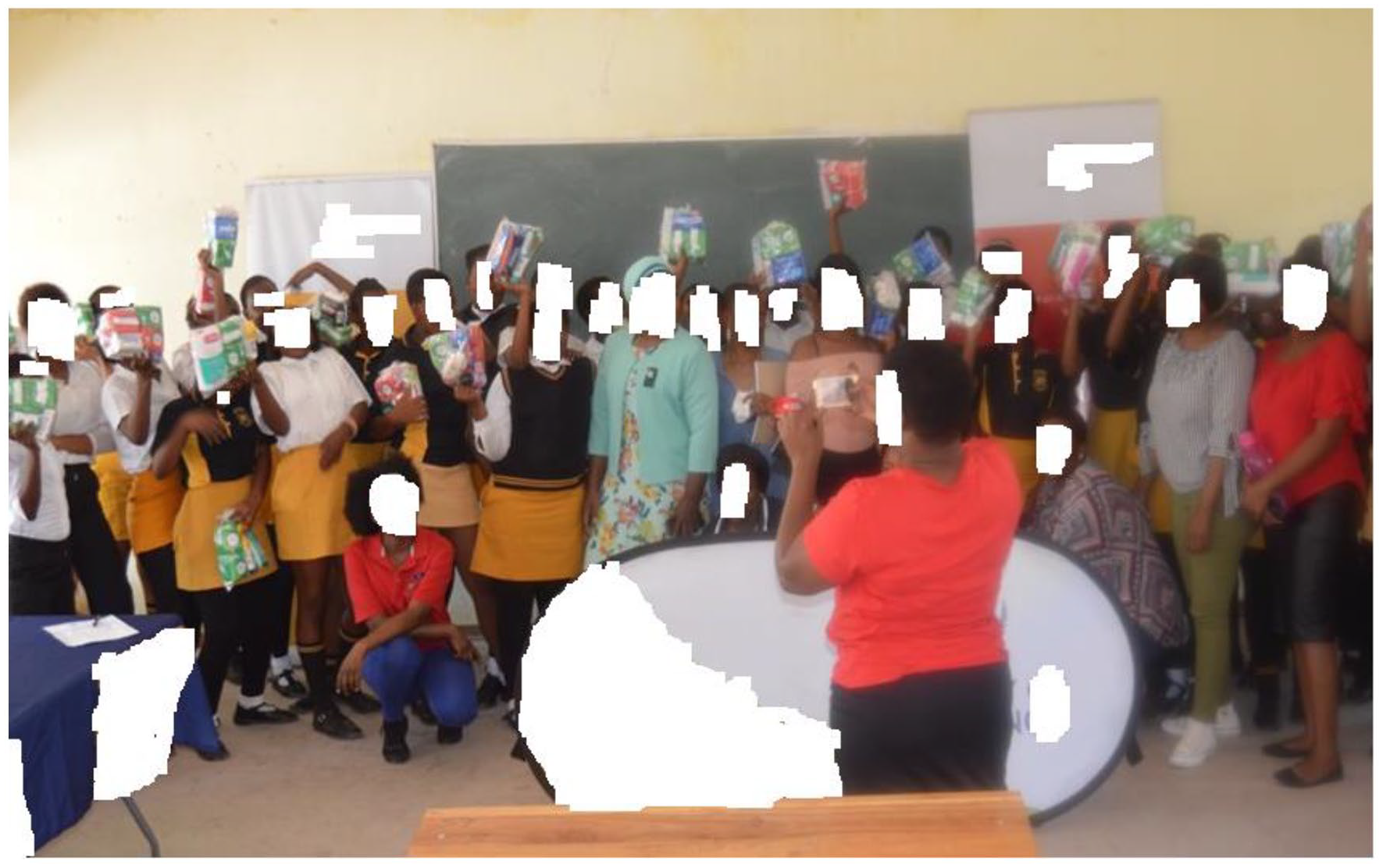
High school girl learners after receiving sanitary towels from a university library (Source: supplied by participant 2021).
Panel discussions, visits and displays that tackle women’s issues
Ifijeh and Osayande (2011) believe that exhibitions and displays can play a critical role in highlighting women’s issues particularly empowerment, abuse and the girl-child education.
Responses of LHs
Three LHs mentioned that their libraries set-up displays on women’s issues especially during Women’s Month. The aim of the displays is often to raise awareness about gender inequality and contribute to the gender empowerment agenda. According to LH 3, this is a way by which her Library ‘. . . puts women’s issues on display’.
Responses of librarians
Focus Group 7 also relayed that their library organised a public lecture that sought to empower women in abusive relationships during Women’s Month in August of 2018. The head of the Law clinic at the university was requested by the library to provide a public lecture in the library to a group of women that included community members, students and learners. As part of this public lecture, the library also organised a display that celebrated Women’s Month.
Focus Group 7 conceptualised the assistance given to women as follows: ‘we can get involved in making resources available to empower the community, you know, by giving people knowledge. I’ll give you an example, we organised a lecture, a public lecture during a Women’s Month, it was in 2018, I think. We asked the head of our law clinic (name) to deliver the lecture. . . we wanted him to show women that as a woman who is in an abusive relationship, you have rights . . . you are not alone, the law is on your side. Our law clinic can provide you with legal services free of charge’.‘
Figure 3 is a picture of a display during Women’s Month copied from a blog of a university library. The display sought to highlight GBV and acknowledge the role of women in academia.
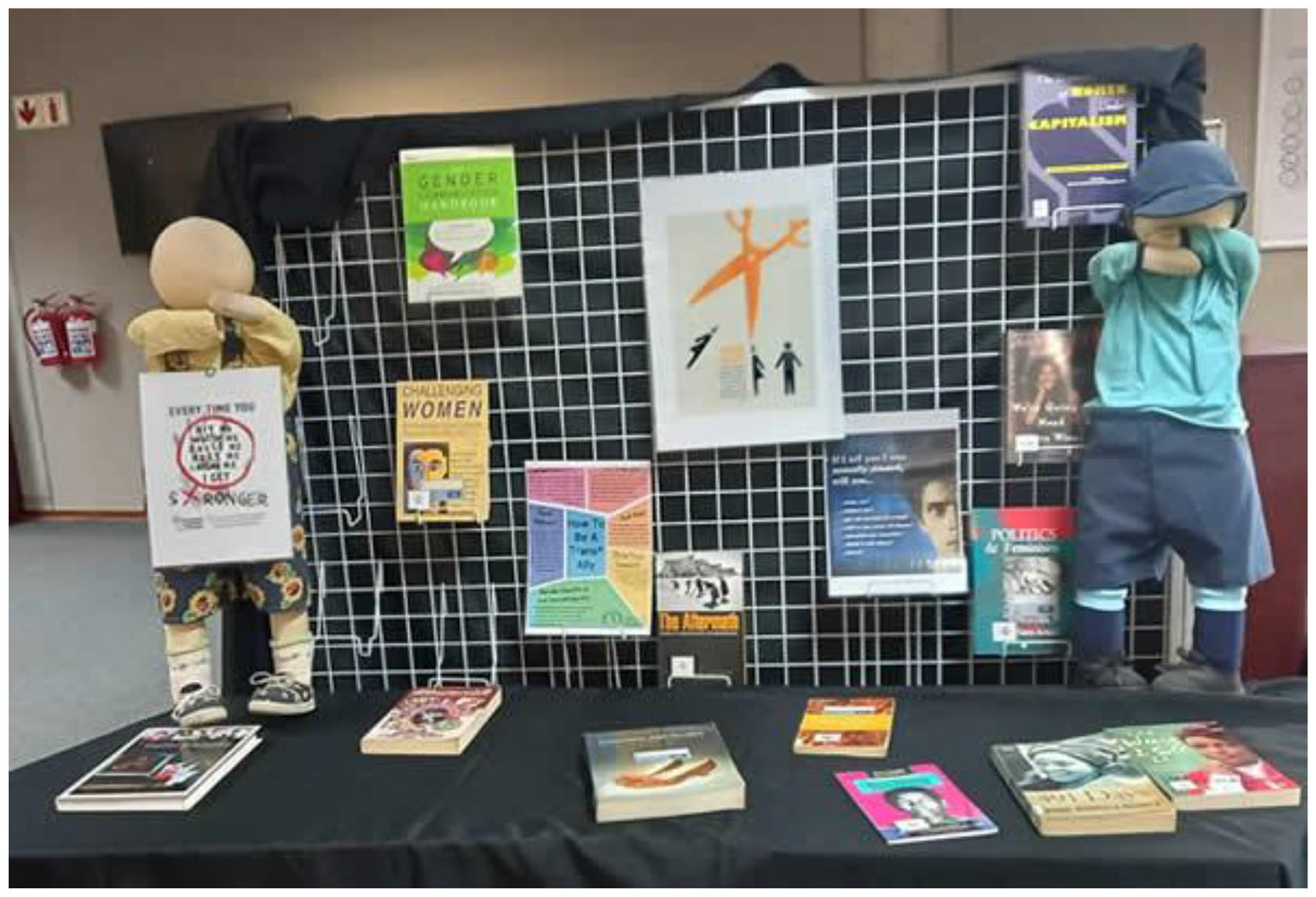
North-West University Library’s display during Women’s Month (NWU Libraries, 2021).
Discussion of the findings
LHs and Librarians viewed gender inequality as one of the major concerns of academic librarians in engaging in CE. Activities that were categorised under contributing to gender equality as shared by participants included visits to safe houses and correctional centres, involvement in Take a Girl Child to Work initiatives and collection and donation of sanitary towels to university students and high school learners. Libraries also hold panel discussions and displays that tackle women’s issues.
Visits to safe houses and correctional centres
Published research on academic library visits to safe houses and correctional centres remains scant although plenty of literature on the role of libraries on women empowerment and equality exists.
A poster by Cunningham (2008) focusses on serving survivors of domestic abuse while an article published in the Reference Librarian in 1996 by Dewdney et al. (1996) focusses on ‘Meeting the information needs of battered women’. Mashroofa (2022) exhorts academic libraries to demonstrate interest in activities that seek to reduce women’s social standing, to close the gender inequalities and empower women.
Other studies show that women face obstacles whether in refugee camps (International Federation of Library Associations and Institutions, 2017), prisons and correctional centres (Asiimwe and Kinengyere, 2011; Mataranyika and Mlalazi, 2016), as LIS professionals (Mbambo-Thata et al., 2019; Vijayakumar and Sheshadri, 2019) or in everyday life (Atuase, 2018; Izah, 2021)
Atuase (2018) holds that academic libraries can play a critical role in gender equality and empowerment by providing women, including those in safe houses, with relevant information resources as well as to inform, educate and train them to realise their full potential. Although Atuase (2018) does not indicate the initiatives taken by her participants, the participants argued that they have responded to developmental needs of women.
In agreement with Atuase, while studying the role of libraries in the empowerment of women inmates in Uganda, Asiimwe and Kinengyere (2011) concluded that the libraries empower the women, keep them informed and provide them the confidence to face the world.
In the case of Zimbabwe, Mataranyika and Mlalazi (2016) hold that Zimbabwean prisons are faced with shortage of sanitary towels for female offenders who rely on their families for these hygienic products. In this environment, offenders whose families cannot afford to visit them or buy sanitary towels often struggle when their menstruation periods came. The University of Zimbabwe Library decided to donate sanitary towels for women incarcerated at Chikurubi Maximum Prison. The authors maintain that the donation was well received by the authorities of this prison and the beneficiaries.
In South Africa, Mojapelo and Modiba (2021) encourage academic libraries to play a role in activities that contribute to women empowerment. Earlier in 2019, UNISA Kwazulu-Natal librarians showed solidarity with female offenders in the Westville Prison near Durban. As part of National Book Week and International Literacy Day, UNISA students in this Correctional Centre were offered Information Literacy training to make their study process easier (Pillay, 2019).
Plenty of information exists to showcase academic libraries’ concern with gender issues. In the case of South Africa, Pillay (2019) provided some evidence of UNISA Library showing solidarity with female offenders. Regarding CE activities in solidarity with institutionalised women, therefore, the results of this study corroborate literature although no evidence could be found of academic libraries visiting safe houses specifically.
Contribution through work and internship
The findings reflected that at least one South African public university library supported women through working with an NGO that provides internship opportunities to women.
Although it proved difficult to find literature on libraries specifically affirming women through internships as is the case in this study. There are examples in published literature where academic libraries affirmed the other marginalised and under-represented groups. A report prepared for the Association of College & Research Libraries (ACRL) and latter submitted to the 1990 ALA annual conference provided evidence of affirmation of minority groups in academic librarianship (Beaudin et al., 1990). The report suggested that a deliberate effort be made by university libraries to recruit from these groups including by offering internships and skills development programmes. In response to this, Díaz and Starkus (1994) revealed a successful 2 year internship programme for minorities carried out at the Ohio State University. The aim of the programme was to contribute to increased representation of minority groups in academic librarianship. However, as can be discerned, this programme targetted Library and Information Science graduates only.
Regarding provision of work opportunities for women, the results of this study could not be confirmed owing to insufficient literature.
Involvement in Take a Girl Child to Work programme
Libraries of all types are concerned with the predicament of girl children (Elisha, 2006; Ifijeh and Osayande, 2011; Jatto et al., 2014). Jatto et al. (2014: 5) cites Ademola (2006) and Atoyebi (2005) to indicate that girls face many socio-economic and cultural impediments including being denied decent education and work.
Elisha (2006) and International Federation of Library Associations and Institutions (2020) believe that providing quality education to girls is one of many ways for empowering the girl child. Sadare et al. (2022) conceptualised women and girl empowerment as the provision of equal opportunities for this marginalised group in education, economic activity, political space and leadership. While focussing on public and school libraries, Ifijeh and Osayande (2011) identify lack of role models as one of the reasons why many girl children struggle in life. Exposure of the girls to role models is therefore one of many ways of encouraging the girls to remain focussed and combatting social exclusion (Ifijeh and Osayande, 2011; International Federation of Library Associations and Institutions, 2020).
According to Maepa and Marumo (2016) the National Library of South Africa (NLSA) participates in the annual Take a Girl Child to Work initiative. The scholars state that during the day, they invite girl children to shadow NLSA’s staff members to learn about the different operations of the library. Maepa and Marumo maintain that through this initiative, girls are empowered and exposed to new career paths, and to the world of work. Sadare et al. (2022) refer to this as exposure to real-life work situations.
An article published in Rustenburg News (2013) (See Figure 1) confirmed that UNISA’s Rustenburg Branch Library was also involved in Take a Girl Child to Work programme. The article reports that girls from the President Mangope Technical High School were hosted at the UNISA Regional Hub in Rustenburg in 2018. Among the spaces that they visited was the library where they were also given a presentation about library careers.
Literature confirmed that although academic libraries all over the world are concerned with the plight of girls, the Take a Girl Child to Work initiative is uniquely South African. Only two reports could be found in the country that provide evidence of libraries participating in this initiative although numerous participants highlighted participation in this initiative as one of their contributions to CE. Literature, therefore, confirms the results.
Collection and donation of sanitary towels
Majola (2019) warns that due to lack of sanitary towels, menstruation period may have adverse effects to girls’ school attendance and lead to eventual high dropout rates. This in turn leads to a vicious cycle of gender inequality and gendered socio-economic challenges. Oloo (2010) believes that lack of sanitary towels can lead to high ‘rates of absenteeism, low self-esteem and poor performance and participation in extra-curriculum activities in school for the girl child. Majola (2019) adds that a lack of sanitary towels for girls is a human rights issue as the girls may be denied their rights to education, human dignity, equality, bodily integrity and reproductive health care. While referring to a United Nations report, Majola stated that 10% of girls in Africa miss school as a result of a lack of access to hygiene products.
However, a study conducted by Haberer (2018) provides a glimmer of hope. Girls involved in Sexual Violence Initiative in Schools programme were not missing school during their menstrual circle but faced other challenges such as shame and embarrassment. However, it was not clear if these results could be generalised to the rest of South Africa.
To deal with the problem of lack of sanitary towels and to empower girls, several academic libraries internationally (Kearns, 2021; Qian, 2021; Student News Team, 2021), other African countries (Brand, 2017; Mataranyika and Mlalazi, 2016) and South Africa (Linden, 2020) are involved in initiatives to collect and distribute sanitary towels to university students and school learners.
Internationally, in Ireland, the University College Dublin (UCD) Library provided free sanitary products for students to ‘tackle period poverty’ and to ensure that ‘no one should have to go without sanitary products’ (Kearns, 2021). Tampons and pads were provided at two campuses of the UCD Library for the benefit of the students. Similar outreaches were done at Manchester University Library in UK (Student News Team, 2021) and University of Stirling Library in Scotland (Qian, 2021). Interestingly, unlike their African counterparts, none of the overseas university libraries seem to have been involved in any distribution of sanitary towels to learners in schools preferring to focus internally on the universities.
In South Africa, a report from the University of Fort Hare’s website shows that the UFH Library is involved in a ‘Sanitary Towel Outreach Project that seeks to ensure no female student misses class due to a lack of access to sanitary towels’ (Linden, 2020). Initially the project was meant to support UFH’s female students but it grew to where the UFH Library now donates sanitary towels to schools around the university.
Literature showed that academic libraries are concerned with the education of the girl child. One way they contribute to her education is through provision of sanitary towels. This was confirmed by news reports and websites. However, it was interesting to note that university libraries elsewhere tended to focus on their student population while those from Africa also distribute the towels to the schools and other institutions around the university.
Panel discussions, visits and displays that tackle women’s issues
Even though many participants of the study stated that they contribute to CE through panel discussions, public lectures, displays and exhibitions to highlight women’s issues, published literature is scant around this area. This was supplemented by information from websites which confirmed participants’ narratives.
The Internet provides numerous examples of academic libraries who facilitate discussions and use displays and exhibitions to highlight women’s struggles and achievements. These include the University of Edinburgh Library and University Collections (2018) in UK, University of Bath Library (Reilly, 2018) in UK, Queen’s University Library (2022) in Canada, Harry C. Moore Library in The Bahamas (International Federation of Library Associations and Institutions, 2020) and University of Johannesburg and UNISA Libraries in South Africa (Pillay, 2019; University of Johannesburg Library and Faculty of Science, 2021).
The University of Edinburgh Library and University Collections (2018), Bath Library (Reilly, 2018) and Queen’s University Library (2022) provide examples of exhibitions held in celebration of International Women’s Day.
Beyond exhibitions, International Federation of Library Associations and Institutions (2020) suppose that libraries can serve as partners from where women’s struggles and opportunities are discussed.
IFLA provides an example of the Harry C. Moore Library of the University of the Bahamas which played host to the 2018 International Women’s Day Forum. Discussions focussed on the opportunities and challenges faced by rural women and girls.
In South Africa, as part of celebrating International Women’s Day, UJ Library partnered with the University’s Faculty of Science to host a Zoom discussion on behalf of UJ Women’s Forum (University of Johannesburg Library and Faculty of Science, 2021). A prominent woman speaker was invited to deliver a public lecture under the hash tagged theme #CHOOSETOCHALLENGE. The North-West University Library and Information Service reported physical displays (see Figure 3 above) across the three campuses of the university to celebrate Women’s Month in August 2021. The displays sought to create awareness about GBV and to celebrate the contribution of women in academia. Through these displays, the library also highlighted the importance of empowering women and girls.
Although some exploratory studies have been published around SDG 5 and academic libraries, very few provide empirical evidence of the contribution of these libraries to this SDG. Further most studies tend to focus on contribution through traditional roles of academic libraries, which are teaching, learning and research support. This study assessed community engagement initiatives of South African libraries and found that some of them can be interpreted as a contribution to SDG 5.
Conclusion
This study examined the contribution of academic libraries to SDG 5 on gender equality through community engagement. The results showed that many libraries in the country are involved in activities that seek to address women’s issues including visits to safe houses and female correctional centres, contribution to work and employment of women, involvement in Take a Girl Child to Work initiatives and collection and donation of sanitary towels to university students and high school learners. Many libraries also shared accounts of holding discussions and displays especially during the Women’s Month celebrated annually in August of each year in South Africa. However, in many instances there was scarcity of literature to properly compare these results.
The fact that libraries target women’s issues, such as by empowering them with the Take a Girl Child to Work initiative and the sanitary towels’ projects is testimony to their commitment to social justice and redress as observed by several participants. Not only does the collection and donation of sanitary towels contribute to SDG 5 but also to SDG 4 which seeks to eliminate gender disparities in education. This is because lack of access to sanitary towels can have far reaching consequences for female students/learners which can result to them eventually dropping out of university or school. When a library provides them with sanitary towels, the female students/learners can see that the library cares about their plight and in a way this ensures that they unashamedly attend school (Haberer, 2018). This motivates them to work hard and complete their studies which will in turn contribute to addressing gender inequality, gender-based violence and other social ills afflicting society in the long run. The results demonstrate that similar to their prison (Asiimwe and Kinengyere, 2011), national (Maepa and Marumo, 2016), school (Elisha, 2006) and public (Jiyane and Mostert, 2008) libraries cousins, academic libraries are not only affected but also concerned about gender equity and redress issues and participate in programmes that seek to contribute to the educational, hygienic, socio-economic and cultural needs of women.
Furthermore, these results showed that besides issuing a statement to decry high levels of GBV and femicide in the country (Crowster, 2020), the voice of LIASA and other library bodies in South Africa is generally missing on gender equality, empowerment and redress debates. This is somewhat surprising as the library profession in the country is dominated by women (Crowster, 2020). This study, therefore, serves as a call for library bodies, such as LIASA and CHELSA to generate and support programmes that seek to advocate for and/or empower women and girls. These results affirm the contribution of academic libraries to the SDGs through CE. The results demonstrate that CE can help academic libraries to contribute to a wide range of SDGs beyond those that traditionally fall within their ambit such as SDG 4 on quality education. This study provides fresh insights on the contribution of academic libraries to SDG 5 through CE. Given that the phenomenon of CE is itself a fairly new area of study in academic libraries, the study will add value to theory in this niche and the topic is of interest to international audiences.
Footnotes
Declaration of conflicting interests
The author declared no potential conflicts of interest with respect to the research, authorship, and/or publication of this article.
Funding
The author received no financial support for the research, authorship, and/or publication of this article.
