




Abstract
This paper reports on academic libraries’ Community Engagement (CE) initiatives in South Africa and outline their potential to contribute to the actualisation of three Sustainable Development Goals (SDGs 2, 3 and 13). The research approach adopted was qualitative using online interviews with 20 heads of libraries in South Africa and eight online focus group discussions with library staff as data collection methods. It was found that South African academic libraries’ CE initiatives can be successfully mapped out against the Sustainable Development Goals (SDGs). The results showed that through CE, academic libraries in South Africa play a role in addressing hunger, improving health and well-being and contributing to climate action, among other SDGs. CE, therefore, can play a role in SDGs that fall outside of academic libraries’ traditional teaching, learning and research support role. These results will serve as a call for academic libraries to consider participating in CE in order to contribute to development areas that they do not normally contribute to directly. This study provides unique insights on the contribution of academic libraries to SDGs. As a recommendation, academic libraries should consider mapping their CE initiatives against the SDGs.
Keywords
Introduction
Sustainable Development Goals (SDGs) are variously described as a ‘global plan’ (Ma and Ko, 2022), ‘a shared blueprint’ (Thorpe and Gunton, 2022) and ‘a framework’ (Missingham, 2021). They seek to address negative trends by improving the quality of life of people across the globe including through ending poverty and food insecurity, provision of better healthcare for all and reduction of bad environmental practices that lead to climate change.
Libraries worldwide are concerned with their role to the SDGs (International Federation of Library Associations and Institutions, 2015, 2021; Mansour, 2020; Mathiasson and Jochumsen, 2022). This is evidenced by the American Library Association (2020a) which formed a Task Force on SDGs that sought to increase participation by libraries in efforts to achieve the Sustainable Development Goals. In addition, the American Library Association (2019) added ‘sustainability’ as part of its core values. Mathiasson and Jochumsen (2022) cite Pinto and Ochoa (2018: 46) as stating that although there is a distinction between ‘sustainability’ and ‘sustainable development’ these concepts are often used interchangeable in the context of libraries. According to Mathiasson and Jochumsen (2022), the interest to SDGs in libraries has grown exponentially over the last few years. One strategy often used by libraries to contribute to SDGs has been through community engagement (CE) (Bangani, 2022, 2023; Ma and Ko, 2022). In the context of this study, CE refers to ongoing networks, partnerships and relationships formed between university libraries and the communities and utilised to collectively deal with societal problems (American Library Association, 2020b). However, the interest of this study is not on the actual social networks and partnerships but on the eventual products of those partnerships and how these can be mapped out against the SDGs. Thorpe and Gunton (2022) support the practice of mapping out academic libraries’ activities against the SDGs.
The focus of this study is on South African academic libraries where CE is understood as a means by which public universities express their social responsibility and a vehicle for addressing social justice issues (Shawa, 2020). The legislative framework of the country mandates public universities to contribute to CE (South Africa, 1997). In addition, the South African National Development Plan (NDP) looks up to universities to address negative trends such as low levels of employment, poverty, illiteracy, poor healthcare, environmental challenges and other social ills (National Planning Commission, 2011). As a result, South African universities have adopted CE as a third mission (Bhagwan, 2020). Elsewhere, CE is called community outreach (Houk et al., 2019).
As intellectual and physical centres of higher education institutions, academic libraries in the country have also responded by adopting CE as a way of contributing to the strategic agenda of their parent institution (Nkondo et al., 2014). CE is viewed as processes and activities that culminate in a better understanding between academic libraries and their immediate communities (Buwule, 2019).
Despite the emergence of CE as one of the strategic imperatives of various university libraries in the country, no study could be found that sought to audit the extent of involvement of these academic libraries in this phenomenon and few have tried to delineate whether the existing activities align to the national and international development agenda (e.g. Bangani, 2022). This study, therefore, seeks to develop an understanding of how South African academic libraries’ CE initiatives contribute to the development agenda, particularly zero hunger (SDG 2), good health and well-being (SDG 3) and climate action (SDG 13). It is not always obvious how libraries contribute to these SDGs. However, great alignment between these SDGs and CE initiatives of academic libraries in South Africa was noticed in this study. It must be pointed out that these also have an uncanny resemblance to some of the country’s NDP aspirations. The specific objective of this study is to: outline the potential contribution of South African academic libraries’ CE initiatives to the actualisation of SDGs 2, 3 and 13. In the context of this study, CE and outreach are used interchangeable without any regard for the distinction that exists between the two concepts.
Literature review
Academic libraries’ contribution to food security
Despite the common perception that university students are an elite group that is immune from the everyday problem of food security, in some instances it has been found that the average levels of food insecurity are higher among students than the national averages (Adeniyi and Durojaye, 2020). Food insecurity among students could potentially lead to adverse effects for their physical, mental and health wellness (Payne-Sturges et al., 2018). It may ultimately lead to high dropout rates (Wood, 2020). In order to deal with students’ food insecurity, universities have embarked on initiatives to address hunger on campuses (Adeniyi and Durojaye, 2020). A study at the University of the Free State reflected that 60% of students were food insecure while the University of Kwazulu-Natal had a lesser percentage of hungry students at 44% (Sabi et al., 2020).
Wood (2020) believes that academic librarians cannot ignore food insecurity among students as it ultimately undermines their work. Wood (2020) narrates that at the California State University-East Bay, the library provides a snacks and drink kiosk ‘where students can pick up healthy snacks and beverages in the evening’ without needing to identify themselves. This service is used to supplement the primary food pantry which closes early. Wood (2020) comments that in some universities the primary food pantry is housed in the library.
Academic libraries are also used as drop-off and collection points for food donations for the vulnerable groups such as the homeless people. At the Western Sydney University, for example, a call was made for donation of items to be dropped off at various campus libraries of this university (Gatt, 2018). The Merrimack College’s McQuade Library partnered with a farm to produce fresh food that was latter distributed to the College and surrounding communities (Wong and Scannell, 2016). Charney (2017) reported an initiative of the Chinese University of Hong Kong (CUHK) Library that sought to contribute to organic food production and greening of the library by collaborating with a green charity Non-Government Organisation (NGO) to create an organic rooftop vegetable garden in the library. This led to interest from librarians as 40 of them participated in the project.
In Nigeria, the Federal University of Technology, Library, Owerri (FUTO), decided to focus their attention to farmers, as primary producers of food. The library purchased cassava seeds and distributed to local farmers for plantation (Mbagwu et al., 2020). Mbagwu et al. (2020) maintains that this CE initiative strengthened the relations between the university and the host community which were not always cordial. According to Mataranyika and Mlalazi (2016), as part of its CE initiatives at the Copota School of the Blind, University of Zimbabwe also donated foodstuffs for the children.
Evidence of contribution of academic libraries to food security initiatives remains anecdotal in South Africa. The 2019 University of Johannesburg Library Annual report reflects that the Library was involved in a Food Drive Project, where foodstuffs were collected, prepared and donated to students during International Mandela Day. Further, the Library provided muffins to students during exams. At the North-West University Library and Information Service (2021), the library donated foodstuffs towards the university’s Meal-a-Day initiative, which was an initiative of the university towards contributing to food security of students. The 2017 annual report of the Stellenbosch University Library and Information Service (2018) mention the library’s ‘donation to, and help with making sandwiches for, the Toasties for Tummies drive as part of the Mandela Day celebrations’. The University of Pretoria Library donated 313 jars of dry soup ingredients and clothing to flood victims at Eerste Fabriek in 2019 (Mothutsi, 2019). At the Sefako Makgatho University Library, money was collected from staff to buy non-perishable food items which were ultimately donated to the Itireleng School for the Blind (Library and Information Association of South Africa, 2017). The library was also involved in cleaning the lecture halls to ensure that they are in good condition. University of the Free State librarian, Coetzer (2018) reported that her library and presumably the Central University of Technology Library participated in a CE project at the Bainsvlei Combined School in Bloemfontein as part of the LIASA delegation. Fresh vegetables and spinach seeds were donated to the school and the soil was prepared for the cultivation of vegetables.
COVID-19 lockdown exacerbated food insecurity (Arndt et al., 2020). Louw and Bici (2019) cite what Lenstra and D’Arpa (2019) called food justice, to justify the involvement of the University of the Western Cape (UWC) Library in an initiative that sought to address food insecurity amidst the COVID-19 lockdown. According to the authors, UWC librarians were involved in ‘feeding children, street dwellers, and the vulnerable groups. . .the elderly and waste pickers. . . in areas such as Cape Town, Klapmuts, Kraaifontein, Observatory, Salt River, Table View (Killarney) and Woodstock’. The authors are adamant that the UWC librarians’ contribution was in line with United Nations’ Sustainable Development Goal 2 on Zero Hunger pointing to the intentionality of this project towards contributing to this SDG.
Academic libraries’ contribution to good health and well-being
Engagement through health and wellness promotion is one of the most common ways by which libraries engage in CE. For example, in the case of United States, German and LeMire (2018) maintains that libraries affiliated with Association of College and Research Libraries target health professionals by promoting health information literacy and encouraging people to join health related careers. This was confirmed by several other studies including Duhon and Jameson (2013), Houk et al. (2019), Musoke (2020), Peñaflor and Labangon (2021), among others.
In Uganda, university librarians from Makerere University also provided health information literacy sessions as a form of assistance to health workers including nurses and doctors as a CE activity (Musoke, 2020). The project involved a team of medical experts and health librarians at the University. Among its aims was to raise awareness, especially about the most prevalent diseases in Uganda, and to foster lifelong learning among the participants. In the case of Kenya, the Kenya Methodist University offered health information literacy to the communities around the university in an intentional effort to assist them make informed health decisions (Kamau and Gichohi, 2018). The authors observed that the CE initiative fostered health development.
Another way by which academic libraries contribute to good health and well-being is through running blood donation drives. These include motivating staff and students to donate blood. According to Zanin et al. (2016) people who donate blood are often driven by altruism and a genuine desire to contribute to the well-being of the society. Peñaflor and Labangon (2021) is among a few academic studies that provide evidence of contribution of university libraries to blood donation drives and activities. According to Peñaflor and Labangon, the Universiti Brunei Darussalam Library partnered with their local medical centre for a blood donation drive in the library as part of its CE programmes. Other libraries who report blood donation drives on their websites include Duke University Libraries (2020), Colfax Library (Giomi, 2021), Morris Library (Mathis, 2010), Ohio State University Libraries (2021), Thompson Library (Perkins, 2022) and Briscoe Library (Soria, 2021).
Academic libraries’ contribution to environmental issues and climate action
Libraries are also involved in environmental literacy initiatives. Studies in this area include Abiolu and Okere (2012), Albertyn (2020), Kurbanoğlu and Boustany (2014) and Oyelude and Alabi (2013). According to Kurbanoğlu and Boustany (2014), academic libraries can contribute to environmental literacy through embedding sustainable thinking in information literacy. This includes embracing green practices in IL training by limiting the distribution of printed flyers and training materials and by printing only on demand, using both sides of paper or using recycled paper. Another way is to use search terms that are aligned to green practices during IL training sessions.
In Nigeria, Oyelude and Alabi (2013) exposed low levels of environmental literacy in that country. Despite many challenges, Abiolu and Okere (2012) charges librarians to be innovative, collaborate with other community groups and NGOs and work towards building and maintaining an environmentally literate citizenry. Akpom et al. (2020) reports that in response to the low levels of environmental literacy, Nigerian university librarians contribute to climate action issues. This is in line with IFLA’s stance which supports activist librarians in climate action through the IFLA Green Library Award (International Federation of Library Associations and Institutions, 2020). The librarians create awareness about environmental sustainability and support educational programmes to increase the literacy levels of the Nigerian communities.
In Kenya, Serbia, Ukraine and Egypt libraries are involved in initiatives that seek to promote environmental literacy among school children (Charney, 2017). This involves educating the communities through various activities including films, exhibitions, monthly lectures, poetry readings and websites, among others. In the case of Egyptian public libraries, Mansour (2020) mentions climate awareness seminars as among the methods by which libraries seek to promote environmental literacy.
The North-West University Library and Information Service (2017) in South Africa was requested by one of the high schools to assist its Grade 11 learners who were working on an ‘Environmental Sustainability Project’ research paper in 2017 for the South African Research Institute on Regional and International Issues (SAIIA). SAIIA is described as ‘an independent public policy think tank advancing a well-governed, peaceful, economically sustainable and globally engaged Africa’. In this instance, the library assisted the learners with information sources, format of the papers as well as the bibliography.
Libraries have shown awareness of the association between high levels of carbon footprint production and climate change (American Library Association, 2020a). As such, they have resorted to using their community engagement initiatives to contribute to recycling and greening activities. According to Haggith (2018), recycling does not only save paper but also reduces the need to cut down trees leading to a greener world. The paper industry consumes a lot of water. Reduction of paper, therefore, can save another scarce resource which is fresh water. Rowley (2006) further identifies recycling of IT-related resources as another way by which libraries can contribute to the management of waste.
A United States study by Rickert (2001) found that the majority of US academic libraries were recycling paper and cartridges at the beginning of the 21st century. Another study conducted by Fisher and Yontz (2007) cites Alpi (2000) as indicating that as early as 1990, the majority of science and technology libraries in US were involved in recycling paper and cardboard. As an example, the Michigan State University Library is involved in recycling, composting and deaccessioning books (Granger, 2017). Morris Library is among a few libraries that formed a recycling/environmental task force to coordinate recycling efforts in the library (Calloway and Callahan, 2003). The efforts of this task force led to the recycling of paper, magazines, cardboard, plastic, glass, aluminium, books, among other items.
In Australia, Hall and Prendergast (2021) state that the Flinders University Library is involved in several recycling initiatives including that of bread tags, paper, soft plastics, e-Waste, batteries and pens. The library is also involved in composting activities.
However, participation in recycling activities is not universal. In China and Nigeria, Kang (2020), and Oyelude and Alabi (2013) found that academic libraries discarded their old electronics and furniture without any regard for its impact on the environment. These were not recycled or distributed for reuse. Oyelude and Alabi (2013) further commented that there were low levels of recycling of paper and ink cartridges in Nigeria while Kang (2020) was concerned with the low levels of awareness about recycling activities by library directors in China.
In South Africa, both the Universities of Cape Town (UCT Libraries, 2021) and Stellenbosch University libraries (Stellenbosch University Library and Information Service, 2018) reported to be involved in recycling of bread tags and bottle tops initiatives. The former reported this in a tweet sent in December 2021 while the latter reported this in their 2017 annual report.
In a nutshell, some evidence in literature exists that academic libraries use their CE initiatives to contribute to the actualisation of SDGs 2, 3 and 13. However, most of these studies emanate from the Global North, especially from the United States. The focus of most studies is on single cases, and they usually highlight one activity. Studies in this area also tend to be exploratory rather than empirical meaning that there is a huge scholarly gap in this area. This study has a broader scope as it covers academic libraries in the whole country and the focus is on all CE initiatives that contribute to the actualisation of these SDGs. Unlike many previous studies, this study is empirical. In general both CE and the libraries’ contribution to SDGs is not well researched. This study therefore will contribute to two areas that are not yet well theorised and researched.
Methodology
This is a multi-methods qualitative research study which used online interviews with Library Heads (LHs) and online focus groups discussions with Librarians as data collection methods. These two methods were complemented by the review of literature. The target was all public university libraries in South Africa of which there are 26 of them, each with a library head. Sampling procedures followed were census for LHs and snowball sampling for library staff. In the end, 20 LHs were interviewed and these were complemented by eight focus group discussions with library staff members.
Regarding the research procedure, LHs from all 26 public university libraries in South Africa were invited to participate in the study via e-mail in June 2021. Ultimately 20 LHs agreed to be interviewed via MS-Teams and Zoom, in one instance. Nineteen interviewees agreed to be recorded and the interviews were automatically transcribed using MS-Teams and Zoom automatic transcription features. To achieve reflexivity, the researcher kept a notebook noting his thoughts and feelings about the research process as well as critical insights from the interviewees and participants.
After the interviews, eight focus group discussions via MS-Teams were held with librarians. Thirty-three Librarians participated. In both instances (interviews and focus group discussions), interview guides with seven sections were prepared and used. The results reported in this study fell under Section C of both interview guides which dealt with approaches to CE initiatives which followed after Sections A and B which dealt with the general view of CE by the participants and institutional commitment of the various libraries to CE, respectively. All online interviews and focus group discussions were carried out between July and December 2021, except one interview which happened in February 2022 owing to inexplicable delays in granting permission for collecting data from the university concerned.
This part of the study stemmed from a question asked from both the LHs and Librarians during online interviews and focus group discussions, respectively. The question requested the participants to outline some of the CE initiatives/programmes that their libraries worked on. The follow-up to the question wanted the LHs and Librarians to share whether their CE initiatives contributed in any way to the SDGs. On this question, interviewees and focus group participants were able to provide adequate insights without much probing.
In preparation for data analysis, the interviewer and research assistant listened afresh to the interviews and the transcripts were corrected, where necessary. When the researcher was happy with the quality of the transcripts, these were then uploaded onto ATLAS.ti. The researcher went through each transcript and identified themes and sub-themes according to the objectives of the original study. Of the 13 themes generated under Section C of the interview guides, three fell under food and security, good health and well-being and climate and environmental issues.
Data was then presented in the form of narratives and verbatim quotations from the participants. It must be noted that in providing consent for their staff to be interviewed, universities requested that they and their staff’s names be anonymised in line with the South African Protection of Personal Information Act of 2013. Therefore, in presenting the findings, the LHs and Librarians have each been allocated a number which corresponds with the sequence of the interviews and focus group discussions. Thus, LH 1 refers to the first LH to be interviewed while LH 20 is for the last one while Focus Group 1 refers to the first focus group to be held and Focus Group 8, the last.
Findings and discussions
This section is aligned to SDG 2, 3 and 13. These SDGs are the subject of this study. Figure 1 below is a visual depiction of the contribution of the university libraries to the three SDGs through CE followed by the discussion.
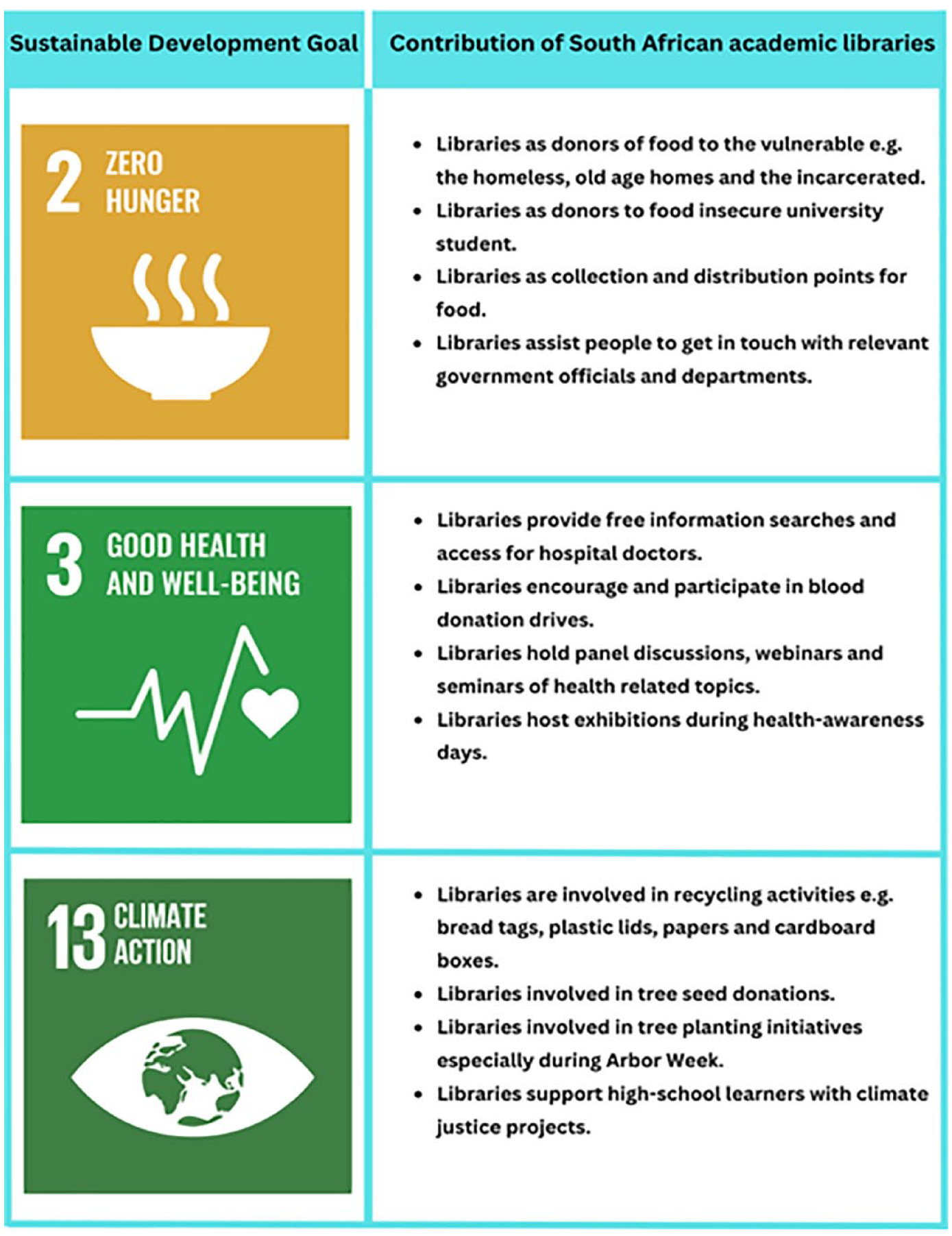
South African academic libraries’ contribution to the three SDGs through CE.
Contributing to zero hunger
South Africa is afflicted by high levels of food insecurity with more than 6.8 million people facing inadequate or severe shortage of food. This translates to close to 20% of households that either do not have food or have inadequate supplies (Statistics South Africa, 2017). Food insecurity is explained as the ‘situation when people lack secure access to sufficient amounts of safe and nutritious food for normal growth and development and an active and healthy life’ (Food and Agriculture Organisation of the United Nations, International Fund for Agricultural Development, United Nations Children’s Fund, World Food Programme & World Health Organisation, 2017). This means that for people to be considered food secure they must have access to daily supplies of adequate amounts of safe and nutritious foods ‘. . .that meets their dietary needs and food preferences for an active and healthy life’ (Food and Agriculture Organisation of the United Nations, 2008). In South Africa, food security is a constitutional imperative. Section 27(1)(b) of the Constitution of the Republic of South Africa enjoins the government of the country to ensure that ‘everyone has the right to have access to sufficient food’ (South Africa, 1996). Faced with this dire situation some academic libraries in South Africa use their CE initiatives to contribute to tackling hunger. Many vulnerable groups have been recipients of university libraries’ goodwill in relation to tackling food insecurity.
An interesting initiative reported by LH 13 is that of a library staff member who is passionate about the plight of homeless people. He often addresses them about the social challenges such as drug abuse. He uses his own funds to buy sandwiches for them to ensure that at least they eat something for a day. However, other willing staff within the library were encouraged to contribute to this project in solidarity with their colleague and the homeless people. In addition, another library donated money for food to a pre-school whose funds had runout due to parents losing jobs during the period of the COVID-19. Although this was a 3-month relief, it gave the pre-school enough time to recover.
Not only do libraries contribute to the food security of the homeless and pre-schools but also to that of university students. University students are not immune from the problem of hunger (Adeniyi and Durojaye, 2020). By some accounts, close to 30% of South African university students face starvation (Mthethwa, 2021). Three LHs cite this as the reason why they encouraged library staff to participate in initiatives that seek to address food insecurity among students. Contributions of academic libraries to these initiatives included donating food parcels to students who were holed up in residences during COVID-19 enforced lockdowns. However, COVID-19 affected some food-related CE initiatives negatively. Although LH 1 is proud of her library’s contribution to food justice. She commented that ‘In 2019, . . . we also donated food parcels. . . so we made donations to the people around the (university) area. So, we had intended in 2020 and this year (2021) to go back and do the same. . . but COVID-19 struck’.
In agreement with the LHs, members of two focus groups also shared accounts of donations by their libraries to initiatives that seek to alleviate the food insecurity for students. Additionally, a Focus Group 5 participant, shared a story of involvement to assisting the family of an elderly women who had lost a house. Upon realising this, the Librarian informed his colleagues and they decided to collect money among themselves to buy food parcels for the family although they realised this was not sustainable. The Librarian wrote a letter to South Africa’s Social Development Department to relay the plight of the family. As a result of his efforts, the family got a house and birth certificates were arranged for some of the family members to get social security grants. This was conceptualised as follows: ‘. . . sometimes we go the extra mile, we bought food parcels for this family of the elderly lady. . . it was for a number of months. The money came out of our pockets. . . but we realised that this is not sustainable, we also have our families to take care of. We could not assist on the issue of a house, so I wrote to various departments, municipality and business people. Fortunately, Social Development (department) responded and I am glad to report that the house was handed to the family a few weeks back and the birth certificates were organised for the children to be eligible for social grants. . . it is such a good feeling when you have contributed to alleviate the plight of a family, even if it is one family’.
This narrative aligns to Mansour (2020) who relayed that Egyptian public libraries often refer people to governments and charities for food security-related problems and issues. Similar to results in various literature (Charney, 2017; Mbagwu et al., 2020; Mothutsi, 2019), participants narratives demonstrated that university libraries contribute to food security programmes on campus as well as to the other vulnerable groups such as the homeless and the disabled. These libraries are used as both drop-off points and collection points for foodstuffs. Therefore, academic libraries in South Africa do not stand by when initiatives are being undertaken by the parent institutions to address food in/security issues. They also contribute to those initiatives to the benefit of the marginalised members of society. This demonstrates libraries that are in touch with their environment and that regards themselves as part of the solution to societal problems and that want to remain relevant through supporting all missions of their parent institutions including the third mission of community engagement.
Contribution to good health and well-being
Some of the CE initiatives shared by LHs and Librarians were categorised under health and well-being support and promotion. This is in line with Tringali (2021) who encouraged academic libraries to be involved in CE initiatives that seek to contribute to health and well-being. In this study, these included motivating staff and students to donate blood, providing assistance to hospital doctors through their medical schools and health libraries, holding public talks and panel discussions on health and well-being issues as well as exhibitions and displays in solidarity with those who suffer from certain ailments during health days.
LHs and Librarians identified the problem of shortage of blood which continue to persist in South Africa (Malange and Atia, 2021). Upon reading an article about the shortage of blood in 2017, some librarians from Focus Group 5 decided to embark on a drive to encourage university staff (including library staff) and students to donate blood. In solidarity, the Librarians themselves donated for the first time in their lives. This campaign has been on-going since then during the National Blood Donor Month and the Librarians have continued to donate blood. In South Africa, people who donate blood do so out of the goodness of their hearts without being paid. Therefore, this act is a demonstration of the altruistic nature of CE initiatives. Ferguson and Lawrence (2016) explain that blood donation is an altruistic act where the donor acts voluntarily, for the benefit of another at a personal cost. In fact, in most cases the blood donor does not even know who the recipient would be. Therefore, this shows the libraries’ resolve to contribute to the plight of the society without expecting material gain in return.
LH 4 further shared a CE initiative where the library invited a speaker from the Childline NGO to share insights on mental health issues. This was in response to COVID-19 which is said to have resulted to increased rates of mental health problems due to the high numbers of bereavements and general anxiety afflicting the population. The lecture was held via Zoom and open to members of the public and university. Parallel to this, LH 7 and Focus Group 5 ’s participants stated that their library organised a panel discussion on COVID-19 fake news. Participants maintain that attendance was widespread in both events with people from other African countries such as Zimbabwe and Namibia attending the sessions. Other presentations related to good health and well-being were held during the Breast Cancer Awareness Month and World Aids Day, among other days, at the university library headed by LH 3. This was to raise awareness about these conditions as well as to demonstrate solidarity with people infected and/or affected by these ailments.
CE done through holding panel discussions and exhibitions is not peculiar to South Africa. Studies such as Cox and Brewster (2020), Hall and McAlister (2021) and Thomas and Lovelace (2019) also report on similar CE initiatives elsewhere. Interestingly, Thomas and Lovelace (2019) reported that like their South African counterparts, the Marshall University Libraries held exhibitions and panel discussions about mental health issues. Hall and McAlister (2021) also found exhibitions on mental health issues as among the most common methods of health engagement in United States academic libraries. These serve to foster social cohesion and reduce the stigma associated with mental illness. Mental illnesses and the mentally ill are often stigmatised. By holding a panel discussion, this is a way of shinning a spotlight on the issue thereby contributing to the destigmatisation of people suffering from mental health illnesses.
Furthermore, two LHs (9 and 10) shared that since their medical schools are in partnerships with government hospitals and other health research NGOs, they entered into agreements through the Deans of the medical faculties to serve doctors affiliated with some of the public hospitals and health research NGOs. The doctors are mostly assisting with Work-integrated Learning for the universities’ students thus contributing to universities’ research and academic success. This has resulted to a situation where the public hospital and research doctors are registered clients of the academic libraries with full service. Initiatives of this nature point to the mutual beneficial nature of CE with doctors offering university students training while the latter opens their library resources for use by the doctors.
Contribution to environmental and climate action issues
Environmental issues are not only of concern to public libraries (Albertyn, 2020), academic libraries are also concerned with climate action resulting to global warming and other environmental challenges (Charney and Hauke, 2020). Several participants (LHs and Focus Groups) confirmed this assertion during interviews and discussions. According to both groups, libraries are involved in activities that seek to mitigate against the adverse effects of global warming. These include participation in waste management and greening activities and working with international NGOs to create spaces dedicated to environmental issues within the library. Activities mentioned by both groups include recycling activities (bread tags, plastic water bottles, plastic lids, papers and cardboard boxes), participation in tree planting, handing seeds to conference delegates and exhibitions, assisting high school learners with assignments that seek to address environmental concerns, promotions and displays during environmental promotion days.
While one LH mentioned that her library included assisting with dealing with environmental issues in their strategic objectives a few years back, six LHs mentioned being involved in the collection of bread tags and plastic lids to be submitted to one of two NGOs, Sweethearts Foundation (2022) and Bread Tags for Wheelchairs (2022). These are then sent to recycling companies and the money is used to buy wheelchairs. Individuals can apply for wheelchairs via the websites of the NGOs. South Africa is struggling to provide enough wheelchairs to cater for all people with mobility impairments (McIntyre, 2010), therefore the initiative does not only seek to deal with environmental factors but also social ones.
Other strategies meant to deal with environmental issues employed include encouraging staff to limit usage of paper. All meeting agendas and minutes were sent in soft copy and no staff member was allowed to print them out to decrease the use of paper. LH 9 utilised his electronic signature to sign most of the documents. Staff were encouraged to switch off all office lights when knocking off, among other strategies. In addition, the library played a leading role in convincing the university to recycle cardboard boxes and paper. LH 12 mentioned that they distributed seeds during some of the library conferences to raise awareness about environmental issues among the delegates. Regarding her library’s contribution to environmental issues, LH 13 mentioned that ‘we are involved in collecting bottle tops, you know these holders of bread, bread tags etc. We get involved in recycling, creating awareness’.
Librarians mentioned assisting learners with assignments that are meant to tackle environmental issues. Focus Group 6 shared that they sometimes help high school learners with environmental related projects and assignments. In these cases, the Librarians help with information provision, format of the paper and the bibliography. Librarians also confirmed involvement in recycling paper and boxes. In one instance they collect for the purpose of donating the paper and boxes to homeless people that are involved in recycling initiatives. That way they can assist them to raise money to buy food.
Nation Arbour Week (NAW) is a South African commemorative indigenous tree planting event celebrated on the first week of September every year. It is a symbolic gesture aimed at conscientising South Africans to the environmental management and sustainability and meant to encourage the aspirations towards a green South Africa (South Africa, 2022). As part of CE initiatives, Librarians from three focus groups indicated that they have participated in tree planting activities during NAW, as part of an outreach project organised at university level. In addition, they indicated that as part of the NAW, their university expects the library to create displays to conscientise the university community about environmental concerns.
Abiolu and Okere (2012) believes that exhibitions can be a powerful way by which libraries communicate their support and advocate for certain issues. In fact, these can also serve to educate the public about the environment (Charney, 2017). Kang (2020) is of the view that not only are displays important to raise awareness but they can also be used to communicate the library’s progress towards reducing its carbon footprint. In creating displays and exhibitions, these libraries are in step with other academic libraries elsewhere. The University of California, San Diego Library also created displays of environmental materials in the library. These displays were done in celebration of Campus Earth Week. In the case of Southern Illinois University’s Morris Library as part of its visual display of support, all screensavers in the library displayed the library’s sustainability and environmental management activities in all computers. It was hoped that this will raise awareness about the Morris Library’s sustainability and environmental management activities (Calloway and Callahan, 2003). Similarly, Ma and Ko (2022) shared about a Climate Action Section at the Chinese University of Hong Kong Library whose responsibility is to create awareness through virtual tours, exhibitions and news and events. Oyelude and Alabi (2013) recommended displays and exhibitions for creating awareness and encouraging greening activities in libraries and society in general.
Libraries do not have to act alone in tackling environmental issues. They can seek partners locally, nationally and internationally. Abiolu and Okere (2012) charges librarians to be innovative, collaborate with other community groups and NGOs and work towards building and maintaining an environmentally literate citizenry. To this, a Focus Group 6 participant confirmed that ‘years back, we worked with an international NGO, they were interested to sustainability and environmental things, they provided some funding to the library to create a space dedicated to sustainability and environmental issues. . . that space was discontinued some years ago when funding ran out’.
However, a comparison of this study’s findings with literature showed mixed results. The majority of US academic libraries are involved in recycling activities including recycling paper and cartridges. Contrary, to this study’s findings, Kang (2020) and Oyelude and Alabi (2013) found low levels of recycling of paper, IT-related material and ink cartridges in Nigerian and Chinese libraries. This points to a possibility of differences between and among continents. In this study, it was found that South African libraries are involved in some recycling activities. The aim of these activities is to reduce the carbon footprint of these libraries.
Conclusion
This study sought to outline the contribution of academic libraries’ CE initiatives to SDGs 2, 3 and 13. Findings showed that academic libraries’ CE initiatives contribute to these SDGs in several ways. They contribute to zero hunger by participating in activities that seek to address food insecurity of students and other vulnerable groups. Contribution to health and well-being is through promotion of health information literacy, participation in blood donation drives and promotion of health awareness through panel discussions and exhibitions. To contribute to SDG 13 on climate action, the libraries participate in recycling and reuse activities, tree planting and other greening activities, imparting of environmental literacy skills to learners and promotions and displays during environmental awareness days. These initiatives are often done for altruistic reasons and are mutually beneficial to the libraries and communities.
The results of this study have implications for academic libraries. These results demonstrated that academic libraries’ CE approaches can be successfully mapped out with SDGs, particularly SDG 2 (No to Hunger), health and well-being of communities (SDG 3) and climate action (SDG 13). Academic libraries, therefore, can use SDGs as a framework with which to contribute to the plight of the communities, specifically to hunger, good health and well-being and climate justice in the context of this study. This study is a timely intervention that seeks to advise academic libraries to map their CE activities against the SDGs to demonstrate impact. Pinto and Ochoa (2018) encouraged libraries to measure and evaluate their contribution to sustainability. It may be a good idea for each of the academic libraries to align most of their CE activities with one or two SDGs and identify approaches through which they can contribute. This could replicate the Australian approach, where university libraries are expected to contribute to quality education, gender and equity, innovation and infrastructure and sustainable cities and communities (Missingham, 2021). To provide guidance and a more complete picture of CE in each country, library bodies could follow the example of the Australian Library and Information Association (Missingham, 2021) and American Library Association (LeMire et al., 2018). Firstly, they could organise SDG awareness workshops, webinars and seminars. This will empower library staff to understand how their actions align to the national and international development agenda. Secondly, commission studies that audit CE activities of all library types in their respective country. This will assist the libraries to share practices and come-up with collective solutions to the challenges encountered. Thirdly, from the audit, they could follow through and identify areas where libraries contribute to CE and map these against the SDGs. This would lead to broader SDG reporting by libraries at national and international levels. Fourthly, create a platform for libraries of all types to share their initiatives along the lines of IFLA’s CE Ideas Store. This may lead to them choosing potential approaches of engaging their communities from the plethora of activities that will be highlighted in the various CE Ideas Stores. Sixthly, they would then need to communicate the results widely. Communicating widely on the alignment of their CE initiatives to SDGs may help libraries when bidding for more funds for their initiatives within their own institutions and externally.
Footnotes
Acknowledgements
I would like to acknowledge the contribution of my colleague, Letlao Seloma, who assisted with the visualisation of the results of this study.
Declaration of conflicting interests
The author(s) declared no potential conflicts of interest with respect to the research, authorship, and/or publication of this article.
Funding
The author(s) received no financial support for the research, authorship, and/or publication of this article.
