




Abstract
The aim of this study was to investigate the coronavirus-related web-searching patterns of people from the 10 most affected nations in September 2020. The authors extracted all searches for the sample nations, consisting of the two words ‘COVID-19’ and ‘coronavirus’ and their variations, from Google Trends for the complete year of 2020. The results showed a discrepancy due to the priority of the language used during searches for coronavirus-related information. The time span of the attention level of citizens towards coronavirus-related information was relatively short (about one month). This supports the assumption of the activation model of information exposure that information which generates a negative affect is not welcomed by users. The findings have practical implications for governments and health authorities in, for example, launching information services for citizens in the early months of a pandemic and them remaining as the preferred source of information for citizens.
Introduction
Looking for online health-related information has become an integral part of our digital everyday lives. The current evidence shows that nearly half of European citizens (Eurostat, 2020) and about 73% of US adults (National Cancer Institute, 2019) search online for health-related information. People use the Internet to get information on injuries, sickness, nutrition and general health improvement advice (Eurostat, 2020). However, online health-related information is not always credible or understandable. For instance, a quality assessment of 100 top-ranked health websites in the USA (Devine et al., 2016) showed that more than half of the surveyed websites lacked quality information. Other evidence (Kutner et al., 2006) shows that nearly half of Americans had below-average health literacy skills and that a search engine (mostly Google) was the starting point for about 80% of health-information seekers (Pew Research Center, 2013).
The global outbreak of the novel coronavirus (i.e. the virus that caused the COVID-19 pandemic) and the lack of knowledge about the pandemic triggered an enormous amount of false information and conspiracy theories about the coronavirus in online environments. This phenomenon is called an ‘infodemic’ – that is, ‘too much information including false or misleading information in digital and physical environments during a disease outbreak’ (World Health Organization, n.d.). Digitization and social media contribute to the escalating expansion of information. A simple search of ‘coronavirus’ on Google results in more than one billion records (date of search 2 July 2021). As well as being used as a source of information, social media and Google may spread and increase misinformation. Infodemics might well be escalators of the length and severity of an outbreak (Jarynowski et al., 2020).
Islam et al. (2020) showed that infodemics, in the form of rumours, stigma and conspiracy theories, have become widespread during the COVID-19 pandemic. Most of these concern illness, contagion and mortality. Gallotti et al. (2020) stated that online rumours and misinformation on social media before an increase in COVID-19 cases could constitute a severe threat to public health. A real example is the Iranian case of methanol poisoning during the pandemic, where misinformation on social media claimed, among other things, that alcohol could prevent or be a remedy for COVID-19. This then led to several deaths due to methanol poisoning (Delirrad and Mohammadi, 2020).
On 7 and 8 April 2020, the World Health Organization Information Network for Epidemics organized a global meeting of international interdisciplinary experts and sourced ideas for managing the COVID-19 infodemic. The result of this gathering was a framework with five Action Areas for governments and public health authorities. More research on the interactions of users with information and their web-search activities was among the proposed major themes under Action Area 4 (World Health Organization, 2020).
Googling coronavirus-related information: state of the art
Data from Google Trends has been used to predict the new and increased recrudescence of COVID-19 among the public, considering the limitation that contextual information (e.g. the language and nationality of the users) is not accessible to researchers (Eysenbach, 2009). Lippi et al. (2020) concluded that Google searches could be a potentially useful tool for predicting and recognizing COVID-19 outbreaks. By analysing the relative search volume in 50 US states, Sun and Gloor (2020) found that the earlier the population starts searching for online coronavirus information, the lower the infection rate will be. Recent studies (Akpan et al., 2021) show that online searches for information about pandemics helped people to learn about the outbreak of SARS-CoV-2 and COVID-19 in the early stages of the pandemic. Although there have been efforts to develop better tools in the surveillance of online users (e.g. Infovigil.com, an open-source infodemiology system at the Consumer Health & Public Health Informatics Lab in Toronto, Canada; Eysenbach, 2011), these tools are not ready or open to researchers yet.
Both Rovetta and Bhagavathula (2020) and Schnoell et al. (2020) analysed data from Google Trends for the first months of 2020 (from 20 February to 6 May, and from 1 January to 19 June, respectively) and showed that countries with a higher number of COVID-19 cases had a higher number of coronavirus-related Google searches. Schnoell et al. (2020) also found that online interest peaked prior to new COVID-19 cases and deaths.
Effenberger et al. (2020) identified national and continental variations in relative-search-volume peaks, and that these peaks were associated with new confirmed COVID-19 cases. From data collected between 31 December 2019 and 1 April 2020 for Europe and the USA, the public interest was on average highest 11.5 days before a peak in new cases. Kurian et al. (2020) found that there was a strong correlation between COVID-19 cases and relative search volume in 16 US states up to 16 days before the first confirmed case in each state.
Szmuda et al. (2020) analysed data from 31 December 2019 to 13 April 2020 and concluded that online searches for coronavirus were not correlated with epidemiology. However, the relative search volume of the European countries was strongly correlated within the sampled countries, and with the international World Health Organization proclamations. Walker and Sulyok (2020), who examined the relative search volume from the date of the first confirmed case in the UK (until numbers reached their peak in April 2020), found that the relative search volume varied but peaks appeared close to events in the development of the pandemic covered by the media. Sousa-Pinto et al. (2020) analysed data from the previous 5 years for 17 countries. Their results showed that (1) there was an increase in relative search volume for symptoms such as ageusia and anosmia in the same week as or one week after official announcements about the symptoms, and (2) there was a stronger correlation between searches for coronavirus-related information and media coverage of epidemical trends. Jarynowski et al. (2020) explored the data for Poland and revealed that official announcements attracted the highest level of attention among Internet users, especially when they concerned mitigation strategies.
Previous studies show that the public level of attention towards coronavirus and COVID-19 information fluctuates and peaks on dates that correlate with either official statements or new confirmed cases and deaths. Hu et al. (2020) reported an increase in relative search volume between 31 December 2019 and 24 February 2020, with the highest volume on 31 January 2020 for six major English-speaking countries. There was found to be a slight correlation between relative search volume and confirmed cases of COVID-19. However, the duration of the public attention was brief, and the public’s response time varied across countries. Bento et al. (2020) showed the shortness of attention among the US public, even though public statements were followed by policy measures. However, there were more searches for information on coronavirus (symptoms and prevention) than for information on community-level policies (quarantine, tests, etc.).
Rovetta and Castaldo (2020) studied online search behaviour in Italy and found two initial peaks on 23 February and 9 March 2020. General online interest then decreased, together with the official number of cases per region. However, they found an increase between 20 February and 10 June 2020 in terms of search queries related to hygiene and prevention.
The findings of the previous research can be summarized as follows: first, they show the popularity of googling coronavirus-related information among the world’s population; second, there is evidence that googling coronavirus-related information is positively correlated with new COVID-19 cases or deaths; third, googling coronavirus-related information has been positively correlated with the official announcements of national authorities or the World Health Organization; and fourth, the attention level of the public during searches for coronavirus-related information was short.
Rationale and importance of our research
Although the current literature shows the popularity of googling coronavirus-related information and the shortness of public attention during the search process, it is not clear whether the severity of the COVID-19 infections in a given country might increase the chance of a higher level of public attention during googling coronavirus-related information. Furthermore, the literature shows that the public attention levels vary across countries, but little is known about the general cross-cultural patterns of searching for coronavirus-related information, and the possible explanations for the short attention level of people during online information seeking.
Our research is focused on coronavirus-related information seeking of the public during a pandemic. It is important for this to be explored because the current evidence (Juva and Archer, 2020) shows that health authorities had difficulty in disseminating coronavirus-related information to all residents at an appropriate time. Furthermore, our research examines the possible usefulness of the activation model of information exposure in explaining the information-seeking behaviour of people during a pandemic. Moreover, this research contributes to research on the web-search activities of the public during a pandemic (World Health Organization, 2020). A better understanding of these aspects could provide clues to help (health) authorities communicate health-related information to all citizens and to counter online fake news and misinformation.
Research questions
Our research addresses the following research questions: Is the severity of the COVID-19 infections in a given country correlated with the attention level of the public during googling coronavirus-related information? Could the general attention level of the public during googling coronavirus-related information be explained by the activation model of information exposure? What are the cross-country similarities/differences in searching for coronavirus-related information?
Activation model of information exposure
One possible explanation for the shortness of attention level of the public during googling coronavirus-related information can be provided by the activation model of information exposure (Donohew et al., 1980; Donohew and Tipton, 1973). Donohew et al. (1980: 296) claimed that people ‘operate at certain levels of activation which vary from individual to individual and that if they drop below that level, they seek out stimulation in order to return to their accustomed state’. This was based on a statement made by Maddi, who argued: Whenever the level of activation actually being experienced is lower than this optimal level, the person will engage in behavior designed to increase activation. A notable form of such behavior is the pursuit of variety. And conversely, whenever his actual level of activation exceeds that which is comfortable for him, he will engage in activation decreasing behaviors, notable among which is the pursuit of consistency. (Maddi, 1968: 273)
The individual consequence of activation outside this optimal level is often a negative affective state. Donohew and Tipton stated: the individual operates between boundaries of variety and consistency (or even redundancy), on the one hand tuning out information if it becomes monotonous in favor of something new, and on the other tuning it out if it reaches a certain threat level. (
Donohew and Tipton, 1973: 245)
Methodology
This study used Google Trends data on online searches for COVID-19/coronavirus in 2020 based on the following inclusion criteria and search strategy.
Inclusion criteria
There are various databases that report statistics on COVID-19 globally. However, we selected Johns Hopkins University’s Coronavirus Resource Center because of the credibility of this source. According to the Coronavirus Resource Center (2020), the 10 most affected countries of the world with regard to coronavirus on 3 September 2020 based on daily confirmed new cases of COVID-19 (with a seven-day moving average) were India, Iran, Mexico, Argentina, the USA, South Africa, Russia, Brazil, Colombia and Peru. The profiles of these countries are illustrated in Table 1.
COVID-19 profiles of the 10 most affected countries on 3 September 2020.
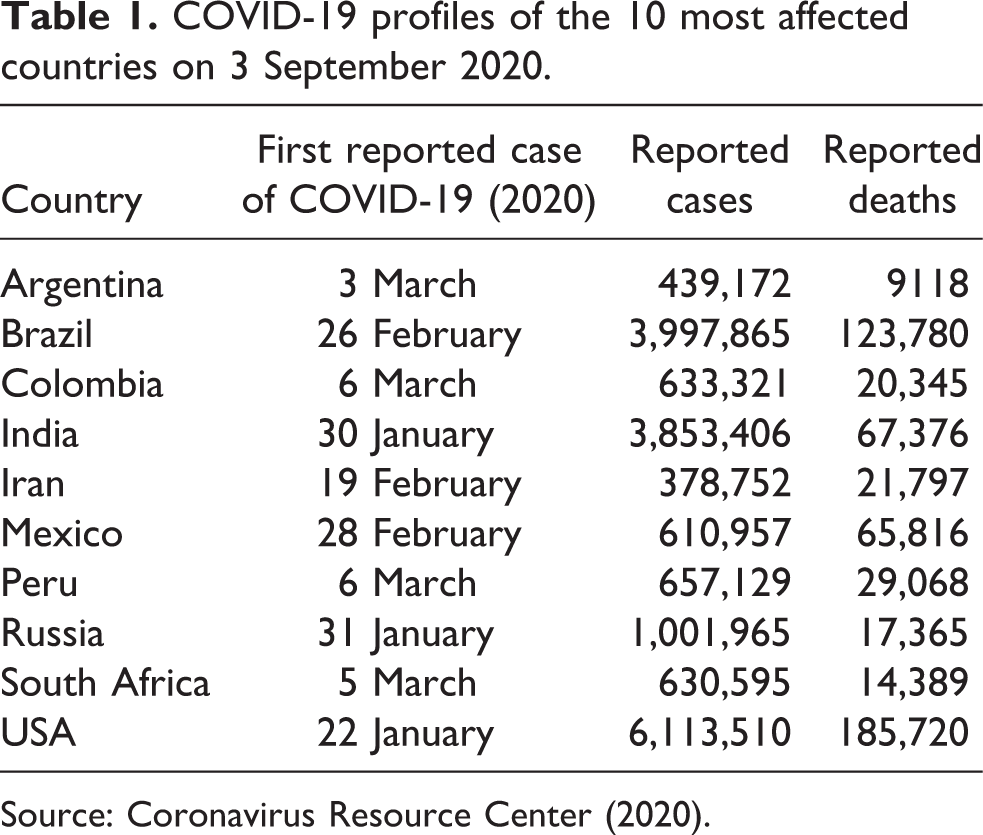
Source: Coronavirus Resource Center (2020).
In this research, we have investigated the online information search patterns of the 10 nations listed in Table 1, which had the following commonalities: Severity of the coronavirus pandemic – the included nations were listed as the 10 most affected countries on 3 September 2020. Relatively inclusive geographical coverage – the included nations are from Asia (Iran and India), North America (Mexico and USA), South America (Argentina, Brazil, Colombia and Peru), Africa (South Africa) and Europe (Russia). First registered case of COVID-19 in the first quarter of 2020 – so we based our study and later analysis on the 2020 data. In this way, it was possible to better compare the search patterns of the countries according to their similar COVID-19 situations, allowing us to see the stability/instability of the search interest in later months.
Search strategy
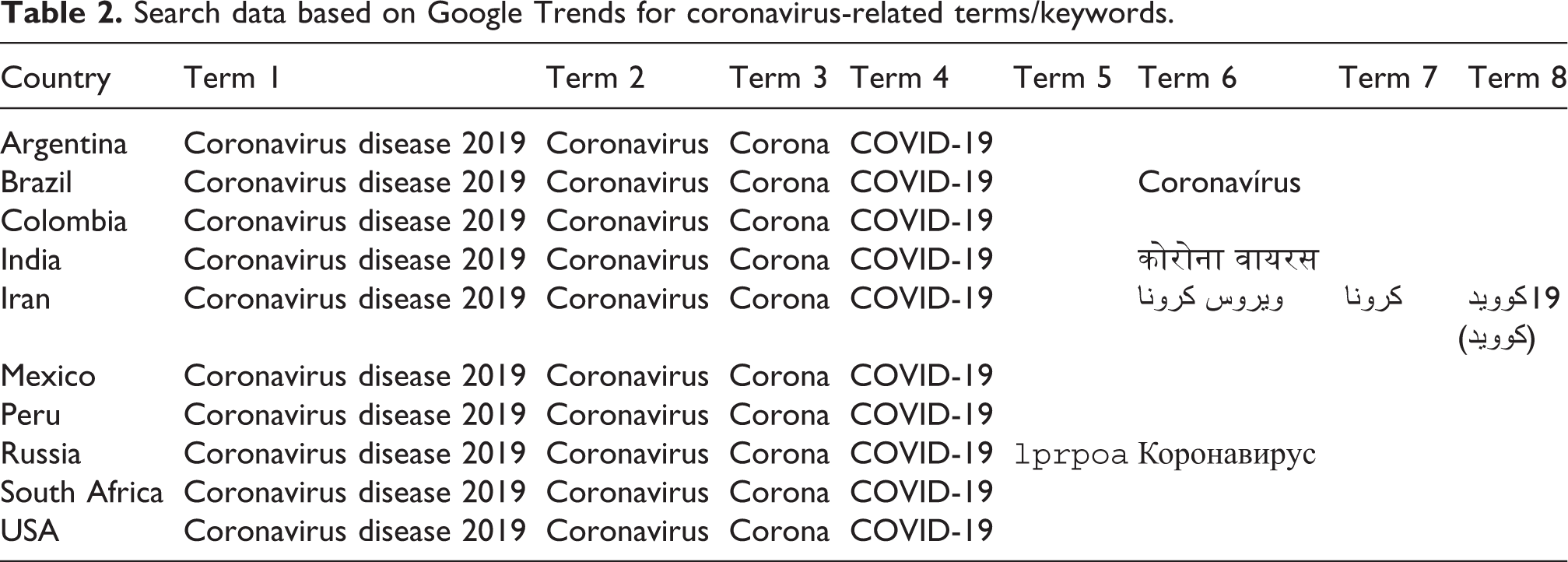
We extracted the data from previous Google searches with different alternatives to the keywords/phrases chosen that could be relevant to this study. The included search terms/keywords for each nation in this study are listed in Table 2. We based our data gathering and analysis on two main terms/keywords – ‘coronavirus’ and ‘COVID-19’ – and their variations, resulting in ‘coronavirus disease 2019’, ‘coronavirus’, ‘corona’ and ‘COVID-19 (COVID 19)’ (see Table 2, Terms 1–4). If the popular results included terms that had alternatives in non-English-speaking countries, they were placed in Columns 5–8 respectively. We have included both the complete and short forms of the terms/keywords because, in some countries, such as Iran, the Persian term ‘کرونا’ (‘corona’) was a widely used keyword among Iranians to get information. In Spanish-speaking countries (e.g. Argentina), the English keyword ‘coronavirus’ was similarly used in Spanish, thus it is not included in Table 2 and the cell for Term 5 is empty for Argentina. It should be mentioned that web searches involving the term ‘coronavirus’ existed before the SARS-CoV-2 outbreak. However, the popularity of searches using this term before 2020 was negligible. Furthermore, we did not include web searches using other terms such as ‘pandemic’ or ‘SARS-CoV-2’, which were not prevalent (see Appendix 1). The extracted data was imported into and visualized in Excel.
Search data based on Google Trends for coronavirus-related terms/keywords.
Results
The country-level data on the searches for ‘coronavirus’ and the level of attention of the public are analysed and described in this section. For each country, the most popular search keywords are included and the general search pattern for the keywords/terms is described in detail.
The level of attention in this study is operationalized as the rate of interest (or popularity) of a topic (keyword/phrase) relative to the highest point in the figures for the given country and time. The level-of-attention scores range from 0 to 100. A level-of-attention score of 100 is peak interest in the topic and a score of 50 shows a middle level of popularity or interest.
Google Trends uses the normalization of search data based on the time and location of a query to make the results easily comparable. The normalization process of Google Trends is described as follows: Each data point is divided by the total searches related to the geography and time range that it represents to compare its relative popularity. Otherwise, places with the highest search volume would always be ranked the highest. The resulting numbers are then scaled based on a range of 0 to 100 in terms of a topic’s proportion among all searches on all topics. (Google, 2022)
Argentina
The online searching for coronavirus-related information in Argentina is illustrated in Figure 1. As shown, the first increase in the level of attention in terms of searching for online coronavirus-related information among Argentinians took place on 1 March 2020. This rising level of attention peaked on 15 March (level of attention = 100) then sharply declined. The sharp decline became relatively stable on 3 May 2020 (25). This decreasing trend continued until the end of 2020. Of the five investigated keywords, Argentinians mostly used ‘coronavirus’ while searching for coronavirus-related information on the Web. The other keywords/terms were not as popular among Argentinians.
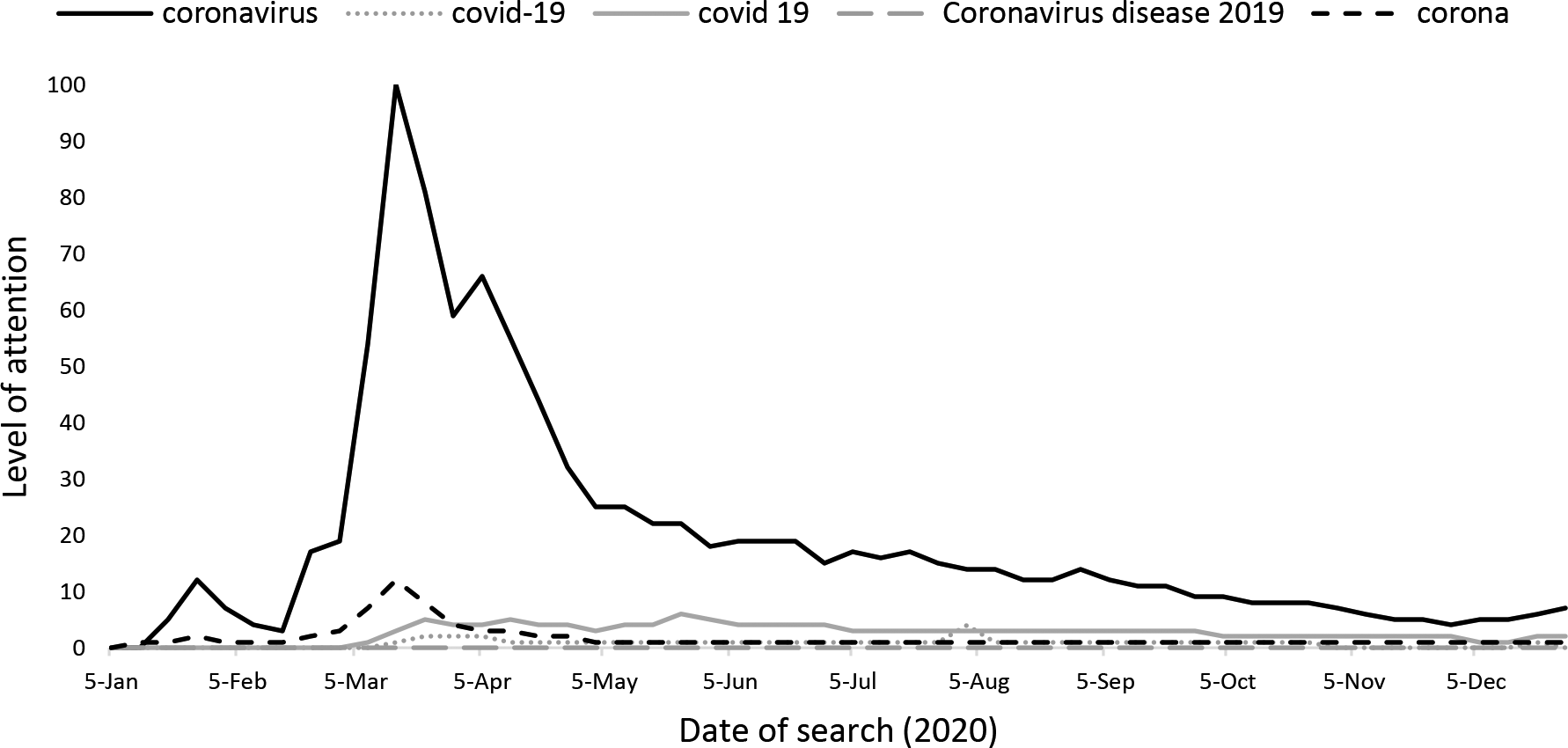
Argentinian search for coronavirus-related information on the Web in 2020.
Brazil
The googling trends for coronavirus-related information in Brazil are shown in Figure 2. As is visible, ‘coronavirus’ and its equivalent in Portuguese (‘coronavírus’) were the two mostly used keywords among Brazilians while searching for online coronavirus-related information. The first rise in the level of attention with regard to online information about ‘coronavirus’ started on 1 March (10) and reached its peak on 15 March (100). The trend declined until 29 March (45), when a second sharp rise in the level of attention began and reached a second peak on 5 April (63). Later, the level of interest decreased and gradually disappeared.
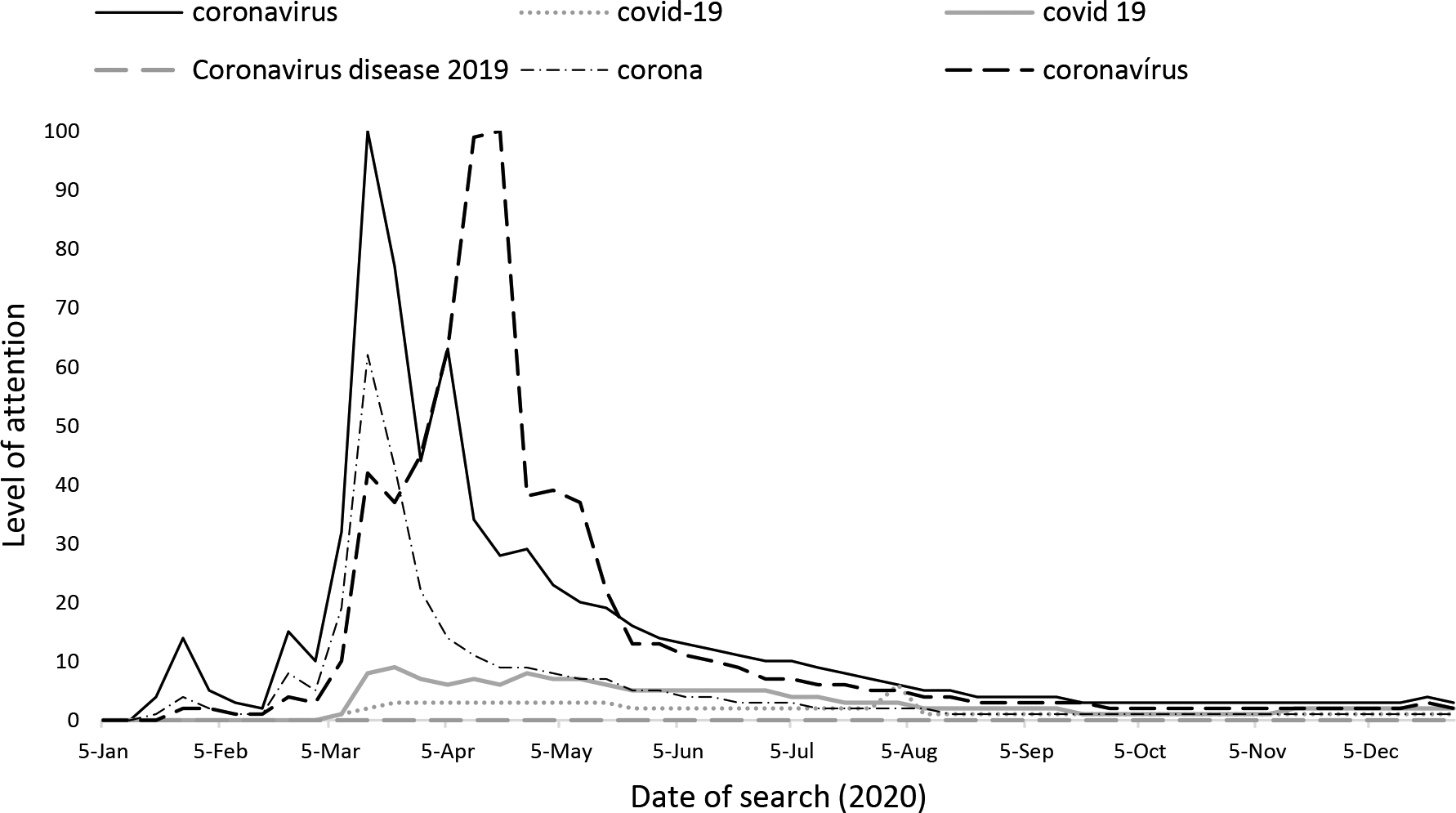
Brazilian search for coronavirus-related information on the Web in 2020.
The Brazilian searches for ‘coronavírus’ started on 1 March (3) and reached a first peak on 15 March (42). Interest decreased slowly for about one week and then experienced a sharp increase. It reached its highest peak on 19 April (100). There is a visible sharp decline in the level of attention from 19–26 April. At this point, the search interest remained level for about two weeks and, finally, after a relatively sharp decrease, it disappeared.
Colombia
The searching for coronavirus-related information on the Web in Colombia is illustrated in Figure 3. Of the investigated keywords, ‘coronavirus’ was the most used keyword by Colombians when searching for online coronavirus-related information. The first rise in the level of attention to online information about the coronavirus started on 1 March (22) and reached its peak on 15 March (100). This trend showed a sharp decline until 29 March and, at that time, a second sharp rise in interest began (67). It grew into a second peak on 5 April (90). Later, the level of attention decreased and slowly vanished.
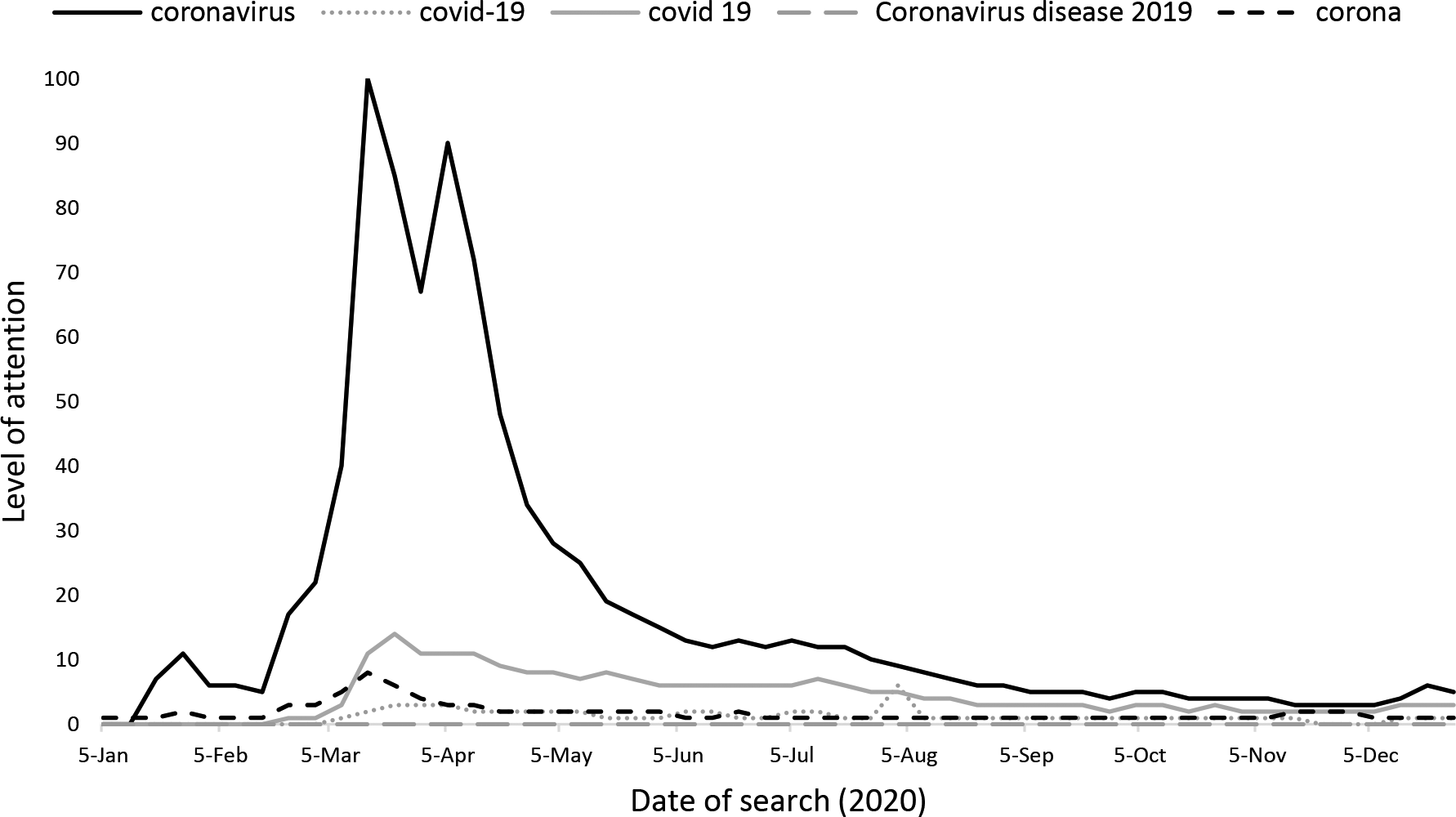
Colombian search for coronavirus-related information on the Web in 2020.
India
The search for coronavirus-related information on the Web in India is displayed in Figure 4. As the investigated keywords in this research show, ‘coronavirus’ and its equivalent in Hindi (‘कोरोना वायरस’) were the two most popular keywords searched for among Indians. The first rise in the level of attention of Indians in terms of searching for ‘coronavirus’ began on 1 March (3) and it reached a peak on 22 March (100). This trend showed a sharp decline until 5 April. At that time, a second sharp rise in interest began (69), which reached a second peak on 12 April (75). Later, the level of interest lessened and gradually disappeared.
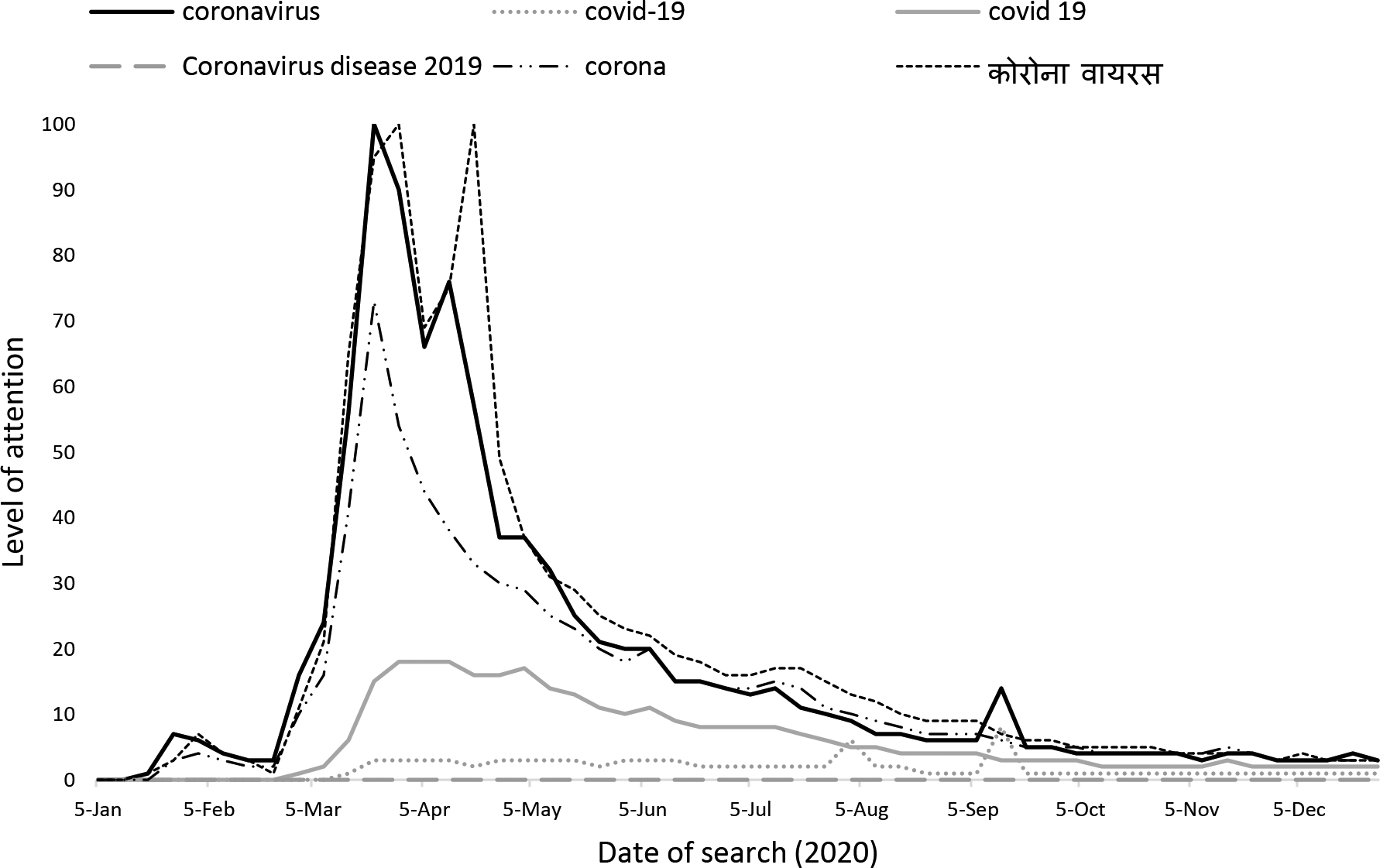
Indian search for coronavirus-related information on the Web in 2020.
Although the search for ‘कोरोना वायरस’ had two peaks (100) on 29 March and 19 April, the general search pattern was similar to that for the ‘coronavirus’ keyword, declining very quickly and disappearing afterwards.
Iran
The Iranian searching for coronavirus-related information on the Web is illustrated in Figure 5. Of the investigated keywords in this research, ‘coronavirus’ and its short equivalent in Persian (‘کرونا’) were the two most popular keywords among Iranians. The first rise in the level of attention among Iranians in terms of searching for ‘coronavirus’ started on 9 February (2) and reached a first peak on 23 February (62). After a sharp decline, the search trend fluctuated but grew until 15 March. At that time, a second sharp increase in search interest began (47), which reached a peak on 29 March (100). Later, the level of interest lessened and slowly disappeared.
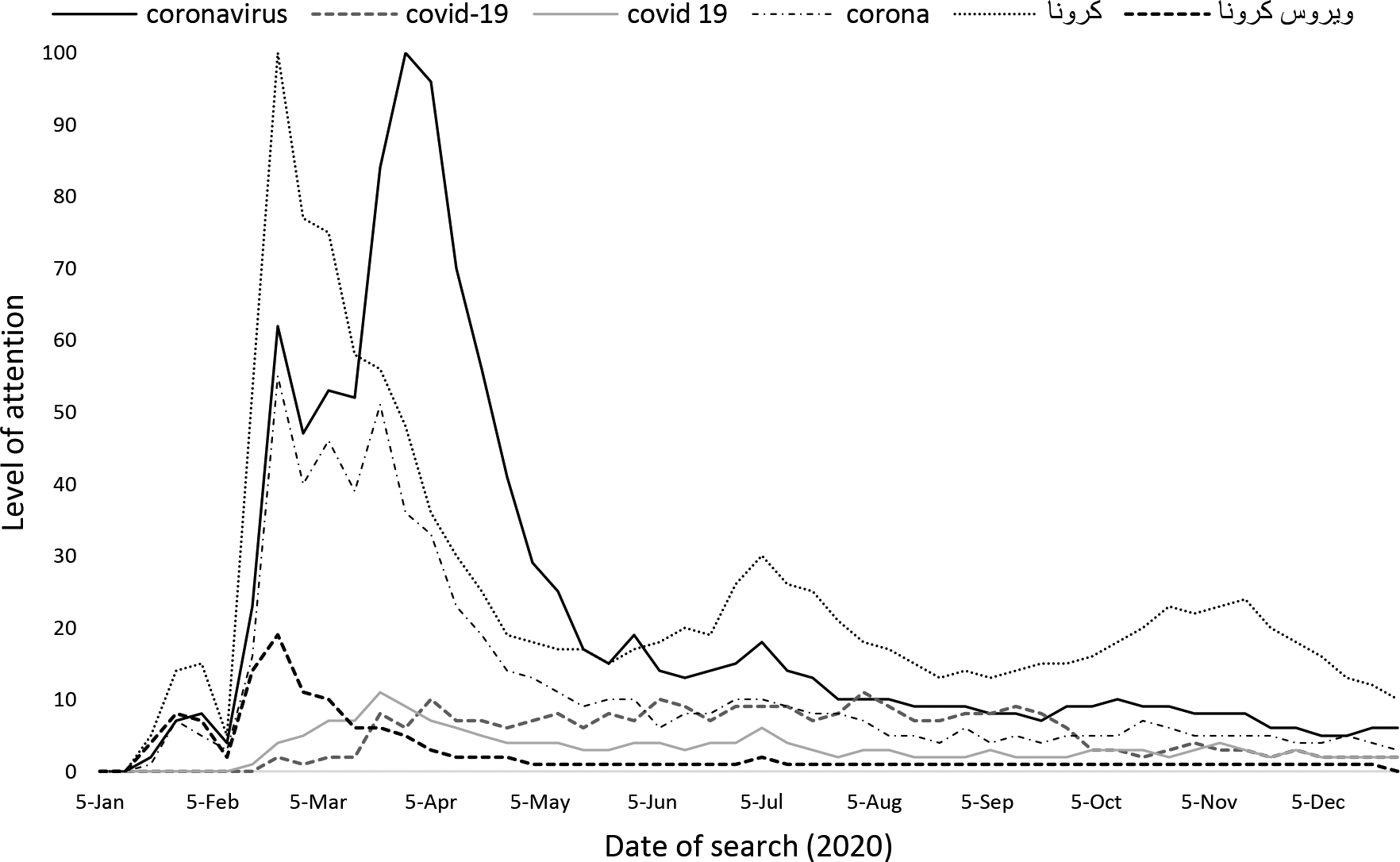
Iranian search for coronavirus-related information on the Web in 2020.
Iranians’ rising level of attention with regard to ‘کرونا’ began on 9 February and was at its highest on 23 February. After a sharp decline, it got more attention again on 21 June (19) and reached a second peak on 5 July (30). Afterwards, the Iranian level of attention was at its lowest level but fluctuating. Three terms/phrases – ‘Coronavirus disease 2019’, ‘کووید’ and ‘19کووید’ – were not used by Iranians and have therefore not been included in Figure 5.
Mexico
The Mexican search for online coronavirus-related information is shown in Figure 6. Of the investigated keywords in this research, ‘coronavirus’ was the most used keyword among Mexicans while searching for online coronavirus-related information. The first increase in the level of attention of Mexicans with regard to ‘coronavirus’ began on 1 March (17) and it peaked on 15 March (85). The trend showed a sharp decline until 29 March and, at that time, there was a second sharp rise in interest (69). This reached a peak on 5 April (100). Later, the level of attention lessened and slowly disappeared.
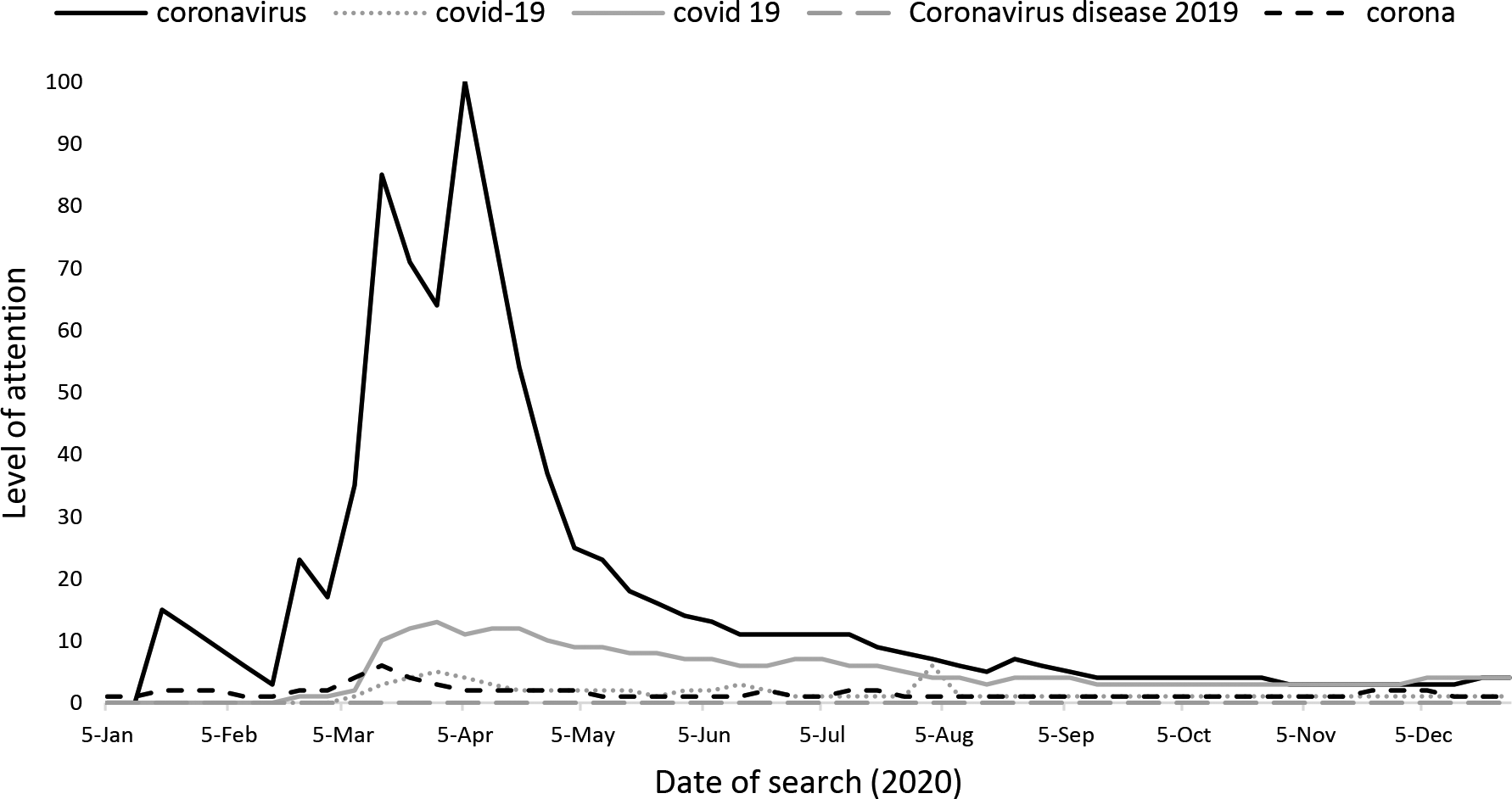
Mexican search for coronavirus-related information on the Web in 2020.
Peru
The Peruvian search for coronavirus-related information on the Web is reviewed in Figure 7. Of our investigated keywords, ‘coronavirus’ was the most popular among Peruvians. The first rise in the level of attention of Peruvians in relation to the word ‘coronavirus’ started from 1 March (17) and reached a first peak on 15 March (85). This trend showed a sharp decline until 29 March and, at that time, a second sharp rise in interest began (69), which reached a peak on 5 April (100). Later, the level of attention of Peruvians declined and gradually faded away.
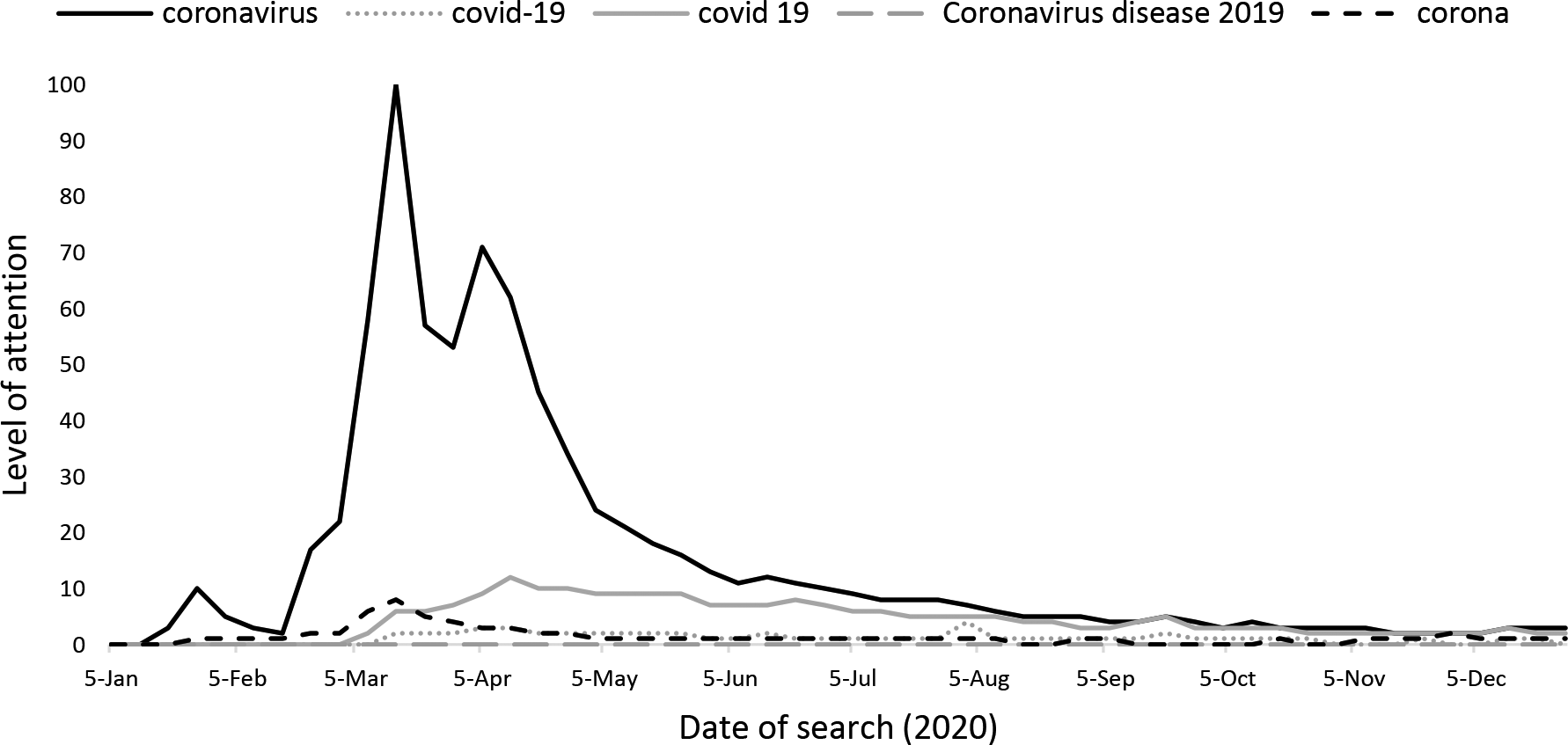
Peruvian search for coronavirus-related information on the Web in 2020.
Russia
The Russians’ search for online coronavirus-related information is shown in Figure 8. Of the examined keywords in this study, ‘coronavirus’ and its equivalent in Russian (‘коронавирус’) were the two most popular keywords among Russians. The first increase in the level of attention of Russians in searching for ‘coronavirus’ began on 1 March (20) and it reached its peak on 29 March (100). Afterwards, the level of attention declined sharply and then gradually vanished.
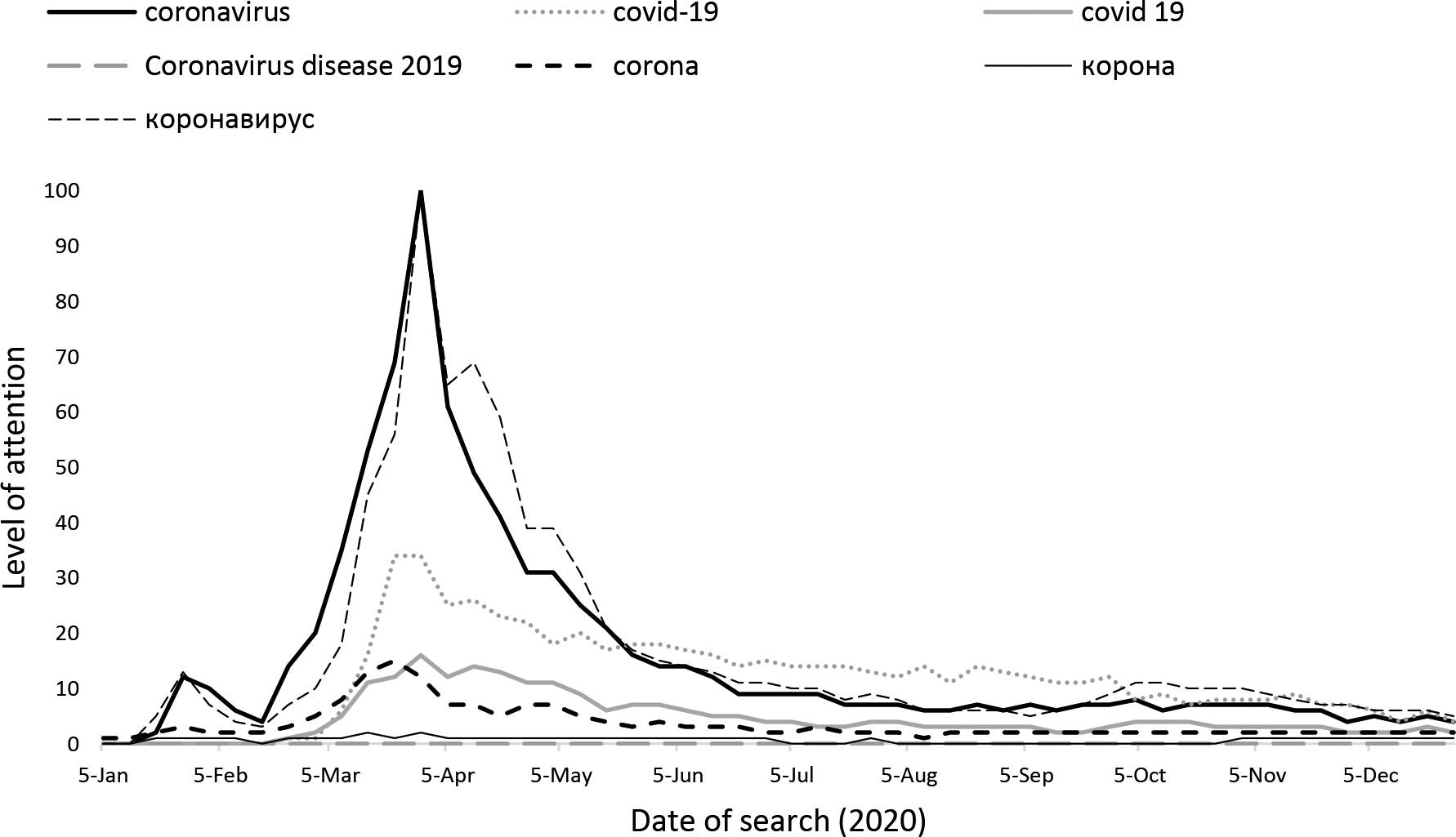
Russian search for coronavirus-related information on the Web in 2020.
The Russian search interest in ‘коронавирус’ began, likewise, on 1 March and demonstrated a relatively similar trend to ‘coronavirus’. The other studied keywords were not predominantly used among Russians.
South Africa
The search for coronavirus-related information on the Web in South Africa is illustrated in Figure 9. As shown, of the investigated keywords in this research, ‘coronavirus’ was the most popular among the people of South Africa. The first rise in the level of attention of South Africans in terms of searching for ‘coronavirus’ began on 23 February (9) and peaked on 22 March (100). This trend showed a sharp decline until 5 April. After two weeks with a stable level of attention, there was a second sharp decline of interest. Following this, the interest in searching diminished and gradually disappeared.
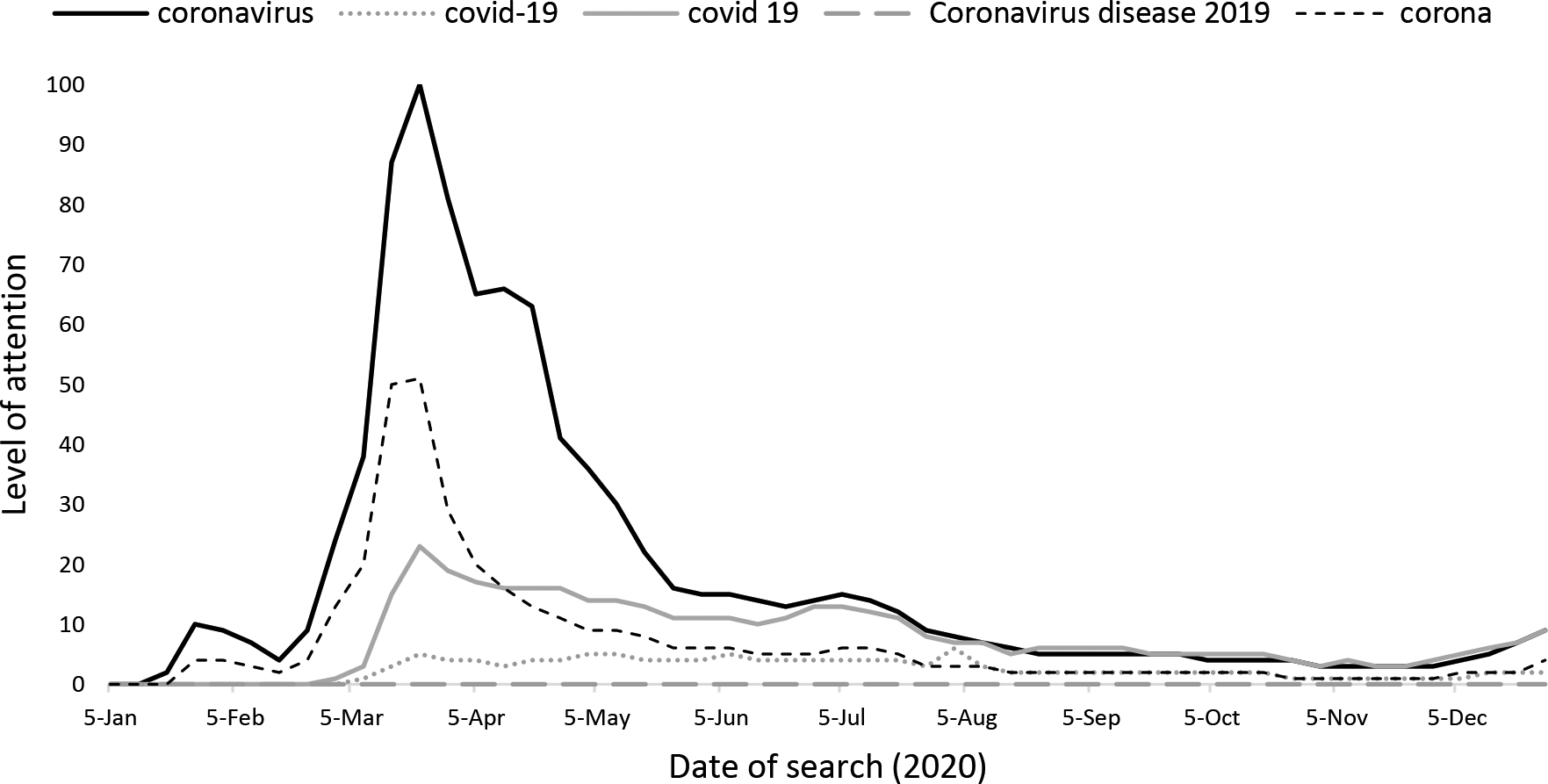
South African search for coronavirus-related information on the Web in 2020.
USA
The searching for online coronavirus-related information on the Web in the USA is shown in Figure 10. Of the investigated keywords in this research, ‘coronavirus’ was the most popular among Americans. The first increase in the level of attention of Americans in terms of searching for ‘coronavirus’ began on 16 February (4). After four weeks, the level of attention peaked on 15 March (100). The search trend experienced a sharp decline until 29 March when, after one week at a stable level, there was a second sharp decline. Subsequently, the American interest in searching for coronavirus-related information diminished and gradually disappeared.
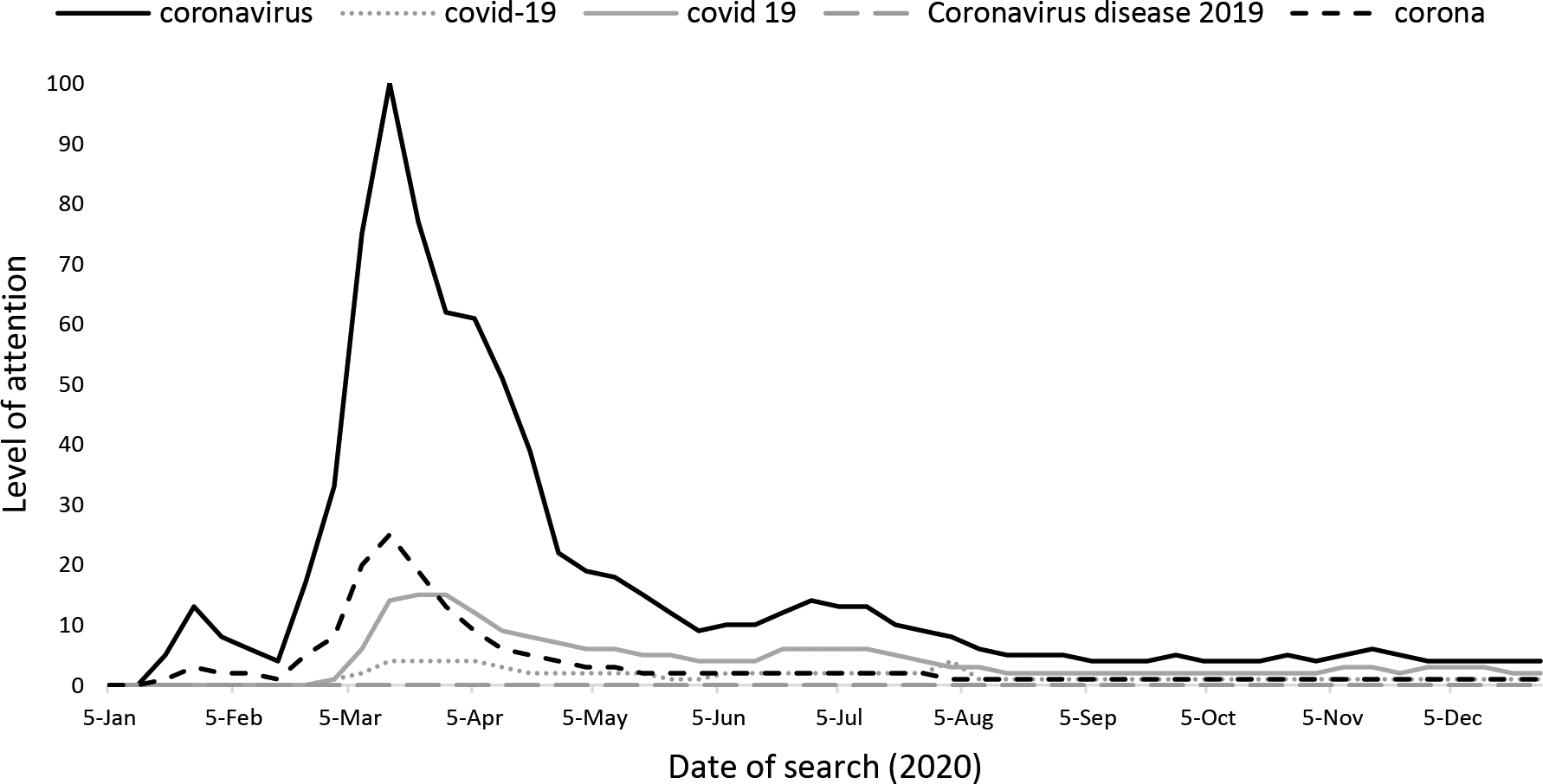
US search for coronavirus-related information on the Web in 2020.
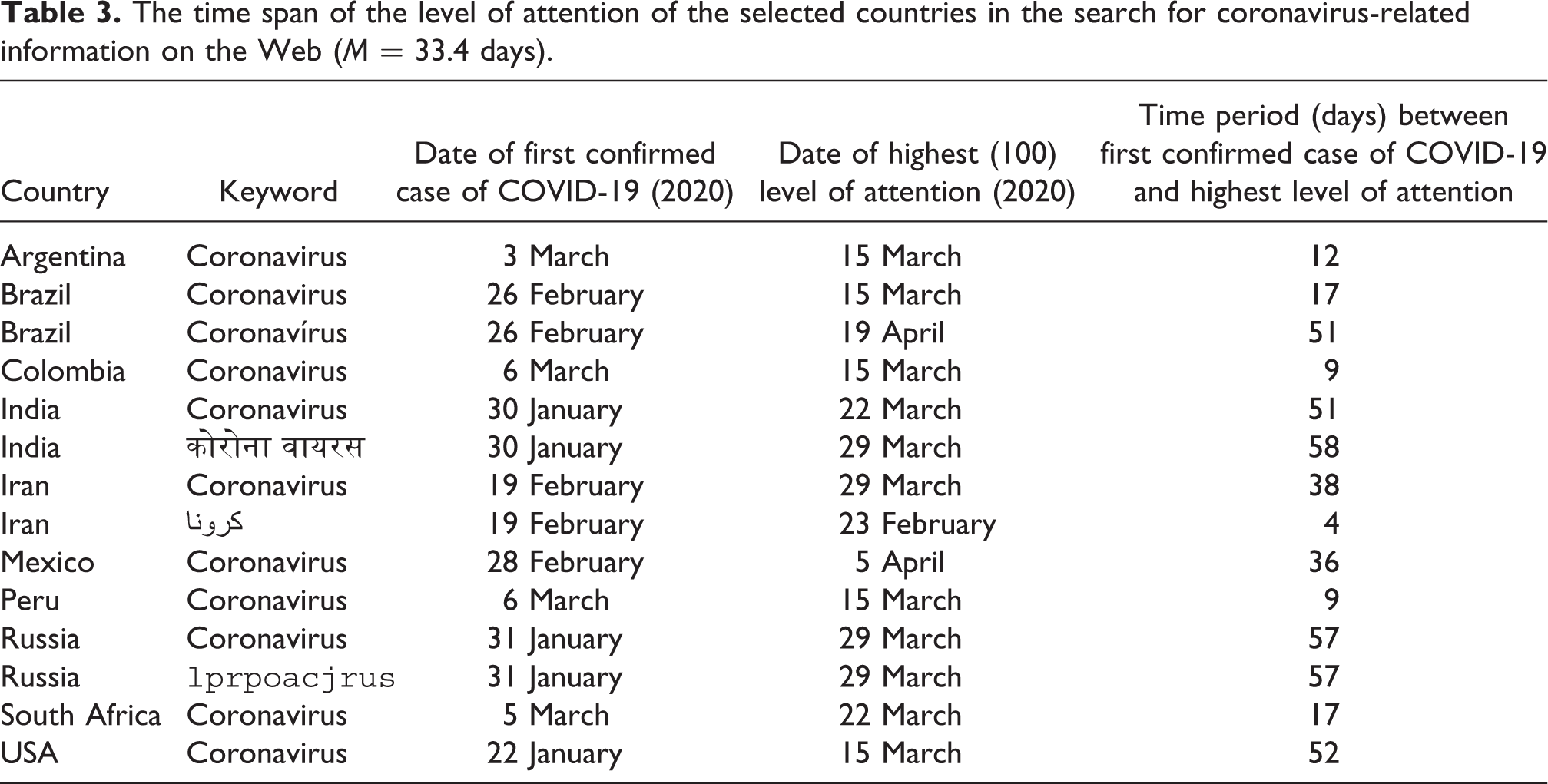
As shown in Table 3, the time span of the level of attention of the general public from the nations included in this study in terms of searching for online coronavirus-related information was short (M = 33.4 days).
The time span of the level of attention of the selected countries in the search for coronavirus-related information on the Web (M = 33.4 days).
Discussion
The aim of this research was (1) to investigate whether the severity of COVID-19 infections in a country could influence people’s level of attention during searching for online coronavirus-related information; (2) to examine the activation model of information exposure in explaining the attention level of public during online searching; and (3) to illustrate the cross-country similarities and differences in search patterns.
Although the 10 countries investigated in this study were among the nations that were most affected by COVID-19 in September 2020, the level of public attention with regard to online information about the coronavirus in these countries was at its lowest level on the date mentioned and afterwards. Furthermore, the search patterns of the countries investigated in this study were very similar to the world trends (see Figure 11). This finding answers the first research question: the severity of COVID-19 infections in the countries included in this study did not influence the public level of attention of people during searching for online coronavirus-related information.
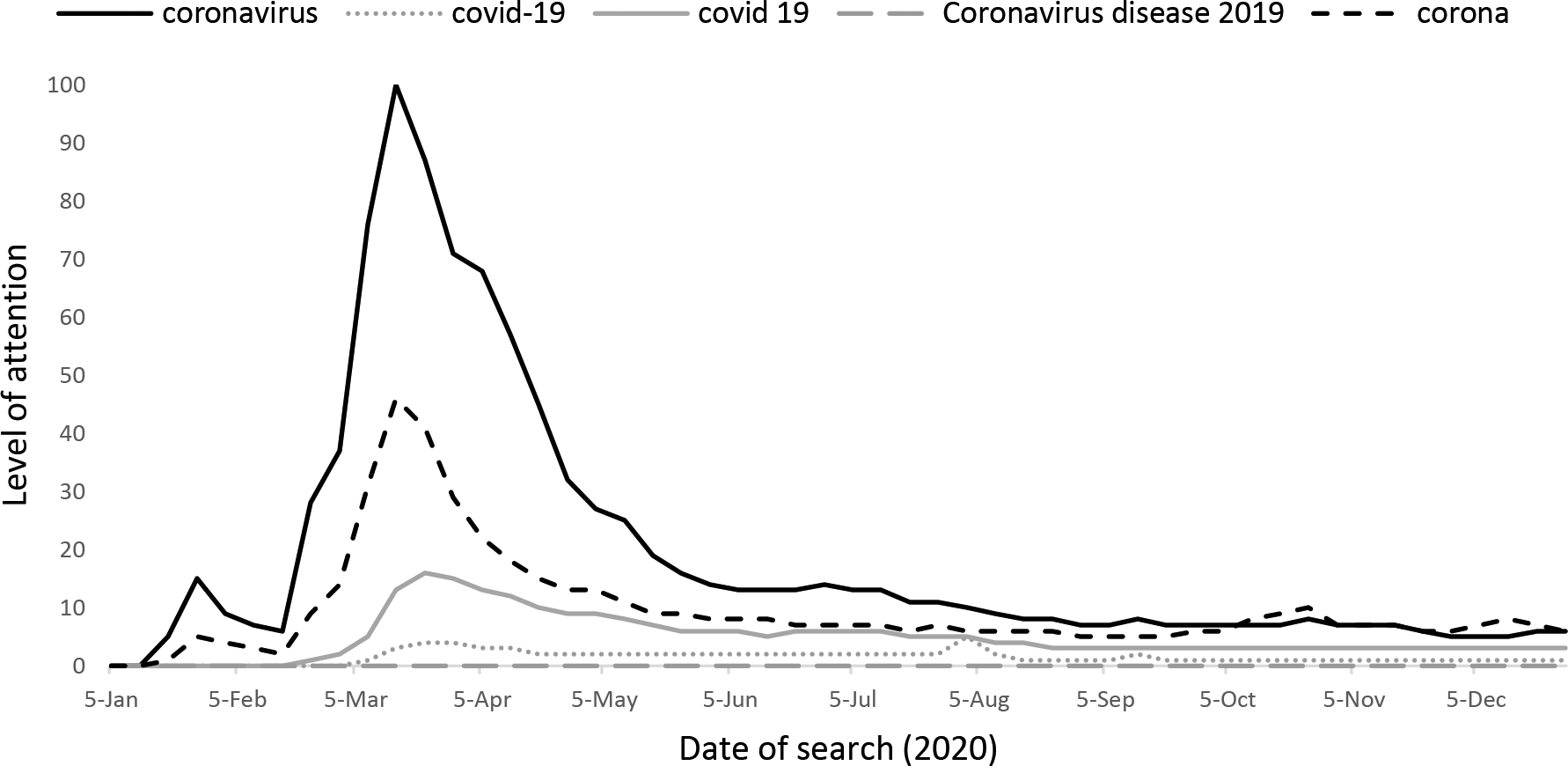
Online searching for coronavirus-related information worldwide in 2020.
The level of attention of the people of the nations included in this study when searching for online coronavirus-related information was short. This is in accordance with the findings of Bento et al. (2020), who showed that the attention level of US citizens towards general coronavirus-related information was short. A possible explanation for the relatively similar and short level of attention of those nations most affected by COVID-19 can be provided by the activation model of information exposure – that is, during a pandemic, the ‘messages which generate a negative or noxious affect because they induce arousal levels either above or below individual baselines are not likely to be well attended’ (Donohew et al., 1980: 303). Furthermore, the information overload of negative information about the coronavirus could be considered ‘monotonous’ or a ‘threat’ (Donohew and Tipton, 1973). This could make people refuse to continue searching for online coronavirus-related information.
The general cross-cultural patterns of searching for coronavirus-related information can be divided into three clusters: the first is the countries with a bilingual search pattern (e.g. Brazil, India, Russia and Iran); the second began to search in English rather than their national language (e.g. Brazil); and the third started with a search in their national language (e.g. Iran).
In Brazil, searches in Portuguese start later than searches in English. The level of attention for Portuguese reaches 100 on 19 April, more than a month after the same level of attention in English, and 14 days after the second peak (63) in English. For India, the English search peak is a week earlier than the search peak in Hindi, and the search in both languages shows a similar decline (down to a level of attention of 69) on the same date. There is a parallel incline, where the tendency for searches in English declines and the likelihood of searches in Hindi increases momentarily before a rapid decline. India is the only country where the search for coronavirus-related information in Hindi reaches a maximum peak (100) twice.
For Russia, the first peaks of searching for coronavirus-related information in both English and Russian happen simultaneously (on 29 March) with an equal level of attention (100). Russians’ search for coronavirus-related information in English declines steadily (without a second peak) while a second peak for searches in the Russian language happens on 12 April. Afterwards, the Russian searches for coronavirus-related information in both Russian and English decline rapidly. Searching for coronavirus-related information in Russian only shows a decrease in the level of attention between the first and the second peaks.
The searching pattern for Iran differs from the three other countries with bilingual searches in the national and English languages. For Iran, the peaks of both languages (Persian and English) are on 23 February. However, the level of attention to coronavirus-related information in the noted languages differs (the level of attention for searches in Persian is 100 and that for searches in English 62). More than a month later, the Iranian searches for coronavirus-related information in English reach a second peak (100). While the Iranian tendency to search in English is declining, the same search in Persian fluctuates during the spring, with a second (weak) peak on 5 July (30).
According to the Google Trends data, Iran has its first increase in public attention at the beginning of February 2020. On this date, the level of attention of Iranians in relation to coronavirus-related information in Persian is higher than it is in English. Brazil, India and Russia have their first sharp increase in public attention on 1 March 2020. For later countries, English is the preferred language. However, the level of attention differs both between countries and between English and the national language. In Brazil and India, searching for coronavirus-related information in English peaks (100) before the national languages. For Russia, searches in English and Russian peak concurrently (100), but, for Iran, only English has a second peak (100) on 29 March.
From the first peak to the second peak in English, only Iran has an increase in the level of attention. Brazil, India and Russia all have a decline in the level of attention for searches in English. From the first to the second peak in the national languages, there is an increase in the level of attention (Brazil), the level of attention is stable (India) or there is a decrease (Iran and Russia). There are several explanations for this. Moreover, our findings show that most of the countries had an earlier peak of searches in English than in the national language.
Initially, at the beginning of 2020, the COVID-19 pandemic was a global phenomenon. This may be the reason why it was more natural to search in English, rather than in national languages, to find global news and information about the coronavirus, as most of the available knowledge initially was in English. While evolving, the pandemic became more of a national issue than a global issue, as national precautions and policies were implemented. Another explanation could be rooted in culture. For example, in low-trust, non-English cultures, it could be possible that citizens shift towards English-speaking sources rather than resources in their national language because they do not trust the authorities.
The peaks in the national-language searches may be an effect of national announcements. This is in line with previous findings (Jarynowski et al., 2020; Sousa-Pinto et al., 2020). The research by Jarynowski et al. (2020) showed a similar pattern for Poland.
Another possible reason could be the number of English-speaking inhabitants of a nation. Individuals who are fluent in English might have easier access to information than people who speak only their (one) national language. Furthermore, experts (e.g. health-care workers in hospitals, epidemiologists or virologists) might have started looking for online information (in English) about the coronavirus earlier than the rest of the population, which could be another reason why, in most cases, the level of attention of the searches in English increased or peaked before that in national languages.
The second sharp increases in public attention and the second peaks may have been more linked to national announcements and internal affairs than the first increases and first peaks. This might be why the patterns became more arbitrary. There are probably both clear and vague reasons for the patterns, and several reasons for the levels of attention, as well as why, in some countries, English seems to be the preferred language when it comes to coronavirus-related information. This is in accordance with previous research indicating that bilingual online information seekers ‘select a language that represents their information need most accurately…rather than choosing their first language’ (Rieh and Rieh, 2005: 249). Other reasons for the fluctuations in the search patterns of the nations included in this study could be to do with, for example, the ease of access to free information and the English-language proficiency of the individuals of a nation.
Conclusion
A major finding of this research is that the level of attention and interest in searching for online coronavirus-related information was short (nearly one month) among the public of all the nations included in this research. This pattern was relatively similar for all of the nations that were greatly affected by COVID-19, and this has been explained by the activation model of information exposure. Furthermore, there was an interest in searching for online information in both the native language and English among the public of the nations investigated in this research.
Practical implications
The shortness of the level of attention of the public when searching for coronavirus-related information online has practical implications for health authorities and professionals in terms of producing as much accurate and updated information as possible in the very early stages of a pandemic and sharing it via various information delivery channels (such as social networks, instant messaging services and websites) to citizens. In this way, those who search for online pandemic-related information can access and use the timely, trustworthy and unambiguous information from health authorities rather than following fake news or messages that could have terrible consequences.
Our findings show that people from some nations searched for coronavirus-related information in at least two languages (English and the national language). Others started to search in English before searching for coronavirus-related information in their native language. The searching for bilingual information could imply that the national authorities have strived to develop a pandemic information dissemination model that is inclusive and where the related information and messages are accessible and understandable by all citizens in society. Especially in cases where a country is multicultural and diverse, and comprises various ethnic groups, relevant online information must be tailored culturally and linguistically. This is important because, as mentioned earlier (e.g. see Juva and Archer, 2020), health authorities have had difficulty in disseminating coronavirus-related information to all residents of a country (e.g. immigrants) in an appropriate space of time. Secondly, the language barrier of minorities has been an obstacle when it comes to reading and understanding the disseminated information. In addition, language barriers have been reported (e.g. Ingraham et al., 2021) to be a major factor in the hospitalization and deaths of some groups of people during the COVID-19 pandemic. This shows the importance and need for all citizens to be targeted with precise and understandable information.
A pandemic information dissemination model should pay close attention to the active participation of health institutions in providing credible information to citizens on social networks. This is important because most fake news and misinformation have been distributed via social networks. Furthermore, such a model should not be limited to digital environments. There are marginalized groups of individuals (e.g. those with limited Internet use/literacy, elders or newly arrived immigrants) in most countries. It is suggested that a traditional (physical) medium of information dissemination (such as brochures) should supplement online information dissemination.
Limitations and future research
This study had several limitations. First, the demographics (e.g. age, education level, information and communications technology skills, Internet access) of the online information seekers were not available via Google Trends for the researchers. Thus, the Google Trends data included in this research cannot be regarded as representative for all groups of people from a nation. The Google Trends data does not show who (humans or robots) the information searchers were. If it is assumed that the information seekers were individuals who had access to the Internet and were familiar with online search techniques, our findings and speculative conclusion cannot be necessarily generalized to the general public.
Second, our findings are based on the data extracted from Google Trends in 2020 for selected nations. Future researchers could investigate the searching patterns of different or similar nations for the following years to see if people’s level of interest while searching for coronavirus-related information was stable or varied.
Third, although a search engine (mostly Google) has been the starting point for the majority of health information seekers (e.g. see Pew Research Center, 2013), and googling coronavirus-related information has been very popular maybe because of a lack of trustworthy knowledge about the coronavirus, it seems logical that, at some point, a large number of these information seekers will turn away from search engines and instead start their coronavirus-related information-seeking process directly via a trustworthy website that is administered by health professionals.
Lastly, based on the current data, it is not clear why people search for coronavirus-related information via search engines. Health literacy may play a part in why people choose Google as a starting point for accessing health information. In addition, it has been claimed that increasing personal health literacy skills may result in informed decisions and disease prevention (e.g. see Hashemi-Shahri et al., 2020). Users’ poor levels of health literacy may make it more difficult to distinguish between correct and incorrect information, and hence to correctly understand and use information. For instance, Chen et al. (2018) found associations between poor health literacy, distrust in health information from specialists and, surprisingly, increased trust in information from, for example, social media, blogs and friends. Future quantitative and/or qualitative studies could reveal whether people perceive online information as the main source of health-related information or as a supplementary, first or last option, and how health literacy could influence people’s online information seeking and use in a pandemic.
Footnotes
Declaration of conflicting interests
The authors declared no potential conflicts of interest with respect to the research, authorship and/or publication of this article.
Funding
The authors received no financial support for the research, authorship and/or publication of this article.
