




Abstract
BACKGROUND:
The current COVID-19 pandemic has changed the entire world population’s physical and mental wellbeing irrespective of the person being infected or not. Flourishing numbers of new research recommends physiotherapy for the management of COVID-19 patients. However, there are cavities in the study in the recommendation of physiotherapy specific to the current pandemic.
OBJECTIVE:
This review aimed to synthesize physiotherapy-related articles to COVID-19 and summarize their efficacious highlights.
METHODS:
For the literature search PubMed, PEDro, DOAJ and The Cochrane Database of Systematic Reviews were used. The keywords included “Physiotherapy”, “COVID-19”, and “Coronavirus”. The Boolean search was applied as required. Selection criteria included studies that included physiotherapy intervention as a tool for recovery of COVID-19. Exclusion criteria included animal studies, non-COVID-19 studies and physiotherapy as an adjunct treatment. The study evaluated evidence of all full-text articles in English from December 2019 to August 2020.
RESULTS:
Of the retrieved 577 articles, 390 articles were excluded at the title and abstract screening. 167 articles underwent full-text screening and further narrowed to 11 studies matching the expected criteria. 156 studies were excluded for various reasons.
CONCLUSION:
The current study findings support that physiotherapy interventions facilitate recovery in COVID-19 patients and act as a protective barrier. Further results include a reduced length of stay in intensive care and reduced treatment cost since this outbreak has brought a significant economic burden to many countries.
Introduction
The current Coronavirus Disease 2019 (COVID-19) pandemic has changed the entire world population’s physical and mental wellbeing irrespective of the person being infected or not. The COVID-19 is a highly ingenious disease caused by a new coronavirus, namely severe acute respiratory syndrome coronavirus-2 (SARS-CoV-2). In China, Wuhan city of Hubei province has reported a cluster of pneumonia cases to the World Health Organization (WHO) at the end of December 2019. The WHO declared COVID-19 a pandemic on March 11, 2020 [1, 16].
Angiotensin-converting enzyme 2 (ACE2) is customarily attached to type I and II alveolar cells. ACE2 helps in secreting surfactant, transepithelial movement of water, alveolar epithelium regeneration, and xenobiotic metabolism. When the virus invades the lung tissue, it damages the alveolar cells, leading to acute respiratory distress syndrome (ARDS), sepsis, septic shock, kidney failure, and cardiac failure, eventually resulting in death [3]. COVID-19 infected individual’s usually demonstrated fever, cough, fatigue, sputum production, and shortness of breath. 80%of cases were asymptomatic without any symptoms; 15%of patients require oxygen support in the hospital, and 5%of cases are critically ill, requiring mechanical ventilation and life support in the intensive care unit (ICU) [2, 4].
A physiotherapist is a multi-professional team member and plays an essential role in providing ventilator support and rendering respiratory techniques to critically ill patients. Moreover, the rehabilitation intervention improves individuals’ quality of life and functional abilities with deficits [5]. In particular, cardio-respiratory physiotherapy aid in the clearance of secretions in individuals who cannot clear independently with or without associated comorbidities leading to favourable recovery. COVID-19 patients in ICU are managed by prolonged protective ventilation, sedation prone to ICU-acquired weakness (ICU-AW), consequently impacting the morbidity and mortality rate. So, it was mandatory to provide early rehabilitation for all COVID-19 cases to enhance the rapid functional recovery rate [6, 7]. Flourishing numbers of new research recommends physiotherapy for the management of COVID-19 patients. However, there are lacunae in research in the recommendation of physiotherapy specific to the current pandemic. This review aimed to synthesize physiotherapy related to COVID-19 studies and summarize their efficacious highlights. The overall aim of this systematic review is to reconnaissance the current shreds of evidence pertaining to physiotherapy interventions in COVID-19. The distinct objectives were to compile the prevailing evidence explicitly related to physiotherapy interventions for people with COVID-19 and pinpoint the deficit in evidence that may require further studies.
Methods
Study setting
A systematic review was conducted in the following defined format and the study was registered in the open science framework (DOI 10.17605/OSF.IO/EDR6M).
Identification of research question
The PICOT(S) method proposed by Sackett et al. [7] was used in this systematic review to formulate a search strategy.
Identify the relevant studies
A comprehensive literature search was conducted in the following databases: PubMed, PEDro, DOAJ and The Cochrane Database of Systematic Reviews. The keywords include “Physiotherapy”, “COVID-19”, and “Coronavirus”. The Boolean search was applied as required. Grey literature or hand searching literature was also considered in the scoping review process.
Study selection
After completing database searches, the collected citations were entered into Mendeley Desktop version 1.19.4 for checking duplicate citations. In stage one, all article titles and abstracts were screened independently by two reviewers. Stage two involves full-text evaluation, and further articles were segregated to fulfill the study objectives. A third expert reviewer cross-checked and finalized the consensus and consistency of studies included in the scoping review. Manual hand searching was performed to ensure comprehensiveness.
A data extraction table was tabulated to collect data from selected studies, including the authors with year, country, samples, intervention, study design, and highlights. The data entries were cross verified by the reviewers to confirm accuracy. Finally, the data table was scrutinized by an expert reviewer.
A descriptive synthesis of collected articles was carried out after the data extraction procedure. Overall, this needs to narrate the available evidence and identify lacunae in the current literature.
Results
The characteristics of the included studies in this scoping review are shown in Fig. 1. Following study selection, 11 papers were included in the scoping review: Ten reviews and one survey analysis. The 11 most relevant studies are described in Table 1. Based on the reviews, we developed an algorithm to categorize COVID-19 patients on different variables (Fig. 2).
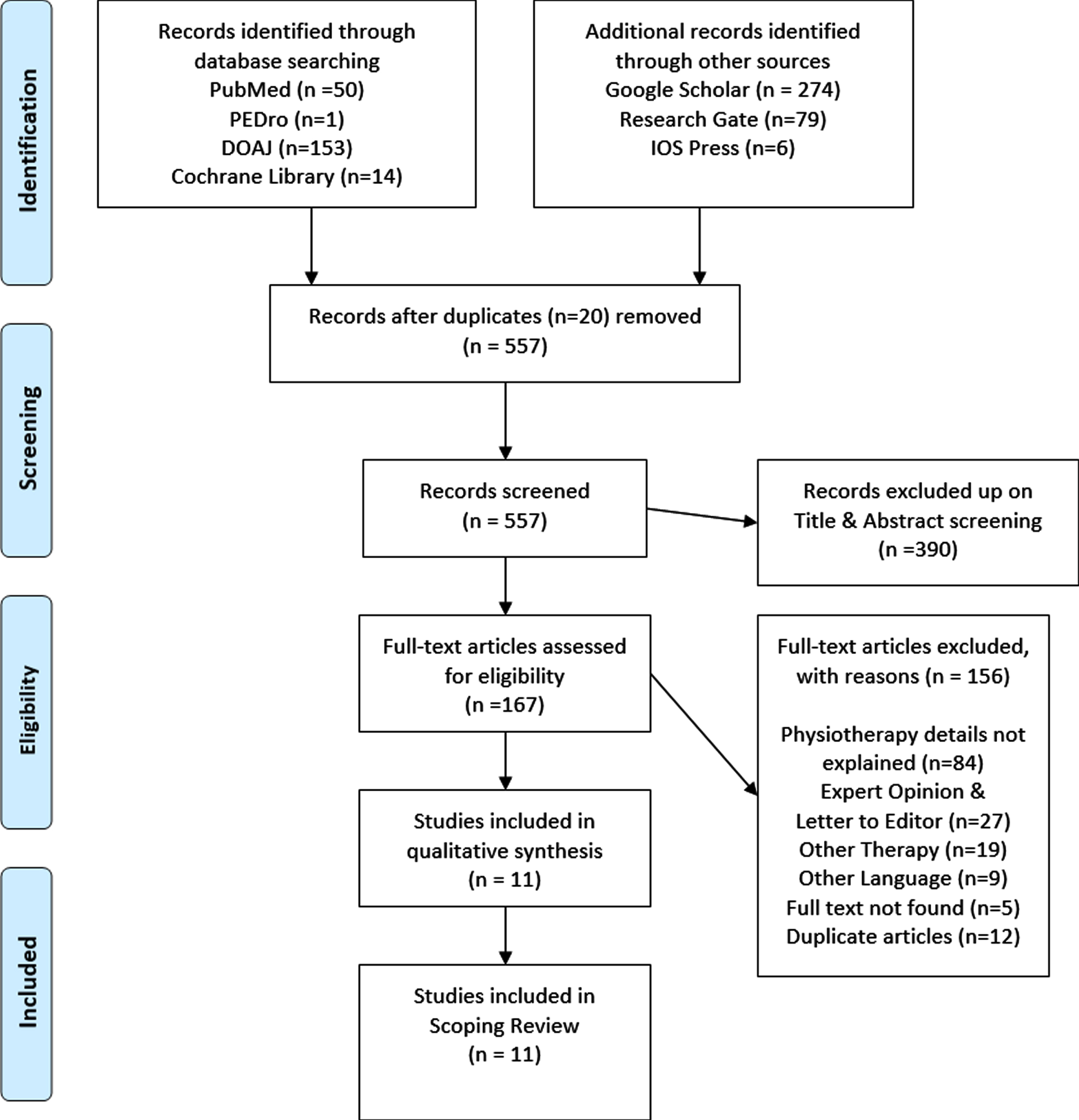
Flowchart of the study selection process.
Description of the 11 studies in this systematic review
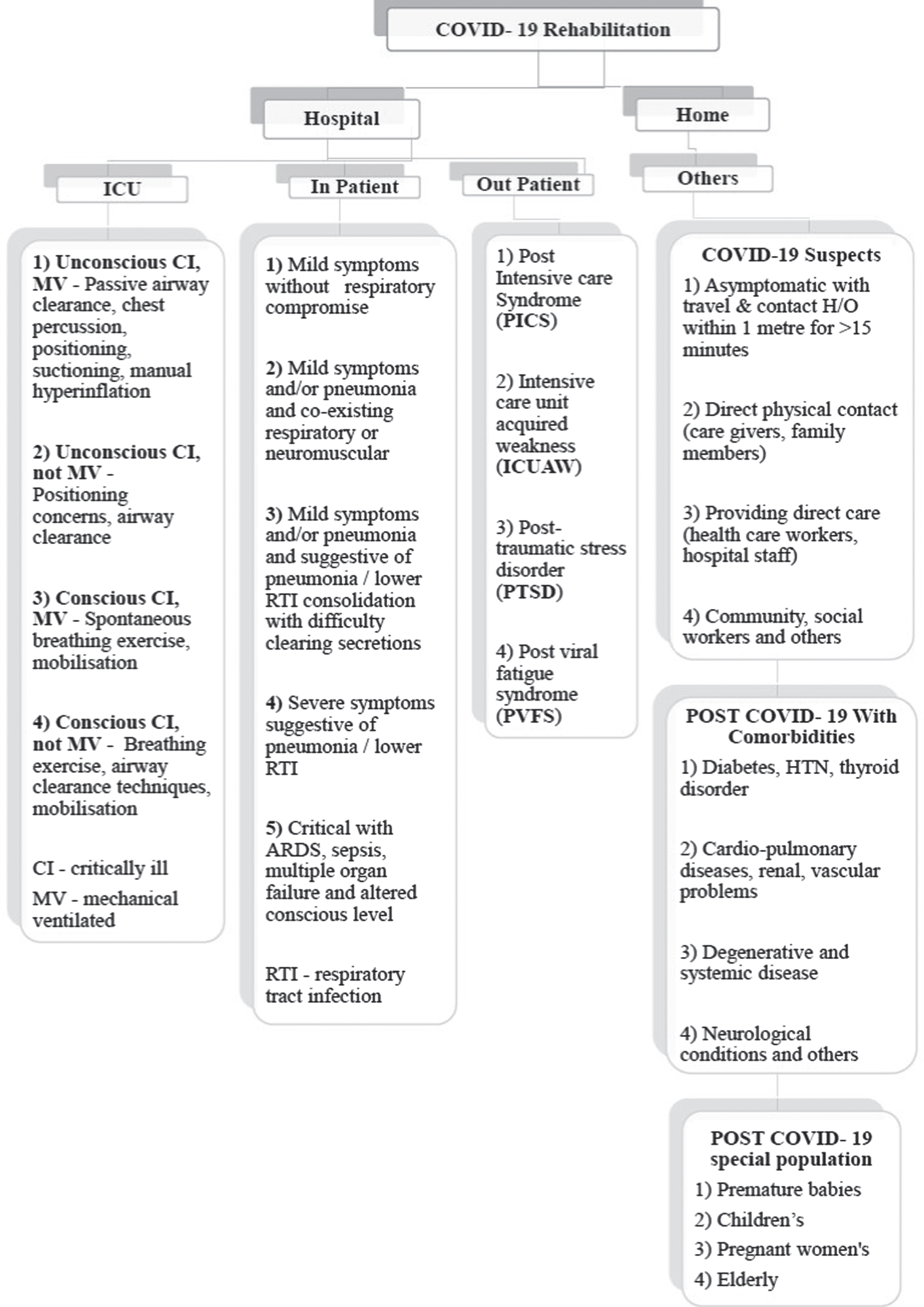
COVID-19 rehabilitation-based classification system for COVID-19 patients.
A classification category was assigned for each COVID-19 patient by the physiotherapist referred for rehabilitation. This classification system is based on various study suggestions that got extracted from the scoping review. The purpose of the algorithm was to standardize rehabilitation protocol for COVID-19 patients worldwide and this was the first systematic review intended to classify and frame an algorithm.
This systematic review aimed to determine the current literature regarding rehabilitation of people with COVID-19 and identify gaps in the evidence. Based on the purpose of the study, the broad inclusion and exclusion criteria were framed. A total of 11 articles that met the inclusion criteria were considered for this review. The review demonstrated a lack of physiotherapy research for COVID-19 patients who were both symptomatic and asymptomatic undergoing rehabilitation. Very few studies discussed physiotherapy intervention in a detailed manner, even though the majority of reviews failed to describe the physiotherapy component at all.
Few reviews related to search strategies were found, but only a few explicitly focused on physiotherapy intervention in detail. Similarly, the majority of the reviews included studies with physiotherapy as part of a rehabilitation process. The few retrieved RCTs were found to represent the protocols and hence it was not considered. No observational studies, experimental studies, clinical trials, systematic review and meta-analysis studies were found during the data extraction, which included physiotherapy interventions for COVID-19 patients exclusively. Most of the review articles are statements from various physiotherapy associations of different countries, council recommendations, and consensus statements. There was no contrasting evidence reported regarding physiotherapy being contraindicated for COVID-19 patients. Only a few physiotherapy techniques (abdominal breathing exercise, incentive spirometry, pursed-lip breathing exercise, manual therapy/stretches for ribcage, exercise training and mobilization during clinical instability) were contraindicated in the acute phase of COVID-19 patients [8].
Individuals infected with COVID-19 require hospital admission and can be further categorized into patients admitted in the intensive care unit (ICU) or inward patient ward. Patients in ICU care can be further sub-grouped based on the level of consciousness and with or without mechanical ventilator support. Based on sub-grouping, the physiotherapy intervention shown in Fig. 2 can be administrated. Patients admitted inward at the hospital can be further sub-grouped, screened and treated according to Thomas et al.’s recommended framework [9]. Physiotherapy interventions for each group must be started once a referral was sought.
Prone positioning for 12–16 hours is recommended for all ventilator support patients. The advantage of the prone position is that it relieves severe hypoxemia and prevents ventilator-induced lung injury. When compared to supine positioning, the prone position promotes more alveolar recruitment and reduces overinflated lung areas. In the prone position, trans-pulmonary pressure along the posterior to the anterior axis is more homogeneously distributed than in the supine position. So prone positioning was suggested to contribute to a decrease in lung stress and strain. Additionally, the physiotherapist must be expertise in safely performing prone positioning of ventilated patients to avoid complications, including airway and pressure area issues [10–12].
Following hospital stay (ICU or in-patient ward) [17], COVID-19 survivors may experience new or worsening complications such as post-intensive care syndrome (PICS), intensive care unit acquired weakness (ICUAW), post-traumatic stress disorder (PTSD), post-viral fatigue syndrome (PVFS), critical illness polyneuropathy (CIP) and critical illness myopathy (CIM) [13]. These complications could be benefited from outpatient physiotherapy services based on scheduled appointments to avoid overcrowding and congestion and further shifted from rehabilitation to telerehabilitation.
Telerehabilitation demonstrated a viable and effective alternative rehabilitation method for patients who are unable to access in-person physiotherapy services in the outpatient department. A well-structured and defined telerehabilitation service in this current COVID-19 pandemic helps COVID-19 patients who are in-home quarantine, community and other patients who are seeking physiotherapy treatment [14]. Telerehabilitation is set to bridge the gap in physiotherapy access during the time of lockdown when social distancing is mandated. Telerehabilitation reduces the chance of spread and transmission of COVID-19, PPE usage cost, and saving traveling time [18–20]. Telerehabilitation is not standard care of practice for rehabilitation and is yet not covered by insurance companies. Changes in insurance rules for claiming telehealth services probably help patients improve their quality and functional abilities and decrease insurance company expenditure [15].
People (post-COVID-19 recovered, COVID-19 contacts/suspects) quarantined at home with or without comorbidities due to restricted mobility have the risk of frailty, sarcopenia, dementia, psychological and musculoskeletal issues. So, it was advisable to perform a multi-component rehabilitation program to maintain and improve the health status of all individuals [16]. People at home quarantine could be further sub-grouped into COVID-19 suspects, post-COVID-19 with comorbidities, post-COVID-19 special population as represented in Fig. 2. Physiotherapy interventions for each patient belonging to each subgroup may be tailored-made/individualized or standard exercise programs focused on the patient’s current and anticipated problem list. These exercise programs must fulfill the recommendations of clinical practice.
COVID-19 rehabilitation can be based on only generalized experience, recommendations and expert opinions. Even though exercise programs were recommended for COVID-19, all shreds of evidence lack involving COVID-19 patients. All researches are based on experience, recommendations/guidelines from associations/councils; hence, no judgment can be made from these features. Since the amount of the data was reviews, additional analysis was precluded. The study’s limitations were search databases, review articles and period. The literature that was included in the systematic review was not reviewed critically. Future research is assured to know the effectiveness of physiotherapy in COVID-19 patients, including all databases for literature search and validating the proposed algorithm with less risk of bias.
Conclusions
The current systematic review findings support the use of physiotherapy interventions aids in quicker recovery of COVID-19 patients and act as a protective barrier and boost immune and respiratory system. Early rehabilitation reduces the length of stay in the ICU/hospitals and further decreases the treatment cost of COVID-19.
Footnotes
Acknowledgments
The authors gratefully acknowledge the Faculty of Physiotherapy, Sri Ramachandra Institute of Higher Education and Research, Chennai.
Conflict of interest
The authors declare no potential conflicts of interest concerning the research, authorship, and/or publication of this article.
Funding
The authors received no financial support for this article.