




Abstract
Introduction
Health information is one of the most frequently searched topics on the internet. In this observational cross-sectional study, we evaluated the content of the highest indexed Google search results related to migraine management.
Methods
We identified the five most used search terms related to migraine management via Google Trends in the time period 1 January 2004 to 2 October 2019. We entered each search term into Google’s search engine and retrieved the search results from the first three pages from each search query. We stratified the recommended treatment options and evaluated the websites using the DISCERN tool.
Results
In total, 73 unique websites recommended a total of 77 different migraine treatment options, consisting of 35 (45%) acute and 42 (55%) preventive treatments. For acute treatments, pharmacological options were more frequently recommended (88% of websites), whereas non-pharmacological options were more frequent among preventive treatments (67%). Evaluation of the consumer health information using the DISCERN tool showed that non-governmental organizations had the highest mean total score with 3.8 (±0.19).
Conclusions
Googling when looking for migraine treatments reveals a multitude of management proposals of varying quality. Non-governmental organizations provide the overall highest quality of written consumer health information on migraine treatments among search results. We encourage stakeholders to optimize and distribute high-quality and peer-reviewed information on migraine management.
Introduction
The general migraine literacy appears to be poor in spite of a high prevalence (1). In both America and Europe, health information is one of the most frequently searched topics on the internet (2). Today, many patients view the internet as a valuable and reliable source of heath related information and consult the internet before seeking a professional diagnosis (2). Despite the benefit of easily accessible health information, the possibility of misinformation leading to unfortunate actions or psychological distress should be a concern. To ensure the best possible treatments for patients, health care providers ought to familiarize themselves with patterns in patients’ self-care (3).
Google is both the most world’s most visited website and most used search engine making this the first (and sometimes) only source of health information.
Google provides indexation by sorting through internet websites and data via multiple proprietary algorithms (4). These algorithms consider a variety of variables when ranking different search results. In part, Google’s algorithms favour newly uploaded content as well as websites that many users seem to appreciate when conducting searches, as well as references from other websites. According to Google, this provides an opportunity for assessment of reliability and authority. Computer software determines which websites to visit and index, including the frequency and volume of indexed data (5).
Given the accessibility of the internet, multiple attempts have been made to elucidate the available tools for assessing quality and reliability of online health information (6). These attempts include website readability scoring systems and quality certification. Besides these approaches, the utilization of standardized instruments to evaluate the framework and content of written consumer health information has been used. The DISCERN instrument is an example of a validated questionnaire to assess consumer health information. The DISCERN instrument was formed on systematic input from an expert panel including clinical specialists, general practitioners and self-help group members (7). It facilitates standardized but yet flexible appraisal of online consumer health information (8).
The aim of this observational cross-sectional study is to evaluate the content of the highest indexed websites about migraine treatment on Google.
Methods
Search strategy
We used Google Trends to identify the most frequent migraine-related search query on Google (9). Google Trends tracks Google searches and provides rankings for past search queries since 2004. Search terms are scored relative to the total amount of searches performed on Google. This is quantified by Relative Search Volume (RSV), ranging from 0–100, where 100 is the most frequently searched term at the given time (10). By entering “migraine” as a search term, Google Trends suggests the highest indexed related search terms to the search term “migraine”. This function is used to determine which search terms to use when screening for information related to treatment. On 2 October 2019, at approximately 16:15, we entered each search term into Google’s Trends search engine. The searches were performed on a Windows 10-operated computer using Mozilla Firefox in Glostrup, Greater Copenhagen, Denmark. All cookies, previous search history and temporary internet files were deleted prior to search entry. In Private Mode, we set Google Trends to capture worldwide non-real-time search data from 1 January 2004 (earliest possible date) to 2 October (date of search query), capturing all categories of web searches. We then identified the five most frequent (top) related queries to migraine treatment. Only the top five search queries in relation to migraine treatment were eligible for further exploration. These five search terms were then entered in Google. We repeatedly cleared cookies, web browsing history, and temporary internet files before and between search queries. The search results (e.g. Uniform Resource Locators – URLs) from the first three Google pages were retrieved for each search query. The rationale for a cutoff of three Google pages is that most people doing an online search will look no further than the first three pages generated (11). We excluded duplicate websites and defective website links across search terms.
Content analysis
For each search query, we screened the content of each website for information related to migraine management. We recorded whether there were recommendations of headache diary usage and cautions against medication overuse headache. Furthermore, we assessed the nature of recommended treatments (e.g. acute, preventative, non-pharmacological, pharmacological interventions) and stratified the recommended treatment options accordingly. Finally, we grouped the websites by information provider type based on their self-reported purpose on the website’s “About us” sections.
Two authors (RB, TPD) independently used the DISCERN tool to evaluate the contents of each website. The DISCERN instrument is a validated tool which was developed to assess the quality for written consumer health information on treatment choices. It consists of a brief questionnaire of 16 questions divided into three sections. Questions 1 through 8 are named Section 1, where the reliability of the information is assessed – for example, the framework of the conveyed message. Section 2 consists of questions 9 through 15, where the quality of information is evaluated. Question 16 addresses the rater’s overall impression of the source. The DISCERN score scale ranges from 1 to 5, where 1 is low quality, 3 is partial quality, and 5 is high quality information (7). We defined agreement as consensus within one score. In case of disagreement, we resolved any discrepancy by re-assessing the website in question.
Approval of a scientific ethics committee is not required as the data is publicly available. We collected, stratified and evaluated the data using Microsoft Excel Version 1908, Microsoft Office 365 ProPlus (Microsoft, 2019) and IBM SPSS Statistics Version 26 (IBM, 2019).
Data availability
All data for this article is available per request.
Results
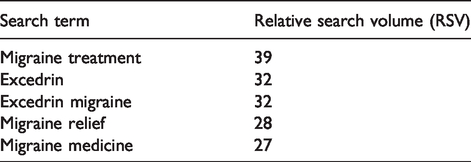
A flowchart of the search strategy and results is presented in Figure 1. We identified the following search terms from Google Trends, which were the highest indexed migraine treatment-related terms on Google (in ranked order): “migraine treatment”, “excedrin”, “excedrin migraine”, “migraine relief”, and “migraine medicine”. Excedrin® is an over-the-counter pharmaceutical product containing aspirin, paracetamol and caffeine.

Flowchart of the search strategy, web searches and processing of results.
Table 1 and Figure 2 shows the search terms and relative search volume. Historically, “excedrin” had the largest change in popularity over time, with peak change in interest around January of 2012. The other four search terms showed sporadic change in interest in search volume over time. Of note, the curves in Figure 2 shows the change in search volume of a search term relative to itself.
Overview of the most popular search terms related to migraine. Relative search volume is the quantity of search interest relative to the highest point of the chart for the given time. A value of 100 is peak popularity for that term. A value of 50 denotes that the term is half as popular as the term with the value of 100. A value of 0 means that there was insufficient data for this term.

Popularity of search terms over time. Figure 2 depicts the worldwide popularity of the five mentioned search queries over time, compared to itself. Google Trends data were available from 1 January 2004 until 2 October 2019. In the upper bar of Figure 2, each search term is marked with colours corresponding to the curve for that specific search term. Note that a curve represents the term’s change in search volume over time compared to itself. The change in volume is not normalized to the four other search terms. Therefore, a higher value over time depicts a change of number of searches for that specific search term. The used search terms and their relative search volume values are listed in Table 1. Google and the Google logo are registered trademarks of Google LLC, used with permission. Data source: Google Trends https://www.google.com/trends.
Search results
Input of these search terms into Google yielded a total of 149 search hits from the first three pages. We removed 75 duplicates and one defective link. The remaining 73 websites were pooled, and the content of these websites were subsequently analyzed by stratification of the recommended treatment options. We evaluated 66 of these 73 websites using the DISCERN tool, as seven websites were excluded due to them being articles in peer-reviewed journals.
Migraine management
Thirty-two websites out of 73 (44%) websites recommended that patients track their symptoms using a headache diary. In the context of pharmacological treatment, 45 out of 73 (62%) websites caution against medication overuse headache.
The 73 included websites recommended 77 different treatment options (Table 2). Sixty-seven websites (92%) recommended at least one of 35 acute migraine treatment options. The majority, 64 websites (88%) recommended at least one of 15 acute pharmacological treatments. Thirty-seven websites recommended at least one of 20 non-pharmacological treatments. Regarding preventive treatment, 49 websites (67%) recommended at least one of 42 different options. Forty-six websites (63%) recommended at least one of 18 preventive non-pharmacological treatments and 40 websites (55%) recommended at least one of 24 pharmacological treatments. Thirty-six out of 73 websites (49%) recommends only pharmacological treatments, whereas six out of 73 websites (8%) strictly recommends non-pharmacological options.
Characteristics of migraine treatment options as recommended in internet search results. The table depicts the recommended treatment options and the number/percentage of websites which recommend them. The table is organised by nature of treatment option. Treatment options are divided into acute/preventive and further into modality of treatment, e.g. pharmacological/non-pharmacological.

*These were specific recommendations for menstrual-related migraine.
Information provider type
Figure 3 shows websites grouped by website category per treatment provider type. Grouping of websites by information provider type revealed eight different categories: 16 e-commerce websites (22%), 11 websites by medical professionals (15%), 11 health information corporation websites (15%), 10 non-profit organizations (14%), nine news websites (12%), seven articles from peer-reviewed journals (10%), five governmental information service websites (7%), and four biotech company websites (5%).

Distribution of health information providers. This pie chart showing the distribution of health information providers found in the processed web search results. The total number of web search results after removal of duplicates and a defective link is 73.
In total, 77 different migraine treatment options were recommended across all eligible websites. Thirty-five options (45%) were acute treatment recommendations and 42 (55%) were preventive treatments. Of the acute treatments, 20 (57%) were non-pharmacological and 15 (43%) were pharmacological. Out of the 42 preventive treatment options, 18 (43%) were non-pharmacological, whereas the remaining 24 (57%) were pharmacological.
Health information corporations cover the largest fraction of acute non-pharmacological treatments with 20 out of 20 (100%) recommended options. Health information corporations also cover the largest fraction of total acute treatments with 34 out of 35 options (97%). Health information corporation and non-profit organizations cover an equal number of acute pharmacological treatments with 14 out of 15 options (93%). Regarding preventive treatment recommendations, health information corporations covers the largest total number of preventive treatments with 41 out of 42 (98%). Furthermore, health information corporations cover the largest fraction of both non-pharmacological preventive treatments with 17 out of 18 (94%) options and pharmacological preventives with 24 out of 24 (100%).
Table 3 is an overview of the respective information provider types and contains examples of websites in each category.
Overview of information provider types. Table 3 shows the defined information provider types with examples of websites. The information provider types of webpages are derived from the websites’ “About us” sections, where websites describe their purpose. Websites with identical purposes are grouped together.

Table 4 lists the remaining website categories and corresponding percentage of treatment recommendations.
Stratification of internet search results by provider type. The table shows website categories and how many treatment options they cover per type of treatment. Treatment types entails acute/preventive and pharmacological/non-pharmacological. Data are presented as number of treatments covered and percentage of total number of treatment options – for example, n (percentage). Website categories are listed in alphabetical order.

Quality of websites on treatment options
Figure 4 shows the quantification of reliability and quality of conveyed health information on treatment using the DISCERN instrument. The figure reports consensus results of DISCERN between raters. Non-profit organizations had the highest mean total DISCERN score of 3.8 (± 0.19). Non-profit organizations had the highest mean DISCERN score for Section 1, which addresses reliability, with a rating of 4.1 (± 0.22). Medical professionals had the highest mean DISCERN score for Section 2, which rates quality of information, with a rating of 3.8 (± 0.17). Statistical significance of DISCERN scores were established between groups with a one-way ANOVA. Differences between categories were significant in Section 1, regarding reliability (p < 0.001); Section 2, regarding quality of content (p = 0.029), and mean total DISCERN score (p < 0.001).
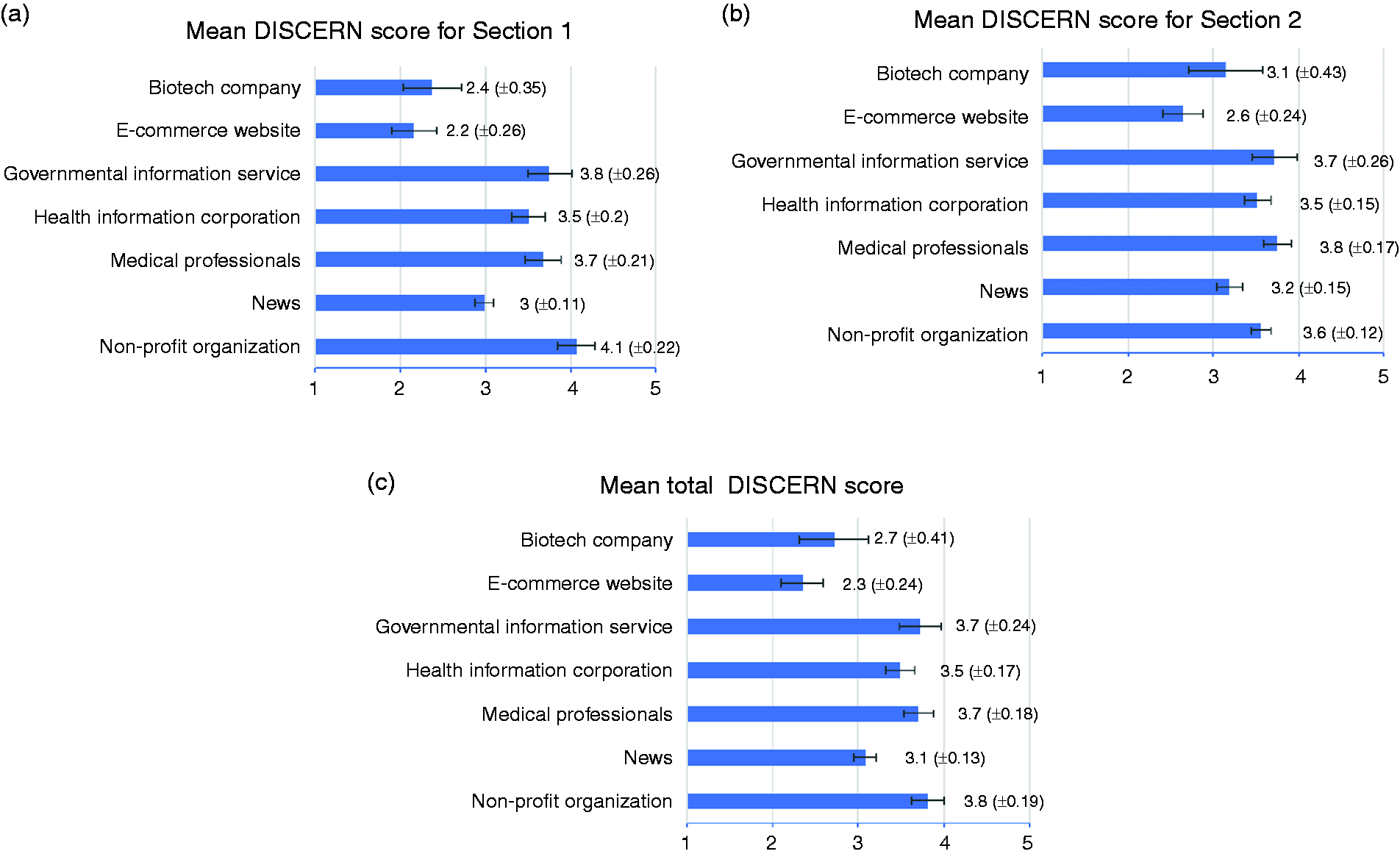
DISCERN scores of consumer health information grouped by website category. These figures provide an overview of mean DISCERN scores according to each section of the questionnaire. (a) Scores for Section 1 (reliability; questions 1 through 8), (b) scores for Section 2 (quality of content; questions 9 through 15), (c) total DISCERN score (all 16 questions). Data shows mean (± standard error of the mean) to the right side of each column for category of information provider type. The reported results are means of consensus scores between raters. The DISCERN tool rates information quality, scoring from 1 to 5, where 1 is low quality, 3 is partial quality, and 5 is high quality information. Columns are arranged in alphabetical order. Statistical significance of DISCERN scores were established between groups with a one-way ANOVA. Differences between categories were significant in Section 1, regarding reliability (p < 0.001); Section 2, regarding quality of content (p = 0.029); and mean total DISCERN score (p < 0.001).
We quantified the level of agreement between raters by weighted Cohen’s kappa coefficient due to the ordinal nature of the DISCERN scale. The estimated agreement between raters was kappa = 0.489, 95% CI (0.448, 0.530), p < 0.001.
Discussion
The current study investigated migraine treatment information on the internet. The highest indexed websites recommended a total of 77 acute and preventive treatment options, both non-pharmacological and pharmacological. Health information corporation is the health information provider type which covers the broadest number of treatments. Non-profit organizations comprise the most reliable provider type, whereas medical professionals provide the highest quality of information. Non-profit organizations also had the highest mean total DISCERN score.
Migraine management
Ranking of treatment recommendations shows that treatment modalities of anecdotal evidence rank highest among acute non-pharmacological options. Relaxation, sleep, and placing ice packs on the head are ranked highest among acute non-pharmacological treatments. These treatments are cheap and easily accessible compared to for example medical devices. In addition, the nature of the aforementioned treatments is based on anecdotal evidence, which may be why they are highly indexed on Google, as these treatments are generally favoured by patients (12).
Among acute pharmacological treatments, the most frequently reported treatments are non-migraine specific treatments such as non-steroidal anti-inflammatory drugs (NSAIDs) rather than migraine-specific therapeutics like triptans. NSAIDs are available as over-the-counter analgesics and cheaper in most countries, which may make them preferred over migraine-specific drugs (13,14). Fourteen websites (19%) mention opioids as a treatment option, and despite specifying opioids as a last-resort option, the high number of websites covering opioids in the context of migraine is problematic. Opioids are potentially addictive and not recommended in any guidelines (15,16). Considering that 64 websites (88%) recommend pharmacological treatment, as well as 49% of websites only recommends pharmacological options, it is noteworthy that only 45 websites (62%) caution against medication overuse headache, highlighting a major challenge in online-based patient education.
Among preventive treatments, non-pharmacological treatments are most frequently covered, with avoidance of triggers as the most frequent recommendation, followed by sleep, meals and relaxation. As with acute treatments, cheap and easily applicable interventions are favoured over migraine-specific products. This may underline the previously described anecdotal nature of internet treatment recommendations.
Botox is the most frequently covered preventive pharmacological treatment, followed by beta blockers and anti-CGRP monoclonal antibodies. Concurrently, conventional preventive therapeutics like beta blockers and tricyclic antidepressants are still frequently recommended, which may be because they are first choice preventives in medical practices (15).
Online health information on migraine treatments covers an extensive number of treatment options, which can be problematic for patients seeking health information online. Considering the estimated level of health literacy (17), most online seekers of health care information may not have the tools to evaluate and compare different treatment options, therefore the high number of treatments recommended by websites may complicate patient’s self-care (18).
Furthermore, the high number of non-validated treatment recommendations can disrupt the overlap between health care professionals’ and patients’ scope of interpretation of optimal migraine treatment. Inability to eliminate discrepancies between the treatment expectations of patients and healthcare professionals can lead to suboptimal treatments (18).
Information provider type
E-commerce websites constitute the largest group of health information providers of migraine treatments. This is perhaps due to Excedrin® being frequently entered in migraine-related searches on the internet, likely derived from non-migraine specific over-the-counter analgesics being widely used as acute migraine relief medication (19). The high search volume index of e-commerce websites can be suggestive of migraineurs using Google in search of acute relief. The abrupt increase in searches on Excedrin® around January of 2012 is likely due to the recall of the drug by the manufacturer at the time (20). The manufacturer at the time recalled all lots because of reports of chipped pills and faulty packaging, which could result in bottles containing foreign tablets, caplets or capsules (20).
Furthermore, Google is often used as a gateway to e-commerce websites across website types (21). Over-the-counter treatment options are therefore readily available for patients to buy directly from the internet without a prescription (22). Restricted access to healthcare, for example in a private healthcare setting, could incite patients to seek available over-the-counter treatments instead of consulting a professional. Taken together, this might explain the high indexation of e-commerce websites.
Stratification analysis of treatment options with respect to provider types revealed that health information corporations are providing the broadest coverage of information on migraine treatment options. Health information corporations are for-profit organizations, which entails a financial incitement for providing a large volume of information with opportunities for both advertisements and sponsored content on websites. Though this can be found on such websites, it is specified per advertisement. Furthermore, high information volume can favour websites in terms of high Google search result ranking, as there is potentially a broader coverage of search term matches (10).
Quality of websites
Non-profit organizations had the highest mean total DISCERN score. When solely observing Section 1 of the DISCERN tool, which addresses the reliability of the conveyed message, non-profit organizations score highest with a mean score of 4.1 (± 0.22).
The DISCERN instrument favours information that is conveyed with clear purpose, framework, and multiple solutions. This might explain why non-profit organisations obtain the highest score in Section 1 and why medical professionals did not, despite obtaining the highest mean score on quality of information. Non-profit organisations scored highest in Section 1 which, when added with scores from Section 2, resulted in the highest mean total DISCERN score. Our results may suggest that, among the highest indexed websites, medical professionals do not prioritise the framework of a message despite being an important factor in patient education (23).
The discrepancy of health information quality between different websites is similar to previous findings in other medical conditions with analysis and evaluation of content (24,25). This suggests that some challenges in online health information is similar across medical conditions.
Websites recommending treatment options based on anecdotal evidence rank relatively high in DISCERN scoring. This is consistent with health information consumers heavily weighing anecdotal information for treatment choices (12). Websites with information on migraine treatment can obtain a high DISCERN score regardless of the evidence behind recommendation of the treatment, which might explain why conventional evidence-based approaches are not favoured.
Strengths and limitations
Google Trends is a search string compositor based on monitoring of Google entries. It is not a proxy marker for epidemiological data, but rather a depiction of queries. We do not use Google searches as a surrogate for epidemiological data, therefore this limitation does not necessarily apply to our study. Furthermore, Google uses proprietary methods to determine indexation of websites. The degree of variability, and thereby generalisability, was not assessed in this study, due to the searches being conducted on a single computer in Greater Copenhagen, Denmark. Although we cannot exclude regional differences in a Google search, we believe the clearance of temporary internet files and strict use of English search terms will limit potential differences.
This is a cross-sectional study of internet websites while the content is constantly indexed. However, this is an inherent limitation in studies of online content.
The DISCERN tool for evaluation of written consumer health information does not require an assessment of interrater reliability. Nevertheless, we quantified the level of agreement between raters by weighted Cohen’s kappa coefficient due to the ordinal nature of the DISCERN scale. The estimated agreement between raters was kappa = 0.489, 95% CI (0.448, 0.530), p < 0.001. The estimated kappa can be interpreted as moderate strength of agreement (26,27) and is similar to the strength of agreement of the founding expert panel of the DISCERN tool (7). Estimations of interrater reliability on online information is elusive as the content is heterogeneous. This emphasised the need for the two raters to settle any disagreement in rating by re-assessing the website in question.
When assessing the content of websites, the authors were not blinded to the publisher of the websites, which can constitute a source of bias. However, extraction of data from the website in a blinded manner (e.g. web-scraping) is considered a violation of the terms of use of the websites (28,29). Furthermore, the purpose of the study is to assess the results from googling migraine, therefore content presentation is included in this scope.
Conclusion
Googling when looking for migraine treatments reveals a myriad of management recommendations of varying quality. Patients use the internet in the context of self-treatment before consulting healthcare professionals, which should incentivise health care professionals, governmental service providers and other stakeholders to provide reliable information of high quality. We encourage stakeholders to optimise the distribution of high-quality and peer-reviewed information on migraine management, possibly in the context of a scientific society; for example, The International Headache Society.
Key findings
Among acute treatments, pharmacological treatments are most frequently covered and most commonly non-migraine specific treatments such as non-steroidal anti-inflammatory drugs (NSAIDs) rather than migraine-specific therapeutics like triptans. Among preventive treatments, non-pharmacological treatments are most frequently covered, with avoidance of triggers as the most frequent recommendation, followed by sleep, meals and relaxation. E-commerce websites dominate the highest-ranked indexed migraine-related websites on Google.
Footnotes
Declaration of conflicting interests
The authors disclosed receipt of the following financial support for the research, authorship, and/or publication of this article: RB, TPD, JMH report no conflicts of interest. DWD reports the following conflicts: Personal fees: Amgen, AEON, Association of Translational Medicine, University Health Network, Daniel Edelman Inc., Autonomic Technologies, Axsome, Aural Analytics, Allergan, Alder BioPharmaceuticals, Biohaven, Charleston Laboratories, Clexio, Dr Reddy's Laboratories/Promius, Electrocore LLC, Eli Lilly, eNeura, Neurolief, Novartis, Ipsen, Impel, Satsuma, Supernus, Sun Pharma (India), Theranica, Teva, Vedanta, WL Gore, Nocira, PSL Group Services, University of British Columbia, XoC, Zosano, ZP Opco, Foresite Capital, Oppenheimer; Upjohn (Division of Pfizer), Pieris, Revance, Equinox, Salvia, Amzak Health. Speaking fees: Eli Lilly, Novartis Canada, Amgen. Speakers Bureaus: None. CME fees or royalty payments: HealthLogix, Medicom Worldwide, MedLogix Communications, Mednet, Miller Medical, PeerView, WebMD Health/Medscape, Chameleon, Academy for Continued Healthcare Learning, Universal Meeting Management, Haymarket, Global Scientific Communications, Global Life Sciences, Global Access Meetings, UpToDate (Elsevier), Oxford University Press, Cambridge University Press, Wolters Kluwer Health; Stock options: Precon Health, Aural Analytics, Healint, Theranica, Second Opinion/Mobile Health, Epien, Nocira, Matterhorn/Ontologics, King-Devick Technologies; Consulting without fee: Aural Analytics, Healint, Second Opinion/Mobile Health, Epien; Board of Directors: Epien, Matterhorn/Ontologics, King-Devick Technologies. Patent: 17189376.1-1466:vTitle: Botulinum Toxin Dosage Regimen for Chronic Migraine Prophylaxis without fee; Research funding: American Migraine Foundation, US Department of Defense, PCORI, Henry Jackson Foundation; Professional society fees or reimbursement for travel: American Academy of Neurology, American Brain Foundation, American Headache Society, American Migraine Foundation, International Headache Society, Canadian Headache Society.
MA reports personal fees from Allergan, Amgen, Alder, Eli Lilly, Novartis and Teva. He participated in clinical trials as the principal investigator for Alder, Amgen, ElectroCore, Novartis and Teva trials; he has no ownership interest and does not own stocks of any pharmaceutical company, and also serves as associated editor of Cephalalgia, Headache, and co-editor of the Journal of Headache and Pain. MA is the President of the International Headache Society and General Secretary of the European Headache Federation.
Funding
The authors disclosed receipt of the following financial support for the research, authorship, and/or publication of this article: The Lundbeck Foundation funded the publication of this article.
