




Abstract
Background
The COMT Val158Met polymorphism has long been regarded as a risk factor for migraine. The possible association between COMT Val158Met polymorphism and migraine has been evaluated in several studies, but the results are not consistent. Therefore, we conduct this meta-analysis to address these issues.
Methods
The WEB OF SCIENCE and EMBASE databases were searched for eligible studies. The odds ratio (OR) with the corresponding 95% confidence interval (CI) was calculated to estimate the strength of the association between COMT Val158Met polymorphism and migraine.
Results
Five studies with 979 cases and 1870 controls were ultimately included in the present meta-analysis. The overall data showed no significant association between COMT Val158Met polymorphism and migraine in the multiplicative model (OR = 0.97, 95% CI: 0.78–1.21, p = 0.805) and dominant model (OR = 1.05, 95% CI: 0.75–1.48, p = 0.773), neither in the additive model (OR = 0.97, 95% CI: 0.77–1.23, p = 0.817) nor in the recessive model (OR = 0.88, 95% CI: 0.71–1.09, p = 0.246). In subgroup analysis, both for Caucasian and Asian populations, no statistically significant associations were observed in any genetic models.
Conclusions
Our meta-analysis suggested that the COMT Val158Met polymorphism was not associated with migraine risk.
Introduction
Migraine is a common neurological disorder, characterized by recurrent moderate to severe headaches and autonomic symptoms (1,2). Although multiple environmental and genetic factors are involved in migraine, the exact etiology and pathogenesis of this disease are not yet fully understood (3,4). Previously, several studies have described that the levels of dopamine are altered in patients with migraine (5–7), and the catecholamine levels are lower in migraine patients than in controls (8). In addition, dopamine agonists and dopamine antagonists have been demonstrated to have efficacy in migraine treatment (9). So the alterations in catecholamine metabolism may be related to migraine pathophysiological mechanisms (10).
Catechol-O-methyltransferase (COMT) is an enzyme responsible for inactivating catecholamines and catechol-containing drugs. The G/A transition of the COMT gene at codon 158 (Single Nucleotide Polymorphism Database No. rs4680) results in a substitution of valine (Val) by methionine (Met) and affects the activity of the COMT enzyme (10). Individuals with the Met/Met genotype have a three- to fourfold reduction in activity of the COMT enzyme than those with the Val/Val genotype (11). Therefore, the COMT Val158Met polymorphism has long been regarded as a risk factor for migraine by altering catecholamine metabolism. The possible association between the COMT Val158Met polymorphism and migraine has been evaluated in many studies, but the results are not consistent. Sullivan et al. (12) found a significant association between migraine and COMT Val158Met polymorphism. Similarly, Emin Erdal et al. (2) also reported the homozygous or heterozygous Met allele was over-represented in patients with migraine compared with controls. Furthermore, the study by Liu et al. (13) reported that brain structure and function of the hippocampus were differentially affected by migraine in Val homozygotes compared with Met carriers. However, four other studies found no associations of COMT Val158Met polymorphism with migraine (14–17).
Among these studies, none has enough power to clarify the association between COMT Val158Met polymorphism and migraine. Whether the COMT Val158Met polymorphism increases migraine risk remains uncertain. Therefore, we conducted this meta-analysis of all eligible studies to address these issues.
Materials and methods
Search strategy and selection criteria
We systematically searched the WEB OF SCIENCE and EMBASE databases to identify all articles that evaluated the association between the COMT Val158Met polymorphism and migraine, using different combinations of the following terms: “rs4680,” “catechol-O-methyltransferase,” “COMT,” “polymorphism,” “migraine” and “headache.” The latest literature search was performed in November 2015, without any language restriction.
Studies were eligible for inclusion if they met the following criteria: (a) case-control study that evaluated the association between the COMT Val158Met polymorphism and migraine; (b) the controls must be healthy people; (c) the methods of data analysis were statistically acceptable; and (d) studies must contain genotype data. Meanwhile, we excluded reviews, abstracts, comments and letters. If the results of a study were reported several times, we chose the latest publication.
Data extraction and quality assessment
Two reviewers extracted data independently and any disagreements were resolved by discussion. The following information was collected from each study: first author, year of publication, country, ethnicity, gender, the number of patients and controls, frequencies of genotypes, and Hardy-Weinberg equilibrium (HWE) of genotype distribution in the controls.
The Newcastle-Ottawa scale (NOS) was used to assess the quality of included studies (18,19). This scale is a nine-point quality scale defining low-quality studies as having a score of ≤4 and high-quality studies as having a score of ≥7.
Statistical analysis
The pooled odds ratio (OR) with the corresponding 95% confidence interval (CI) was calculated to estimate the strength of the association between COMT Val158Met polymorphism and migraine in a multiplicative model (Met vs. Val), dominant model (Met/Met + Met/Val vs. Val/Val), recessive model (Met/Met vs. Met/Val + Val/Val) and additive model (Met/Met vs. Met/Val vs. Val/Val). In the additive model, genotypes Met/Met, Met/Val and Val/Val were coded as 2, 1 and 0, respectively. The Z-test was carried out to assess pooled OR, and p < 0.05 was considered significant. The Chi squared-based Q-test and I2 were applied to examine the heterogeneity between studies, the heterogeneity was considered significant when p value was below 0.1 (20). I2 < 25%, I2 = 25%–50%, I2 = 50%–75% and I2 > 75%, indicated no, low, moderate and high heterogeneity, respectively (21). If there was heterogeneity between studies, the data were pooled according to the random-effect model (DerSimonian and Laird), otherwise, the fixed-effect model (Mantel-Haenszel) was used (22).
Sensitivity analysis was applied by omitting one study at a time to examine the influence of a single study on the overall results. The source of heterogeneity was assessed by performing a subgroup analysis according to ethnicity. Publication bias was evaluated by Begg’s test and Egger’s test (23,24). If the p value of a test was less than 0.05, it meant that there was publication bias in the meta-analysis. Analyses were conducted using STATA 12.0 (StataCorp, College Station, TX, USA). All p values are two tailed.
Results
Literature search and characteristics of studies
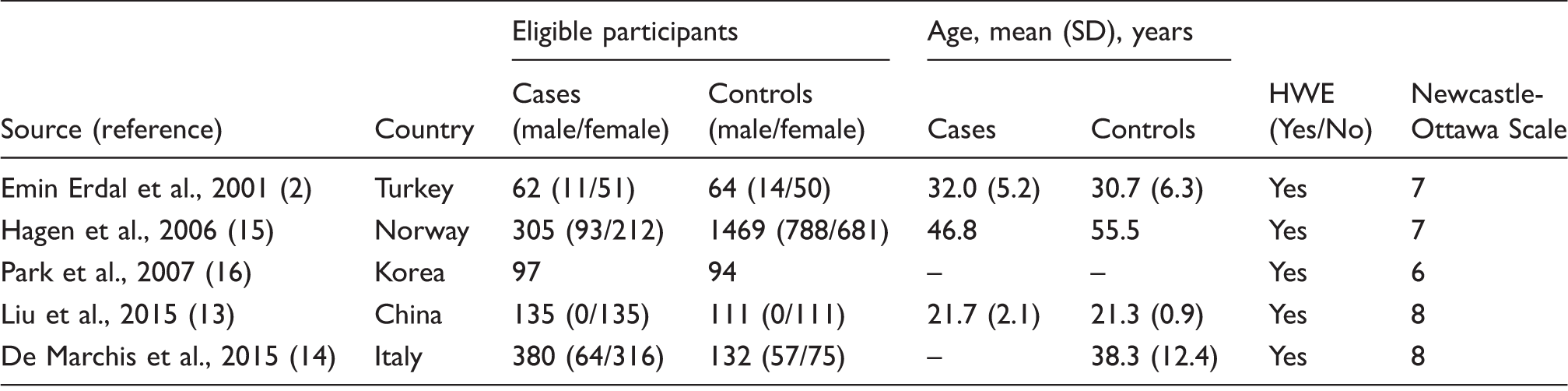
A total of 87 studies were identified through a search of EMBASE and WEB OF SCIENCE databases. Of these studies, 82 studies were excluded for not meeting the inclusion criteria. Finally, five studies with 979 cases and 1870 controls were included in the current meta-analysis. The selection process is shown in Figure 1. All of the five studies were written in English, and the populations in the studies were from Turkey, Norway, Korea, China and Italy. For all studies, the distribution of genotypes in the control groups was in HWE. The studies included in this meta-analysis showed good quality with an NOS score of no less than 6. The characteristics of the studies considered in the meta-analysis are shown in Table 1. Genotype and allele frequencies of the included studies are shown in Table 2. Among the five studies, two were carried out in Caucasians, and three in Asians.
Process of study selection for the meta-analysis. Main characteristics of studies included in the meta-analysis. HWE: Hardy–Weinberg equilibrium; SD: standard deviation. Distribution of the COMT Val158Met polymorphism among migraine cases and controls included in the meta-analysis. COMT: catechol-O-methyltransferase; Val: valine; Met: methionine.

Meta-analysis
Meta-analysis of the association between COMT Val158Met polymorphism and migraine.

COMT: catechol-O-methyltransferase; Val: valine; Met: methionine; OR: odds ratio; CI: confidence interval.
The overall data showed no significant association between the COMT Val158Met polymorphism and migraine in the multiplicative model (OR = 0.97, 95% CI: 0.78–1.21, p = 0.805) and dominant model (OR = 1.05, 95% CI: 0.75–1.48, p = 0.773), neither in the additive model (OR = 0.97, 95% CI: 0.77–1.23, p = 0.817) nor in the recessive model (OR = 0.88, 95% CI: 0.71–1.09, p = 0.246) (Table 3 and Figure 2). In the subgroup analysis, no statistically significant associations were observed in any genetic models for Caucasian or Asian individuals (Table 3 and Figure 2).
Forest plot of the association between the COMT Val158Met polymorphism and migraine stratified by ethnicity in the recessive model (Met/Met vs. Met/Val + Val/Val).
In the sensitivity analysis, similar results were obtained when any single study was omitted, so the data in this meta-analysis were relatively stable and credible. Both Begg’s test (p = 0.462) and Eggar’s test (p = 0.868) suggested there was no publication bias in our meta-analysis.
Discussion
The COMT Val158Met polymorphism was confirmed to be related to many neurological and psychiatric disorders such as bipolar disorder, fibromyalgia, anxiety-related traits, and violence in schizophrenia (25–28). Migraine is a common neurological disease and its association with the COMT Val158Met polymorphism was also investigated in several studies, but the results were inconsistent and even contradictory. The main reasons might include small sample size and differences in ethnicity. Therefore, we conducted this meta-analysis of all eligible studies to examine the association between the COMT Val158Met polymorphism and migraine.
In our meta-analysis, the overall data suggested there was no significant association between the COMT Val158Met polymorphism and migraine. The finding was consistent with a previous meta-analysis (29), in which only three studies regarding the association between COMT Val158Met polymorphism and migraine were included. Because of the limited number of studies included in their meta-analysis, the researchers didn’t have enough data to perform a subgroup analysis. In the present subgroup analysis, no association between COMT Val158Met polymorphism and migraine was found in either Caucasian or Asian populations. Furthermore, our results were different from those of another previous meta-analysis (30), in which the COMT gene Val158Met polymorphism was considered to be associated with a decreased risk of migraine in Caucasians but the evidence was based on only one study. Compared with the two previous meta-analyses, our analysis included more studies, therefore, a larger sample size and greater statistical power could be obtained.
Recent biochemical studies have reported that metabolic abnormalities of catecholaminergic neurotransmitters occur in migraine (31). The metabolism of catecholaminergic neurotransmitters like dopamine can be influenced by the level of activity of COMT enzyme, which is responsible for the functional inactivation of catecholamines (32). The single nucleotide polymorphism (SNP) caused by a substitution of Val with Met in the 158 codon of the COMT gene (COMT Val158Met) leads to lower COMT enzymatic activity and higher catecholamines availability in Met carriers (33). So the COMT Val158Met polymorphism has been considered as a potential risk factor of migraine by altering catecholamine metabolism. However, in the current meta-analysis, we find that the COMT Val158Met polymorphism is not associated with migraine risk. Maybe some other COMT SNPs play much more roles than the COMT Val158Met polymorphism in the pathogenesis of migraine. Diatchenko et al. (34) found the pain sensitivity was related only to SNPs rs6269 and rs4818 but not to SNP rs4680 after examining the six COMT SNPs (rs2097903, rs6269, rs4633, rs4818, rs4680 and rs165599). Furthermore, the abnormal catecholamine levels in migraine perhaps are caused by other enzymes involved in catecholamine metabolism, such as monoamine-oxidase, dopamine beta-hydroxylase, tyrosine-hydroxylase or tyrosine-decarboxylase (14).
To find the potential sources of heterogeneity, we performed a subgroup analysis according to ethnicity. The results showed that the heterogeneity was reduced after the data were separated into two groups (Caucasians and Asians). This suggested that the ethnicity was a source of heterogeneity between studies. Although the results of the sensitivity analysis indicated the stability and credibility of the present meta-analysis, several inevitable limitations should be acknowledged. First, a limited number of studies were included in this meta-analysis. It might be slightly underpowered to assess the real association between the COMT Val158Met polymorphism and migraine. Second, it is possible that some relevant published and unpublished studies that met the inclusion criteria were missed during the literature search. Therefore, some biases would be inevitably generated in the current study, though no evidence of any publication bias was detected in the Begg’s or Egger’s tests. Third, some other potential confounding factors, such as environment, age, gender, physical activity and education, could not be extracted from the studies. Therefore, we were unable to explore them further in subgroup analysis and meta-regression.
In conclusion, our meta-analysis suggested that the COMT Val158Met polymorphism was not associated with migraine risk. Considering the limitations of our study, further well-designed studies, especially those with gene-gene and gene-environment interactions, are warranted to validate these results.
Article highlights
No statistically significant associations between catechol-O-methyltransferase (COMT) valine (Val)158methionine(Met) polymorphism and migraine were observed in our study. Compared with the previous studies, our analysis included more participants, therefore a larger sample size and greater statistical power could be obtained. Our meta-analysis results may be helpful to make clear the pathogenesis of migraine.
Footnotes
Declaration of conflicting interests
The authors declared no potential conflicts of interest with respect to the research, authorship, and/or publication of this article.
Funding
The authors received no financial support for the research, authorship, and/or publication of this article.