




Abstract
Background
Oxidative and nitrosative stress are considered key events in the still unclear pathophysiology of migraine.
Methods
Studies comparing the level of biomarkers related to nitric oxide (NO) pathway/oxidative stress in the blood/urine of migraineurs vs. unaffected controls were extracted from the PubMed database. Summary estimates of mean ratios (MR) were carried out whenever a minimum of three papers were available. Nineteen studies were included in the meta-analyses, accounting for more than 1000 patients and controls, and compared with existing literature.
Results
Most studies measuring superoxide dismutase (SOD) showed lower activity in cases, although the meta-analysis in erythrocytes gave null results. On the contrary, plasma levels of thiobarbituric acid reactive substances (TBARS), an aspecific biomarker of oxidative damage, showed a meta-MR of 2.20 (95% CI: 1.65–2.93). As for NOs, no significant results were found in plasma, serum and urine. However, higher levels were shown during attacks, in patients with aura, and an effect of diet was found. The analysis of glutathione precursor homocysteine and asymmetric dimethylarginine (ADMA), an NO synthase inhibitor, gave inconclusive results.
Conclusions
The role of the oxidative pathway in migraine is still uncertain. Interesting evidence emerged for TBARS and SOD, and concerning the possible role of diet in the control of NOx levels.
Keywords
Introduction
The pathophysiology of migraine is unclear, but is likely to be multifactorial. Nitric oxide (NO), a gaseous signaling mediator inducing vasodilation in cerebral and extracerebral arteries and affecting nociceptive processing, is a causative molecule in migraine (1). NO donors, such as glyceryl trinitrate, reliably trigger genuine migraine attacks in migraineurs, whereas the NO-cyclic guanosine monophosphate (cGMP) cascade is a target for emerging migraine treatments (1). NO reacts with superoxide-producing peroxynitrite, a highly reactive free radical that exerts noxious effects on tissues. Thus, at least from a theoretical point of view, migraine could per se be associated with high levels of oxidative stress. A number of recent studies reported an association between high levels of oxidative stress and migraine, particularly in children, adolescents and women (2–5). Much other indirect evidence point to the occurrence of oxidative stress in migraine, in particular in migraine with aura (MA). In the mouse, cortical spreading depression, the neurophysiological event underlying migraine aura, activates genes involved in oxidative stress response (6). Neuroimaging in patients with MA frequently reveals the presence of white matter abnormalities, possibly originating from a brain oxidative mechanism, which correlates with aura duration and progress over time (7).
Targeting free nitrogen and oxygen radicals is considered a very promising strategy for future pain management, and compounds used as analgesic, anti-inflammatory and antimigraine agents can regulate nitroxidative stress (8).
Correct diagnosis is essential to devise an appropriate treatment strategy. Currently, diagnosis of headache is made according to the International Classification of Headache Disorders, third edition beta (ICHD-3) criteria (9), based on clinical history and after exclusion of other headache disorders. The availability of validated biomarkers of diagnosis, but also of prognosis and response to therapy, might provide valuable tools for the management and control of migraine.
We summarized published evidence on the use of different biomarkers related to the NO pathway and oxidative stress in association with migraine, performing meta-analyses.
Material and methods
Bibliographic search
Studies were identified through an extensive literature search using the PubMed database (http://www.ncbi.nih.gov/PubMed) without any language restriction, updated through February 1, 2014 (MN, investigator).
The final search strategies, adapted from Frustaci et al. (10), were based on medical subject headings (MeSH) terms and/or text words in the title or abstract. In summary, 179 citations were obtained and manually reviewed. A few additional publications were identified by reviewing the bibliographies of retrieved articles. All selected articles were in English.
Study selection, data extraction, study characteristics
Hospital or population-based studies were selected, comparing the level of biomarkers related to the NO pathway or oxidative stress, in the blood or urine of clinically diagnosed migraineurs vs. unaffected controls (not related to cases). Paper selection and data extraction were coordinated by MN (investigator) and independently checked by AF and MM (investigators). When the article did not report the mean and standard deviation of the biomarker’s level, they were calculated from published data or directly requested from the corresponding author (11–14). The biomarkers reported in at least three studies carried out on the same biological sample were the object of separate meta-analyses.
Statistical analyses
For each study, the mean level of selected biomarkers in migraineurs was compared with the control group to provide a point estimate, the mean ratio (MR), which is independent of the absolute value of the biomarker level (15). MR with confidence intervals (CIs) was calculated for each study, and a summary estimate, meta-MR, was computed weighting MRs according to the variance and the number of participants in the study (16).
Heterogeneity was assessed through chi square analysis and the I2 statistic, and a conservative random-effects approach was adopted (16).
To rule out the presence of publication bias, the association between study size and magnitude of effect were analyzed by means of Begg’s adjusted rank correlation test and Egger’s regression asymmetry test, together with a funnel plot (17). To evaluate if a single study would be able to affect meta estimates (only for meta analyses of four studies or more), sensitivity analyses were carried out by removing studies one by one from the analysis. Stata statistical software version 12.0 (18) was used to perform statistical analysis.
Results and discussion
Study characteristics
Nineteen articles fulfilling the selection criteria were carefully evaluated. The meta-analyses all together accounted for more than 1100 cases and their controls, although the size of each single study was generally small.
All the studies had a cross-sectional design, with cases diagnosed according to the IHCD (19,20).
Most authors provided the results of migraine without aura (MO) or MA separately, but some studies considered patients with migraine tout-court. Patients were recruited more often during attack-free periods, but in one case there were enough studies to conduct a meta-analysis of results obtained ictally (nitrogen oxides (NOx) in plasma/serum). Generally, patients with metabolic, cardiovascular or other major comorbidities were expressly excluded.
Cases were recruited in clinical settings, while the origin of controls was often poorly described. Cases and controls were generally well matched by age (young adults to middle-aged, two studies on children (5,21)) but not always by gender (typically, there were more females among cases than controls). Ethnicity was seldom specified.
Many studies reported information on treatment regimen of patients or included only individuals not taking medications. In some cases information on smoking habits, diet or nutritional supplements was provided.
Generally speaking, the majority of studies reported inconclusive or conflicting results. When a consistent trend emerged for a biomarker, in most cases the difference between cases and controls was very low, making the biomarker barely useful in clinic, although interesting from a merely scientific point of view. Neither the migraine subtype (MO or MA), nor the moment when specimens were collected (interictally or during attacks), sensibly modified the association between migraine and the biomarkers.
Biomarkers related to oxidative stress
Superoxide dismutases (SODs) are the most important metalloenzymes that protect the cells against oxidative stress, arising from reactive-oxygen species that are produced during vasoconstriction, vasospasm, and ischemia/reperfusion. When SOD and other oxidoreductases are insufficient, membrane degradation generates highly reactive and unstable lipid peroxides, whose decomposition results in the formation of thiobarbituric acid reactive substances (TBARS), including malondialdehyde (MDA).
Mean ratios of biomarkers related to oxidative stress and defense in blood of migraineurs (interictally) and controls.
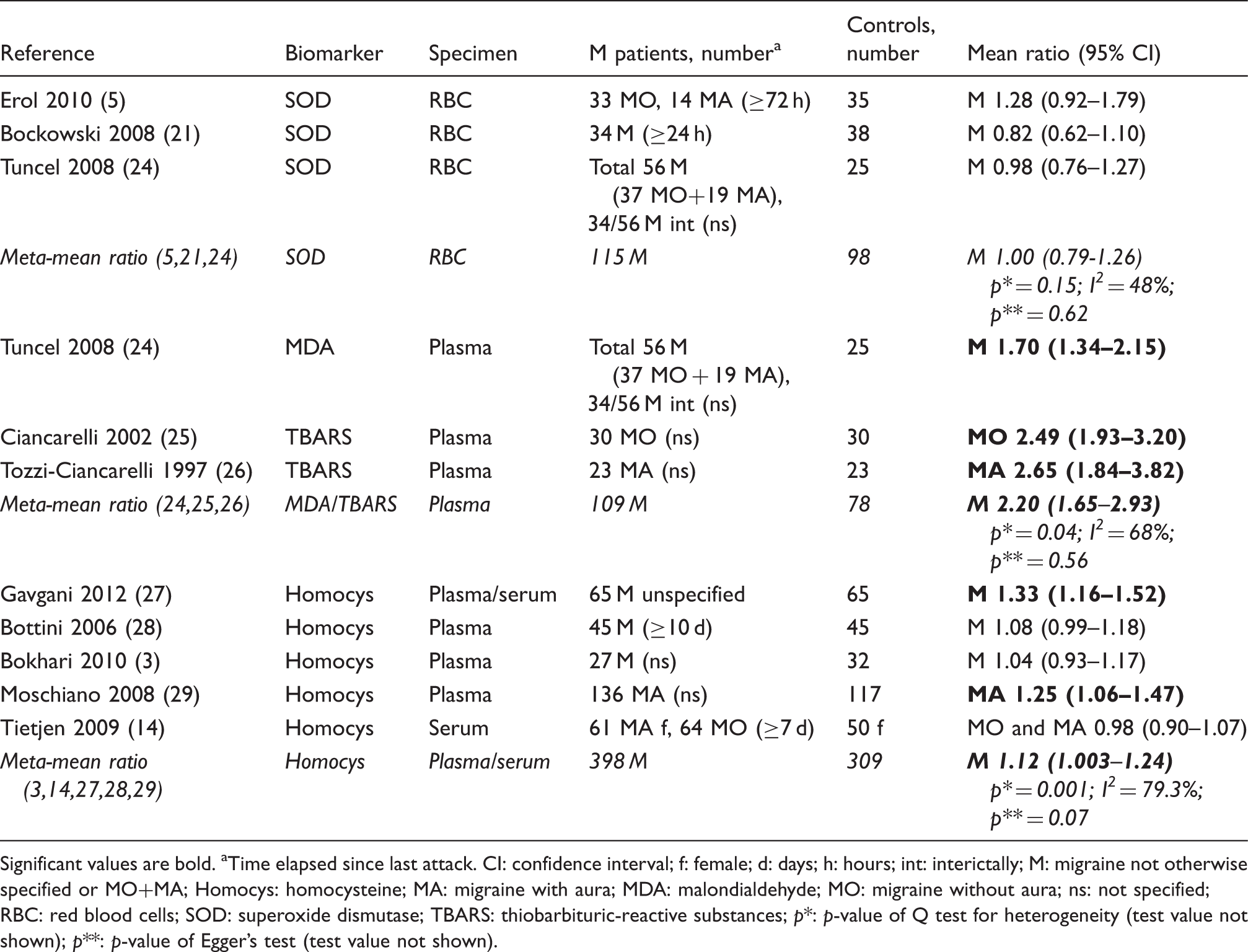
Significant values are bold. aTime elapsed since last attack. CI: confidence interval; f: female; d: days; h: hours; int: interictally; M: migraine not otherwise specified or MO+MA; Homocys: homocysteine; MA: migraine with aura; MDA: malondialdehyde; MO: migraine without aura; ns: not specified; RBC: red blood cells; SOD: superoxide dismutase; TBARS: thiobarbituric-reactive substances; p*: p-value of Q test for heterogeneity (test value not shown); p**: p-value of Egger's test (test value not shown).
TBARS are a non-specific witness of oxidative stress and their validity as an efficient oxidative damage biomarker is the object of discussion in the scientific community. However, they are rather homogeneous, when measured by spectrophotometry, irrespective of the name assigned by the authors to the assay (TBARS or MDA); instead, chromatographic techniques are specific for MDA (30,31). In the retrieved papers, TBARS were significantly higher in cases than in controls when measured with spectrophotometry in plasma (24–26,32), and similar results were found in platelets (33,34) and urine (35,36). In the summary estimate of the three studies with available data (24–26), cases doubled control values (Table 1). However, the opposite was found in serum, with chromatography and other methods. This apparent contradiction should be addressed in future studies. Glutathione pathway has a major role in antioxidant defenses. Homocysteine is one of the sources of cytosolic cysteine, the rate limiting amino acid for the synthesis of the active antioxidant form of glutathione (GSH; 37). Five studies evaluated serum/plasma homocysteine levels interictally, comprising about 400 cases and 300 controls altogether (Table 1). Two showed 25% to 30% higher values in patients (statistically significant in (27,29)), while three gave inconclusive results (3,14,28)). After meta-analysis, they gave a borderline statistically significant increased meta-MR, which became statistically significant after excluding Tietjen et al. (14) in the sensitivity analysis (1.16, 95% CI: 1.04–1.29). This is consistent with the values shown in the National Health and Nutrition Examination Survey (NHANES), conducted on “severe headaches including migraine” in almost 12,000 children and adolescents. On the other hand, another study showed opposite results in females (data not available, p = 0.001 (38)).
NOx
The unstable gaseous molecule NO causes vasodilation and is rapidly degraded to nitrates and nitrites. Its half-life is very short (a few seconds) so the body needs to constantly produce NO by oxidizing the amino acid L-arginine with the enzyme NO synthase. If there is not enough L-arginine or if there are L-arginine-like NO synthase inhibitors, such as asymmetric dimethyl arginine (ADMA), less NO is produced and this leads to hypertension.
Mean ratios of biomarkers related to nitrogen oxide pathway in blood or urine of migraineurs and controls.

Significant values are bold. aTime elapsed since last attack (int) or time elapsed from the attack onset (ict). bPatients on low nitrite/nitrate diet; ADMA: asymmetric dimethylarginine; CI: confidence interval; f: female; d: days; h: hours; w: week; ict: ictally; int: interictally; M: migraine not otherwise specified or MO + MA; MA: migraine with aura; MO: migraine without aura; na: complete data not available in the original article; ns: not specified; nss: not statistically significant; NOx: nitrogen oxides; p*: p-value of Q test for heterogeneity (test value not shown); p**: p-value of Egger's test (test value not shown).
Specifically, 343 migraineurs recruited interictally vs. 320 healthy individuals gave a non-significant meta-MR, that grew to 1.12 (1.04–1.19) after excluding Ciancarelli et al. (4) in the sensitivity analysis. In the subgroup of MO, the meta-MR was 1.06 (0.94–1.20), while cases recruited during an attack showed a meta-MR of 1.78 (95% CI 0.89–3.56), both without any relevant change after the sensitivity analysis. Similar results were obtained in platelets: in two articles NOx levels were slightly higher in migraineurs than controls (38,44), one additional study on patients with MA reported more than double levels interictally and more than four-fold during attacks (both statistically significant (45)).
Three studies on urinary NOx demonstrated more than double concentrations in patients with respect to controls (13,30,46), but one conducted only in females gave opposite results (14). Consequently, the summary estimate showed no difference (Table 2).
At first glance, NOx results failed to show major differences between cases and controls. However, all reports on patients recruited during attacks showed higher MRs, independently of the specimen, and the same was true for all the studies conducted in MA, but one (14). In addition, given the potential role of diet in regulating nitrates/nitrites balance, we checked dietary information in all articles (reported in Table 2). All the studies in blood resulting in inconclusive/absent difference between cases and controls, plus the only study with a significant decrease in migraine patients, were conducted in patients on a low-nitrite/-nitrate diet. On the other hand, almost all studies conducted without dietary limitations showed significantly higher blood NOx levels in cases than controls. These results should be validated and reproduced in further well-designed studies.
Finally, ADMA concentration in plasma or serum showed limited difference between cases and controls in three studies (40,43,46), and in their meta-analysis (Table 2).
Limitations
Study heterogeneity was often significant; however, it did not affect three meta-analyses, i.e. SOD, ADMA, and NOx in plasma/serum of MO patients. No evidence of publication bias was found in any meta-analysis, although this measure has low reliability as fewer than 10 studies were evaluated (47). Another limitation is the insufficient patients’ clinical characterization: the term “interictal” is ambiguous per se, and future studies should address more in-depth clinical features of migraine, e.g. attack frequency and disease duration, in addition to MO and MA status. Sensitivity analyses revealed that, in a couple of examples, individual studies could critically affect meta estimates. In both cases it was a bias toward the null, which only further emphasizes the importance of standardization and good quality of study design.
Conclusions
This meta-analysis represents the first systematic attempt to summarize the existing evidence on the relationship between migraine and biomarkers of oxidative stress or NO pathway. Results from these meta-analyses should be considered as preliminary, since the picture is still hazy; however some lines of evidence and interesting cues are emerging, such as in the case of TBARS, SOD, or the possible role of environmental factors (diet) in the control of NOx levels.
Existing data referring to different biomarkers within the same pathways should be carefully reviewed, in order to gain a more detailed view and to track direction for future research. An improvement in standardization of study design and laboratory methods is strongly required in order to put together consistent and meaningful data.
Clinical implications
Oxidative and nitrosative stress are considered key events in the still unclear pathophysiology of migraine. Nineteen studies comparing the level of biomarkers related to nitric oxide pathway/oxidative stress in the blood/urine of migraineurs vs. unaffected controls were extracted from the PubMed database, accounting for more than 1100 patients and their controls. After meta-analysis, plasma levels of the aspecific biomarker thiobarbituric acid reactive substances (TBARS) were more than double in cases than in controls. Most studies measuring superoxide dismutase (SOD) showed lower activities in cases. As for nitrate/nitrite, higher levels were found in patients with migraine with aura between attacks than in controls, but not in individuals on a low-nitrite/-nitrate diet.
Footnotes
Funding
This work was supported by AIRC, Fondazione Veronesi and FORST.
Conflict of interest
None declared.
References
Supplementary Material
Please find the following supplemental material available below.
For Open Access articles published under a Creative Commons License, all supplemental material carries the same license as the article it is associated with.
For non-Open Access articles published, all supplemental material carries a non-exclusive license, and permission requests for re-use of supplemental material or any part of supplemental material shall be sent directly to the copyright owner as specified in the copyright notice associated with the article.
