




Abstract
Introduction
In 2013 the International Headache Society published the third International Classification of Headache Disorders beta-version, ICHD-3 beta. Its structure is identical to that of the present proposed version of the International Classification of Diseases (ICD-11), although slightly abbreviated to fulfill the needs of ICD-11. In the following, only ICHD-3 beta is mentioned, but findings regarding the validity of ICHD-3 beta categories are equally relevant to the forthcoming ICD-11. Here we field-tested the criteria for 1.2 migraine with aura (MA), 1.2.1 migraine with typical aura (MTA), 1.2.3 hemiplegic migraine, 1.2.2 migraine with brainstem aura, and the alternative criteria A1.2 MA and A1.2.1 MTA.
Methods
Clinical characteristics were systematically and prospectively collected from patients with 1.2.1 MTA, 1.2.4 familial hemiplegic migraine (FHM), 1.2.5 sporadic hemiplegic migraine (SHM) and 1.2.6 basilar-type migraine according to ICHD-2 in a cross-sectional study design. A database of 2464 patients with 1.1 migraine without aura and 1.2 migraine with non-hemiplegic aura and a database of 252 hemiplegic migraine patients (1.2.4 FHM or 1.2.5 SHM) was collected. We used SPSS 20 for Windows 8.0 for the statistical analysis.
Results
All ICHD-2 patients fulfilled ICHD-3 beta criteria for 1.2 MA. The ICHD-3 beta criteria for 1.2.1 MTA were more sensitive than ICHD-2 and ICHD-3 beta alternative criteria; they resulted in fewer probable MA diagnoses. Too many patients fulfilled ICHD-2 and ICHD-3 beta criteria for 1.2.2 migraine with brainstem aura. ICHD-3 beta criteria for 1.2.4 FHM and 1.2.5 SHM both comply with ICHD-2.
Conclusion
The new criteria in ICHD-3 beta/proposed ICD-11 for 1.2 MA, 1.2.1 MTA, 1.2.3.1 FHM and 1.2.3.2 SHM have more desirable properties than ICHD-2 and the ICHD-3 beta alternative criteria. The criteria for 1.2.2 migraine with brainstem aura should be more restrictive.
Keywords
Introduction
In 2013 the International Headache Society (IHS) published the third International Classification of Headache Disorders beta-version, the ICHD-3 beta (1). It is the first time that the ICHD has been published in a beta version and the purpose was to field-test the criteria before publishing the final version. According to Oxford Advanced Learner’s Dictionary, to “field-test” is to “test something, such as a piece of equipment, in the place where it will be used.” In this context, field-testing means testing the criteria on actual patients with actual symptoms, often collected in a database, as is tradition within the field of headache research (1). The 11th edition of the World Health Organization’s (WHO’s) International Classification of Diseases (ICD-11) in a preliminary form uses the same linear structure of ICHD-3 beta and field-testing is therefore equally relevant to both classifications. In the following we mention for ease only ICHD-3 beta codes and criteria.
The purpose of the present study was to field-test the ICHD-3 beta criteria for 1.2 migraine with aura (MA) and its sub-diagnoses: 1.2.1 migraine with typical aura (MTA), 1.2.3.1 familial hemiplegic migraine (FHM), 1.2.3.2 sporadic hemiplegic migraine (SHM) and 1.2.2 migraine with brainstem aura. The study population consisted of a large cohort of patients with extensive prospectively collected data on clinical characteristics and with diagnoses made by specialists in migraine and headache diseases according to ICHD-2 (2). The patients’ diagnosis according to ICHD-2 was compared to the diagnosis according to the ICHD-3 beta criteria. We discussed any mismatch between the ICHD-2 and ICHD-3 beta diagnosis. We also tested the alternative criteria for A1.2 MA and A1.2.1 MTA proposed in the appendix of ICHD-3 beta. The purpose was to see if the alternative criteria had more desirable qualities than the criteria for 1.2 MA in the main body of ICHD-3 beta.
Material and methods
1.2.1 Typical aura with migraine headache in ICHD-2.

ICHD-2: International Classification of Headache Disorders, second edition.
1.2 Migraine with aura, MA in ICHD-3 beta.

ICHD-3 beta: International Classification of Headache Disorders, third edition beta.
1.2.1 Migraine with typical aura, MTA in ICHD-3 beta.

ICHD-3 beta: International Classification of Headache Disorders, third edition beta.
Division of sub-diagnoses of migraine with aura (MA) in ICHD-2 and ICHD-3 beta.

ICHD-2: International Classification of Headache Disorders, second edition; ICHD-3 beta: International Classification of Headache Disorders, third edition beta.
A 1.2.1 Migraine with typical aura alternative criteria in ICHD-3 beta.
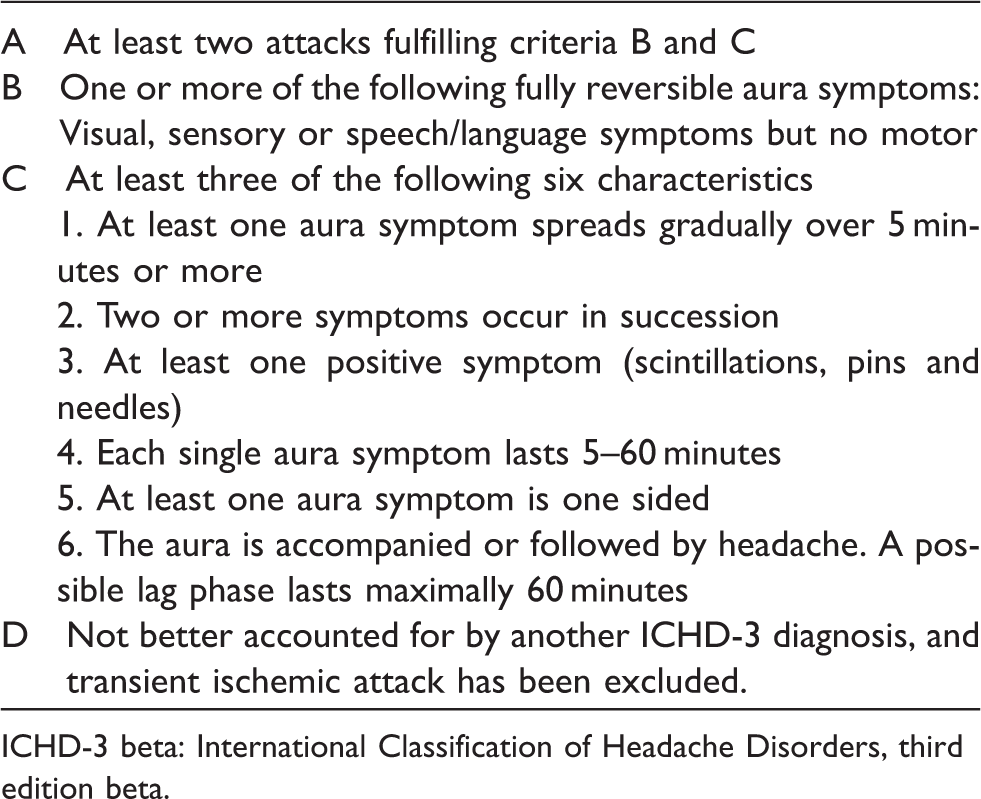
ICHD-3 beta: International Classification of Headache Disorders, third edition beta.
The present study was based on detailed patient information from our database that consisted of a total of 2464 patients with 1.1 migraine without aura (MO) and 1.2 migraine with non-hemiplegic aura, and a database of 252 hemiplegic migraine patients (1.2.4 FHM or 1.2.5 SHM). The patients were diagnosed with any type of 1.2 MA including 1.6.2 probable migraine with aura in ICHD-2.
The first cohort was recruited 1997–1999 by a computerized search of the Danish National Patient Register and screening of 27,000 case files from neurological clinics. The recruitment has been described in detail in a previous publication (4–6). In brief, the patients were systematically questioned about headache symptoms by a trained physician or a trained senior medical student using a validated, semi-structured interview. They were sent written information before contact by telephone. A total of 980 were included in our database and diagnosed with migraine with non-hemiplegic aura. They were initially diagnosed according to ICHD-1, based on the raw clinical data from the interview, but the operational characteristics of ICHD-2 were later applied to the clinical data for the purpose of later studies. A large study from 2010–2011 recruited more patients using the same method.
The diagnosis of the 1.2.4 FHM and 1.2.5 SHM patients (1.2.4 FHM and 1.2.5 SHM) was originally based on the criteria of ICHD-1 (5) and information about these patients was gathered during two study periods described in detail previously (7–9). In short, the patients were similarly recruited and diagnosed as above. They were screened by telephone and 252 patients were identified with hemiplegic migraine (1.2.4 or 1.2.5). In total, our database consisted of 147 1.2.4 FHM patients and 105 1.2.5 SHM patients. The extensive data allowed us to convert their diagnoses into ICHD-2 diagnoses.
The study was approved by the Danish Standards Ethical Committees and the Danish Data Protection Agency (protocol no. KA91234, KA94076m and H-2-2010-122). Written informed consent was obtained from all participants.
Data processing and statistical analysis
The statistical analysis used SPSS Base System 20 for Windows 8.0.
Patients fulfilling ICHD-2 criteria for 1.2.1 MTA and 1.6.2 probable MA were submitted to testing of the criteria for 1.2 MA in ICHD-3 beta. They were also tested according to the criteria for 1.2.1 MTA and 1.5.2 probable MA in ICHD-3 beta.
1.2.3 Hemiplegic migraine in ICHD-3 beta.
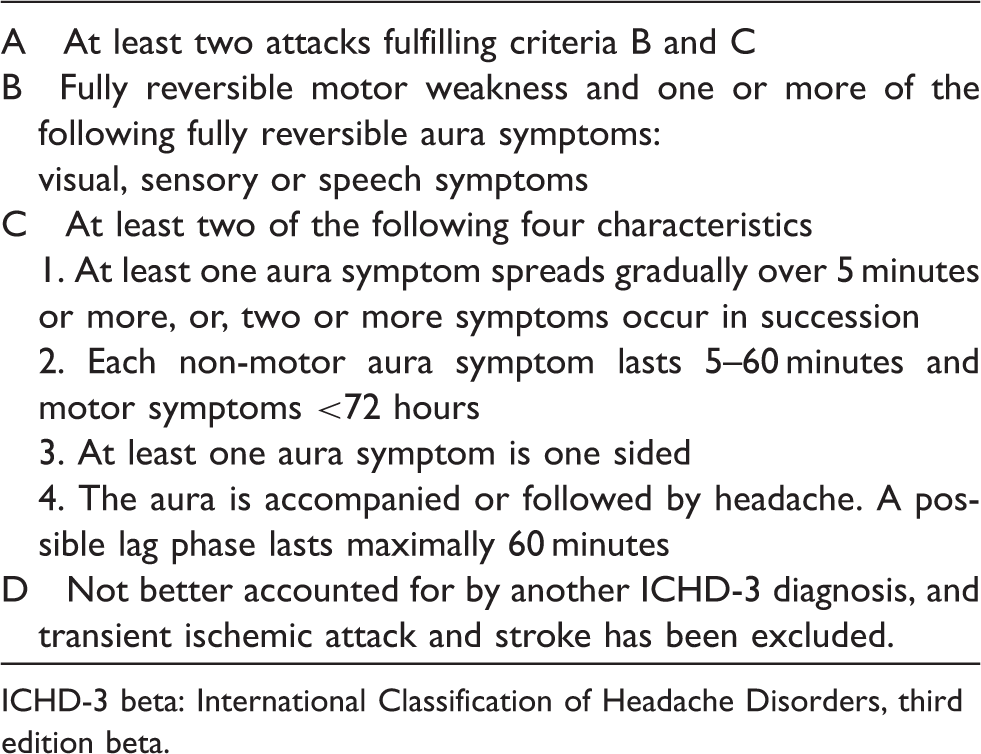
ICHD-3 beta: International Classification of Headache Disorders, third edition beta.
1.2.3.1 Familial hemiplegic migraine (FHM) in ICHD-3 beta.

ICHD-3 beta: International Classification of Headache Disorders, third edition beta.
It was also tested whether hemiplegic attacks (1.2.3.1 FHM or 1.2.3.2 SHM) met the 1.2 MA diagnostic criteria in ICHD-3 beta, which were meant to include all types of migraine with aura. In hemiplegic patients, only data from hemiplegic attacks were used. Some of these patients also had attacks of 1.2.2 MTA, which were not used.
1.2.3.2 Sporadic hemiplegic migraine (SHM) in ICHD-3 beta.
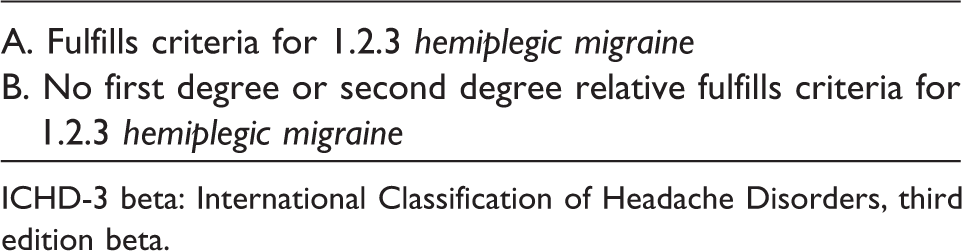
ICHD-3 beta: International Classification of Headache Disorders, third edition beta.
1.2.2 Migraine with brainstem aura in ICHD-3 beta.

ICHD-3 beta: International Classification of Headache Disorders, third edition beta.
The appendix criteria for A1.2 MA and A1.2.1 MTA (A1.2.1 appendix MTA) were also field-tested using this cohort.
Sensitivity and specificity were used to indicate how many patients share or do not share the same diagnosis in the different classification systems, respectively, with the ICHD-2 classification as reference in the absence of a Gold Standard (1).
Results
Distribution of patients according to diagnosis in ICHD-2, ICHD-3 beta and appendix ICHD-3 betaa.

aA patient in our database can have more than one migraine sub-diagnosis. Therefore the same patient can be counted more times if they have more than one of the primary migraine sub-diagnoses.
bThere are no common criteria for 1.2 MA in ICHD-2. 1.2 MA is fulfilled if a sub-diagnosis is fulfilled.
cA total of 194 patients out of these 1210 MTA patients have migraine with brainstem aura according to ICHD-3 beta. dThis included 1210 MTA; 147 FHM and 105 SHM patients. ICHD-2: International Classification of Headache Disorders, second edition; ICHD-3 beta: International Classification of Headache Disorders, third edition beta; MA: migraine with aura; MTA: migraine with typical aura; FHM: familial hemiplegic migraine; SHM: sporadic hemiplegic migraine.
All patients from all MA subgroups diagnosed according to ICHD-2 fulfilled the new diagnostic criteria for 1.2 MA in ICHD-3 beta. These new second-digit diagnostic criteria were thus 100% sensitive (data not shown).
A total of 283 patients (56 males, 227 females) had an ICHD-2 diagnosis of 1.6.2 probable MA. In ICHD-3 beta, 170 had 1.2.1 MTA; 52 had 1.5.2 probable MA and 61 had 1.1 MO (Figure 1(a)).
(a) 1.6.2 Probable MA patients in ICHD-2 and their diagnosis according to ICHD-3 beta. (b) Patients with 1.5.2 probable MA in ICHD-3 beta and their diagnosis according to ICHD-2.
We had 113 patients with 1.5.2 probable MA according to ICHD-3 beta. Fifty-two of these were 1.6.2 probable MA and 61 were 1.1 MO in ICHD-2 (Figure 1(b)).
A total of 895 patients (215 males, 680 females) fulfilled the criteria for 1.2.1 MTA in ICHD-2 (Figure 2 and Table 8). All patients also fulfilled the ICHD-3 beta criteria for 1.2.1 MTA. According to ICHD-3 beta 1210 patients were diagnosed with 1.2.1 MTA. In ICHD-2, 895 of these were 1.2.1 MTA, eight were 1.2.6 basilar-type migraine, 170 were 1.6.2 probable MA and 137 were 1.1 MO (Figure 2).
Migraine patients with typical aura (1.2.1 MTA) according to ICHD-3 beta and their former diagnosis in ICHD-2
A total of 1098 patients fulfilled the criteria for A1.2.1 MTA in the ICHD-3 beta appendix and all also fulfilled the A1.2 MA appendix criteria in ICHD-3 beta. A total of 1138 patients were diagnosed with A1.2 MA and 211 as probable MA. Of the 1098 A1.2.1 MTA patients according to the appendix ICHD-3 beta criteria, only 843 were 1.2.1 MTA in ICHD-2, while eight fulfilled the criteria for 1.2.6 basilar-type migraine, 137 patients 1.6.2 probable MA and 110 had a 1.1 MO diagnosis in ICHD-2 (Figure 3).
Migraine with typical aura alternative criteria in ICHD-3 beta (A1.2.1 MTA) and their former diagnosis in ICHD-2*.
A total of 843 of 895 ICHD-2 1.2.1 MTA patients (94.1%) fulfilled the criteria for A1.2.1 MTA in the appendix of ICHD-3 beta, while 100% (895/895) of the 1.2.1 MTA patients in ICHD-2 fulfilled the criteria for 1.2.1 MTA in ICHD-3 beta.
All patients with 1.2.4 FHM or 1.2.5 SHM according to ICHD-2 had the same diagnosis after applying the ICHD-3 beta criteria (data not shown).
According to ICHD-2, 198 patients (42 males and 156 females; 45 mean age, SD 13.6) were diagnosed as having 1.2.6 basilar-type migraine. After application of the ICHD-3 beta criteria, this number was changed to 194 patients (32 males and 162 females; 46.9 mean age, SD 13.6). One-hundred and forty-eight patients had the diagnosis according to both ICHD-2 and ICHD-3 beta. Forty-eight patients had the 1.2.1 MTA diagnosis and two patients fulfilled the 1.6.2 probable MA criteria in ICHD-3 beta (Figure 4(a)). Thus, there was no significant change in the number of patients diagnosed with 1.2.2 migraine with brainstem aura according to ICHD-3 beta compared to ICHD-2. Figure 4(b) shows the 194 patients diagnosed with 1.2.2 migraine with brainstem aura and their diagnosis in ICHD-2.
(a) Patients with 1.2.6 basilar-type migraine in ICHD-2 and their diagnosis according to ICHD-3 beta. (b) Patients with 1.2.2 migraine with brainstem aura according to ICHD-3 beta and their previous diagnosis in ICHD-2. MA: migraine with aura; MTA: migraine with typical aura; MO: migraine without aura; ICHD-2: International Classification of Headache Disorders, second edition; ICHD-3 beta: International Classification of Headache Disorders, third edition beta.
Discussion
This study is the first to ever field-test the diagnostic criteria for 1.2 MA. The main results were that the ICHD-3 beta criteria had more desirable qualities than the ICHD-2 criteria but that criteria for 1.2.6 basilar-type migraine, now called 1.2.2 migraine with brainstem aura, were too open in both editions of the classification. Because the structure of ICHD-3 beta is also used in the preliminary version of the ICD-11, our field-testing is relevant for the forthcoming ICD-11.
The diagnostic criteria of 1.2 MA in ICHD-3 beta included all sub-forms of 1.2 MA in ICHD-2. Thus, ICHD-3 beta was 100% sensitive in diagnosing 1.2 MA. This is an important finding because diagnosis of migraine at the second-digit level is the preferred level of diagnosis in clinical practice. The specificity of the ICHD-3 beta criteria for 1.2 MA was determined to be 88.7% using the ICHD-2 diagnosis as reference. This was a result of 137 patients changing their diagnosis from 1.1 MO in ICHD-2 to 1.2 MA in ICHD-3 beta. Visual aura often gets confused with headache-induced visual disturbances. Clinicians are advised to exert caution when asking and interpreting patients’ visual symptoms as visual aura and carefully follow the criteria.
We have shown that the new criteria for 1.2 MA proposed in the ICHD-3 beta have more desirable properties than ICHD-2 in terms of diagnosing already suspected migraine cases. Several studies suggest that MA is difficult to distinguish from transient ischemic attacks (TIAs) (10, 11). It has been proposed that the gradual development of an aura does not occur in TIAs (12) and the inclusion of this criterion in ICHD-3 beta (Table 2) could contribute to a better differentiation between TIA and 1.2 MA. Others suggest that TIA mostly have negative symptoms, i.e. paresis, loss of sensation and so on (13). Even though the implementation of this criterion was proposed in the appendix of ICHD-3 beta, we did not have information on TIA patients to support that this contributes to the diagnosis of 1.2 MA. Further research using the diagnostic criteria in large materials of TIA is needed.
The main change in 1.2.1 MTA diagnosis for ICHD-2 to ICHD-3 beta is the addition of a single sub-criterion in ICHD-3 beta: “The aura is accompanied or followed by headache. A possible lag phase lasts maximally 60 minutes.” In ICHD-2 this criterion was criterion D, but in ICHD-3 beta it has been included in criterion C, which has four sub-criteria of which at least two must be fulfilled. All 1.2.1 MTA patients (according to ICHD-2) also fulfilled the criteria for 1.2.1 MTA in ICHD-3 beta (Figure 2 and Table 8). Thus, the reason for the increased number of 1.2.1 MTA patients in ICHD-3 beta must be attributed to the addition of this sub-criterion.
Since all 1.2.1 MTA patients in ICHD-3 beta fulfilled the criteria for 1.2 MA in ICHD-3 beta and did not fulfill criteria for another primary migraine diagnosis, the diagnosis according to ICHD-3 beta of 1.2.1 MTA in all 1210 1.2.1 MTA patients was determined to be their true diagnosis. Only 94.1% of 1.2.1 MTA patients in ICHD-2 fulfilled the alternative criteria for A1.2.1 MTA in the appendix of ICHD-3 beta while 100% of the 1.2.1 MTA patients in ICHD-2 fulfilled the 1.2.1 MTA criteria in the main text. Thus, the criteria for 1.2.1 MTA in the main text were preferable to ICHD-2 and to the appendix criteria.
All hemiplegic patients were diagnosed with the same diagnosis after application of the ICHD-3 beta criteria for 1.2.3.1 FHM and 1.2.3.1 SHM. The diagnostic criteria for 1.2.3.1 FHM and 1.2.3.2 SHM in ICHD-3 beta were 100% sensitive compared to the criteria in ICHD-2.
Proposed criteria for Migraine with brainstem aura.

GCSC: Glasgow Coma Scale modified by Palma and Cook; ICHD-3 beta: International Classification of Headache Disorders, third edition beta.
We did not have information on the quality of the sensory symptoms and therefore we tested the criteria from the appendix of ICHD-3 beta first with the assumption that all sensory disturbances were positive disturbances and also where all sensory disturbances were negative. The data showed no difference in final diagnosis (data not shown). This complies with the theory that most patients have another aura, usually visual, together with the sensory aura (14).
The strengths of this paper include a very large cohort, the use of a professionally conducted interview and of a validated, semi-structured format. Furthermore the collection of a multitude of clinical characteristics allowed the application of different sets of diagnostic criteria to the raw clinical data. A potential weakness is that the data were collected at different time points and by different investigators. On the other hand that makes the data more naturalistic. The interpretation of the symptoms explained by the patient may vary given the interviewer’s perspective at the given time. This is an inherent bias, but minimized by the fact that all interviewers were trained physicians or trained senior medical students with a significant knowledge about headaches in general and migraine in particular. Our patient group is highly specialized and thus may not represent the general population.
Conclusion
The new criteria in ICHD-3 beta for 1.2 MA, 1.2.1 MTA, 1.2.3.1 FHM and 1.2.3.2 SHM have more desirable qualities than ICHD-2 and the ICHD-3 beta appendix criteria. Further changes are needed to tighten the criteria for 1.2.2 migraine with brainstem aura (former 1.2.6 basilar-type migraine in ICHD-2). More clinical studies are needed to test if ICHD-3 beta is better in distinguishing between MTA and TIA. Our results are also relevant for the forthcoming ICD-11 of the WHO, which uses definitions based on the diagnostic criteria of the ICHD-3 beta.
Clinical implications
Field-testing of the new diagnostic criteria in the International Classification of Headache Disorders, third version beta (ICHD-3 beta)/proposed International Classification of Diseases (ICD-11) for migraine with aura. Clinically based with large study population of patients already diagnosed with migraine with aura by migraine specialists. New migraine with aura criteria is more sensitive and will aid general practitioners in making their initial diagnosis.
Footnotes
Funding
This research received no specific grant from any funding agency in the public, commercial, or not-for-profit sectors.
Conflict of interest
None declared.