




Abstract
On 7 September 1847, in Melbourne in the Port Phillip District of the Colony of New South Wales, David John Thomas (1813–1871) presented a paper, ‘On the inhalation of the vapour of Æther, with cases’, at an ordinary monthly meeting of the Port Phillip Medical Association. This is the earliest known presentation of a paper on etherisation in Australia. The partial publication of the manuscript in October 1847 in the Australian Medical Journal may have led to it being returned to Thomas in Melbourne. The handwritten manuscript is now preserved in the Medical History Museum, University of Melbourne, Melbourne, Victoria. A transcript of the complete manuscript is now recorded with relevant historical notes.
On 16 October 1846, after witnessing the first public demonstration of surgical etherisation at the Massachusetts General Hospital, Boston surgeon Henry Jacob Bigelow, MD (1818–1890), is said to have remarked to the effect that the news of the discovery was “a thing one might ride round the world on”. 1 Although he was then not aware of the composition of William T G Morton’s anodyne preparation, Bigelow took an immediate interest in its application in surgery and dentistry. Three weeks later, he presented the first paper on the still poorly understood process, and soon thereafter he published the first account of the discovery in a medical journal. 2 The anodyne and soporific vapour was of course sulphuric ether, and once this became known, it was reported in articles in newspapers and medical journals. The news of the discovery was also spread through personal correspondence.
Medical practitioners and the public in the Australian colonies received the news primarily from English sources; the published reports and mail were carried on sailing ships on a perilous four-month journey to Australia. The earliest documented cases of painless dentistry and surgery under etherisation in Australia were performed in Sydney and Launceston on 7 June 1847, nearly six months after the first cases of dental and surgical etherisation in London, and eight months after Morton had first administered ether for a surgical operation in Boston. 3
In Melbourne (population 12,000), in the Port Phillip District of New South Wales, ether was first administered to a surgical patient on 2 August 1847.4 –6 The delay in the introduction of ether as an anaesthetic in Melbourne could have a number of explanations, but the small town had a well-organised medical society, founded in May 1846. 7 The relative isolation of Melbourne may have led to greater cooperation among its medical practitioners, and was perhaps one of several reasons why the society succeeded when a similar proposal had failed in Sydney. On 7 September 1847, at an ordinary monthly meeting of the Port Phillip Medical Association, the surgeon David John Thomas, LSA, MRCS (1813–1871) (Figure 1) presented this first case of etherisation along with four other cases to a small group of medical practitioners.4 –8 His paper, ‘On the inhalation of the vapour of Æther, with cases’ is the earliest known presentation of a paper on etherisation in Australia. Remarkably, Thomas’ handwritten paper is still extant. It is now preserved in the Medical History Museum (Accession number MHMA1137.1), University of Melbourne, having previously been held in the historical collection of the Medical Society of Victoria, and thereafter by the organisations that succeeded it: the Victorian Branch of the British Medical Association, and the Victorian Branch of the Australian Medical Association (now known as AMA Victoria). 6
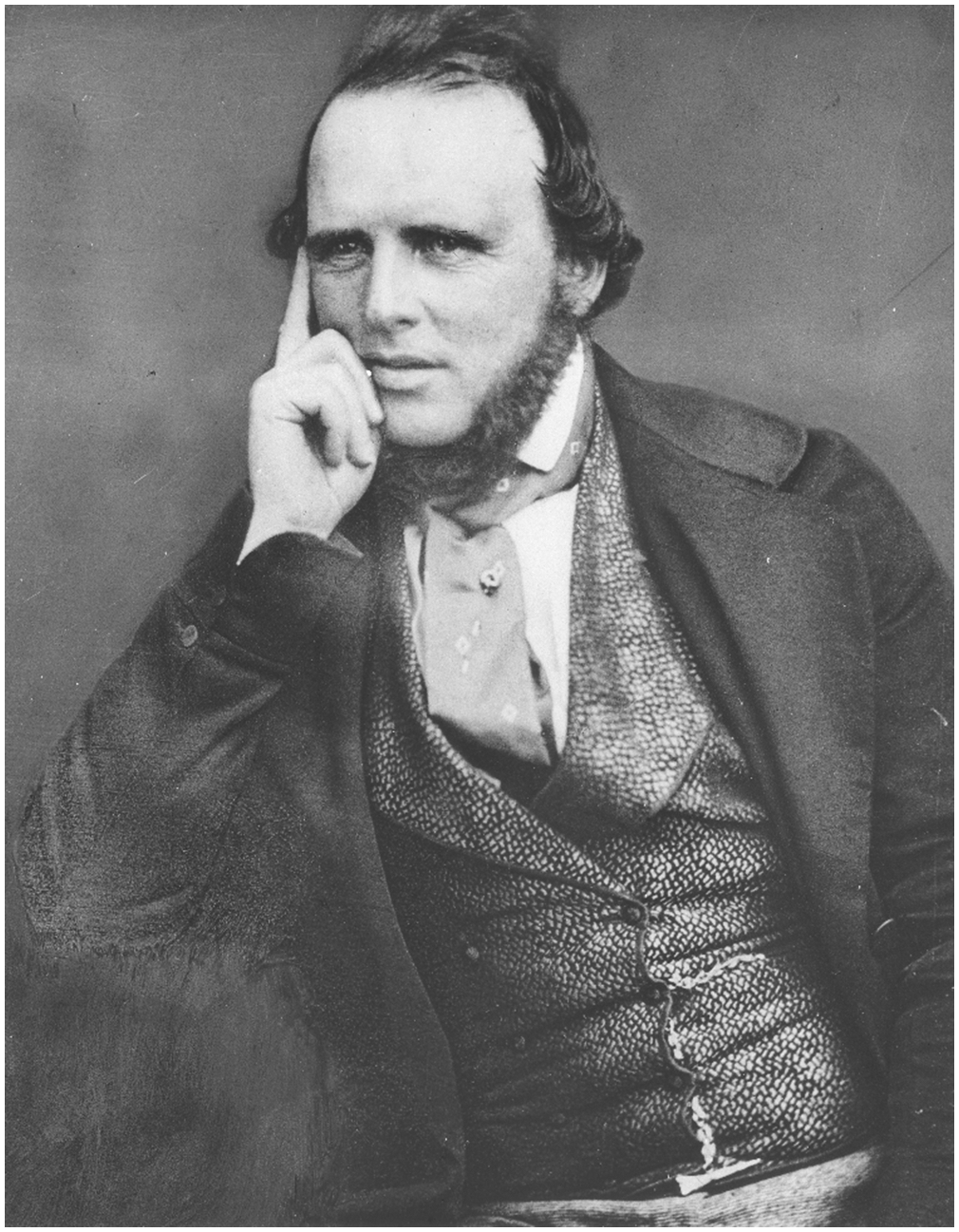
David John Thomas (1813–1871). Image courtesy of The Royal Melbourne Hospital, Melbourne, Victoria.
Thomas’ paper was published in part in October 1847 in the final issue of the series of the Australian Medical Journal that was published in Sydney, NSW, from August 1846 to October 1847 (15 issues). 9 The partial publication of the handwritten manuscript almost certainly led to its preservation—the manuscript may have been returned to Thomas in Melbourne soon after the Journal ceased publication. A full transcript of Thomas’ paper was published nearly a century later in the December 1933 issue of The Melbourne Hospital Clinical Reports. 10 When the original manuscript was examined by the author in July 2019, it became apparent that a more accurate transcript was required. Brief comments regarding the cases discussed by Thomas, other persons mentioned by him, apothecary prescriptions, and related developments in anaesthesia were also deemed necessary, leading eventually to the creation of an annotated transcript.
Notes on the transcription
The original manuscript was penned on unlined sheets of paper that were folded in the middle and stitched together to form a booklet (Figures 2 and 3). The resulting page size (21.5 cm × 31.8 cm) is slightly larger than the modern ISO 216 standard A4 paper size (21.0 cm × 29.7 cm). The 31 pages of handwritten text include a covering letter to the editor of the Australian Medical Journal, followed by 27 numbered pages that were read by Thomas (transcript pp. 1–27). The comments and discussion that followed the presentation of the 6,000-word paper were recorded by Thomas on three unnumbered pages at the end of the manuscript (in the transcript that follows, these pages have been assigned page numbers 28 to 30; word count 550).
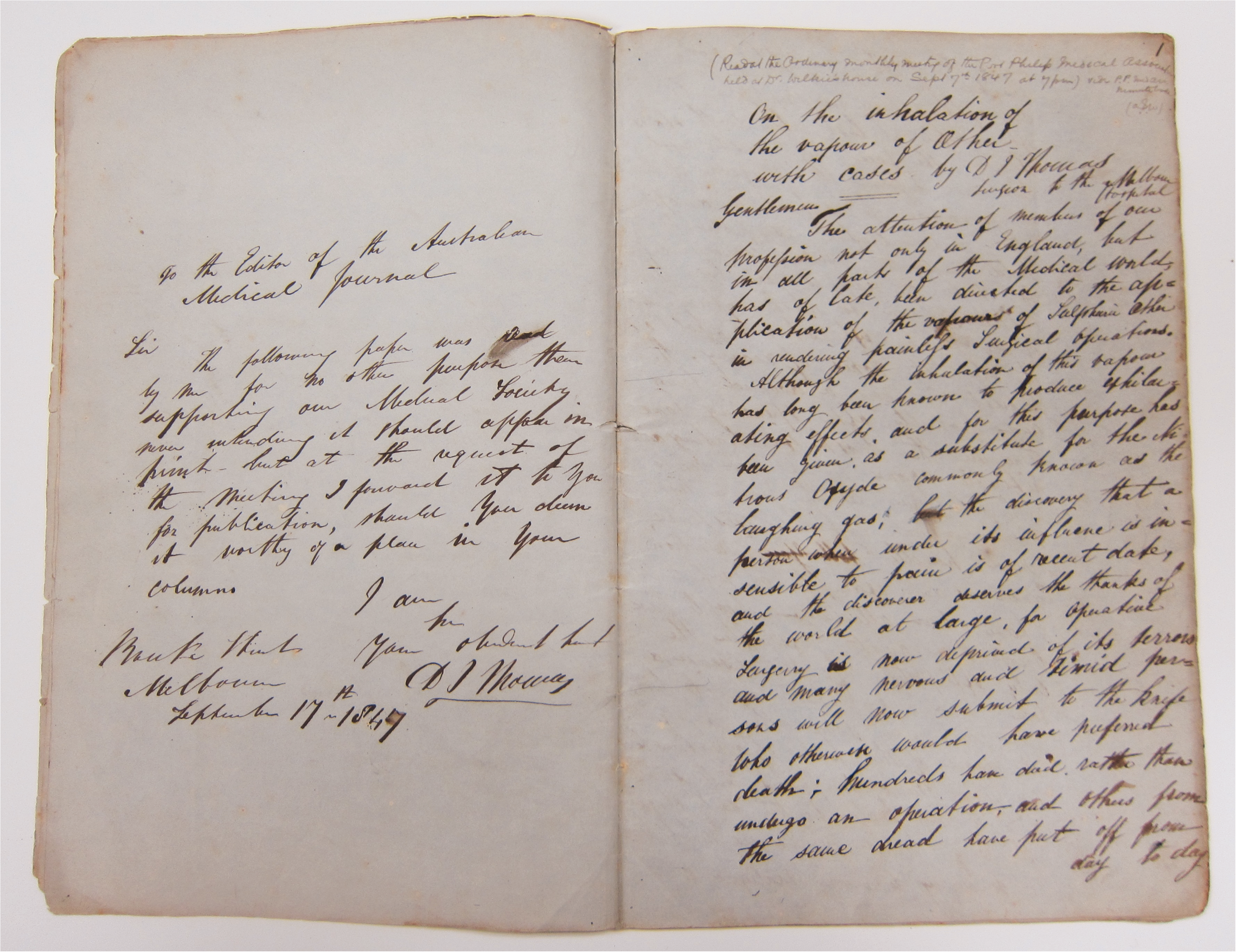
Covering letter, dated 17 September 1847, from David John Thomas to Isaac Aaron, editor of the Australian Medical Journal, and page one of Thomas’ paper ‘On the inhalation of the vapour of Æther, with cases.’ Original document in the Medical History Museum, University of Melbourne: Accession number MHMA1137.1 (gift of AMA Victoria).
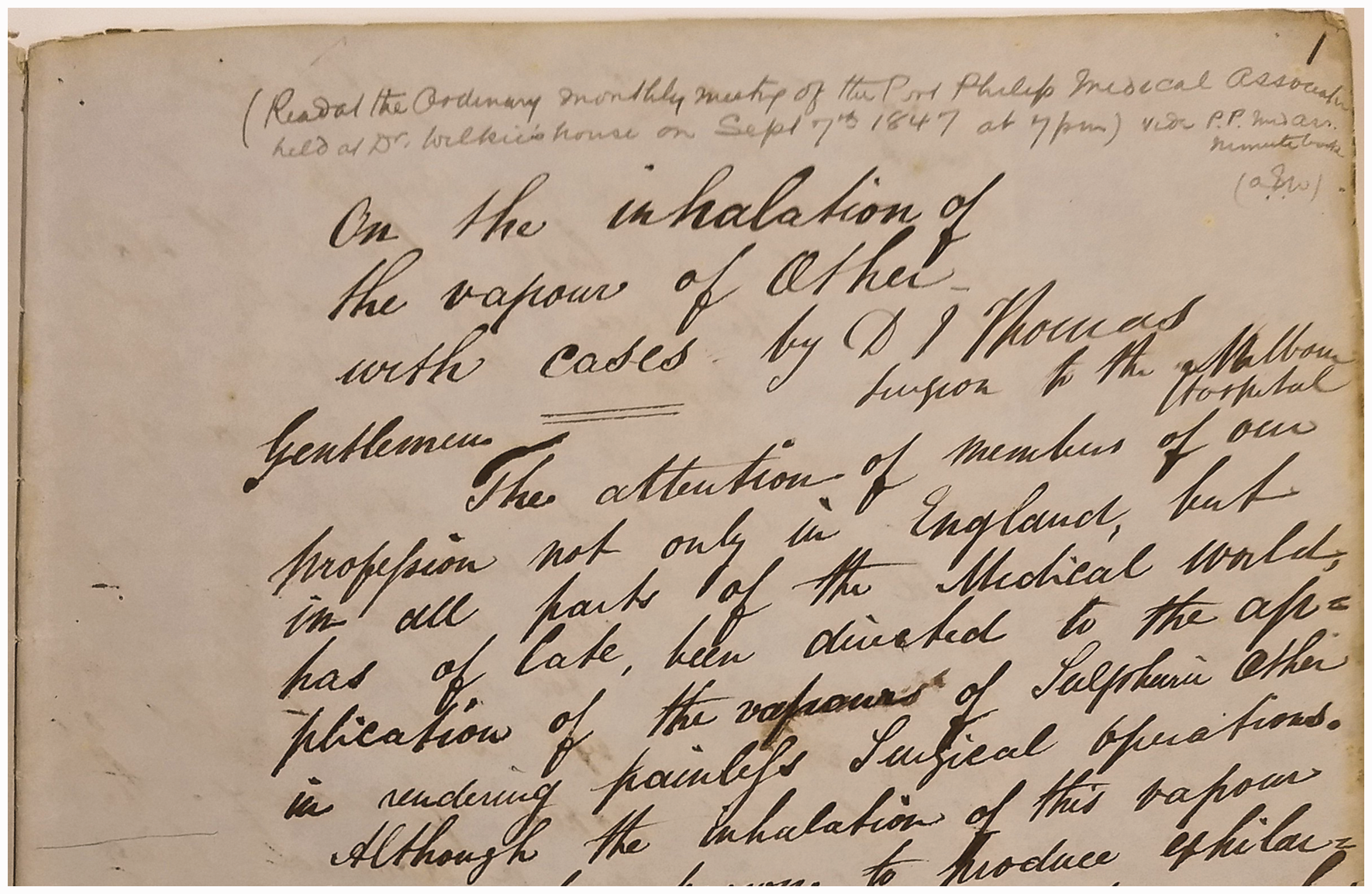
‘On the inhalation of the vapour of Æther, with cases.’ Title and first paragraph of a paper delivered by David John Thomas on 7 September 1847 at a meeting of the Port Phillip Medical Association, Melbourne. Original document in the Medical History Museum, University of Melbourne: Accession number MHMA1137.1 (gift of AMA Victoria).
A transcript of the covering letter, the first twelve pages and part of the thirteenth page of the manuscript were published in the October 1847 issue of the Australian Medical Journal. 9 It should be remembered that this transcript does not include the five cases presented by Thomas in his paper in September 1847. The cases, which are described on pages 15 to 25 of the manuscript, were first published in 1933 when Thomas’ paper was published in The Melbourne Hospital Clinical Reports. 10
Thomas did not always begin a sentence with a capital (upper case) letter or end a sentence with a distinct full stop. The use of punctuation marks varies throughout the manuscript. To assist the reader, punctuation marks have been inserted in square brackets, although these are used sparingly. Words in square brackets are words that were omitted from the manuscript, or the contemporary (present-day) spelling of misspelled words. Only a handful of words remain unresolved. In the transcript of pages 28 and 29, the missing letters from the surnames of doctors are provided in square brackets: for example, ‘Dr W’ is transcribed as ‘Dr W[ilkie]’. The transcript retains the use of capital letters where they have been used to begin words in the middle of a sentence or phrase. The word ‘ether’ or ‘æther’ is transcribed with an uppercase Æ: Æther. Deleted words or passages were not transcribed. Supplementary information and explanations of terms are provided in endnotes that are identified by the page number of the handwritten manuscript followed by a letter: for example, ‘1a’ is the first endnote for page 1 of the manuscript.
Footnotes
Acknowledgements
My research of the Port Phillip District, its pioneering medical practitioners, the first surgical operations performed in Melbourne with the aid of ether, and the manuscript of Dr David John Thomas was conducted over a period of four years (2017 to 2020). During this time, I received valuable comments from Emeritus Professor Laurie Mather, Emeritus Professor Barry Baker, Rod Westhorpe, Richard Bailey, John Paull, Michael Cooper and George Bause. I am grateful for information provided by Ken Smith, Martin Playne and Gerald Segal. Laurie Mather, Geoff Pritchard and Norm McFarlane reviewed the details of apothecary prescriptions.
I was assisted in my enquiries by the librarians, curators and archivists of a number of institutions: Brownless Biomedical Library and the Medical History Museum at the University of Melbourne; Royal Melbourne Hospital; State Library of Victoria; State Library of New South Wales; Fisher Library at the University of Sydney; Monash University Library; Richard Bailey Library at the Australian Society of Anaesthetists; and the History of Medicine Library at the Royal Australasian College of Physicians.
Author Contribution(s)
Declaration of conflicting interests
The authors declared no potential conflicts of interest with respect to the research, authorship, and/or publication of this article.
Funding received
The authors received no financial support for the research, authorship, and/or publication of this article.
