



Abstract
In the second half of the nineteenth century and up to the First World War, anaesthetic practice in Scotland differed markedly from that in England. Chloroform was invariably used in Scotland with apparent disregard for reports of deaths under its influence. By contrast, in England concern about chloroform deaths, which were subject to inquests there, led to ether often being chosen instead. This article examines the different interpretations and handling of chloroform deaths in the two countries, drawing on the medical journals of the period and archived documents. Quite symmetrical claims were made. Whereas in England the danger of chloroform was perceived to be an inherent property of the agent itself, in Scotland the blame was thrown on a timid method of administration. The interpretation in Scotland was supported by a network of doctors who promoted chloroform as effective, safe and easy to administer; manufacturers who had monopoly of its manufacture; and legal practitioners who were uninterested in investigating anaesthetic deaths. Although the reporting of anaesthetic deaths was flawed in England, underreporting was far worse in Scotland. The fear of anaesthetic deaths in England allowed the seeds of specialisation in anaesthesia to germinate, whereas in Scotland the downplaying of anaesthetic risk obviated the notion of such specialisation.
Introduction
In December 1846 general anaesthesia was introduced to the UK, and within just 8 years marked differences in anaesthetic practice developed between Scotland and England. These differences can be summarised as follows:
From 1848 chloroform anaesthesia remained the norm in Scotland until at least 1914. In England from 1848, chloroform also displaced ether, but from 1873 the anaesthetic of choice reverted back to ether due to concern over deaths under chloroform; however, by 1882 chloroform was reinstated for some cases because of increasing reports of ether causing bronchial irritation, perceived to result in postoperative chest complications. Anaesthetic apparatus (in the form of various inhalers) was commonly employed in England, but eschewed in Scotland, where the liquid anaesthetic was simply dripped from a drop-bottle onto a single layer of cloth held over the patient’s face. In English hospitals the administration of anaesthetics became restricted to qualified medical doctors, but in Scottish hospitals it was commonly the task of medical students. Deaths under anaesthesia were subject to a coroner’s inquest in England, but not in Scotland. Scotland was the main supplier of chloroform, as manufacturers there had achieved a monopoly.
These points of difference have been broadly agreed upon in frequently quoted books by historians since 1947, notably Barbara M Duncum, 1 W Stanley Sykes, 2 MH Armstrong Davison 3 and Stephanie J Snow. 4 Regarding chloroform, perhaps the only point of agreement between the two countries was that the vapour of chloroform should be largely diluted with air. Their several points of disagreement are shown in Table 1.
Points of disagreement on chloroform administration between Scotland and England.

However, the reasons for these differences have been largely ignored. This article aims to examine the details of the anaesthetic practices and focus on the reasons for the differences.
Loyalty to the Scottish ethos of chloroform anaesthesia
The culture of ‘anaesthesia’ meaning chloroform by ‘rag and bottle’ that pervaded Scotland, certainly at least the central part, for over six decades came from three prominent medical men and their disciples: James Young Simpson (1811 to 1870), James Syme (1799 to 1870) and Joseph Lister (1827 to 1912).
Sir James Young Simpson
James Young Simpson was Professor of Midwifery in Edinburgh from 1840, and in January 1847 he was probably the first to use ether in obstetrics. The story of how Simpson ‘discovered’ chloroform by inhaling it, together with his two young assistants in the dining room of his home, on 4 November 1847, is well known. 5 Just 11 days later, on 15 November, Simpson published his account of its use in surgery and midwifery, stating that he had exhibited it successfully in about 50 cases. He recommended no special apparatus, just a little chloroform on a cloth held over the patient’s mouth and nostrils. 6
On 28 January 1848 came the first reported death under chloroform anaesthesia. Near Newcastle upon Tyne, healthy 15-year-old Hannah Greener died when chloroform was administered for the removal of her right great toenail. An inquest was held, and the case was reported in the London Medical Gazette including an account by Dr Meggison, who administered the chloroform. 7 It was also reported in the Lancet, to which Simpson wasted no time in submitting his opinion that the death was not caused by chloroform, but from drowning by brandy used in resuscitation. 8 Dr Meggison gave a robust response. 9 These events were also reported in the Edinburgh Medical & Surgical Journal, where the editor remarked on Simpson’s critical observations: ‘it is difficult, and not quite safe, for any one who was not present to give any opinion’. 10
Simpson achieved an international reputation as the introducer of chloroform, and he was conferred a baronetcy by Queen Victoria in 1866. Despite reports of chloroform deaths, he never wavered from promoting chloroform for the rest of his life. 11 He always advocated it should be administered by dripping onto a facecloth; his criticism of the English method of sparing dosage by inhalers, on the grounds of effectiveness, was reported by Charles Kidd in 1868. 12
James Syme
James Syme was appointed to the University of Edinburgh Chair of Clinical Surgery in 1833 with admission to the staff of the Royal Infirmary. He was cautious to adopt ether anaesthesia when it became available at the beginning of 1847 and temporarily abandoned it, being impatient with the rather difficult and time-consuming induction of anaesthesia that was inherent in this agent. 13 However, from 1848 he embraced the easier-to-administer chloroform for most operations. Indeed, by the winter of 1854/1855 he incorporated within his lectures on clinical surgery a lecture on chloroform, which was published in the Lancet. This set out the principles for administration of chloroform (following the example of Simpson), which were followed in Edinburgh and most of Scotland for the next 60 years. His rules were as follows: administer chloroform by inhalation from a folded towel or handkerchief, allowing free admixture of air; give it rapidly and unstintingly; be guided entirely by the respiration (not by the circulation); if the breathing becomes stertorous, cease administration; if respiration becomes difficult or ceases, open the mouth, seize the tip of the tongue with artery-forceps and pull it well forward; always give the chloroform with the patient in the horizontal position; take care that the neck is not constricted by clothing. In the lecture, Syme implied that while chloroform deaths occurred in London, this was not so in Edinburgh, discounting one case ‘in another part of the hospital’ as if this did not matter because it had not involved his department. He also inferred that deaths under chloroform in London were due to the methods of its administration, which he decried, alluding to inhalers, attention to the quantity of chloroform given, and monitoring the pulse. 14 He did not deign to respond to John Snow’s (1813 to 1858) ‘Reply to Symes’s Lecture on Chloroform’ published just a week later in the Lancet, in which Snow pointed out the overlooking of Edinburgh’s lower population and deduced that deaths from chloroform there were as high as in London. 15 Snow was correct. Per the 1851 census, the population of Edinburgh was 202,000, while that of London was at least 2,685,000, similar to the population of Scotland (2,888,742).
Lord Joseph Lister
Joseph Lister was an Englishman who, on graduating in medicine at London University in 1852, arranged through William Sharpey (Professor of Anatomy and Physiology in London) to spend a month in Edinburgh observing the work of James Syme. The two got on well and Lister remained in Edinburgh for 7 years. He progressed from being Syme’s clerk to house surgeon at the Royal Infirmary of Edinburgh (RIE), and it was he who submitted Syme’s series of lectures including ‘Lecture III: On Chloroform’ (noted above) to the Lancet. In 1856 he married Syme’s daughter, Agnes. Lister fully adopted Syme’s teachings on chloroform, apparently disagreeing with the contrary views from London. In 1860 Lister was appointed Professor of Clinical Surgery in Glasgow, and the following year he contributed the article on anaesthesia in the first edition of Holmes and Hulke’s A System of Surgery – this reiterated Syme’s principles. 16 Following the retirement of Syme in 1869, Lister succeeded him as Professor of Clinical Surgery in Edinburgh. In his next article on anaesthesia for the second edition of A System of Surgery in 1870 Lister stated that, in the 9 years since the first edition, he knew of no cases of death from chloroform in the operating theatre of either the Edinburgh- or the Glasgow Infirmary, where it was administered unmeasured and unstinted by ‘rag and bottle’. 17 His denial of chloroform deaths in Edinburgh and Glasgow invites scrutiny. Perusal of the clinical surgery ward journals pertaining to James Syme at the RIE revealed three perioperative deaths between August and November 1863. In one of the cases the journal entry stated: ‘The patient has never recovered thoroughly from the effect of the chloroform, and has even shown a tendency to sink’. 18 Lister had stated ‘in the operating theatre’. Perhaps he thought that if death occurred in the ward shortly after leaving the theatre, this did not count. He also failed to mention a death in the private practice of James D Gillespie, surgeon at the RIE, the report of which he must surely have seen in the Edinburgh Medical Journal of January 1866. This report described the death of a frightened 16-year-old girl within seconds of a tooth extraction under chloroform administered by Gillespie at her home in November 1865. 19
Specialist anaesthetist Joseph T Clover (1825 to 1882), who had succeeded John Snow (died 1858) as the leading anaesthetist in London, responded to Lister’s new article by writing to the British Medical Journal (BMJ), which duly published his ‘Chloroform Accidents’ in its issue of 8 July 1871. 20 In a little less than two full columns, Clover politely asserted his disagreement with the following points made by Lister: ‘1. That in deaths from chloroform the breathing fails before the circulation; 2. That the chief danger arises from laryngeal obstruction; 3. That the chief duty of the administrator is to watch for laryngeal obstruction, and draw out the tongue with forceps when it occurs; 4. That it is useless to watch the pulse; 5. That chloroform may be given as safely by means of a towel as by any apparatus’. Clover had developed skill in maintaining the airway of the anaesthetised patient by forward jaw thrust, and he could boast 7000 chloroform administrations without a single death. He stated that when giving anaesthetics he watched both pulse and breathing, and he backed this up with a sensible explanation of the uptake of chloroform from the lungs by pulmonary circulation. He attributed chloroform deaths to the effect of the agent upon the heart, especially at too high a concentration. 20
Lister retaliated in a somewhat acrimonious manner. His lengthy responding article (more than five full columns) in the BMJ of 29 July 1871, 21 was a defence of his ‘Scotch schools’ technique’, reiterating the dogma of Syme. He said that Clover, in counselling medical men in general to disregard the pulling forward of the tongue, ‘promulgates most mischievous doctrine’ and ‘gives about as pernicious a piece of advice as can well be given with reference to the administration of chloroform’. He did acknowledge Clover’s experience and expertise in maintaining the airway ‘by raising the chin’ (so that he did not have to resort to pulling forward the tongue). However, Lister declared that in his practice (free from fatal accident in 3500 cases), chloroform was administered ‘by young men coming fresh to the duty every three months, and whose only instructions were to watch the breathing closely, and, in case of its obstruction, remove the cloth from the face, and at once adopt means to clear away the obstacle’. He alluded to ‘the whitewashings of coroners’ inquests’ and opined that chloroform deaths were due to preventable asphyxia resulting from negligence in the attention paid by the administrators. 21
In 1877 Lister moved to London to be Professor of Surgery at King’s College Hospital. He again wrote the article on anaesthetics for the third edition of Holmes and Hulke’s A System of Surgery in 1882, in which he disparaged an 1880 report of the British Medical Association (‘Glasgow Committee’) on anaesthetics, which warned that chloroform depressed the heart. He continued to promote chloroform by ‘rag and bottle’ by students under strict instructions, never touching the pulse. He stated that he had used this for the past 12 years. 22
‘Rag and bottle’ versus inhalers
Besides loyalty to the three strong personalities who advocated the ‘rag and bottle’ method of administering chloroform, an important reason for eschewing inhalers in Scotland must surely have been that these were very expensive. The standard model of Clover’s chloroform apparatus in 1870 cost ten guineas, 23 equivalent to about GBP 1200 in 2021. Expertise in such apparatus required training in both preparation and use, which when mastered could justify an administration fee – and a further cost to the surgeon and presumably the patient.
Reluctance to change beliefs
Generally, practitioners trained in the Scottish method of anaesthesia maintained their loyalty to the teachings of Simpson, Syme and Lister, and tended not to change their views when shown the English methods. Notably Surgeon Major Edward Lawrie, who had been house surgeon to Professor Syme in Edinburgh, staunchly supported Syme’s views on chloroform at Hyderabad, India, where he was appointed Residency Surgeon in 1885. He instigated the two Hyderabad Chloroform Commissions of 1888 and 1889 (animal experiments funded by the Nizam), which concluded that chloroform was not directly injurious to the heart and that it killed only by stopping breathing.24,25
Another who would not change was Elsie Inglis, who trained at the Edinburgh School of Medicine for Women, graduating LRCPS (Edin.), LRCPS (Glasg.) in 1892. She then obtained a resident medical officer post at the New Hospital for Women (London), and in a letter that year she gave this opinion on the anaesthetic service she encountered there: They are all most frightfully nervous about anaesthetics here, in all the hospitals … they watch the wrong organ, viz. the heart. In Scotland they hardly think of the heart, and simply watch the breathing. The Hyderabad Commission settled conclusively that it was the breathing gave out first; but having made up their minds that it does not, all the Commissions in the world won’t convince them to the contrary.
26
Interpretation and handling of anaesthetic deaths in Scotland compared to England
Debates over the cause of sudden death
The problem with chloroform was that sudden death sometimes occurred even though the administration of anaesthesia seemed careful and at the appropriate dosage. The Scottish view, led by Simpson, Syme and later Lister, was that death under chloroform only occurred under ‘light’ anaesthesia or from respiratory failure – therefore it should be given generously (unmeasured) with attention to the breathing. Opposing this was the English view, led by John Snow and later Joseph Clover. They maintained that death under chloroform was frequently caused by stoppage of the heart, especially if the concentration of chloroform was too high. Therefore they advocated quantitative (measured) administration with continuous monitoring of the pulse. 27 What was not yet understood was the potential for dangerous dysrhythmia of the heart induced by a combination of light chloroform and fear.
A clue to the danger being an effect on the heart was provided as early as 1842 by Robert M Glover, in a paper that described how chloroform could induce an irregular heartbeat in animals. 28 This was also in Glover’s 1840 thesis for his Doctor of Medicine, which he defended before Simpson, yet Simpson ignored it. 29 In the 1880s consideration was also given to the possibility of deaths being due to impurities in chloroform. 30
Legal differences
On the instigation of Thomas Wakley, the London surgeon and editor of the Lancet, who advocated that inquests should be held for all cases of sudden death, 31 medical coronerships were established in England from the 1840s. The addition of postmortem examination received support from Dr William Farr, Statistical Superintendent at the General Register Office (GRO) for obtaining vital statistics. Independent medical men might contribute and in 1893 the expert anaesthetist Dudley Buxton wrote (on the request of a London coroner) ‘The Coroner’s Catechism’ on relevant questions to be asked of the administrator of anaesthesia. In 1894 the Coroners Society agreed a general rule to hold inquests in all cases of death under anaesthesia. The London County Council in 1895 recommended that every case of death after surgical operation should be reported to the coroner. However, there was no legislation that coroners be notified of deaths under anaesthesia. The 1858 Medical Act authorised practitioners to certify causes of death on certificates for the GRO, but there was no requirement to mention anaesthetics as a contributing cause or for a local registrar of deaths to forward such a certificate to the coroner. After the 1860 Coroners Act, most coroners were paid by fixed salary, but this could be adjusted every 5 years according to the average number of inquests held by the individual coroner. The coroners’ courts were open to the public. 32
Instead of coroners, Scotland had Procurators Fiscal (appointed by local sheriffs, under the Lord Advocate), in whom was vested the decision to proceed with investigations into suspicious, sudden, and accidental deaths. 33 Instructions were drawn up by the Lord Advocate and issued by the Crown Office. Deaths under anaesthesia were sometimes investigated, including postmortem examination, but this was far less frequent than in England. From 1868 the directions were formalised into a first Book of Regulations, but (like in England) this had no mention of anaesthesia. Professor Syme of Edinburgh was involved in the drawing up of the directions. 34 Not until 1904/1905 did the Lord Advocate issue instructions to Procurators Fiscal that in cases of deaths under anaesthetic, a report should be obtained from an independent medical man; this was interpreted as ‘deaths under anaesthetic in unusual circumstances’. 35 In practice, investigations of sudden and suspicious deaths were conducted in private and locally; there was no obligation to return findings to a central court of record. Pursuance of inquiry was at the discretion of the Procurator Fiscal. Due to differences in the priority of reporting and costs, there was correspondingly less investigation of sudden deaths by postmortem examination in Scotland than in England. For example, between 1848 and 1857, approximately 500 such reported deaths were investigated annually in Scotland out of about 20,000, that is, a rate of 2.5%; the corresponding rate in England was 5%. 36
In England it was commonplace for hospital anaesthetic deaths to be reported to the Registrar General, albeit reporting of anaesthetic deaths in private practice was low. 37 In contrast, there is evidence that Scottish legal examiners were less likely than their English counterparts to be alerted to anaesthetic deaths. An article in the Edinburgh Medical Journal of July 1855 by surgeon James Craig summarised the modus operandi of inquests in Scotland. He opined that following the change to fixed salaries for Procurators Fiscal, they had less zeal in bringing cases for trial, than formerly when they were paid fees for individual cases; not uncommonly the legal authorities neglected their duties for sudden and suspicious deaths. He gave several examples, including the death of a woman after chloroform administered for childbirth that was not investigated. He alleged that the law authorities in Scotland very rarely sanctioned a postmortem examination, because of the parsimony of the exchequer. Further, he opined that the recent Registration Act had not remedied the problems, because all that was demanded was that the correct form be completed – it was permitted to record in the register ‘found dead’ or ‘cause of death unknown’. 38
At the British Pharmaceutical Conference held in Edinburgh in August 1892, during discussion of a paper on tests for the purity of chloroform, one of the delegates expressed astonishment on learning that coroners’ inquests were not required in Scotland: ‘A patient might succumb under chloroform in the Edinburgh Infirmary, and the world would know nothing of it, but the same thing could not happen in England’. 39 Regarding private practice, a letter from author ‘FFPSG’ was published in the BMJ of 18 September 1897 warning of a false sense of security in Scotland about chloroform, because ‘the Procurator-Fiscal’ often did nothing about chloroform deaths. 40
Rules for hospitals
As early as 1853, consequent on an inquest conducted under Thomas Wakley, rules for chloroform administration were promulgated at University College Hospital (UCH), London, restricting it to qualified medical staff. 41 In 1896, standing orders on administration of anaesthetics at the London Hospital (Whitechapel) forbade chloroform administration by residents, excepting a few specific cases, including the presence/authorisation of the visiting staff or instructor in anaesthetics. 42 Searching has not revealed any cases of coroners requesting reports of anaesthetic deaths from hospitals, presumably because such reports were already being generated to the General Medical Council. St Bartholomew’s Hospital compiled reports of deaths related to anaesthetics from 1878 and the London Hospital (Whitechapel) from 1886. 43
By contrast, in Scotland, it was not until 1880 that the Procurator Fiscal recommended to the RIE that two qualified medical men be present at all operations involving administration of chloroform. When a death under chloroform (administered by a fourth-year medical student) occurred following a lapse of this policy in early 1889, the Procurator Fiscal advised the Committee to adopt the following rule: ‘No member of the Resident Staff shall perform any operation under chloroform without the presence of another qualified medical man’. 44 In 1892 the ‘Crown Agent’ requested a report of deaths under chloroform at the RIE for the period 1889 to 1891, which was duly compiled. 45
Statistics of anaesthetic-related deaths
While statistics on causes of sudden death in England were flawed, in Scotland the figures were even less reliable, because of the lack of coroners’ inquests and other reasons as follows. The attitude of Syme in disregarding deaths outside the operating theatre was prevalent. Thus, a surgeon at the Western Infirmary in Glasgow, GHB Macleod, stated in his lecture on chloroform in 1875: Free and unrestricted use of chloroform has gone on since 1848; and yet, during those 27 years, no patient has ever died in the operating theatre of either this hospital or the Royal Infirmary from its use. True, four deaths have occurred from chloroform during that time in the latter institution, but they all took place when it was administered for comparatively trivial things in the ward.
46
Even a death in the operating theatre of a Scottish hospital might evade being reported. In 1882 a Committee of the Glasgow Royal Infirmary (GRI) published in the Lancet the returns from 20 UK hospitals to which it had that year sent a questionnaire on the administration of anaesthetics, especially chloroform. Six of the hospitals, including the Aberdeen Royal Infirmary (ARI) claimed to have had nil deaths under chloroform. 47 This was definitely untrue, because a report of a death under chloroform at the start of an operation for hernia at the ARI had appeared in the BMJ in 1871, 48 and this was further confirmed by a letter in response to the GRI report in the Lancet. 49
By 1905 the change in legal instruction enabled a return of the figures for deaths under anaesthetics in Scotland, which could be compared with those for England and Wales. According to the annual reports of the Registrars General for England and Wales, and for Scotland, the anaesthetic deaths in 1905 were as follows: England and Wales: 155 (most often chloroform, but the precise drug not always stated); Scotland: 18 (17 chloroform, 1 ethyl chloride). As the population in England and Wales was (per the 1911 census) 7.57 times that of Scotland, the number of anaesthetic deaths in England and Wales proportionate to the size of the Scottish population was 20, so the rates were nearly the same. The deaths in Scotland were listed ‘among the accidental deaths from poisons’ and may have been underreported. FJ Waldo, Coroner for London and Southwark, opined ‘The method of the investigation of violent or unnatural deaths being by private inquiry of the Procurator Fiscal is hardly favourable to a full statement of the facts with regard to so delicate a matter as that of fatal anaesthesia’. 50
Reporting to medical peers for understanding and knowledge production
In his 1858 book, John Snow listed the first 50 known cases of death under chloroform. In 46 cases, death occurred before the surgery even started or within 2 min. In 40 cases, the operation was trivial or ‘minor surgery’, certainly not expected to result in death, and several cases were not in the operating theatre. 51
An editorial in the BMJ of 29 April 1871 alleged that deaths under chloroform at the RIE were not reported in the medical journals. 52 After weeks of reticence from Edinburgh, an anonymous response from ‘FRCSE’ was published in the journal deploring the failure of officials at the RIE to report chloroform deaths in the medical journals. 53
In the 1880s, almost every month one to three deaths under chloroform were reported in the British medical journals. Writing to the Lancet in 1890, Dr W Roger Williams tried to address the huge range in published statistics for deaths under chloroform, which ranged from 1:36,500 to 1:2666 administrations. He provided a summary of figures from a careful recording of anaesthetics at St Bartholomew’s Hospital in London, from which annual statistical reports of the hospital were produced. According to this, for the 10 years 1878 to 1887 there had been the following administrations 54 : chloroform 12,368 with 10 deaths (1 in 1236), ether 14,581 with 3 deaths (1 in 4860).
In 1893 came the report of The Lancet Commission on Administration of Chloroform and Other Anaesthetics. The commissioner appointed by the editor was Dudley Buxton, the chief anaesthetist at UCH, London. Questionnaires were sent to every hospital with over 10 beds, as well as to individual doctors in the UK, and larger hospitals overseas. These clinical records were collected through 1891 and analysed. The report concluded that mortality under chloroform was at least double that under ether. Regarding Scotland, it commented as follows: ‘In Scotland … there is no reliable evidence of how many deaths under chloroform really occur, although it is believed that deaths are fairly frequent’. 55
A further report on statistics collected at St Bartholomew’s Hospital for the 12 years 1884 to 1895 was published in the BMJ in 1897 by H Bellamy Gardner, anaesthetist at Charing Cross Hospital, London 56 : chloroform 22,219 administrations with 14 deaths (1 in 1587); ether 17,067 administrations with 1 death (1 in 17,067).
The above statistics from English hospitals (but not Scottish) reflect the absence of recording in Scottish hospitals, probably because the Procurators Fiscal did not start asking for reports of anaesthetic deaths until the 1890s.
There was a British Medical Association special chloroform committee from 1901, which eventually produced a report in 1910 recommending apparatus that limited the maximum strength of chloroform to 2%. Dr Dudley Buxton served as secretary of this committee, which was comprised entirely of English ‘experts’, who believed that deaths in the overwhelming majority of cases were due to overdosage. 57
Laboratory research on the effect of chloroform on the heart
It was not until 1887 that John A MacWilliam, Professor of Physiology in Aberdeen, provided the first description of ventricular fibrillation. 58 In 1890 he associated chloroform anaesthesia with ventricular fibrillation in cats. 59 Twelve years later, in 1902, Edward H Embley at the Physiological Laboratory of the University of Melbourne demonstrated that high-dose chloroform caused sudden heart arrest in morphinised dogs, apparently due to an enhanced vagal effect. 60 This further sowed the seeds of belief that sudden death under chloroform was due to its effect on the heart, not respiration. Definitively, in 1911 A Goodman Levy and Thomas Lewis in London reported that cats, when lightly anaesthetised with chloroform, could die of ventricular fibrillation. 61 Levy followed this up with a paper in 1914 arguing (controversially) that the deaths of humans under light chloroform anaesthesia were also due to ventricular fibrillation. 62
Scottish monopoly of chloroform production
In his first paper on chloroform in November 1847, James Young Simpson acknowledged that the liquid had been manufactured for him by Mr Hunter of Duncan, Flockhart & Co. 6 However, it took time for that firm (Figure 1) to scale up its manufacturing in response to the demand that followed Simpson’s enthusiastic promotion of the new anaesthetic agent. Help for the large-scale production and purification of chloroform came from William Gregory, Professor of Chemistry at the University of Edinburgh. His 1849 paper on this topic bears witness to his liaison with Simpson. 63
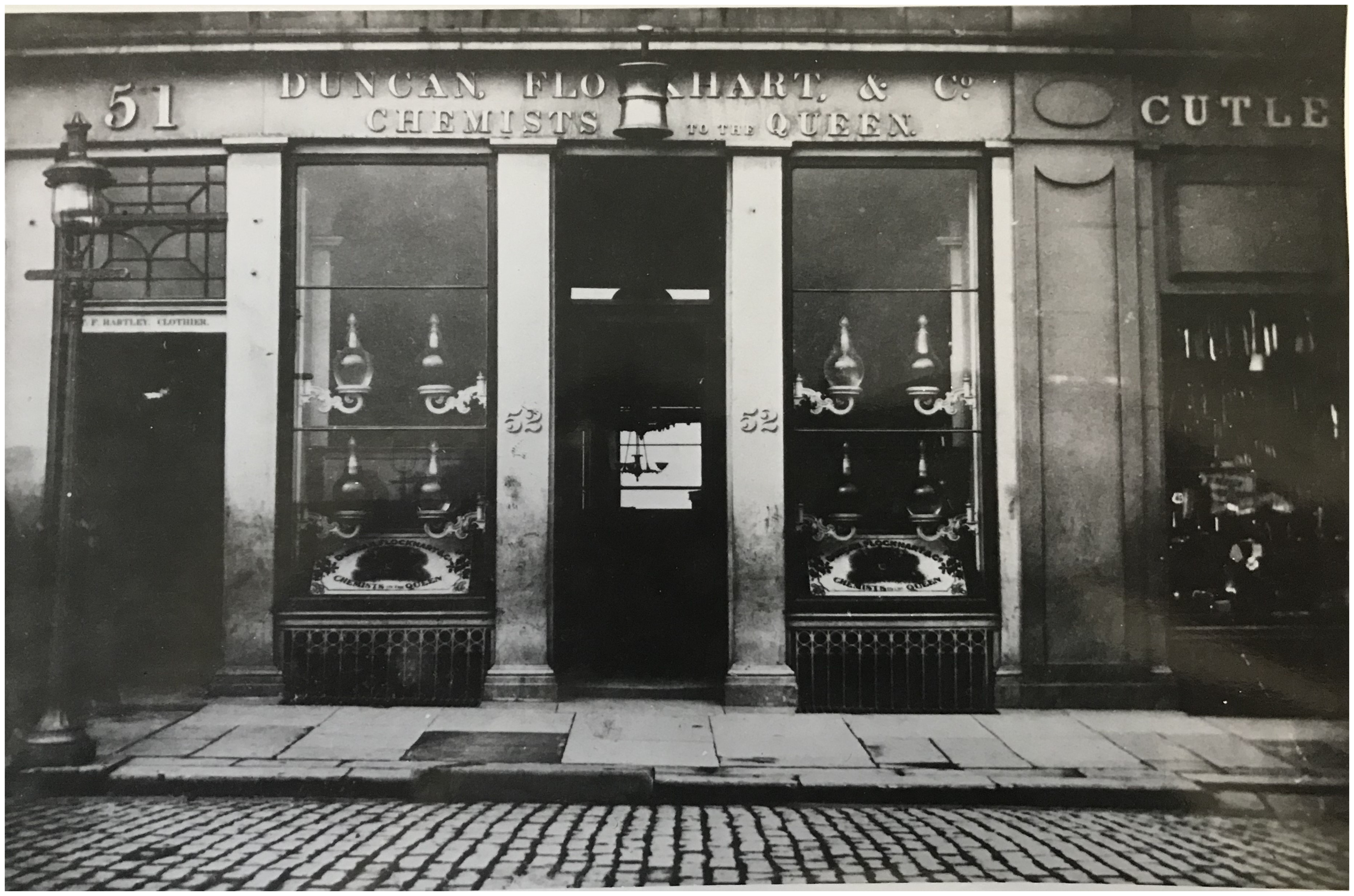
Shop front of Duncan, Flockhart & Co. at 52 North Bridge, Edinburgh in the 1850s. Image courtesy of City of Edinburgh Council: Edinburgh City Archives, UK/2/DF/7/: Box no. DF012.
Within a few years, Scottish manufacturers achieved a monopoly in the manufacture of chloroform. This was not because they had more initial expertise in chemistry or business than their English competitors, but because of a cost advantage. Chloroform was made by heating rectified spirit with chloride of lime, and the spirit duty was lower in Scotland than in England. Other Edinburgh-based manufacturers that took advantage of the lower spirit duty to prepare competitively priced ether and chloroform were JF Macfarlan and later T and H Smith. The April 1848 issue of the Pharmaceutical Journal lamented that the higher spirit duty inflicted hardship on the English manufacturer. 64 In the next issue (May 1848), the difference in duty rates was stated as ‘7s 10d per gallon in England cf 3s 8d in Scotland’. This editorial noted that the object of the legislature was to fix the duty at the point that would secure the greatest revenue at the smallest cost: not too extravagant, tempting smuggling; not too cheap, promoting intoxication. It was found that England would bear a higher duty than Scotland or Ireland, mainly due to the habits of the people and the type of spirit they imbibed. In England the spirit mainly drunk was gin, the manufacture of which required a large rectifying establishment; while in Scotland and Ireland they drank whisky, a plain spirit easily obtained on a small scale. It was feared that raising the duty in Scotland and Ireland to equal the English rate would escalate illicit distilling of whisky. 65
John Snow wrote in On Chloroform and Other Anaesthetics (published posthumously 1858) ‘Nearly all the chloroform used in Great Britain … is made in Edinburgh, where the spirit duty is lower than in England. The London druggists have almost ceased to make it, as they find it cheaper to get it from the trade in Edinburgh’. 66
The situation changed a little after 1856 when manufacturers began to use the new duty-free methylated spirit (which was made unfit for consumption by the addition of naphtha and a dye). The first to inform the Pharmaceutical Society of successful attempts to prepare chloroform and ether from methylated spirit was Mr John F Macfarlan of Edinburgh in December 1855. 67 The Edinburgh manufacturers were able to maintain a competitive price for their anaesthetics despite the reduced cost to English manufacturers of the main starting material; Duncan, Flockhart & Co. advertised chloroform made from both pure and methylated spirit. 68
William Flockhart, who was partner to John Duncan in Duncan, Flockhart & Co., had qualified as a Licentiate of the Royal College of Surgeons of Edinburgh in 1830, the same year in which James Young Simpson did so, the two were likely acquainted then. But instead of practising as a surgeon, Flockhart joined Duncan and they engaged with doctors on improving experimental drugs. 69 Through the promotion of chloroform by Simpson, the demand for it became high within a few months, propelling the expansion and profits of Duncan, Flockhart & Co. 70 The outbreak of the Crimean War in 1854 boosted the firm’s manufacture of chloroform for military surgery, encouraged by Simpson. 71 The firm even exported some chloroform to the USA, despite competition there from American manufacturers, such as ER Squibb. In 1862 the renowned New York surgeon Valentine Mott wrote that in his own practice he had been in the habit of using chloroform from Duncan, Flockhart & Co., Scotland. 72 One of the partners (admitted in 1863) was John Simpson, nephew of James Young Simpson. 71 Further confirmation of the friendship between William Flockhart and James Young Simpson is a prescription of a liniment for back pain written by Simpson for Flockhart’s elderly sister, in December 1869. 73 By 1876 Duncan, Flockhart & Co. had a factory and laboratories, situated between Canongate and Holyrood Road in Edinburgh. 71
Competitors, who had also passed the Licentiate of the Royal College of Surgeons of Edinburgh, but pursued careers in pharmacy, included John Fletcher Macfarlan, and brothers Thomas and Henry Smith. 74 Because of their expertise in manufacture of stable chloroform, the Scottish manufacturers of it still maintained a degree of monopoly in 1878. 75 Internationally there was a further fall in the price of chloroform from 1885 due to an improved method of manufacture from acetone. 76 Again, the Edinburgh manufacturers of chloroform were able to adapt: T and H Smith introduced the ‘acetone process’ in 1890. 74
The interaction between chemical manufacturers and medical practitioners is exemplified by the liaison between James Young Simpson and the staff of Duncan, Flockhart & Co., as described above. The chloroform manufactured by Duncan, Flockhart & Co. remained recognised as a high-quality product well into the twentieth century. 71 This was kickstarted by the lower duty on ethanol in Scotland, which allowed development of larger-scale production. It was sustained by the profit-enabled development of expertise in chemically stabilising the product and marketing it in appropriate containers, which protected it from light and air.
Whether consciously or not, the manufacturers of chloroform and the surgeons who administered it in Edinburgh participated in a network of mutual benefits. The growth of the manufacturers from small pharmacies to large manufacturing concerns corroborates Richard Rodger’s claim that the urban expansion of Edinburgh was supported by networks. 77 Having chloroform readily available at a reasonable price certainly benefitted the medical doctors who promoted it, especially Simpson. He acquired great financial benefit from the growth in his obstetric practice because of chloroform. Pregnant ladies came to Edinburgh from afar to be sure of receiving chloroform. These included duchesses who rented mansions in the city area for their confinement. 78 For those wealthy ladies who could not travel to Edinburgh for confinement, Simpson also travelled to London on occasion to deliver them under chloroform. 79 His prestige also rose because of chloroform. The letter from the prime minister offering him the award of baronetcy in 1866 stated the grounds in the first sentence as ‘Your professional merits, especially your introduction of chloroform’. 80 In the relatively small, close-knit community of Edinburgh medicine, surgeons and medical suppliers were both socially acquainted and closely associated in their professional work. This fits the ‘actor network theory’ described by Latour. 81
Conclusion
The reason why chloroform was almost always chosen over ether in Scotland is that it was supported by a network of prestigious doctors (who promoted chloroform as effective, safe and easy to administer), monopoly manufacturers (who made it readily available at a reasonable price), and legal practitioners (who acquiesced to surgeons’ reluctance to implicate chloroform as the cause of deaths). Inhalers were largely eschewed in Scotland because they were expensive, required training to use, and the teachers declared them unnecessary. By contrast, in England the greater propensity for inquests increased the concern about chloroform deaths, and the use of inhalers was perceived as reducing the risk by limiting the concentration.
The crux of this investigation lies in the differences in the interpretation of data on chloroform by doctors in England compared with Scotland, and indeed the differences in the availability of data. It is fair to make the comparison because both groups were ‘top doctors’ (experts) working in the UK, who spoke the same language (English) and read the same literature. Yet they came to different and opposing inferences, so that the ‘science’ was disputed and controversial, displaying interpretive flexibility as described by Collins. 82 In the case of chloroform, the different interpretation in Scotland (compared to England), seems to have been driven by pride in the ‘Scottish discovery’, the strong personalities who promoted the dogma, and ties with the pharmaceutical and legal professions that lasted until the First World War. Considering the two opposing explanations of deaths under chloroform, in England these were perceived as an inherent danger in the agent itself, whereas in Scotland the cause was held to be a timid method of administration. These claims seem quite symmetrical.
The difference in legal systems between England and Scotland allowed a lack of transparency about chloroform deaths north of the border. The potentially unavoidable death rate from chloroform of about 1 in 2000 would be unacceptable now, but in those days, there were similar risks from accidental injury at work in industry and from disease, and indeed from surgery more generally, especially in hospitals. For example, in 1874 John E Erichsen, Professor of Clinical Surgery at UCH in London, noted that the mortality rate after amputation in his hospital (about 25%) compared favourably with Edinburgh (43%) and Glasgow (39%). 83 Doctors in Scotland were less constrained by the law than those in England. Whereas in England there was more weighing of the risks and benefits of anaesthesia, in Scotland it was hardly recognised as posing any risk. Arguably, from a twenty-first century view, the involvement of the surgeon James Syme in the directions for Procurators Fiscal posed a potential conflict of interest, which needed attention.
The actions of the individual actors were shaped by a whole network of interests and associations, with symmetry in Scotland versus England. In each country the observations and inferences of the doctors were fundamentally informed by their culture. The Scottish surgeons were intelligent and mindful of the welfare of their patients, but their culture of individual surgical authority prevented them seriously reconsidering the risks of chloroform anaesthesia.
Footnotes
Author Contribution(s)
Acknowledgements
The author thanks Professors Steve Sturdy and Steven Yearley at the School of Social and Political Science, University of Edinburgh, for their advice in the preparation of the dissertation on which this paper is based. The following archives kindly provided access and help in data collection: Lothian Health Services Archive, Centre for Research Collections, University of Edinburgh Library; Edinburgh City Archives; St Bartholomew’s Hospital Archives.
Declaration of conflicting interests
The author declared no potential conflicts of interest with respect to the research, authorship, and/or publication of this article.
Funding
The author received no financial support for the research, authorship, and/or publication of this article.
