




Abstract
The first patient etherised by David John Thomas was James Egan, an Irish bounty immigrant who lived on a pastoral lease about 120 km from Melbourne. Egan had injured his left hand and forearm in a shooting accident. It would take Egan five or six days to reach Melbourne where he had his forearm amputated on 2 August 1847. Egan had fainted frequently in the cart on the way to Melbourne and was fortunate to survive the etherisation and surgery. In September 1847, Thomas presented a paper on etherisation at a monthly meeting of the Port Phillip Medical Association—this is the earliest known presentation of a paper on etherisation in the Australian colonies. The original manuscript of Dr Thomas is now held by the Medical History Museum at the University of Melbourne.
At last M.D.’s have found a way
To ease all men of ailing;
A tooth extracted is child’s play
While ether they’re inhaling
Bell’s Life in Sydney and Sporting Reviewer, 26 June 1847, p. 2
On 2 August 1847, David John Thomas performed the first operation under ether in Melbourne, then in the Port Phillip District of the Colony of New South Wales. The earliest documented cases of etherisation for surgery and dentistry in the Australian colonies had occurred two months earlier—on 7 June 1847—in both Sydney, New South Wales, and Launceston, Van Diemen’s Land (Tasmania). On 7 September 1847, Thomas read a paper on etherisation at a meeting of the Port Phillip Medical Association—it is the earliest known presentation of a paper on etherisation in Australia.1,2 Thomas’ observations were based on published accounts that he had read over a period of about three months, and his clinical experience which was limited to a five-week period preceding his talk.
Thomas’ paper was submitted to the editor of the Australian Medical Journal and published in part in the October 1847 issue of the journal. 1 The original manuscript was ‘rediscovered’ in 1931 and a full transcript was published in The Melbourne Hospital Clinical Reports in December 1933. 2 The extant manuscript has, nevertheless, remained unknown to nearly all anaesthetists and anaesthesia historians throughout the 20th century and the first two decades of the 21st century.
This article is an account of Thomas’ patient, James Egan, and the first operation under ether in Melbourne. Thomas’ paper on etherisation is discussed separately. 3 The author will be publishing a new transcript of Thomas’ manuscript in a monograph, Paper Trails: History and Transcript of the First Australian Paper on Ether Anaesthesia. Text quoted from Thomas’ manuscript is cited with reference to the page number of the manuscript (e.g. transcript p. x).
Dr David John Thomas
David John Thomas (Figure 1) was born in Glanyrwyth (Glanrwyth), a hamlet near the town of Llandeilo, Carmarthenshire, Wales, on 12 September 1813. (This information was recorded on a typewritten transcript of the entries in the Thomas family bible. The transcript was found in a collection of notes made by David M. O’Sullivan for his biography of Thomas; the notes are now held in the AMA Archive, Medical History Museum, The University of Melbourne.) Historians and biographers have reported his place of birth as Llwynyberllan4–6 or ‘near Llangadock’ (Llangadog) 7 or that his father was from Llwynyberllan.8–10 He was baptised on 5 October 1813, in Llandilo Fawr. By 1819, the family had moved to Llwynyberllan where Thomas’ five youngest siblings were born between 1819 and 1825.
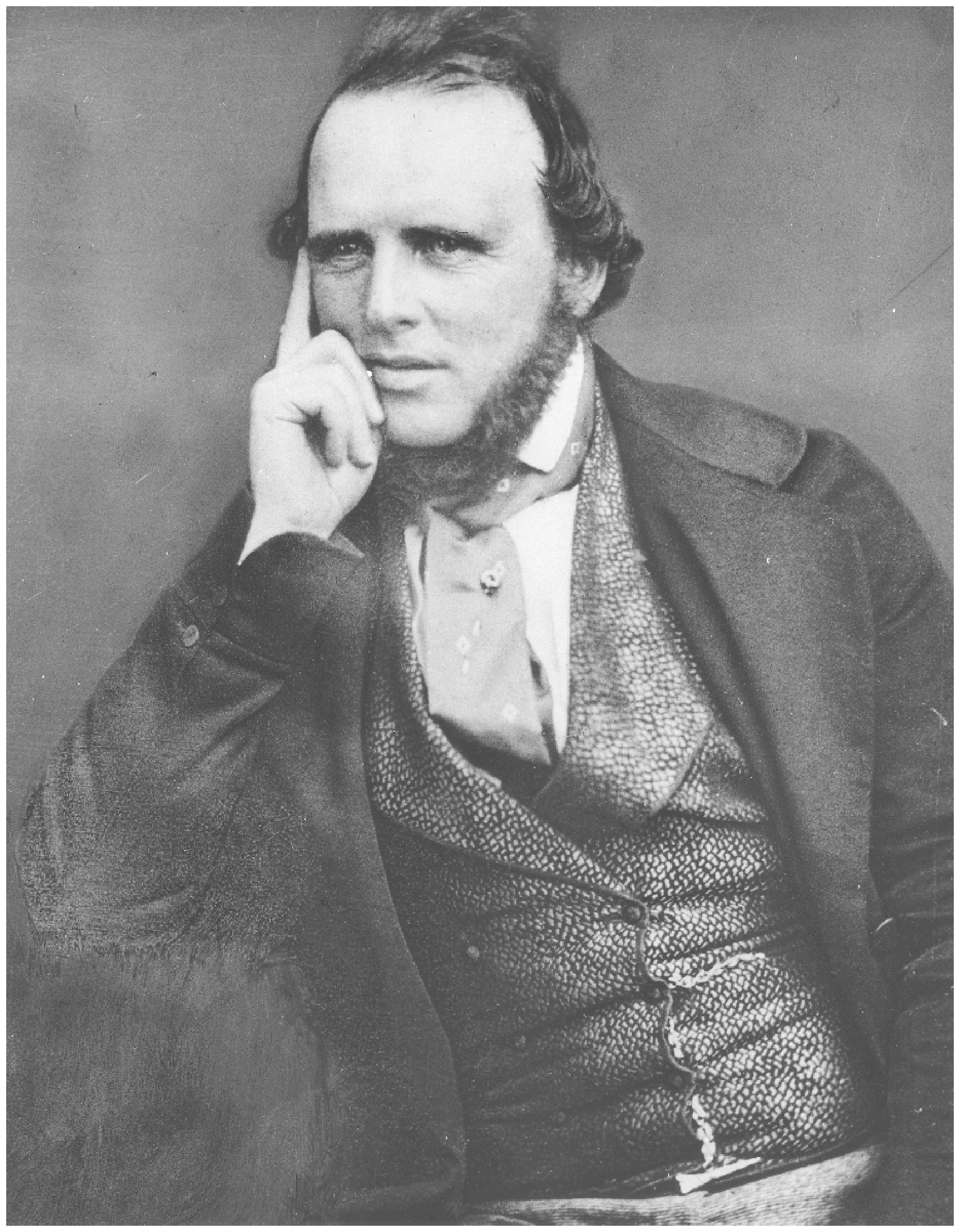
David John Thomas (1813–1871). Image courtesy of The Royal Melbourne Hospital, Melbourne, Vic.
In July 1837, Thomas became a Licentiate of the Society of Apothecaries (LSA). The Apothecaries’ Hall record of his licentiate indicates that he had completed a five-year apprenticeship with Mr Thomas Brookman Powell, apothecary, Swansea Infirmary, as well as attendance at the prescribed courses of lectures and a 12-month attendance at North London Hospital. Thomas became a Member of the Royal College of Surgeons of England (MRCS) in 1838. Towards the end of the year, he accepted a position as a ship’s surgeon on the barque Louisa Campbell for a trip to Van Diemen’s Land (the colony was renamed Tasmania in December 1855).
The Louisa Campbell stopped briefly in Port Phillip before sailing to Launceston, arriving on 21 January 1839. While in Launceston, Thomas would probably have become acquainted with William Russ Pugh (1806–1897), who had settled in Launceston in 1836. In the paper that he read to the Port Phillip Medical Association on 7 September 1847, Thomas speaks highly of Pugh (transcript p. 6): ‘I know a little of Dr Pugh, he stands high in his profession and any case given by him would be more convincing than a hundred opinions if founded on theory.’ Pugh administered ether by inhalation to three patients on 7 June 1847 at St John’s Hospital and Self-Supporting Dispensary, Launceston, and reported his experience with etherisation in the Launceston Examiner 11 and the Australian Medical Journal, 12 both of which may have been read by Thomas before he performed the first operation under etherisation in Melbourne on 2 August 1847.
After a stay of three weeks in Launceston, the Louisa Campbell departed for Port Phillip on 12 February 1839. The journey across Bass Strait took just about a week, the ship arriving in Port Phillip on 20 February 1839. The story of Thomas’ arrival in Port Phillip must have been recounted frequently by Thomas—and it appears in Edmund Finn’s The Chronicles of Early Melbourne, 1835 to 1852. Historical, Anecdotal and Personal, which was published under the pseudonym ‘Garryowen’.
13
A version of this story can be found in Georgiana’s Journal.
14
The poet Hugh McCrae, who edited the journals of his grandmother Georgiana McCrae, wrote: ‘Robin’ Russell’s account of Dr Thomas’s arrival at Port Phillip reads like the scenario for a cinematograph play. He said Thomas was overturned coming ashore from the ‘Louisa Campbell’, and that he swam to save his life. Soaked to the skin, there was nothing the doctor could do except wander about the scrub looking for the cottage by the Yarra where Russell used to live. At last, when he reached R.R.’s gate – in the pitch-dark night – a dog seized him by the breeches, but he escaped into the surveyor’s skiff, and, after shooting the Falls, continued down the river till he boated oars opposite Fawkner’s hotel. Thomas himself told this story, stuttering delightfully, as he always did.
In 1840, Thomas entered into a partnership with another recent migrant Farquhar McCrae (1807–1850), who had arrived a few months after Thomas. On 1 December 1840, Thomas married Margaret Forbes McCrae (c. 1813–1894), youngest sister of Farquhar McCrae. In 1843, Farquhar McCrae moved to Sydney where he established a medical practice and held an appointment at the Sydney Dispensary and Infirmary.
The free settlers of Melbourne did not have access to a public hospital. Although a committee for a proposed public hospital was established in 1841, several makeshift hospitals served the settlement until the opening of the Melbourne Hospital in March 1848 (the hospital was renamed The Royal Melbourne Hospital in 1935). In July 1847, Thomas was one of the three honorary surgeons appointed to the Melbourne Hospital, which was still under construction.
On 2 August 1847, Thomas administered ether and performed the first operation under etherisation in Melbourne. The ether inhaler used by Thomas had been constructed with ‘considerable trouble’ in Melbourne. 15 The design of the inhaler is not known, although it was most likely based on illustrations of Hooper’s ether inhaler that were published in The Illustrated London News, 9 January 1847, and The Lancet, 16 January 1847.
Thomas claimed in 1865, in his valedictory address as the President of the Medical Society of Victoria, to have been the first to administer chloroform in Melbourne. 16 However, Thomas’ claim could not be substantiated. Not surprisingly, the first Australian cases of chloroform anaesthesia were not as well documented as the first dental and surgical etherisations nearly a year earlier. Thomas’ experience and knowledge of ether anaesthesia would undoubtedly have made him the leading etherist in Melbourne. He would be expected to be the first medical practitioner to be consulted about the administration of chloroform. Moreover, he was one of three honorary surgeons at the recently opened Melbourne Hospital where the first surgical operation under chloroform is likely to have been performed.
In 1853, Thomas returned to the United Kingdom with his family. In the same year, he obtained by ‘special examination’ an MD at the University of St Andrews, Scotland. Afterwards he lived in France and Germany where he visited some of the leading medical centres. He obtained his Fellowship of the Royal College of Surgeons of England (FRCS) in 1856, before returning to Melbourne in 1859.
A year after returning to Melbourne, Thomas was elected to the honorary staff of the Melbourne Hospital. He was a leading member of the profession and one of the most experienced surgeons in Melbourne. In 1862, he was appointed as an examiner in anatomy at the newly established medical school at the University of Melbourne; 17 in the same year, the university conferred on him a doctorate in medicine ad eundem gradum. (A degree awarded by one university to an alumnus of another university. The recipient of the ad eundem degree is often a faculty member of the university which is awarding the degree. The ad eundem degree is not an honorary degree, but the academic equivalent of the original degree held by the recipient.)
In the following year, Thomas was one of three applicants for the position of lecturer in surgery at the medical school. The university council elected Edward Barker, who had become a partner of Thomas after the departure of Farquhar McCrae in the early 1840s. Thomas was elected president of the Medical Society of Victoria in 1864 and president of the annual Ballarat Eisteddfod in 1867. A proud Welshman, he took a ‘deep interest in the literature and traditions of Wales’. 4 ‘I have not altogether forgotten my mother tongue’, he declared in his address at the Ballarat Eisteddfod in 1867, ‘and I sincerely trust I never shall’. 18 He became a prolific author in the last decade of his life. David M O’Sullivan, author of a comprehensive biography of Thomas, listed 50 medical articles and correspondence published by Thomas during the period 1862–1871. 8
In 1864, Thomas received a curious accolade that his biographers have overlooked. German–Australian physician and botanist Ferdinand Jacob Heinrich von Mueller (1825–1896) named a small native Queensland shrub in the family Myrtaceæ in honour of Thomas. 19 Originally named Chamælaucium thomasii F.Muell., the plant was later named Darwinia thomasii (F.Muell.) Benth., and in 1991 as Homoranthus thomasii (F.Muell.) Craven & S.R.Jones (Figure 2). Mueller’s original description was published in his Fragmenta Phytographiæ Australiæ (1858–1882, 11 vols.), the only Australian scientific journal completely written in Latin. Mueller wrote, ‘Speciem pulchellam et singularem appellavi in agnitione ingenii dotium medici et chirurgi peritissimi Davidi Joannis Thomas, M.D., nunc societatis medicorum Melbournensis præsidis.’ This translates as, ‘A unique and beautiful species named in recognition of the talented and gifted physician and skillful surgeon David John Thomas, MD, now president of the society of Melbourne doctors.’ Thomas was at that time president of the Medical Society of Victoria.
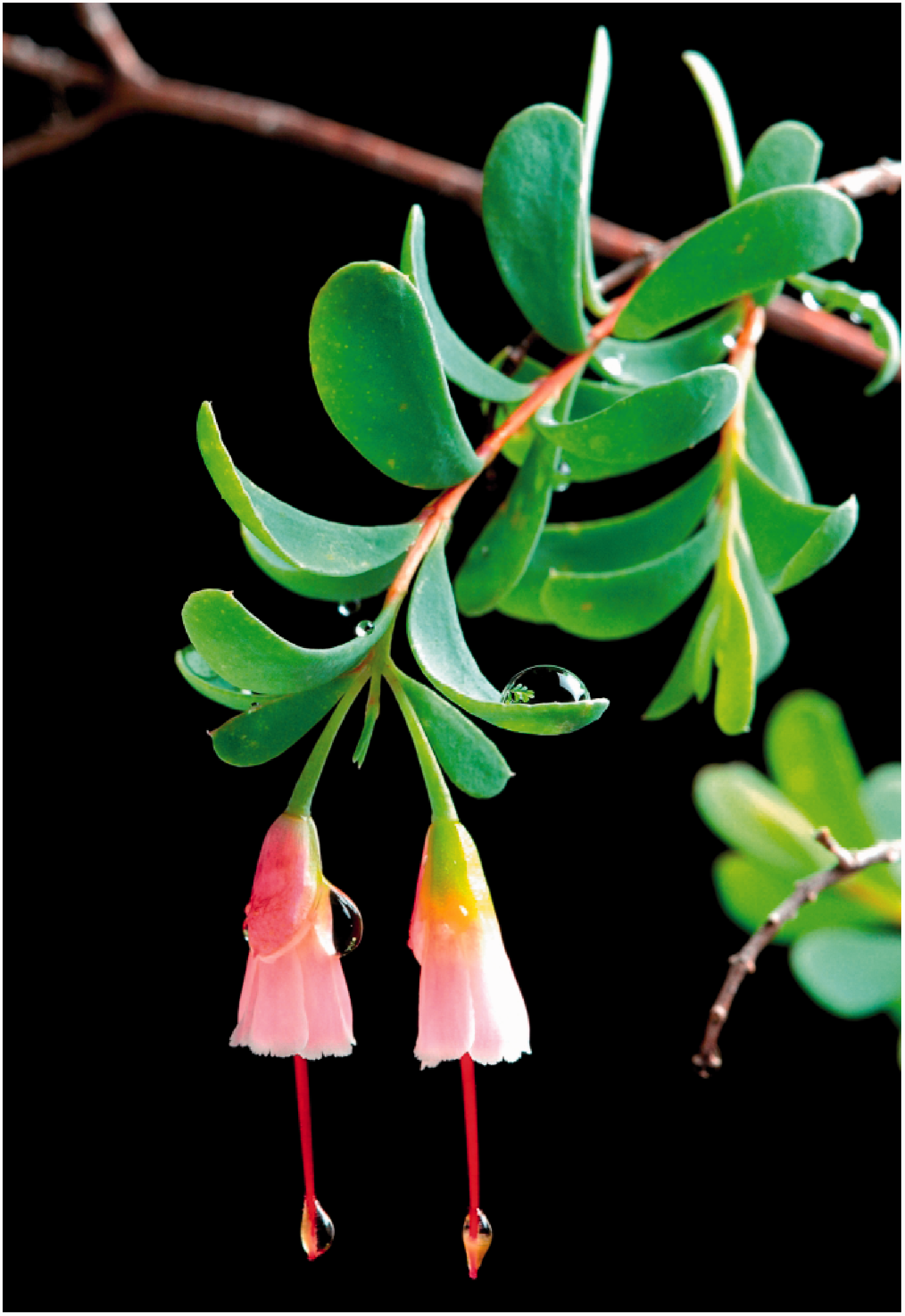
Homoranthus thomasii. Image courtesy of Andrew Orme, National Herbarium of New South Wales.
Thomas was said to be ‘a small man of boundless energy and good humour, partial to a good dinner and a convivial gathering, but no less afraid of controversy’. 7 According to GT Howard, who had ‘rediscovered’ Thomas’ 1847 paper on etherisation, Thomas was ‘a delightful combination of Puck, Peter Pan, Fluellen, and shrewd, alert, efficient leader of the profession’. 20 Thomas died on 1 June 1871 at the age of 58 of a sudden illness described as apoplexy (a neurological condition of sudden onset, usually a cerebrovascular accident or stroke). 21 He was survived by his wife and four daughters. In an obituary in The Australian Medical Journal, James E Neild described Thomas as ‘a cheerful, impulsive, warm-hearted man, with a vivid sense of humour’ and ‘one of the founders of Victorian Medicine’. 3
The first operation under etherisation in Melbourne
Thomas’ patient, James Egan, injured his left hand and forearm when his shotgun burst while he was shooting wild duck. 2 Egan lived on a pastoral lease (station) known as Major’s Line about 120 km from Melbourne, close to the present day town of Heathcote, Vic. 22 For a number of reasons, it would take Egan five or six days to reach Melbourne for treatment.
Egan’s dire medical state on his arrival in Melbourne on Sunday, 1 August 1847—likely a combination of septic and hypovolaemic shock, exacerbated by the usual wet winter weather—would be quite apparent to anaesthetists today. He had fainted on a number of occasions while travelling to Melbourne for treatment. Thomas wisely decided not to operate immediately on his injured patient. He ordered the application of warm water dressings to the wounds on Egan’s left hand and forearm, ‘warm Mutton broth with some dry toast in it’ (transcript p. 16), and an anodyne draught containing opium:—℞ Tinct Opii fʒj, Mist Camph f℥ij. ft. haust. to be taken immediately (Prepare a draught consisting of one fluid dram (3.55 ml) of tincture of opium and two fluid ounces (56.8 ml) of a mixture of camphor. The amount of morphine in this draught cannot be quantified because the composition of tincture of opium is not known) (Figure 3). Thomas left orders ‘that someone should sit up with him and should any change take place that I should be sent for immediately’. 2
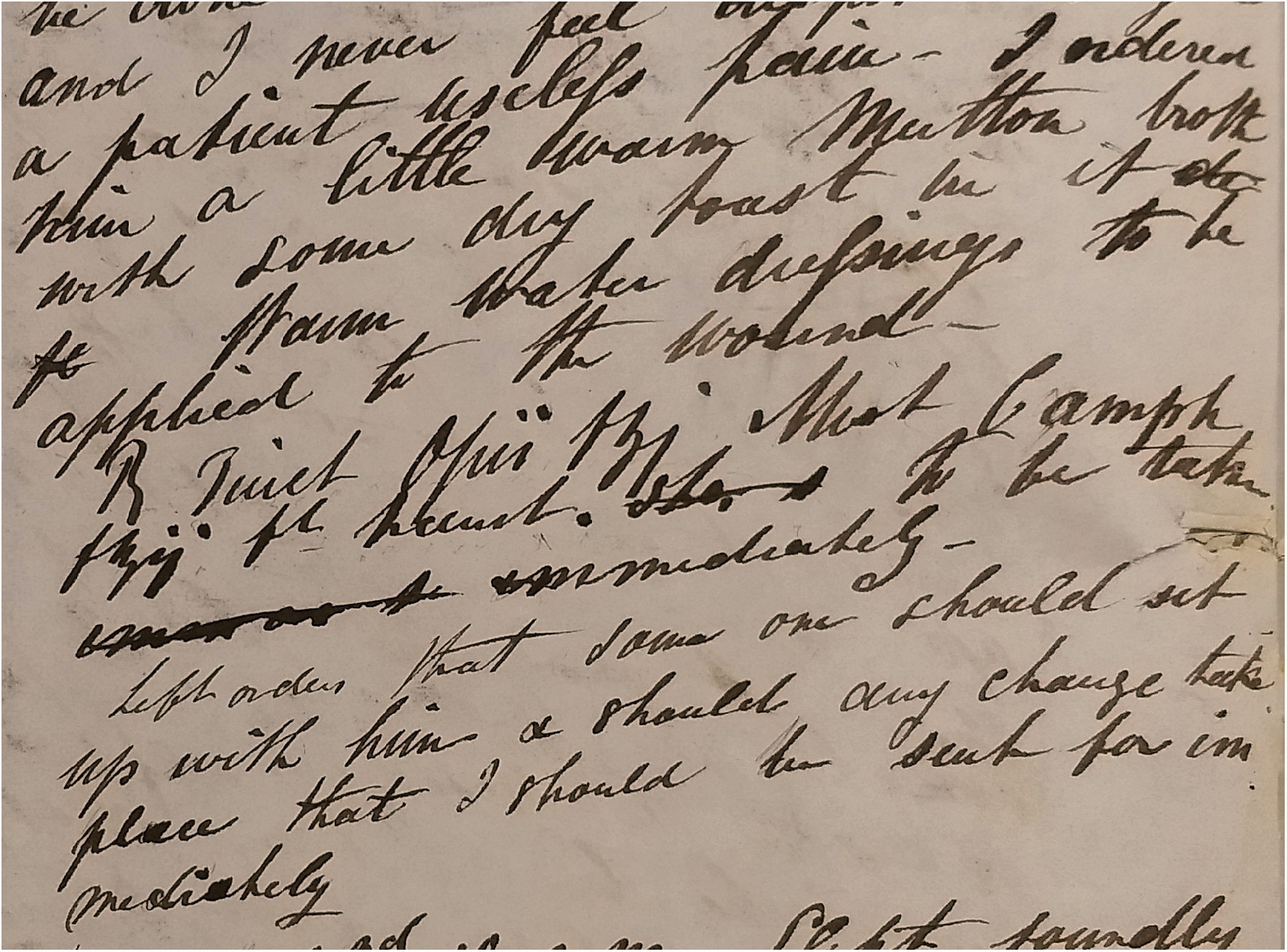
Apothecary prescription on p. 16 of the Thomas manuscript. Original document in the Medical History Museum, the University of Melbourne: accession number MHMA1137.1 (gift of AMA Victoria).
The next morning (Monday, 2 August 1847), Thomas conducted a full examination and recommended an amputation. But ‘as a satisfaction to him [Egan] as well as myself’, Thomas obtained a second opinion from Dr George Playne (1802–1885). The operation was scheduled for 03.00 p.m. that afternoon. Thomas was ‘assisted’ by Drs Playne, Greeves and Campbell. Thomas does not mention the duration of inhalation of ether, apart from noting that the mouthpiece of the inhaling apparatus was removed from Egan’s mouth after about 12 inhalations (transcript p. 17). 2 According to Thomas (transcript p. 18), ‘The period occupied from the commencement of the first incision to the separation of the arm from body by the saw occupied a period of forty seconds’. The Port Phillip Patriot reported that the patient inhaled ether for two minutes before he reached the necessary state of insensibility, and the operation was performed in 40 seconds (Figure 4). 23
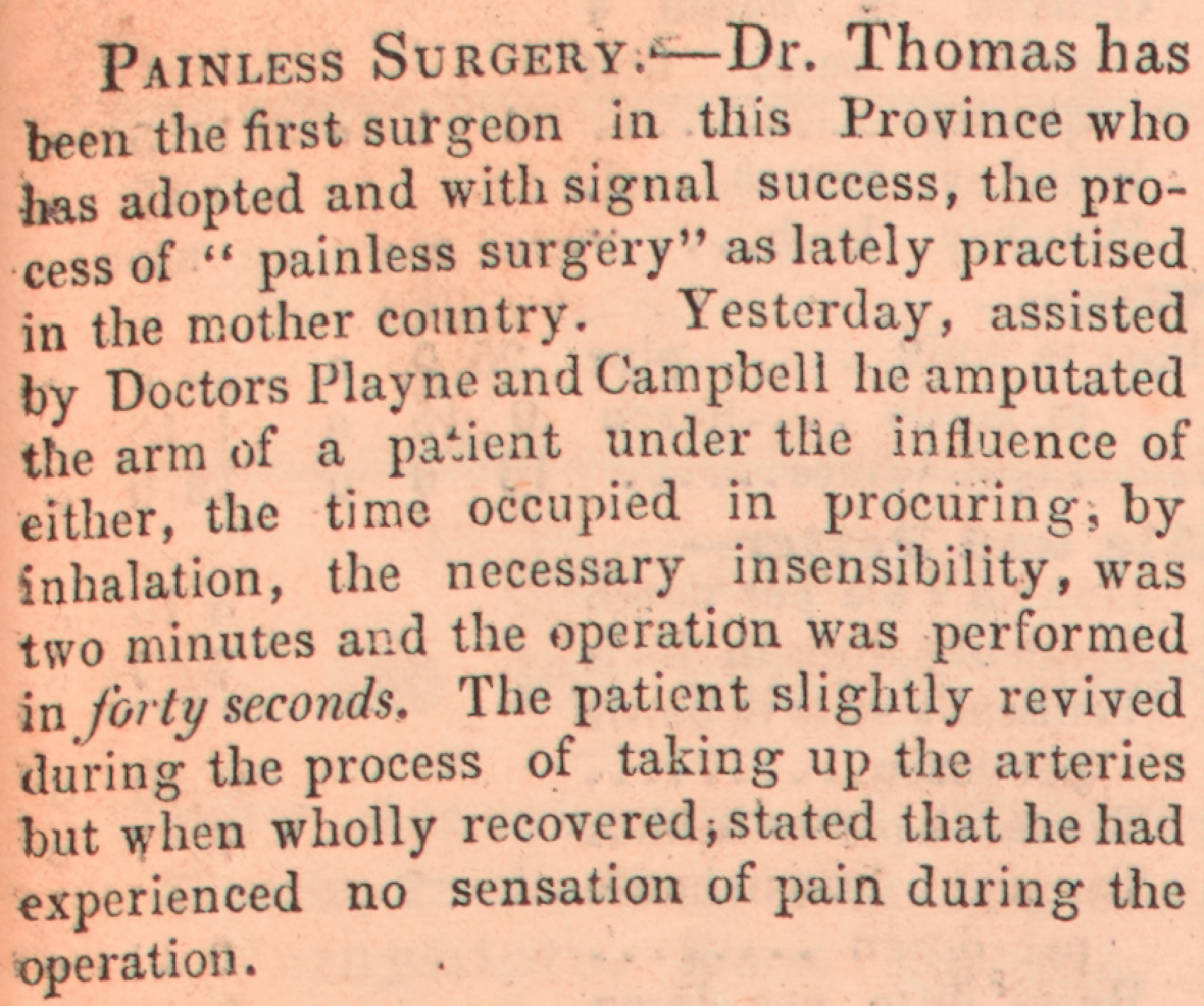
The Port Phillip Patriot, 3 August 1847, p. 3.
Egan reported afterwards that although he was aware of the surgery, he did not experience any pain. He had, as noted earlier, received an anodyne draught soon after he was first seen by Thomas on the day preceding the operation—perhaps Egan had also received the anodyne on the day of his operation. While the amount of morphine in the anodyne draught is not known, any residual effect of the morphine would have facilitated the administration of ether. Egan’s pulse became imperceptible after about 12 inhalations from an inhaler containing ether (transcript p. 17), suggesting that he was still in a state of mild or moderate shock when he received ether for the amputation of his left forearm. He was undoubtedly fortunate to have survived the trial of etherisation as well as the operation. In early September 1847, one month after the operation, Egan left Melbourne on horseback for his station ‘in good health and spirits’. 2
Within days of the operation, brief reports of the operation on Mr Egan were published in the Melbourne newspapers, with varying accounts of where he resided: he was reportedly from ‘Western Port’, ‘near the Campaspie [River]’ or a ‘settler on the Goulburn [River]’ (Figures 4–6).23–25 Thomas not only documented his patient’s age as 53, but recorded that his patient lived ‘beyond’ the Campaspe River and had travelled nearly 100 miles to Melbourne for treatment. 2 This additional information enabled the identification of a James Egan who was the patient of Dr Thomas.
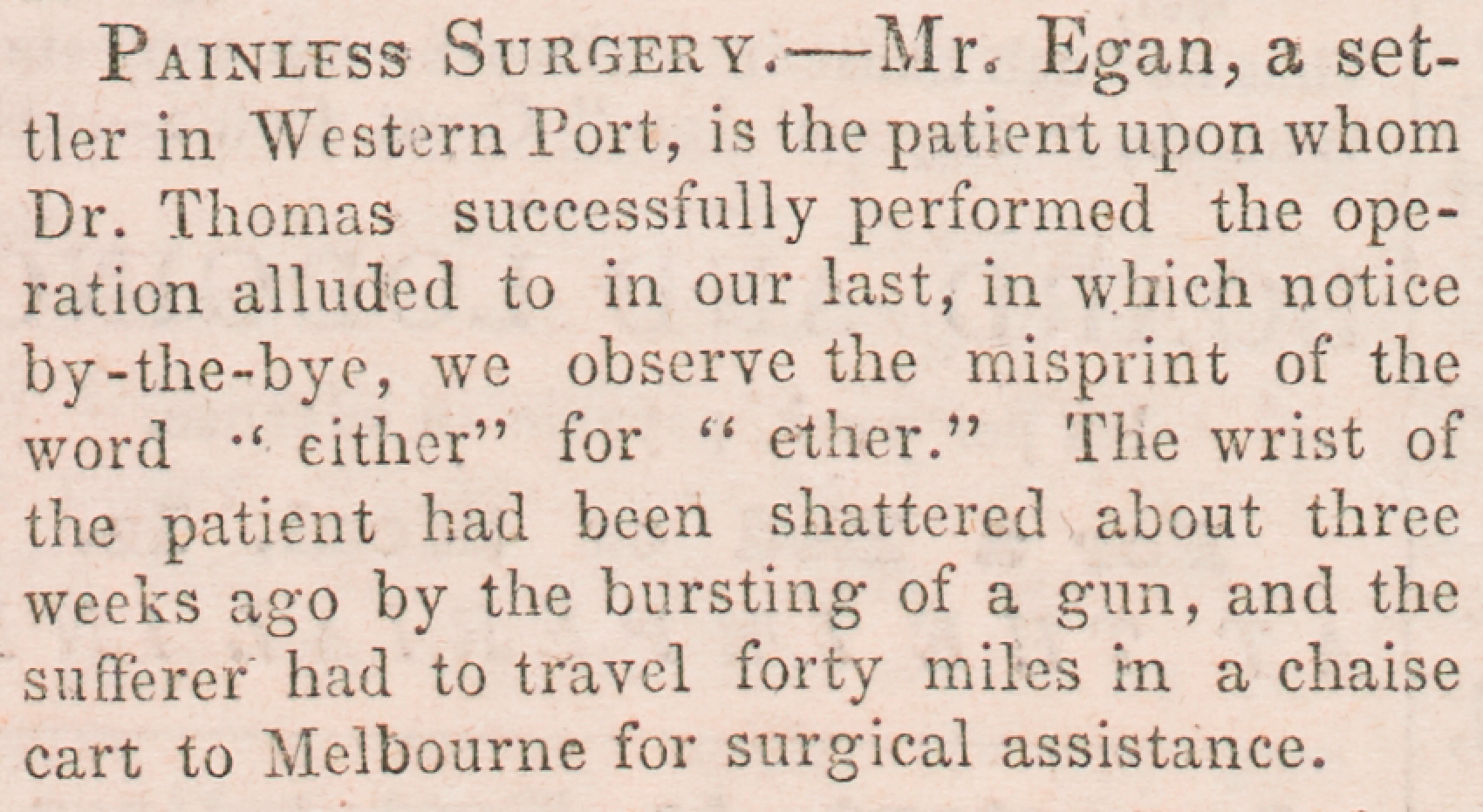
The Port Phillip Patriot, 4 August 1847, p. 2.
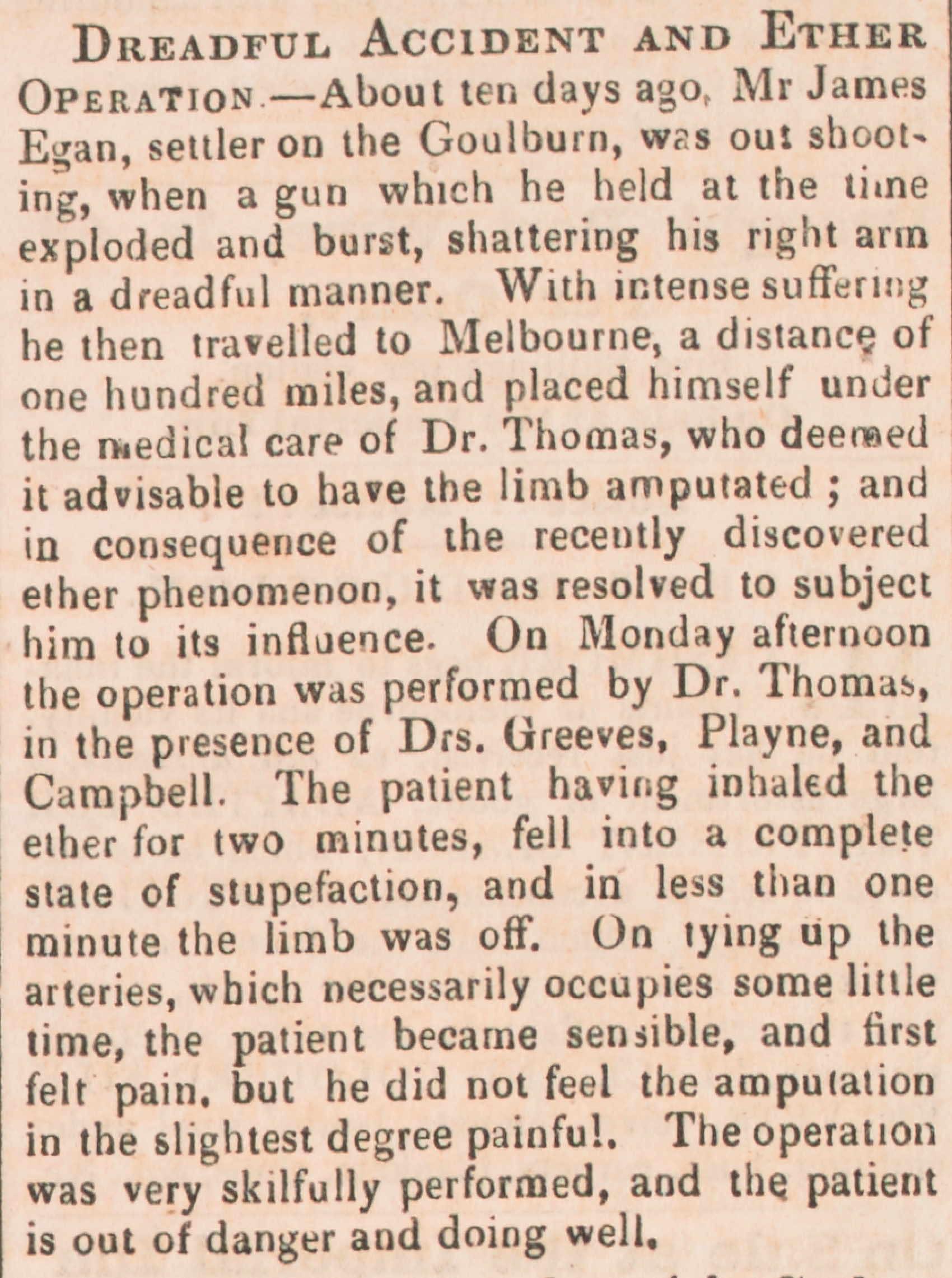
The Port Phillip Herald, 5 August 1847, p. 2.
James Egan (c. 1794–1870)
James Egan was most likely born in 1794 in King’s County (now known as County Offaly), Ireland. He married Ann (Anne) Carr (1817–1861) in 1838. In 1841, James, Ann and their first child Maria travelled from Liverpool to Melbourne as bounty immigrants. 26 The family arrived in Melbourne in November 1841 on the ship Frances. James was listed in the arrival record as a 37-year-old labourer, who was unable to read or write 26 —his actual age at the time would have been 47 years. One of the Colonial Government regulations for bounty immigrants was that the ‘age of married couples, not having children above the age of 10 years, is not to exceed on embarkation 40 years.’ 27 Thus, Egan, or his agent, might have knowingly recorded his age as 37 instead of 47 years. Ann, aged 24 years, was listed as a housemaid. The ‘bounty’ was £19 for each adult and £5 for the two-year-old daughter Maria.
Within a year of his arrival, Egan acquired a lease on Major’s Line, a pastoral run (station) located about 120 km (75 miles) from Melbourne. 22 Major’s Line was adjacent to the Campaspie Plains pastoral lease, acquired in 1840 by Dr George Playne and his business partner Daniel Jennings. 28 This partnership ended in 1844, when Playne returned to Melbourne to become a magistrate and practise as a surgeon, leaving Jennings as the sole owner of the lease. The relevance of this information is that Playne and Egan lived on neighbouring pastoral properties from 1842 to 1844. On 2 August 1847, Playne provided a second opinion on Egan’s injuries. In the afternoon of the same day, Playne was one of three doctors who ‘assisted’ Thomas at the operation on Egan.
James and Ann Egan had ten children: their first child Maria was born in Ireland; nine children were born in Australia. Ann Egan died in 1861. 29 James Egan died in the Heathcote area in 1870.30,31 His age at the time of his death would have been around 76 years, based on the age that he had reported to Dr Thomas. However, a newspaper report of his death declared that he was 81 years; 30 the same age (81 years) is recorded in the Victorian Registry of Births, Deaths and Marriages. 31
Conclusion
The first patient etherised by David John Thomas was James Egan, an Irish bounty immigrant who lived on a pastoral lease known as Major’s Line about 120 km from Melbourne. Egan had injured his left hand and forearm in a shooting accident. It would take Egan five or six days to reach Melbourne where he had his forearm amputated on 2 August 1847. Egan had fainted frequently in the cart on the way to Melbourne and was fortunate to survive the etherisation and surgery. He returned to Major’s Line station a month after the operation. The primary source of information regarding Egan’s injuries and treatment is a paper delivered by Thomas in September 1847 at a monthly meeting of the Port Phillip Medical Association. The original manuscript penned by Thomas is now held by the Medical History Museum, the University of Melbourne (accession number MHMA1137.1—gift of AMA Victoria). Thomas’ paper on etherisation is discussed in a separate article. 3 The author will be publishing a new annotated transcript of the manuscript (Paper Trails: History and Transcript of the First Australian Paper on Ether Anaesthesia).
Footnotes
Acknowledgements
The author is grateful for the assistance provided by librarians and curators at the Brownless Biomedical Library and the Medical History Museum at the University of Melbourne, the State Library of Victoria, the State Library of New South Wales, the Fisher Library at the University of Sydney, the Richard Bailey Library at the Australian Society of Anaesthetists, and the History of Medicine Library at the Royal Australasian College of Physicians.
Declaration of conflicting interests
The author(s) declared no potential conflicts of interest with respect to the research, authorship and/or publication of this article.
Funding
The author(s) received no financial support for the research, authorship, and/or publication of this article.
