




Abstract
In the past few years some very historic anaesthetic documents, long thought lost, have been rediscovered. In Australia, these include the log and journal of Dr William Russ Pugh’s 1835 voyage from England to New Holland held by Pugh’s descendants in the UK; 1 also the original manuscript of Dr David John Thomas’ paper on etherisation in Melbourne, October 1847, held at the University of Melbourne. 2
Emily Bunker is the daughter of Dr John Bunker, founding chair of the Department of Anaesthesia at Stanford University. Emily is an author and anthropologist, who was assisting her father at the end of his career with his work on a history of anaesthesia. After his death, she became fascinated by his material on Horace Wells and the letters between Horace and his wife Elizabeth. Some of these letters were found by W Harry Archer in the 1930s, 3 but these were subsequently thought to have been lost and were unavailable to later biographers of Wells. Bunker sourced these letters in the library of the University of Pittsburgh.
Today, letter writing has all but disappeared, few keep important emails and probably no-one keeps text messages. What is not important now may be historically relevant in the future. These letters show the value and personal touch of correspondence written in an era when there was time to write thoughtfully. The letters range from 1835 to Wells’ death in 1848, but then continue with various correspondence to 1870.
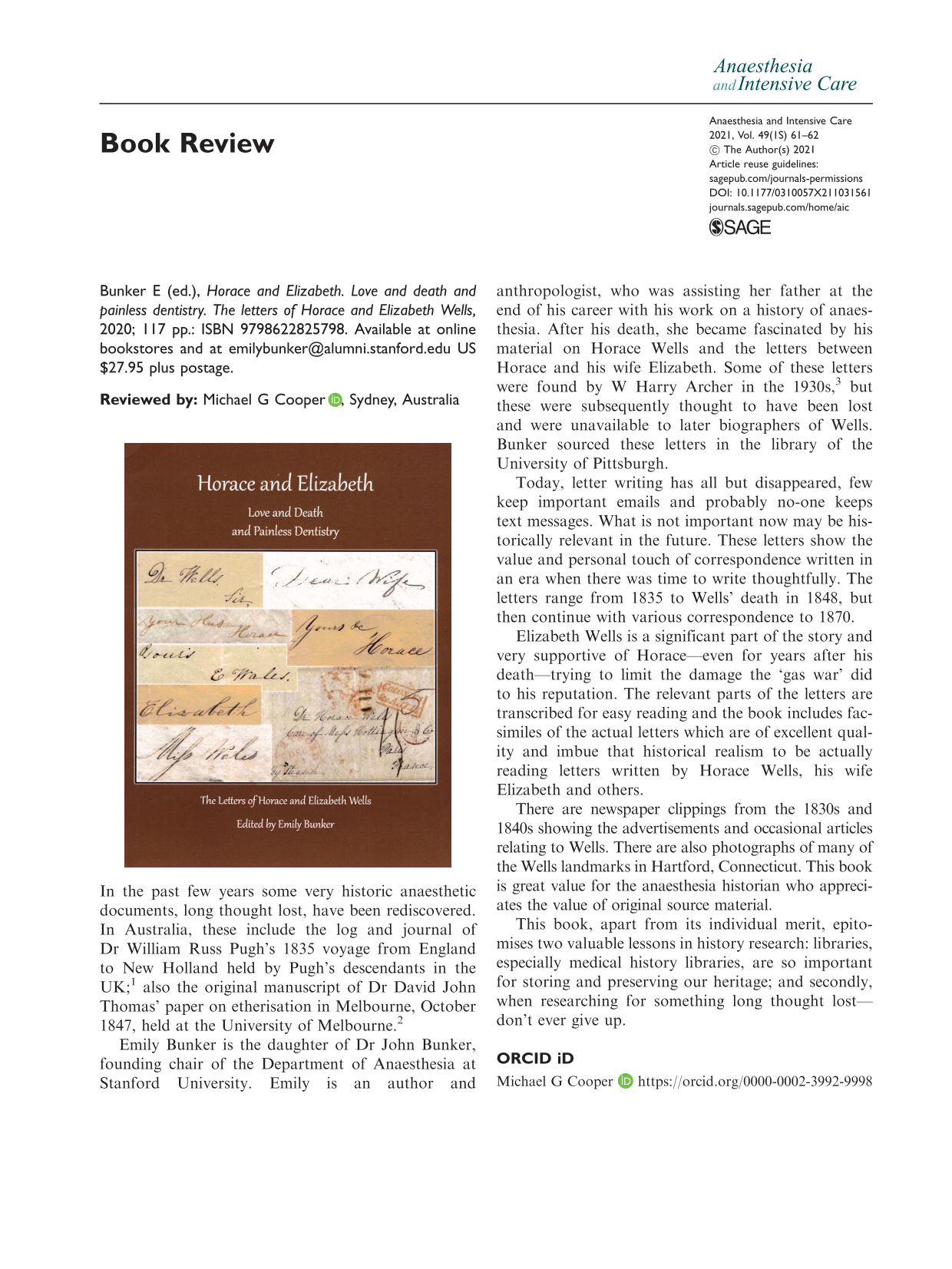
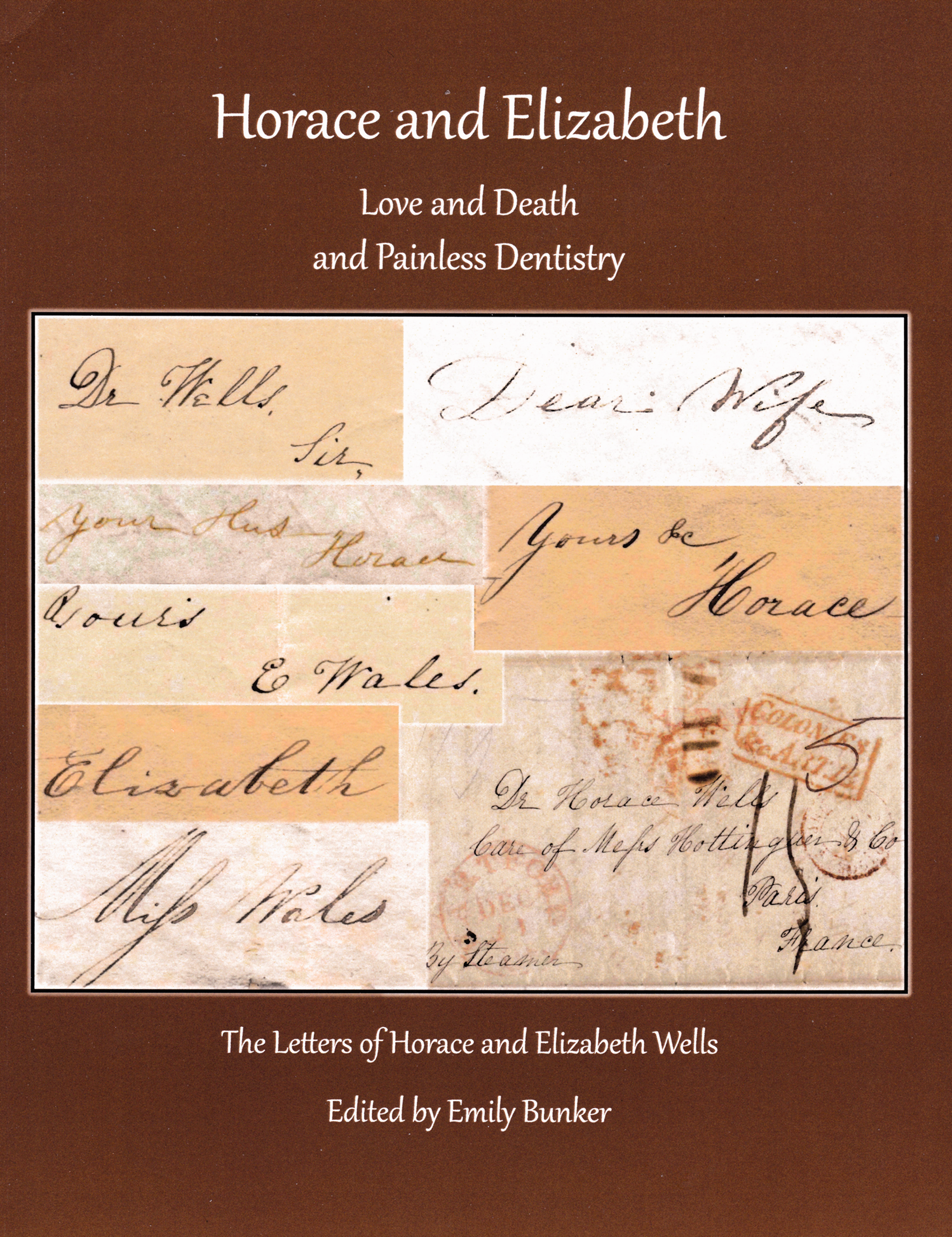
Elizabeth Wells is a significant part of the story and very supportive of Horace—even for years after his death—trying to limit the damage the ‘gas war’ did to his reputation. The relevant parts of the letters are transcribed for easy reading and the book includes facsimiles of the actual letters which are of excellent quality and imbue that historical realism to be actually reading letters written by Horace Wells, his wife Elizabeth and others.
There are newspaper clippings from the 1830s and 1840s showing the advertisements and occasional articles relating to Wells. There are also photographs of many of the Wells landmarks in Hartford, Connecticut. This book is great value for the anaesthesia historian who appreciates the value of original source material.
This book, apart from its individual merit, epitomises two valuable lessons in history research: libraries, especially medical history libraries, are so important for storing and preserving our heritage; and secondly, when researching for something long thought lost—don’t ever give up.
Supplemental Material
sj-pdf-1-aic-10.1177_0310057X211031561 - Supplemental material for Bunker E (ed.), Horace and Elizabeth. Love and death and painless dentistry. The letters of Horace and Elizabeth Wells,
Supplemental material, sj-pdf-1-aic-10.1177_0310057X211031561 for Bunker E (ed.), Horace and Elizabeth. Love and death and painless dentistry. The letters of Horace and Elizabeth Wells, by Michael G Cooper in Anaesthesia and Intensive Care

References
Supplementary Material
Please find the following supplemental material available below.
For Open Access articles published under a Creative Commons License, all supplemental material carries the same license as the article it is associated with.
For non-Open Access articles published, all supplemental material carries a non-exclusive license, and permission requests for re-use of supplemental material or any part of supplemental material shall be sent directly to the copyright owner as specified in the copyright notice associated with the article.
