




Abstract
Dr Himson Tamur Mulas was born on the Gazelle Peninsula of East New Britain, New Guinea, on 13 March 1934. After finishing his schooling, he was selected to go to Fiji to undertake a medical course at Fiji Central Medical School in 1953, returning to New Guinea in 1958. He successfully completed residency posts and after a period of training in anaesthesia in Port Moresby, was sent to the Alfred Hospital in Melbourne, Australia, in 1966–1967 to further his anaesthetic career. After returning to New Guinea he undertook several administrative posts as well as continuing his anaesthetic career before settling at Nonga Hospital in Rabaul, East New Britain Province. He was first registered as a specialist anaesthetist in 1972. He went on to complete a Diploma in Public Health in New Zealand in 1974, and in 1976 completed a Diploma in Tropical Health and Hygiene at the University of Sydney. He left public hospital anaesthetic practice in 1980. He is recognised as the first New Guinean to be a specialist anaesthetist. He died on 28 July 2000 aged 66 years.
Keywords
An anaesthetist has the difficult, exacting job of administering the appropriate knockout or pain-killer treatment to patients before and after operations. A fraction too much or too little or administered too late, can mean death for the patient … or, at least, a lot of unnecessary pain for the patient. (Dr Himson Tamur Mulas 1 )
Little reference has been made to many aspects of Dr Himson Mulas’ life in previous publications and we believe that this is the first article dedicated solely to him. This article has depended on documentation from newspaper reports of the time and archival records from the Australian Administration of Papua and New Guinea, as it was then known. Early government records from before the Second World War were destroyed during that conflict. The destruction of these records was extensive around Rabaul, and as such, no official records remain of Dr Mulas’ early life.
The title of the first national anaesthetist in Papua New Guinea (PNG) can be ascribed to Dr Himson Mulas who was the first person from New Guinea to be recognised as a specialist anaesthetist in his country. Subsequently in 1977, Dr Chris Marjen was the first doctor to have trained at the Papuan Medical School, PNG, having undertaken his anaesthetic training at the Western Pacific Anaesthesia Regional Training Centre, Manila, Philippines. In 1986 Dr Gary Ou’u was the first PNG-trained doctor to complete the Diploma of Anaesthesia in PNG and in 1991 Dr Noel Yaubihi was first doctor trained in PNG to complete the Masters of Medicine in Anaesthesiology at the University of Papua New Guinea (UPNG), having already completed the diploma. Each of these occasions represent developments in the availability of medical teaching in PNG, the introduction of a Diploma in Anaesthesia and then the Masters in Anaesthesia.
When discussing these priorities of who was first, it is important to put them in the context of the country’s history. In 1884, Germany annexed the northern parts of the Pacific island of New Guinea and Britain proclaimed a protectorate over the southern parts (which were formally annexed by Britain in 1888 and became British New Guinea). In 1906, Australia accepted control of British New Guinea under a Commonwealth Act, having been renamed a year earlier as the Territory of Papua. The Australian army occupied German New Guinea in the First World War and in 1920 Australia received from the League of Nations a mandate to govern New Guinea, as it was then called. In 1942 the Japanese army occupied parts of New Guinea and Papua; the Australian military administered the rest. Under the Papua and New Guinea Act of 1949, the two parts were united for administration as the Territory of Papua and New Guinea and put under United Nations International Trusteeship. In the intervening years up until 1975 there was a gradual evolution of PNG national citizens running their country until 16 September 1975 when Papua New Guinea proceeded to full independence as a sovereign state. 2
Himson Mulas was a Tolai person born in Raluana village. The Tolai are the indigenous people of the Gazelle Peninsula and the Duke of York Islands of East New Britain. He completed his high school education in Kerevat from 1949 to 1953 and was then selected to go to the Central Medical School Suva, Fiji to receive medical training.
3
In David Watters’ book Stitches in Time: Two centuries of surgery in Papua New Guinea, there is a personal communication from Dr Clem Nommensen, a surgeon who worked with Dr Mulas in Rabaul. He recalls, …obviously must have been a very promising student in the top grade of his high school. When I asked him how he came to be a doctor, Himson said he was in class at school one day when some men came around with the head teacher and called him out. They then said to him without preamble: ‘you are going to the Medical School at Suva in Fiji to become a doctor!’ This announcement seemed to come quite out of the blue.
3
In 1958 Dr Mulas returned to New Guinea from Fiji having successfully completed a Diploma of Medicine and Surgery (Suva) and with a passion for rugby union. He completed two years of residency at Port Moresby General Hospital (PMGH) and was subsequently sent to various hospitals in the New Guinea Highlands for a further three years of general duties as a district doctor. 1
In 1962 he was appointed adviser by the Australian Minister for Territories, Mr Paul Hasluck, and the Minister for External Affairs, Sir Garfield Barwick, as advisers to the Australian delegation to the United Nations Trusteeship Council meeting in New York in May–July, which considered reports by the Trusteeship Council visiting mission on the Australian administration of the trust territories of New Guinea and Nauru. Several photos of him in Canberra are held in the National Library of Australia archives (Figure 1). 5
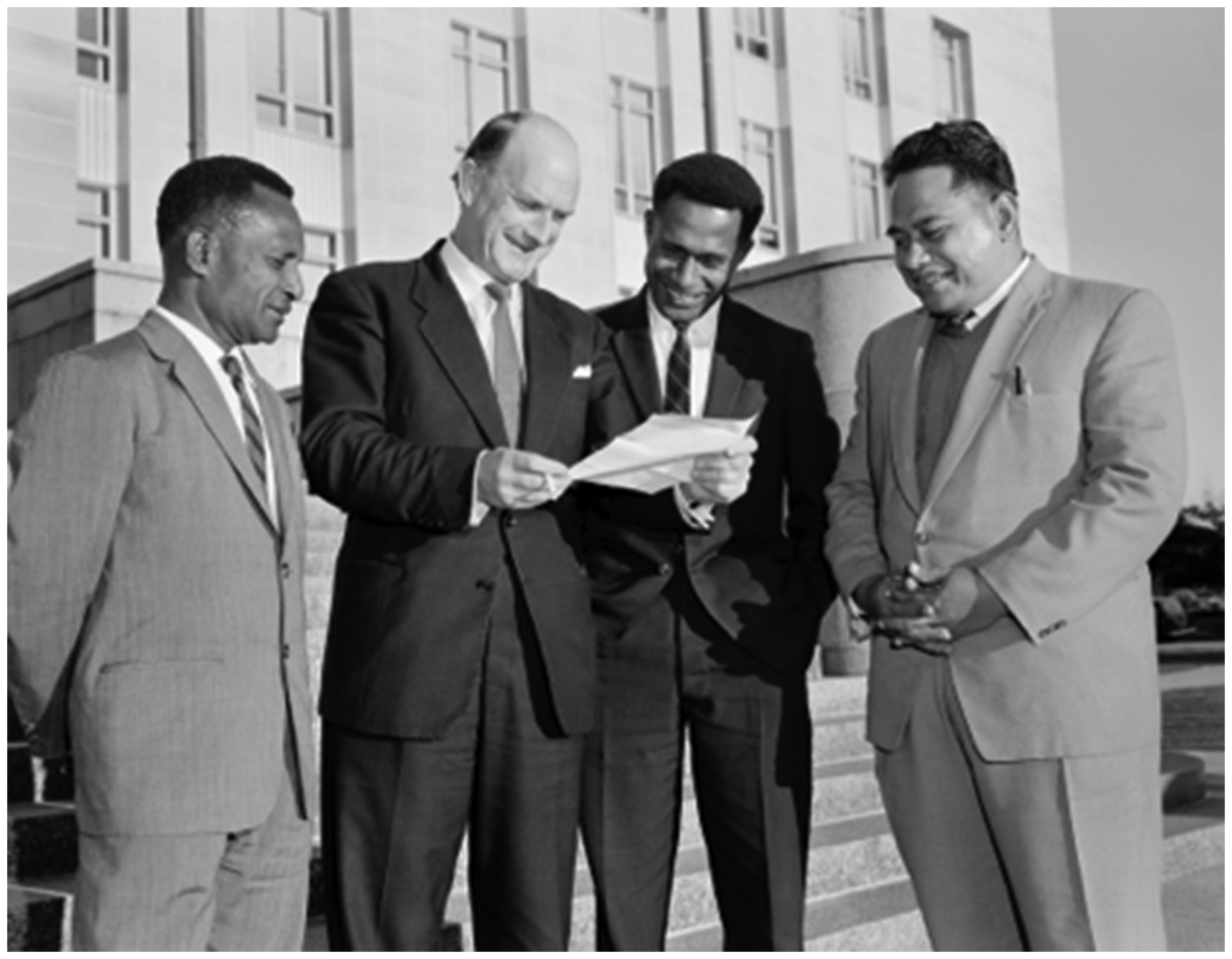
Left to right: Mr Somu Sigob, Mr WT Doig, Dr Himson Mulas and Hammer de Roburt in Canberra, 1962. Mr Sigob was a member of the legislative council of Papua and New Guinea, Mr Doig was in the Australian Department of External Affairs, Dr Mulas was from Papua and New Guinea and Head Chief de Roburt was from Nauru. Photo from the National Library of Australia, with permission. Filename 8912424_0001.
In 1965 he returned to Port Moresby General Hospital as the anaesthetic registrar to Dr John Foley. John Foley was a British-trained anaesthetist who worked in Port Moresby from 1963 to 1971. He was the head of anaesthesia at Port Moresby General Hospital and was seen as the senior anaesthetist for the country. At this stage there was no medical course in the country. This did not start until the Papuan Medical College commenced in 1962, with their first graduations in 1966. 3
In 1966 Himson was supported to attend the Alfred Hospital in Melbourne, Australia, under the directorship of Robert Orton, where he was taught anaesthesia from 1966 to 1967. In 1966 he was granted honorary membership of the Australian Society of Anaesthetists (personal correspondence from Australian Society of Anaesthetists, 26th November 2020). In David Watters’ book, he records Himson being at the Alfred Hospital in Melbourne in 1963, but records from the Alfred Hospital archivist, Peter Frawley, shows that this was 1966–1967 based on operating theatre records of the time where he was listed as the anaesthetist. Himson’s own recollection in newspaper articles also reflect this later date.
1
However, from The Alfred’s Operation Book No 119 covering the period 7/9/1964–24/10/1968, I found Dr Mulas listed as anaesthetist on a number of occasions on 18 January 1967 and 28 February 1967 with comment Pento, Fluo, N2O & O2. My understanding is that much of the anaesthesia training at the time was conducted to allow students to administer anaesthetic in operation conditions. I note that Dr Gray a senior anaesthetist may have been on hand as he is in the same operation book listed with a student. (Peter Frawley, Alfred Hospital archivist, Melbourne, December 2019, personal communication)
Prior to coming to Melbourne, there is evidence of him representing East New Britain in rugby in a 1966 photo. 6 Himson returned to New Guinea from the Alfred in late 1967 and was sent to Nonga Hospital in Rabaul, East New Britain, as an anaesthetist. He was appointed to the board of the National Fitness Council in September 1967. 7 In 1968 Himson was involved in a fatal car crash but was acquitted of culpability in 1969. 8 In 1970 he was coaching the local Pacific Isles rugby team 9 and in October was appointed quarantine officer as one of his duties. 10 The 1969 Register of Medical Practitioners record his qualifications as ‘Diploma Medicine and Surgery (Suva) 1958’. 11 In the subsequent registers the qualification of specialist anaesthetist (1972) appears. 12 His expertise was recognised by Dr John Foley who was chief anaesthetist, and Himson became acknowledged as an anaesthetist. It appears that no formal examination took place in New Guinea, but this was acceptable practice in the era. There was no formal process of examination in place until 1992, with the first graduation of the Masters of Medicine (Anaesthesiology) programme. His importance as a political figure and as a uniting figure was acknowledged when he was appointed to a Warmaram (or Warmaran) group to mediate between various tribal factions on the Gazelle Peninsula and the Tavui area. This is also recorded in Hansard, the Australian parliamentary record, 13 and this was obviously a difficult task judging by newspaper reports of the period. 14
In 1970 he attended the Third Asian and Australasian Congress of Anaesthesiology in September in Canberra accompanied by Dr John Foley. There is a photo of Mulas with Dr Semesa Serevatu of Fiji and Dr Posesi Fanua of Tonga. 15 Dr Serevatu would later come to PMGH and become chief anaesthetist until ill health led to his departure from PNG in 1985. He is honoured by the Serevatu Medal granted annually to the best exam performance for the Diploma of Anaesthesia in Fiji. Immediately after that meeting, Himson chaired a session at the Third Regional Conference of the International Hospital Federation in Sydney. This was believed to be the first time that a medical officer from PNG was awarded the honour of chairing a session at an international medical conference. 16 That year he was appointed provisional health officer, Lae, and anaesthetist, ANGAU Hospital, Lae. 1
In 1974 he undertook a Diploma in Public Health at Otago University, New Zealand. 17 When he returned to PNG he was appointed assistant secretary, medical services. In 1976 he went on to complete a Diploma in Tropical Health and Hygiene at the University of Sydney and then returned to PMGH. 1 In 1976 he was elected president of the National Medical Officers Union 18 and in 1977 he was appointed provisional health officer, East New Britain, where he also worked at Nonga Hospital as an anaesthetist. In 1978 Himson successfully challenged a decision that enabled him to receive overtime pay because of his anaesthetic on-call commitments that were above and beyond his role as a health officer. 19 He first married in the early 1960s and had two sons and two daughters. He separated from his wife a few years later and remarried in 1978 by customary process to Jeanette Namo, a nursing officer. He then had another two sons with her. Dr Mulas was a quiet reserved man who apparently spoke little of his own achievements or background according to his family (personal correspondence with Jeanette Namo by PBW, 2020).
In November 1978 Himson was involved in a car accident near his village of Raluana. The newspaper at the time recorded a head injury and abdominal injuries.
20
It is reported that Himson left public practice to establish private practice in 1980, although in the 1978 newspaper report of his accident he is listed as a private practitioner. This is corroborated by his wife Jeanette, with whom he operated the clinic. However, at this time he worked as a general practitioner with no anaesthetic duties. He is remembered by Glen Mola, current professor of obstetrics and gynaecology, Port Moresby, as ‘someone who seemed to give flawless anaesthetics and taught me how to do axillary blocks, even though I was there as a surgical registrar’. Glen remembers him in private practice in 1985–1986. Ken Clezy, an Australian surgeon, remembers I left Rabaul in early 1964; I think my memories of him must be from Port Moresby, which I visited every few weeks from 1965–69, and where I was stationed 1970–80. Himson was a Tolai, an out-going chap, highly competent, and as I recall took his full share of work with the expat anaesthetists. He gave many anaesthetics for me; no excitement that I remember. I think he did medicine in Fiji.
One moment in Mulas’ career that had extremely positive and long-lasting implications was in 1975, when he worked as an administrator at the National Department of Health, Port Moresby. At that time, he was the key person that corresponded with the medical professionals and volunteers from overseas who wanted to work in Papua New Guinea. Notably, he assisted Professor John Vince in getting him to come to PNG from the United Kingdom and work as a paediatrician in Port Moresby on a two-year contract in 1976. Prof Vince is now the deputy executive dean of the medical school. Since coming to PNG, he (Vince) has been part of the medical school, teaching all the doctors and medical students since. Amongst the PNG medical family, he is a role model that everyone looks up to. He is patient, kind, listens, and constantly mentoring. (PBW)
In many ways the career of Dr Himson Mulas documents the stages in medical training in PNG when no medical school existed and the talented had to train out of country. It reflects a time when it was necessary to travel overseas to complete specialty training, including when these practitioners were required to complete multiple roles including medical administration, as part of their duties along with government roles. While it can be difficult to ascribe who was the first to do or achieve something, it appears indisputable that Dr Himson Mulas was the first PNG national to be recognised by the PNG government and medical registration body as a specialist anaesthetist.
Footnotes
Acknowledgements
This project was supported in part by a grant from the Geoffrey Kaye Museum of Anaesthetic History at the Australian and New Zealand College of Anaesthetists. The authors also acknowledge the support and advice given by Michael Cooper in preparation of this manuscript, David Watters who reviewed the manuscript, Al Maha, physician at Nonga General Hospital who located Mrs Himson and was able to obtain information previously unrecorded, and John Vince UPNG for his information and support.
Declaration of conflicting interests
The author(s) declared no potential conflicts of interest with respect to the research, authorship, and/or publication of this article.
Funding
The author(s) received no financial support for the research, authorship, and/or publication of this article.
