




Abstract

There is sufficient evidence to show that a solution (or rather extract) of chlorinated lime in water, when used as an injection into the tissues under the skin, is a powerful remedy for snake-bite, whether the bite be that of the cobra, the viper, the tiger snake, or the black snake. Advice as to snake-bite and chlorinated lime treatment (by a Physician) c.1895.1
Shortly after its inaugural issue was published on 5 March 1803, The Sydney Gazette and New South Wales Advertiser (Australia’s first newspaper) began to report encounters between snakes and colonial settlers.2–7 A number of ‘vipers’ were discovered in and around domestic dwellings, 2 , 5 and the deaths of several animals served to demonstrate the virulence of the ‘poison of the loathsome reptile’. 7 A small terrier died after receiving a bite from a ‘very large black snake’, 4 and another dog, bitten ‘whilst in pursuit of a kangaroo … was supposed to have been seized suddenly with a hydrophobia – expiring in less than 5 minutes’. 7
Then in October 1804 in Hawkesbury, a young boy was bitten on the arm as he reached into the hollow of a tree. 6 , 7 Soon after, ‘the poor little fellow went home, to chill with horror the hearts of his afflicted parents, who had to witness his almost immediate dissolution’. 6 A post mortem examination revealed the wound ‘through which the noxious viper had poured the contaminating fluid’. 7
While some subsequently suggested that ‘natural antipathy and rooted aversion to a brood no less inimical and dangerous to humanity ought to direct us to destroy the serpent’,
8
others began to recommend treatments for snake bite. In a letter published on 16 December 1804, M.M. wrote: whatever can be done must of necessity be done at once, or otherwise prove useless: I would therefore advise, that as soon as possible after the bite be inflicted the wounded part be cut away. Fire, the strong vitriolic acid nitrous or marine acids timely applied would answer the purpose as well, without any appearance of severity, which may attend the remedy afforded by the knife.
9
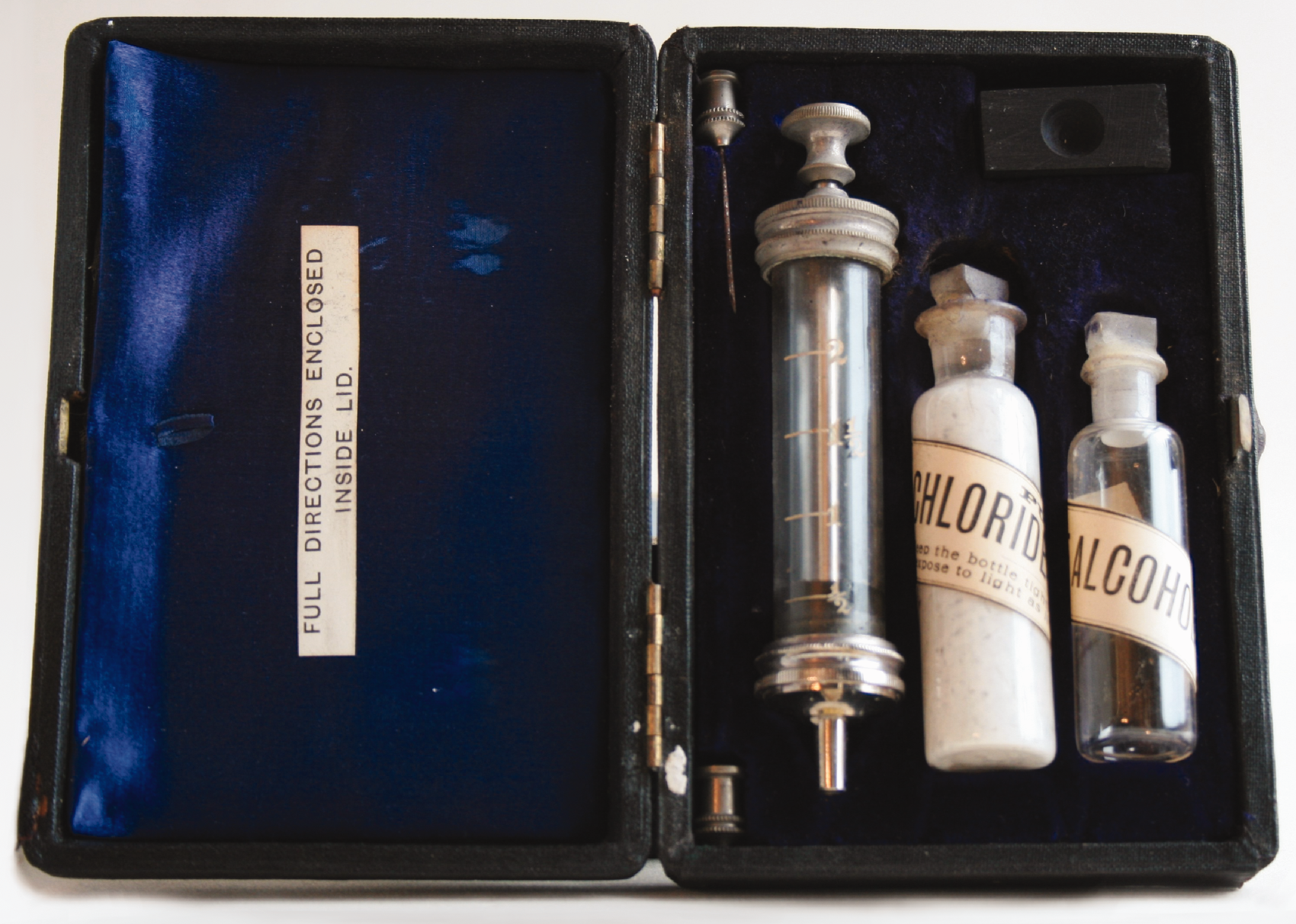
Pocket case of chloride of lime antidote for snake-bite, produced by Felton, Grimwade and Co., Melbourne, c.1895. The set was supplied with a graduated syringe, two needles and a bottle containing powdered chloride of lime (bleaching powder). When required, this was dissolved in water and injected subcutaneously around the site of the snake bite. A bottle of pure alcohol was included as a means of sterilising the equipment before use. Image courtesy of the Geoffrey Kaye Museum of Anaesthetic History, VGKM2615.
Twenty years later, these interventions remained in common use, and were put to the test in the ‘almost hopeless case’ of a 14-year-old boy bitten by a ‘red snake’ near New Norfolk, Tasmania. 12 One hour after the incident occurred, a local doctor ‘stopped the circulation by bandages, incised the wound, cut out the snake fang, exploded gunpowder on the leg, and sucked the wound’. Ammonia was applied topically, brandy administered enterally and water ‘freely used on his head’. Despite these efforts, the boy sank into unconsciousness and had no perceptible pulse. Consequently, a group of 18 men ‘struck work to assist in the recovery of the patient’. During the following 6 hours, ‘5 men continually jumped and walked the lad about’, and two gallons of cold water was poured over his head from a height of 12 feet, at 5-minute intervals. Furthermore, the boy received ‘ammonia every 5 minutes to the nostrils, severe beatings on the back (worthy to be remembered), the arms nettled, and ammonia rubbed in also on the spine’. Following the application of a mustard poultice, and immersion of his feet in hot water and mustard, he finally ‘rallied’, and ‘knew his mother, and recognised his friends.’ Nonetheless, the boy’s ordeal was not yet over, and after being permitted half an hour’s sleep, he was awoken with a shock from a galvanic battery. 12
Around the same time, a ‘proliferation of snake showmen’, as well as various medical practitioners, began to promote a diverse range of ‘infallible antidotes’ and ‘extraordinary cures’ for snake bite. 10 Among the earliest and most enduring of these was Charles Underwood’s ‘antidote for the bites of snakes and other venomous reptiles’. 13 A single application of the secret formula was deemed ‘quite sufficient for a perfect cure’, and its inventor was ‘ready to submit his medicine to any test with rabbits, dogs, and other descriptions of animals, for the purpose of proving its efficacy in saving life before any competent person.’ 13 In common with other showmen, Underwood would also allow himself to be bitten as a means of demonstrating the utility of his remedy.
Concomitantly, physicians experimented with a variety of antidotes, including unguentum hydrargyri fortius (strong mercurial ointment), 14 potassium permanganate 10 and the intravenous injection of ammonia. 15 While the latter treatment was briefly embraced as ‘a true specific’ for snake bite, 16 not all were convinced of its safety. In 1869, Dr J. Berncastle wrote: ‘the remedy is worse than the disease … if the bite could not kill a man, he would have a very fair prospect of being killed by such a dangerous and useless proceeding’. 17 The use of parenteral ammonia waned in 1874 after a Commission set up to investigate the effects of artificial respiration and various drugs in cases of Indian and Australian snake poisoning concluded that it possessed ‘no antidotal or remedial power … and probably by promoting the absorption of the poison, rather expedites than retards the tendency to death’. 16
Nevertheless, the search for an effective antidote continued during the closing years of the 19th century. In 1884, Joseph Bancroft suggested that the inhalation of ether might prove valuable in cases of snake bite, 18 and 4 years later, Augustus Mueller attempted to popularise the subcutaneous injection of strychnine. 19 In December 1894, George Halford, Professor of Anatomy, Physiology and Pathology at the University of Melbourne, was among the first to recommend the use of chlorinated lime, a therapy also known to Albert Calmette, 20 who played a crucial role in the discovery of effective antivenoms.