




Abstract
Wind power only received occasional attention since the introduction of electricity until the 1970s, when a revived interest in alternative energy sources spurred the development thread that led to today’s wind turbines. Although attention and financial support at the time were directed toward government-funded MW-scale wind turbines, the small models developed in the late 1970s for the Danish market were ultimately the way forward. The wind industry has since matured, as evidenced by the lower specific power and higher capacity factors of recent turbine models and the similarity between their power curve shapes. Moreover, this study highlights two historical accomplishments by Europeans that are sometimes incorrectly credited to Americans: the first wind turbine to generate electricity was built in 1883 by Austrian Josef Friedländer and the Danish Agricco (1919) became the first public grid-connected wind turbine.
Introduction
For thousands of years, wind energy has been employed to sail boats, pump water, grind grain, saw timber, shred tobacco, and press oil. The mechanical machines powered by windmills in the Netherlands precede Britain’s coalfields from the Industrial Revolution (DE Decker, 2009; Stokhuyzen, 1963, 2019).
For millennia, humans have utilized the wind to sail boats. While it is challenging to pinpoint the exact moment when land-based wind applications started, traces of vertical-axis wind turbines (VAWTs) in Persia indicate that onshore wind power has been utilized since at least the 9th century (Hills, 1996; Wailes, 1971). Typically, one side of these drag-based mechanisms was covered to make the wind push the blades on half a revolution and then rotate them about the vertical axis. Before electrification, the energy harvested from the wind was converted to mechanical energy and transmitted using shafts mainly designed to grind grain, pump water for irrigation, or harvest salt. From the Middle East to Central Asia, wind power spread to India and China. The grain-grinding windmills used in Europe in the 12th century had a horizontal-axis configuration and were based on the aerodynamic lift principle; this design can be said to be one of the pivotal forerunners of modern propeller turbines. Over the years, windmills were substantially developed, and their usage peaked in the 19th century, when there existed hundreds of thousands of windmills. For example, unlike manually oriented or fixed-angle windmills, a type of windmill called the Smock mill had a fantail fixed at a right angle to its main sails that turned the cap into the wind automatically. Small windpumps with multiple blades became widespread in Australia and on the American Great Plains in the 19th century; their popularity peaked in the 1930s (Gipe, 2016). These turbines, which were typically fast-rotating, had several important applications, including pumping water for cattle and steam locomotives.
With electricity emerging as a way of transmitting energy in the late 1800s, wind power also became of interest for generating electricity. While coal-fired power plants and hydropower were still preferred, wind turbines were sporadically developed for electricity generation throughout the coming century. A renewed interest came with the oil crisis of the 1970s and, since the great wind revival of the 1980s, wind turbines were gradually developed into today’s three-bladed design with upwind rotors, which is still steadily increasing in size. Today, wind turbines and solar photovoltaics are the main technologies in terms of new electricity generation by capacity.
Aim of the paper
Descriptions of the history of wind power in book format (Gipe, 1995, 2016) has previously been published by one of the authors. Two of the authors have also published a longer article in two parts (Gipe and Möllerström, 2022a, 2022b) that describes historically important and other notable wind turbines as well as a book chapter (Möllerström and Gipe, 2023). This work aims to comprehensively describe the main development threads of wind turbines while focusing on the thread that produced today’s large, commercially viable wind turbines. Furthermore, in this work, a novel approach regarding the historical connection between the capacity factor and the specific power is used to analyze and illustrate the development of maturity of the wind power industry. It also aims to call attention to some historical misstatements regarding wind turbine developments and suggest further reading on the various wind turbines covered in the paper.
Limitations
The focus is on the development of onshore wind turbines in North America and Europe. Vertical-axis wind turbines have already been covered by the authors (Möllerström et al., 2019), so they are not discussed in depth. Moreover, we omit concepts that are not directly related to the mainstream development of wind turbines, such as ducted or one-bladed models.
Lack of momentum until the 1970s
With the breakthrough of electricity in the final decades of the 1800s, hydropower and coal-fired power plants from the start became the main sources of electrical power. However, the already mastered method of converting wind energy into mechanical energy also gained some interest for the purpose of generating electricity. Without coming near to breaking the dominance of hydro and coal, electricity-generating wind turbines were sporadically built throughout the following century.
The first electricity-producing wind turbine
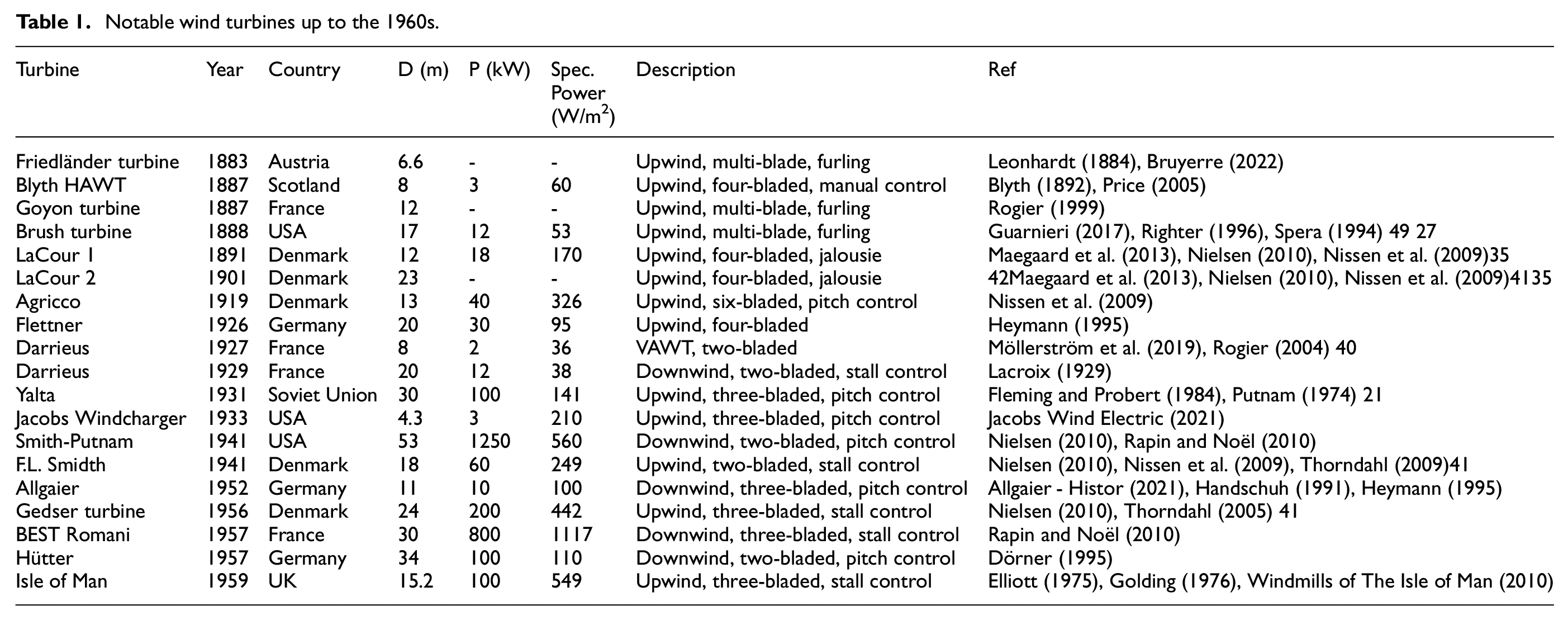
Following the rapid development of electric power transmission systems in the final parts of the 1800s, finding alternatives for electricity generation came into focus and electricity-generating wind turbines were soon introduced. The first electricity-generating wind turbine was previously believed to have been built by James Blyth in Marykirk, eastern Scotland, in 1887. Blyth allegedly offered to use the electricity surplus for providing the village with electric streetlights but was turned down by the villagers who viewed electricity as the “work of the devil” (Price, 2005). More recent findings have put the Austrian Josef Friedländer’s 6.6 m Halladay wind turbine as the current frontrunner (Bruyerre, 2022). The Halladay turbine was installed in 1883 at the Vienna International Electrical Exhibition. The turbine consisted of a wind pump supplied by U.S. Wind Engine & Pump Co. that drove a dynamo at ground level, feeding electricity into a series of batteries.
In 1888, the American Charles F. Brush had a by far larger wind turbine constructed in Cleveland, Ohio (Figure 1). This horizontal-axis wind turbine (HAWT) had a rated power of 12 kW, a 17 m rotor with 144 blades, and functioned for 20 years (Guarnieri, 2017; Righter, 1996; Spera, 1994). Another wind power pioneer, the Dane Poul la Cour, constructed a HAWT with an 18 kW rating in Askov, Jutland, in 1891 (Figure 1). This HAWT was the first of several windmill-like models ranging up to 35 kW (Maegaard et al., 2013; Nielsen, 2010; Nissen et al., 2009). While it was unusual to use hydrogen rather than batteries to store energy, it was the experiments on aerodynamics that came to be of most use for future wind turbine developments.
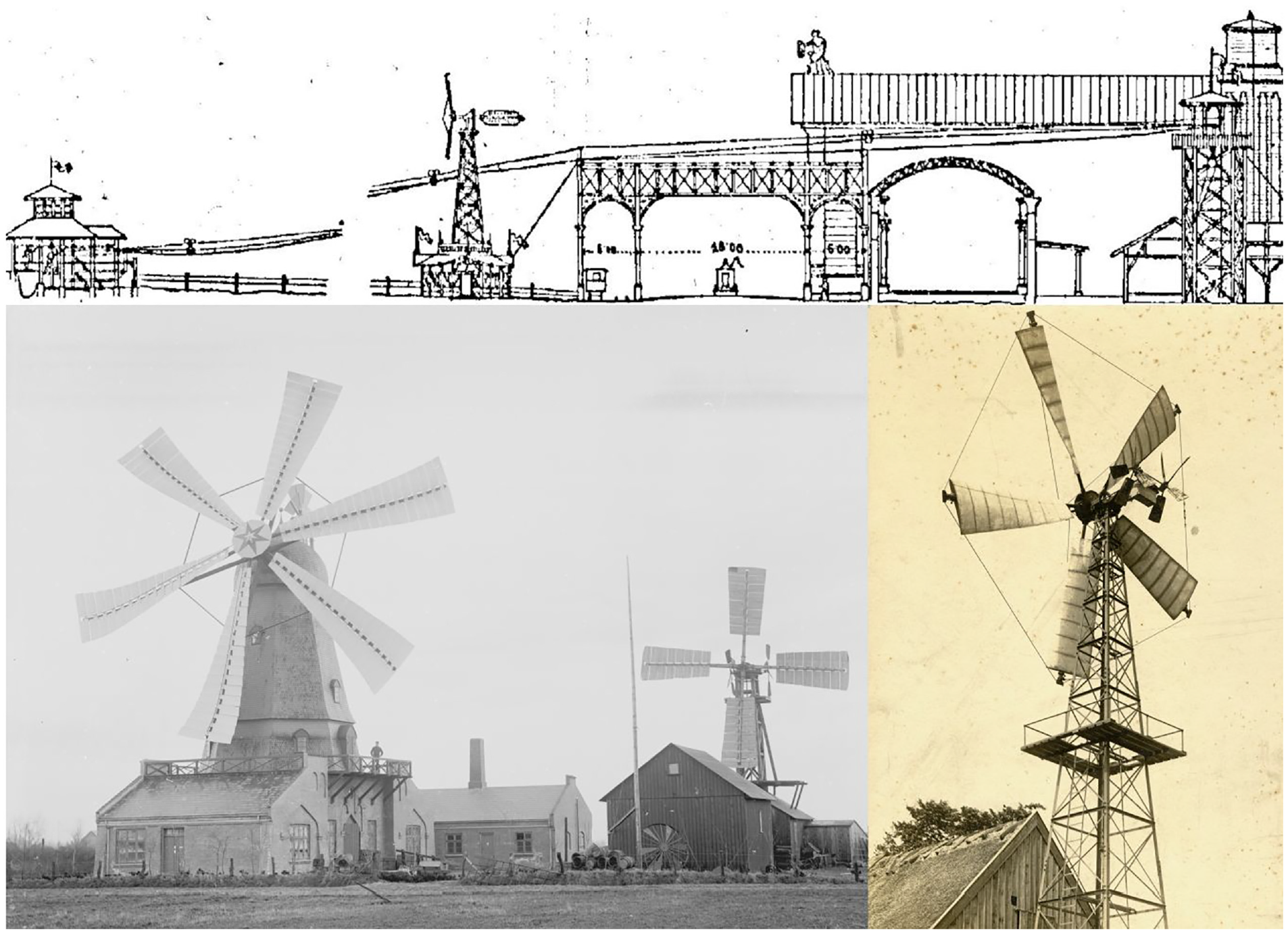
Top: A drawing of the Friedländer’s Halladay wind motor at the 1883 Vienna International Electrical Exposition (Leonhardt, 1883). Public domain. Lower left: Poul la Cour’s 18 kW turbine (right in photo) and the larger aftercoming “conical wind catcher” (left in photo). Photo used with permission from the Poul la Cour Foundation. Lower right: The Agricco wind turbine, which became the first grid-connected wind turbine in 1919. Photo used with permission from The Danish Museum of Energy.
Concurrent with the rapid advancements in electricity generation, transmission, and usage, several wind turbines were built, as reported in Table 1. Although the electricity-generating potential of wind turbines was demonstrated, wind power as never fully able to be a viable option to early hydropower and coal-fired power plants. This remained the case until the 1970s (see section 3 1970s and 1980s: the great wind revival), although some electricity-generating wind turbines were also built before then (see sections 2.2 The interwar period and 2.3 Post-war years).
Notable wind turbines up to the 1960s.
The interwar period
Due to the rapid advances in aeronautical engineering from military developments, more sophisticated airfoils were used in many of the post-WWI wind turbines. Although wind energy remained a marginalized way of producing electricity, this period included the first alternating current (AC) network-connected wind turbine and saw significant advances in wind turbine design.
Partly based on la Cour’s progress, in 1918 Denmark had 120 wind turbines that ranged between 20 and 25 kW and met 3% of its electricity demand (Meyer, 1995). Before WWI, many areas in rural Denmark were served by electrical systems that used direct current (DC) and were supported by wind turbines similar to la Cour’s. During WWI, AC became available in districts of Copenhagen. In 1919, the 40 kW, 13 m Agricco wind turbine (Figure 1) became both the first model with true airfoils in the blades and the first known wind turbine connected to an AC network (Nissen et al., 2009).
In the American countryside, where mechanical windpumps were already common, wind turbines with similar sizes but 2–3 blades rapidly gained popularity, particularly in remote off-grid locations. Notably, the Windcharger (Figure 2) of the Jacobs Wind Electric Company in Minneapolis sold 20,000 units in the 1930s–50s (Jacobs Wind Electric, 2021). However, these small models gradually lost market share with the expansion of the electrical grid. Another notable American development was the 53 m, 1.25 MW Smith-Putnam turbine (Figure 2), which was built in 1941 and remained the world’s largest wind turbine until 1979 (Nielsen, 2010). This downwind model was fitted with a synchronous generator and was functionable until one of its steel blades had a failure and was thrown off in 1945.
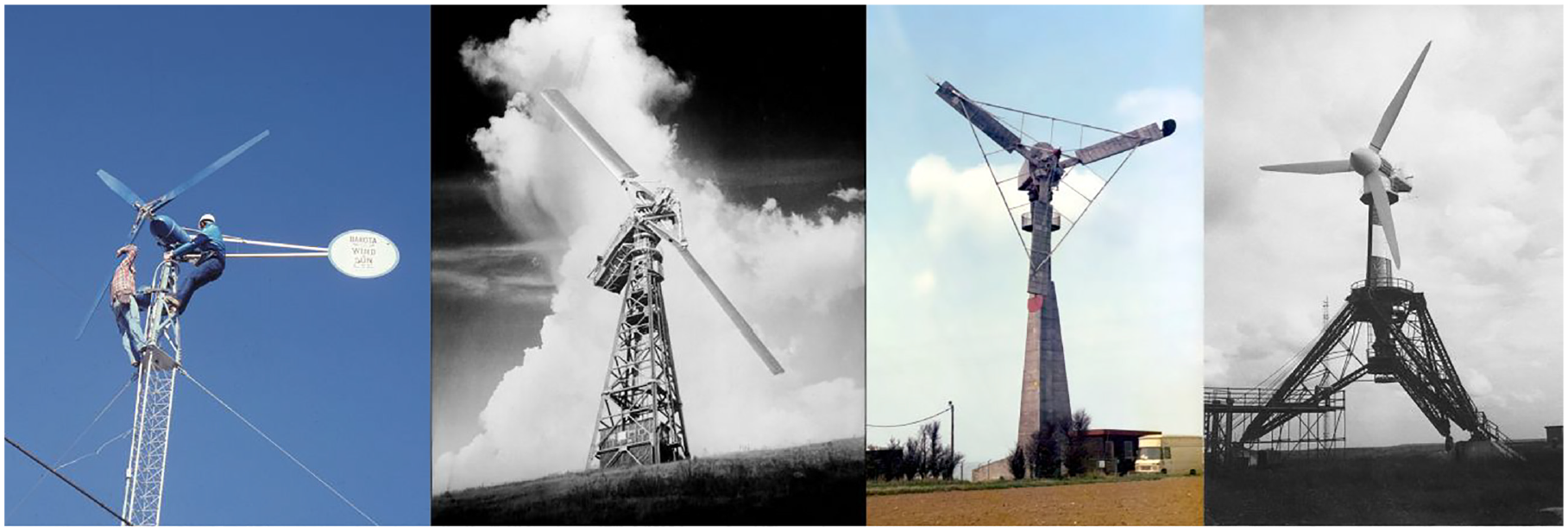
Left: A ca 1930s wood-bladed Jacobs Windcharger in Texas in 1979; the round tail vane that turned the upwind rotor into the wind direction is seen on the right-hand side. Photo by Paul Gipe. Second from the left: The Smith-Putnam turbine located at Grandpa’s Knob, Vermont. From the Carl Wilcox collection, made available by Paul Gipe. Third from the left: The 200 kW, 24 m Gedser mill that was erected in 1957. Photo used with permission from The Danish Museum of Energy. Right: The French BEST-Romani turbine. From the archives of Jean-Luc Cavey (L'Eolienne de Nogent Le Roi (France) 1955-1966 EDF - BEST - Romani, 2023). All rights reserved.
The major advances in aviation prompted by war efforts led to several more aerodynamically advanced wind turbines leading up to and during WWII, for example, by the Frenchman Darrieus (Lacroix, 1929), the Germans Flettner, Bilau and Hütter (Dörner, 1995; Heymann, 1995), the Dane F.L Smidth (Nielsen, 2010), and the 100 kW Russian Yalta turbine (Rapin and Noël, 2010). After the previously mentioned Agricco turbine, the Yalta became the second wind turbine connected to an AC network in 1931 (Owens, 2019). See Table 1 for turbine specifications and (Gipe and Möllerström, 2022a) for a more detailed description of these turbines. While others attempted to develop electricity-generating wind turbines, wind energy still lagged behind other sources in electricity generation as the power sector continued to expand rapidly.
Post-war years
After WWII, many countries and the United Nations started wind energy programs to see if wind power could play a significant role in meeting the growing electricity demand. Once more, Denmark hosted some of the most significant developments which provided the foundation for what would become the modern wind turbine. Nevertheless, wind turbine developments also occurred in other countries.
The Danish wind power developments continued: after several smaller machines were built in the early 1950s, Poul la Cour’s student Johannes Juul built the Gedser wind turbine (Figure 2) near the Danish town Gedser situated on the island of Falster in 1957 (Thorndahl, 2005). This 200 kW, 24 m wind turbine functioned until 1967 and then for a short period in the 1970s after being renovated. The Gedser turbine was fitted with an asynchronous generator, an upwind rotor with electrical yaw motors, and stall power control supplemented with aerodynamic tip brakes. Effectively, this model was a key forerunner to the dominating wind turbine design during the commercialization of wind turbines in the 1980s (Meyer, 1995; Thorndahl, 2005).
Besides Danish developments, there were serious attempts in several other countries including Germany, France, and the United Kingdom. In Germany, the previously mentioned Ulrich Hütter developed a 3-bladed, 10 kW turbine for the Allgaier company; around 150–200 models were built in the first part of the 1950s (Handschuh, 1991). Other developments, such as the 640 kW BEST-Romani turbine in France (see Figure 2) (Rapin and Noël, 2010) and the Isle of Man turbine in United Kingdom, (Elliott, 1975; Golding, 1976), are outlined in Table 1 with further information available in (Gipe and Möllerström, 2022a). To summarize this period, further development was made on turbine technology, but the breakthrough of wind energy was yet to come.
1970s and 1980s: the great wind revival
When Organization of Arab Petroleum Exporting Countries (OAPEC) declared an oil embargo against the countries that had supported Israel during the Yom Kippur War, the 1973 oil crisis was a fact. This fueled an interest in alternative sources of energy, including wind energy. This period was characterized by government-funded energy programs that had top-down, centrally set strategies and centrally selected stakeholders such as contractors and utilities. Simultaneously but to a lesser extent, the development of much smaller wind turbines with sizes and robustness suitable for rural, often agricultural customers took place in Denmark.
Large government-funded prototype turbines: a wrong turn
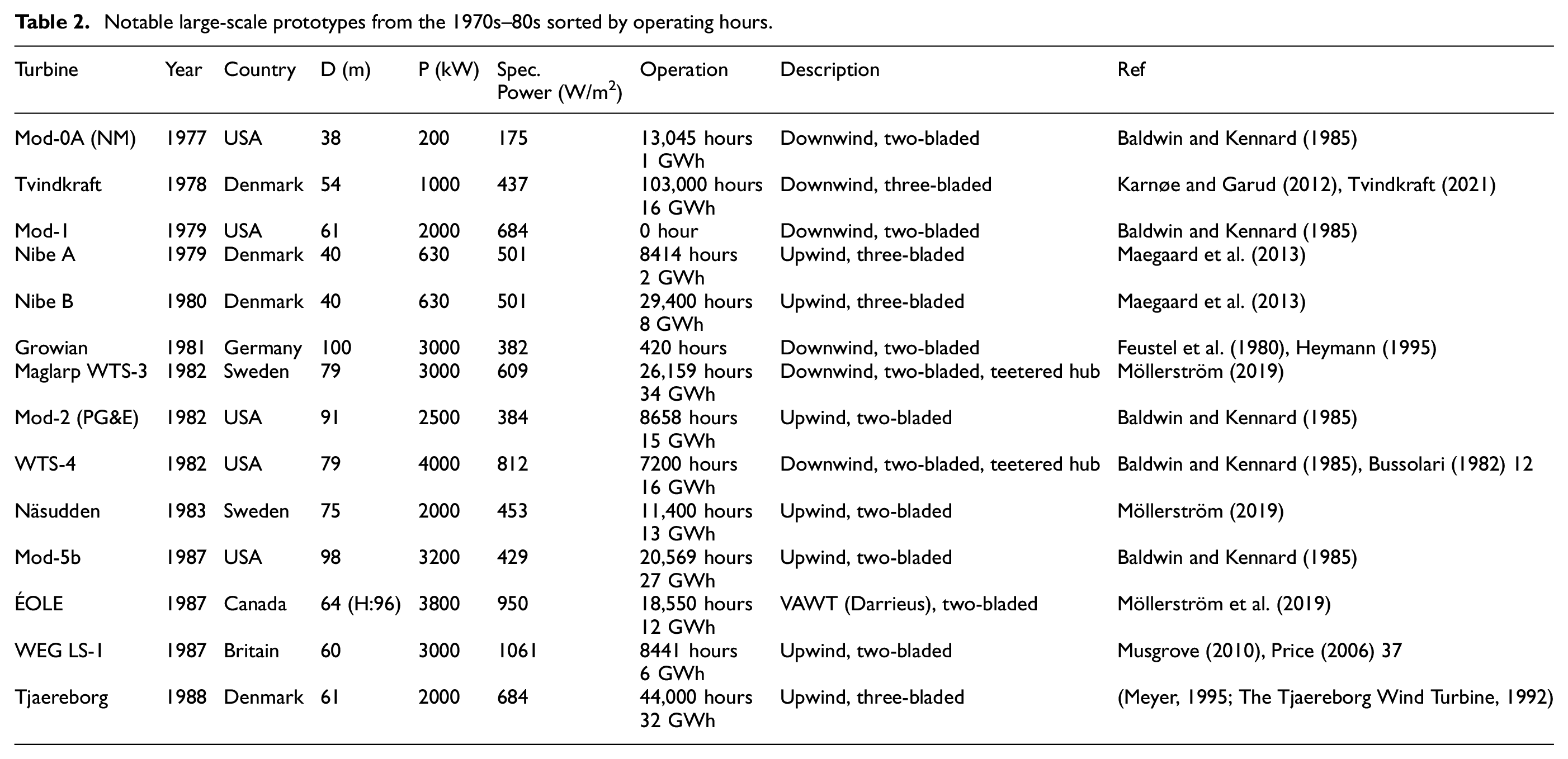
The energy crisis of the 1970s prompted several government-funded programs to explore alternative energy sources. In the USA, a NASA-led American program where different multi-MW concepts were tested with full-scale prototypes started in the mid-1970s (Baldwin and Kennard, 1985). NASA developed and evaluated several upwind and downwind turbines with two blades but different sizes and technological setups, from the Mod-1 in 1977 to the Mod-5b in 1987 (Figure 3). However, the program did not significantly advance wind turbine design, and NASA’s interest in wind energy waned when oil prices dropped in the late 1980s.
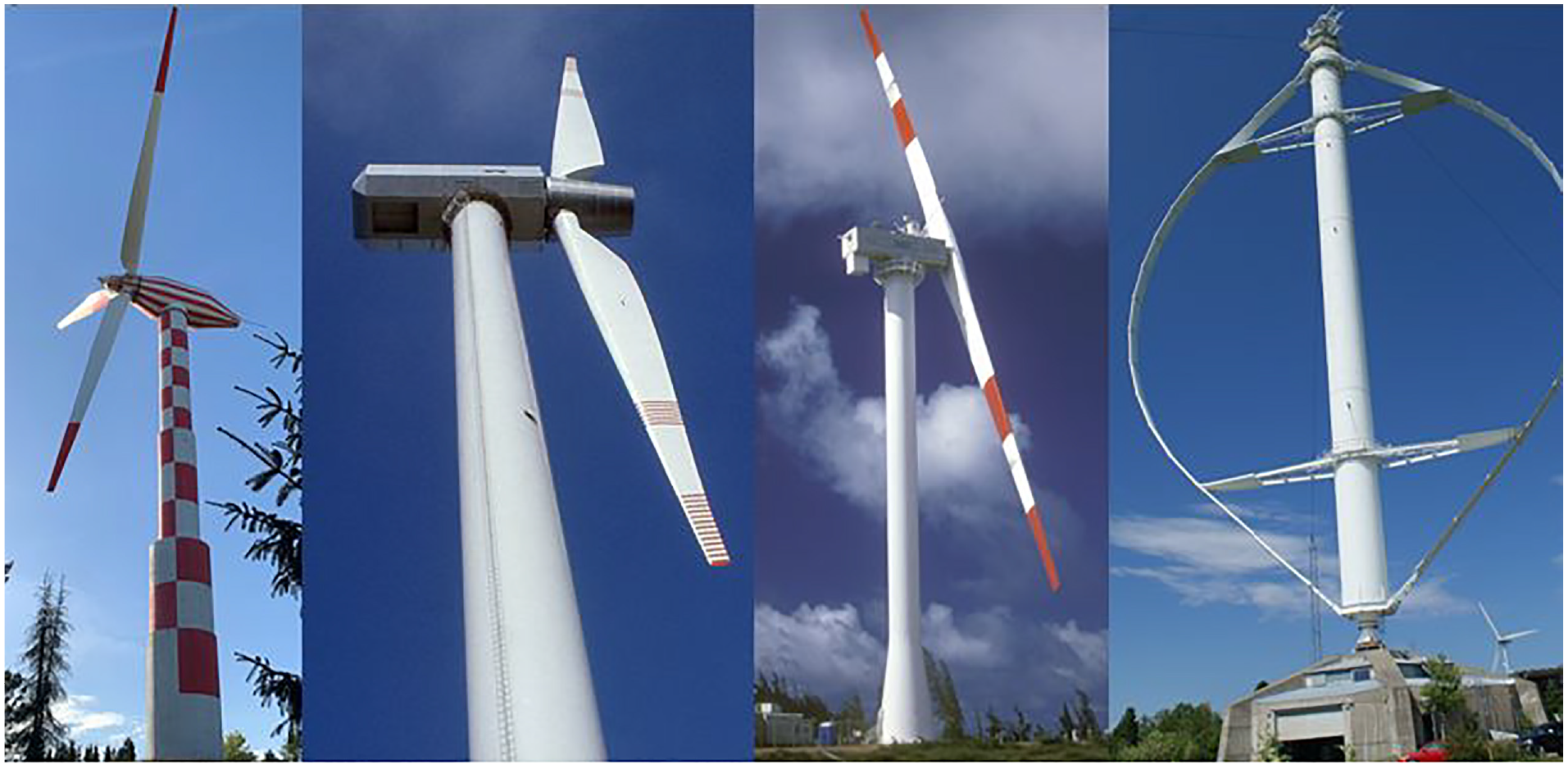
Far-left: Tvindkraft, the still-operating MW-scale turbine erected by the TVind school in Jutland, Denmark. Center-left: The 3 MW WTS-3 turbine in Maglarp, Sweden. Center-right: Boeing Mod-5b, the most successful wind turbine among US DOE’s large-scale models. Far-right: The 3.8 MW ÉOLE, the all-time largest VAWT. Photos: Paul Gipe (Mod-5b), Erik Möllerström (Tvindkraft, ÉOLE), and Jos Beurskens (WTS-3, with permission).
In Germany, another giant, the 3 MW Growian wind turbine, was commissioned in 1987: with a 100 m rotor diameter, this downwind model was the largest wind turbine in the world at that point. Involving the previously mentioned Ulrich Hütter, the Growian turbine had a lean tower and was supported by guy wires. However, it had suboptimal performance: it operated only for 420 hours and was demolished in 1987 (Heymann, 1995). In Sweden, two MW-scale wind turbines were erected in the early 1980s as part of a government-funded program: the downwind 3 MW WTS-3 turbine in Maglarp, southern Sweden, and a 2 MW upwind turbine at Näsudden on the Gotland island in the Baltic Sea (Möllerström, 2019). In Canada, VAWTs were reinvented, and multiple prototypes were developed using government funding. Notably, the 3.8 MW ÉOLE wind turbine was built in 1987 in Cap-Chat, Quebec, and remains the largest VAWT ever built (Möllerström et al., 2019).
At the time, MW-scale wind turbines were, from the governmental point of view, seen as the only serious electricity-generating alternative to centralized plants such as coal-fired and nuclear power stations. As a result, expecting to gain economy-by-scale, these government-initiated attempts jumped directly to developing MW-scale models rather than developing smaller, reliable models and incrementally scaling them up. The turbines mentioned above as well as other large-scale prototypes from the 1970s–80s can be seen in Table 2; and further descriptions are available in (Gipe and Möllerström, 2022b).
Notable large-scale prototypes from the 1970s–80s sorted by operating hours.
Small turbines in Denmark: the way forward
Denmark is a story by itself: rather than promoting technical development, the political incentives in the second half of the 1970s and the first half of the 1980s focused on supporting the market with grants and various feed-in tariffs offering long-term, above the market-set electricity prices (Meyer, 1995; Nissen et al., 2009). Through this, many farmers became interested in wind turbines, and agricultural machinery manufacturers started to stock small, robust wind turbines. In retrospect, it was these small models, initially rating 10–20 kW, rather than the often-troubled MW-scale models funded by the government, that evolved into the large commercial wind turbines of today.
Christian Riisager, a Danish carpenter, was also a wind energy forerunner: in 1975, he started to build and sell basic wind turbines. By 1979, Riisager’s turbines and similar models produced by his competitors totaled 700 kW of installed capacity in Denmark (Maegaard et al., 2013). One of Riisager’s wind turbines is depicted in Figure 4. These experiences in building durable models were useful to several early wind turbine manufacturers, including Vestas, an agricultural equipment manufacturer that took over the wind turbine manufacturing of Herborg Vindkraft, (HVK) (Dykes, 2013; Stiesdal, 2013), and Bonus (which later became Siemens Wind Power). Moreover, the growing demand for connecting wind turbines to the grid and selling surplus electricity strongly influenced the national policies that enabled these companies to sell and refine their wind turbines.
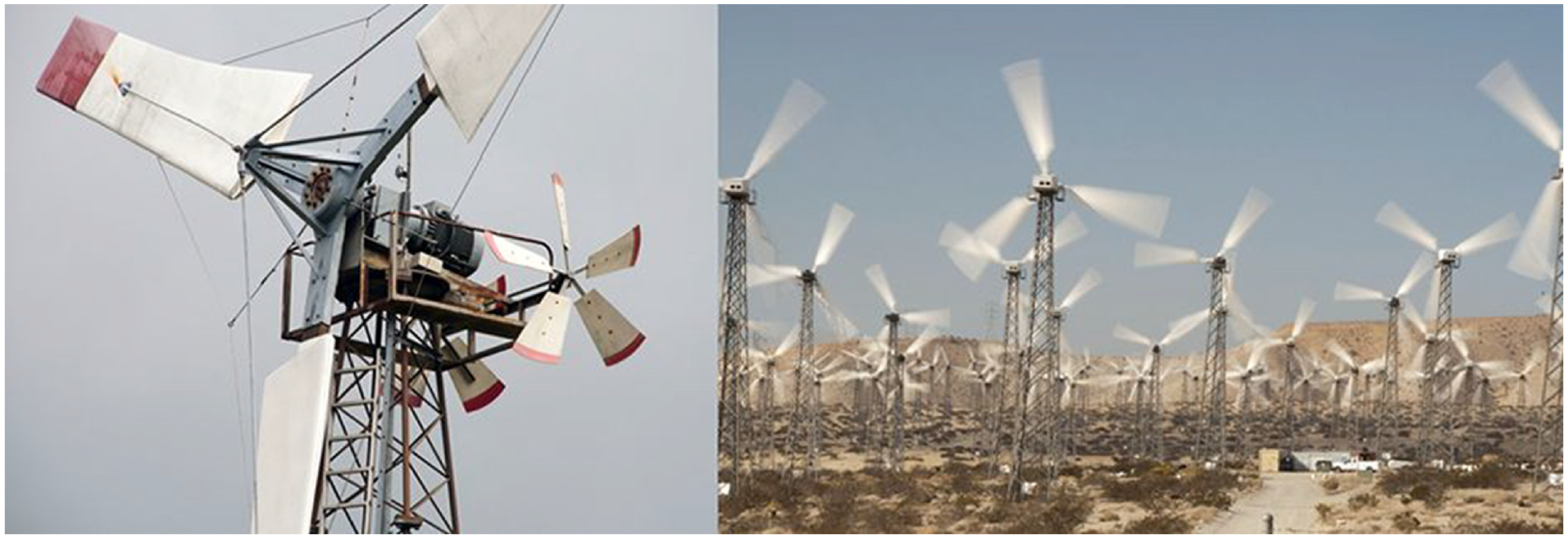
Left: An early 30 kW Riisager turbine, now located at the Danish Museum of Energy. Right: A wind farm with Vestas V17 turbines situated in the San Gorgonio Pass, California. Photos: Paul Gipe.
In 1978, Denmark saw the installation of a particularly large wind turbine when the 2 MW Tvindkraft turbine (Figure 3) was built near Ulfborg, Jutland. At the time, this 54 m tall downwind model was the largest wind turbine in the world. Excluding its downwind rotor orientation, the Tvindkraft turbine shares many features with today’s wind turbines. Unlike the MW-scale prototypes developed through top-down, government-ordered strategies, the Tvindkraft turbine was spawned from the alternative education school “Tvind” and built using recycled scraps and novel elements including pitch-controlled, epoxy-reinforced blades. Learnings from Tvindkraft was important for several Danish wind turbine producers including Bonus, Micon, Nordtank, and Vestas. Remarkably, the Tvindkraft turbine still functions in 2024.
The great Californian wind rush
At the end of the 1970s, US President Jimmy Carter implemented a federal reform introducing a competitive fixed price for electricity generated using renewable energy sources in the form of feed-in tariffs. In California, this reform and significant (up to 50%) tax deductions for investments in wind power within the state started the “California wind rush” in 1981 (Ackermann and Söder, 2000; Asmus, 2001; Owens, 2019). Gathered in large wind farms close to Los Angeles and San Francisco, wind turbines at first between 25 and 65 kW and later above 100 kW were installed. By 1985, there were more than 12,000 wind turbines totaling over 1000 MW. Figure 4 depicts one of the Californian wind farms and in Table 3, information can be found for some important wind turbine models, during and leading up to the Californian wind rush.
Significant independently developed wind turbines between the mid-1970s and early 1980s.

The sturdy Danish models quickly gained popularity. While bulkier and more expensive than lightweight American wind turbines, the Danish models were more reliable, which is a critical consideration for a wind turbine. By the end of the great Californian wind rush, the Danish manufacturers Micon, Nordtank, Vestas, and WindMatic (a company inspired by Christian Riisager’s work) dominated the Californian market. The wind turbines sold at the time had the same fundamental layout with an upwind rotor and three blades used today, although they were less complex than today’s commercial MW-scale models. In 1986, the wind rush ended, with wind turbine sales suddenly dropped due to discontinuation of the tax deductions and feed-in tariffs as well as the oil price becoming low once again. Danish wind turbine manufacturers struggled greatly since they had become heavily reliant on the Californian market, which was significantly larger than the Danish market. Nevertheless, many Danish manufacturers overcame the end of the Californian wind rush by restructuring and entering new markets, now with products that had become larger, more efficient and reliable as a result of the major market developments in California. While the sudden end of the Californian wind rush may be viewed as a failure, the wind rush had been vital for the development of wind power. The favorable economic environment contributed to the development of wind turbine technology until it became commercially viable, leading to making wind power more competitive compared to other sources of electricity generation. Many of the wind turbines that were installed in California during the wind rush still function today, although several have been replaced with larger, more efficient models in recent years.
1990s and onward
Danish wind turbine manufacturers, notably Bonus, Vestas, Micon, and Nordtank (Nordtank and Micon merged into NEG Micon in 1997 which became part of Vestas in 2003), experienced significant growth during the good California years and then greatly struggled when that market collapsed (Karnøe and Garud, 2012; Meyer, 1995). After California, Europe and especially Germany became the main markets. Thus, the Danes now had to compete against other European manufacturers including Spain’s Gamesa (today merged with Siemens Wind Power, which originated from Bonus) and Germany’s Enercon. The latter pioneered the direct-drive gearless wind turbine concept. Starting from the 1980s, there was a continuous increase in the size of wind turbines, as exemplified by the progress of onshore Vestas models shown in Figure 5.
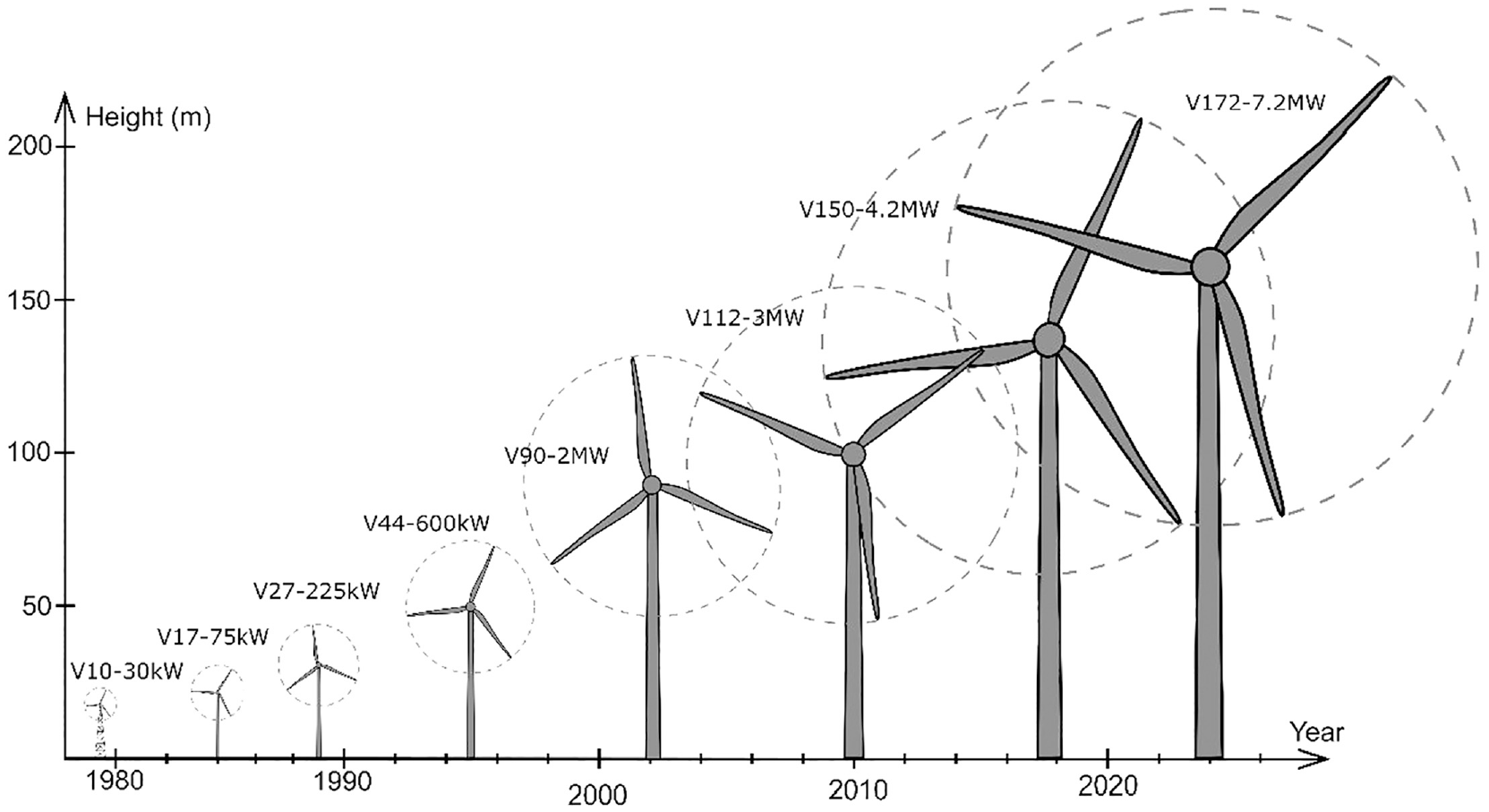
Size evolution of the onshore Vestas wind turbines. With 23,223 m2, Vestas V171 has the same swept area as 294 Vestas V10 turbines. The figure does not depict all Vestas models; moreover, some offshore turbines are even bigger.
Europe—especially Denmark, Germany, and Spain—dominated the wind power market for a long period until the global market awoke around 2010, especially in China and the USA. By 2024, these two countries had installed the largest capacity of wind power by far. However, if counting their wind capacity as a percentage of their electricity market, they are ranked much lower on the European-dominated list. It is noteworthy that domestic wind turbine manufacturers dominate the Chinese market, particularly Goldwind, which mainly operates in China. Several Chinese wind turbine manufacturers are the largest in the world as a result of the large size of China’s wind energy market.
The need to lower global emissions of greenhouse gases, in combination with the economic maturity of wind energy technology, means that wind power keeps growing and several ambitious targets have been set for the future, both globally such as the 2016 Paris Agreement and at the national and international (e.g. EU) levels. After growing by a factor of 100 in <30 years, in 2022 wind energy accounted for about 7.5% of global electricity generation (Energy, 2023).
Continued development
As wind turbines became larger, new problems arose regarding, among other factors, function, and wear. However, the turbine size was increased continuously in small steps, which somewhat simplified the development process as issues were also being gradually overcome. Addressing development setbacks, such as gearboxes often failing in the early 2000s, led to today’s MW-scale models being very reliable, not least in comparison with the first models of similar sizes from the 1980s. However, the Danish design has been largely retained aside from some minor refinements: for example, pitch control of the wings and variable speed with the help of frequency converters are both standard features today.
Increasing capacity factor
In parallel to the wind turbine size increase, a clear trend in recent wind turbine developments is the increasing capacity factor. Lengthening the blades while keeping the generator rating unchanged decreases the specific power, increasing the specific area. Considering a unique wind regime, longer blades lead to a greater swept area as well as a higher capacity factor since the rated power is reached at a lower wind speed. Such design modifications became realistic with pitch-controlled turbine models, where the pitch control can be configured to step in at a lower wind speed. The increased blade lengths imply more expensive blades but also more income from increased electricity generation. Consequently, the optimal blade length for a certain wind regime is an economic trade-off based on current blade manufacturing efficiency. Over time, manufacturing improvements have indeed resulted in decreased specific power, increased specific area, and increased capacity factors. For a unique wind regime and constant generator capacity, an increasing specific area correlates with increasing capacity factors. Figure 6(a) illustrates the capacity factors of the turbines shown in Figure 5 at a hypothetical location where the mean wind speed at a 100 m height is 7.0 m/s with a Weibull shape parameter of 2.0 and the surrounding landscape is characterized by a roughness length of 0.05 m. A significant increase in the capacity factor over time can be noted as the specific area increases. The Vestas V150 turbine shows a particularly high capacity factor in Figure 6(a), which can be explained by V150-4.2MW being a low-speed turbine with a high specific area (4.2 m2/kW), here operating in a wind regime close to its upper limit.
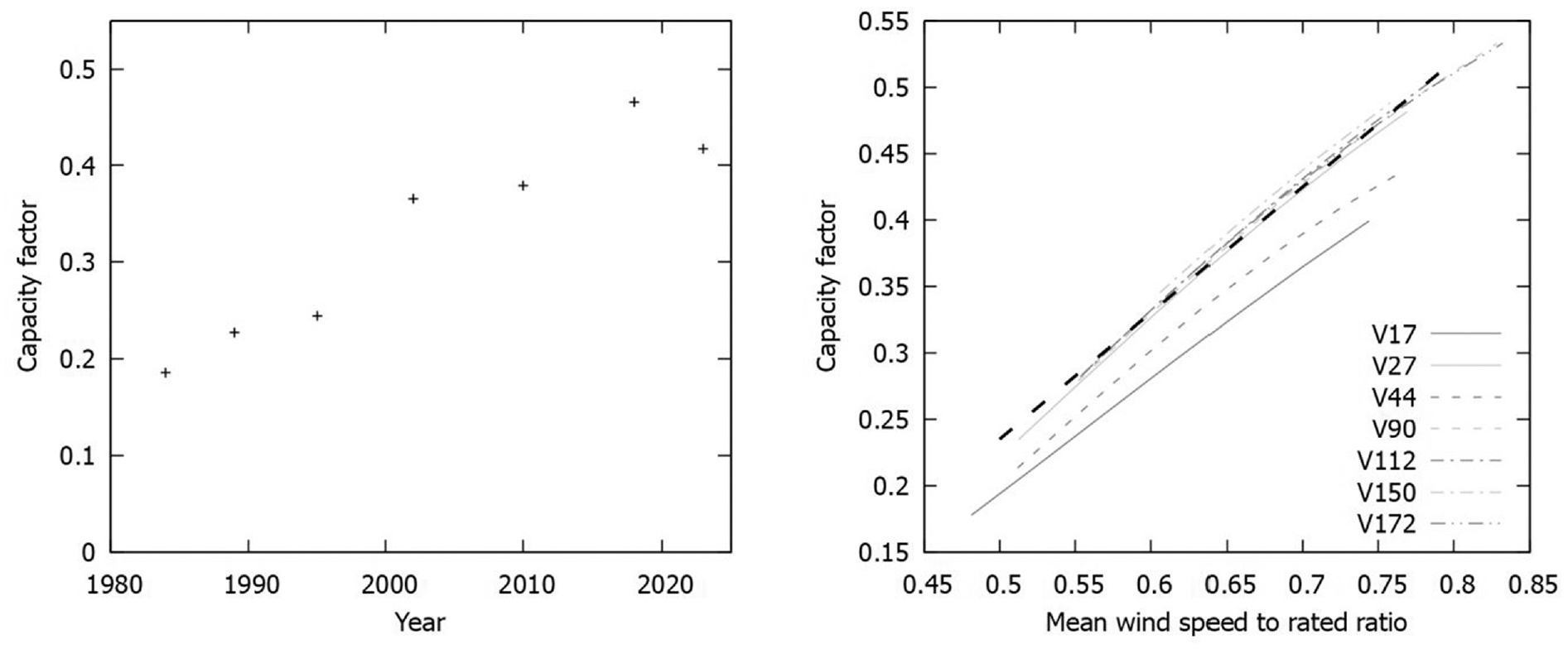
No-loss capacity factors for the turbines in Figure 5 considering Weibull distributed wind speeds with a shape parameter of 2.0. Availability and other losses are not included. In plot (a), a specific logarithmic wind profile is assumed, where the mean wind speed at 100 m is 7.0 m/s and the roughness length is 0.05 m, meaning that the hub-height mean wind speed varies between the turbines. In plot (b), the capacity factors are plotted against the ratio between the hub-height mean wind speed and the estimated rated wind speed, as calculated from equation (1). The trend of most of the turbines is indicated by the dashed black line, which is expressed in equation (2).
Generally, the capacity factor is dependent on the mean wind speed

where

which is indicated in Figure 6(b) as a dashed black line. Many wind turbine models from various manufacturers from 2000 onward have similarly shaped power curves, which means that equation (2) may be used to quickly estimate the no-loss capacity factor for a certain mean wind speed at standard air density. It may be noted that the estimated rated wind speed is calculated only from the specific power, which is readily available for every model. Also, the numbers given in equation (2) are closely linked to the selected values for
Discussion and conclusion
Wind turbines have evolved from the simple, small Danish designs of the 1970s to the large, more efficient models used today (Figure 5). It was the small turbines that grew incrementally, and not those developed by the government-funded aerospace industry, that have led to the multi-MW wind turbines we now see worldwide. Government-funded top-down development programs simply could not predetermine which design would work best when prematurely developing large machines with diameters up to 100 m. Wind turbines generate little revenue per operating hour relative to their investment cost, so they need to be durable and have low downtime and maintenance requirements to minimize operating costs. Large wind turbines are expected to have minimal issues over their target 20 plus year lifespan. It is infeasible to hand draw such large models: these wind turbines can only be developed by first building smaller models and then designing larger versions in a stepwise manner while simultaneously gathering operational and maintenance data from an existing fleet and addressing issues as they arise. The wind turbines of today were gradually developed through governmental support and changes in energy markets rather than solely through direct design. Market support has proven to be the path toward steady technological development.
Both the size and the specific power changed over time. The latter started at around 300–400 W/m2 at the end of the 1970s and kept therein into the 2000s, at which point wind turbines had multi-MW power ratings and diameters of about 100 m. A few models even exceeded 500 W/m2 which, considering the onshore locations where they were installed, was a selling point since their rated power exceeded that of wind turbines of equivalent sizes. In the mid-2010s, rated powers generally stopped growing with the increasing diameters, causing a drop in specific power values, which are now often close to 200 W/m2. This development resulted from the optimization of wind turbines for inland sites, which typically have less strong winds, and industry maturation, which naturally led to the prioritization of electricity generation and machinery longevity over high power ratings. As a consequence of designing for lower specific power relative to the wind regime, capacity factors started increasing; this has been observed for both onshore and offshore installations in the 2000s–2010s. The power curves of many wind turbines from this period have similar shapes, which implies that the ratio between the mean wind speed and the estimated rated wind speed essentially determines the no-loss capacity factor.
In conclusion, it was the small and simple wind turbines built for the Danish energy market at the end of the 1970s that evolved into the commercial MW-scale models of today. The early MW-scale wind turbines, funded by governments, ultimately proved to be a futile pursuit, or even a damaging one as each project failure helped to portray wind energy as unsuitable for large-scale electricity generation. Furthermore, various historical achievements that are sometimes mistakenly attributed to Americans belong to Europeans: the first electricity-generating wind turbine was built by the Austrian Josef Friedländer in 1883, followed by the Scottish Blyth turbine in 1887, both preceding Brush’s 1888 wind turbine in Ohio. Similar, the Danish Agricco and Russian Yalta turbines were constructed in 1919 and 1931 respectively, preceding the 1941 Smith-Putnam turbine as the earliest instances of public grid-connected wind turbines.
Footnotes
Acknowledgements
The authors would like to thank John Twidell, Philippe Bruyerre, Mark Haller, Jos Beurskens, Etienne Rogier, Matthias Heymann, and James Manwell for kindly providing information on historical wind developments and other inputs.
Declaration of conflicting interests
The author(s) declared no potential conflicts of interest with respect to the research, authorship, and/or publication of this article.
Funding
The author(s) received no financial support for the research, authorship, and/or publication of this article.
