




Abstract
Background:
In this celebratory issue of Prosthetics and Orthotics International, we review professional communication skills in the field of prosthetics and orthotics.
Objective:
We aim to reflect on communication skills in the past 50 years, to discuss developments in the coming 50 years, and to create a toolkit and research agenda to facilitate progress in professional communication in the next 50 years.
Results:
Despite being a key area in prosthetics and orthotics training programmes, we found no studies on professional communication with an experimental design published in Prosthetics and Orthotics International. As an alternative, we provide clinical reflections on the changes in professional communication in the past 50 years, and we discuss questionnaire-based and qualitative studies that provide evidence for the importance of communication in pedorthic footwear provision. In the coming 50 years, professional communication in the field of prosthetics and orthotics may be impacted by aging populations, global mobility, information technology, technological advances and emphasis on prevention. We discuss each of these topics. To facilitate progress in professional communication, we have created a toolkit with resources for prosthetics and orthotics professionals, prosthetics and orthotics students and other interested professionals.
Conclusions:
We hope this toolkit will inspire others to use, extend and implement it in their daily practice. As a research agenda, we strongly recommend undertaking research on interventions to improve professional communication and to study its effect on clinically meaningful outcomes.
Keywords
Introduction
We communicate. It is crucial for our existence and survival. Our most dominant form of communication is verbal. While words are considered ‘the most powerful drug’ 1 and ‘our most inexhaustible source of magic’, 2 use of words in a professional environment receives remarkably scant attention. In this celebratory issue of Prosthetics and Orthotics International, we have been invited to use words to reflect on professional communication skills in the field of prosthetics and orthotics (P&O). With our words, we aim to reflect on communication skills in the past 50 years, to discuss developments in the coming 50 years and to create a toolkit and research agenda to facilitate progress in professional communication over the next 50 years.
The past 50 years
The starting point for this article is a seminal paper by Dr Sidney Fishman on education in P&O, published in this journal in 1977. 3 Fishman identified six areas of skills and knowledge indispensable for P&O professionals, including the area of communication skills. 3 Using only seven lines for his description of this area (the shortest of the six areas), both what is and what is not written are informative.
Communication can be defined as a process of exchanging information between individuals, through a common set of symbols, signs or behaviour. 4 However, Fishman narrows this, by focusing solely on communicating one’s own ‘ideas, opinions and points of view’. 3 Gathering information, an integral part in its exchange, is not described. Further, of the various symbols, signs or behaviour that can be used to communicate, Fishman focuses only on written and spoken words (‘an adequate command of language skills’). Non-verbal communication or communication aids were not included. And while understanding others is discussed as part of other areas (‘psychological sciences’ and ‘personal and cultural qualifications’), this separation makes communication seem more like a one-way street: from the P&O professional directed towards a patient or colleague. The intricate levels of trust and mutual understanding that can follow from person-centred two-way interactive communication, including being listened to and being informed, 5 is nowhere to be seen in his description of the skill of professional communication.
In the more than 40 years following this article, the lack of attention on professional communication in the field of P&O has hardly changed. Having searched Prosthetics and Orthotics International for articles on this topic, the only paper with communication in its title or keywords is our own clinical note: 6 an expert opinion paper, without scientific data on this topic. Extending the search by including articles with ‘communication’ in their abstract resulted in additional 19 papers. Of these, nine were not related to the topic of professional communication skills. A further five were partly related to this topic by, for example, describing a model or scale to facilitate professional communication; however, these studies did not include any relevant outcome data.7–11 Of the five remaining studies, two did not include outcomes: one compared P&O programmes (including courses on communication skills) 12 and the other discussed the development of a visualization aid, but not if using this aid improved communication or clinical outcomes. 13 The only three studies in which data on this topic were presented included an observational study and two semi-quantitative studies. In the first, it was reported that P&O professionals agreed on role expectations related to professional communication. 14 In the latter two, the need for good communication and the importance of training P&O professionals in communication skills was discussed, but not investigated.15,16 Taking this together, no studies with an experimental design on the topic of professional communication have been published in this journal, despite communication being a key area in P&O programmes. 17
Irrespective of its absence in research, the importance and complexity of professional communication has been clearly acknowledged in daily clinical practice. This has led to marked changes over the past 50 years. In Box 1, one of the authors reflects on his personal experiences with professional communication in the P&O field throughout his long career.
Personal experiences – professional communication in the past 50 years.
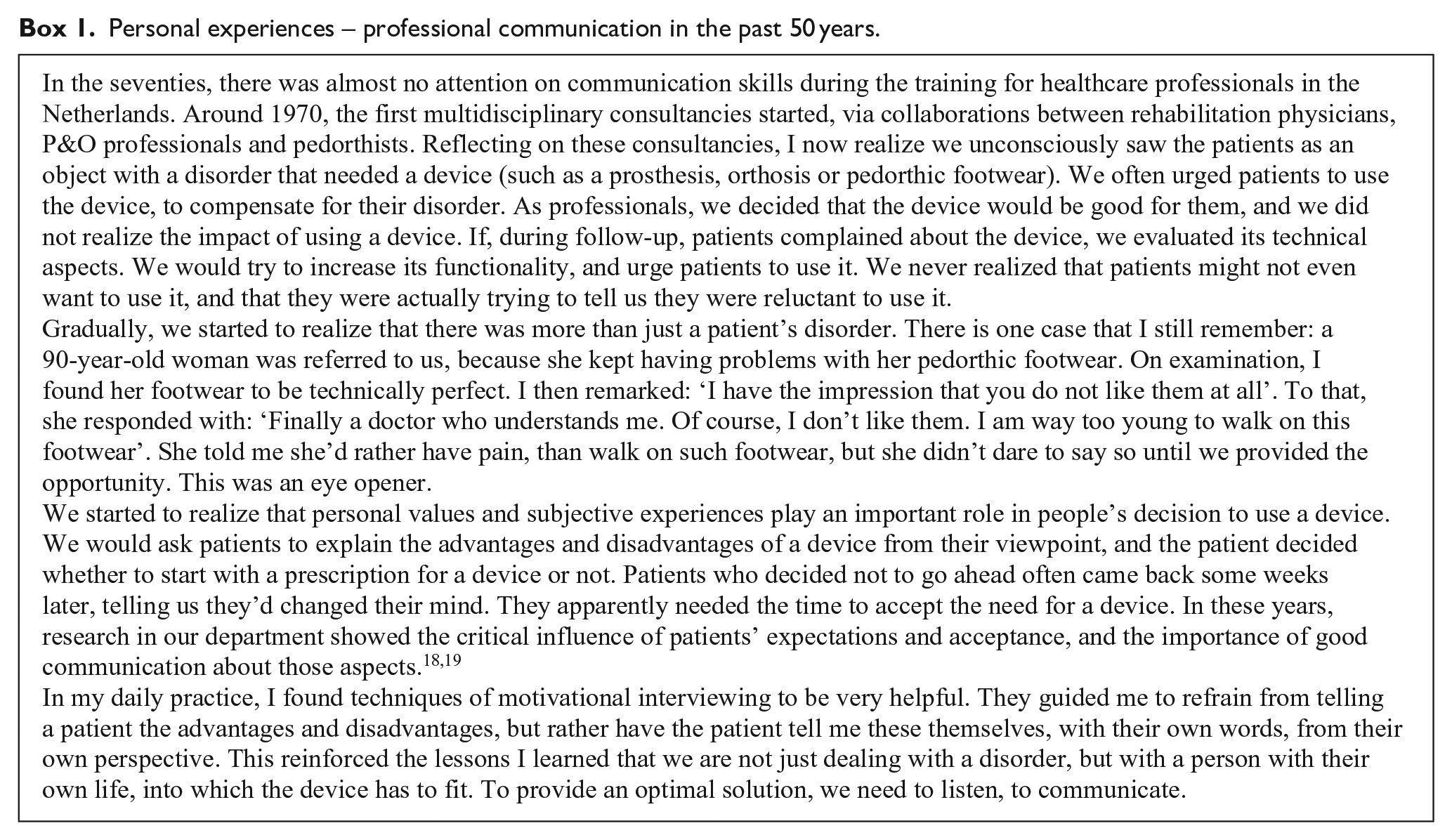
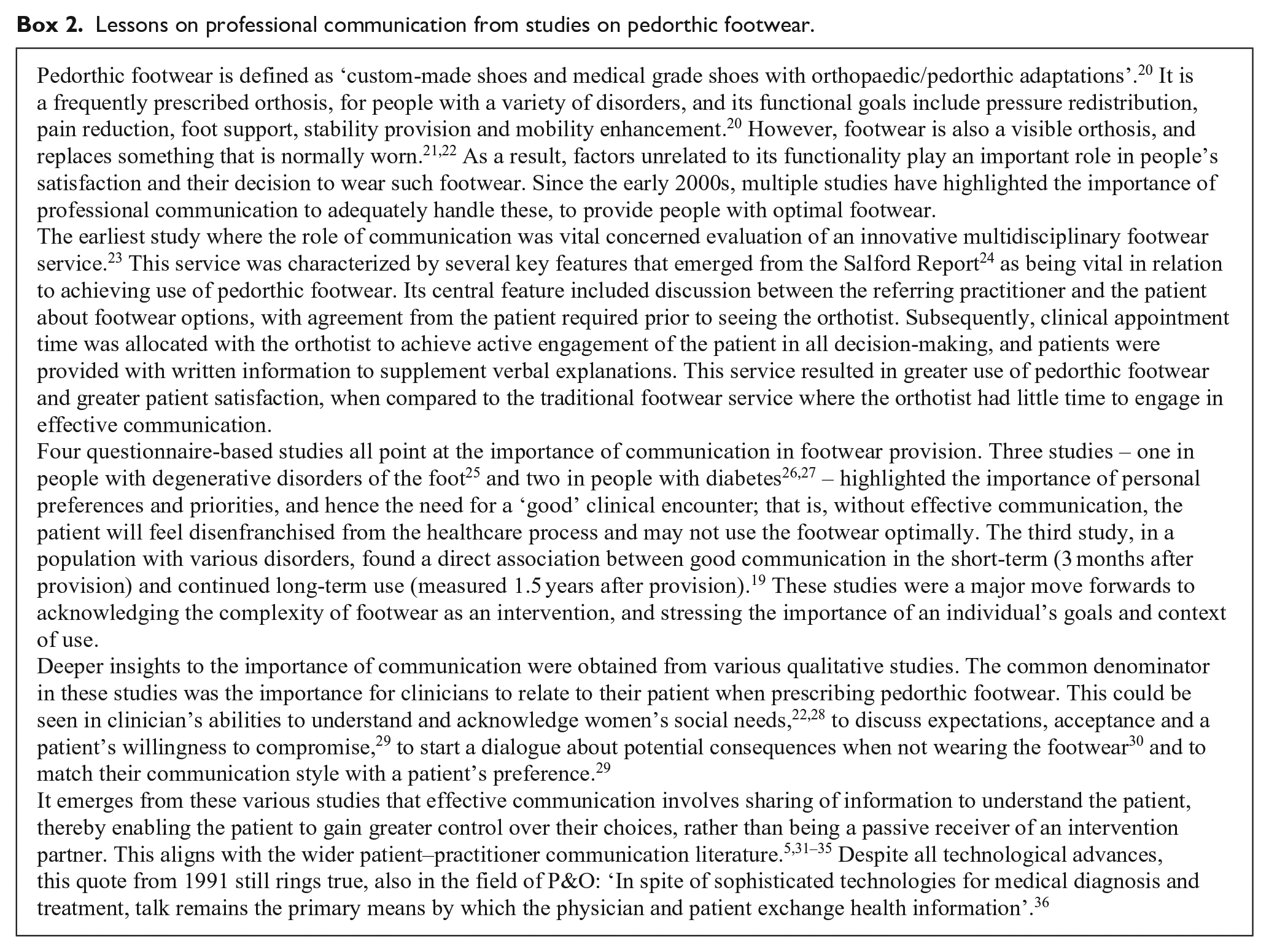
As acknowledged in those experiences, some progress in professional communication in the field was the result of outcomes from questionnaire-based or qualitative research studies. In these studies, users and professionals reflect on the crucial role communication has in reaching positive outcomes. As a full review of such studies on all P&O-related topics goes beyond the scope of this article, we chose the topic of pedorthic footwear to illustrate the lessons on professional communication learned from such studies over the past 50 years, see Box 2 for our findings.
Lessons on professional communication from studies on pedorthic footwear.
The coming 50 years
Predictions of the future are inherently uncertain. However, some current global trends can be expected to continue. For example, professional communication in the P&O field will likely be impacted by aging populations, global mobility, information technology, technological advances and an emphasis on prevention of disease or complications, rather than their treatment.
Aging populations
In the future, patients will increasingly include older people with several co-morbidities and in need of coordinated multidisciplinary healthcare interventions. 37 For this reason, P&O professionals can expect to continue working with multidisciplinary teams. 38 These teams include patients, their family, and different healthcare professionals. When communicating with professionals inside and outside the P&O field, the International Classification of Functioning, Disability and Health (ICF) is useful as it is becoming the standard language for describing health and health-related states. 39 Also, the ICF is useful for effective communication within the patient’s assessment, as it is based on a holistic biopsychosocial perspective, including both personal and environmental factors. Different tools have been developed for implementing the ICF in P&O practice, such as core sets,40,41 an ICF-based supply framework, 42 and the Prosthetic and Orthotic Process model. 9 Also, a special issue focussing on the ICF was published in Prosthetics and Orthotics International in 2011. 43 However, outcomes following implementation of such communication tools have not been investigated. Evaluation and optimization of such tools and other methods to facilitate working with an aging multimorbid population is needed.
Global mobility
Global mobility is increasing, meaning that more people will spend parts of their life in countries and cultures in which they did not grow up. This will increase the demands for communication skills and knowledge about cultural differences in conceptualizations of disease, disability and health. Some patients come from countries where people with disability have very low social status and disability is believed to be caused by witchcraft; this causes patients to feel discouraged and shy, and have low self-esteem.44,45 When meeting these patients, it is especially important that P&O professionals show an attitude absent of judgement and encourage patients to express their wishes and expectations. Cultures may also have a different emphasis on internal and external locus of control, that is, to what extent outcomes are believed to be caused by factors inside or outside the person’s own control. This results in different levels of adherence to self-care behaviours.46,47 Thus, P&O professionals need to clearly communicate why self-care is needed and in what ways it is expected to benefit patients.
Information technology
Information technology can be a valuable resource for accessing information on health, disease and P&O devices. However, patients generally do not have the education and knowledge to separate evidence-based information from advertisements and opinions. Thus, P&O professionals will likely meet knowledgeable patients demanding state-of-the-art interventions, but also patients with certain misconceptions, including unrealistic expectations of outcomes with P&O devices. This will place demands on P&O professionals to not only remain updated on recent innovations and evidence, but also to clearly communicate devices’ mechanisms of action, inappropriateness of certain devices and realistic outcomes.
Online (non-physical) consultations have become more common in other parts of healthcare, and we can expect that certain consultations will become non-physical in the P&O field as well. For example, this may include consultations on how a device should be used, if it needs to be repaired or replaced, and questions on device-related issues such as skin chafing and pain. Non-physical consultations have several advantages, such as saving travel time and reducing environmental impact, and may be the preferred method by patients of working-age and patients with multiple healthcare appointments. However, this will present additional challenges for professional communication, for example, in obtaining relevant information when it is not possible to physically examine a patient or device.
Technological advances
Technological developments of P&O devices are likely to continue in the future, meaning that P&O devices will be more technologically advanced, but may also be more expensive. 48 Given that medical and technological intervention options increase faster than healthcare budgets, there is an increasing gap between what can be done and what can be afforded. 49 This will put demands on P&O professionals’ ability to communicate priorities with patients, including having the integrity to prioritize patients based on their needs, rather than based on ‘who shouts the loudest’.
Emphasis on prevention
Historically, P&O devices were prescribed to improve functioning of individuals with a disability. However, there is an increasing emphasis on prevention, rather than treatment, of disease or complications. 50 As a result, more devices that aim to prevent disability over the longer-term, rather than directly improving functioning will be prescribed. For devices that aim to improve functioning, the patient’s needs and the device’s benefits are often immediately evident. In contrast, for devices used to prevent disability, patients’ needs may be less obvious and the device’s benefits may not be evident until after a substantial period of use. This makes it more difficult to motivate patients to use the device. 30 An example: for a patient with diabetes and a lower limb amputation following an infected foot ulcer, the need for a prosthesis and benefit of its use are obvious. In contrast, for a patient at risk of such an ulcer, the need for and benefit of using pedorthic footwear to prevent foot ulcers can be less obvious, especially as sensory neuropathy can obscure symptoms from the patient. 51 This was illustrated in a study where only 5% of patients with sensory neuropathy and a foot ulcer history mentioned ‘protection’ as important for usability of their footwear. 26 For P&O devices to prevent disability, communication skills of P&O professionals need to include strategies to support patients’ adherence to using the devices. A number of techniques have been used in the P&O field, for example, person-centred communication, shared decision-making and motivational interviewing,6,52 but research on its effectiveness and implementation is very limited.
Toolkit and research agenda
To facilitate progress in professional communication over the next 50 years, continuing professional education and additional research on this topic are crucial. Based on our experiences, we have created a toolkit with multiple resources for P&O professionals, P&O students and other interested professionals to use (Table 1). This toolkit contains reading material such as research papers, frameworks and position statements, in addition to ideas for training, teaching and improving professional communication.
Communication toolkit.
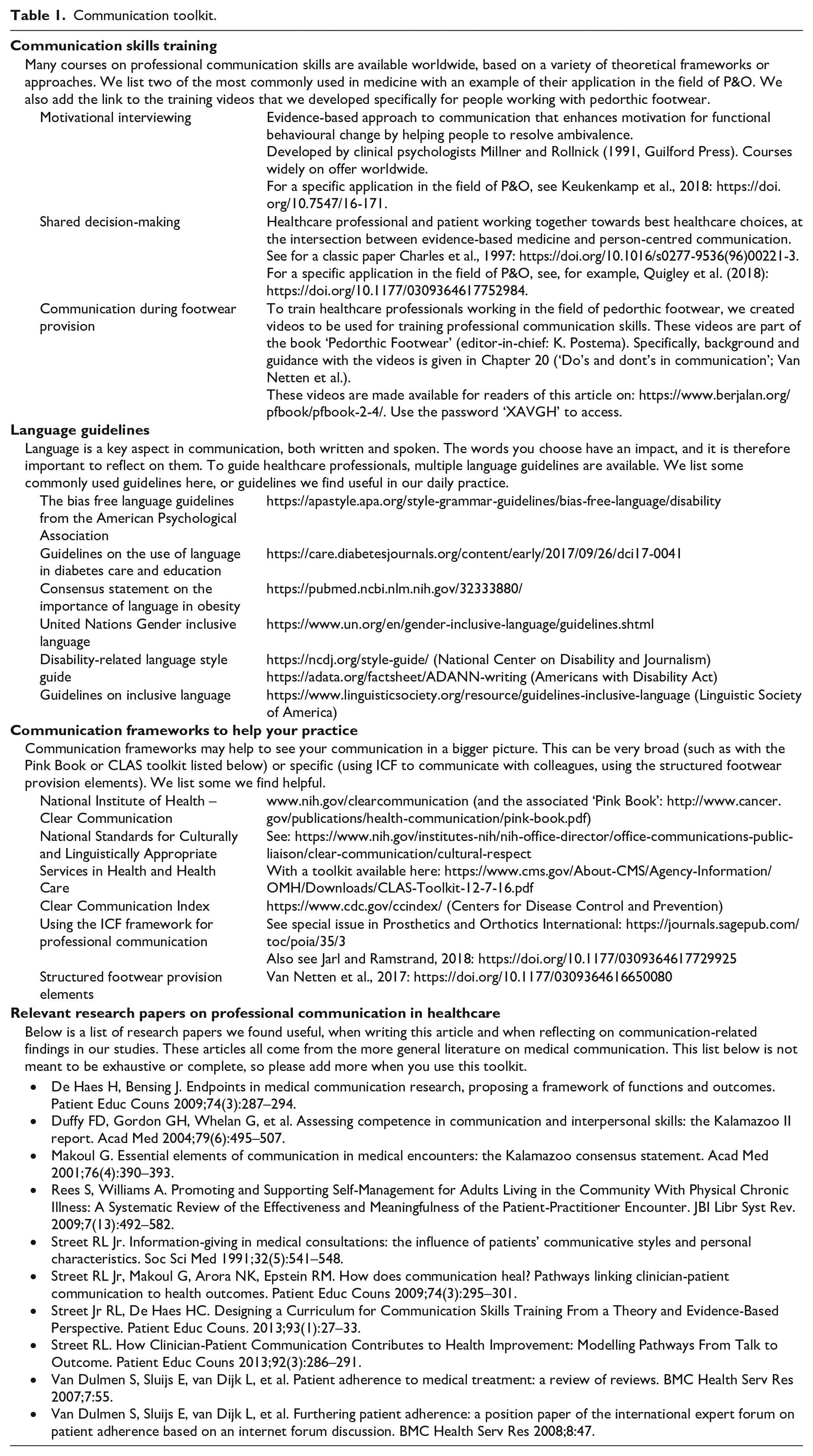
The intention of this toolkit is not to remain a static table in this article. It is available as a word document in Table 1, to be used and extended.We hope it will inspire others to implement it in daily practice, in P&O programmes at universities or schools, in professional courses or conferences, or anywhere else. We further hope others will extend this toolkit by adding resources, and sharing these via social media.
As a research agenda, we strongly recommend undertaking research on interventions to improve professional communication, and to study its effect on clinically meaningful outcomes. It is important for these studies to clearly define and describe the intervention to allow replication, and to use predefined outcomes at predefined immediate, intermediate or longer-term time points. 31 Interventions may concern training professionals in using models or frameworks to facilitate communication, training professionals in specific communication techniques, developing and using visualization aids or other communication tools, testing educational interventions and many more.
Conclusion
Professional communication was regarded as a key area in the P&O programme Fishman described in this journal in 1977, 3 and that is still the case. However, the lack of research on this topic stands in the way of evidence-based professional communication in P&O. Professional communication remains a skill taught and refined based on expert opinion. While we celebrate 50 years of the International Society of Prosthetics and Orthotics, we hope the society’s journal will receive many gifts in the years to come in the form of high-quality studies on this topic, to progress the field and to improve outcomes for people who rely on P&O professionals.
Footnotes
Author Contributions
All authors contributed equally in the preparation of this manuscript. JJvN wrote the first and last section, made Table 1, and performed the search. GJ wrote the second section, KP wrote Box 1, AEW wrote Box 2. All authors critically reflected on sections written by others, and added to these. JJvN is the guarantor of the work.
Declaration of Conflicting Interests
The author(s) disclosed no potential conflicts of interest with respect to the research, authorship and/or publication of this article.
Funding
The author(s) disclosed that they received no financial support for the research, authorship and/or publication of this article.
