




Abstract
Background and Aim:
The author designed customized upper-limb prosthetic devices for a 22-year-old man with quadrilateral limb loss. The devices were created to meet his functional requirements, while remaining cost-effective. What made this solution unique was that it utilized low-cost items that were easily sourced and maintained.
Technique:
Devices with polypropylene sockets, wooden positional fingers from an artist’s wooden hand and a metal extension plate were conceptualized and manufactured. The patient gave written consent to the publication of information and photographs in this report.
Discussion:
The devices allowed the individual to complete tasks he desired to be able to perform independently, which included using a computer mouse, aided by the devices. The devices utilized were low-cost and easily accessible materials, such as polypropylene and wood, to cater to financial constraints. The final design had positional fingers and an extension plate to restore surface area for grip, support, and opposition to enable the execution of daily tasks of living.
Clinical relevance
A cost-effective method of fabricating partial-hand devices with easily accessible materials is described. The resulting devices were successful at restoring the upper-limb surface area for improved grip, support, and opposition for performance of daily tasks.
Keywords
Background and aim
Despite significant advancements in myoelectric prosthetics, they remain out of reach for many patients due to their complex components and high cost. 1 For individuals who suffer from quadrilateral amputation, the cost would naturally multiply. There is, therefore, a need to provide a customized prosthetic device that meets an individual’s functional requirements, yet remain cost-effective. Several criteria in the provision of upper-limb prosthetics include good motor function capabilities, high reliability and energy efficiency, cosmetic appeal, comfort, and ease of control. 2 This technical note details the conceptualization and design process behind the fabrication of upper-limb devices for an individual with quadrilateral amputation with special considerations for his specific requirements.
The uniqueness of this solution was that it used low-cost items, such as a wooden artist’s hand, which is not a typical prosthetic componentry. These items were not highly specialized or difficult to source. The aim was to create easily reproducible devices at low long-term cost to the patient.
The patient was a 22-year-old man with quadrilateral amputations due to peripheral gangrene secondary to inotropic injury after undergoing extracorporeal membrane oxygenation (ECMO) inotropic support.
In January 2017, the patient elected to have the gangrenous digits on both hands removed. He underwent amputations of the right middle, ring, and fifth fingers and the left index, middle, ring, and fifth fingers at the metacarpal levels. He underwent bilateral transtibial amputations in March 2017 and was then admitted for intense inpatient rehabilitation. For the purposes of this technical note, this article will focus on the upper-limb management.
Initial assessment
Prior to amputation, the patient was a student at a local polytechnic and was an avid gamer. Patient reported that he was premorbidly dominant with his left hand.
Postamputation, the patient was able to accomplish most activities of daily living independently, including dressing and toileting. He was able to independently mobilize in a wheelchair. Upper-limb manual muscle testing reflected full active range of motion and power at all joints.
For both upper-limb residuums (Figure 1(a) and (b)), the patient was prone to keloid formations over the dorsum and could not tolerate much pressure over those sensitive regions. He had a remaining thumb on his left hand, and both the thumb and index finger on the right hand.
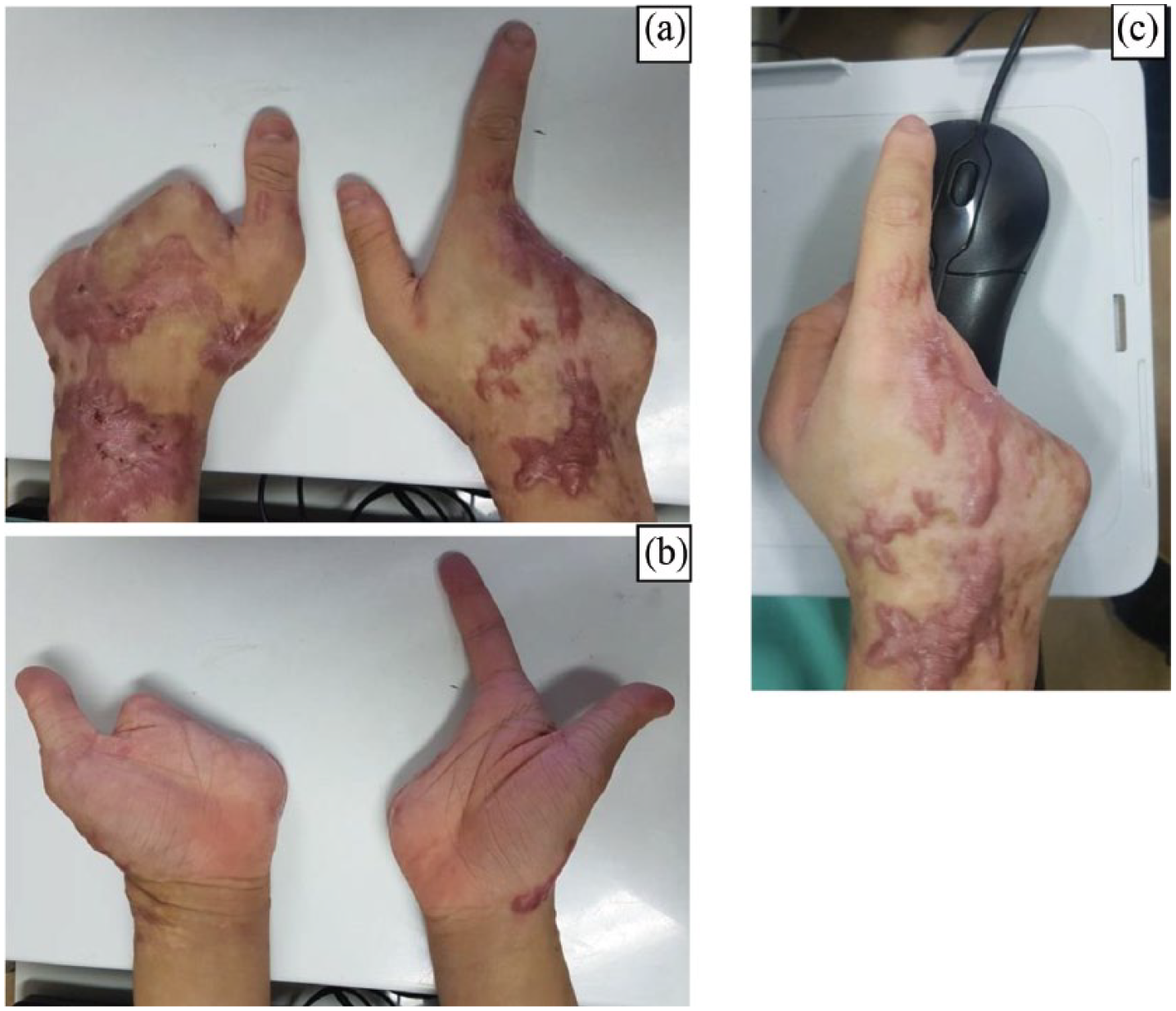
(a) Dorsal view. (b) Palmar view. (c) Illustrates the loss of opposition force when trying to grip a computer mouse with the right hand.
Upper-limb management
Partial-hand limb loss can have a profound impact on an individual’s daily function. 3 Careful planning for the prosthetic prescription and final design should not only consider the level of amputation, but also take into account the patient’s goals, occupation, and social factors. 4
For upper-limb function, the patient shared several key requirements:
To have a supportive surface on the right hand for easy use of a computer mouse by having a platform for opposition force (see Figure 1(c) above).
To restore the surface area on the left hand to aid with supporting and gripping of various objects, for example, gaming controller, cup, cellphone.
To be relatively low cost.
Need for development
The initial thought process was to match design to function needed by the patient by considering options available commercially.
For example, myoelectric options for partial hands include iDigits Quantum (Ossur/Touch Bionics) or the Vincent Finger (Vincent Systems) with options for an active or passive thumb. M-fingers and partial M-fingers with positional thumbs are body-powered options relying on wrist flexion control (Liberating Technologies Inc./College Park). Static opposition posts have been made to restore palmar surface and to offload from residuums to more pressure-tolerant forearms. Silicone cosmetic partial hands are also available along with body-powered 3D-printed options.
However, none of these options could sufficiently meet the three goals indicated by the patient in the previous section to a satisfactory level. They were too expensive and/or were unable to allow easy positioning of the fingers without using myoelectrics. Hence, a new option had to be designed specifically for the patient.
Through various rounds of discussion, goal-setting, and trial-and-error, a left upper-limb device with positional fingers and a right upper-limb device for use with a computer mouse were designed and fabricated.
Technique
Left-hand device
The plan was to design and fabricate upper-limb devices with positional fingers.
The initial idea was to fit the residuums with devices made from polypropylene sockets with modified prosthetic cosmetic gloves pulled over. The cosmetic gloves were to have steel wires inserted into each finger and be filled with a gel that would allow bending for positioning, but be able to retain its position.
Several gel substances were trialled, including silicone sealant, hot glue, and rigid resin, but none of the substances worked well enough. The fingers either came out too stiff to allow for positioning, or were unable to hold their position well.
The design was then revamped to have polypropylene sockets with straps and wooden fingers fixed on the distal end. Patient’s upper-limb residuums were first casted with plaster of Paris. Plaster replicas of the residuums were then made, and polypropylene sockets with loop and buckle Velcro straps were then formed over these models.
Wooden fingers were the key to providing the positional fingers requested by the patient. Wooden hands commonly used by artists (Figure 2(a)) were modified to screw onto the polypropylene sockets and attached in anatomic alignment. They were low-cost and simple to use, with hinges to imitate the anatomic joints of a sound hand. For a start, only the left device was manufactured as a test device, while the design was still in a prototype stage.
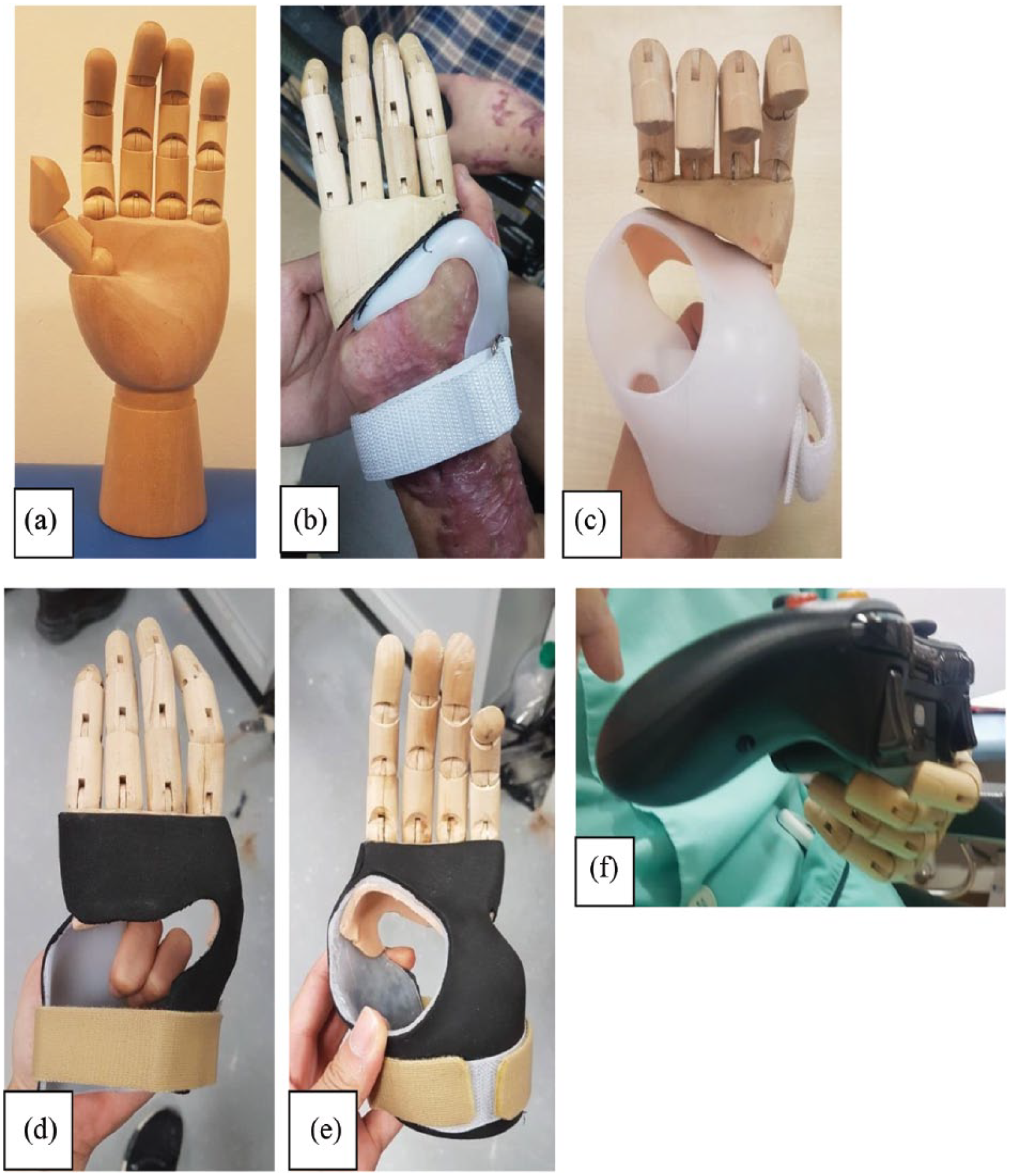
(a) Wooden hand. (b) First prototype on hand (dorsal view). (c) First prototype (palmar view). (d) Final device (dorsal view). (e) Final device (palmar view). (f) Final device holding gaming controller.
At initial fitting, the medio-lateral trimlines of the socket had to be widened to allow ease of donning (Figure 2(b) and (c)). The dorsal trimlines were modified to avoid catching onto the sensitive keloids. The trimlines at the thenar eminence were also reduced to allow free range of motion at the thumb.
For the finalized left-hand device (Figure 2(d) and (e)), the buckle-strap Velcro system was changed to layover Velcro straps to make donning and doffing easier. A thin ethylene-vinyl acetate (EVA) cover was added to the palmar surface of the device to provide better grip as objects tended to slide away when held against the smooth polypropylene sockets. Washers were added into the proximal joints of the wooden fingers to tighten them for better retention of position.
Alignment of the fingers in relation to the sockets was also adjusted to improve grip of various objects, such as a gaming controller (Figure 2(f)) and cellphone.
Right-hand device
Patient requested a device to help mainly in supporting a computer mouse; hence, the device was conceptualized to create opposition for support. Using the polypropylene socket with layover straps, a polypropylene extension plate was added to provide lateral support when using a computer mouse (Figure 3(a)).
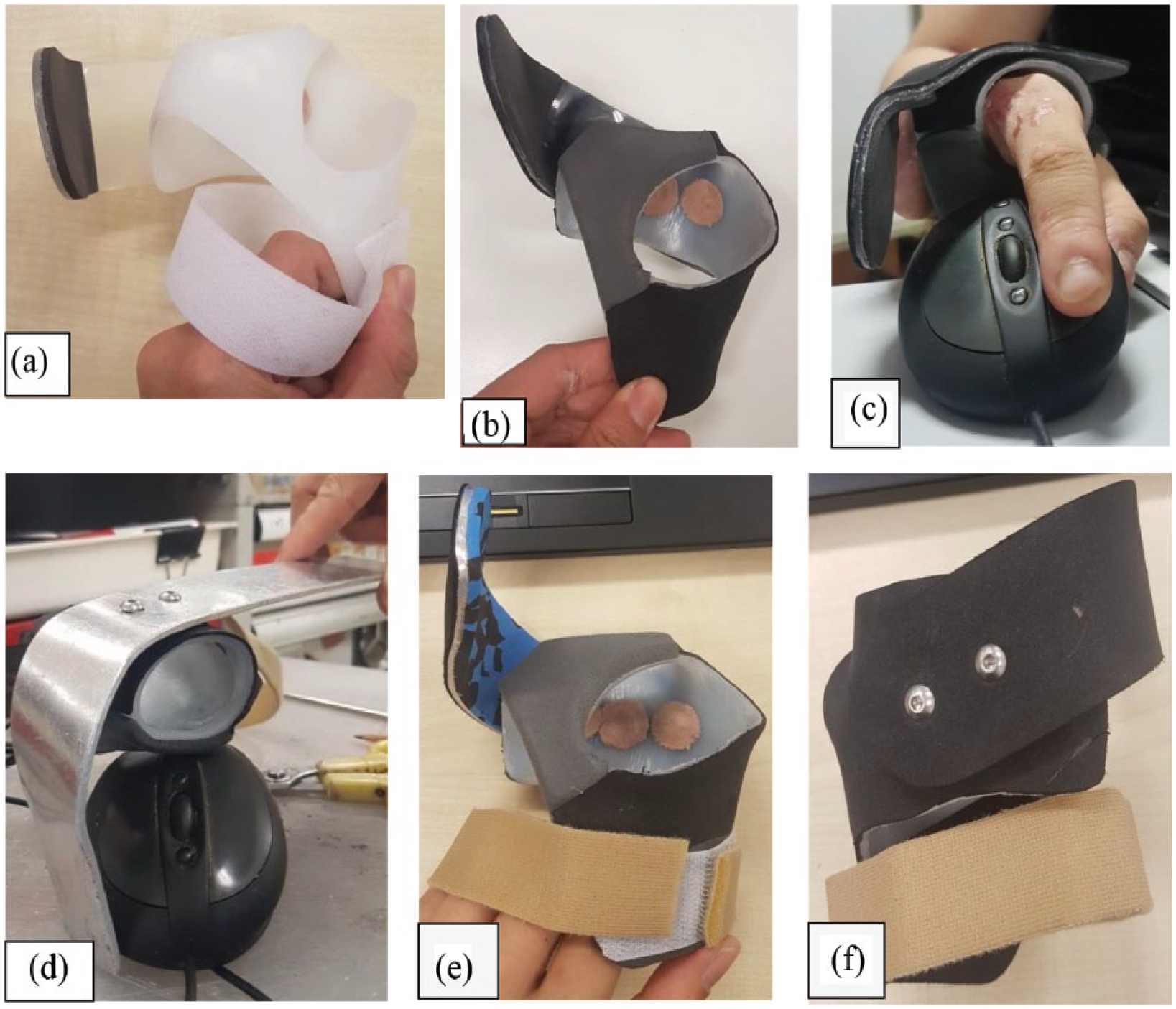
(a) First prototype of right-hand device (palmar view). (b) Plate curvature and material adjusted (palmar view). (c) Poor fit of device when used with patient’s gaming computer mouse. (d) Bending alloy extension plate to fit gaming mouse profile. (e) Final right-hand device (palmar view). (f) Final right-hand device (dorsal view).
However, the first prototype needed alignment changes in terms of position of the plate and its curvature in order to support the mouse well. Thin EVA was also added to the extension to provide better grip of the mouse against the polypropylene socket (Figure 3(b)).
It was noted at a subsequent fitting that the patient, as an avid gamer, used a specialized gaming mouse with a different curvature to the standard office computer mouse that affected accuracy of the extension profile (Figure 3(c)).
Patient provided a sample of his gaming mouse for a more accurate alignment of the device (Figure 3(d)). The material of the extension was changed to an alloy for durability as the polypropylene quickly showed signs of fatigue after several rounds of adjustment.
The finalized right-hand device (Figure 3(e) and (f)) had a polypropylene socket with Velcro straps, an alloy extension plate moulded to the contours of the patient’s gaming mouse, with an EVA covering to increase grip on objects.
Outcome
Upon discharge from the rehabilitation ward, patient was able to use the left-hand device to hold objects such as a cellphone or support a gaming controller. He was also able to successfully use the right-hand device to operate a computer mouse with ease. He even found it useful for supporting a book when reading, along with other uses.
Discussion
Throughout the creation of these partial-hand devices, several key design features became apparent.
The polypropylene sockets, Velcro straps, and EVA coverings were all low-cost materials, easy to fabricate with, adjust, and replace. This addressed the patient’s concerns regarding cost of devices.
Wooden artist’s hands were modified to recreate positional fingers to fit the profile of different objects the patient would have to grip or support. The articulated joints allow for multiple degrees of motion and had room for resistance adjustability by the addition of washers into the joints that required stiffening. They were also easily installed onto the polypropylene sockets too.
The metal opposition plate was durable and easily adjustable with the right tools to match profiles of various objects, in this case, the unique profile of a gaming computer mouse, which was important to the patient both as a gaming hobbyist as well as in his education and future career.
The combination of these low-cost, yet, durable materials were more than sufficient to create upper-limb devices that provided not only the exact features requested by the patient to meet his functional needs, but also enabled him to complete other tasks that he did not consider crucial, but were highly welcomed by him, such as supporting a book when reading.
Key Points
Developing innovative customized upper-limb orthoses for patient with bilateral partial-hand amputation
Device developed with positional fingers from artist’s wooden hand to provide increased surface area and grip
Second device developed with a contoured alloy extension plate to provide opposition for use with a gaming computer mouse
Use of low-cost and easily accessible objects to create novel customized upper-limb devices
Footnotes
Author contribution
All authors contributed equally in the preparation of this article.
Declaration of conflicting interests
The author(s) declared no potential conflicts of interest with respect to the research, authorship, and/or publication of this article.
Funding
The author(s) received no financial support for the research, authorship, and/or publication of this article.
