




Abstract
Background:
Gaitography is gait parametrization from center-of-pressure trajectories of walking on an instrumented treadmill. Gaitograms may be useful for prosthetic gait analyses, as they can be rapidly and unobtrusively collected over multiple gait cycles without constraining foot placement. However, its reliability must still be established for prosthetic gait.
Objectives:
To evaluate (a) within-method test–retest repeatability and (b) between-methods agreement for temporal gait events (foot contact, foot off) and gait characteristics (e.g. step times, single-support duration).
Study design:
Cohort study with repeated measurements.
Methods:
Ten male proficient prosthetic walkers with a unilateral trans-femoral or trans-tibial amputation were equipped with a pressure-insole system and were invited to walk on separate days on an instrumented treadmill.
Results:
We found better between-methods reproducibility than within-method repeatability in temporal gait characteristics. Step times, stride times, and foot-contact events matched well between the two methods. In contrast, insole-based foot-off events were detected one-to-two samples earlier. Likewise, a similar bias was observed for temporal gait characteristics that incorporated foot-off events.
Conclusion:
Notwithstanding small systematic biases, the good between-methods agreement indicates that temporal gait characteristics may be determined interchangeably with gaitograms and insoles in persons with a prosthesis. However, the relatively poorer test–retest repeatability hinders longitudinal assessments with either method.
Clinical relevance:
Clinical practice could potentially benefit from gaitography as an efficient, unobtrusive, easy to use, automatized, and patient-friendly means to objectively parametrize prosthetic gait, with immediate availability of test results allowing for prompt clinical decision-making. Temporal gait parameters demonstrate good between-methods agreement, but poorer within-method repeatability hinders detecting prosthetic gait changes.
Background
Prosthetic gait analysis provides quantitative information to help prescribe treatment, to monitor progress and to assess its outcome.1,2 Regular gait analysis is important for monitoring rehabilitation progress or the effects of changes in prosthetic components.1,2 The demand for prosthetic gait analysis is expected to increase in view of the rising incidence rates of amputations associated with life-style-related diseases in aging societies (e.g. peripheral vascular disease, diabetes mellitus3,4). However, gait laboratories across the world are faced with tight budgets or even budget cuts, and future gait analysis (i.e. measurements and reporting) should thus be more productive and efficient.1,2
The main costly elements of prosthetic gait analysis in clinical practice are (1) the length of time required for performing gait analysis, for example, caused by time-consuming marker placement, calibration procedures, and repetitions of walking trials to achieve “clean” force plate hits in conventional camera plus force plate type of gait analysis, and (2) the efforts put into reporting and discussing the results, by analyzing gait data, generating patient reports and discussion of the results. Currently, these elements strongly limit routine gait assessments, which is problematic for an optimal utilization of gait analysis in clinical practice. There is a clear need to reduce the time required for performing gait analysis and to expedite the availability of test results.
Gait analysis on a treadmill instrumented with an embedded single large force platform or a grid of pressure sensors5–10 may fulfill this need, even though some clinical implementation issues remain such as access to and cost of the instrumented treadmill and familiarization to treadmill walking. These issues notwithstanding, instrumented treadmills do allow for a significant reduction in patient-preparation time and data-collection time. That is, instead of markers or sensors attached to the body, center-of-pressure trajectories are recorded during walking, without constraining foot placement (i.e. the treadmill is, in contrast to instrumented split-belt treadmills, equipped with a single large force platform or a grid of several thousand independent pressure sensors). Moreover, treadmill walking affords rapid gait data collection over multiple strides, which makes the estimation of gait characteristics more reliable. 11 Finally, recent advances in pattern recognition allow for online processing of gait such that gait analysis and generating patient reports take place in near real time.7,12,13
Center-of-pressure trajectories during walking on instrumented treadmills, so-called gaitograms, exhibit a characteristic butterfly-like shape,8,9,14 resulting from alternated left and right weight bearing as well as the anterior-posterior displacement of the center of pressure during the single-support stance phases (see also Methods, Figure 1(a)). Specific features in the shape of the center-of-pressure evolution during walking represent specific gait events: instants of left and right foot contact and foot off can be identified in the gaitogram contralateral to the side of interest, with anterior and posterior center-of-pressure extrema signaling time instants of foot off (tFO) and foot contact (tFC), respectively.8,9 In addition, the butterfly-like shape of the gaitogram is also indicative of specific gait characteristics, such as step width (i.e. represented by the width of the gaitogram) and asymmetries in single-support stance duration (i.e. represented by a difference in wing length of the center-of-pressure butterfly). Other temporal and spatial gait characteristics, like stride time, step time, swing duration, double-support stance duration, stride length, and step length, can be readily derived from gaitograms.8,9,14 The analysis of gaitograms aimed at characterizing gait is defined as “gaitography.” 9
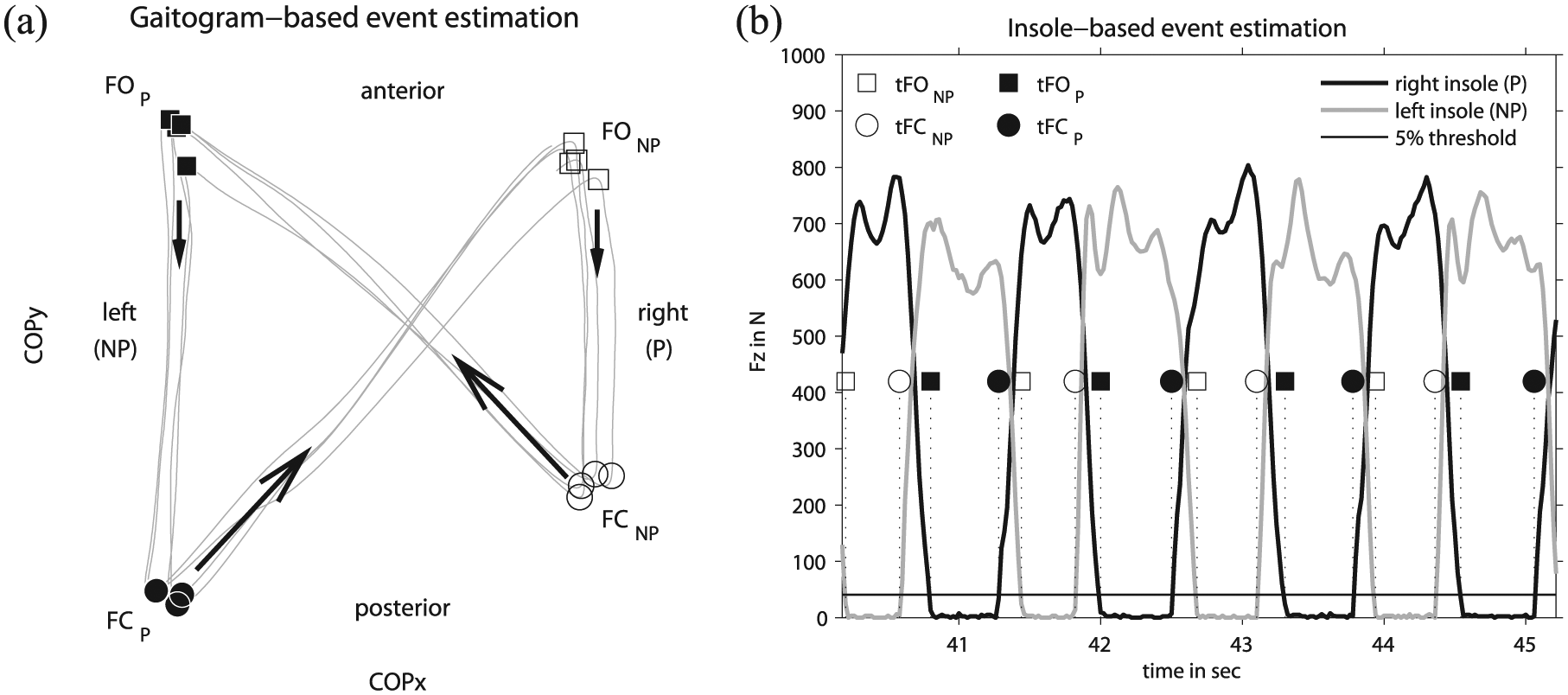
Representative gaitogram (medio-lateral (COPx) vs anterior-posterior (COPy) center-of-pressure trajectories; panel (a)) and vertical force time series from prosthetic (P) and non-prosthetic (NP) insoles (panel (b)), showing estimated foot-off (FO) and foot-contact (FC) gait events for four gait cycles of a participant with a right lower-limb prosthesis. Arrows in panel (a) schematically represent the direction and speed of center-of-pressure progression during a gait cycle. Note the longer single-support stance duration on the non-prosthetic (left) side in both panels.
Gaitogram-based online tFC and tFO events and gait characteristics of healthy adults match well with offline counterparts based on kinematics registered by an opto-electronic registration system. 8 This accurate online gait-event and gait-characteristic detection has inspired the development of gait-dependent event-control applications for gait studies, including technical applications for the presentation of online feedback of gait characteristics, 12 presentation of acoustic cues or visual stepping targets attuned to online-determined gait characteristics,13,15–17 and gait-phase specific vibratory stimulation. 16 Interestingly, gaitography was recently also employed to assess9,13 and treat18–23 pathological gait, including prosthetic gait. Nevertheless, before using gaitography and gaitogram-based interventions in routine clinical practice, its reliability must be established for pathological gait, including prosthetic gait, as it is unknown to what extent gaitography is influenced by gait deviations. Moreover, such a study is timely because a previous reliability study on healthy adults 8 only focused on a cross-sectional assessment of between-methods agreement, using relative reliability statistics (e.g. intraclass correlations), which may not be the most meaningful statistic, 24 see also Bland and Altman 25 for other arguments against relative reliability indices. In contrast, absolute reliability measures, such as the bias and limits of agreement, 26 allow for determining between-methods biases and reproducibility limits in the same measurement units as the used assessment methods.24,25 Moreover, when using a test–retest design, absolute reliability statistics (e.g. repeatability coefficient25,27) allow for quantifying the absolute level of within-method reproducibility, again in the same measurement units as the used assessment methods, which can be used to determine the minimal detectable within-method changes over repeated measurements. The aims of the present study therefore were (1) to establish test–retest repeatability of temporal gait characteristics (i.e. stride times, step times, single-support stance durations, double-support stance durations) for online gaitograms and offline pressure-insole system (i.e. within-method reproducibility) and (2) to examine the agreement of these temporal gait characteristics and underlying foot-off and foot-contact events between the two methods (i.e. between-methods agreement), using absolute (i.e. repeatability coefficient, bias, and limits of agreement) rather than relative reliability indices.
Methods
Participants
We recruited 10 male participants (mean age: 48 years, range 31–67 years; mean height: 1.68 m, range 1.62–1.73 m; mean weight: 77 kg, range 58–94 kg) with a unilateral (seven left, three right) lower-limb amputation (five trans-femoral, five trans-tibial) resulting from a trauma from everyday clinical routine of Centro Protesi INAIL (Budrio, Italy). All participants were proficient users of their own prosthesis (mean time since amputation: 206 months, range 10–624 months; mean time of current prosthesis: 132 months, range 3–618 months) and free of co-morbidities that could influence walking ability or the ability to understand instructions. Participants varied widely with regard to the type of prostheses used. Trans-femoral prosthesis included three C-legs (one with Vari-flex foot, one with Axtion, and one with Elation foot), one Genium knee (with Vari-flex foot), and one Hybrid Knee (with Vari-flex foot). Trans-tibial prostheses included four Vari-flex feet (one with Harmony suspension) and one Echelon foot (with Harmony suspension). Ethical aspects of the project were approved by the Scientific-Technical Committee of Centro Protesi INAIL and all participants provided written informed consent before data collection.
Procedure
Participants were equipped with a pressure-insole system (Pedar insole-system, Novel, Munich, Germany), a commonly used system for in-shoe pressure measurement with known repeatability, reliability, and validity.28,29 Participants were invited to walk on an instrumented treadmill with an embedded single large (0.86 by 2.99 m) force platform (C-Mill, Motek, Amsterdam, the Netherlands). All participants were familiar with treadmill walking. Nevertheless, ample time was allowed for familiarization to treadmill walking and for determining participant’s comfortable treadmill walking speed. Participants started walking at a relatively slow speed (i.e. 1.0 km/h) followed by increments of 0.1 km/h until participants reported that they walked at their comfortable treadmill walking speed. Thereafter, 1.0 km/h was added to the current speed, followed by a stepwise decrease of 0.1 km/h to re-establish their comfortable walking speed. These two indications were then averaged to represent participant’s comfortable treadmill walking speed. After selecting their comfortable treadmill walking speed (mean speed: 0.81 m s−1, range 0.44–1.08 m s−1), participants’ gait was registered at this speed with or without handrail support in terms of medio-lateral and anterior-posterior center-of-pressure time series from the instrumented treadmill (sampling frequency: 500 Hz) as well as in terms of synchronized vertical force time series per foot from the pressure insoles (sampling frequency: 50 Hz). Figure 1 depicts a gaitogram (an x-y plot of medio-lateral and anterior-posterior center-of-pressure time series; panel (a)) and insole vertical force data (panel (b)) of four representative gait cycles of a person with a right lower-limb amputation. We further saved the associated prosthetic and non-prosthetic foot-off and foot-contact time indices (tFOP, tFONP, tFCP, and tFCNP, respectively; markers in Figure 1(a)) as determined online with the instrumented treadmill’s built-in software (Cuefors, Motek, Amsterdam the Netherlands). Data were collected for 50 gait cycles. Three days later, participants performed an additional gait registration under the same measurement circumstances in terms of treadmill speed, handrail use, and data registration parameters to evaluate the test–retest repeatability.
Data analysis: preprocessing
Insole pressure data were processed using threshold analyses to determine foot-contact and foot-off gait events, that is, the instants when the foot was placed on and off the ground, respectively (see threshold and markers in Figure 1(b)). tFC was defined to occur at the last instant before the vertical force of an insole exceeded the 5% body-weight threshold (i.e. 5% of the sum of the insoles’ output from a pretrial in which the participant was instructed to freely stand upright in a bipedal posture). tFO was similarly defined to occur at the first instant that an insole’s vertical force dropped below this 5% body-weight criterion. Subsequently, in order to standardize the number of repetitions per gait event analyzed per participant, and to minimize the influence of warm-up and/or fatigue effects on gait during a trial, 26 time indices per gait event were selected from the central part of the trial for further analyses, starting with a prosthetic foot off. Finally, the corresponding online-determined gaitogram-based gait events were selected from the same central part of the trial for the evaluation of the agreement between gaitogram-based and insole-based gait events.
Preprocessing of temporal gait characteristics was fully based on the selected gait-event indices (i.e. tFOP, tFCP, tFONP, tFCNP). Specifically, the following gaitogram-based and insole-based temporal gait characteristics were quantified: prosthetic and non-prosthetic stride times, step times, single-support stance durations (equals swing duration of the contralateral leg), and double-support stance durations using conventional definitions. 9 For each method and trial, this resulted in 25 values per gait characteristic.
Statistics
Within-method reproducibility of temporal gait characteristics
The test–retest repeatability of temporal gait characteristics was assessed by quantifying the variation in repeated measurements on the same participants, separately for gaitogram-based and insole-based estimates. In this way, we can evaluate the assumption that both gaitogram-based and insole-based temporal gait-characteristic estimates would show good repeatability. Per gait characteristic and per method, mean gait-characteristic values between test and retest measurements were evaluated with a paired-samples t-test. In addition, the coefficient of repeatability (RC) was determined, representing the value below which the absolute difference between two repeated measurements may be expected to lie with a probability of 95% (i.e. 1.96 times the standard deviation of the differences between test and retest 25 ).
Between-methods agreement for temporal gait characteristics
The agreement between gaitogram-based and insole-based gait characteristics was assessed by determining the bias or mean difference (
Between-methods agreement for foot-contact and foot-off events
For the test data, we first determined the bias and limits of agreement for prosthetic and non-prosthetic gait events (i.e. tFOP, tFONP, tFCP, tFCNP). Note that the gait-event data comprise a mixture of between-participant and within-participant information on the differences between the gaitogram-based and insole-based gait-event estimation methods. Specifically, 260 pairs of measurements were available per gait-event measure for the 10 participants with unilateral lower-limb prosthesis, containing 26 repetitions per participant (i.e. 26 tFOP, 26 tFONP, 26 tFCP, and 26 tFCNP). The bias over the 26 replicates per participant per gait-event measure was subjected to a one-sample t-test against 0 ms, with the Bonferroni correction. Subsequently, the limits of agreement were estimated. Because the interval between the limits of agreement may become too narrow if each pair is treated as if from a different participant, we adopted the conservative modification for repetitions as proposed by Bland and Altman.26,27 Specifically, per gait-event measure, the between-method differences were subjected to a one-way analysis of variance (ANOVA) to estimate the total variance for single differences on different participants (see Bland and Altman26,27 for more details), from which the square root was taken to arrive at the SD used to estimate the limits of agreement.
Results
Within-method test–retest repeatability
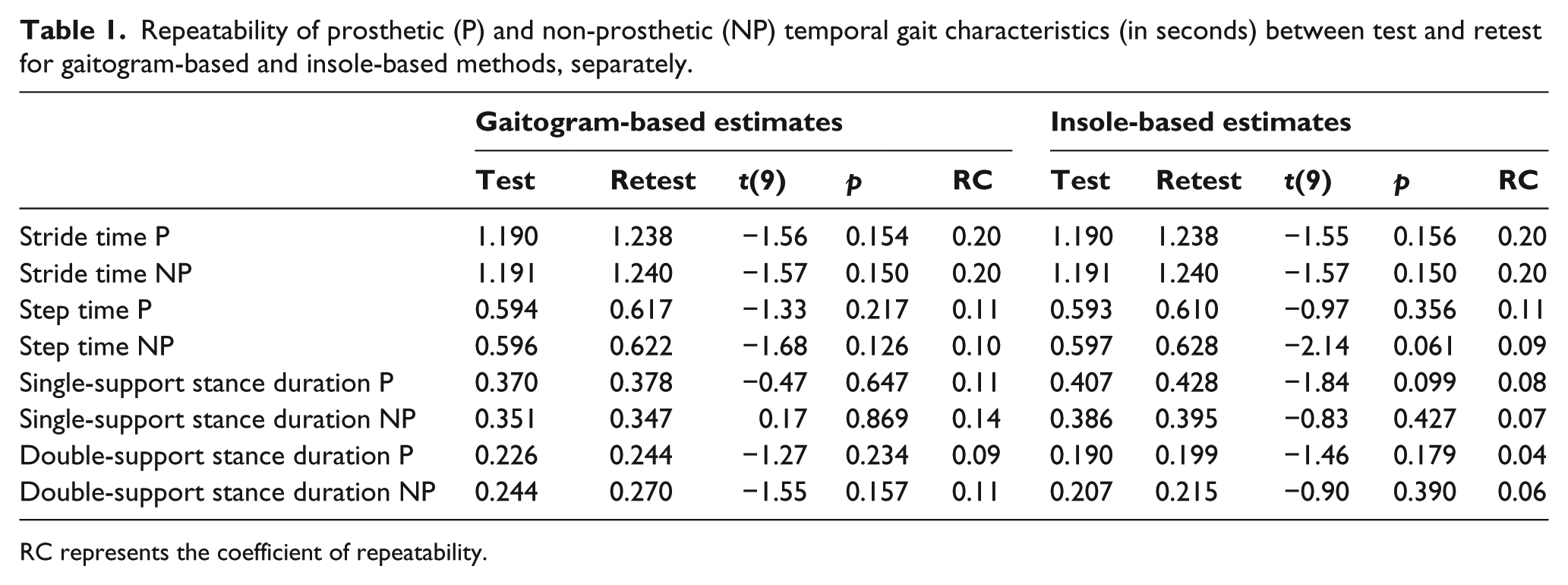
None of the temporal gait characteristics differed significantly between test and retest (see Table 1), irrespective of the employed method of estimation (gaitogram-based, insole-based). The coefficients of repeatability varied between 0.04 and 0.20 s (RC in Table 1).
Repeatability of prosthetic (P) and non-prosthetic (NP) temporal gait characteristics (in seconds) between test and retest for gaitogram-based and insole-based methods, separately.
RC represents the coefficient of repeatability.
Between-methods agreement
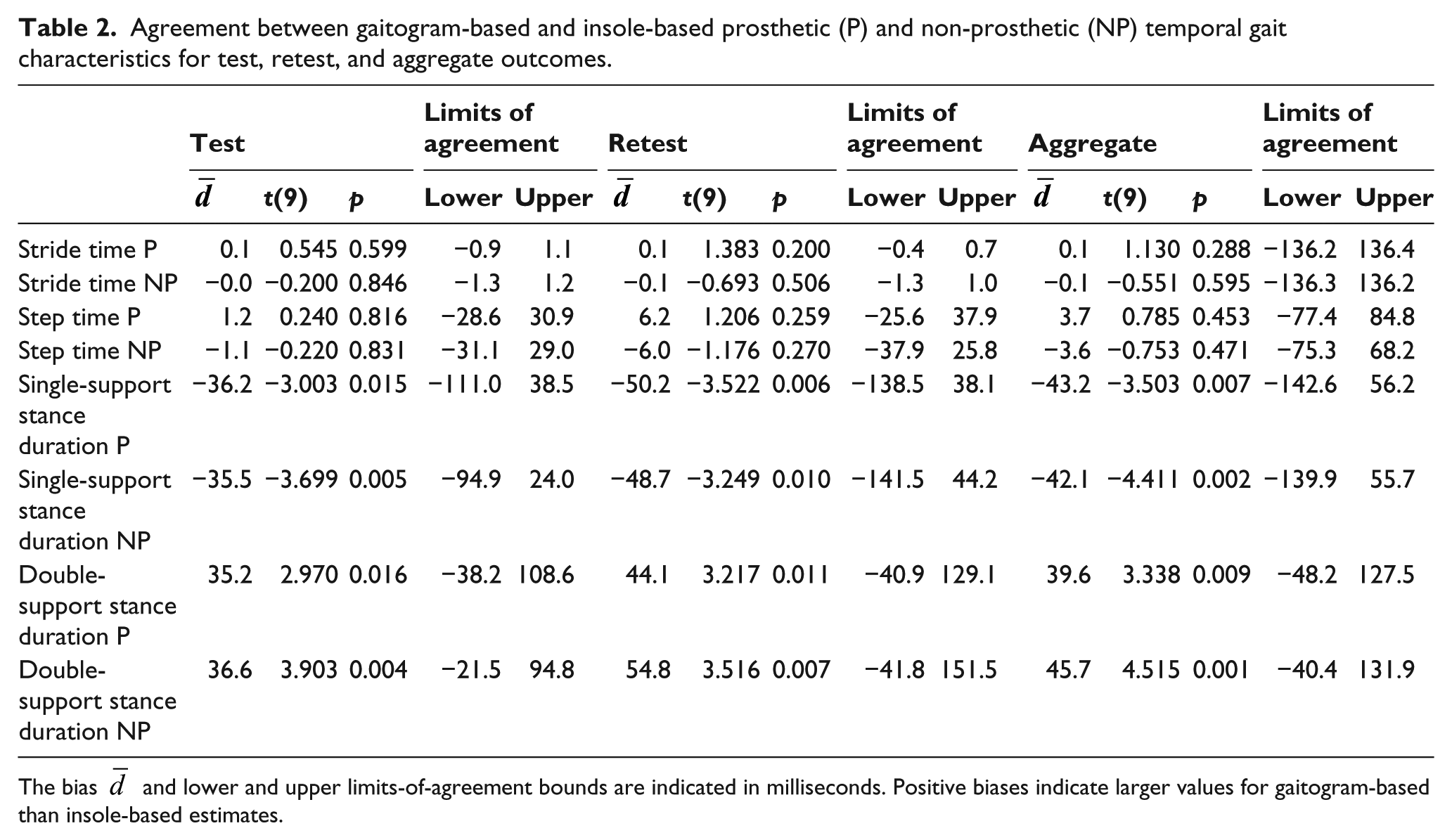
As can be appreciated from Table 2, the bias was negligible for stride times and step times for test, retest, and aggregate scores alike. Interestingly, whereas the limits of agreement for stride times and step times were comparably narrow for test and retest scores, the corresponding limits of agreement of the aggregate scores were much wider. In combination, these findings indicate that the differences between methods are much smaller than the differences within methods over the repeated measurements. Nevertheless, a significant and systematic bias was observed between gaitogram-based and insole-based estimates of single-support and double-support stance durations, in opposite directions (Table 2).
Agreement between gaitogram-based and insole-based prosthetic (P) and non-prosthetic (NP) temporal gait characteristics for test, retest, and aggregate outcomes.
The bias
The latter observation that significant between-methods biases were only observed for temporal gait characteristics involving foot-off events (Table 2) would suggest significant and systematic between-methods biases in foot-off events only. This was indeed the case. In Figure 2, the bias
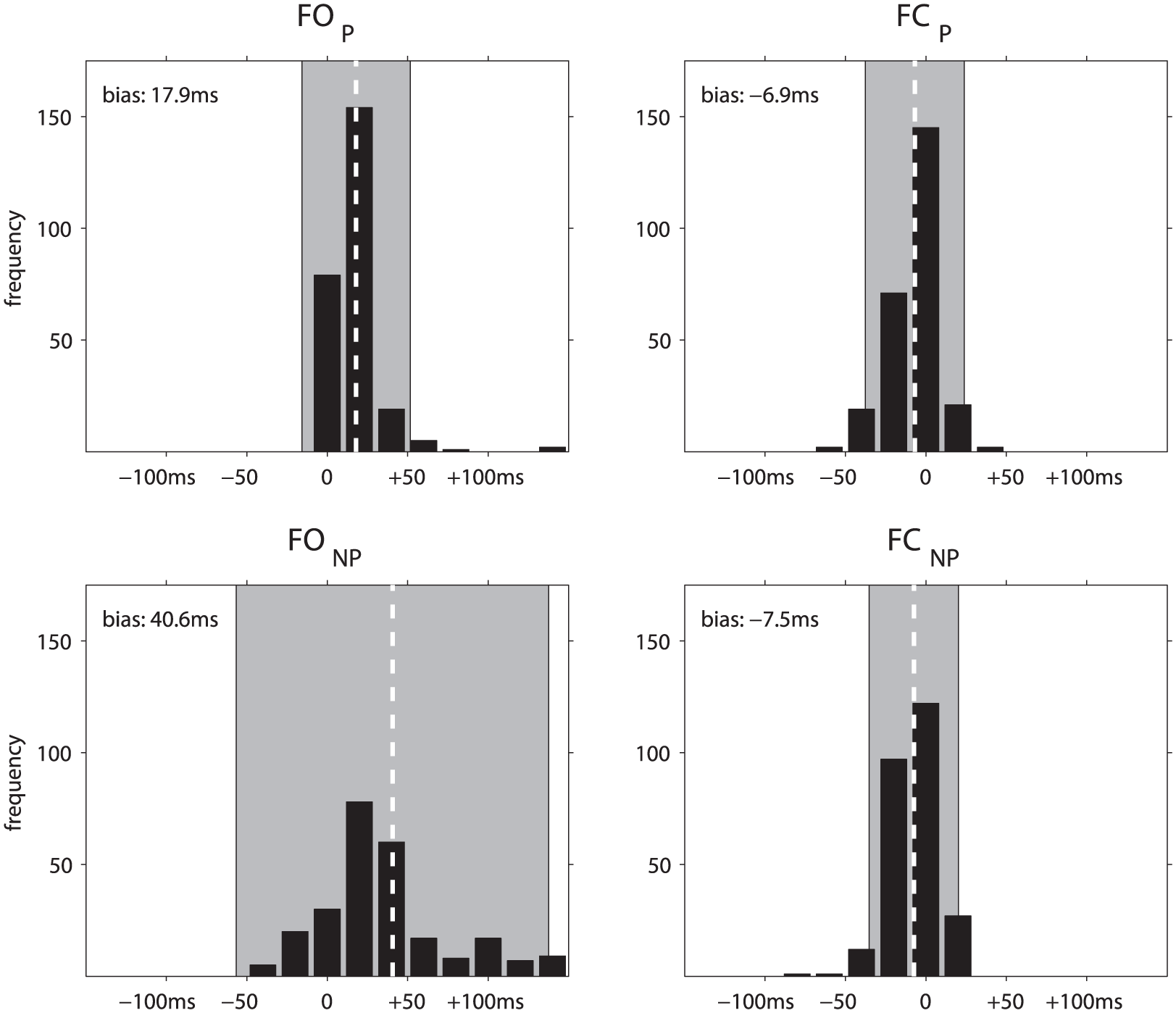
Frequency distribution of gait-event estimation errors using 260 estimates for prosthetic (P) and non-prosthetic (NP) foot-off (FO) and foot-contact (FC) gait events. Bias and limits of agreement are represented by dashed white lines and gray patches, respectively. A positive bias implies that insole-based gait events preceded gaitogram-based gait events.
Discussion
This study aimed to determine test–retest repeatability and between-methods agreement of temporal gait characteristics (i.e. stride times, step times, single-support stance durations, double-support stance durations) and gait events (i.e. instants of foot contact and foot off) in a heterogeneous group of persons walking with a prosthesis after a unilateral lower-limb amputation. We found relatively poor within-method test–retest repeatability in temporal gait characteristics (Table 1). However, good agreement was achieved between gaitogram-based and insole-based prosthetic and non-prosthetic foot-contact detections (Figure 2). The same was logically true for the temporal gait characteristics that were based on foot-contact events (i.e. stride times and step times; Table 2). In contrast to this good between-methods agreement in foot-contact events and associated temporal gait characteristics, a significant systematic bias was observed for both prosthetic and non-prosthetic foot-off events. Average systematic biases were approximately one insole sample for tFOP and two insole samples for tFONP. The bias was positive, indicating that insole-based foot-off events were detected earlier than gaitogram-based foot-off events (Figure 2). These biases consequently also introduced a bias in temporal gait characteristics that incorporated foot-off events (i.e. single-support and double-support stance durations; Table 2).
A likely explanation for the bias in foot-off detection may be that the moment of foot off may not be very well demarcated with the 5% body-weight threshold of the pressure-insole method. Whereas for foot-contact events the pressure signal increased sharply, this was not (always) the case for foot-off events, where the pressure registered by the insoles often changed more gradually toward zero. As a consequence, still some pressure may be registered by the insoles, albeit below the 5% body-weight threshold, suggesting that the foot was still not fully cleared from the ground. In other words, insole-based foot-off events may be detected too early. Apparently, tFONP was more susceptible to this effect than tFOP, at least for two outlier participants (P5 and P6, with biases of 121.0 and 103.0 ms, respectively) whose individual bias and limits of agreement did not overlap but rather fell outside the upper bounds of the 95% confidence intervals of differences of all other participants (i.e. the highest upper bound of the remaining eight participants was 51 ms). Nevertheless, after removal of these two outliers, the resulting bias was still significant (t(7) = 3.03, p < 0.05), albeit considerably smaller (22.7 ms) and comparable to that observed for tFOP (Figure 2). Upper and lower bounds of the limits of agreement were then −30.0 and 75.4 ms, respectively, still approximately twice the width that was observed for the other three gait events. So apparently, there is something special about the non-prosthetic foot off in persons walking with a lower-limb prosthesis.
A tentative explanation for this observation may be that tFONP delineates the end of the push-off phase with the non-prosthetic leg and thus the start of the single-support stance phase with the prosthetic leg. Considering that single-support stance on the prosthetic leg is often somewhat insecure and less stable than that of the non-prosthetic leg, a more gradual push off with the non-prosthetic leg may be in place to help prevent such instabilities. This is consistent with the observation of a more gradual load transfer during double support from the non-prosthetic to the prosthetic leg. 30 Notwithstanding uncertainties on its exact cause, the more gradual drop in pressure as registered with the insoles clearly hampers insole-based foot-off event detection in prosthetic gait. Gaitogram-based foot-off event detection seems less susceptible to this effect because as soon as the foot is cleared from the instrumented treadmill, the center of pressure starts progressing posteriorly, resulting in a well-recognizable point in the gaitogram (the upper wingtips of the center-of-pressure butterfly, Figure 1(a)8,9). Thus, although pressure insoles are widely regarded as a standard for gait-event detection,28,29 it is important to realize that such standards may be prone to errors as well.
An interesting observation from a statistical point of view was that the test–retest variation in temporal gait characteristics (i.e. within-method repeatability) was much greater than the between-methods variation in temporal gait characteristics (Table 1). As a consequence, the limits of agreement defined for the aggregate scores were much wider than those for test and retest scores separately (Table 2). On one hand, this is positive, as temporal gait characteristics may then be determined interchangeably with gaitogram-based and insole-based methods. On the other hand, the fairly large differences in temporal gait characteristics over repeated measurements—for both methods alike—limits their sensitivity for detecting changes in temporal gait characteristics as a function of time, rehabilitation intervention or component variation. Specifically, the coefficients of repeatability for temporal gait characteristics reported in Table 1 represent the value below which the absolute difference between two repeated measurements may be expected to lie with a probability of 95%. 25 Thus, whereas there is a good agreement between insole-based and gaitogram-based temporal gait parameter estimation methods (i.e. also good in comparison to other between-methods agreement studies 31 ), the relatively poorer repeatability from test to retest (i.e. RC or minimal detectable change (MDC) ranged from 0.04 to 0.20 s) should be kept in mind when performing longitudinal prosthetic gait assessments with either method. Unfortunately, in the field of prosthetic gait analysis, repeatability studies are few and far between (see Zahedi et al. 32 for a notable exception).
A limitation of this study was the difference in sampling frequency between the online gaitogram-based and the offline insole-based gait-event detection method. The temporal resolution with which temporal gait events can be detected is therefore lower for the insoles (0.02 s) than for the instrumented treadmill (0.002 s). Another limitation of this study was the lack of comparison for spatial gait characteristics. Spatial gait characteristics can be readily derived from gaitograms; 9 however, a between-methods comparison was impossible because the employed insole system cannot estimate spatial characteristics. This is unfortunate because spatial gait characteristics are often used in gait analysis (e.g. step length, step width) and in walking-adaptability assessments such as obstacle avoidance and goal-directed stepping (e.g. margins, stepping accuracy). Validating spatial gait characteristics is timely, given that the instrumented treadmill employed in this study (i.e. C-Mill) is increasingly used for evaluating and training walking adaptability of various patient groups.13,18–23,33 To circumvent abovementioned limitations of pressure insoles (i.e. lower temporal resolution, only temporal and not spatial gait parameters, gradual reduction in pressure hindering non-prosthetic foot-off detection), we recommend future studies on the reliability of gaitography to be performed on a treadmill instrumented with a dual force plate (i.e. left and right separately), from which thresholds in the left and right vertical forces may be used to determine instants of foot off and foot contact. By combining the force data of the two force plates, a center-of-pressure profile (i.e. gaitogram) can be reconstructed as if the patient was walking on a single large force platform. This would be an ideal test setup for investigating the reliability of foot-off and foot-contact events and associated temporal and spatial gait characteristics from gaitograms.
Conclusion
From this study on gaitogram-based gait-event and gait-characteristic detection, it can be concluded that temporal gait characteristics may be determined interchangeably with gaitogram-based and insole-based methods in a cross-sectional gait assessment of persons walking with a prosthesis. However, the relatively poorer repeatability from test to retest should be kept in mind when performing longitudinal prosthetic gait assessments with either method.
Footnotes
Author contribution
AGC and MR initiated the study. AGC provided equipment and patients. CT and HD performed the experiment, CT, HD and MR analyzed the data and CT and MR prepared the draft of this manuscript. HD and AGC revised the manuscript critically. All authors read and approved the manuscript and agreed to be accountable for all aspects of the work.
Declaration of conflicting interests
The author(s) declared no potential conflicts of interest with respect to the research, authorship, and/or publication of this article.
Funding
The author(s) disclosed receipt of the following financial support for the research, authorship, and/or publication of this article: This study was supported by International Society for Prosthetics and Orthotics and Italian Workers Compensation Authority, Grant AR.3, PRES-CS 257.