




Abstract
Background and aim:
Although Paralympic T42 class Men’s 200 m sprints are currently competed by athletes with bilateral and unilateral transfemoral amputations, there may be performance differences between the groups. This study aimed to compare the spatiotemporal parameters of a 200-m sprint between bilateral and unilateral transfemoral amputees wearing running-specific prostheses.
Technique:
We analyzed 29 races (nine sprinters) with bilateral or unilateral transfemoral amputations from publicly available Internet broadcasts. For each sprinter’s race, the average speed, step frequency, and step length were calculated using the number of steps in conjunction with the official race time.
Discussion:
Average speed of bilateral transfemoral amputees was 5.7% greater than in unilateral transfemoral amputees. Bilateral transfemoral amputees exhibited lower step frequency (–8.9%) but longer step length (16.3%) than unilateral transfemoral amputees. Therefore, even in the same Paralympic classification (T42), different spatiotemporal strategies exist between bilateral and unilateral transfemoral amputees wearing running-specific prostheses during 200-m sprints.
Clinical relevance
Since different spatiotemporal strategies exist between bilateral and unilateral transfemoral amputees during 200-m sprints, our data supports recent revisions of classification rules (1st January, 2018), which each population was allocated into the different classification (T61 and T63, respectively).
Background and aim
Current Paralympic classifications for track events in athletics are generally based on sex, level of amputation, and/or similar levels of disabilities. For example, unilateral transfemoral amputees and athletes with other impairments that are comparable to a single above-knee amputation are classified in the T42 class. 1 Consequently, the T42 class contains athletes with bilateral and unilateral transfemoral (BTF and UTF, respectively) amputations.
Notably, unlike the 100-m sprint, the top three finishers of the T42 Men’s 200 m sprint in the 2016 Paralympic games hosted in Rio de Janeiro were BTF amputees wearing running-specific prostheses (RSPs). Furthermore, according to the World Para Athletics Ranking of T42 Men’s 200 m in 2016, four of the top six athletes were BTF amputees. 2 These results suggest that even in the same Paralympic classification (T42 class), there may be potential performance differences between BTF and UTF amputees during the 200-m sprint. Although previous studies demonstrated that there were no significant differences in average step frequency (fstep) and step length (Lstep) during Men’s 200 m sprint between bilateral and unilateral transtibial amputees wearing RSPs, 3 it remains unclear whether differences between bilateral/unilateral amputations truly exist or whether they vary at other amputation levels.
The aim of this study was to investigate the differences in spatiotemporal parameters of a 200-m sprint between BTF and UTF amputees wearing RSPs. In this study, we hypothesized that different spatiotemporal strategies would be adopted between BTF and UTF amputees wearing RSPs during a 200-m sprint.
Technique
Data collection
We analyzed 16 and 13 races of four and five sprinters with BTF and UTF amputations from publicly available Internet broadcasts, respectively. These races included several Paralympics, the IPC Athletics World Championships, and other national- and international-level competitions between 2011 and 2016 (Table 1). Each performance at every competition was considered individually. Individual races were excluded from the analysis if the athlete did not complete the race or if the athlete’s body was not visible throughout the race. To ensure homogeneity of data in both groups, we only included sprinters who satisfied the A-qualification standards of a 200-m sprint in the Men’s T42 (28.50 s) category. In this study, we separated the whole population into two groups based on amputation level: BTF and UTF. Consequently, we collected spatiotemporal data from 16 and 13 races of BTF (four sprinters) and UTF (five sprinters), respectively. A similar approach—analyzing publicly available data from sports competitions for research purposes—has been performed by Salo et al. 4 for sprint running using 52 male elite-level 100 m races and by Hobara et al. 5 for prosthetic sprint races using 42 races. Since our data set was obtained from publicly available Internet broadcasts, we did not obtain informed consent. Institutional review board approval was obtained prior to our study.
Summary of the competitions analyzed.
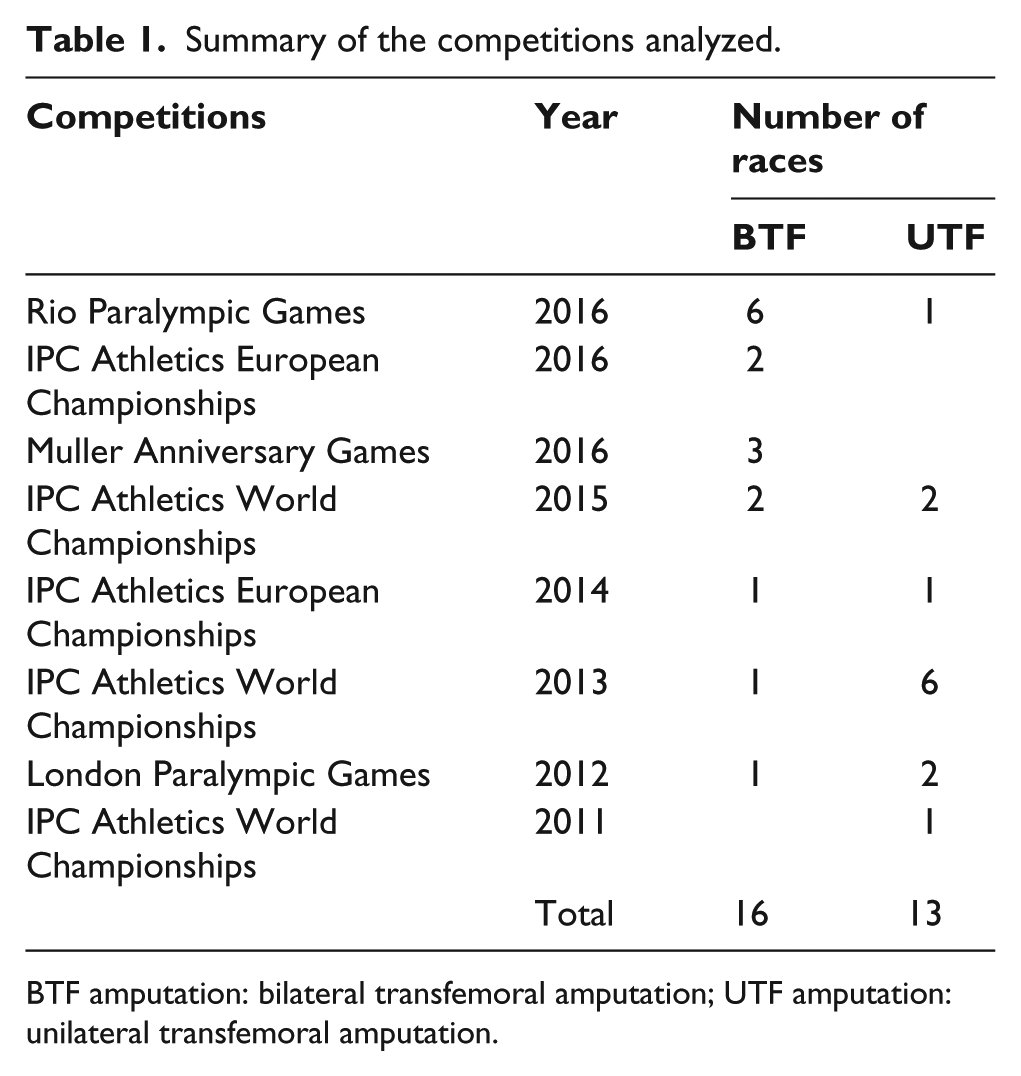
BTF amputation: bilateral transfemoral amputation; UTF amputation: unilateral transfemoral amputation.
Data analyses
According to previous studies,3,5 we determined the average speed (S200) of each individual by dividing the race distance (200 m) by the official race times (trace) obtained from each competition’s official website, thus

In this study, we calculated average step frequency (fstep) as

where Nstep is the number of steps, which was manually counted by the authors. If the number of steps could not be counted, we excluded the data from our analyses. The last step before the finish line was considered the last step. 3 If an athlete’s foot was located on the finish line, we considered it as a step. Since S200 is the product of fstep and average step length (Lstep), we calculated the Lstep by

Statistical analysis
Prior to statistical analyses, Shapiro–Wilk normality test was performed to ensure that the assumptions of normality and homogeneity of variance were met. When the assumptions were not violated, independent parametric t-test was performed to compare spatiotemporal parameters between the two groups. When the assumptions of normality and homogeneity of variance were violated, Welch’s t-test was used. We calculated the effect size (ES) for the independent t-test and Welch’s t-test using Cohen’s d. 6 From this ES calculation, the results were interpreted as small (d > 0.2), medium (d > 0.5), or large (d > 0.8). Statistical significance was set at p < 0.05. These statistical analyses were executed using SPSS version 19 (IBM SPSS Statistics Version 19; SPSS Inc., Chicago, IL, USA).
Results
Figure 1(a) shows the fstep–Lstep plot for all individual data in the two groups. Dotted lines indicate the official times determined using the combination of fstep and Lstep. As shown in Figure 1(b), S200 in BTF amputees was significantly greater than that of UTF amputees (t(27) = 3.66, ES = 1.37, p < 0.01). Although fstep in BTF amputees was significantly lower than UTF amputees (t(27) =−4.84, ES = 1.81, p < 0.01; Figure 1(c)), Lstep values in BTF amputees were significantly longer than those in UTF amputees (t(23) = 7.81, ES = 2.73, p < 0.01; Figure 1(d)).
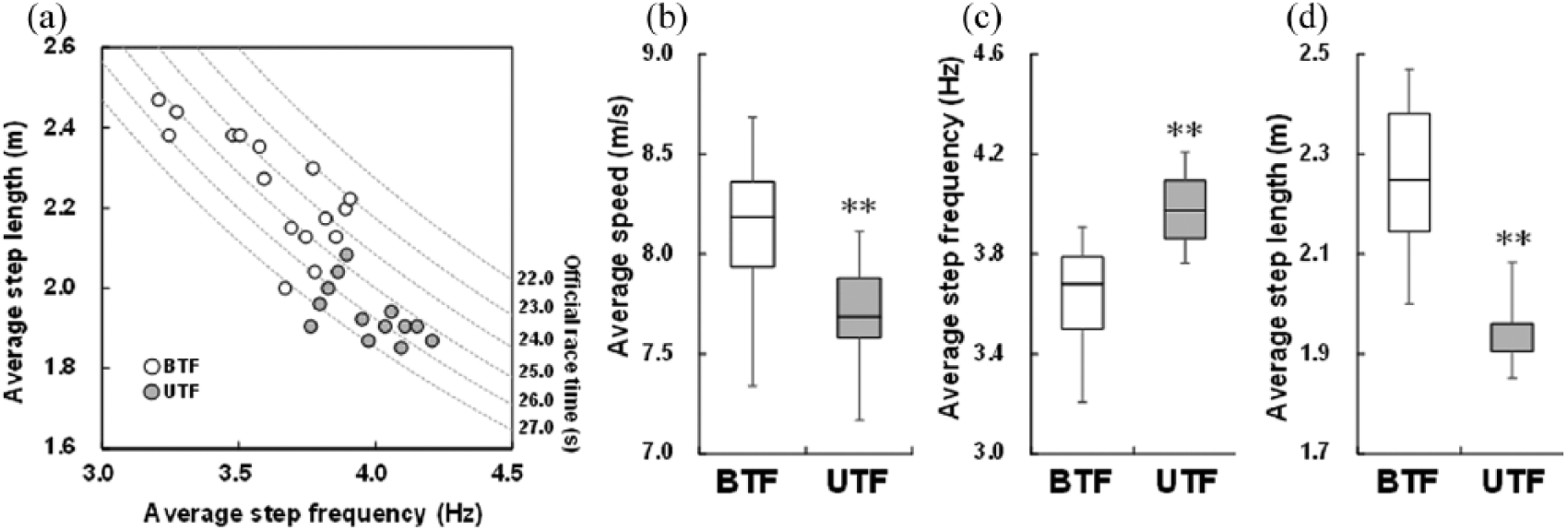
(a) Relationship between average step frequency (fstep) and average step length (Lstep) for the two groups. Unfilled and filled circles indicate the data for the bilateral (BTF) and unilateral transfemoral amputees (UTF), respectively. Dotted lines denote the official race times as a result of the combination of fstep and Lstep. (b)–(d) Comparisons of average speed (S200), fstep, and Lstep between BTF and UTF amputees. Asterisks indicate a significant difference between the two groups (p < 0.01).
Discussion
The aim of this study was to investigate the differences in spatiotemporal parameters of a 200-m sprint between BTF and UTF amputees wearing RSPs. In this study, S200 in BTF amputees was significantly greater than that in UTF amputees (Figure 1(b)). Although fstep in BTF amputees was significantly lower than in UTF amputees, Lstep values in BTF amputees were significantly longer than those in UTF amputees (Figure 1(c) and (d)). Therefore, these results support our initial hypothesis that different spatiotemporal strategies would be adopted between BTF and UTF amputees wearing RSPs during 200 m sprints.
To our knowledge, this is the first study describing running mechanics in BTF amputees in comparison with UTF amputees. A recent study investigated differences in spatiotemporal parameters between BTF and UTF amputees when walking on level ground at a self-selected speed. 7 The authors found that BTF amputees exhibited slightly lower cadence and shorter step lengths than UTF amputees. In contrast, the present data indicated that BTF amputees had a lower step frequency but longer step lengths than UTF amputees (Figure 1(c) and (d)). Therefore, the results of this study suggest that differences in spatiotemporal strategies between BTF and UTF amputees would vary according to the type of locomotion (e.g. walking and running) and used prosthetic components, such as elastic responses.
One possible explanation for differences in spatiotemporal parameters between BTF and UTF amputees during a 200-m sprint may be differences in the prosthetic components. According to a previous study, while running, the prosthetic knee joint in UTF amputees fully extends early during the swing and remains straightened until the late stance. 8 The overextended knee increases the moment of inertia of the leg around the flexion–extension axis of hip joint, which affects swing leg kinematics. 8 As a result, the time it takes prosthetic knee users to reposition the swing leg for the next step increases, which has a direct effect of reducing fstep. Indeed, previous studies suggested that differences in inertial properties of prosthesis may affect running mechanics in amputees.9,10 Unlike UTF amputees, BTF amputees in the current data set did not use prosthetic knee joints for both legs during sprinting (no-knee conditions, in which a straight pylon attaches to the prosthetic socket and foot components). Therefore, if angular impulse of hip joint is given, transfemoral prostheses without a knee joint in BTF amputees may have a greater moment of inertia in both legs, leading to a lower fstep than UTF amputees.
According to a previous study, 11 Lstep during sprint running is partly explained by the segment positions at touchdown and takeoff, segment inertial parameters, horizontal velocity at touchdown, relative horizontal and vertical ground reaction force (GRF) impulse. Recent findings have shown that sprinters with UTF amputations wearing RSPs during sprinting have a smaller vertical GRF impulse and more erect posture at touchdown and takeoff in their prosthetic leg than in their intact leg.12,13 Both a smaller vertical GRF and erected postures would have positive effect to increase fstep but negative effect to increase Lstep, particularly in sprinters with a BTF amputation. However, current results demonstrated that the Lstep in BTF amputees was significantly longer than in UTF amputees. A previous study 12 revealed that prosthetic legs in UTF amputees have smaller braking GRF impulses in their prosthetic leg than in their intact leg. 12 Notably, they also demonstrated that there were no significant differences in propulsive GRF impulses between prosthetic and intact legs, 12 leading to the greater horizontal velocity at next touchdown. Therefore, BTF amputees could increase their Lstep to a greater extent than can UTF amputees through smaller braking GRF.
There are certain considerations that must be acknowledged when interpreting the results of this study. First, due to the limited number of transfemoral amputees who can perform sprinting, only 29 races of nine sprinters with BTF or UTF amputations were available for analysis in this study. Therefore, caution needs to be taken regarding the interpretation and generalization of these findings. Second, we calculated Lstep using the number of steps taken and the race time. However, not all the steps would be of the same length. For example, many short steps may be taken in the initial acceleration phase from the start. Indeed, Salo et al. 4 subtracted a distance of 0.55 m and a time of 0.52 s from the calculations of averaged step length and step frequency based on their pilot test. This is because the first step out from the starting blocks does not cover as much ground as all subsequent steps and it clearly takes the longest time. Therefore, the present data should be interpreted as an “averaged” step rate and length across the 200-m distance. Finally, we did not determine natural frequencies of RSP in both groups. Since spatiotemporal parameters is influenced by the characteristics,14,15 further research is required to investigate whether a link exists between dynamic characteristics of RSP and running mechanics in each group.
In summary, we investigated the differences in spatiotemporal parameters of a 200-m sprint between BTF and UTF amputees wearing RSPs. The results of this study suggest that because of differences in the prosthetic components, spatiotemporal strategies during 200 m sprint are different between BTF and UTF amputees.
Key points
BTF amputees were characterized by relatively lower fstep but longer Lstep than UTF amputees.
Even in the same Paralympic classification (T42 class), different spatiotemporal strategies exist between BTF and UTF amputees wearing RSP during 200-m sprints.
It needs to be considered whether BTF and UTF should be allocated into the same Paralympic classification.
Footnotes
Author contribution
All authors contributed equally in the preparation of this manuscript.
Declaration of conflicting interests
The author(s) declared no potential conflicts of interest with respect to the research, authorship, and/or publication of this article.
Funding
The author(s) disclosed receipt of the following financial support for the research, authorship, and/or publication of this article: This work was supported by the JSPS KAKENHI (Grant/Award Number: “26702027”).