




Abstract
Background:
There is a lack of knowledge of the psychosocial wellbeing and attributes of Paralympic athletes. Such knowledge may reveal what contributes to exceptional performance.
Objectives:
To systematically review the literature on psychosocial wellbeing and attributes of the Paralympic athlete.
Study Design:
Systematic literature review.
Methods:
Five key databases that index psychosocial literature were searched: CINAHL, ISI Web of Science, MEDLINE, PsycINFO and SportsDiscus.
Results:
Sixteen papers were found that met the inclusion criteria. The studies were characterised by heterogeneity of design, sample characteristics, outcome assessment and outcomes examined. The emerging thematic areas are 1) participation, motivations and goals; 2) mental imagery; 3) stress and coping; 4) personality; 5) attitudes towards other disabled-bodied athlete groups; 6) knowledge and attitudes towards doping; and 7) transitions to retirement.
Conclusions:
Relative to the biomechanical aspects of the Paralympian, the psychosocial literature remains limited and diffuse. Nonetheless an understanding of the psychosocial profile of these athletes complements the extant physiological and technological knowledge in enabling a holistic view of what contributes to the successful Paralympic athlete and may facilitate the team working to optimize performance and wellbeing in these high-performing individuals.
Clinical relevance
An understanding of the psychological profile of the Paralympic athlete complements the extant physiological and technological knowledge in enabling a holistic view of what contributes to the successful athlete and may facilitate optimizing performance and wellbeing.
Background
Sport opportunities for disabled-bodied individuals have significantly increased in recent decades, including increasing opportunities for enhanced training and competition. Research on the psychosocial aspects of disability sport participation has a relatively short history and disabled-bodied athletes have only begun to receive attention in the last 20 years. 1 Consequently, even less is known about the psychosocial characteristics of disabled-bodied athletes that perform to an elite standard, such as at the Paralympian level.
The Paralympic Games due to take place in London 2012 will be the largest to date, involving 4,200 athletes from 160 countries competing in 20 different sports. 2 The competing athletes will have a wide range of disabilities, though the International Paralympic Council (IPC) classify 10 specific categories of impairment that are eligible for participation: impaired muscle power, impaired passive range of movement, limb deficiency, leg length difference, short stature, hypertonia, ataxia, athetosis, vision impairment, and intellectual impairment. 3 With the growing profile of the Paralympic Games and the wide-ranging investment that is made in Paralympic athletes to attend these competitions, it is becoming increasingly important to understand how these diverse athletes perform to the best of their abilities, invoking a holistic account of both biomechanical and psychosocial attributes.
Some reviews of disability and sport have been undertaken in the psychosocial literature,4-7 though none, to our knowledge, have specifically investigated Paralympic athletes. In a related inquiry, Bragaru et al. 4 undertook a review of amputees and sports. Their review focused exclusively on limb amputation and participation in sport on a wide range of outcomes including biomechanics, cardiopulmonary function, psychology, sport participation and sport injuries. Notwithstanding the acknowledged limitations inherent in the available papers identified by the authors, they identified, inter alia, the psychological benefits of sport for people with an amputation. Bragaru et al. 4 also argued that sport participation appears to be hindered to some extent by the unavailability of a suitable prosthesis, poor performance or high cost of the prosthesis, inadequate facilities or insufficient information. Given these challenges in day-to-day sport participation, participation at an elite level becomes all the more difficult.
For many disabled-bodied elite athletes, participation requires the use of advanced and high specification state-of-the-art assistive and enabling technology, such as wheelchair basketball, ice sledge hockey and lower limb amputees competing in track and field events, yet the athlete is not independent from the technology they employ. Previous research has highlighted the role the person plays in making the most of the technology and the impact that technology can have on the person.8-10
The current review is not directly interested in the psychological benefits of sport for the person with a physical disability but rather the psychosocial wellbeing and attributes of athletes with a disability that perform at a Paralympic standard. Consequently, the aim of this paper was to systematically review the literature on the psychosocial attributes and wellbeing of Paralympians. Within the emerging papers, the relationship between assistive technologies, such as prosthetics, wheelchairs, or other ambulating or enabling devices and the Paralympic athlete will also be reviewed.
Methods
Search Strategy
Five key databases that index relevant literature were searched throughout the full date range available: CINAHL Plus (from 1937 to April 2012), ISI Web of Science (sci-expanded, SSCI, A&HCI; from 1945 to April 2012), MEDLINE (via OvidSP; from 1946 to April 2012), PsycInfo (from 1919 to April 2012), and SportDiscus (from 1800 to April 2012). A supplementary search was conducted using the Google Scholar search engine to identify any articles that may not be indexed in the databases (Figure 1). 11
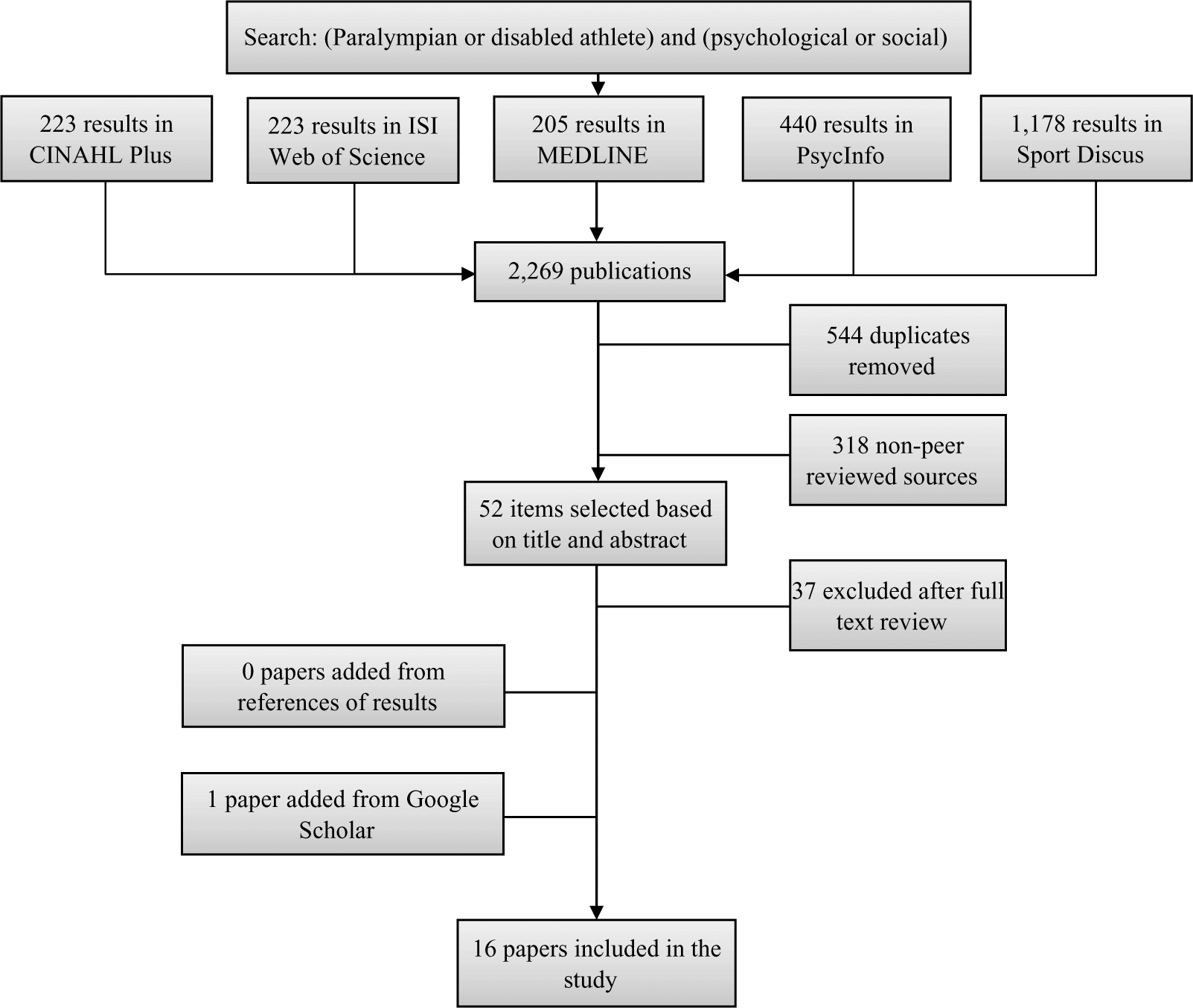
Search strategy.
An initial search using only permutations of ‘paralympian’ and ‘psychological’/’social’ keywords proved to be too narrow in producing results. To capture studies involving Paralympic athletes that may not be indexed under these terms, the search was broadened to also include the terms ‘athlete’ and ‘disability’. Wildcards, truncations and common misspellings of Paralympian/Paralympic were also employed to maximize results.
Exact search string criteria included:
CINAHL Plus, MEDLINE, Sport Discus: (paralymp* or para-lymp* or paraolymp* or para-olymp* or (athlet* and disab*)) and (psych* or soc*)
ISI Web of Science: TS=((paralymp* or para-lymp* or para-olymp* or paraolymp* or (athlet* and disab*)) and (psych* or soc*))
PsycInfo: (paralymp* or para-lymp* or paraolymp* or para-olymp* or (athlet* and disab*))
Abstracts for all resulting citations were read by one reviewer (P Jefferies) and where titles and abstract suggested potential relevance based on the inclusion criteria or where there was insufficient information to assess the applicability of the inclusion criteria, full texts of the articles were requested. The full text of the article was initially reviewed by one author (P Jefferies). If there were outstanding issues or questions about relevance, the full text was reviewed by a second reviewer (P Gallagher).
In addition to the results from the databases, the references of all the resulting articles were also searched by one reviewer (P Jefferies) for any additional papers that met the inclusion criteria.
Inclusion Criteria
For studies to be included in the review, the inclusion criteria required that (a) the full text must be in English, (b) it must consist of a study containing empirical data published in a peer-review journal, and (c) the group sampled must be elite disabled-bodied athletes performing at the Paralympian level. To ensure this, we only included studies where athletes were explicitly stated to have been competing in, qualified for, or were retiring from Paralympic sport. Participant groups of all ages were included, as individuals as young as 12 have competed as Paralympians. Studies were excluded where (a) there was no clear indication of whether an athlete was a Paralympic athlete, (b) where the sample combined Paralympic athletes with, and could not be distinguished from, athletes of other abilities, including those competing in other international competitions, and (c) where the article did not incorporate empirical data (e.g. a review or commentary).
Quality Assessment
Studies selected for inclusion in the review were appraised through a quality assessment (QA) procedure to evaluate their risk of bias. The QA evaluation tool was derived by two reviewers (S Dunne and P Jefferies) by adapting the QA tool of Minis et al. 12 Minis et al. provide a visibly comprehensive means of QA, but this was adapted using the guidelines of van Tulder et al. 13 and the National Institute for Health and Clinical Excellence 14 to improve its applicability to the large proportion of cross-sectional quantitative and qualitative study designs that dominated the review. Using this procedure, studies were given a score of a maximum of 12 for quantitative studies, and nine for qualitative studies; a maximum score indicating the best possible standard for a study. Each study was evaluated by two of the review authors (S Dunne and P Jefferies) and in the case of disagreement, consensus was achieved through discussion of the study. A third author (P Gallagher) was available if disagreement persisted. The outcome of this assessment can be found in Table 1.
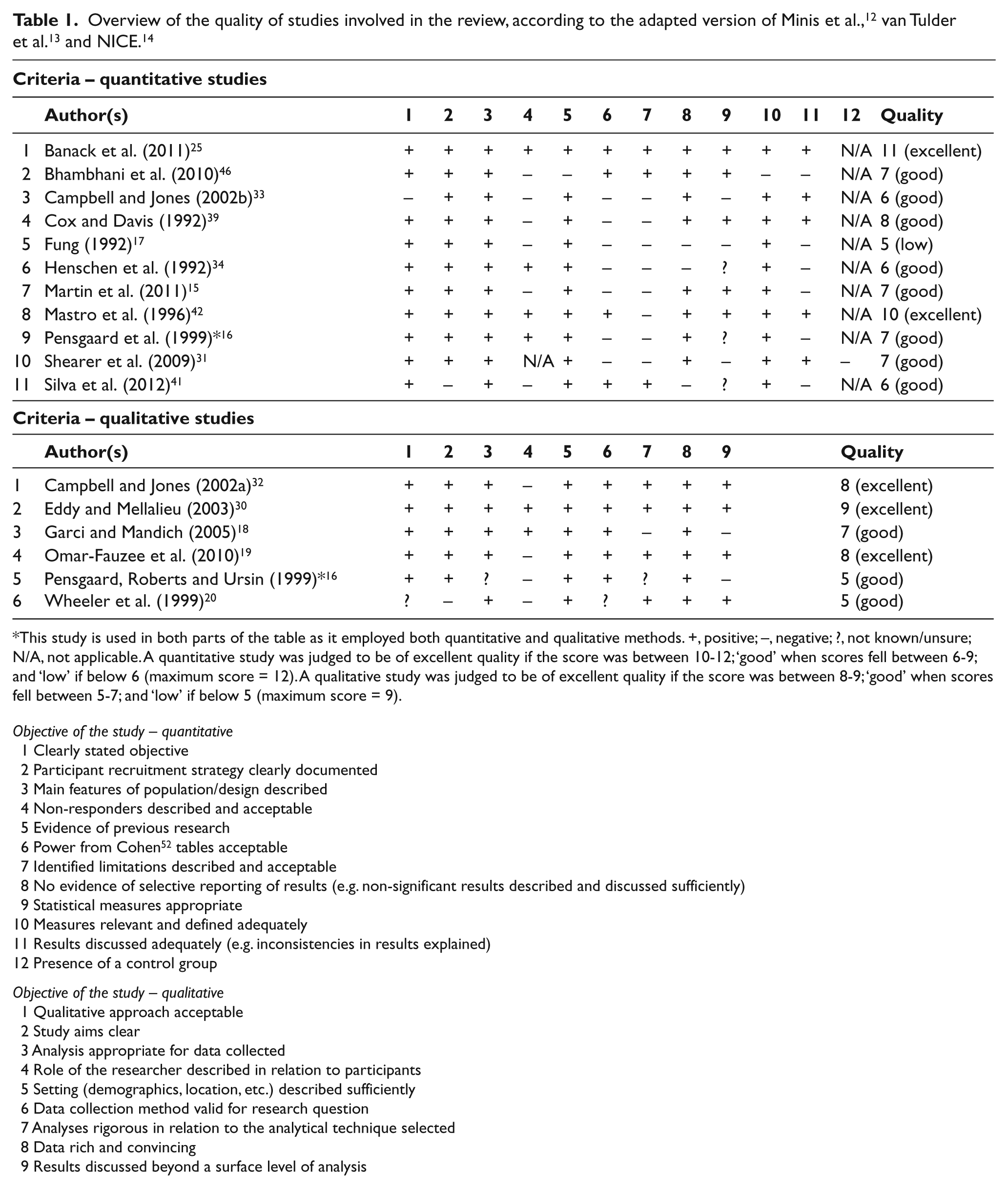
This study is used in both parts of the table as it employed both quantitative and qualitative methods. +, positive; −, negative; ?, not known/unsure; N/A, not applicable. A quantitative study was judged to be of excellent quality if the score was between 10-12; ‘good’ when scores fell between 6-9; and ‘low’ if below 6 (maximum score = 12). A qualitative study was judged to be of excellent quality if the score was between 8-9; ‘good’ when scores fell between 5-7; and ‘low’ if below 5 (maximum score = 9).
Objective of the study – quantitative
Clearly stated objective
Participant recruitment strategy clearly documented
Main features of population/design described
Non-responders described and acceptable
Evidence of previous research
Power from Cohen 52 tables acceptable
Identified limitations described and acceptable
No evidence of selective reporting of results (e.g. non-significant results described and discussed sufficiently)
Statistical measures appropriate
Measures relevant and defined adequately
Results discussed adequately (e.g. inconsistencies in results explained)
Presence of a control group
Objective of the study – qualitative
Qualitative approach acceptable
Study aims clear
Analysis appropriate for data collected
Role of the researcher described in relation to participants
Setting (demographics, location, etc.) described sufficiently
Data collection method valid for research question
Analyses rigorous in relation to the analytical technique selected
Data rich and convincing
Results discussed beyond a surface level of analysis
Results
Study Selection
The literature search returned 2,269 citations from the five databases (223 in CINAHL Plus, 223 in Web of Science, 205 in MEDLINE, 440 in PsycInfo, and 1,178 in Sport Discus). In total, 544 duplicate citations and 318 non peer-reviewed sources were removed, reducing the total to 1,407 articles. A further 1,355 citations were excluded upon checking the title and abstract of each paper against the inclusion criteria.
Of the remaining 52 articles, a reading of the full text led to a further 37 being removed due to not matching the inclusion criteria, five of which were discarded as they could not be obtained in English, and one of which where the full text could not be obtained. No further articles were found through searching the references of all included citations. One study meeting the inclusion criteria that was not identified through the database search was added from searching Google Scholar. Sixteen papers in total were included in the review.
Overview of the Literature and Methodological Quality
The key characteristics of the reviewed papers are displayed in Tables 1 and 2 below. The literature exploring the psychosocial characteristics of elite disabled-bodied athletes that compete as Paralympic athletes is diffuse and diverse. The studies were characterized by heterogeneity of design, sample characteristics, outcome assessment and outcomes examined. Consequently the data cannot be pooled for analytical purposes. The quality assessment indicated that 5 studies were of ‘excellent’ quality, 11 were of ‘good’ quality, and one was of ‘low’ quality (one study was judged twice due to its inclusion of both quantitative and qualitative methods). Where quality fell, this was often due to sample sizes being too low for the statistical technique employed and judgements about the appropriateness of the analytical technique chosen (e.g. the low sample size supporting a MANOVA in the case of Martin et al. or explication of the usage of the phenomenological description approach employed by Pensgaard et al. 16 ).
Overview of the main features of the included studies that involved psychosocial investigations of Paralympic athletes.
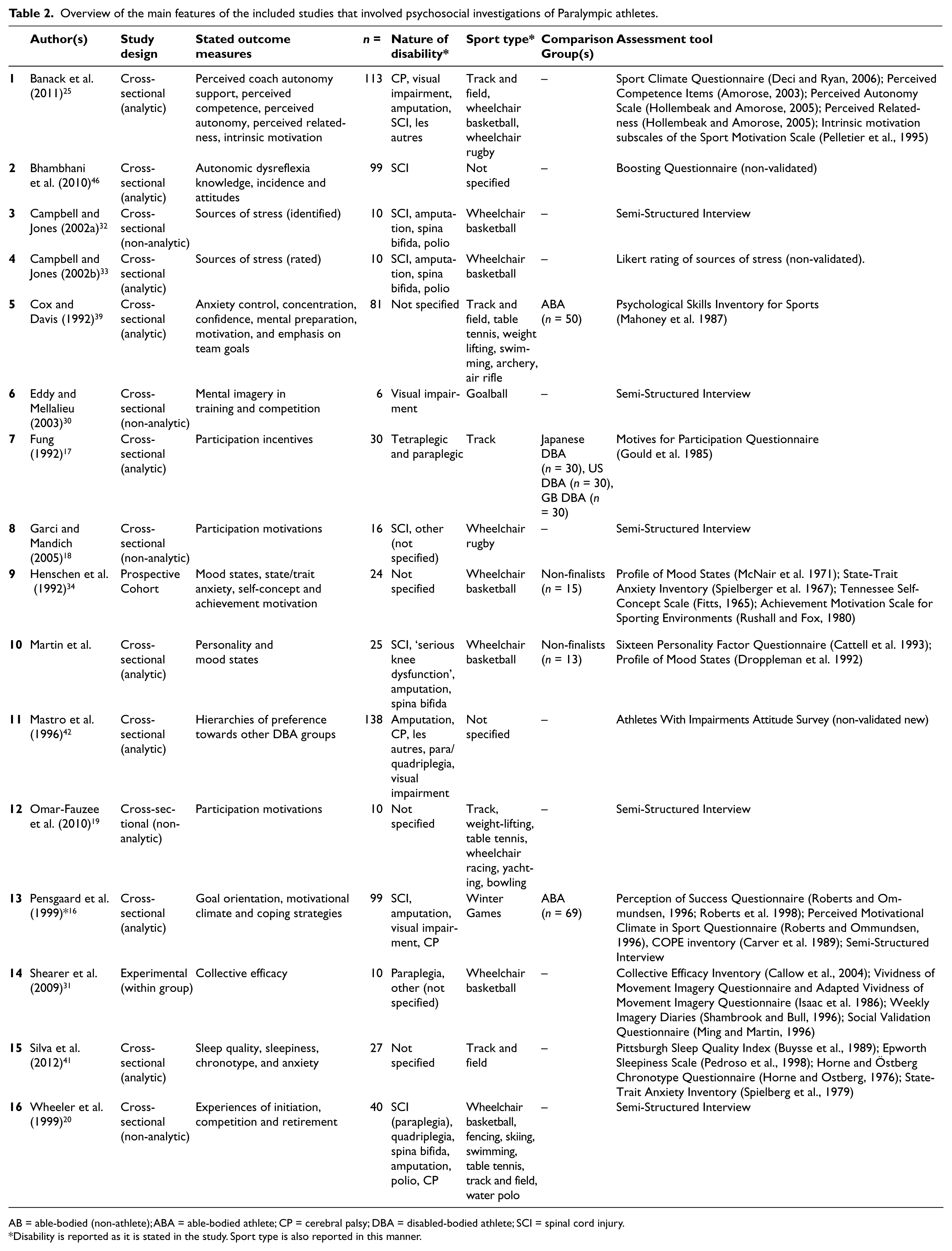
AB = able-bodied (non-athlete); ABA = able-bodied athlete; CP = cerebral palsy; DBA = disabled-bodied athlete; SCI = spinal cord injury.
Disability is reported as it is stated in the study. Sport type is also reported in this manner.
Design and Sample Characteristics
The majority of studies were cross sectional (analytic) (n = 9). The remaining studies were cross sectional (non-analytic) (n = 5), prospective cohort (n = 1) and experimental (within group) study (n = 1). The majority were of quantitative design (n = 10), though there were some qualitative investigations (n = 5), and one that combined quantitative and qualitative methods (n = 1). The studies differed in sample size, ranging from six to 138 participants (M = 46.69, SD = 43.77). Sport type also varied, but wheelchair basketball was the most common sport (n = 7). The majority of studies did not employ comparison groups (n = 11), though one compared to able-bodied athletes, one compared to able-bodied non-athletes, two contrasted finalists with non-finalists, and one contrasted disabled-bodied athletes from three different countries.
Thematic Areas
A thematic assessment of the literature identified a number of subject areas into which studies could be grouped. These consist of 1) participation, motivations and goals; 2) mental imagery; 3) stress and coping; 4) personality; 5) attitudes towards other disabled-bodied athlete groups; 6) knowledge and attitudes towards doping; and 7) transitions to retirement.
Participation, Motivations and Goals
Six studies were found to assess the behaviour prompting and continuing participation in Paralympic sport. In one investigation, Fung 17 surveyed the motivations to participate in wheelchair athletes (n = 30) from the USA, Great Britain and Japan, that were competing in track events at the Seoul 1988 Paralympic Games. Differences in motivations were found across countries and genders. For instance, male athletes were found to compete for status and achievement motivations (F (1,77) = 4.24, p < 0.05), whereas female athletes demonstrated a stronger preference for the social aspect of developing friendships (F (1,77) = 4.08, p < 0.05). As reported by Fung, athletes from the USA and Great Britain rated fitness (GB males, M = 2.73, SD = 0.30; GB females, M = 2.62, SD = 0.41; US males, M = 2.77, SD = 0.31; US females, M = 2.80, SD = 0.20) as the most important reason for participation, whereas Japanese athletes cited skill development (Japan males, M = 2.43, SD = 0.72; Japan females, M = 2.40, SD = 0.48) and friendship (Japan females, M = 2.40, SD = 0.45) as the most important. Achievement and fostering friendships were also strong themes reported by Garci and Mandich 18 in their interviews with Canadian wheelchair basketball athletes (n = 16). Athletes commonly referred to their teammates and coaches as a ‘second family’, often due to the bonds formed during intensive training periods (e.g. competition years). Additionally, the desire to attain the highest possible achievement in the sport and to represent their country were reported as important motivating factors, as were feeling challenged, overcoming disability, and the recognition of the individuals as athletes and the sport itself by others. Omar-Fauzee et al. 19 reported that the Malaysian Paralympic athletes (n = 10) they interviewed cited reasons of fitness, friendships and rewards. However, they also reported that athletes competed to relieve stress, being able to showcase talents to others, and for reasons of desiring travel and financial gain. In further qualitative investigations, Wheeler et al. 20 concluded that sport was vital to the retired Paralympic athletes (n = 40) they interviewed, as it became a central identity through which athletes defined themselves and their competence as an individual. An athletic identity was valued by these individuals as it gave them a means of being perceived by others as an athlete rather than primarily a disabled individual. Some even claimed to feel able-bodied when engaged in the sport. Additionally, Wheeler et al. suggested that athletes undertook sport as a means to cope with their disability and the reactions of others, by engaging in the sport to prove their own capability to themselves, which enabled a means of improving self-esteem and confidence as skills developed. A further motivation was the acceptance of the family of the athlete and pride instilled through demonstrating their competence and consequently their perceived worth as a member of society.
Other investigations have employed theoretical frameworks to explore how Paralympic athletes are motivated to participate and succeed in their sports. Pensgaard et al. assessed Norwegian athletes competing at the 1994 Norway Winter Paralympics (n = 30), using Achievement Goal Theory 21 to understand how individuals motivate themselves to compete. Achievement Goal Theory posits that individuals partake in sports to demonstrate ability or competence and that there are two different types of achievement perspectives, depending on how the individual construes ability and success.22,23 For example, athletes who measure competence through mastery in their sport, such as improving a personal best, are said to be task-orientated individuals. Those who evaluate their performance by comparison to others are said to be ego-orientated. A high task goal orientation is said to be beneficial in sport. 24 Another conception of Achievement Goal Theory has been used to assess the type of motivational climate perceived by individuals. This occurs when situational cues in the external environment emphasize a given approach to a task. For instance, when these cues give the impression of improvement or effort, a mastery-orientated climate is perceived. This is said to be more adaptive, as there is a recognition that success and effort co-vary. Alternatively, when ability or social comparison is emphasized, a performance-orientated climate is perceived. Pensgaard et al. 16 discovered that Paralympic athletes did not differ from (n = 69) Olympic athletes in their goal orientations, with both groups displaying a similarly higher task than ego-oriented profile. However, the Paralympians perceived a more mastery-orientated climate in their sports than Olympians’ climate (F (1,98) = 12.6, p < 0.01).
Banack et al. 25 surveyed Canadian athletes competing in the 2008 Beijing Paralympic Games (n = 113), using Self-Determination Theory to assess intrinsic motivation to take part in their sport. Self-Determination Theory26,27 posits that intrinsic motivation (the motivation to learn a new skill, to experience an activity for sensory enjoyment, and to become accomplished through success) is optimal when their perceptions of freedom and control in an activity, as well as their perceived competence and perceptions of being connected to others are fulfilled. In support of this, the authors found that perceptions of autonomy and relatedness to others (i.e. team members) were predicted by coaches promoting autonomy (e.g. coaches that give constructive feedback; that promote task-orientated environments; or that give a rationale for their actions) (R2 = 0.58; 0.45, respectively). Perception of competence was found to predict the three forms of intrinsic motivation (to know, R2 = 0.71; to experience, R2 = 0.57; to accomplish, R2 = 0.63) and perceived autonomy predicted the aspects of experiencing and accomplishing (R2 = 0.45; 0.39, respectively).
Mental Imagery
It is known that generating specific imagery in sports is linked to improvements in performance such as enhanced confidence and self-efficacy.28,29 Eddy and Mellalieu 30 investigated visual mental imagery in goalball athletes with visual impairments (n = 6) that competed at the 2000 Sydney Paralympic Games. All of the athletes were classified as having a ‘B1’ visual impairment, which is a significant impairment to sight. Through a content analysis of semi-structured interviews, the authors discovered that visual impairment does not limit the ability to utilize mental imagery, indeed, positive, success-orientated imagery was predominantly used prior to and during the event, but was also used in training and for analysis post-competition. In an imagery intervention study conducted by Shearer et al., 31 wheelchair basketball athletes preparing for the 2008 Beijing Paralympic Games (n = 10) were invited to partake in a four week programme where they were requested to generate images of team performance (aided with video footage) within their sport that would enhance their confidence about their personal and team performance. Results indicated mixed support for the intervention. In particular, the intervention was evaluated through a number of self-report measures, one of which was the collective efficacy inventory, and though the authors found an increase in intervention scores relative to baseline in all three of their regional participant locales (baseline, M = 35.42, SD = 5.75; M = 41.03, SD = 7.90; M = 40.71, SD = 5.21; intervention, M = 46.63, SD = 1.26; M = 45.34, SD = 1.27; M = 42.96, SD = 1.50), there was an unexpected rise in collective efficacy scores at time points just prior to the intervention, which the authors state would affect evaluations. However, individuals reported satisfaction with the imagery training programme across four questions suggesting the usefulness of the intervention (M = 6.1, SD = 0.88; M = 5.2, SD = 1.23; M = 5.0, SD = 1.05; M = 4.7, SD = 1.34).
Stress and Coping
Taking part in the Paralympic Games can be an intensely stressful experience for athletes, and one which is not only limited to the competition itself. In an exploratory study of areas of stress, Campbell and Jones32,33 conducted interviews with (n = 10) wheelchair basketball athletes, identifying 10 specific sources of potential tension. In particular, the researchers determined concerns before, during and post-competition, that pertained to preparation, perceived contributions to team events, ruminations on performance, and managing psychological pressures. For instance, before the event, athletes were concerned about having to perform consistently well throughout training in order to be on peak form for selection and the tournament itself. During the event, athletes had concerns about their ability to concentrate and perform under pressure, as well as whether they could deal with poor refereeing decisions. Post-match, participants reported that evaluations of their own performance from others were a source of stress, as was responsibility for the team losing, or how they worked with the team. There were also negative aspects of the event itself that would present considerable tension, such as the mode of travel and the time taken to get to the Games, social and domestic arrangements such as being away for an extended period of time, poor coach input, relationship issues, finance and a lack of disability awareness in catering for needs. Coping strategies were assessed in the aforementioned study by Pensgaard et al., 16 who determined that according to the COPE inventory, when faced with stressful scenarios, Paralympic athletes were found to use similar coping strategies to their Olympic counterparts, aside from one emotion-based strategy. Specifically, Olympic athletes employed more redefinition and growth strategies than did Paralympic athletes (F (1,97) = 6.72, p < 0.01, ES = 0.0), meaning Olympians invested more energies in re-interpreting situations to view them in a more positive light and tried to improve themselves from the experience.
Personality
The exploration of mood states, an early technique in sports psychology, has been used to assess potential unique properties of the elite disabled-bodied athlete.15,34,35 It has been proposed that mood states of athletes will correlate with performance in a sport. 36 This hypothesis was developed into the Profile of Mood States (POMS), which has determined a unique profile in high-achieving athletes. This profile is depicted as an iceberg when plotted, as out of the six subscale concepts of vigour, tension, depression, anger, fatigue and confusion, vigour appears above population normal levels in these athletes, whereas the other five are beneath. 36 Two studies were conducted with athletes competing for selection in wheelchair basketball Paralympian teams. In the first, Henschen et al. 34 found that those selected for the US team competing in the 1988 Seoul Paralympics (n = 9) had lower scores of tension (F (1,22) = 11.77, p = 0.002) and anger (F (1,22) = 4.11, p = 0.055) than those not selected for the team (n = 15). In the second study, Martin et al. 15 determined that individuals selected for the US team competing in the 2004 Athens Paralympics (n = 12) had higher scores of vigour (F (1,23) = 11.58, p = 0.002, η2 = 0.34), and lower confusion (F (1,23) = 4.96, p = 0.04, η2 = 0.18) and depression (F (1, 23) = 5.83, p < 0.02, η2 = 0.20) than those not selected for the team (n = 13). Additionally, those selected for the team were found to be higher in tough-mindedness (F (1,23) = 5.94, p = 0.02, η2 = 0.21) and less anxious (F (1,23) = 14.91, p = 0.001, η2 = 0.39) according to the 16 Personality Factor Questionnaire.37,38 Those who were selected for the team also become less trait anxious (F (1,8) = 9.47, p = 0.015) and less self-critical (F(1,8) = 4.33, p = 0.071) as competition approached. 34
In a different form of personality assessment, Cox and Davis 39 compared the psychological skills of wheelchair athletes training for the 1988 Seoul Paralympic Games (n = 31) with those of a group of able-bodied athletes training for a regional competition (n = 50). These skills included anxiety control, concentration, confidence, mental preparation, motivation and team emphasis and were tested via the Psychological Skills Inventory for Sports. 40 High scores in each variable indicated greater desirable qualities. Only the track and field athletes were assessed, due to their comprising nearly half of the Paralympian group (n = 15), with results indicating that these athletes had significantly higher scores in anxiety control (F (1,63) = 10.02, p = 0.002), confidence (F (1,63) = 9.51, p = 0.003), and motivation (F (1,63) = 18.82, p = 0.000), than their able-bodied counterparts. In a further study by Silva et al., 41 sleep quality and anxiety was assessed in athletes competing in the Beijing 2008 Paralympic Games (n = 27). Those that were found to report poorer sleep reported higher levels of anxiety (72%) than those with good quality sleep (28%). Additionally, those presenting poorer sleep quality and sleepier athletes (general sleepiness in both active and passive situations) had lower sleep efficiency (time spent asleep compared to time spent in bed) (p = 0.0119, p = 0.0241, respectively) and exhibited greater sleep latency (sleepiness during periods of wakefulness) (p = 0.0068).
Attitudes towards other Disabled-Bodied Athlete Groups
The Paralympics have expanded over the decades to involve more disability groupings. Mastro et al. 42 conducted research with athletes on the US team competing in the 1992 Barcelona Paralympics (n = 138), assessing their perceptions of five disability classifications set by the IPC at the time of publication (amputation, cerebral palsy, para/quadriplegia, visual impairment and les autres: other impairments that do not fit the other categories). The authors found that out of the five groupings, the least preferred groups were cerebral palsy and visual impairment. Amputation (71–92% preferred by other groups), followed by les autres, then paraplegia/quadriplegia were judged to be the more desirable groups (68–74% preferred).
Doping
Cheating via doping is a concern in any competitive sport, and the Paralympics are not exempt from this. In athletes with spinal cord injury, a reduced sympathetic cardiac innervation results in a lower maximum heart rate, leading to limited cardiac output and oxygen uptake. Increasing both increases exercise capacity and is known to be related to enhanced performance. 43 One compensatory technique is inducing autonomic dysreflexia (AD), where a dysreflexive state is voluntarily induced by individuals applying force to their bodies, such as by clamping urinary catheters to produce bladder distension, over-tightening leg straps, or applying pressure to the scrotum. Athletes inducing this state have reported significantly faster race performance times. 44 According to the IPC, athletes are prohibited from competing in a dysreflexive state, whether intentional or otherwise. 45 Bhambhani et al. 46 investigated the incidence and attitudes of AD in Paralympic athletes at the 2008 Beijing Paralympic Games (n = 99). They found that 54% had heard of AD, whereas 39.4% had not, and that significantly more males had knowledge of boosting than females (p = 0.016). Additionally, 16.7% (all male) had used AD at least once in their athletic career. Furthermore, 48.9% rated AD as somewhat dangerous, 21.3% as dangerous and 25.5% as very dangerous.
Retirement
As part of the aforementioned study by Wheeler et al. 20 experiences of retirement from Paralympic sport were examined. Only 10% of the sample was deemed to have emotional adjustment issues (e.g. altered mood state, appetite loss, sense of purpose, impaired social functioning) upon retiring from disability sport. However, former athletes did disclose that they were not prepared for retirement, in part, reportedly due to not being given any information by organizations; a lack of support which athletes stated continued throughout their retirement. Athletes also found it difficult to contemplate giving up all the personal and social benefits of the sport, and so part of being unprepared was also due to avoiding considering the scenario. Consequently, the heavy investment in their sporting career that came at the expense of their education, family, friends and finances, was perpetuated, and would then become salient upon retirement. When considering the reasons for retiring, some athletes did recognize the sacrifices being made in other areas of their lives and when combined with constant fatigue, an awareness of age, damage or pain, and losing positions to newcomers, seasoned athletes found retirement an increasingly attractive option.
Discussion
The research exploring the psychosocial characteristics of Paralympic athletes is a small but steadily growing body of literature. However, the diversity of the topic areas suggests that additional carefully constructed research is needed before findings can be assessed analytically. For instance, it is necessary to further investigate the extent of the impact that various disabilities and sport types can have to better understand the potential effects of each characteristic.47,48
Despite this, a number of areas were highlighted in the review that contribute to a more holistic account of the Paralympic athlete. For example, to be selected as a Paralympian, the need to be able to manage and present lower anxiety levels recurred in a number of studies.15,34,39 It can also be recognized that athletes engage in Paralympic sport for accomplishment and prowess, but the reviewed studies also describe the close friendships that are developed as a result of participation, and that demonstrating competency to others was a strong motive for taking part.17-20
The research also indicates areas for maintaining and addressing the wellbeing of the Paralympic athlete. For instance, particular areas of stress and tension have been identified,32,33 and coaches and organizations might consider how they might work with athletes in order to address these difficulties.32,33 Given that their career has been cited as a central part of an athlete’s identity, 20 the transition to retirement is a period of particular relevance for ongoing attention. Furthermore, this particular review identified limited research on doping and prejudice or discrimination in Paralympic events. Nonetheless ongoing education and awareness of these issues is warranted to foster greater inclusion and acceptance within and beyond disability sport. 42
However, we must restate that these findings must be taken tentatively, especially where it is inferred that improvements to particular psychosocial characteristics may lead to enhanced performance. The majority of the literature did not involve an experimental measure of performance and thus it is only a logical inference that management of variables such as anxiety and sleep quality or the promotion of particular goal orientations will result in improved athletic prowess. Further experimental intervention research with larger sample sizes is required to explore these areas with confidence. 49
An interesting observation is that none of the research identified made explicit reference to the technology employed by the athletes in their sports. It is our opinion that future research might find this a useful area for study, given the evidence of psychosocial effects of assistive technology that occur in situations other than sport.9,10,50,51 Furthermore, technology for Paralympic athletes serves a different purpose; it is not about daily functioning, it is about enabling excellence and elite performance. Prosthetists, orthotists and professionals play an important role in the life of an elite disabled-bodied athlete as assistive technology devices are specifically developed, often at high cost. They are not universally available nor automatically prescribed. Users need to agitate for them. The development of technology is reliant not only on technical expertise but also by the enthusiasm and desire for improvement by the end user. A person who is very clear about what they want and need the technology to achieve is an important member of the multidisciplinary team. 9 Furthermore, such knowledge of the psychosocial characteristics of Paralympian athletes (e.g. motivations and goals) complements biomechanical or physical characteristics and can inform those working on the multidisciplinary team to match technology to the person, to facilitate maximum usage and impact of the technology and to optimise performance and wellbeing.
Conclusion
This review summarises the psychosocial investigations conducted with Paralympic athletes and highlights areas such as participation, motivations and goals, mental imagery, stress and coping, personality, attitudes towards other disabled-bodied athlete groups, knowledge and attitudes towards doping, and transitions to retirement. Knowledge of the psychosocial attributes of Paralympic athletes can enable a greater understanding of what constitutes a successful Paralympian and what may contribute to successful performance and wellbeing. Such knowledge can also facilitate the multidisciplinary team working with these athletes.
Footnotes
Funding
This research was supported by an Irish Research Council for Humanities and Social Sciences Postgraduate Research Scholarship.
Conflict of interest
The authors declare that there is no conflict of interest.